Biosimilars – The Clinical Development Approach
The Selection of Sensitive Patient Populations as
a one of the Prerequisites for the Extrapolation of
Clinical Data of Biosimilar Monoclonal Antibodies
Dr. Thomas Schreitmueller, Head Regulatory Policy, Biologics
F. Hoffmann – La Roche Ltd., Basel, Switzerland
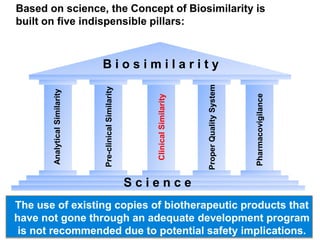
Based on science, the Concept of Biosimilarity is
built on five indispensible pillars:

Pharmacovigilance

Proper Quality System

Clinical Similarity

Pre-clinical Similarity

Analytical Similarity

Biosimilarity

Science
The use of existing copies of biotherapeutic products that
have not gone through an adequate development program
is not recommended due to potential safety implications.
3
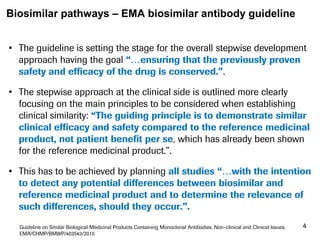
Biosimilar pathways – EMA biosimilar antibody guideline
• The guideline is setting the stage for the overall stepwise development
approach having the goal “…ensuring that the previously proven
safety and efficacy of the drug is conserved.”.
• The stepwise approach at the clinical side is outlined more clearly
focusing on the main principles to be considered when establishing
clinical similarity: “The guiding principle is to demonstrate similar
clinical efficacy and safety compared to the reference medicinal
product, not patient benefit per se, which has already been shown
for the reference medicinal product.”.
• This has to be achieved by planning all studies “…with the intention
to detect any potential differences between biosimilar and
reference medicinal product and to determine the relevance of
such differences, should they occur.”.
Guideline on Similar Biological Medicinal Products Containing Monoclonal Antibodies. Non-clinical and Clinical Issues.
EMA/CHMP/BMWP/403543/2010

4
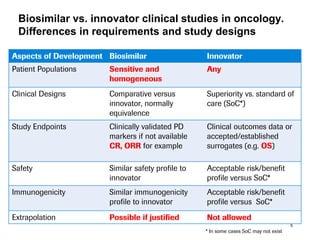
Biosimilar vs. innovator clinical studies in oncology.
Differences in requirements and study designs
Aspects of Development Biosimilar

Innovator

Patient Populations

Sensitive and
homogeneous

Any

Clinical Designs

Comparative versus
innovator, normally
equivalence

Superiority vs. standard of
care (SoC*)

Study Endpoints

Clinically validated PD
markers if not available
CR, ORR for example

Clinical outcomes data or
accepted/established
surrogates (e.g. OS)

Safety

Similar safety profile to
innovator

Acceptable risk/benefit
profile versus SoC*

Immunogenicity

Similar immunogenicity
profile to innovator

Acceptable risk/benefit
profile versus SoC*

Extrapolation

Possible if justified

Not allowed
5

* In some cases SoC may not exist
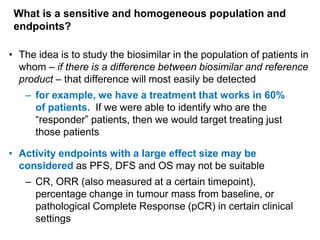
What is a sensitive and homogeneous population and
endpoints?
• The idea is to study the biosimilar in the population of patients in
whom – if there is a difference between biosimilar and reference
product – that difference will most easily be detected
– for example, we have a treatment that works in 60%
of patients. If we were able to identify who are the
“responder” patients, then we would target treating just
those patients
• Activity endpoints with a large effect size may be
considered as PFS, DFS and OS may not be suitable
– CR, ORR (also measured at a certain timepoint),
percentage change in tumour mass from baseline, or
pathological Complete Response (pCR) in certain clinical
settings
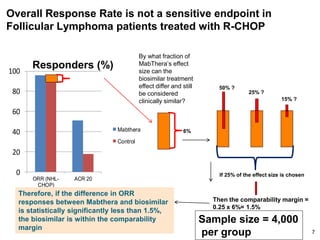
Overall Response Rate is not a sensitive endpoint in
Follicular Lymphoma patients treated with R-CHOP

100

By what fraction of
MabThera’s effect
size can the
biosimilar treatment
effect differ and still
be considered
clinically similar?

Responders (%)

80

50% ?

25% ?
15% ?

60
Mabthera

40

6%

Control

20
0

ORR (NHLCHOP)

ACR 20

Therefore, if the difference in ORR
responses between Mabthera and biosimilar
is statistically significantly less than 1.5%,
the biosimilar is within the comparability
margin

If 25% of the effect size is chosen

Then the comparability margin =
0.25 x 6%= 1.5%

Sample size = 4,000
per group

7
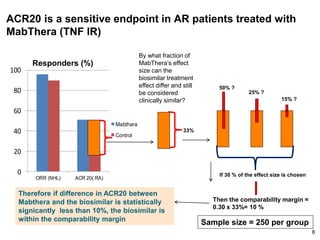
ACR20 is a sensitive endpoint in AR patients treated with
MabThera (TNF IR)

100

By what fraction of
MabThera’s effect
size can the
biosimilar treatment
effect differ and still
be considered
clinically similar?

Responders (%)

80

50% ?

25% ?
15% ?

60
Mabthera

40

Control

33%

20

0

ORR (NHL)

ACR 20( RA)

Therefore if difference in ACR20 between
Mabthera and the biosimilar is statistically
signicantly less than 10%, the biosimilar is
within the comparability margin

If 30 % of the effect size is chosen

Then the comparability margin =
0.30 x 33%= 10 %

Sample size = 250 per group
8
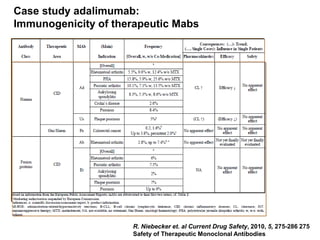
Case study adalimumab:
Immunogenicity of therapeutic Mabs

Page 9
R. Niebecker et. al Current Drug Safety, 2010, 5, 275-286 275
Safety of Therapeutic Monoclonal Antibodies
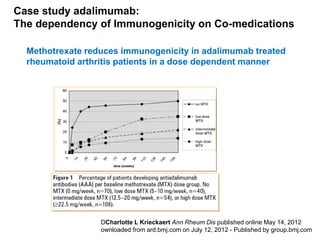
Case study adalimumab:
The dependency of Immunogenicity on Co-medications
Methotrexate reduces immunogenicity in adalimumab treated
rheumatoid arthritis patients in a dose dependent manner

DCharlotte L Krieckaert Ann Rheum Dis published online May 14, 2012
Page 10
ownloaded from ard.bmj.com on July 12, 2012 - Published by group.bmj.com
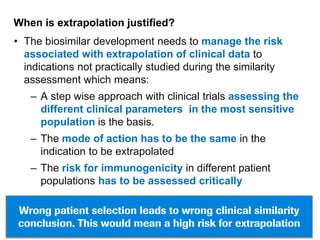
When is extrapolation justified?

• The biosimilar development needs to manage the risk
associated with extrapolation of clinical data to
indications not practically studied during the similarity
assessment which means:
– A step wise approach with clinical trials assessing the
different clinical parameters in the most sensitive
population is the basis.
– The mode of action has to be the same in the
indication to be extrapolated
– The risk for immunogenicity in different patient
populations has to be assessed critically
Wrong patient selection leads to wrong clinical similarity
conclusion. This would mean a high risk for extrapolation
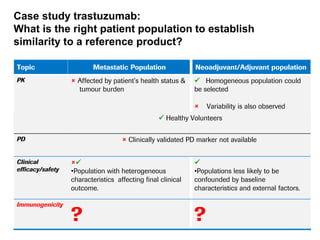
Case study trastuzumab:
What is the right patient population to establish
similarity to a reference product?
Topic
PK

Metastatic Population

 Affected by patient’s health status &
tumour burden

Neoadjuvant/Adjuvant population

 Homogeneous population could
be selected


Variability is also observed

 Healthy Volunteers
PD

 Clinically validated PD marker not available

Clinical
efficacy/safety


•Population with heterogeneous
characteristics affecting final clinical
outcome.


•Populations less likely to be
confounded by baseline
characteristics and external factors.

Immunogenicity

?

?

12
Case study trastuzumab:
What is the most sensitive indication/patient population
to establish similarity in immunogenicity
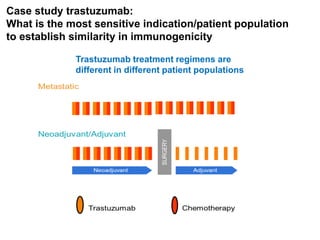
Trastuzumab treatment regimens are
different in different patient populations
Case study trastuzumab:
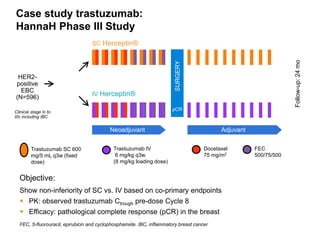
HannaH Phase III Study

IV Herceptin®

pCR

Clinical stage Ic to
IIIc including IBC

Neoadjuvant
Trastuzumab SC 600
mg/5 mL q3w (fixed
dose)

Trastuzumab IV
6 mg/kg q3w
(8 mg/kg loading dose)

Adjuvant
Docetaxel
75 mg/m2

Objective:
Show non-inferiority of SC vs. IV based on co-primary endpoints

 PK: observed trastuzumab Ctrough pre-dose Cycle 8
 Efficacy: pathological complete response (pCR) in the breast
FEC, 5-fluorouracil, epirubicin and cyclophosphamide. IBC, inflammatory breast cancer

FEC
500/75/500

Follow-up: 24 mo

R
1:1

SURGERY

HER2positive
EBC
(N=596)

18 cycles / 1 year

SC Herceptin®
Case study trastuzumab:
Sensitivity of the neoadjuvant-adjuvant setting to
detect differences in immunogenicity
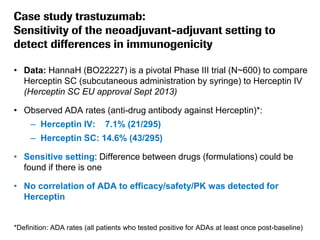
• Data: HannaH (BO22227) is a pivotal Phase III trial (N~600) to compare
Herceptin SC (subcutaneous administration by syringe) to Herceptin IV
(Herceptin SC EU approval Sept 2013)
• Observed ADA rates (anti-drug antibody against Herceptin)*:
– Herceptin IV:

7.1% (21/295)

– Herceptin SC: 14.6% (43/295)
• Sensitive setting: Difference between drugs (formulations) could be
found if there is one

• No correlation of ADA to efficacy/safety/PK was detected for
Herceptin

*Definition: ADA rates (all patients who tested positive for ADAs at least once post-baseline)
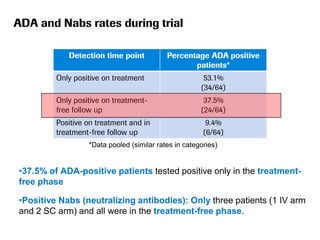
ADA and Nabs rates during trial
Detection time point

Percentage ADA positive
patients*

Only positive on treatment

53.1%
(34/64)

Only positive on treatmentfree follow up

37.5%
(24/64)

Positive on treatment and in
treatment-free follow up

9.4%
(6/64)

*Data pooled (similar rates in categories)

•37.5% of ADA-positive patients tested positive only in the treatmentfree phase
•Positive Nabs (neutralizing antibodies): Only three patients (1 IV arm
and 2 SC arm) and all were in the treatment-free phase.
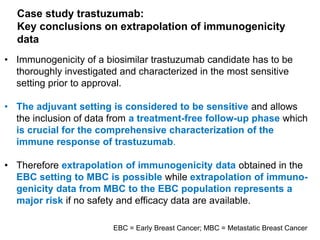
Case study trastuzumab:
Key conclusions on extrapolation of immunogenicity
data
• Immunogenicity of a biosimilar trastuzumab candidate has to be
thoroughly investigated and characterized in the most sensitive
setting prior to approval.
• The adjuvant setting is considered to be sensitive and allows
the inclusion of data from a treatment-free follow-up phase which
is crucial for the comprehensive characterization of the
immune response of trastuzumab.
• Therefore extrapolation of immunogenicity data obtained in the
EBC setting to MBC is possible while extrapolation of immunogenicity data from MBC to the EBC population represents a
major risk if no safety and efficacy data are available.
EBC = Early Breast Cancer; MBC = Metastatic Breast Cancer
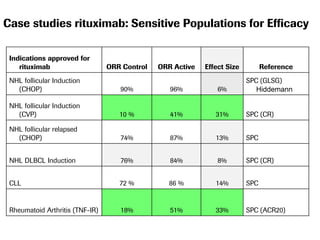
Case studies rituximab: Sensitive Populations for Efficacy
Indications approved for
rituximab

ORR Control

ORR Active

Effect Size

Reference

NHL follicular Induction
(CHOP)

90%

96%

6%

SPC (GLSG)
Hiddemann

NHL follicular Induction
(CVP)

10 %

41%

31%

SPC (CR)

NHL follicular relapsed
(CHOP)

74%

87%

13%

SPC

NHL DLBCL Induction

76%

84%

8%

SPC (CR)

CLL

72 %

86 %

14%

SPC

Rheumatoid Arthritis (TNF-IR)

18%

51%

33%

SPC (ACR20)
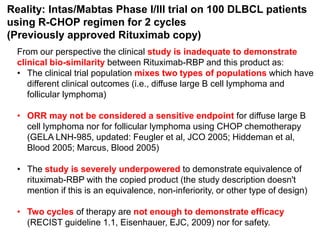
Reality: Intas/Mabtas Phase I/III trial on 100 DLBCL patients
using R-CHOP regimen for 2 cycles
(Previously approved Rituximab copy)
From our perspective the clinical study is inadequate to demonstrate
clinical bio-similarity between Rituximab-RBP and this product as:
• The clinical trial population mixes two types of populations which have
different clinical outcomes (i.e., diffuse large B cell lymphoma and
follicular lymphoma)
• ORR may not be considered a sensitive endpoint for diffuse large B
cell lymphoma nor for follicular lymphoma using CHOP chemotherapy
(GELA LNH-985, updated: Feugler et al, JCO 2005; Hiddeman et al,
Blood 2005; Marcus, Blood 2005)
• The study is severely underpowered to demonstrate equivalence of
rituximab-RBP with the copied product (the study description doesn't
mention if this is an equivalence, non-inferiority, or other type of design)

• Two cycles of therapy are not enough to demonstrate efficacy
(RECIST guideline 1.1, Eisenhauer, EJC, 2009) nor for safety.
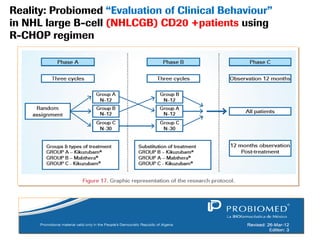
Reality: Probiomed “Evaluation of Clinical Behaviour”
in NHL large B-cell (NHLCGB) CD20 +patients using
R-CHOP regimen
Summary
• MAb products, have and will provide essential and safe
treatment opportunities for many diseases.

• The application of proper risk mitigation strategies during the
development and marketing of biosimilar MAb’s is fundamental.
• Comparative clinical testing is a key part of these strategies and
has to be done in the relevant setting(s) most sensitive to detect
potential differences in safety, efficacy and immunogenicity.
• Unfortunately the concept of sensitive populations in the context
of the clinical development of biosimilar MAb’s often is not yet
well understood by manufacturers.
• Taking into consideration these strategies will not only minimize
the risk for the patient, only those strategies will actually make
the development of true biosimilar MAb’s feasible.
•
Thank You !

22

12 Dr. Thomas Schreitmueller Roche

  • 1.
    Biosimilars – TheClinical Development Approach The Selection of Sensitive Patient Populations as a one of the Prerequisites for the Extrapolation of Clinical Data of Biosimilar Monoclonal Antibodies Dr. Thomas Schreitmueller, Head Regulatory Policy, Biologics F. Hoffmann – La Roche Ltd., Basel, Switzerland
  • 2.
    Based on science,the Concept of Biosimilarity is built on five indispensible pillars: Pharmacovigilance Proper Quality System Clinical Similarity Pre-clinical Similarity Analytical Similarity Biosimilarity Science The use of existing copies of biotherapeutic products that have not gone through an adequate development program is not recommended due to potential safety implications.
  • 3.
  • 4.
    Biosimilar pathways –EMA biosimilar antibody guideline • The guideline is setting the stage for the overall stepwise development approach having the goal “…ensuring that the previously proven safety and efficacy of the drug is conserved.”. • The stepwise approach at the clinical side is outlined more clearly focusing on the main principles to be considered when establishing clinical similarity: “The guiding principle is to demonstrate similar clinical efficacy and safety compared to the reference medicinal product, not patient benefit per se, which has already been shown for the reference medicinal product.”. • This has to be achieved by planning all studies “…with the intention to detect any potential differences between biosimilar and reference medicinal product and to determine the relevance of such differences, should they occur.”. Guideline on Similar Biological Medicinal Products Containing Monoclonal Antibodies. Non-clinical and Clinical Issues. EMA/CHMP/BMWP/403543/2010 4
  • 5.
    Biosimilar vs. innovatorclinical studies in oncology. Differences in requirements and study designs Aspects of Development Biosimilar Innovator Patient Populations Sensitive and homogeneous Any Clinical Designs Comparative versus innovator, normally equivalence Superiority vs. standard of care (SoC*) Study Endpoints Clinically validated PD markers if not available CR, ORR for example Clinical outcomes data or accepted/established surrogates (e.g. OS) Safety Similar safety profile to innovator Acceptable risk/benefit profile versus SoC* Immunogenicity Similar immunogenicity profile to innovator Acceptable risk/benefit profile versus SoC* Extrapolation Possible if justified Not allowed 5 * In some cases SoC may not exist
  • 6.
    What is asensitive and homogeneous population and endpoints? • The idea is to study the biosimilar in the population of patients in whom – if there is a difference between biosimilar and reference product – that difference will most easily be detected – for example, we have a treatment that works in 60% of patients. If we were able to identify who are the “responder” patients, then we would target treating just those patients • Activity endpoints with a large effect size may be considered as PFS, DFS and OS may not be suitable – CR, ORR (also measured at a certain timepoint), percentage change in tumour mass from baseline, or pathological Complete Response (pCR) in certain clinical settings
  • 7.
    Overall Response Rateis not a sensitive endpoint in Follicular Lymphoma patients treated with R-CHOP 100 By what fraction of MabThera’s effect size can the biosimilar treatment effect differ and still be considered clinically similar? Responders (%) 80 50% ? 25% ? 15% ? 60 Mabthera 40 6% Control 20 0 ORR (NHLCHOP) ACR 20 Therefore, if the difference in ORR responses between Mabthera and biosimilar is statistically significantly less than 1.5%, the biosimilar is within the comparability margin If 25% of the effect size is chosen Then the comparability margin = 0.25 x 6%= 1.5% Sample size = 4,000 per group 7
  • 8.
    ACR20 is asensitive endpoint in AR patients treated with MabThera (TNF IR) 100 By what fraction of MabThera’s effect size can the biosimilar treatment effect differ and still be considered clinically similar? Responders (%) 80 50% ? 25% ? 15% ? 60 Mabthera 40 Control 33% 20 0 ORR (NHL) ACR 20( RA) Therefore if difference in ACR20 between Mabthera and the biosimilar is statistically signicantly less than 10%, the biosimilar is within the comparability margin If 30 % of the effect size is chosen Then the comparability margin = 0.30 x 33%= 10 % Sample size = 250 per group 8
  • 9.
    Case study adalimumab: Immunogenicityof therapeutic Mabs Page 9 R. Niebecker et. al Current Drug Safety, 2010, 5, 275-286 275 Safety of Therapeutic Monoclonal Antibodies
  • 10.
    Case study adalimumab: Thedependency of Immunogenicity on Co-medications Methotrexate reduces immunogenicity in adalimumab treated rheumatoid arthritis patients in a dose dependent manner DCharlotte L Krieckaert Ann Rheum Dis published online May 14, 2012 Page 10 ownloaded from ard.bmj.com on July 12, 2012 - Published by group.bmj.com
  • 11.
    When is extrapolationjustified? • The biosimilar development needs to manage the risk associated with extrapolation of clinical data to indications not practically studied during the similarity assessment which means: – A step wise approach with clinical trials assessing the different clinical parameters in the most sensitive population is the basis. – The mode of action has to be the same in the indication to be extrapolated – The risk for immunogenicity in different patient populations has to be assessed critically Wrong patient selection leads to wrong clinical similarity conclusion. This would mean a high risk for extrapolation
  • 12.
    Case study trastuzumab: Whatis the right patient population to establish similarity to a reference product? Topic PK Metastatic Population  Affected by patient’s health status & tumour burden Neoadjuvant/Adjuvant population  Homogeneous population could be selected  Variability is also observed  Healthy Volunteers PD  Clinically validated PD marker not available Clinical efficacy/safety  •Population with heterogeneous characteristics affecting final clinical outcome.  •Populations less likely to be confounded by baseline characteristics and external factors. Immunogenicity ? ? 12
  • 13.
    Case study trastuzumab: Whatis the most sensitive indication/patient population to establish similarity in immunogenicity Trastuzumab treatment regimens are different in different patient populations
  • 14.
    Case study trastuzumab: HannaHPhase III Study IV Herceptin® pCR Clinical stage Ic to IIIc including IBC Neoadjuvant Trastuzumab SC 600 mg/5 mL q3w (fixed dose) Trastuzumab IV 6 mg/kg q3w (8 mg/kg loading dose) Adjuvant Docetaxel 75 mg/m2 Objective: Show non-inferiority of SC vs. IV based on co-primary endpoints  PK: observed trastuzumab Ctrough pre-dose Cycle 8  Efficacy: pathological complete response (pCR) in the breast FEC, 5-fluorouracil, epirubicin and cyclophosphamide. IBC, inflammatory breast cancer FEC 500/75/500 Follow-up: 24 mo R 1:1 SURGERY HER2positive EBC (N=596) 18 cycles / 1 year SC Herceptin®
  • 15.
    Case study trastuzumab: Sensitivityof the neoadjuvant-adjuvant setting to detect differences in immunogenicity • Data: HannaH (BO22227) is a pivotal Phase III trial (N~600) to compare Herceptin SC (subcutaneous administration by syringe) to Herceptin IV (Herceptin SC EU approval Sept 2013) • Observed ADA rates (anti-drug antibody against Herceptin)*: – Herceptin IV: 7.1% (21/295) – Herceptin SC: 14.6% (43/295) • Sensitive setting: Difference between drugs (formulations) could be found if there is one • No correlation of ADA to efficacy/safety/PK was detected for Herceptin *Definition: ADA rates (all patients who tested positive for ADAs at least once post-baseline)
  • 16.
    ADA and Nabsrates during trial Detection time point Percentage ADA positive patients* Only positive on treatment 53.1% (34/64) Only positive on treatmentfree follow up 37.5% (24/64) Positive on treatment and in treatment-free follow up 9.4% (6/64) *Data pooled (similar rates in categories) •37.5% of ADA-positive patients tested positive only in the treatmentfree phase •Positive Nabs (neutralizing antibodies): Only three patients (1 IV arm and 2 SC arm) and all were in the treatment-free phase.
  • 17.
    Case study trastuzumab: Keyconclusions on extrapolation of immunogenicity data • Immunogenicity of a biosimilar trastuzumab candidate has to be thoroughly investigated and characterized in the most sensitive setting prior to approval. • The adjuvant setting is considered to be sensitive and allows the inclusion of data from a treatment-free follow-up phase which is crucial for the comprehensive characterization of the immune response of trastuzumab. • Therefore extrapolation of immunogenicity data obtained in the EBC setting to MBC is possible while extrapolation of immunogenicity data from MBC to the EBC population represents a major risk if no safety and efficacy data are available. EBC = Early Breast Cancer; MBC = Metastatic Breast Cancer
  • 18.
    Case studies rituximab:Sensitive Populations for Efficacy Indications approved for rituximab ORR Control ORR Active Effect Size Reference NHL follicular Induction (CHOP) 90% 96% 6% SPC (GLSG) Hiddemann NHL follicular Induction (CVP) 10 % 41% 31% SPC (CR) NHL follicular relapsed (CHOP) 74% 87% 13% SPC NHL DLBCL Induction 76% 84% 8% SPC (CR) CLL 72 % 86 % 14% SPC Rheumatoid Arthritis (TNF-IR) 18% 51% 33% SPC (ACR20)
  • 19.
    Reality: Intas/Mabtas PhaseI/III trial on 100 DLBCL patients using R-CHOP regimen for 2 cycles (Previously approved Rituximab copy) From our perspective the clinical study is inadequate to demonstrate clinical bio-similarity between Rituximab-RBP and this product as: • The clinical trial population mixes two types of populations which have different clinical outcomes (i.e., diffuse large B cell lymphoma and follicular lymphoma) • ORR may not be considered a sensitive endpoint for diffuse large B cell lymphoma nor for follicular lymphoma using CHOP chemotherapy (GELA LNH-985, updated: Feugler et al, JCO 2005; Hiddeman et al, Blood 2005; Marcus, Blood 2005) • The study is severely underpowered to demonstrate equivalence of rituximab-RBP with the copied product (the study description doesn't mention if this is an equivalence, non-inferiority, or other type of design) • Two cycles of therapy are not enough to demonstrate efficacy (RECIST guideline 1.1, Eisenhauer, EJC, 2009) nor for safety.
  • 20.
    Reality: Probiomed “Evaluationof Clinical Behaviour” in NHL large B-cell (NHLCGB) CD20 +patients using R-CHOP regimen
  • 21.
    Summary • MAb products,have and will provide essential and safe treatment opportunities for many diseases. • The application of proper risk mitigation strategies during the development and marketing of biosimilar MAb’s is fundamental. • Comparative clinical testing is a key part of these strategies and has to be done in the relevant setting(s) most sensitive to detect potential differences in safety, efficacy and immunogenicity. • Unfortunately the concept of sensitive populations in the context of the clinical development of biosimilar MAb’s often is not yet well understood by manufacturers. • Taking into consideration these strategies will not only minimize the risk for the patient, only those strategies will actually make the development of true biosimilar MAb’s feasible. •
  • 22.