Dr. Anuj Singh
Asst. Professor
Community Medicine Dept.
UIMS, Prayagraj
Contents:-
Source
Function
Deficiency
Prevention
What are vitamins
• Vitamins are tasteless organic substances that are
indispensable to the normal metabolic processes
of organisms. They are essential to maintain
health and performance, and have to be supplied
with the feed.
• Vitamins do not provide energy themselves, but a
deficiency of any vitamin can cause serious
complications.
History
• The term vitamin was coined by biochemist
'Casimir Funk"
• In 1912 When scientists trying to isolate fat soluble
factor B, they discovered a substance containing
nitrogen which was chemically an amine, and
therefore termed as vitamin (vita = life).
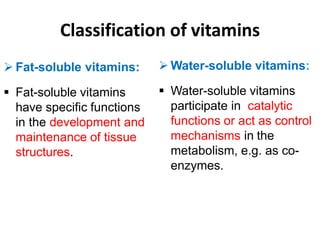
Classification of vitamins
 Fat-soluble vitamins:
 Fat-soluble vitamins
have specific functions
in the development and
maintenance of tissue
structures.
 Water-soluble vitamins:
 Water-soluble vitamins
participate in catalytic
functions or act as control
mechanisms in the
metabolism, e.g. as co-
enzymes.
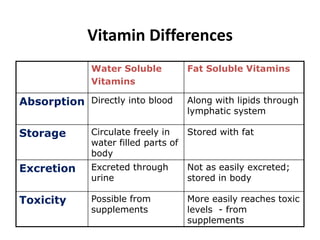
Vitamin Differences
Water Soluble
Vitamins
Fat Soluble Vitamins
Absorption Directly into blood Along with lipids through
lymphatic system
Storage Circulate freely in
water filled parts of
body
Stored with fat
Excretion Excreted through
urine
Not as easily excreted;
stored in body
Toxicity Possible from
supplements
More easily reaches toxic
levels - from
supplements
Fat soluble vitamins
• The vitamins A, D, E, K and ß-carotene
(precursor of vitamin A) belong to the fat-
soluble vitamins.
• These are stored in the body for long periods of
time and generally pose a greater risk for
toxicity when consumed in excess.
• The sites of storage are such as kidneys
and liver, the muscles, the brain and fat
tissue.
Vitamin D
(2 Forms: Calciferol D2, Cholecalciferol D3)
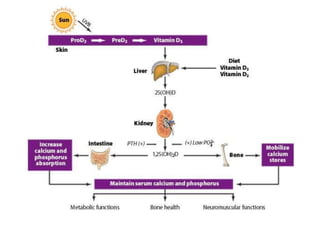
• Functions
– Bone Growth and normal mineralization
– Helps to maintain blood levels of calcium and phosphorus by
absorbtion from intestine and reabsorption from kidney
– Works in combination with other nutrients and hormones
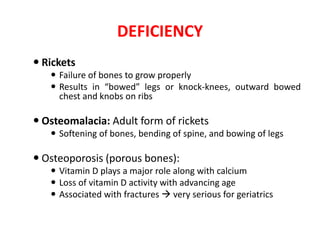
DEFICIENCY
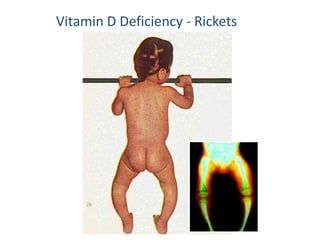
 Rickets
 Failure of bones to grow properly
 Results in “bowed” legs or knock-knees, outward bowed
chest and knobs on ribs
 Osteomalacia: Adult form of rickets
 Softening of bones, bending of spine, and bowing of legs
 Osteoporosis (porous bones):
 Vitamin D plays a major role along with calcium
 Loss of vitamin D activity with advancing age
 Associated with fractures  very serious for geriatrics
Vitamin D Deficiency - Rickets
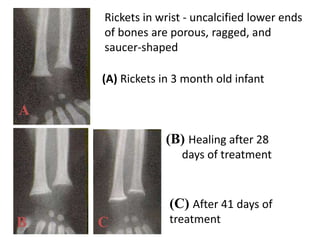
Rickets in wrist - uncalcified lower ends
of bones are porous, ragged, and
saucer-shaped
(A) Rickets in 3 month old infant
(B) Healing after 28
days of treatment
(C) After 41 days of
treatment
A
B C
PREVENTION
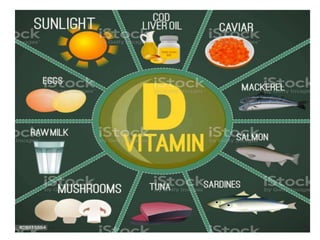
• Exposure to sunshine
• Vitamin D supplement to children
• Milk in diet
• Food fortification
Vitamin -E
• Vitamin E was discovered 1922 in wheat germ
oil.
• There are eight different forms of naturally
occurring vitamin E, but one form, alpha-
tocopherol (α- tocopherol), is most active in
the body with a side chain of saturated carbons.
Vitamin- E
What does it do?
• Protects cell membranes and other fat‐soluble parts of the
body (LDLcholesterol) from oxidation
– May reduce the risk of heart disease
– May also discourage development of some types of cancer
• Promotes normal growth anddevelopment
• Promotes normal red bloodcell formation
• Acts as anti‐blood clottingagent
• Plays some role in the body’s ability to process glucose
• Also been known to aid the process of wound healing
Natural sources and bioavailability
• Grass, clover, alfalfa, green meal and
uncrushed oilseeds are rich in vitamin E.
• Humidity and long storage have an adverse
effect on vitamin E stability and content.
• Cereals and middlings mainly contain Beta,
gama and delta tocopherols (70–90%) with a
biological activity significantly lower than that of
alpha tocopherol.
Physiological Role
 Reduces the production of lipid peroxyl radicals
from highly unsaturated fatty acids.
 Antitoxic effect in cell metabolism.
 Reduces the incidence of liver necrosis and
muscular degeneration.
 Antioxidant effect .
 Stabilization of fat (protection against
oxidation) in animal products (meat, milk,
eggs).
• Controls metabolism of the hormones via the
anterior lobe of the hypophysis.
• Maintains membrane stability, especially of the
cardiac and skeletal muscles.
• Controls the development and function of the
gonads.
• Stimulates antibody production, phagocytosis
and the bactericide effects of phagocytes.
• Protection against abortion.
Interaction with other nutrients
Nutrients Synergistic to Vitamin E
• Selenium : Function closely linked to vitamin E
(needed for GSH peroxidase).
• Vitamin C : Helps in anti oxidant property.
• Sulfur containing amino acids.
Nutrients antagonistic to Vitamin E
• Vitamin A : Vitamin E Inhibits carotene absorption
and conversion to retinol.
• Vitamin K : May impair absorption.
• May cause vitamin -D dependent bone
mineralization problems.
Recommended Dietary Allowance
(RDA)
Adult = 7.5-10mg Tocopherol/Day
(depending on edible oil used)
Vit- E
Vitamin-E
Who should take supplements?
• People over the age of55
• Smokers
• People who abusealcohol
• Anyone with inadequate
caloric or nutritional dietary
intake or increased
nutritional requirements
Deficiency symptoms
• Damage to cardiac and skeletal muscles
(dystrophy, myopathy)
• Sudden death through damage to the heart
muscle (mulberry heart disease)
• Liver lesions and changes in fat deposits
(yellow-fat disease in mink, brown coloration
of bacon).
• Locomotory disorders and muscle incurvation
(banana disease) in pigs.
• Stiff lamb disease and White muscle disease
due to dystrophic alteration in calves and
lambs.
• Fertility disorders
• Changes in the vascular and nervous system.
• Exudative diathesis.
• Nutritional encephalomalacia.
• Reduced hatchability and exudative diathesis
(increased plasma secretion of the blood) in
Toxicity
• There isn’t any known risk of consuming too
much vitamin E from natural food sources.
• Because vitamin E can act as an anticoagulant
and interfere with blood clotting, excess
amounts in the body increase the risk of
hemorrhage.
Vitamin -K
• Vitamin K was discovered in 1929 in alfalfa
Natural sources and bioavailability
• Vitamin K is a generic term for vitamin K1
(phylloquinone), K2 (menaquinone) and K3
(menadione).
• Green plants are rich in vitamin K1, Vitamin K2
is produced by bacteria in the lumen of large
• Vitamin K – produced by bacteria in large intestine
– Roles
• Promotes synthesis of blood clotting proteins (**Interferes with
Coumadin)
• Bone formation
– Deficiencies are rare but seen in infants, after prolonged
antibiotic therapy, and in patients with decreased bile
production.
– Toxicities (>1000 mg/day): rupture of RBCs and jaundice
• Vitamin K3 (menadione) is an industrial form.
• The fat-soluble forms K1 and K2 can only be
absorbed when pancreas lipase and bile acid
are secreted.
• This is not necessary for the water-soluble
vitamin K3.
• All three forms serve as a basis for the
production of menaquinone-4, which is highly
active in the metabolism.
Physiological role
• Synthesis of blood coagulation factors II
(pre- thrombin), VII, IX and X.
• Production of the calcium transport protein
osteocalcin for bone mineralization
Participation in carboxylation of other proteins.
Interaction with other nutrients
• Vitamin A & Vitamin E : May reduce the
absorption of Vitamin K.
• Vitamin E : interfere with blood clotting
mechanism of Vitamin K.
Recommended Dietary Allowance
(RDA)
Adult= 0.03mg/kg/day
Vit. k
Toxicity
• Occurs rarely.
• Vitamin K, excessive amounts can cause the
breakdown of red blood cells and liver damage.
LECTURE Vitamin D  E & K.pptx

LECTURE Vitamin D E & K.pptx

  • 1.
    Dr. Anuj Singh Asst.Professor Community Medicine Dept. UIMS, Prayagraj
  • 2.
  • 3.
    What are vitamins •Vitamins are tasteless organic substances that are indispensable to the normal metabolic processes of organisms. They are essential to maintain health and performance, and have to be supplied with the feed. • Vitamins do not provide energy themselves, but a deficiency of any vitamin can cause serious complications.
  • 4.
    History • The termvitamin was coined by biochemist 'Casimir Funk" • In 1912 When scientists trying to isolate fat soluble factor B, they discovered a substance containing nitrogen which was chemically an amine, and therefore termed as vitamin (vita = life).
  • 5.
    Classification of vitamins Fat-soluble vitamins:  Fat-soluble vitamins have specific functions in the development and maintenance of tissue structures.  Water-soluble vitamins:  Water-soluble vitamins participate in catalytic functions or act as control mechanisms in the metabolism, e.g. as co- enzymes.
  • 6.
    Vitamin Differences Water Soluble Vitamins FatSoluble Vitamins Absorption Directly into blood Along with lipids through lymphatic system Storage Circulate freely in water filled parts of body Stored with fat Excretion Excreted through urine Not as easily excreted; stored in body Toxicity Possible from supplements More easily reaches toxic levels - from supplements
  • 7.
    Fat soluble vitamins •The vitamins A, D, E, K and ß-carotene (precursor of vitamin A) belong to the fat- soluble vitamins. • These are stored in the body for long periods of time and generally pose a greater risk for toxicity when consumed in excess. • The sites of storage are such as kidneys and liver, the muscles, the brain and fat tissue.
  • 9.
    Vitamin D (2 Forms:Calciferol D2, Cholecalciferol D3) • Functions – Bone Growth and normal mineralization – Helps to maintain blood levels of calcium and phosphorus by absorbtion from intestine and reabsorption from kidney – Works in combination with other nutrients and hormones
  • 12.
    DEFICIENCY  Rickets  Failureof bones to grow properly  Results in “bowed” legs or knock-knees, outward bowed chest and knobs on ribs  Osteomalacia: Adult form of rickets  Softening of bones, bending of spine, and bowing of legs  Osteoporosis (porous bones):  Vitamin D plays a major role along with calcium  Loss of vitamin D activity with advancing age  Associated with fractures  very serious for geriatrics
  • 13.
  • 14.
    Rickets in wrist- uncalcified lower ends of bones are porous, ragged, and saucer-shaped (A) Rickets in 3 month old infant (B) Healing after 28 days of treatment (C) After 41 days of treatment A B C
  • 15.
    PREVENTION • Exposure tosunshine • Vitamin D supplement to children • Milk in diet • Food fortification
  • 19.
    Vitamin -E • VitaminE was discovered 1922 in wheat germ oil. • There are eight different forms of naturally occurring vitamin E, but one form, alpha- tocopherol (α- tocopherol), is most active in the body with a side chain of saturated carbons.
  • 20.
    Vitamin- E What doesit do? • Protects cell membranes and other fat‐soluble parts of the body (LDLcholesterol) from oxidation – May reduce the risk of heart disease – May also discourage development of some types of cancer • Promotes normal growth anddevelopment • Promotes normal red bloodcell formation • Acts as anti‐blood clottingagent • Plays some role in the body’s ability to process glucose • Also been known to aid the process of wound healing
  • 21.
    Natural sources andbioavailability • Grass, clover, alfalfa, green meal and uncrushed oilseeds are rich in vitamin E. • Humidity and long storage have an adverse effect on vitamin E stability and content. • Cereals and middlings mainly contain Beta, gama and delta tocopherols (70–90%) with a biological activity significantly lower than that of alpha tocopherol.
  • 22.
    Physiological Role  Reducesthe production of lipid peroxyl radicals from highly unsaturated fatty acids.  Antitoxic effect in cell metabolism.  Reduces the incidence of liver necrosis and muscular degeneration.  Antioxidant effect .  Stabilization of fat (protection against oxidation) in animal products (meat, milk, eggs).
  • 23.
    • Controls metabolismof the hormones via the anterior lobe of the hypophysis. • Maintains membrane stability, especially of the cardiac and skeletal muscles. • Controls the development and function of the gonads. • Stimulates antibody production, phagocytosis and the bactericide effects of phagocytes. • Protection against abortion.
  • 24.
    Interaction with othernutrients Nutrients Synergistic to Vitamin E • Selenium : Function closely linked to vitamin E (needed for GSH peroxidase). • Vitamin C : Helps in anti oxidant property. • Sulfur containing amino acids.
  • 25.
    Nutrients antagonistic toVitamin E • Vitamin A : Vitamin E Inhibits carotene absorption and conversion to retinol. • Vitamin K : May impair absorption. • May cause vitamin -D dependent bone mineralization problems.
  • 26.
    Recommended Dietary Allowance (RDA) Adult= 7.5-10mg Tocopherol/Day (depending on edible oil used) Vit- E
  • 27.
    Vitamin-E Who should takesupplements? • People over the age of55 • Smokers • People who abusealcohol • Anyone with inadequate caloric or nutritional dietary intake or increased nutritional requirements
  • 28.
    Deficiency symptoms • Damageto cardiac and skeletal muscles (dystrophy, myopathy) • Sudden death through damage to the heart muscle (mulberry heart disease) • Liver lesions and changes in fat deposits (yellow-fat disease in mink, brown coloration of bacon). • Locomotory disorders and muscle incurvation (banana disease) in pigs.
  • 29.
    • Stiff lambdisease and White muscle disease due to dystrophic alteration in calves and lambs. • Fertility disorders • Changes in the vascular and nervous system. • Exudative diathesis. • Nutritional encephalomalacia. • Reduced hatchability and exudative diathesis (increased plasma secretion of the blood) in
  • 30.
    Toxicity • There isn’tany known risk of consuming too much vitamin E from natural food sources. • Because vitamin E can act as an anticoagulant and interfere with blood clotting, excess amounts in the body increase the risk of hemorrhage.
  • 33.
    Vitamin -K • VitaminK was discovered in 1929 in alfalfa Natural sources and bioavailability • Vitamin K is a generic term for vitamin K1 (phylloquinone), K2 (menaquinone) and K3 (menadione). • Green plants are rich in vitamin K1, Vitamin K2 is produced by bacteria in the lumen of large
  • 34.
    • Vitamin K– produced by bacteria in large intestine – Roles • Promotes synthesis of blood clotting proteins (**Interferes with Coumadin) • Bone formation – Deficiencies are rare but seen in infants, after prolonged antibiotic therapy, and in patients with decreased bile production. – Toxicities (>1000 mg/day): rupture of RBCs and jaundice
  • 35.
    • Vitamin K3(menadione) is an industrial form. • The fat-soluble forms K1 and K2 can only be absorbed when pancreas lipase and bile acid are secreted. • This is not necessary for the water-soluble vitamin K3. • All three forms serve as a basis for the production of menaquinone-4, which is highly active in the metabolism.
  • 36.
    Physiological role • Synthesisof blood coagulation factors II (pre- thrombin), VII, IX and X. • Production of the calcium transport protein osteocalcin for bone mineralization Participation in carboxylation of other proteins.
  • 37.
    Interaction with othernutrients • Vitamin A & Vitamin E : May reduce the absorption of Vitamin K. • Vitamin E : interfere with blood clotting mechanism of Vitamin K.
  • 38.
  • 39.
    Toxicity • Occurs rarely. •Vitamin K, excessive amounts can cause the breakdown of red blood cells and liver damage.