Developing a
Research Plan
Objective: Date due:
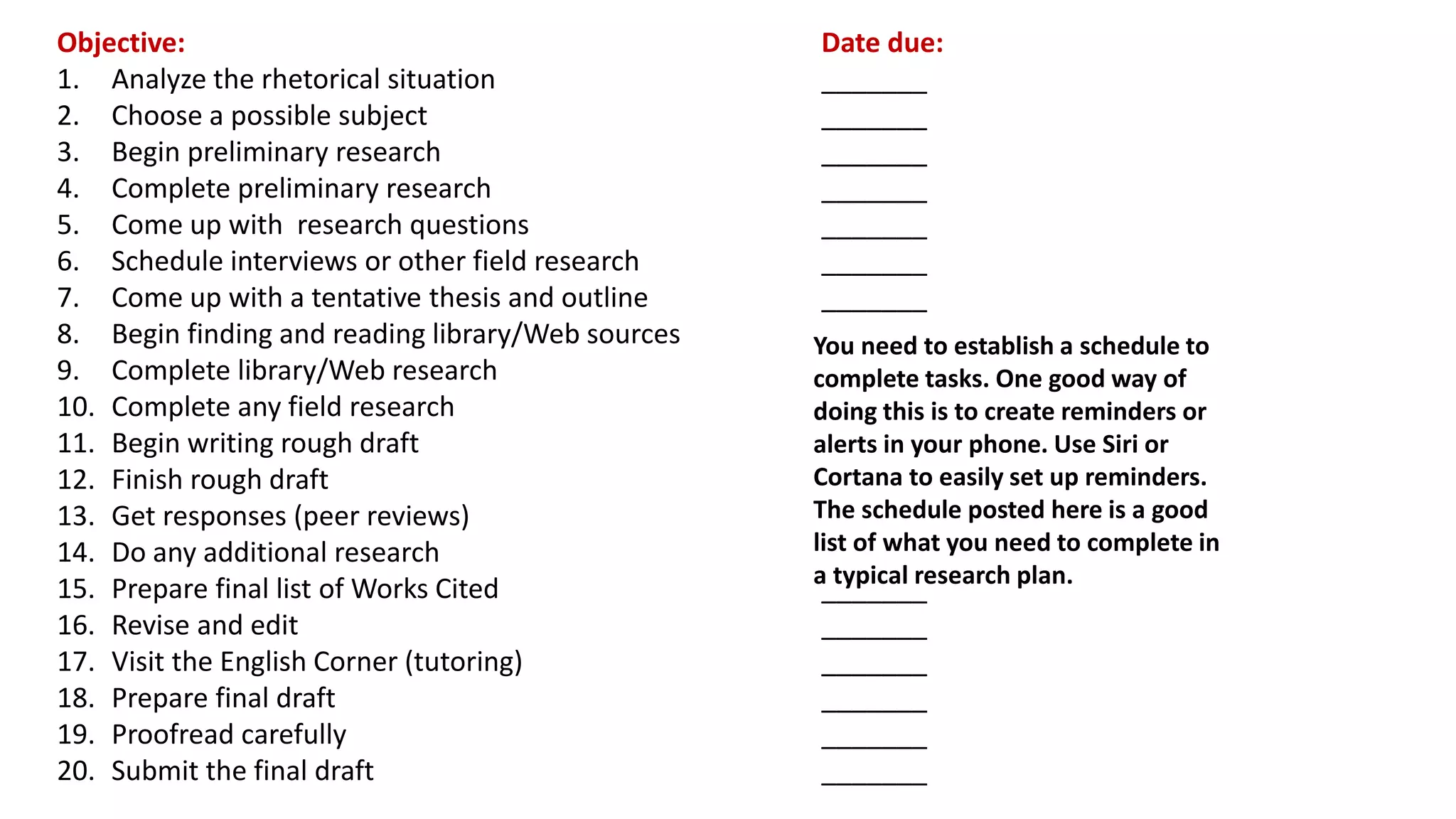
1. Analyze the rhetorical situation _______
2. Choose a possible subject _______
3. Begin preliminary research _______
4. Complete preliminary research _______
5. Come up with research questions _______
6. Schedule interviews or other field research _______
7. Come up with a tentative thesis and outline _______
8. Begin finding and reading library/Web sources _______
9. Complete library/Web research _______
10. Complete any field research _______
11. Begin writing rough draft _______
12. Finish rough draft _______
13. Get responses (peer reviews) _______
14. Do any additional research _______
15. Prepare final list of Works Cited _______
16. Revise and edit _______
17. Visit the English Corner (tutoring) _______
18. Prepare final draft _______
19. Proofread carefully _______
20. Submit the final draft _______
You need to establish a schedule to
complete tasks. One good way of
doing this is to create reminders or
alerts in your phone. Use Siri or
Cortana to easily set up reminders.
The schedule posted here is a good
list of what you need to complete in
a typical research plan.
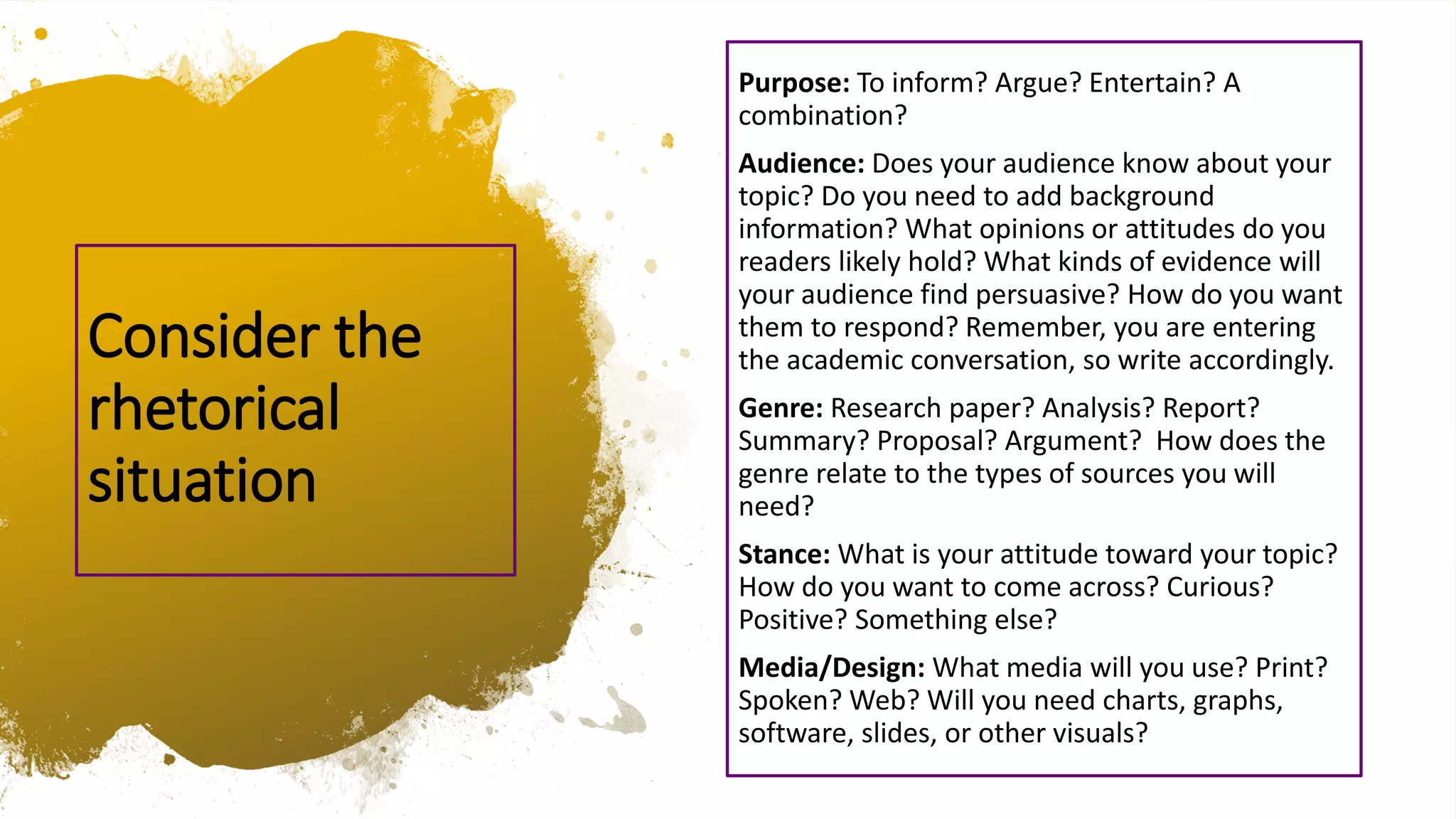
Purpose: To inform? Argue? Entertain? A
combination?
Audience: Does your audience know about your
topic? Do you need to add background
information? What opinions or attitudes do you
readers likely hold? What kinds of evidence will
your audience find persuasive? How do you want
them to respond? Remember, you are entering
the academic conversation, so write accordingly.
Genre: Research paper? Analysis? Report?
Summary? Proposal? Argument? How does the
genre relate to the types of sources you will
need?
Stance: What is your attitude toward your topic?
How do you want to come across? Curious?
Positive? Something else?
Media/Design: What media will you use? Print?
Spoken? Web? Will you need charts, graphs,
software, slides, or other visuals?
Consider the
rhetorical
situation
Coming up with a topic
• Consider your interests:
• What do you want to learn about or have
questions about?
• What community, national, or global issues
do you care about?
• What do you feel passionately or care
deeply about?
• Try to limit your topic to something you can
relate to. World peace or ending world
hunger is a bit too large to tackle.
• Try focusing closer to home, like hungry
children in our area or homeless people in
DFW.
• Remember, be specific and close to home,
not general.
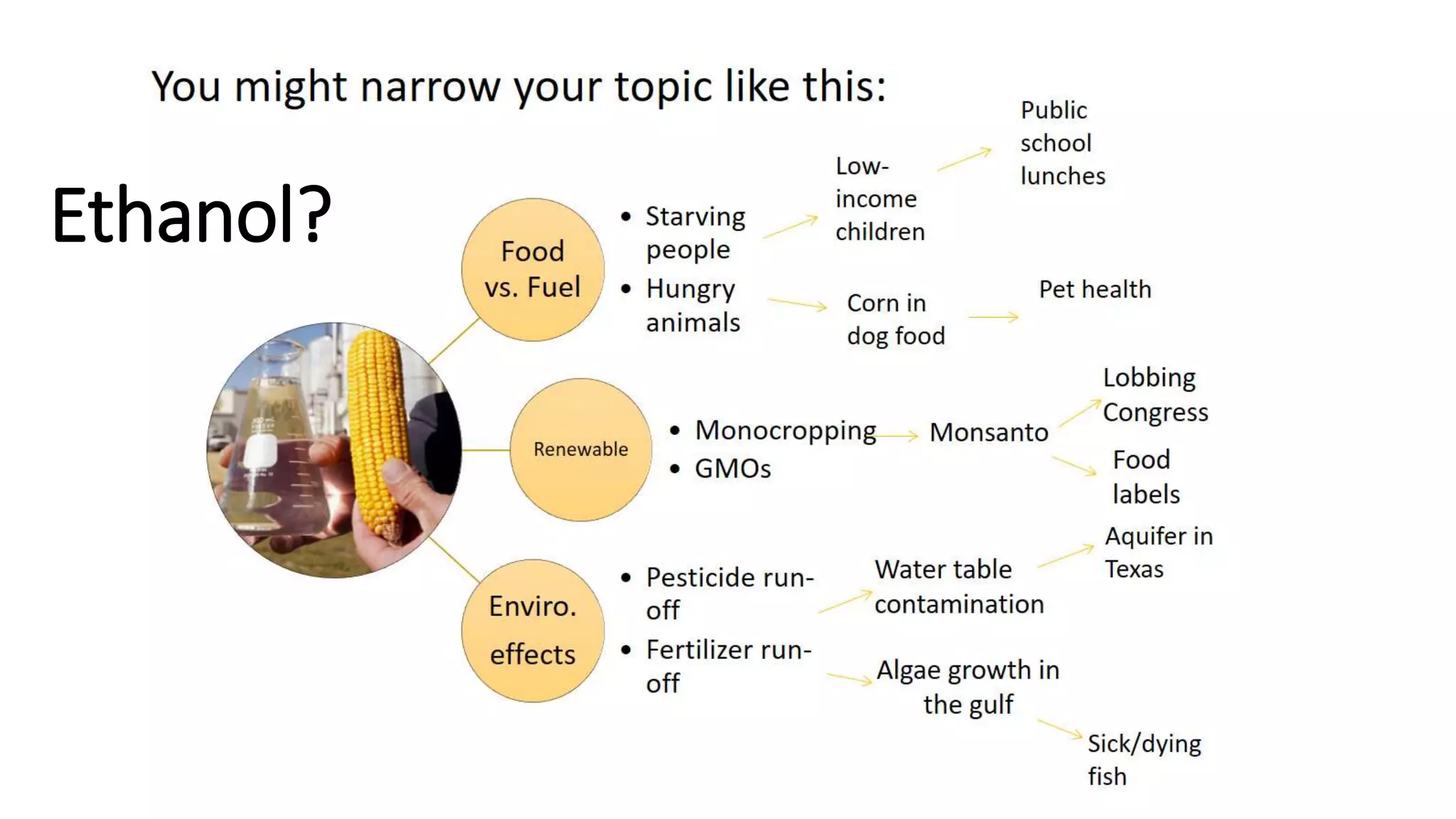
Narrow you topic
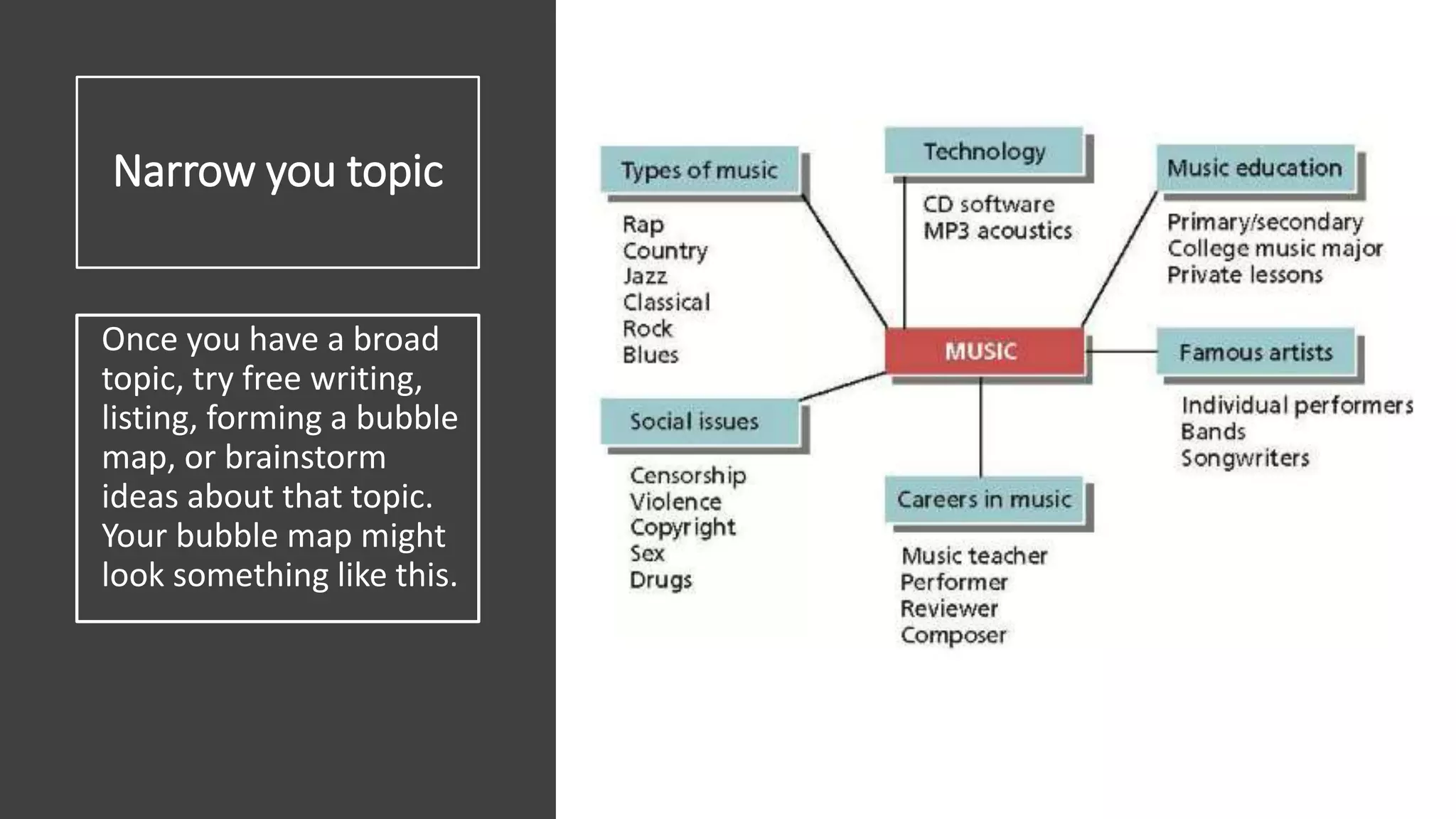
Once you have a broad
topic, try free writing,
listing, forming a bubble
map, or brainstorm
ideas about that topic.
Your bubble map might
look something like this.
Ethanol?
• Bubble Map/Free Writing: Take five
minutes to create a bubble map over a
topic you think would make a good
research paper. If you don’t want to make a
bubble map, just write down questions or
ways/areas you might take your research.
• Writing/Listing: Take about five minutes to
write down everything you know about
your narrow topic. Chances are you know
quite a bit already. Write down everything
you have ever heard or learned about your
topic, even if you aren’t sure if it’s true or
not. You can always verify it later
Pre-writing
• Common knowledge?: Read through the topic
and information on your paper. Think about
what would be considered “common
knowledge” verses information you need to
cite or find support/evidence for in a paper.
Highlight or star all the information your think
will need to be cited. In other words, mark
everything that is NOT common knowledge.
• Sources: The places you marked are good
places to begin your research and find sources
and evidence for your paper!
Finding Sources
• Do some preliminary research: To help you refine
and focus your topic, do some exploratory
research. It will save you time and effort in the long
run because you will be able to eliminate
unnecessary topics or unrelated ideas that won’t
help you write your paper.
• Begin with reference works: Encyclopedias are
great places to begin but are not appropriate
sources for college papers. Skimming websites can
be helpful as well. If you already know a lot of
information about your topic, doing preliminary
research can open new avenues or new ways of
seeing and approaching your topic. However,
reference works or dot com websites are not
acceptable as sources for your final paper.
Pre-Research
• After you’ve done some preliminary research,
you may discover that your interests have
changed, or your research has led to surprises
or additional research. That’s OK. Now is the
time to refine your topic and focus on a specific
question that you will work to answer in your
research paper.
• Generate a list of questions beginning with
What? When? Where? Who? How? Why?
Would? Could? and Should? About your
tentative topic.
Research Questions
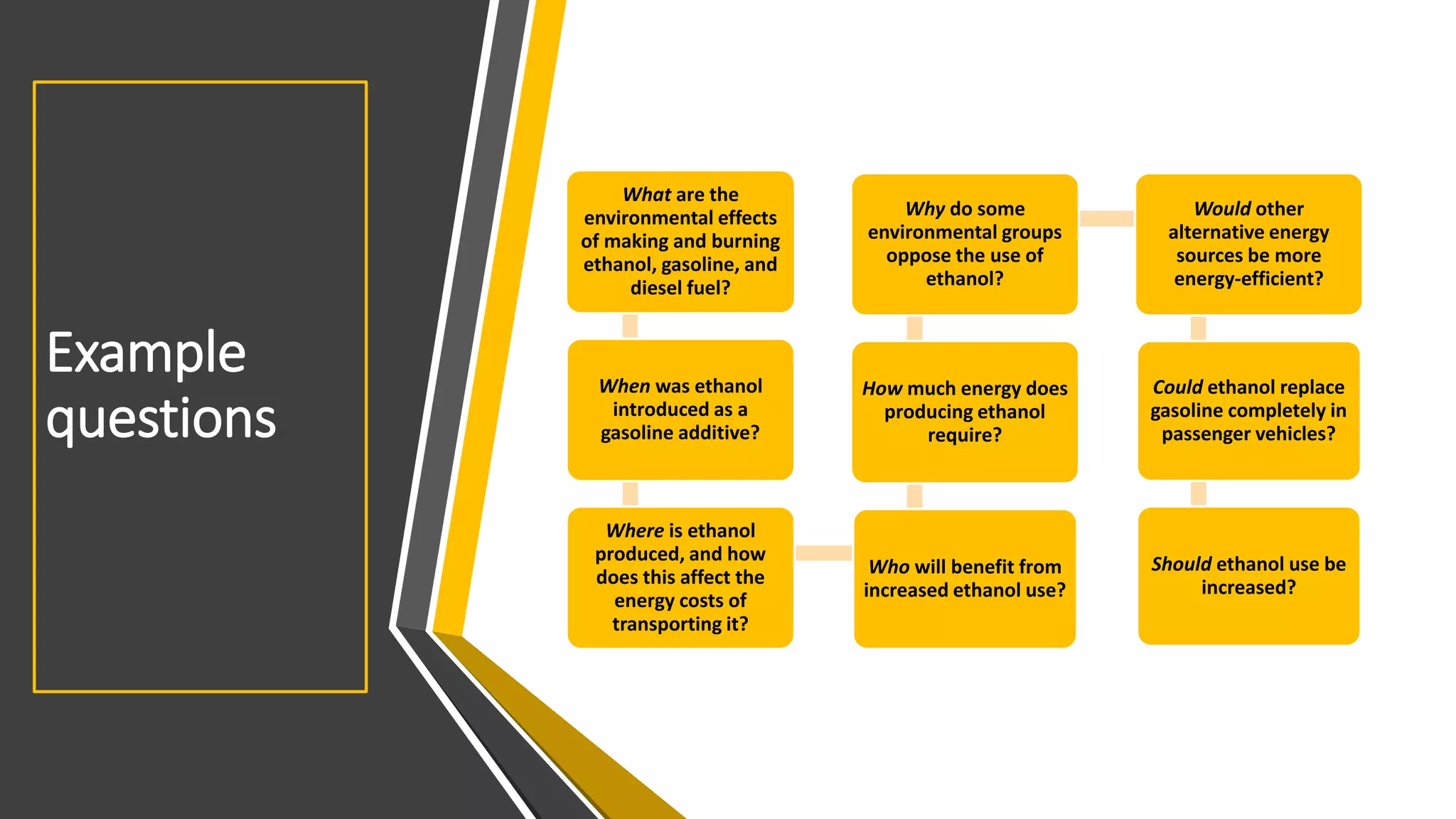
What are the
environmental effects
of making and burning
ethanol, gasoline, and
diesel fuel?
When was ethanol
introduced as a
gasoline additive?
Where is ethanol
produced, and how
does this affect the
energy costs of
transporting it?
Who will benefit from
increased ethanol use?
How much energy does
producing ethanol
require?
Why do some
environmental groups
oppose the use of
ethanol?
Would other
alternative energy
sources be more
energy-efficient?
Could ethanol replace
gasoline completely in
passenger vehicles?
Should ethanol use be
increased?
Example
questions
• Drafting a tentative thesis: Now that you have
some questions about your research and
possible answers to those questions, try to
formulate a working thesis. Don’t feel trapped by
your thesis at this point. Your thesis may (and
probably will) change as you learn more about
your subject, consider the many points of view
on it, and reconsider your goal.
• A working thesis allows you to move forward by
clarifying your purpose for doing research. As
with a research question, a tentative thesis
should guide your research efforts. Don’t hold
too tightly to your working thesis, or you may
avoid contradicting evidence and make you
paper biased or unconvincing.
Thesis Statements
• Creating a rough outline: After you have a
working thesis, create a rough outline. Your
rough outline can simply be a list of subjects or
topics you wish to explore. An outline will help
you structure your research and organize your
notes and materials.
• Organize carefully: Use your rough outline to
organize your thoughts. Label your outline by
number or letter and write the corresponding
letter or number on the matching source
material.
Outlines
• Keeping track of your sources: Keep a
working bibliography. Use online sources like
Noodle Tools on the Richland website,
OneNote, Easybib.com. Make an account at
Easybib.com to organize lists of sources by
the name of your paper.
• Label everything: Print articles and write
bibliographic info directly on the printout.
Highlight sections you think you may want to
use. Label sources according to your outline.
• Working bibliography templates: The most
frustrating part of finalizing your paper is
trying to find lost bibliographic information.
Organization is the key to writing a stress-free
paper.
Sources and Works Cited

Developing a Research Plan-1302

  • 1.
  • 2.
    Objective: Date due: 1.Analyze the rhetorical situation _______ 2. Choose a possible subject _______ 3. Begin preliminary research _______ 4. Complete preliminary research _______ 5. Come up with research questions _______ 6. Schedule interviews or other field research _______ 7. Come up with a tentative thesis and outline _______ 8. Begin finding and reading library/Web sources _______ 9. Complete library/Web research _______ 10. Complete any field research _______ 11. Begin writing rough draft _______ 12. Finish rough draft _______ 13. Get responses (peer reviews) _______ 14. Do any additional research _______ 15. Prepare final list of Works Cited _______ 16. Revise and edit _______ 17. Visit the English Corner (tutoring) _______ 18. Prepare final draft _______ 19. Proofread carefully _______ 20. Submit the final draft _______ You need to establish a schedule to complete tasks. One good way of doing this is to create reminders or alerts in your phone. Use Siri or Cortana to easily set up reminders. The schedule posted here is a good list of what you need to complete in a typical research plan.
  • 3.
    Purpose: To inform?Argue? Entertain? A combination? Audience: Does your audience know about your topic? Do you need to add background information? What opinions or attitudes do you readers likely hold? What kinds of evidence will your audience find persuasive? How do you want them to respond? Remember, you are entering the academic conversation, so write accordingly. Genre: Research paper? Analysis? Report? Summary? Proposal? Argument? How does the genre relate to the types of sources you will need? Stance: What is your attitude toward your topic? How do you want to come across? Curious? Positive? Something else? Media/Design: What media will you use? Print? Spoken? Web? Will you need charts, graphs, software, slides, or other visuals? Consider the rhetorical situation
  • 4.
    Coming up witha topic • Consider your interests: • What do you want to learn about or have questions about? • What community, national, or global issues do you care about? • What do you feel passionately or care deeply about? • Try to limit your topic to something you can relate to. World peace or ending world hunger is a bit too large to tackle. • Try focusing closer to home, like hungry children in our area or homeless people in DFW. • Remember, be specific and close to home, not general.
  • 5.
    Narrow you topic Onceyou have a broad topic, try free writing, listing, forming a bubble map, or brainstorm ideas about that topic. Your bubble map might look something like this.
  • 6.
  • 7.
    • Bubble Map/FreeWriting: Take five minutes to create a bubble map over a topic you think would make a good research paper. If you don’t want to make a bubble map, just write down questions or ways/areas you might take your research. • Writing/Listing: Take about five minutes to write down everything you know about your narrow topic. Chances are you know quite a bit already. Write down everything you have ever heard or learned about your topic, even if you aren’t sure if it’s true or not. You can always verify it later Pre-writing
  • 8.
    • Common knowledge?:Read through the topic and information on your paper. Think about what would be considered “common knowledge” verses information you need to cite or find support/evidence for in a paper. Highlight or star all the information your think will need to be cited. In other words, mark everything that is NOT common knowledge. • Sources: The places you marked are good places to begin your research and find sources and evidence for your paper! Finding Sources
  • 9.
    • Do somepreliminary research: To help you refine and focus your topic, do some exploratory research. It will save you time and effort in the long run because you will be able to eliminate unnecessary topics or unrelated ideas that won’t help you write your paper. • Begin with reference works: Encyclopedias are great places to begin but are not appropriate sources for college papers. Skimming websites can be helpful as well. If you already know a lot of information about your topic, doing preliminary research can open new avenues or new ways of seeing and approaching your topic. However, reference works or dot com websites are not acceptable as sources for your final paper. Pre-Research
  • 10.
    • After you’vedone some preliminary research, you may discover that your interests have changed, or your research has led to surprises or additional research. That’s OK. Now is the time to refine your topic and focus on a specific question that you will work to answer in your research paper. • Generate a list of questions beginning with What? When? Where? Who? How? Why? Would? Could? and Should? About your tentative topic. Research Questions
  • 11.
    What are the environmentaleffects of making and burning ethanol, gasoline, and diesel fuel? When was ethanol introduced as a gasoline additive? Where is ethanol produced, and how does this affect the energy costs of transporting it? Who will benefit from increased ethanol use? How much energy does producing ethanol require? Why do some environmental groups oppose the use of ethanol? Would other alternative energy sources be more energy-efficient? Could ethanol replace gasoline completely in passenger vehicles? Should ethanol use be increased? Example questions
  • 12.
    • Drafting atentative thesis: Now that you have some questions about your research and possible answers to those questions, try to formulate a working thesis. Don’t feel trapped by your thesis at this point. Your thesis may (and probably will) change as you learn more about your subject, consider the many points of view on it, and reconsider your goal. • A working thesis allows you to move forward by clarifying your purpose for doing research. As with a research question, a tentative thesis should guide your research efforts. Don’t hold too tightly to your working thesis, or you may avoid contradicting evidence and make you paper biased or unconvincing. Thesis Statements
  • 13.
    • Creating arough outline: After you have a working thesis, create a rough outline. Your rough outline can simply be a list of subjects or topics you wish to explore. An outline will help you structure your research and organize your notes and materials. • Organize carefully: Use your rough outline to organize your thoughts. Label your outline by number or letter and write the corresponding letter or number on the matching source material. Outlines
  • 14.
    • Keeping trackof your sources: Keep a working bibliography. Use online sources like Noodle Tools on the Richland website, OneNote, Easybib.com. Make an account at Easybib.com to organize lists of sources by the name of your paper. • Label everything: Print articles and write bibliographic info directly on the printout. Highlight sections you think you may want to use. Label sources according to your outline. • Working bibliography templates: The most frustrating part of finalizing your paper is trying to find lost bibliographic information. Organization is the key to writing a stress-free paper. Sources and Works Cited