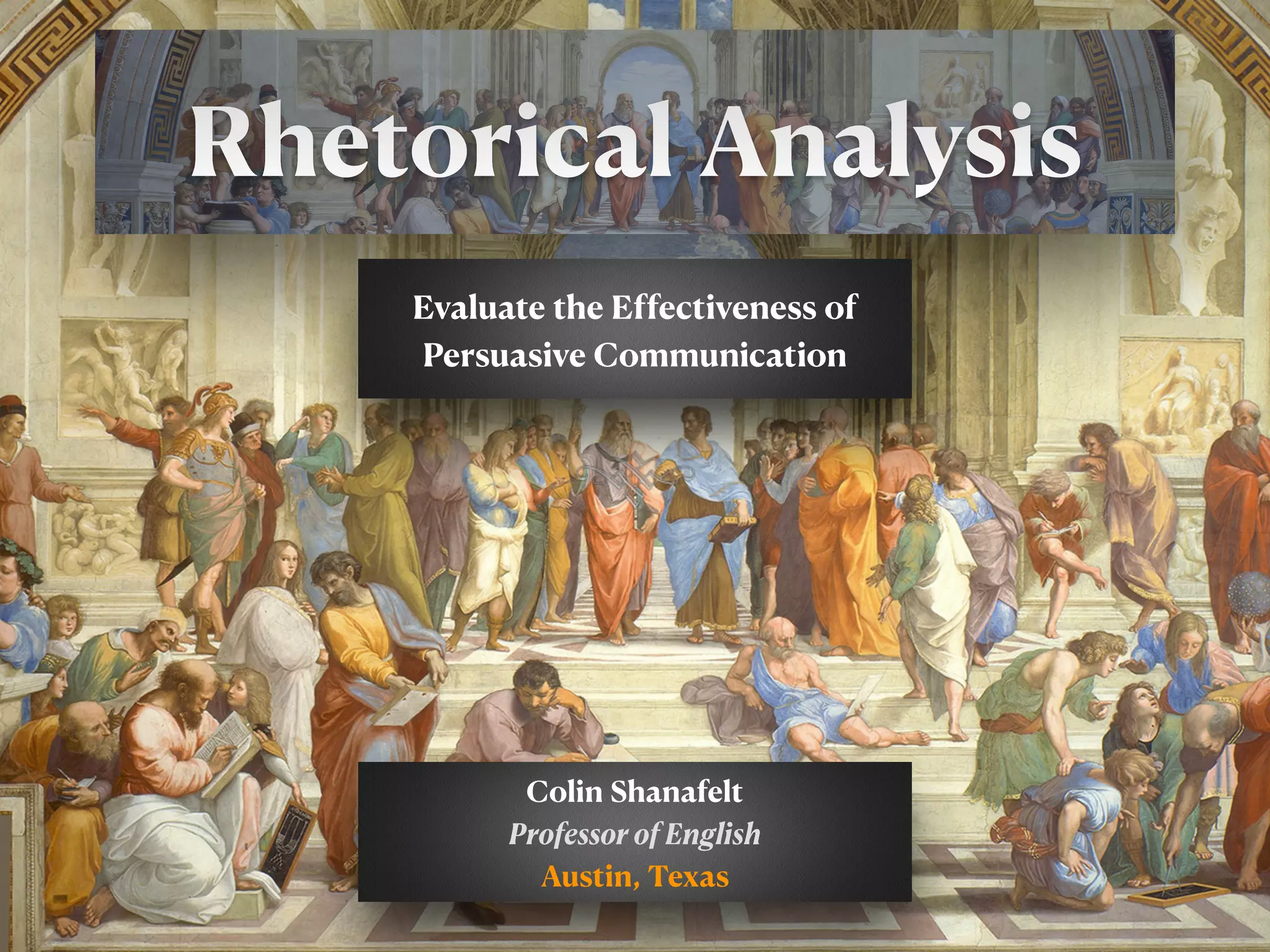



Rhetorical Analysis
Evaluate the Effectiveness of
Persuasive Communication
Colin Shanafelt


Professor of English


Austin, Texas
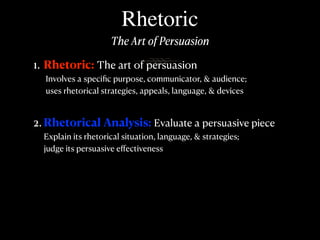
Rhetoric


The Art of Persuasion
1. Rhetoric: The art of persuasion


Involves a speci
fi
c purpose, communicator, & audience;


uses rhetorical strategies, appeals, language, & devices


2. Rhetorical Analysis: Evaluate a persuasive piece
Explain its rhetorical situation, language, & strategies;


judge its persuasive e
ff
ectiveness
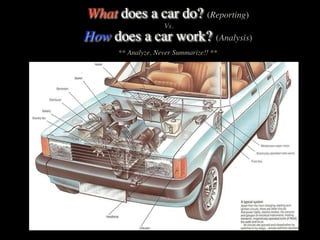
Analysis vs. Reporting
** Analyze, Never Summarize!! **
What does a car do? (Reporting)
Vs.
How does a car work? (Analysis)
** Analyze, Never Summarize!! **
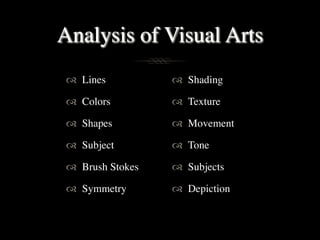
Analysis of Visual Arts
! Lines
! Colors
! Shapes
! Subject
! Brush Stokes
! Symmetry
! Shading
! Texture
! Movement
! Tone
! Subjects
! Depiction
Woman, I


Willem de Kooning
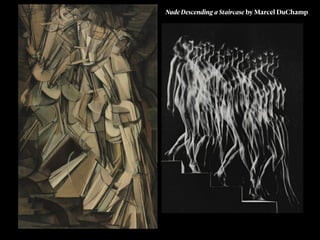
Nude Descending a Staircase by Marcel DuChamp
JMW Turner
The Fighting Temeraire Towed to her Last Resting Place - JMW Turner
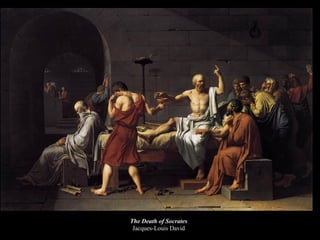
The Death of Socrates


Jacques-Louis David
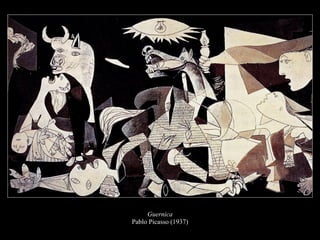
Guernica


Pablo Picasso (1937)
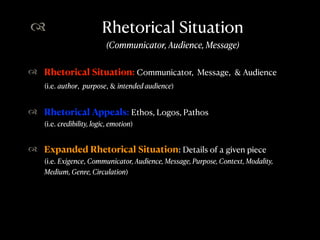
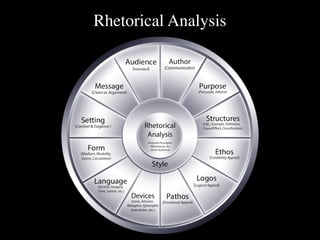
! Rhetorical Situation: Communicator, Message, & Audience


(i.e. author, purpose, & intended audience)


! Rhetorical Appeals: Ethos, Logos, Pathos


(i.e. credibility, logic, emotion)


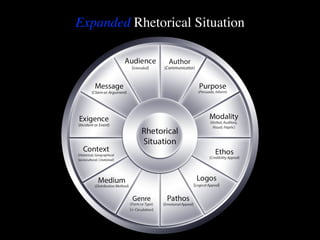
! Expanded Rhetorical Situation: Details of a given piece


(i.e. Exigence, Communicator, Audience, Message, Purpose, Context, Modality,
Medium, Genre, Circulation)
! Rhetorical Situation


(Communicator, Audience, Message)
Expanded Rhetorical Situation
Rhetorical Appeals


(Ethos, Logos, Pathos)
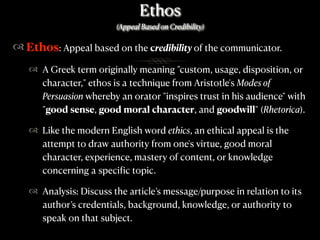
Ethos


(Appeal Based on Credibility)
! Ethos: Appeal based on the credibility of the communicator.


! A Greek term originally meaning "custom, usage, disposition, or
character," ethos is a technique from Aristotle's Modes of
Persuasion whereby an orator "inspires trust in his audience" with
"good sense, good moral character, and goodwill" (Rhetorica).


! Like the modern English word ethics, an ethical appeal is the
attempt to draw authority from one's virtue, good moral
character, experience, mastery of content, or knowledge
concerning a speci
f
ic topic.


! Analysis: Discuss the article’s message/purpose in relation to its
author’s credentials, background, knowledge, or authority to
speak on that subject.
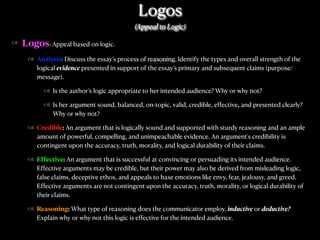
Logos


(Appeal to Logic)
! Logos: Appeal based on logic.


! Analysis: Discuss the essay’s process of reasoning. Identify the types and overall strength of the
logical evidence presented in support of the essay’s primary and subsequent claims (purpose/
message).


! Is the author’s logic appropriate to her intended audience? Why or why not?


! Is her argument sound, balanced, on-topic, valid, credible, effective, and presented clearly?
Why or why not?


! Credible: An argument that is logically sound and supported with sturdy reasoning and an ample
amount of powerful, compelling, and unimpeachable evidence. An argument's credibility is
contingent upon the accuracy, truth, morality, and logical durability of their claims.


! Effective: An argument that is successful at convincing or persuading its intended audience.
Effective arguments may be credible, but their power may also be derived from misleading logic,
false claims, deceptive ethos, and appeals to base emotions like envy, fear, jealousy, and greed.
Effective arguments are not contingent upon the accuracy, truth, morality, or logical durability of
their claims.


! Reasoning: What type of reasoning does the communicator employ, inductive or deductive?
Explain why or why not this logic is effective for the intended audience.
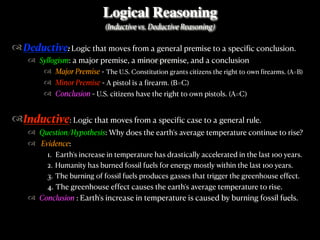
Logical Reasoning


(Inductive vs. Deductive Reasoning)
!Deductive: Logic that moves from a general premise to a speci
f
ic conclusion.


! Syllogism: a major premise, a minor premise, and a conclusion


! Major Premise - The U.S. Constitution grants citizens the right to own
f
irearms. (A=B)


! Minor Premise - A pistol is a
f
irearm. (B=C)


! Conclusion - U.S. citizens have the right to own pistols. (A=C)


!Inductive: Logic that moves from a speci
f
ic case to a general rule.


! Question/Hypothesis: Why does the earth's average temperature continue to rise?


! Evidence:


1. Earth's increase in temperature has drastically accelerated in the last 100 years.


2. Humanity has burned fossil fuels for energy mostly within the last 100 years.


3. The burning of fossil fuels produces gasses that trigger the greenhouse effect.


4. The greenhouse effect causes the earth's average temperature to rise.


! Conclusion : Earth's increase in temperature is caused by burning fossil fuels.
Pathos


(Appeal Based on Emotion)
! Pathos Appeal based on emotion.


! The goal of an emotional appeal is to tug at readers' heartstrings.


! Pathos is an appeal to emotions like pity and sympathy, using tender experiences
and base sentiments to break down mental barriers to persuasion.


! However, pathos also persuades through higher passions like idealism, beauty,
humor, and nostalgia.


! Analysis: Discuss how the persuasive piece appeals to readers’ emotions


(i.e. needs, fears, feelings, beliefs/values, & sympathies).


! Is the emotion appropriate to the intended audience?


Evaluate the effectiveness of this emotional element to persuade this particular audience.


! Consider tone, allusions, comparisons, & emotionally charged language.


! Example 1: ”For just ten cents a day, you can save these starving puppies
from a slow and certain death."


! Example 2: An anecdotal war story told from the perspective of a child
who lost her father to the conflict.
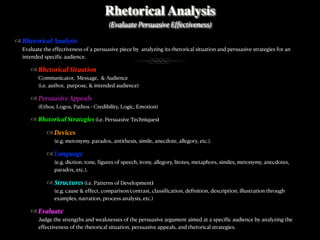
Rhetorical Analysis


(Evaluate Persuasive Effectiveness)
Rhetorical Analysis


(Evaluate Persuasive Effectiveness)
! Rhetorical Analysis


Evaluate the effectiveness of a persuasive piece by analyzing its rhetorical situation and persuasive strategies for an
intended speci
f
ic audience.


! Rhetorical Situation


Communicator, Message, & Audience


(i.e. author, purpose, & intended audience)


! Persuasive Appeals


(Ethos, Logos, Pathos - Credibility, Logic, Emotion)


! Rhetorical Strategies (i.e. Persuasive Techniques)


! Devices


(e.g. metonymy. paradox, antithesis, simile, anecdote, allegory, etc.).


! Language


(e.g. diction, tone,
f
igures of speech, irony, allegory, litotes, metaphors, similes, metonymy, anecdotes,
paradox, etc.).


! Structures (i.e. Patterns of Development)


(e.g. cause & effect, comparison/contrast, classi
f
ication, de
f
inition, description, illustration through
examples, narration, process analysis, etc.)


! Evaluate


Judge the strengths and weaknesses of the persuasive argument aimed at a speci
f
ic audience by analyzing the
effectiveness of the rhetorical situation, persuasive appeals, and rhetorical strategies.
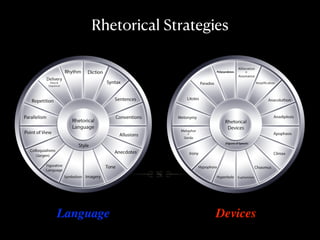
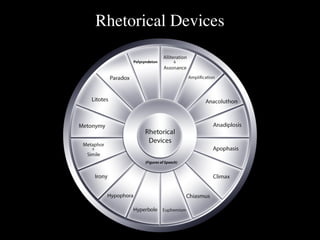
Rhetorical Analysis
Language Devices
Rhetorical Strategies
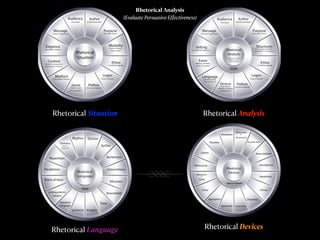
Rhetorical Situation Rhetorical Analysis
Rhetorical Language Rhetorical Devices
Rhetorical Analysis


(Evaluate Persuasive Effectiveness)
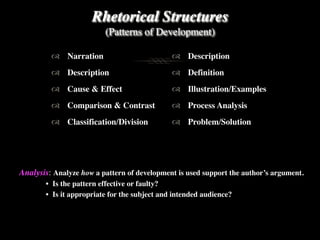
Rhetorical Structures


(Patterns of Development)
! Narration
! Description
! Cause & Effect
! Comparison & Contrast
! Classification/Division


! Description
! Definition
! Illustration/Examples
! Process Analysis
! Problem/Solution
Analysis: Analyze how a pattern of development is used support the author’s argument.
• Is the pattern effective or faulty?
• Is it appropriate for the subject and intended audience?
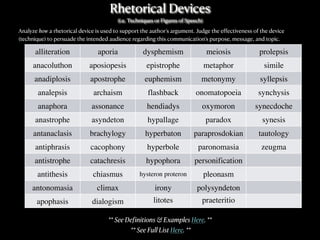
Rhetorical Devices


(i.e. Techniques or Figures of Speech)
Analyze how a rhetorical device is used to support the author’s argument. Judge the effectiveness of the device
(technique) to persuade the intended audience regarding this communication’s purpose, message, and topic.
** See De
f
initions & Examples Here. **


** See Full List Here. **
alliteration aporia dysphemism meiosis prolepsis
anacoluthon aposiopesis epistrophe metaphor simile
anadiplosis apostrophe euphemism metonymy syllepsis
analepsis archaism flashback onomatopoeia synchysis
anaphora assonance hendiadys oxymoron synecdoche
anastrophe asyndeton hypallage paradox synesis
antanaclasis brachylogy hyperbaton paraprosdokian tautology
antiphrasis cacophony hyperbole paronomasia zeugma
antistrophe catachresis hypophora personification
antithesis chiasmus hysteron proteron pleonasm
antonomasia climax irony polysyndeton
apophasis dialogism litotes praeteritio
Rhetorical Devices
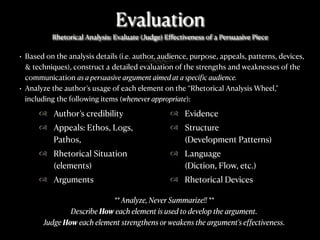
Evaluation


Rhetorical Analysis: Evaluate (Judge) Effectiveness of a Persuasive Piece
! Author’s credibility


! Appeals: Ethos, Logs,
Pathos,


! Rhetorical Situation


(elements)


! Arguments


! Evidence


! Structure


(Development Patterns)


! Language


(Diction, Flow, etc.)


! Rhetorical Devices
• Based on the analysis details (i.e. author, audience, purpose, appeals, patterns, devices,
& techniques), construct a detailed evaluation of the strengths and weaknesses of the
communication as a persuasive argument aimed at a speci
f
ic audience.


• Analyze the author’s usage of each element on the “Rhetorical Analysis Wheel,”
including the following items (whenever appropriate):
** Analyze, Never Summarize!! **


Describe How each element is used to develop the argument.


Judge How each element strengthens or weakens the argument's effectiveness.

Rhetorical Analysis Notes

  • 1.
    Rhetorical Analysis Evaluate theEffectiveness of Persuasive Communication Colin Shanafelt 
 Professor of English 
 Austin, Texas
  • 2.
    Rhetoric 
 The Art ofPersuasion 1. Rhetoric: The art of persuasion 
 Involves a speci fi c purpose, communicator, & audience; 
 uses rhetorical strategies, appeals, language, & devices 2. Rhetorical Analysis: Evaluate a persuasive piece Explain its rhetorical situation, language, & strategies; 
 judge its persuasive e ff ectiveness
  • 3.
    Analysis vs. Reporting **Analyze, Never Summarize!! **
  • 4.
    What does acar do? (Reporting) Vs. How does a car work? (Analysis) ** Analyze, Never Summarize!! **
  • 5.
    Analysis of VisualArts ! Lines ! Colors ! Shapes ! Subject ! Brush Stokes ! Symmetry ! Shading ! Texture ! Movement ! Tone ! Subjects ! Depiction
  • 6.
  • 8.
    Nude Descending aStaircase by Marcel DuChamp
  • 9.
    JMW Turner The FightingTemeraire Towed to her Last Resting Place - JMW Turner
  • 10.
    The Death ofSocrates Jacques-Louis David
  • 11.
  • 12.
    ! Rhetorical Situation:Communicator, Message, & Audience 
 (i.e. author, purpose, & intended audience) 
 ! Rhetorical Appeals: Ethos, Logos, Pathos 
 (i.e. credibility, logic, emotion) 
 ! Expanded Rhetorical Situation: Details of a given piece 
 (i.e. Exigence, Communicator, Audience, Message, Purpose, Context, Modality, Medium, Genre, Circulation) ! Rhetorical Situation 
 (Communicator, Audience, Message)
  • 13.
  • 14.
  • 15.
    Ethos 
 (Appeal Based onCredibility) ! Ethos: Appeal based on the credibility of the communicator. ! A Greek term originally meaning "custom, usage, disposition, or character," ethos is a technique from Aristotle's Modes of Persuasion whereby an orator "inspires trust in his audience" with "good sense, good moral character, and goodwill" (Rhetorica). ! Like the modern English word ethics, an ethical appeal is the attempt to draw authority from one's virtue, good moral character, experience, mastery of content, or knowledge concerning a speci f ic topic. ! Analysis: Discuss the article’s message/purpose in relation to its author’s credentials, background, knowledge, or authority to speak on that subject.
  • 16.
    Logos 
 (Appeal to Logic) !Logos: Appeal based on logic. ! Analysis: Discuss the essay’s process of reasoning. Identify the types and overall strength of the logical evidence presented in support of the essay’s primary and subsequent claims (purpose/ message). ! Is the author’s logic appropriate to her intended audience? Why or why not? ! Is her argument sound, balanced, on-topic, valid, credible, effective, and presented clearly? Why or why not? ! Credible: An argument that is logically sound and supported with sturdy reasoning and an ample amount of powerful, compelling, and unimpeachable evidence. An argument's credibility is contingent upon the accuracy, truth, morality, and logical durability of their claims. ! Effective: An argument that is successful at convincing or persuading its intended audience. Effective arguments may be credible, but their power may also be derived from misleading logic, false claims, deceptive ethos, and appeals to base emotions like envy, fear, jealousy, and greed. Effective arguments are not contingent upon the accuracy, truth, morality, or logical durability of their claims. ! Reasoning: What type of reasoning does the communicator employ, inductive or deductive? Explain why or why not this logic is effective for the intended audience.
  • 17.
    Logical Reasoning 
 (Inductive vs.Deductive Reasoning) !Deductive: Logic that moves from a general premise to a speci f ic conclusion. ! Syllogism: a major premise, a minor premise, and a conclusion ! Major Premise - The U.S. Constitution grants citizens the right to own f irearms. (A=B) ! Minor Premise - A pistol is a f irearm. (B=C) ! Conclusion - U.S. citizens have the right to own pistols. (A=C) 
 !Inductive: Logic that moves from a speci f ic case to a general rule. ! Question/Hypothesis: Why does the earth's average temperature continue to rise? ! Evidence: 1. Earth's increase in temperature has drastically accelerated in the last 100 years. 2. Humanity has burned fossil fuels for energy mostly within the last 100 years. 3. The burning of fossil fuels produces gasses that trigger the greenhouse effect. 4. The greenhouse effect causes the earth's average temperature to rise. ! Conclusion : Earth's increase in temperature is caused by burning fossil fuels.
  • 18.
    Pathos 
 (Appeal Based onEmotion) ! Pathos Appeal based on emotion. ! The goal of an emotional appeal is to tug at readers' heartstrings. ! Pathos is an appeal to emotions like pity and sympathy, using tender experiences and base sentiments to break down mental barriers to persuasion. ! However, pathos also persuades through higher passions like idealism, beauty, humor, and nostalgia. ! Analysis: Discuss how the persuasive piece appeals to readers’ emotions 
 (i.e. needs, fears, feelings, beliefs/values, & sympathies). ! Is the emotion appropriate to the intended audience? 
 Evaluate the effectiveness of this emotional element to persuade this particular audience. ! Consider tone, allusions, comparisons, & emotionally charged language. ! Example 1: ”For just ten cents a day, you can save these starving puppies from a slow and certain death." ! Example 2: An anecdotal war story told from the perspective of a child who lost her father to the conflict.
  • 19.
  • 20.
    Rhetorical Analysis 
 (Evaluate PersuasiveEffectiveness) ! Rhetorical Analysis 
 Evaluate the effectiveness of a persuasive piece by analyzing its rhetorical situation and persuasive strategies for an intended speci f ic audience. ! Rhetorical Situation 
 Communicator, Message, & Audience 
 (i.e. author, purpose, & intended audience) ! Persuasive Appeals 
 (Ethos, Logos, Pathos - Credibility, Logic, Emotion) ! Rhetorical Strategies (i.e. Persuasive Techniques) ! Devices 
 (e.g. metonymy. paradox, antithesis, simile, anecdote, allegory, etc.). ! Language 
 (e.g. diction, tone, f igures of speech, irony, allegory, litotes, metaphors, similes, metonymy, anecdotes, paradox, etc.). ! Structures (i.e. Patterns of Development) 
 (e.g. cause & effect, comparison/contrast, classi f ication, de f inition, description, illustration through examples, narration, process analysis, etc.) ! Evaluate 
 Judge the strengths and weaknesses of the persuasive argument aimed at a speci f ic audience by analyzing the effectiveness of the rhetorical situation, persuasive appeals, and rhetorical strategies.
  • 21.
  • 22.
  • 23.
    Rhetorical Situation RhetoricalAnalysis Rhetorical Language Rhetorical Devices Rhetorical Analysis 
 (Evaluate Persuasive Effectiveness)
  • 24.
    Rhetorical Structures 
 (Patterns ofDevelopment) ! Narration ! Description ! Cause & Effect ! Comparison & Contrast ! Classification/Division 
 
 ! Description ! Definition ! Illustration/Examples ! Process Analysis ! Problem/Solution Analysis: Analyze how a pattern of development is used support the author’s argument. • Is the pattern effective or faulty? • Is it appropriate for the subject and intended audience?
  • 25.
    Rhetorical Devices 
 (i.e. Techniquesor Figures of Speech) Analyze how a rhetorical device is used to support the author’s argument. Judge the effectiveness of the device (technique) to persuade the intended audience regarding this communication’s purpose, message, and topic. ** See De f initions & Examples Here. ** 
 ** See Full List Here. ** alliteration aporia dysphemism meiosis prolepsis anacoluthon aposiopesis epistrophe metaphor simile anadiplosis apostrophe euphemism metonymy syllepsis analepsis archaism flashback onomatopoeia synchysis anaphora assonance hendiadys oxymoron synecdoche anastrophe asyndeton hypallage paradox synesis antanaclasis brachylogy hyperbaton paraprosdokian tautology antiphrasis cacophony hyperbole paronomasia zeugma antistrophe catachresis hypophora personification antithesis chiasmus hysteron proteron pleonasm antonomasia climax irony polysyndeton apophasis dialogism litotes praeteritio
  • 26.
  • 27.
    Evaluation 
 Rhetorical Analysis: Evaluate(Judge) Effectiveness of a Persuasive Piece ! Author’s credibility ! Appeals: Ethos, Logs, Pathos, ! Rhetorical Situation 
 (elements) ! Arguments ! Evidence ! Structure 
 (Development Patterns) ! Language 
 (Diction, Flow, etc.) ! Rhetorical Devices • Based on the analysis details (i.e. author, audience, purpose, appeals, patterns, devices, & techniques), construct a detailed evaluation of the strengths and weaknesses of the communication as a persuasive argument aimed at a speci f ic audience. • Analyze the author’s usage of each element on the “Rhetorical Analysis Wheel,” including the following items (whenever appropriate): ** Analyze, Never Summarize!! ** 
 Describe How each element is used to develop the argument. 
 Judge How each element strengthens or weakens the argument's effectiveness.