How to Write a Personal
Statement


Beverly Tate
Arkova M. Scott
What is a personal
statement?
The personal statement is your opportunity to sell
yourself in the application process. It normally
describes one special, unique, distinct, and/or
impressive story about you.
Why do you need to write a personal statement?
Often 4-year colleges and graduate schools require a
personal statement from their applicants, along with
the application. 2-year colleges, often, require students
to write a personal statement for specific scholarships.
What does a personal statement include?
Details of your life (personal family issues, books
read, and/or people or events that have shaped you or
influenced your goals) that might help the committee
better understand your or help set you apart from
other applicants.
What is the format for a personal statement?
It is written in an essay format. Normally, they will limit
the number of words you can write.

They might ask for 500 to 750 words only.
(You have to stick to that number.)
Click the link below to watch a short video about the various
elements that should be included in your personal statement.


 Wait a few minutes for
 video to load….
Write out on a separate piece of paper……

What personal characteristics
(i.e., resilience, integrity, compassion, and/or
persistence) do you
possess that would improve your prospects for success
in college?
• First identify the characteristic.

• Secondly, select one incident in your past that
  demonstrates that characteristic.

• Third, describe how it (characteristic) proves that
  you will be successful in college.
Tell a story-provide a concrete experience that is fresh
and different:

•   Who was involved?
•   Where did it take place?
•   When did it take place?
•   Why did it take place?
•   What sensory details can you use?
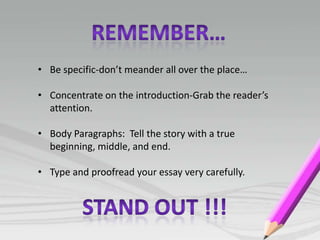
• Be specific-don’t meander all over the place…

• Concentrate on the introduction-Grab the reader’s
  attention.

• Body Paragraphs: Tell the story with a true
  beginning, middle, and end.

• Type and proofread your essay very carefully.
•    Sloppiness
      Avoid spelling, punctuation, formatting, and
      grammatical errors. Be sure to leave yourself adequate
      time to edit and revise your essay. You do not want to
      send your first draft to the admissions committee.

•   Writing one statement for all schools
      Learn about each school’s program, including
      research interests and publications of faculty.
      Clearly state reasons for pursuing a degree from
      that school. Be sure to mention faculty members
      with whom you would like study.

•   Boring content
      Have a positive tone, vary length and structure of
      sentences, and avoid clichés.

•   Sounding like everyone else
      Identify your strengths and clearly articulate
      what sets you apart from other applicants.

•   Dwelling on crisis
      If you discuss a personal crisis, it should relate
      to the purpose of your essay. Mention how it
      affected your personal goals, perspective, or
      academic performance.
•   Did my opening paragraph capture the reader’s attention?
•   Is the statement as a whole interesting?
•   Is it well written?
•   Is the statement positive and upbeat?
•   Does it reflect well on me and my qualifications?
•   Is it an honest and forthright presentation of me?
•   Does it answer key questions posed in the application?
•   Was relevant material omitted?
•   Is there inappropriate or irrelevant material in the statement?
•    Does the reader gain insight from reading the statement?
•   Is it free of typos or other errors?
•   Has the statement distinguished me from other applicants?
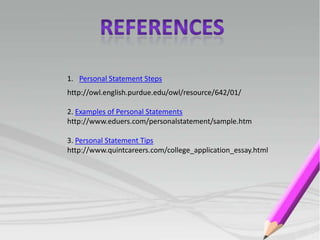
1. Personal Statement Steps
http://owl.english.purdue.edu/owl/resource/642/01/

2. Examples of Personal Statements
http://www.eduers.com/personalstatement/sample.htm

3. Personal Statement Tips
http://www.quintcareers.com/college_application_essay.html
Writing a Personal Statement

Writing a Personal Statement

  • 1.
    How to Writea Personal Statement Beverly Tate Arkova M. Scott
  • 2.
    What is apersonal statement?
  • 3.
    The personal statementis your opportunity to sell yourself in the application process. It normally describes one special, unique, distinct, and/or impressive story about you.
  • 4.
    Why do youneed to write a personal statement?
  • 5.
    Often 4-year collegesand graduate schools require a personal statement from their applicants, along with the application. 2-year colleges, often, require students to write a personal statement for specific scholarships.
  • 6.
    What does apersonal statement include?
  • 7.
    Details of yourlife (personal family issues, books read, and/or people or events that have shaped you or influenced your goals) that might help the committee better understand your or help set you apart from other applicants.
  • 8.
    What is theformat for a personal statement?
  • 9.
    It is writtenin an essay format. Normally, they will limit the number of words you can write. They might ask for 500 to 750 words only. (You have to stick to that number.)
  • 10.
    Click the linkbelow to watch a short video about the various elements that should be included in your personal statement. Wait a few minutes for video to load….
  • 11.
    Write out ona separate piece of paper…… What personal characteristics (i.e., resilience, integrity, compassion, and/or persistence) do you possess that would improve your prospects for success in college?
  • 12.
    • First identifythe characteristic. • Secondly, select one incident in your past that demonstrates that characteristic. • Third, describe how it (characteristic) proves that you will be successful in college.
  • 13.
    Tell a story-providea concrete experience that is fresh and different: • Who was involved? • Where did it take place? • When did it take place? • Why did it take place? • What sensory details can you use?
  • 14.
    • Be specific-don’tmeander all over the place… • Concentrate on the introduction-Grab the reader’s attention. • Body Paragraphs: Tell the story with a true beginning, middle, and end. • Type and proofread your essay very carefully.
  • 15.
    Sloppiness Avoid spelling, punctuation, formatting, and grammatical errors. Be sure to leave yourself adequate time to edit and revise your essay. You do not want to send your first draft to the admissions committee. • Writing one statement for all schools Learn about each school’s program, including research interests and publications of faculty. Clearly state reasons for pursuing a degree from that school. Be sure to mention faculty members with whom you would like study. • Boring content Have a positive tone, vary length and structure of sentences, and avoid clichés. • Sounding like everyone else Identify your strengths and clearly articulate what sets you apart from other applicants. • Dwelling on crisis If you discuss a personal crisis, it should relate to the purpose of your essay. Mention how it affected your personal goals, perspective, or academic performance.
  • 16.
    Did my opening paragraph capture the reader’s attention? • Is the statement as a whole interesting? • Is it well written? • Is the statement positive and upbeat? • Does it reflect well on me and my qualifications? • Is it an honest and forthright presentation of me? • Does it answer key questions posed in the application? • Was relevant material omitted? • Is there inappropriate or irrelevant material in the statement? • Does the reader gain insight from reading the statement? • Is it free of typos or other errors? • Has the statement distinguished me from other applicants?
  • 17.
    1. Personal StatementSteps http://owl.english.purdue.edu/owl/resource/642/01/ 2. Examples of Personal Statements http://www.eduers.com/personalstatement/sample.htm 3. Personal Statement Tips http://www.quintcareers.com/college_application_essay.html