Project Proposal
Preparation
• Introduction
• Types of project
proposals
• How to write a project
proposal
• Tips for writing an
effective project
proposal
• CDA project proposal
Contents
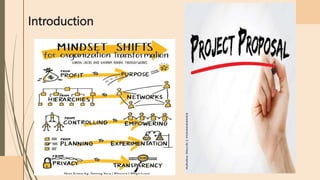
Introduction
Understanding Project Terms
Project
• Project – is a temporary endeavor to create a unique product, ( a
rare and collectible variety of ceramic cups/mugs), service
(delivery service company), or information ( planning a new
DIY product)
• It is divided into several phases to improve management control
and provide links to the ongoing operations of the performing
organization
• Collectively the project phases are known as the project life cycle
A project is completed when its goals and objectives are accomplished. It is these goals
that drive the project, and all the planning and implementation efforts undertaken to achieve them.
Sometimes projects end when it is determined that the goals and objectives cannot be
accomplished or when the product or service of the project is no longer needed and the project is
cancelled.
It provides a shared vision for what the
project will accomplish – this common
understanding can bind the team together in
completing actions that satisfy the project’s
goals.
It gives clarity on the responsibilities of
members and other organizations in
contributing to the goals of the project.
It organizes the work of the project and
be used to prevent extraneous work from
crowding out legitimate project activities.
It can be a very powerful communication
mechanism, supplementing verbal
interactions. This is an important written
reference for the team, and can also be used
with other stakeholders.
• The main purpose of a project
proposal is to get buy-in from
decision-makers;
• To convince stakeholders - your
boss, investors, sponsors, or
management that your project
is worth investing in;
• To grab the attention of
stakeholders and project
sponsors;
5
Why do we need a project proposal?
Cont.
• To coordinate resources, tasks,
equipment and raw materials within a
specific timeframe to achieve a particular
business goal;
• To formalize the project so that it has a
specific vision that needs to be achieved
to determine its success;
• Help you communicate your project's
value to clients, investors or an
employer;
6
Cont.
• Define your project, including things
such as start and end dates,
objectives and goals;
• Plans all your project details, map the
goals and predicts risks and
challenges; and
• To convince the donor agency to fund
your project.
7
Cont.
• when you have a specific project in mind
and need approval
• need funding, or support to make it happen
The following are instances when you might
not need a proposal:
•Personal or small-scale projects
•Routine tasks
•Projects with established processes
•Informal projects
8
What is a project
proposal?
• A project proposal is a detailed
pitch explaining what your project
is, why it’s important, how you plan
to do it, and how much it will cost.
It also includes who will be
involved and how you’ll measure
success.
9
• A project proposal is a written
document outlining everything
stakeholders should know about a
project, including the timeline,
budget, objectives, and goals.
• Project proposals are documents
that define your project, including
things such as start and end dates,
objectives and goals.
10
Cont.
• A project proposal is a project
management document that’s
used to define the objectives and
requirements of a project.
• A project proposal is a detailed
project document that’s used to
convince the project sponsor that
the project being proposed is
worth the time, money and effort
to deliver it.
11
Cont.
12
Cont.
Benefits of a Good Project Proposal
1) Drives innovation. A project proposal provides enough detail that
stakeholders can feel confident investing resources in it.
2) Helps projects stay focused. Businesses can refer to project proposals while
the project is being executed to ensure they stay focused and deliver what was
promised.
3) Anticipates and solves problems early. A project proposal exposes a
project's planning to a new audience. Discussing risks and challenges early can
help project teams solve problems before they become major issues.
4) Aids planning. A good project proposal helps businesses and their
stakeholders plan for the future. They can anticipate how to allocate finances,
time and other resources and predict how the project may impact their business
in the future.
13
5)Project Understanding. A project proposal outlines the purpose and
scope of a project.
6) Establish Credibility. A project proposal should be seen as a sales tool
that helps establish credibility. It should communicate to the decision-
maker or stakeholder that the service provider is capable of completing
the project and fulfilling expectations.
7) A project proposal also proposes a timeline and budget for the project.
project.
8) A project proposal also sets expectations for the client relationship. This
This includes having a mutual understanding of deliverables, timelines, and
and budget.
14
Cont.
 Each type has a different goal.
 The tone of voice and content of your project
proposal will differ based on the type of proposal
you’re sending.
 When you know your project goals, you can write
your proposal accordingly.
15
Types of Project Proposals
17
Solicited project proposal:
This is sent as a response to a
request for proposal (RFP). Here,
you’ll need to adhere to the RFP
guidelines of the project owner
Unsolicited project proposal:
You can send project proposals
without having received a request
for a proposal
Informal project proposal:
This type of project proposal is
created when a client asks for an
informal proposal without an RFP
Renewal project proposal:
You can use a renewal project proposal
when you’re reaching out to past
customers. The advantage is that you can
highlight past positive results and future
benefits
Continuation project proposal:
A continuation project proposal is sent
to investors and stakeholders to
communicate project progress.
Supplemental project proposal:
This proposal is sent to investors to ask
for additional resources during the
project execution phase
18
How to Write a
Project
Proposal?
19
1. Write an Executive Summary
The executive summary serves as the introduction to your
project proposal.
Your executive summary should include:
•The problem your project plans to solve
•The solution your project provides for that problem
•The impact your project will have
This section should aim to catch your recipient's attention
and encourage them to read on.
The length of your executive summary will depend on your
project's complexity. Make your executive summary concise
to keep it engaging and convincing.
20
21
Some questions to include are:
•What is the problem your project addresses?
•What is already known about this problem?
•Who has addressed this problem before/what
research is there?
•Why is past research insufficient at addressing this
problem?
In this section, you’ll go into the background of the project. Use references and
statistics to convince your reader that the problem you’re addressing is worthwhile.
2. Explain the Project
Background
3. Present a Solution
The next logical step in proposal writing is to present a
solution. This section is your opportunity to outline your
project approach in greater detail.
Some items to include are:
•Your vision statement for the project
•Your project schedule, including important
milestones
•Project team roles and responsibilities
•A risk register showing how you’ll mitigate risk
•The project deliverables
•Reporting tools you’ll use throughout the project
22
4. Define Project Deliverables and Goals
Defining your project deliverables is a crucial step in
writing your project proposal.
Stakeholders want to know what you’re going to produce
at the end of your project, whether that’s a product, a
program, an upgrade in technology, or something else.
When defining your deliverables, you should include:
•The end product or final objective of your project
•A project timeline for when deliverables will be
ready
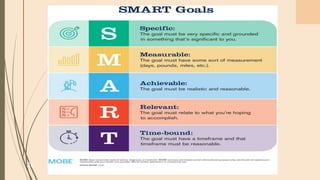
•SMART goals that align with the deliverables
you’re producing
23
Deliverables
P
L
A
N
N
I
N
G
Start Finish
Timelines
Deliverables
• Brainstorm project process. consult members of your team about your
development plans - they may contribute insights that you've overlooked
• Review process and look for areas of improvement
• Explain the whys of working from start to finish
• Sequential steps – linearly step by step of what should be executed
• How deep of a PM do you create?
• High Level – in depth
• Middle level – process map
Note: The conclusion of a project is marked by a review of both key deliverables and
project performance to date
Phase-end-review are called -phase exits, stage gates or kill points
Deliverable Diagram
Build a House
Structure
Design Electrical Inside work Outside
Works
Scaling
Modifyin
gy
Finalize
design
foundation
Framing
Wiring
Plumbing
Appliance
Cabinets
landscapin
g
Security
Roofin
g
Sub
works
• Deliverable is a tangible, verifiable work product such as FS, detail design, or a working
prototype
• Each phase s marked by the completion of one or more deliverables
Interior
designs
26
5. List What Resources Needed
In this section, you’ll include:
•Project budget: The project budget involves everything from the
supplies you’ll need to create a product to ad pricing and team salaries.
You should include any budget items you need to deliver the project
here.
•Breakdown of costs: This section should include research on why you
need specific resources for your project; that way, stakeholders can
understand what their buy-in is being used for. This breakdown can also
help you mitigate unexpected costs.
•Resource allocation plan: You should include an overview of your
resource allocation plan outlining where you plan to use the specific
resources you need. For example, if you determine you need PhP500,000
to complete the project, do you plan to allocate this money to salaries,
technology, materials, etc.
27
6. State your Conclusion
Finally, wrap up your project proposal with a
persuasive and confident conclusion. Like the
executive summary, the conclusion should
briefly summarize the problem your project
addresses and your solution for solving that
problem.
You can emphasize the impact of your project
in the conclusion but keep this section
relevant, just like you would in a traditional
essay.
28
29
Workshop 1
Identification of problem,
solution and impact
30
PROJECT PROPOSAL FORMAT
31
32
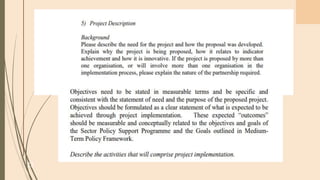
4) Organization
33
34
35
It is very important to know some steps that will ensure your project
proposal has all the right elements. If you want to impress your readers
and win their approval, your writing must shine.
Tips for Writing an
Effective Project
Proposal
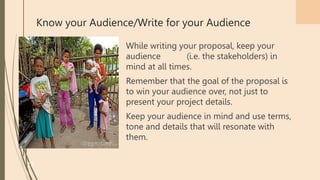
Know your Audience/Write for your Audience
While writing your proposal, keep your
audience (i.e. the stakeholders) in
mind at all times.
Remember that the goal of the proposal is
to win your audience over, not just to
present your project details.
Keep your audience in mind and use terms,
tone and details that will resonate with
them.
37
Be Persuasive
• A project proposal aims to convince
its recipients to act, so being
persuasive is vital. Use persuasive
tools, including historical data, survey
results, market predictions,
testimonials and case studies to
encourage action.
38
Connect the Project to the Recipient
• A project may seem like a good
idea, but it may not be
approved or funded if your
recipient does not understand
why it matters to them. Make
the connection between your
recipient's goals and the
project clear to increase your
chance of success.
39
Keep it Simple
• A simple proposal is easy to read and
understand. Use easily understood
terms, simple sentences and an easy-
to-follow format to make your
proposal clear.
40
Follow Convention
• It might be tempting to be
creative with your proposal's
structure to help it stand out.
However, following tradition
reduces the chance of confusing
your reader and forgetting
essential information. If you are
given a set format, follow it
strictly.
41
Proofread and revise your proposal
• Read through your proposal to
make sure it is clear and free of
spelling and grammatical errors.
Presenting a clear and mistake-free
proposal helps you demonstrate
your professionalism, which can
help you increase your chance of
approval.
42
Project Proposal
For CDA Financial Assistance
44
45
Workshop 2
Prepare a project proposal
following the CDA format
46
References
• https://asana.com/resources/project-proposal
• https://www.grammarly.com/blog/project-proposal/
• https://www.projectmanager.com/blog/how-to-create-a-project-proposal
• https://www.indeed.com/career-advice/career-development/how-to-write-a-project-
proposal
• https://www.mobeforlife.com/blog/smart-goals-put-your-goals-within-reach
• https://www.celoxis.com/article/what-is-a-project-proposal-and-why-is-it-important
• https://www.kantata.com/blog/article/what-is-a-project-proposal-and-why-is-it-important
• https://utt.edu.tt/documents/files/9th_edf_project_proposal_template.pdf
47
Thank
you
Arlenne C. Espinoza, DPA
CDS II

Lecture Presentation on Project Proposal

  • 1.
  • 2.
    • Introduction • Typesof project proposals • How to write a project proposal • Tips for writing an effective project proposal • CDA project proposal Contents
  • 3.
  • 4.
    Understanding Project Terms Project •Project – is a temporary endeavor to create a unique product, ( a rare and collectible variety of ceramic cups/mugs), service (delivery service company), or information ( planning a new DIY product) • It is divided into several phases to improve management control and provide links to the ongoing operations of the performing organization • Collectively the project phases are known as the project life cycle A project is completed when its goals and objectives are accomplished. It is these goals that drive the project, and all the planning and implementation efforts undertaken to achieve them. Sometimes projects end when it is determined that the goals and objectives cannot be accomplished or when the product or service of the project is no longer needed and the project is cancelled.
  • 5.
    It provides ashared vision for what the project will accomplish – this common understanding can bind the team together in completing actions that satisfy the project’s goals. It gives clarity on the responsibilities of members and other organizations in contributing to the goals of the project. It organizes the work of the project and be used to prevent extraneous work from crowding out legitimate project activities. It can be a very powerful communication mechanism, supplementing verbal interactions. This is an important written reference for the team, and can also be used with other stakeholders. • The main purpose of a project proposal is to get buy-in from decision-makers; • To convince stakeholders - your boss, investors, sponsors, or management that your project is worth investing in; • To grab the attention of stakeholders and project sponsors; 5 Why do we need a project proposal?
  • 6.
    Cont. • To coordinateresources, tasks, equipment and raw materials within a specific timeframe to achieve a particular business goal; • To formalize the project so that it has a specific vision that needs to be achieved to determine its success; • Help you communicate your project's value to clients, investors or an employer; 6
  • 7.
    Cont. • Define yourproject, including things such as start and end dates, objectives and goals; • Plans all your project details, map the goals and predicts risks and challenges; and • To convince the donor agency to fund your project. 7
  • 8.
    Cont. • when youhave a specific project in mind and need approval • need funding, or support to make it happen The following are instances when you might not need a proposal: •Personal or small-scale projects •Routine tasks •Projects with established processes •Informal projects 8
  • 9.
    What is aproject proposal? • A project proposal is a detailed pitch explaining what your project is, why it’s important, how you plan to do it, and how much it will cost. It also includes who will be involved and how you’ll measure success. 9
  • 10.
    • A projectproposal is a written document outlining everything stakeholders should know about a project, including the timeline, budget, objectives, and goals. • Project proposals are documents that define your project, including things such as start and end dates, objectives and goals. 10 Cont.
  • 11.
    • A projectproposal is a project management document that’s used to define the objectives and requirements of a project. • A project proposal is a detailed project document that’s used to convince the project sponsor that the project being proposed is worth the time, money and effort to deliver it. 11 Cont.
  • 12.
  • 13.
    Benefits of aGood Project Proposal 1) Drives innovation. A project proposal provides enough detail that stakeholders can feel confident investing resources in it. 2) Helps projects stay focused. Businesses can refer to project proposals while the project is being executed to ensure they stay focused and deliver what was promised. 3) Anticipates and solves problems early. A project proposal exposes a project's planning to a new audience. Discussing risks and challenges early can help project teams solve problems before they become major issues. 4) Aids planning. A good project proposal helps businesses and their stakeholders plan for the future. They can anticipate how to allocate finances, time and other resources and predict how the project may impact their business in the future. 13
  • 14.
    5)Project Understanding. Aproject proposal outlines the purpose and scope of a project. 6) Establish Credibility. A project proposal should be seen as a sales tool that helps establish credibility. It should communicate to the decision- maker or stakeholder that the service provider is capable of completing the project and fulfilling expectations. 7) A project proposal also proposes a timeline and budget for the project. project. 8) A project proposal also sets expectations for the client relationship. This This includes having a mutual understanding of deliverables, timelines, and and budget. 14 Cont.
  • 15.
     Each typehas a different goal.  The tone of voice and content of your project proposal will differ based on the type of proposal you’re sending.  When you know your project goals, you can write your proposal accordingly. 15 Types of Project Proposals
  • 17.
    17 Solicited project proposal: Thisis sent as a response to a request for proposal (RFP). Here, you’ll need to adhere to the RFP guidelines of the project owner Unsolicited project proposal: You can send project proposals without having received a request for a proposal Informal project proposal: This type of project proposal is created when a client asks for an informal proposal without an RFP Renewal project proposal: You can use a renewal project proposal when you’re reaching out to past customers. The advantage is that you can highlight past positive results and future benefits Continuation project proposal: A continuation project proposal is sent to investors and stakeholders to communicate project progress. Supplemental project proposal: This proposal is sent to investors to ask for additional resources during the project execution phase
  • 18.
    18 How to Writea Project Proposal?
  • 19.
  • 20.
    1. Write anExecutive Summary The executive summary serves as the introduction to your project proposal. Your executive summary should include: •The problem your project plans to solve •The solution your project provides for that problem •The impact your project will have This section should aim to catch your recipient's attention and encourage them to read on. The length of your executive summary will depend on your project's complexity. Make your executive summary concise to keep it engaging and convincing. 20
  • 21.
    21 Some questions toinclude are: •What is the problem your project addresses? •What is already known about this problem? •Who has addressed this problem before/what research is there? •Why is past research insufficient at addressing this problem? In this section, you’ll go into the background of the project. Use references and statistics to convince your reader that the problem you’re addressing is worthwhile. 2. Explain the Project Background
  • 22.
    3. Present aSolution The next logical step in proposal writing is to present a solution. This section is your opportunity to outline your project approach in greater detail. Some items to include are: •Your vision statement for the project •Your project schedule, including important milestones •Project team roles and responsibilities •A risk register showing how you’ll mitigate risk •The project deliverables •Reporting tools you’ll use throughout the project 22
  • 23.
    4. Define ProjectDeliverables and Goals Defining your project deliverables is a crucial step in writing your project proposal. Stakeholders want to know what you’re going to produce at the end of your project, whether that’s a product, a program, an upgrade in technology, or something else. When defining your deliverables, you should include: •The end product or final objective of your project •A project timeline for when deliverables will be ready •SMART goals that align with the deliverables you’re producing 23 Deliverables
  • 24.
    P L A N N I N G Start Finish Timelines Deliverables • Brainstormproject process. consult members of your team about your development plans - they may contribute insights that you've overlooked • Review process and look for areas of improvement • Explain the whys of working from start to finish • Sequential steps – linearly step by step of what should be executed • How deep of a PM do you create? • High Level – in depth • Middle level – process map Note: The conclusion of a project is marked by a review of both key deliverables and project performance to date Phase-end-review are called -phase exits, stage gates or kill points
  • 25.
    Deliverable Diagram Build aHouse Structure Design Electrical Inside work Outside Works Scaling Modifyin gy Finalize design foundation Framing Wiring Plumbing Appliance Cabinets landscapin g Security Roofin g Sub works • Deliverable is a tangible, verifiable work product such as FS, detail design, or a working prototype • Each phase s marked by the completion of one or more deliverables Interior designs
  • 26.
  • 27.
    5. List WhatResources Needed In this section, you’ll include: •Project budget: The project budget involves everything from the supplies you’ll need to create a product to ad pricing and team salaries. You should include any budget items you need to deliver the project here. •Breakdown of costs: This section should include research on why you need specific resources for your project; that way, stakeholders can understand what their buy-in is being used for. This breakdown can also help you mitigate unexpected costs. •Resource allocation plan: You should include an overview of your resource allocation plan outlining where you plan to use the specific resources you need. For example, if you determine you need PhP500,000 to complete the project, do you plan to allocate this money to salaries, technology, materials, etc. 27
  • 28.
    6. State yourConclusion Finally, wrap up your project proposal with a persuasive and confident conclusion. Like the executive summary, the conclusion should briefly summarize the problem your project addresses and your solution for solving that problem. You can emphasize the impact of your project in the conclusion but keep this section relevant, just like you would in a traditional essay. 28
  • 29.
  • 30.
    Workshop 1 Identification ofproblem, solution and impact 30
  • 31.
  • 32.
  • 33.
  • 34.
  • 35.
  • 36.
    It is veryimportant to know some steps that will ensure your project proposal has all the right elements. If you want to impress your readers and win their approval, your writing must shine. Tips for Writing an Effective Project Proposal
  • 37.
    Know your Audience/Writefor your Audience While writing your proposal, keep your audience (i.e. the stakeholders) in mind at all times. Remember that the goal of the proposal is to win your audience over, not just to present your project details. Keep your audience in mind and use terms, tone and details that will resonate with them. 37
  • 38.
    Be Persuasive • Aproject proposal aims to convince its recipients to act, so being persuasive is vital. Use persuasive tools, including historical data, survey results, market predictions, testimonials and case studies to encourage action. 38
  • 39.
    Connect the Projectto the Recipient • A project may seem like a good idea, but it may not be approved or funded if your recipient does not understand why it matters to them. Make the connection between your recipient's goals and the project clear to increase your chance of success. 39
  • 40.
    Keep it Simple •A simple proposal is easy to read and understand. Use easily understood terms, simple sentences and an easy- to-follow format to make your proposal clear. 40
  • 41.
    Follow Convention • Itmight be tempting to be creative with your proposal's structure to help it stand out. However, following tradition reduces the chance of confusing your reader and forgetting essential information. If you are given a set format, follow it strictly. 41
  • 42.
    Proofread and reviseyour proposal • Read through your proposal to make sure it is clear and free of spelling and grammatical errors. Presenting a clear and mistake-free proposal helps you demonstrate your professionalism, which can help you increase your chance of approval. 42
  • 43.
    Project Proposal For CDAFinancial Assistance
  • 44.
  • 45.
  • 46.
    Workshop 2 Prepare aproject proposal following the CDA format 46
  • 47.
    References • https://asana.com/resources/project-proposal • https://www.grammarly.com/blog/project-proposal/ •https://www.projectmanager.com/blog/how-to-create-a-project-proposal • https://www.indeed.com/career-advice/career-development/how-to-write-a-project- proposal • https://www.mobeforlife.com/blog/smart-goals-put-your-goals-within-reach • https://www.celoxis.com/article/what-is-a-project-proposal-and-why-is-it-important • https://www.kantata.com/blog/article/what-is-a-project-proposal-and-why-is-it-important • https://utt.edu.tt/documents/files/9th_edf_project_proposal_template.pdf 47
  • 48.