Business writing
Presented by Ms. Jaze M. Marco
Writing Project Proposals
In this lesson you will learn about:
• the nature and types of project proposals
• the language of writing project proposals
Warm up:
1. As a reader, what do you think should you look for in a proposal?
2. What do you think are the factors to consider in writing a proposal so it will get a higher chance of being approved?
What is Project Proposal
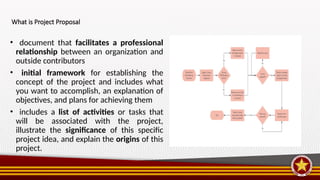
• document that facilitates a professional
relationship between an organization and
outside contributors
• initial framework for establishing the
concept of the project and includes what
you want to accomplish, an explanation of
objectives, and plans for achieving them
• includes a list of activities or tasks that
will be associated with the project,
illustrate the significance of this specific
project idea, and explain the origins of this
project.
• allows an organization to
establish a formal, logical
presentation to an outside
worker or project donor
• drafted during one of the early
phases of your project
• time and budget estimates are
often rough, at best.
Creating a Proposal
• required to get executive buy-in for a new project,
program, or service at your organization.
• used to get everyone on the team thinking about
the same goals and priorities.
• way for the organization to know when they need to
make new hiring decisions or budget adjustments
Why do you need a project proposal?
What are the different Project Proposal Types?
1. Formally solicited project
proposals
2. Informally solicited proposal
3. Unsolicited project proposals
4. Continuation project proposals
5. Renewal project proposal
6. Supplemental project proposal
Formally solicited project proposal
• established in response to an official request for a
new proposal.
• In this case, a Request for Proposal document is
used to outline client demands and specific
needs.
• A formally solicited proposal is the structured and
specific response to said RFP.
• Having an RFP makes the entire proposal process
easier. As the specifics are spelled out, project
planning can prevent misunderstandings or a lack
of information that may cause complications later.
What are the basic parts of a project proposal?
1. Introduction - contains the overview of the project; summarizing
what the reader can expect
2. Issue - main definition of the issue, subject purpse, main
argument, background information, and importance
3. Solution- main definition of the solution, step-by-step plan,
benefits, and how potential obstacles will be overcomes
4. Qualifications- list of the people involved in the project, their
corresponding roles, and their summary of roles
5. Conclusion of the costs and benefits, and wrap up -
presents the expected income and expenses over a specified
time period
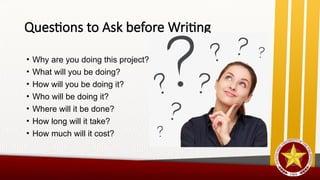
Questions to Ask before Writing
• Why are you doing this project?
• What will you be doing?
• How will you be doing it?
• Who will be doing it?
• Where will it be done?
• How long will it take?
• How much will it cost?
1. Define the problem
2. Present your solution
3. Define your deliverables and success criteria
4. State your plan or approach
5. Outline your project schedule and budget
6. Tie it all together
7. Edit/proofread your proposal
Steps to writing your own project proposal
Pointers for Writing a Project Proposal
• After considering what type of
proposal is the best fit for you and
your project, it is time to start
planning your document.
• It is imperative to keep in mind
that, regardless of the proposal
type, you will always want to
check the following boxes when
starting a proposal document.
Let’s look at how each part of a
proposal is written
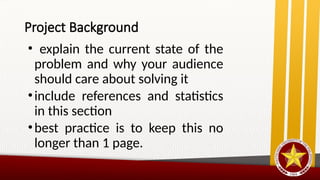
Project Background
• explain the current state of the
problem and why your audience
should care about solving it
•include references and statistics
in this section
•best practice is to keep this no
longer than 1 page.
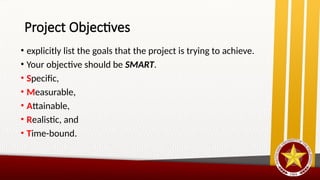
Project Objectives
• explicitly list the goals that the project is trying to achieve.
• Your objective should be SMART.
• Specific,
• Measurable,
• Attainable,
• Realistic, and
• Time-bound.
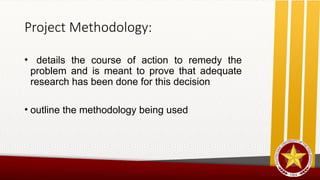
Project Methodology:
• details the course of action to remedy the
problem and is meant to prove that adequate
research has been done for this decision
• outline the methodology being used
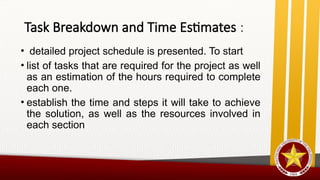
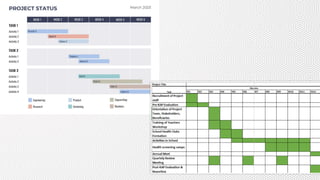
Task Breakdown and Time Estimates :
• detailed project schedule is presented. To start
• list of tasks that are required for the project as well
as an estimation of the hours required to complete
each one.
• establish the time and steps it will take to achieve
the solution, as well as the resources involved in
each section
Project Deliverables :
• list out all the deliverables you expect to see after
the project is closed.
• each deliverable has an associated estimated
delivery date.
Project Deliverables :
• list out all the deliverables you expect to see after
the project is closed.
• each deliverable has an associated estimated
delivery date.
Risk Management Plan:
• A detailed plan of action to minimize the chance of risk or
change during the project
Risk Register:
• A line-item list of risks and potential counter efforts that will
be used to counteract these risks.
BUDGET:
• This section is dedicated to estimating the overall cost
of the proposed project.
This section is broken into three major parts:
• Project Budget This should be a detailed, line-item budget
broken up by different project categories, such as travel, salary,
or supplies. Ensure all overhead or indirect costs are also
included in the budget.
• Budget Narrative This is a brief list of commentaries on the
budget if any further clarification or justification is needed.
• Additional Financial Statements Some projects, depending on
complexity, will require additional financial statements like a
profit and loss statement, a tax return, or funding sources.
Conclusion:
• This section intends to be a brief review of all the points
already discussed.
• This is your last chance to win over your audience, so
ensure that you incorporate the most important evidence
to receive approval.
• This is also the final moment to prove you have adequately
researched all solutions and your proposed method is the
best for business.
Appendices
•This section is dedicated to any
additional charts, graphs, images, or
reports that were cited in the
proposal. Many times, referenced
material will go into the appendix as it
does not naturally fall into the main
body copy of the proposal.
LESSON-5-Writing-a-Project-Proposal.pptx

LESSON-5-Writing-a-Project-Proposal.pptx

  • 1.
    Business writing Presented byMs. Jaze M. Marco Writing Project Proposals
  • 2.
    In this lessonyou will learn about: • the nature and types of project proposals • the language of writing project proposals
  • 3.
    Warm up: 1. Asa reader, what do you think should you look for in a proposal? 2. What do you think are the factors to consider in writing a proposal so it will get a higher chance of being approved?
  • 4.
    What is ProjectProposal • document that facilitates a professional relationship between an organization and outside contributors • initial framework for establishing the concept of the project and includes what you want to accomplish, an explanation of objectives, and plans for achieving them • includes a list of activities or tasks that will be associated with the project, illustrate the significance of this specific project idea, and explain the origins of this project.
  • 5.
    • allows anorganization to establish a formal, logical presentation to an outside worker or project donor • drafted during one of the early phases of your project • time and budget estimates are often rough, at best. Creating a Proposal
  • 6.
    • required toget executive buy-in for a new project, program, or service at your organization. • used to get everyone on the team thinking about the same goals and priorities. • way for the organization to know when they need to make new hiring decisions or budget adjustments Why do you need a project proposal?
  • 7.
    What are thedifferent Project Proposal Types? 1. Formally solicited project proposals 2. Informally solicited proposal 3. Unsolicited project proposals 4. Continuation project proposals 5. Renewal project proposal 6. Supplemental project proposal
  • 8.
    Formally solicited projectproposal • established in response to an official request for a new proposal. • In this case, a Request for Proposal document is used to outline client demands and specific needs. • A formally solicited proposal is the structured and specific response to said RFP. • Having an RFP makes the entire proposal process easier. As the specifics are spelled out, project planning can prevent misunderstandings or a lack of information that may cause complications later.
  • 9.
    What are thebasic parts of a project proposal? 1. Introduction - contains the overview of the project; summarizing what the reader can expect 2. Issue - main definition of the issue, subject purpse, main argument, background information, and importance 3. Solution- main definition of the solution, step-by-step plan, benefits, and how potential obstacles will be overcomes 4. Qualifications- list of the people involved in the project, their corresponding roles, and their summary of roles 5. Conclusion of the costs and benefits, and wrap up - presents the expected income and expenses over a specified time period
  • 10.
    Questions to Askbefore Writing • Why are you doing this project? • What will you be doing? • How will you be doing it? • Who will be doing it? • Where will it be done? • How long will it take? • How much will it cost?
  • 11.
    1. Define theproblem 2. Present your solution 3. Define your deliverables and success criteria 4. State your plan or approach 5. Outline your project schedule and budget 6. Tie it all together 7. Edit/proofread your proposal Steps to writing your own project proposal
  • 12.
    Pointers for Writinga Project Proposal • After considering what type of proposal is the best fit for you and your project, it is time to start planning your document. • It is imperative to keep in mind that, regardless of the proposal type, you will always want to check the following boxes when starting a proposal document.
  • 13.
    Let’s look athow each part of a proposal is written
  • 14.
    Project Background • explainthe current state of the problem and why your audience should care about solving it •include references and statistics in this section •best practice is to keep this no longer than 1 page.
  • 15.
    Project Objectives • explicitlylist the goals that the project is trying to achieve. • Your objective should be SMART. • Specific, • Measurable, • Attainable, • Realistic, and • Time-bound.
  • 16.
    Project Methodology: • detailsthe course of action to remedy the problem and is meant to prove that adequate research has been done for this decision • outline the methodology being used
  • 17.
    Task Breakdown andTime Estimates : • detailed project schedule is presented. To start • list of tasks that are required for the project as well as an estimation of the hours required to complete each one. • establish the time and steps it will take to achieve the solution, as well as the resources involved in each section
  • 19.
    Project Deliverables : •list out all the deliverables you expect to see after the project is closed. • each deliverable has an associated estimated delivery date.
  • 20.
    Project Deliverables : •list out all the deliverables you expect to see after the project is closed. • each deliverable has an associated estimated delivery date.
  • 21.
    Risk Management Plan: •A detailed plan of action to minimize the chance of risk or change during the project
  • 22.
    Risk Register: • Aline-item list of risks and potential counter efforts that will be used to counteract these risks.
  • 23.
    BUDGET: • This sectionis dedicated to estimating the overall cost of the proposed project.
  • 24.
    This section isbroken into three major parts: • Project Budget This should be a detailed, line-item budget broken up by different project categories, such as travel, salary, or supplies. Ensure all overhead or indirect costs are also included in the budget. • Budget Narrative This is a brief list of commentaries on the budget if any further clarification or justification is needed. • Additional Financial Statements Some projects, depending on complexity, will require additional financial statements like a profit and loss statement, a tax return, or funding sources.
  • 25.
    Conclusion: • This sectionintends to be a brief review of all the points already discussed. • This is your last chance to win over your audience, so ensure that you incorporate the most important evidence to receive approval. • This is also the final moment to prove you have adequately researched all solutions and your proposed method is the best for business.
  • 26.
    Appendices •This section isdedicated to any additional charts, graphs, images, or reports that were cited in the proposal. Many times, referenced material will go into the appendix as it does not naturally fall into the main body copy of the proposal.