PRESENTATION ON:
PHARMACEUTICAL SOLVENTS
COLORING AGENTS
FLAVORING AGENTS
SWEETING AGENTS
DILUTING AGENTS
ANTIOXIDANTS
PRESERVATIVES
1
PREPARED BY
ASIF PAPPU
Chemical substances that can dissolve, suspend or extract other materials usually
without chemically changing other materials.
Function: used to enhanced solubility, taste, antimicrobial effectiveness or
stability, to reduce dose volume.
Ideal properties:
• Non toxic
• Stable
• Not high volatile
• Free of any therapeutic activity
Example: Water, isopropyl alcohol, glycerin, ethyl oxide, chloroform.
PHARMACEUTICALS
SOLVENTS
2
Widely Used Pharmaceutical
Solvents
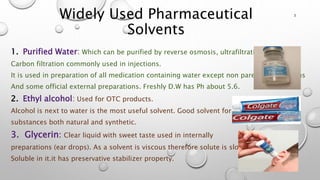
1. Purified Water: Which can be purified by reverse osmosis, ultrafiltration
Carbon filtration commonly used in injections.
It is used in preparation of all medication containing water except non parenteral solutions
And some official external preparations. Freshly D.W has Ph about 5.6.
2. Ethyl alcohol: Used for OTC products.
Alcohol is next to water is the most useful solvent. Good solvent for many organic
substances both natural and synthetic.
3. Glycerin: Clear liquid with sweet taste used in internally
preparations (ear drops). As a solvent is viscous therefore solute is slowly
Soluble in it.it has preservative stabilizer property.
3
4. Propylene Glycol: Viscous liquid miscible with water and alcohol in all
proportion. Sometimes it is substituted with glycerin in modern
pharmaceutical and cosmetic preparations. Commonly used in suppository.
5. Liquid Silicone: Used in barrier ointments due to water repellent
properties of this component.
4
Coloring
Agents
Ingredients that impart the preferred color to the pharmaceutical formulation.
Dosage form that are colored are : tablets, hard or soft gelatin capsule, oral
liquids, creams, ointments etc.
Properties:
1. Nontoxic 3. Inexpensive
2. Free of any therapeutic activity 4. Stable ( not highly volatile)
Types:
1. Mineral colors: mineral pigments were used to color drugs but because many
have toxic effects they were displaced by synthetic dyes.
Example: Mixture of red and yellow ferric oxides, Titanium dioxides.
2. Vegetable colors: Ribo, Cyano.
5
Uses of Colors and Dyes in Dosage has Three
Purpose:
1. Masking of off color drugs.
2. Product identification.
3. Production of more elegant products.
Widely used colorants:
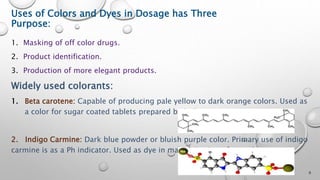
1. Beta carotene: Capable of producing pale yellow to dark orange colors. Used as
a color for sugar coated tablets prepared by ladle process.
2. Indigo Carmine: Dark blue powder or bluish purple color. Primary use of indigo
carmine is as a Ph indicator. Used as dye in manufacturing of capsules.
6
Bright yellow dye with green shade.
Insoluble in water but soluble in non polar
organic solvents.
Mainly used in polystyrene, polyamides, acrylic
resins and
to color hydrocarbon solvents.
4. Quinizarine Green SS :
Green dye, Anthraquinone derivative
Has the appearance of a black powder with
melting point of 220- 221 degree Celsius.
Used for adding greenish coloring to materials.
Mainly used in cosmetics and medications.
7
8
Flavoring Agents:
Substances which are used to impart pleasant flavor to a
pharmaceutical preparations. It increase the aesthetic value of those
preparations. Many flavoring agents are available or may be
compounded in the pharmacy.
The four basic taste sensations are- salty, sweet, bitter & sour. Certain
flavors should be used to mask this specific sensation.
Examples: Clove oil, Rose oil, Menthol etc.
Purpose:
1. Render palatable product by masking unpleasant taste.
2. They have the additional advantage of enabling identification of
liquid products to be achieved easily.
9
Sweetening agents:
Provide sweet taste to the pharmaceutical products. Sweeteners
are seldom found in standard tablets but frequently in chewable
tablets and syrup.
Types:
1. Natural sweeteners: Lactose, Sucrose, Mannitol, Dextrose,
Fructose etc.
2. Artificial sweeteners: saccharin, Sucralose etc.
Widely used Sweeteners:
Lactose: Naturally occurring simple carbohydrate or sugar
found only in the milk of mammals. Referred to a milk sugar.
The lactose molecule comprises one molecule of D-galactose
chemically linked to one molecule of D-glucose. Used as a filler
or diluents in tablets & capsules.
10
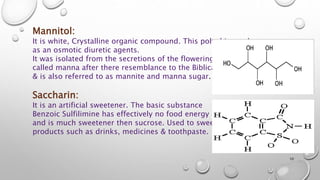
Mannitol:
It is white, Crystalline organic compound. This polyol is used
as an osmotic diuretic agents.
It was isolated from the secretions of the flowering ash,
called manna after there resemblance to the Biblical food
& is also referred to as mannite and manna sugar.
Saccharin:
It is an artificial sweetener. The basic substance
Benzoic Sulfilimine has effectively no food energy
and is much sweetener then sucrose. Used to sweeten
products such as drinks, medicines & toothpaste.
11
Diluting agents:
Certain fluids are too viscous to be pumped easily or too dense to flow from
one particular point to the other. To ease these restricted movement, diluents
are added. Used to make up the required bulk formation, when the drug dosage
itself is inadequate to produce the bulk.
Examples: starch, sorbitol, mannitol, lactose etc.
Properties:
1. Quite stable.
2. Nontoxic
3. Chemically & physically inert.
4. Do not alter the bioavailability of the API.
5. Inexpensive.
12
Widely used diluting Agents:
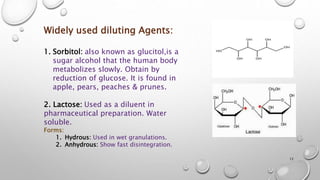
1. Sorbitol: also known as glucitol,is a
sugar alcohol that the human body
metabolizes slowly. Obtain by
reduction of glucose. It is found in
apple, pears, peaches & prunes.
2. Lactose: Used as a diluent in
pharmaceutical preparation. Water
soluble.
Forms:
1. Hydrous: Used in wet granulations.
2. Anhydrous: Show fast disintegration.
13
Antioxidants:
Substances that prevent or reduce oxidation of pharmaceutical ingredients. It is
capable of inhibiting oxidation and that may be added for this purpose to
pharmaceutical products. They act as reducing agents.
Examples:
BHA(Butylated Hydroxyanisole)
BHT(Butylated Hydroxytoluene)
Ascorbic acid
Properties:
1. Inert
2. Readily soluble or dispersible
3. Safe and nontoxic
4. Chemically compatible
5. Non irritant
6. Effective in low concentration
14
Mechanism of action:
Oxidation reaction can produce free radicals. These radicals can
start chain reaction. When the chain reaction occur in cell it can
cause damage or death to the cell. Antioxidant terminates these
chain reaction by removing free radical intermediates.
Widely used antioxidants:
1. BHA( Butylated Hydroxyanisole): Used as an antioxidant in
pharmaceutical products containing fats & oils(Ointment).
2. BHT( Butylated hydroxytoluene): Used as an antioxidant to retard
oxidative degradation of oils and fats in various pharmaceuticals.
15
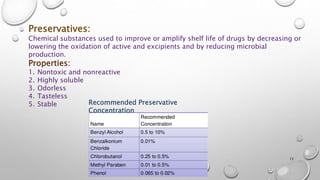
Preservatives:
Chemical substances used to improve or amplify shelf life of drugs by decreasing or
lowering the oxidation of active and excipients and by reducing microbial
production.
Properties:
1. Nontoxic and nonreactive
2. Highly soluble
3. Odorless
4. Tasteless
5. Stable Recommended Preservative
Concentration
16
Widely used preservative:
1. Methylparabens: Used as an Antiseptic and Preservative in
various pharmaceutical preparation.
2. Sodium Benzoate: Used as food and pharmaceutical
preservatives. It is not a bacterial, only a bacteriostatic agent
along with fungistatic activity.
3. Chloro Butanol: Used as preservative and bacteriostatic agent.
4. Phenylmercuric Nitrate: Used as bacterial preservative in
pharmaceutical preparation and used as topical antiseptic.
17
Side Effects of
Preservatives:
18
References:
https://www.slideshare.net/SoniaNazir/pharmaceutical-preservatives
https://basicmedicalkey.com/16antimicrobialpreservatives2/
https://www.pharmacopeia.cn/b29240/usp29nf.html
Thank you!

Pharmaceutical Solvents

  • 1.
    PRESENTATION ON: PHARMACEUTICAL SOLVENTS COLORINGAGENTS FLAVORING AGENTS SWEETING AGENTS DILUTING AGENTS ANTIOXIDANTS PRESERVATIVES 1 PREPARED BY ASIF PAPPU
  • 2.
    Chemical substances thatcan dissolve, suspend or extract other materials usually without chemically changing other materials. Function: used to enhanced solubility, taste, antimicrobial effectiveness or stability, to reduce dose volume. Ideal properties: • Non toxic • Stable • Not high volatile • Free of any therapeutic activity Example: Water, isopropyl alcohol, glycerin, ethyl oxide, chloroform. PHARMACEUTICALS SOLVENTS 2
  • 3.
    Widely Used Pharmaceutical Solvents 1.Purified Water: Which can be purified by reverse osmosis, ultrafiltration Carbon filtration commonly used in injections. It is used in preparation of all medication containing water except non parenteral solutions And some official external preparations. Freshly D.W has Ph about 5.6. 2. Ethyl alcohol: Used for OTC products. Alcohol is next to water is the most useful solvent. Good solvent for many organic substances both natural and synthetic. 3. Glycerin: Clear liquid with sweet taste used in internally preparations (ear drops). As a solvent is viscous therefore solute is slowly Soluble in it.it has preservative stabilizer property. 3
  • 4.
    4. Propylene Glycol:Viscous liquid miscible with water and alcohol in all proportion. Sometimes it is substituted with glycerin in modern pharmaceutical and cosmetic preparations. Commonly used in suppository. 5. Liquid Silicone: Used in barrier ointments due to water repellent properties of this component. 4
  • 5.
    Coloring Agents Ingredients that impartthe preferred color to the pharmaceutical formulation. Dosage form that are colored are : tablets, hard or soft gelatin capsule, oral liquids, creams, ointments etc. Properties: 1. Nontoxic 3. Inexpensive 2. Free of any therapeutic activity 4. Stable ( not highly volatile) Types: 1. Mineral colors: mineral pigments were used to color drugs but because many have toxic effects they were displaced by synthetic dyes. Example: Mixture of red and yellow ferric oxides, Titanium dioxides. 2. Vegetable colors: Ribo, Cyano. 5
  • 6.
    Uses of Colorsand Dyes in Dosage has Three Purpose: 1. Masking of off color drugs. 2. Product identification. 3. Production of more elegant products. Widely used colorants: 1. Beta carotene: Capable of producing pale yellow to dark orange colors. Used as a color for sugar coated tablets prepared by ladle process. 2. Indigo Carmine: Dark blue powder or bluish purple color. Primary use of indigo carmine is as a Ph indicator. Used as dye in manufacturing of capsules. 6
  • 7.
    Bright yellow dyewith green shade. Insoluble in water but soluble in non polar organic solvents. Mainly used in polystyrene, polyamides, acrylic resins and to color hydrocarbon solvents. 4. Quinizarine Green SS : Green dye, Anthraquinone derivative Has the appearance of a black powder with melting point of 220- 221 degree Celsius. Used for adding greenish coloring to materials. Mainly used in cosmetics and medications. 7
  • 8.
    8 Flavoring Agents: Substances whichare used to impart pleasant flavor to a pharmaceutical preparations. It increase the aesthetic value of those preparations. Many flavoring agents are available or may be compounded in the pharmacy. The four basic taste sensations are- salty, sweet, bitter & sour. Certain flavors should be used to mask this specific sensation. Examples: Clove oil, Rose oil, Menthol etc. Purpose: 1. Render palatable product by masking unpleasant taste. 2. They have the additional advantage of enabling identification of liquid products to be achieved easily.
  • 9.
    9 Sweetening agents: Provide sweettaste to the pharmaceutical products. Sweeteners are seldom found in standard tablets but frequently in chewable tablets and syrup. Types: 1. Natural sweeteners: Lactose, Sucrose, Mannitol, Dextrose, Fructose etc. 2. Artificial sweeteners: saccharin, Sucralose etc. Widely used Sweeteners: Lactose: Naturally occurring simple carbohydrate or sugar found only in the milk of mammals. Referred to a milk sugar. The lactose molecule comprises one molecule of D-galactose chemically linked to one molecule of D-glucose. Used as a filler or diluents in tablets & capsules.
  • 10.
    10 Mannitol: It is white,Crystalline organic compound. This polyol is used as an osmotic diuretic agents. It was isolated from the secretions of the flowering ash, called manna after there resemblance to the Biblical food & is also referred to as mannite and manna sugar. Saccharin: It is an artificial sweetener. The basic substance Benzoic Sulfilimine has effectively no food energy and is much sweetener then sucrose. Used to sweeten products such as drinks, medicines & toothpaste.
  • 11.
    11 Diluting agents: Certain fluidsare too viscous to be pumped easily or too dense to flow from one particular point to the other. To ease these restricted movement, diluents are added. Used to make up the required bulk formation, when the drug dosage itself is inadequate to produce the bulk. Examples: starch, sorbitol, mannitol, lactose etc. Properties: 1. Quite stable. 2. Nontoxic 3. Chemically & physically inert. 4. Do not alter the bioavailability of the API. 5. Inexpensive.
  • 12.
    12 Widely used dilutingAgents: 1. Sorbitol: also known as glucitol,is a sugar alcohol that the human body metabolizes slowly. Obtain by reduction of glucose. It is found in apple, pears, peaches & prunes. 2. Lactose: Used as a diluent in pharmaceutical preparation. Water soluble. Forms: 1. Hydrous: Used in wet granulations. 2. Anhydrous: Show fast disintegration.
  • 13.
    13 Antioxidants: Substances that preventor reduce oxidation of pharmaceutical ingredients. It is capable of inhibiting oxidation and that may be added for this purpose to pharmaceutical products. They act as reducing agents. Examples: BHA(Butylated Hydroxyanisole) BHT(Butylated Hydroxytoluene) Ascorbic acid Properties: 1. Inert 2. Readily soluble or dispersible 3. Safe and nontoxic 4. Chemically compatible 5. Non irritant 6. Effective in low concentration
  • 14.
    14 Mechanism of action: Oxidationreaction can produce free radicals. These radicals can start chain reaction. When the chain reaction occur in cell it can cause damage or death to the cell. Antioxidant terminates these chain reaction by removing free radical intermediates. Widely used antioxidants: 1. BHA( Butylated Hydroxyanisole): Used as an antioxidant in pharmaceutical products containing fats & oils(Ointment). 2. BHT( Butylated hydroxytoluene): Used as an antioxidant to retard oxidative degradation of oils and fats in various pharmaceuticals.
  • 15.
    15 Preservatives: Chemical substances usedto improve or amplify shelf life of drugs by decreasing or lowering the oxidation of active and excipients and by reducing microbial production. Properties: 1. Nontoxic and nonreactive 2. Highly soluble 3. Odorless 4. Tasteless 5. Stable Recommended Preservative Concentration
  • 16.
    16 Widely used preservative: 1.Methylparabens: Used as an Antiseptic and Preservative in various pharmaceutical preparation. 2. Sodium Benzoate: Used as food and pharmaceutical preservatives. It is not a bacterial, only a bacteriostatic agent along with fungistatic activity. 3. Chloro Butanol: Used as preservative and bacteriostatic agent. 4. Phenylmercuric Nitrate: Used as bacterial preservative in pharmaceutical preparation and used as topical antiseptic.
  • 17.
  • 18.