Presented to:Dr. Rafi Ullah Khan
Presented by: Anum Khan
Mphils Scholar 2nd Semester
Taxila Institute of Asian Civilizations
Quaid-e-Azam University
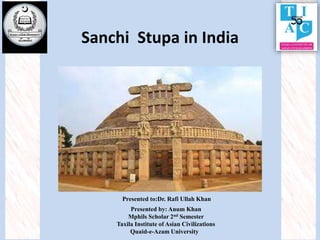
Sanchi Stupa in India
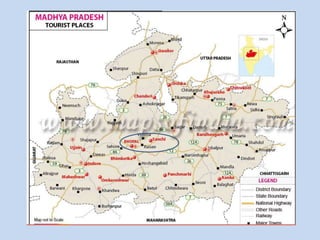
Where was the Sanchi Stupa Built ?
Sanchi is a small village of India,located 60km north east of Bhopal,in the central part of
the Madhya Pradesh.It is the location of several Buddhist monuments,dating from the
3rd century B.C.E to the 12th century C.E
Sanchi Stupa
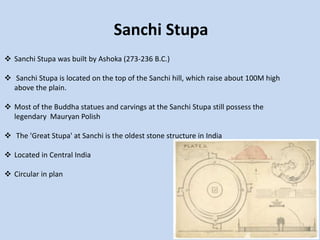
 Sanchi Stupa was built by Ashoka (273-236 B.C.)
 Sanchi Stupa is located on the top of the Sanchi hill, which raise about 100M high
above the plain.
 Most of the Buddha statues and carvings at the Sanchi Stupa still possess the
legendary Mauryan Polish
 The 'Great Stupa' at Sanchi is the oldest stone structure in India
 Located in Central India
 Circular in plan
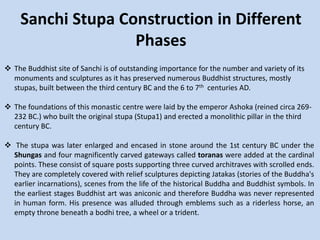
Sanchi Stupa Construction in Different
Phases
 The Buddhist site of Sanchi is of outstanding importance for the number and variety of its
monuments and sculptures as it has preserved numerous Buddhist structures, mostly
stupas, built between the third century BC and the 6 to 7th centuries AD.
 The foundations of this monastic centre were laid by the emperor Ashoka (reined circa 269-
232 BC.) who built the original stupa (Stupa1) and erected a monolithic pillar in the third
century BC.
 The stupa was later enlarged and encased in stone around the 1st century BC under the
Shungas and four magnificently carved gateways called toranas were added at the cardinal
points. These consist of square posts supporting three curved architraves with scrolled ends.
They are completely covered with relief sculptures depicting Jatakas (stories of the Buddha's
earlier incarnations), scenes from the life of the historical Buddha and Buddhist symbols. In
the earliest stages Buddhist art was aniconic and therefore Buddha was never represented
in human form. His presence was alluded through emblems such as a riderless horse, an
empty throne beneath a bodhi tree, a wheel or a trident.
Stupa Architecture
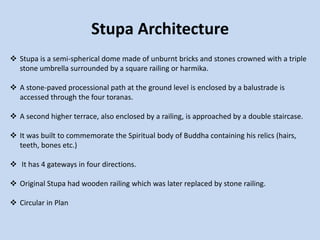
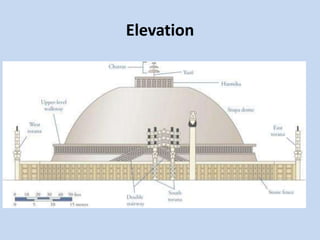
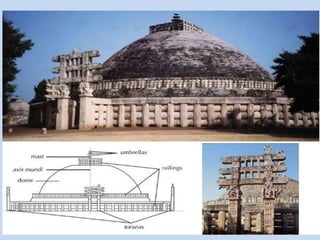
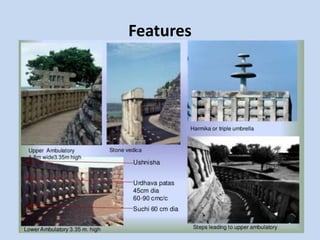
 Stupa is a semi-spherical dome made of unburnt bricks and stones crowned with a triple
stone umbrella surrounded by a square railing or harmika.
 A stone-paved processional path at the ground level is enclosed by a balustrade is
accessed through the four toranas.
 A second higher terrace, also enclosed by a railing, is approached by a double staircase.
 It was built to commemorate the Spiritual body of Buddha containing his relics (hairs,
teeth, bones etc.)
 It has 4 gateways in four directions.
 Original Stupa had wooden railing which was later replaced by stone railing.
 Circular in Plan
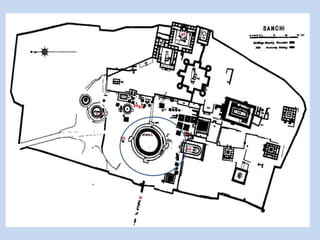
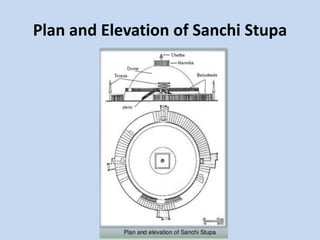
Plan and Elevation of Sanchi Stupa
Elevation
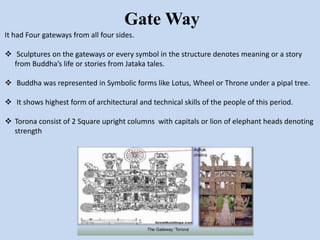
Gate Way
It had Four gateways from all four sides.
 Sculptures on the gateways or every symbol in the structure denotes meaning or a story
from Buddha’s life or stories from Jataka tales.
 Buddha was represented in Symbolic forms like Lotus, Wheel or Throne under a pipal tree.
 It shows highest form of architectural and technical skills of the people of this period.
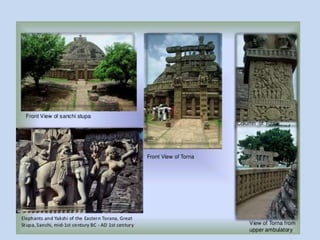
 Torona consist of 2 Square upright columns with capitals or lion of elephant heads denoting
strength
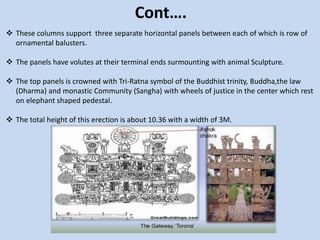
Cont….
 These columns support three separate horizontal panels between each of which is row of
ornamental balusters.
 The panels have volutes at their terminal ends surmounting with animal Sculpture.
 The top panels is crowned with Tri-Ratna symbol of the Buddhist trinity, Buddha,the law
(Dharma) and monastic Community (Sangha) with wheels of justice in the center which rest
on elephant shaped pedestal.
 The total height of this erection is about 10.36 with a width of 3M.
Features
Cont…
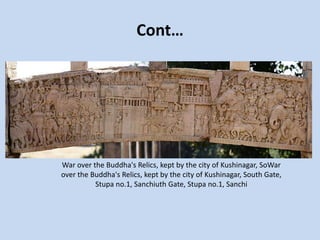
War over the Buddha's Relics, kept by the city of Kushinagar, SoWar
over the Buddha's Relics, kept by the city of Kushinagar, South Gate,
Stupa no.1, Sanchiuth Gate, Stupa no.1, Sanchi
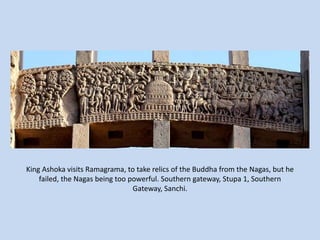
• King Ashoka visits Ramagrama, to take relics of
the Buddha from the Nagas, but he failed, the
Nagas being too powerful. Southern gateway,
Stupa 1, Southern Gateway, Sanchi.[
King Ashoka visits Ramagrama, to take relics of the Buddha from the Nagas, but he
failed, the Nagas being too powerful. Southern gateway, Stupa 1, Southern
Gateway, Sanchi.
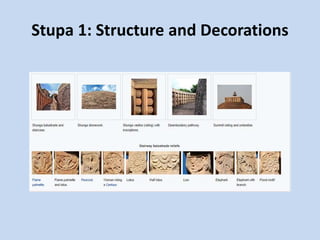
Stupa 1: Structure and Decorations
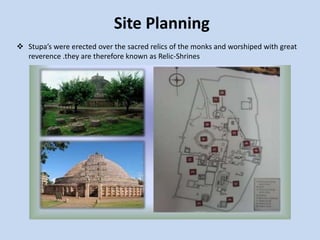
Site Planning
 Stupa’s were erected over the sacred relics of the monks and worshiped with great
reverence .they are therefore known as Relic-Shrines
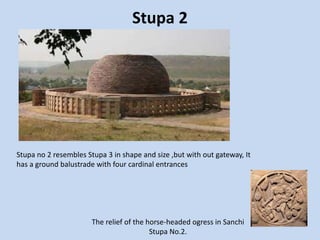
Stupa 2
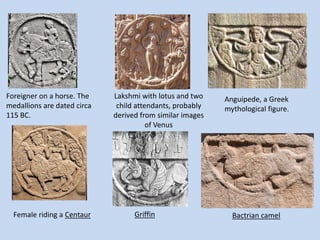
Stupa no 2 resembles Stupa 3 in shape and size ,but with out gateway, It
has a ground balustrade with four cardinal entrances
The relief of the horse-headed ogress in Sanchi
Stupa No.2.
Foreigner on a horse. The
medallions are dated circa
115 BC.
Lakshmi with lotus and two
child attendants, probably
derived from similar images
of Venus
Anguipede, a Greek
mythological figure.
Female riding a Centaur Bactrian camelGriffin
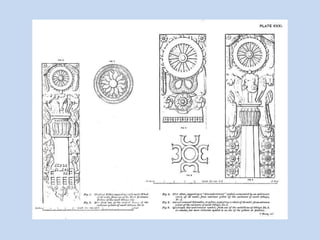
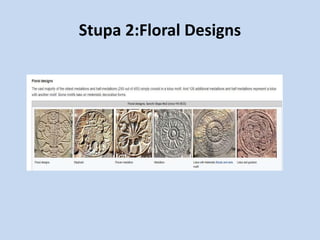
Stupa 2:Floral Designs
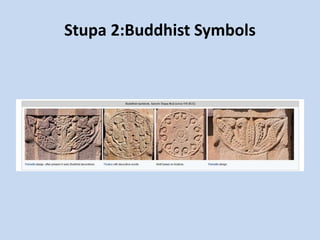
Stupa 2:Buddhist Symbols
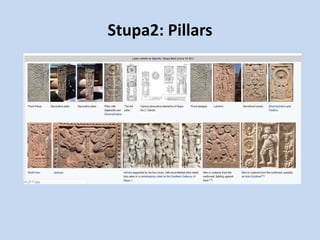
Stupa2: Pillars
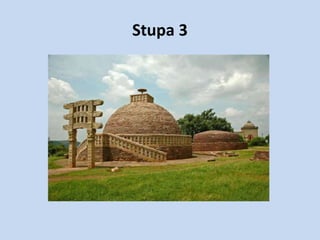
Stupa 3
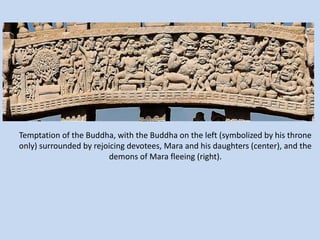
Temptation of the Buddha, with the Buddha on the left (symbolized by his throne
only) surrounded by rejoicing devotees, Mara and his daughters (center), and the
demons of Mara fleeing (right).
Site decayed with Decline of
Buddhism
 With the decline of Buddhism the site decayed until it was rediscovered in the19th
century and the stupa was completely reconstructed at the beginning of the 20th
century.
 Lieutenant Maisey spent the cold seasons of 1849-50 and 1850-51 at Sanchi to prepare
an illustrated Government report of the antiquities of the site. He was joined by Major
Alexander Cunningham in 1851. The result of his work was published in 'Sanchi and its
remains' of 1892
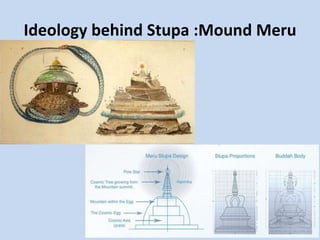
Ideology behind Stupa :Mound Meru
Link for video
https://www.youtube.com/watch?v=C7W9sHdfJ
xA&fbclid=IwAR0O-
drnzxAJbuG_ScSCFZ5qM596glSh8Gc0SDgqD9jso
rHnSgbXAFr3NcE
Bibliography
• https://www.opendharma.com/2016/07/08/sanchi-
and-its-remains/Accessed20-May-2019
• https://curatorhall.wordpress.com/2015/09/06/sanchi
-stupa/Accessed22-May-2019
• https://mocomi.com/sanchi-stupa/ Accessed21-May-
2019
• Maisey, F.c. 'Sanchi and its remains' 1892

Sanchi Stupa

  • 1.
    Presented to:Dr. RafiUllah Khan Presented by: Anum Khan Mphils Scholar 2nd Semester Taxila Institute of Asian Civilizations Quaid-e-Azam University Sanchi Stupa in India
  • 2.
    Where was theSanchi Stupa Built ? Sanchi is a small village of India,located 60km north east of Bhopal,in the central part of the Madhya Pradesh.It is the location of several Buddhist monuments,dating from the 3rd century B.C.E to the 12th century C.E
  • 5.
    Sanchi Stupa  SanchiStupa was built by Ashoka (273-236 B.C.)  Sanchi Stupa is located on the top of the Sanchi hill, which raise about 100M high above the plain.  Most of the Buddha statues and carvings at the Sanchi Stupa still possess the legendary Mauryan Polish  The 'Great Stupa' at Sanchi is the oldest stone structure in India  Located in Central India  Circular in plan
  • 6.
    Sanchi Stupa Constructionin Different Phases  The Buddhist site of Sanchi is of outstanding importance for the number and variety of its monuments and sculptures as it has preserved numerous Buddhist structures, mostly stupas, built between the third century BC and the 6 to 7th centuries AD.  The foundations of this monastic centre were laid by the emperor Ashoka (reined circa 269- 232 BC.) who built the original stupa (Stupa1) and erected a monolithic pillar in the third century BC.  The stupa was later enlarged and encased in stone around the 1st century BC under the Shungas and four magnificently carved gateways called toranas were added at the cardinal points. These consist of square posts supporting three curved architraves with scrolled ends. They are completely covered with relief sculptures depicting Jatakas (stories of the Buddha's earlier incarnations), scenes from the life of the historical Buddha and Buddhist symbols. In the earliest stages Buddhist art was aniconic and therefore Buddha was never represented in human form. His presence was alluded through emblems such as a riderless horse, an empty throne beneath a bodhi tree, a wheel or a trident.
  • 7.
    Stupa Architecture  Stupais a semi-spherical dome made of unburnt bricks and stones crowned with a triple stone umbrella surrounded by a square railing or harmika.  A stone-paved processional path at the ground level is enclosed by a balustrade is accessed through the four toranas.  A second higher terrace, also enclosed by a railing, is approached by a double staircase.  It was built to commemorate the Spiritual body of Buddha containing his relics (hairs, teeth, bones etc.)  It has 4 gateways in four directions.  Original Stupa had wooden railing which was later replaced by stone railing.  Circular in Plan
  • 8.
    Plan and Elevationof Sanchi Stupa
  • 9.
  • 11.
    Gate Way It hadFour gateways from all four sides.  Sculptures on the gateways or every symbol in the structure denotes meaning or a story from Buddha’s life or stories from Jataka tales.  Buddha was represented in Symbolic forms like Lotus, Wheel or Throne under a pipal tree.  It shows highest form of architectural and technical skills of the people of this period.  Torona consist of 2 Square upright columns with capitals or lion of elephant heads denoting strength
  • 12.
    Cont….  These columnssupport three separate horizontal panels between each of which is row of ornamental balusters.  The panels have volutes at their terminal ends surmounting with animal Sculpture.  The top panels is crowned with Tri-Ratna symbol of the Buddhist trinity, Buddha,the law (Dharma) and monastic Community (Sangha) with wheels of justice in the center which rest on elephant shaped pedestal.  The total height of this erection is about 10.36 with a width of 3M.
  • 13.
  • 15.
    Cont… War over theBuddha's Relics, kept by the city of Kushinagar, SoWar over the Buddha's Relics, kept by the city of Kushinagar, South Gate, Stupa no.1, Sanchiuth Gate, Stupa no.1, Sanchi
  • 16.
    • King Ashokavisits Ramagrama, to take relics of the Buddha from the Nagas, but he failed, the Nagas being too powerful. Southern gateway, Stupa 1, Southern Gateway, Sanchi.[ King Ashoka visits Ramagrama, to take relics of the Buddha from the Nagas, but he failed, the Nagas being too powerful. Southern gateway, Stupa 1, Southern Gateway, Sanchi.
  • 17.
    Stupa 1: Structureand Decorations
  • 18.
    Site Planning  Stupa’swere erected over the sacred relics of the monks and worshiped with great reverence .they are therefore known as Relic-Shrines
  • 19.
    Stupa 2 Stupa no2 resembles Stupa 3 in shape and size ,but with out gateway, It has a ground balustrade with four cardinal entrances The relief of the horse-headed ogress in Sanchi Stupa No.2.
  • 21.
    Foreigner on ahorse. The medallions are dated circa 115 BC. Lakshmi with lotus and two child attendants, probably derived from similar images of Venus Anguipede, a Greek mythological figure. Female riding a Centaur Bactrian camelGriffin
  • 22.
  • 23.
  • 24.
  • 25.
  • 26.
    Temptation of theBuddha, with the Buddha on the left (symbolized by his throne only) surrounded by rejoicing devotees, Mara and his daughters (center), and the demons of Mara fleeing (right).
  • 27.
    Site decayed withDecline of Buddhism  With the decline of Buddhism the site decayed until it was rediscovered in the19th century and the stupa was completely reconstructed at the beginning of the 20th century.  Lieutenant Maisey spent the cold seasons of 1849-50 and 1850-51 at Sanchi to prepare an illustrated Government report of the antiquities of the site. He was joined by Major Alexander Cunningham in 1851. The result of his work was published in 'Sanchi and its remains' of 1892
  • 28.
  • 29.
  • 30.

Editor's Notes

  • #3 Rational:Rational explanation of Past Critical Realism : Critical Interpretation of Past .How and For What purpose things to be done? Her Emphasis is to identify the reason or Cause behind to an Historical event. Academia: She is known as a Think Tank, She wrote books of class 6th subjected to Ideology of India and its Nationalist narrative. Unbiased: She is Not abide by the norms which proliferates History. Subjective: Key elements of Evolution of Indian Society was a Aftermath of Colonization. Descriptive Analysis: Historical data and figures and Analysis of elements like politics, society, Economics, Capitalism etc. Historiography Analysis : She study the methods of historians in developing history and make analysis of it by concerning other chronicles in order to get the facts regarding history
  • #12 Rational:Rational explanation of Past Critical Realism : Critical Interpretation of Past .How and For What purpose things to be done? Her Emphasis is to identify the reason or Cause behind to an Historical event. Academia: She is known as a Think Tank, She wrote books of class 6th subjected to Ideology of India and its Nationalist narrative. Unbiased: She is Not abide by the norms which proliferates History. Subjective: Key elements of Evolution of Indian Society was a Aftermath of Colonization. Descriptive Analysis: Historical data and figures and Analysis of elements like politics, society, Economics, Capitalism etc. Historiography Analysis : She study the methods of historians in developing history and make analysis of it by concerning other chronicles in order to get the facts regarding history