
A Presentation on
Architecture of Sarnath
(Stupas)
Presented by:
Sarang Barbarwar
B.Arch , IIIrd Sem
STUPAS AT SARNATH
Sarnath – an Overview
Sarnath derived from ‘Sarang Nath’ meaning ‘Lord of the
Deers’ i.e, Gautama Buddha. Famous foreign travellers such
as Fa-Hien and Hiuen-Tsang visited Sarnath during the 5th
and 7th
centuries respectively.
The main sites at Sarnath include three Stupas , a Main
Shrine and a few Monasteries. The three Stupas are:
 The Chaukhandi Stupa
 The Dhamekh Stupa
 The Dharamrajika Stupa
It is noteworthy that apart from these sites an important
remain found here is the Ashoka’s Pillar.
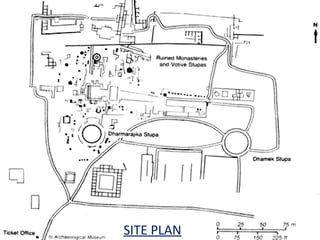
SITE PLAN
Stupa: A Stupa is a solid hemispherical structure built to
enshrine the corporeal remains of Lord Buddha, or
as a memorial of some remarkable event.
Types of Stupas:
Relic Stupa
Commemorial Stupa
Object Stupa
Symbolic Stupa
Votive Stupa
Stupa – Introduction and Types
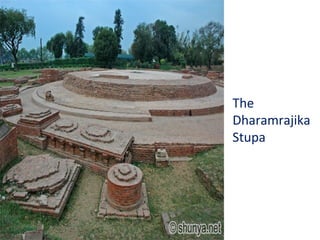
The
Dharamrajika
Stupa
Sarnath- The Dharamrajika Stupa
• Built by Ashoka to enshrine the relics of Lord Buddha.
• Typical hemispheric Stupa with umbrella and railings.
• Is made out of concentric layers of wedge-shaped bricks.
•Originally had a 49’ diameter, after enlargement attained
110’ diameter.
• Rebuilt or restored six different times, included additions
like a pradakshina path of 15’ width, railings 4’5’’ high and
doorways on cardinal points.
• Had a relic casket with bones of Buddha and a few pearls.
• The Stupa was unfortunately destroyed by Jagat Singh of
Benares in order to exploit the building materials in 1794
A.D.
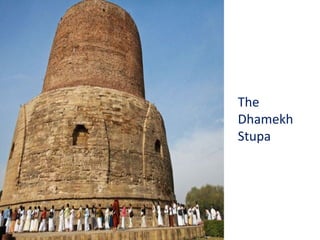
The
Dhamekh
Stupa
Sarnath- The Dhamekh Stupa
• Built by Ashoka in the 249 B.C.E. and modified time to
time.
•143’ high Stupa including the foundation.
• Lower part made up of stones, and upper part of bricks.
• Has a diameter of about 93’ at the base.
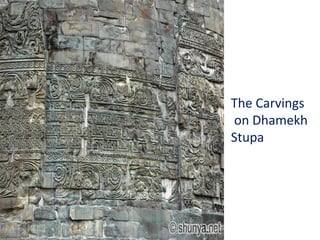
• The stone portion is carved beautifully with floral patterns
and geometric designs.
• It has eight projections of lotus petal shape and each has a
niche which had an image of Lord Buddha.
• Has a circumambulatory path.
• Has a Jaina temple adjoining to it.
The Carvings
on Dhamekh
Stupa
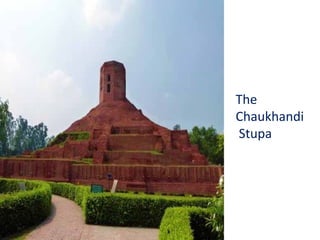
The
Chaukhandi
Stupa
Sarnath- The Chaukhandi Stupa
• Chaukhandi in local language means Square edifice.
• Stands on a basement consisting of 3 terraces each 12’
high and 12’ broad.
•Estimated to have had a height of 200’.
•The core is made of solid brickwork in clay mortar, the
terraces are supported on rows of hollow cells.
•Surmounted by a tower octagonal in shape built in 1585
A.D. Akbar to memorize the visit of HUMAYUN.
• Buddha met his 5 disciples at this place.
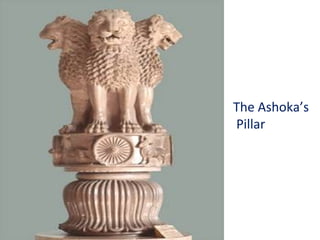
The Ashoka’s
Pillar
Sarnath- Ashoka’s pillar
• Stood in the Deer Park near the Dharamrajika Stupa.
• Has a spoked wheel (Dharamchakra) depicting prevalance
of Law.
• Four lions each in one direction showing that Ashoka ruled
in all directions.
• Has animals carved over it depicting different life stages of
Buddha.

Architecture of sarnath

  • 1.
    A Presentation on Architectureof Sarnath (Stupas) Presented by: Sarang Barbarwar B.Arch , IIIrd Sem
  • 2.
  • 3.
    Sarnath – anOverview Sarnath derived from ‘Sarang Nath’ meaning ‘Lord of the Deers’ i.e, Gautama Buddha. Famous foreign travellers such as Fa-Hien and Hiuen-Tsang visited Sarnath during the 5th and 7th centuries respectively. The main sites at Sarnath include three Stupas , a Main Shrine and a few Monasteries. The three Stupas are:  The Chaukhandi Stupa  The Dhamekh Stupa  The Dharamrajika Stupa It is noteworthy that apart from these sites an important remain found here is the Ashoka’s Pillar.
  • 4.
  • 5.
    Stupa: A Stupais a solid hemispherical structure built to enshrine the corporeal remains of Lord Buddha, or as a memorial of some remarkable event. Types of Stupas: Relic Stupa Commemorial Stupa Object Stupa Symbolic Stupa Votive Stupa Stupa – Introduction and Types
  • 6.
  • 7.
    Sarnath- The DharamrajikaStupa • Built by Ashoka to enshrine the relics of Lord Buddha. • Typical hemispheric Stupa with umbrella and railings. • Is made out of concentric layers of wedge-shaped bricks. •Originally had a 49’ diameter, after enlargement attained 110’ diameter. • Rebuilt or restored six different times, included additions like a pradakshina path of 15’ width, railings 4’5’’ high and doorways on cardinal points. • Had a relic casket with bones of Buddha and a few pearls. • The Stupa was unfortunately destroyed by Jagat Singh of Benares in order to exploit the building materials in 1794 A.D.
  • 8.
  • 9.
    Sarnath- The DhamekhStupa • Built by Ashoka in the 249 B.C.E. and modified time to time. •143’ high Stupa including the foundation. • Lower part made up of stones, and upper part of bricks. • Has a diameter of about 93’ at the base. • The stone portion is carved beautifully with floral patterns and geometric designs. • It has eight projections of lotus petal shape and each has a niche which had an image of Lord Buddha. • Has a circumambulatory path. • Has a Jaina temple adjoining to it.
  • 10.
  • 11.
  • 12.
    Sarnath- The ChaukhandiStupa • Chaukhandi in local language means Square edifice. • Stands on a basement consisting of 3 terraces each 12’ high and 12’ broad. •Estimated to have had a height of 200’. •The core is made of solid brickwork in clay mortar, the terraces are supported on rows of hollow cells. •Surmounted by a tower octagonal in shape built in 1585 A.D. Akbar to memorize the visit of HUMAYUN. • Buddha met his 5 disciples at this place.
  • 13.
  • 14.
    Sarnath- Ashoka’s pillar •Stood in the Deer Park near the Dharamrajika Stupa. • Has a spoked wheel (Dharamchakra) depicting prevalance of Law. • Four lions each in one direction showing that Ashoka ruled in all directions. • Has animals carved over it depicting different life stages of Buddha.