EXPERT TESTIMONY
AND EXPERT WITNESS
BY,
TANMAY HEMANTKUMAR GUJARATHI
LAW STUDENT OF MUMBAI UNIVERSITY
© 2019 Tanmay Gujarathi. All Rights Reserved
 CONTENT
 Introduction
 Philosophical Insight Of Exclusionary Rules
 Opinion Testimony by Lay Witness
 Testimony by Experts
 Function of an Experts
 History of Expert Evidence
 What is Expert Opinion and who is an Expert?
 Identifying Expert
 The Exclusionary Rules
 References
© 2019 Tanmay Gujarathi. All Rights Reserved
 INTRODUCTION
• As a general rule, the opinions, inferences, beliefs and mere speculations of
witnesses are inadmissible before a Court of law. It means that such types of
evidence do not merit consideration.
• Hence they are excluded as inadmissible in the law of Evidence.
• Witnesses a-e considered as fact reporting agents of the legal machinery and
their role in the, adjudicating process is to inform the court of facts. 'Facts' means
and contains; only facts and not opinions or inferences. Witness must testify only
what he had perceived with one of his five senses.
© 2019 Tanmay Gujarathi. All Rights Reserved
 PHILOSOPHICAL INSIGHT OF EXCLUSIONARY
RULES
• The fundamental rationale of this exclusionary rule is that evidence consisting of mere
speculation is unhelpful to a court as it may mislead and waste the courts time. It is also
established that in matters of opinion distinct from the fact reporting, there are more chances for
witnesses to make mistakes.
• This is due to the following reasons –
1. One, for making opinion from observed facts, witnesses have to use their own reason.
2. Next reason for the exclusion is that the opinion may mislead the judges in arriving at a
conclusion. Judges have to draw their own conclusions from the facts narrated to them
by the witnesses.
3. Another justification for excluding the opinion is that it may tend to usurp the functions of
the tribunal.
© 2019 Tanmay Gujarathi. All Rights Reserved
 EXCEPTIONS TO THE GENERAL RULE OF
EXCLUSION
• There are number of exceptions to the general rule of exclusion. These
exceptions have been found to be necessary for the due administration of justice
and as a matter of convenience.
• Exceptions can be categorized in two areas –
1. One is with regard to lay opinion testimony and the other with expert opinion
testimony.
2.Secondly, persons accepted by the court as experts may give guidance
extending to opinions.
© 2019 Tanmay Gujarathi. All Rights Reserved
1. THE LAY OPINION TESTIMONY AND THE OTHER
WITH EXPERT OPINION TESTIMONY.
• First, certain opinion-testimony by persons, who are not testifying as experts, is admissible. For
example, lay persons may testify their feelings like cold, heat, weight, regarding identity of a person or
thing, speed of a moving object, color, taste etc.
• These types of testimonies can be considered as opinion rather than fact reporting. They are admitted
because such facts could not otherwise be adequately presented or explained to the judge.
• This situation may occur due to the difficulty of data re-production by the witness, difficulty in factual
explanation, due to the complex and combination of circumstances and appearances that cannot be
adequately described and presented with force and clearness as they appeared to the witness.
• The rationale behind these exceptions is that it may sometimes be difficult to describe the mental or
physical condition that arises in a day-to-day observation of lay witnesses.
© 2019 Tanmay Gujarathi. All Rights Reserved
2. PERSONS ACCEPTED BY THE COURT AS EXPERTS
MAY GIVE GUIDANCE EXTENDING TO OPINIONS.
• These experts form their opinions by evaluating the foundational facts.
• The justification for receiving this type of opinion is that the expert adds
something relevant to the materials upon which the tribunal of fact received.
• The pre-condition for admitting this type of testimony is that without it the judge is
not competent to determine the issue
• The common principle running through these two categories of exception is that
such testimonies will add something relevant to the evidence to be used by the
court, which is not within their purview.
© 2019 Tanmay Gujarathi. All Rights Reserved
 OPINION TESTIMONY BY LAY WITNESS
• The traditional rule, lay witness must have personal knowledge about what he is testifying is
outdated. Nowadays lay witnesses give opinion in special circumstances. This liberal trend is
due to necessity and convenience.
• Sometimes it may be difficult or impossible to make out actual or accurate meaning of facts
collected by a lay witness because they may not be readily, properly and accurately describe.
• In such a situation he may be permitted to give a shorthand rendition of his knowledge about
the collective facts.
• A) Law Regarding the Admissibility of Lay Opinion Testimony
B) Extent of Admissibility
© 2019 Tanmay Gujarathi. All Rights Reserved
A) LAW REGARDING THE ADMISSIBILITY OF LAY
OPINION TESTIMONY
• In United States, Rule 731 of the Federal Rules of Evidence gives authenticity to the opinion by
lay witnesses. Rule 701 read as follows: If the witness is not testifying as an expert, the witness
testimony in the form of opinions or inferences is limited to those opinions or inferences which
are (a) rationally based on the perception of the witness and (b) helpful to a clear understanding
of the witness testimony or the determination of a fact in issue
• In India, there is no separate provision in the Indian Evidence Act regarding the admissibility of
lay opinion testimony. In order to admit a particular piece of opinion, it should come under
Section 45 of the Act.
• But from the language of Section 47 to 50. lay opinion testimony relating to handwriting,
existence of right or custom. usages, tenets and relationship may be admitted.
© 2019 Tanmay Gujarathi. All Rights Reserved
• In all other cases it should satisfy the requirements under Section 45. Section 45
specifically provides that in order to admit a particular piece of opinion.
• The person stating that opinion must prove that he is an expert. Section 47 of the
Evidence Act reads as follows-
“When the court has to form an opinion as to the person by
whom any document was written or signed, the opinion of any person
acquainted with the handwriting of the person by whom it is supposed to be
written or signed that it was or was not written or signed by that person, is a
relevant fact.”
© 2019 Tanmay Gujarathi. All Rights Reserved
B) EXTENT OF ADMISSIBILITY
• To what extent lay-opinion testimony can be admitted is a moot question. Lay
witnesses are ordinary witnesses having no special qualification or experience.
• Therefore, their opinion shall be received only in such cases where it cannot be
avoided.
• Some limitations imposed on the admissibility of lay opinion testimony were proved
effective to check unnecessary evidence. In almost all jurisdictions lay opinion
testimony will be avoided if it will invade the province of the judges or it will not be
helpful to the determination of a fact in issue.
• Similarly, if a lay witness attempts to take the role of an expert and vice versa, his
testimony will be exclude.
© 2019 Tanmay Gujarathi. All Rights Reserved
 TESTIMONY BY EXPERTS
• The evolution of the concept of 'expertise' is one of the path-breaking achievements
of the legal system. Expertisation involves an interaction between different subjects.
• Through this interaction what law aims is to acquire knowledge, which is outside the
ambit of non-expert fact finders.
• Courts are expected to hear and determine all the cases that come before them. They
cannot escape from their duty by saying that the case cannot be disposed of due to
the non-existence of judicial techniques.
• Therefore, judges in their everyday life depend on expert's testimony generally and
more specifically.
© 2019 Tanmay Gujarathi. All Rights Reserved
• Moreover, as a consequence of advances in science and technology, there has
been an increasing necessity for the courts of law to rely on expert testimony.
• Forensic science has become a handmaid of the law enforcement authorities.
Criminal investigation is largely centered in the forensic science laboratories.
• So scientific proof has become inevitable in adjudicating criminal issues. It covers
a large number of disciplines, with science at its nucleus.
• Modern technology and recent advances in scientific area have enlarged the
scope of Forensic Science.
© 2019 Tanmay Gujarathi. All Rights Reserved
 FUNCTION OF AN EXPERT
• The function of an expert witness was clearly laid down by Lawton L J. in Regina v. Turner,
{[1975] 1 Q.B. 834} as follows:
“... their function is to provide the court with information about a point at issue
or to help the tribunal of fact to interpret information about a point at issue, which is out
with the knowledge and experience of that tribunal.”
• In National Justice Campania Naviera v. Prudential Assurance Co. Ltd, {[1993] 2 Lloyd's Rep
68} the duties of expert witnesses were summarized by Creswell J., as follows:
1. Expert evidence should be independent and not influenced by the exigencies of litigation;
2. Expert opinion should be unbiased and objective; an expert witness should never assume the
role of an advocate;
© 2019 Tanmay Gujarathi. All Rights Reserved
3. Facts or assumptions upon which the opinion was based should be stated, together
with material facts which could detract from the concluded opinion,
4. An expert witness should make it clear when a question or issue fell outside his
experience;
5. If there was insufficient data upon which to reach an opinion, this had to be stated
with an indication that the opinion was provisional and any doubts had to be stated;
6. If the expert changed his mind, this had to be made known to the other side without
delay:
7. There ought to be full disclosure of documents referred to in the expert evidence.
© 2019 Tanmay Gujarathi. All Rights Reserved
 HISTORY OF EXPERT EVIDENCE
• It was a very old concept that an offence could be proved through scientific evidence
Heropelus and Eracis were the two physicians who conducted a postmortem in 300
BC In Alexandria A European collector William Hershel discovered the factum that
persons could be distinctly identified with the help of fingerprints.
• The courts have been usual to act on the opinion of experts from very early times. But
the procedure used for trial was different. Before the 16Ih Century, the trial was
merely a submission to a mechanical process of proof.
• At that time there was no person named as an expert. Cases were tried by a group of
rational men using reasoning process upon the information before them.
© 2019 Tanmay Gujarathi. All Rights Reserved
• Jury system was there and witnesses who were acquainted with the facts of the case were included in
the jury panel.
• For the first time, it was in 1562, that a process was issued to compel witnesses to attend and testify
in the Common law courts.
• At that time courts used two types of methods for obtaining the specialized knowledge –
1. One was to empanel a jury of persons specially qualified to pass judgements in a particular
case.
2. The second was for the court to summon skilled persons to inform it about matters beyond its
knowledge.
• By the middle of the 17th century, the office of jury had become clearly distinct from that of a witness.
The party system of experts had started by the middle of 18th century
© 2019 Tanmay Gujarathi. All Rights Reserved
 WHAT IS 'EXPERT OPINION' AND WHO IS AN
EXPERT?
• It is very difficult to give a precise definition for the term 'expert opinion'. Simply one
can say that 'expert opinion' means opinion given by an expert. This can be taken
only as a layman’s explanation
• American jurist, Wigmore has stated that "...whenever inferences and conclusions
can be drawn by the jury as well as by the witness, the witness is superfluous: and
that thus an experts opinion is received because and whenever his skill is greater
than the jury's...".
• In the light of the statement of Wigmore, an attempt to explain the term 'expert' may
help to some extent in getting the meaning of the word expert opinion. Here the line
that demarcates expert from non-expert opinion assumes importance.
© 2019 Tanmay Gujarathi. All Rights Reserved
• The definition given by Lawson and Roger seems to be in the said manner of
experiential capacity. Lawson defines expect as a person who has special knowledge
and skill in the particular calling to which the enquiry relates.
• Roger gives a special emphasis regarding that special knowledge as science, art and
trade.
• Modern definition regarding expert is paraphrased on the statement "an expert is
what an expert does".
• From these words one can say that an expert becomes an expert not only through
academic qualifications but also of the spectrum of activities, which he does in any
specialized field.
© 2019 Tanmay Gujarathi. All Rights Reserved
 IDENTIFYING EXPERTS
• There is no particular class of people, who may be called as 'experts'. No person shall
remain permanently ii that name.
• The only requirement which law seeks to name a person as an expert is one who had
superior knowledge and practical experience in the area in which he is required to
give his opinion.
• Generally, nothing more is required to entitle one to give testimony as an expert than
that he has educated in a particular art or profession. It is not confined to professional
men.
• An expert, however eminent and qualified in his field, his opinion shall not be receive
as evidence, if it is not helpful to the judge in adjudicating the matter in dispute.
© 2019 Tanmay Gujarathi. All Rights Reserved
• In India the term 'expert' or 'expert opinion' is not directly defined any where in the
Indian Evidence Act or in any other Statute. Section 45 of the Indian Evidence Act
simply says that the persons who are specially skilled in foreign law, science, art,
handwriting or finger impressions are called experts.65 Thus Section 45 limits the
subject of expert testimony as stated.
• Lawton L J., observed: An expert's opinion is admissible to furnish the court with
scientific information which is likely to be outside the experience and knowledge
of a judge or jury. If on the proven facts, a judge or jury can form their own
conclusion without help; then tie opinion of an expert is unnecessary.
© 2019 Tanmay Gujarathi. All Rights Reserved
 THE EXCLUSIONARY RULES
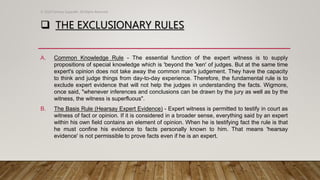
A. Common Knowledge Rule - The essential function of the expert witness is to supply
propositions of special knowledge which is 'beyond the 'ken' of judges. But at the same time
expert's opinion does not take away the common man's judgement. They have the capacity
to think and judge things from day-to-day experience. Therefore, the fundamental rule is to
exclude expert evidence that will not help the judges in understanding the facts. Wigmore,
once said, "whenever inferences and conclusions can be drawn by the jury as well as by the
witness, the witness is superfluous".
B. The Basis Rule (Hearsay Expert Evidence) - Expert witness is permitted to testify in court as
witness of fact or opinion. If it is considered in a broader sense, everything said by an expert
within his own field contains an element of opinion. When he is testifying fact the rule is that
he must confine his evidence to facts personally known to him. That means 'hearsay
evidence' is not permissible to prove facts even if he is an expert.
© 2019 Tanmay Gujarathi. All Rights Reserved
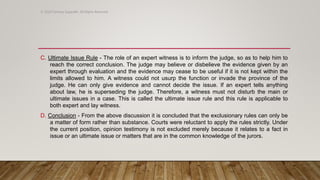
C. Ultimate Issue Rule - The role of an expert witness is to inform the judge, so as to help him to
reach the correct conclusion. The judge may believe or disbelieve the evidence given by an
expert through evaluation and the evidence may cease to be useful if it is not kept within the
limits allowed to him. A witness could not usurp the function or invade the province of the
judge. He can only give evidence and cannot decide the issue. If an expert tells anything
about law, he is superseding the judge. Therefore, a witness must not disturb the main or
ultimate issues in a case. This is called the ultimate issue rule and this rule is applicable to
both expert and lay witness.
D. Conclusion - From the above discussion it is concluded that the exclusionary rules can only be
a matter of form rather than substance. Courts were reluctant to apply the rules strictly. Under
the current position, opinion testimony is not excluded merely because it relates to a fact in
issue or an ultimate issue or matters that are in the common knowledge of the jurors.
© 2019 Tanmay Gujarathi. All Rights Reserved
 REFERENCES
• Acts
1. Indian Evidence Act, 1872.
2. Federal Rules of Evidence (U.S.)
3. Criminal Evidence Act, 1598
• Books
1. Carol A E Jones, Expert Witnesses (Oxford 1994)
2. Charles T. McCormick, McCormick On The Law of Evidence
• Websites
1. http://shodhganga.inflibnet.ac.in
© 2019 Tanmay Gujarathi. All Rights Reserved
THANK YOU…!
© 2019 Tanmay Gujarathi. All Rights Reserved