Speech

1
 Warm up: How do I compose and deliver a speech?

How do you feel about speaking in public?
Whether you love the limelight or avoid it, you may
need to deliver a speech as a class assignment, as
an after-school activity, or as part of a campaign for a
class office.
 Speeches fifer from written compositions. Your
audience must grasp the main point of your speech
just by hearing your words once. They can not
review what you have said as they could if they were
reading. To get your messages across, you must use
precise words, emphasize important ideas,, and
write sentences with a pleasing sounds and rhythm.
2
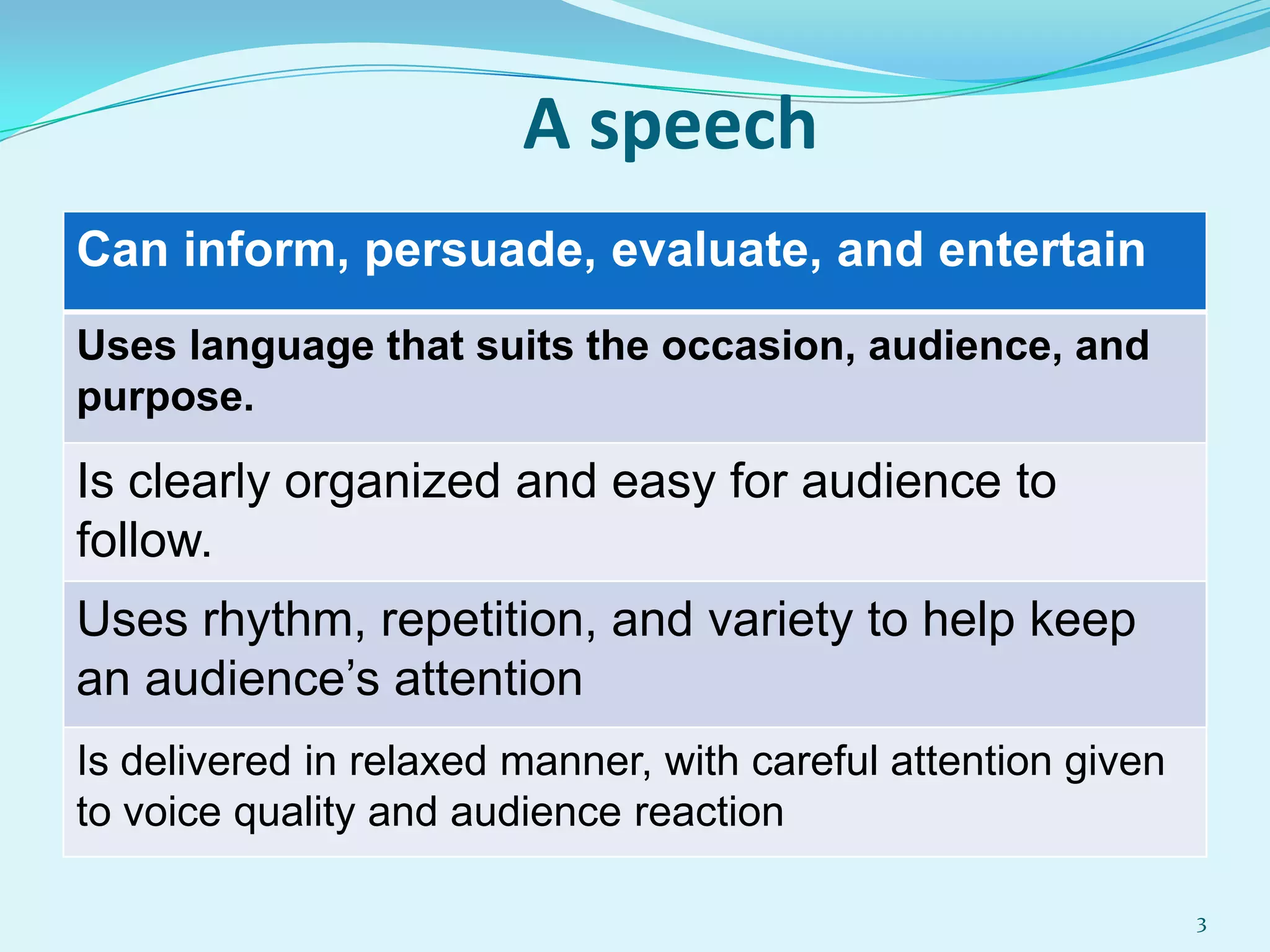
A speech
Can inform, persuade, evaluate, and entertain
Uses language that suits the occasion, audience, and
purpose.

Is clearly organized and easy for audience to
follow.

Uses rhythm, repetition, and variety to help keep
an audience’s attention
Is delivered in relaxed manner, with careful attention given
to voice quality and audience reaction
3
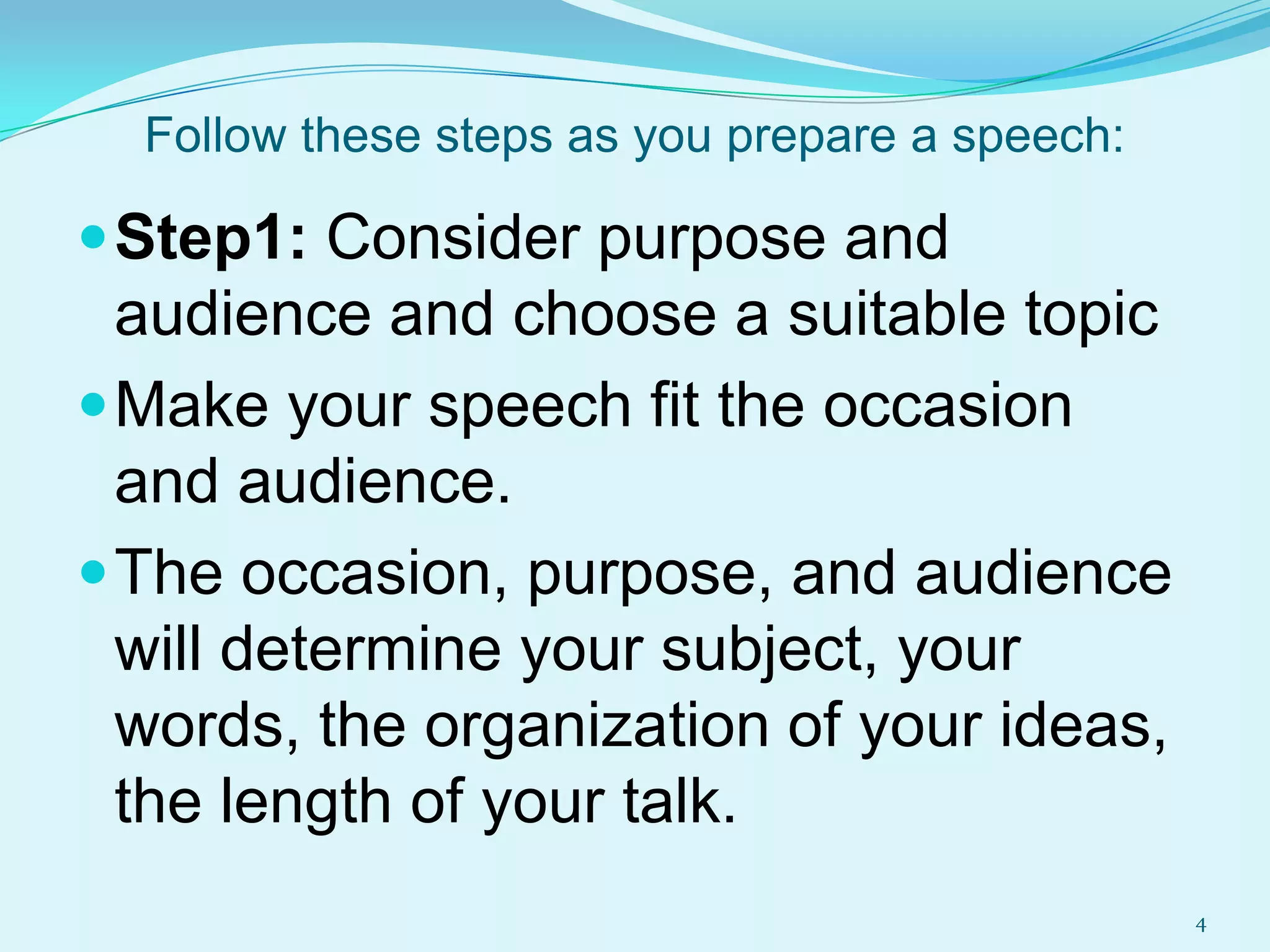
Follow these steps as you prepare a speech:

 Step1: Consider purpose and

audience and choose a suitable topic
 Make your speech fit the occasion
and audience.
 The occasion, purpose, and audience
will determine your subject, your
words, the organization of your ideas,
the length of your talk.
4
Here some questions that will help you plan your speech:
 Where and why am I giving this speech? What is the








occasion?
What is my purpose? Do I want my audience to laugh? To
learn something?
What age is my audience? What topic would suit them?
What does my audience already know and not know about
my subject? What information must I give them?
How long should my speech be to maintain my audience’s
interest?
What language should I choose for this occasion and this
audience? Do I need to be formal or informal?
Once you have thought about these questions, you will be
ready to plan, compose, and practice your speech.
5
Step2: Organize ideas
 Step2: Organize ideas

Arrange you ideas in either chronological order
or order of importance. Use chronological, or
time, order to talk about a series of events or a
process, as in a speech about programming .
Use order of importance to analyze a topic or to
present argument in a persuasive speech.
 Step 3: Use speech –making strategies
 Use sentence variety. Make your speech
interesting by varying the length and structure of
your sentences.
6
Applying for a Student Visa

When Do I Need to Apply for My Student Visa?
 Students are encouraged to apply for their visa early
to provide ample time for visa processing. Students
may apply for their visa as soon as they are
prepared to do so.
 Students should note that Embassies and
Consulates are able to issue your student visa 120
days or less, in advance of the course of study
registration date. If you apply for your visa more than
120 days prior to your start date or registration date
as provided on the Form I-20, the Embassy or
Consulate will hold your application until it is able to
issue the visa. Consular officials will use that extra
time for application processing.
7
 Students are advised of the Department of Homeland

Security regulation which requires that all initial or
beginning students enter the U.S. 30 days or less in
advance of the course of study start/report date as
shown on the Form I-20. Please consider this date
carefully when making travel plans to the U.S.
 A beginning student who wants an earlier entry into
the U.S. (more than 30 days prior to the course start
date), must qualify for, and obtain a visitor visa. A
prospective student notation will be shown on his/her
visitor visa and the traveler will need to make the intent to
study clear to the U.S. immigration inspector at port of
entry. Before beginning any studies, he or she must obtain
approval for a change to Exchange Visitor status,
8
 Application for Change of Nonimmigrant Status
and pay the fee. Also you must submit the
required Form I-20 to the Department of
Homeland Security office where the application
is made. Please be aware that one can not begin
studies until the change of classification is

approved.
 Continuing students may apply for a new visa at
any time, as long as they have been maintaining
student status and their SEVIS records are
current. Continuing students may also enter the
U.S. at any time before their classes start.
9
 Repeat key words and phrases. Stress key points

by repeating words and phrases and by summarizing
ideas.
Use parallelism. The use of similar words, phrases,
and clauses to express similar ideas is called
parallelism. When you use parallel structures in a
speech, listeners will remember your words more
easily.
 Step 4: Practice your speech
 Practice aloud. Rehearse your speech in front of a
mirror while you time it. if possible, tape-record or
videotape your speech, and ask your family and
friends for advice on how to improve your
performance.
10
 Memorize the speech but outline key points on

note cards.
 Watching someone read a speech can be boring.
Therefore, outline the main points of your speech on
note cards and memorize the rest. That will help you
look at your audience most of the time and glance
down only occasionally at your note cards to remind
you of your main point.
 Step 5: Deliver your speech
 Relax while delivering the speech. Stand up
straight.
Distribute your weight evenly on both feet. Don’t
fidget or pace. Use natural gestures and facial
expressions to emphasize your points.
11
 Look at audience.
 Make brief eye contract with individuals in different parts






of the room. Try to make each person think you are
speaking directly to him or her. Another strategy is to find a
face that inspires confidence and speak to that person.
Your voice well
Speak so that you can be understood and heard.
Otherwise, you may lose your audience’s attention.
Experienced speakers ask people to raise their hands if they
cannot hear.
Pause when appropriate. Give you audience at least three or
four seconds to think about an idea before you go on the
next one. Dramatic pauses help emphasize your important
pointing.
12
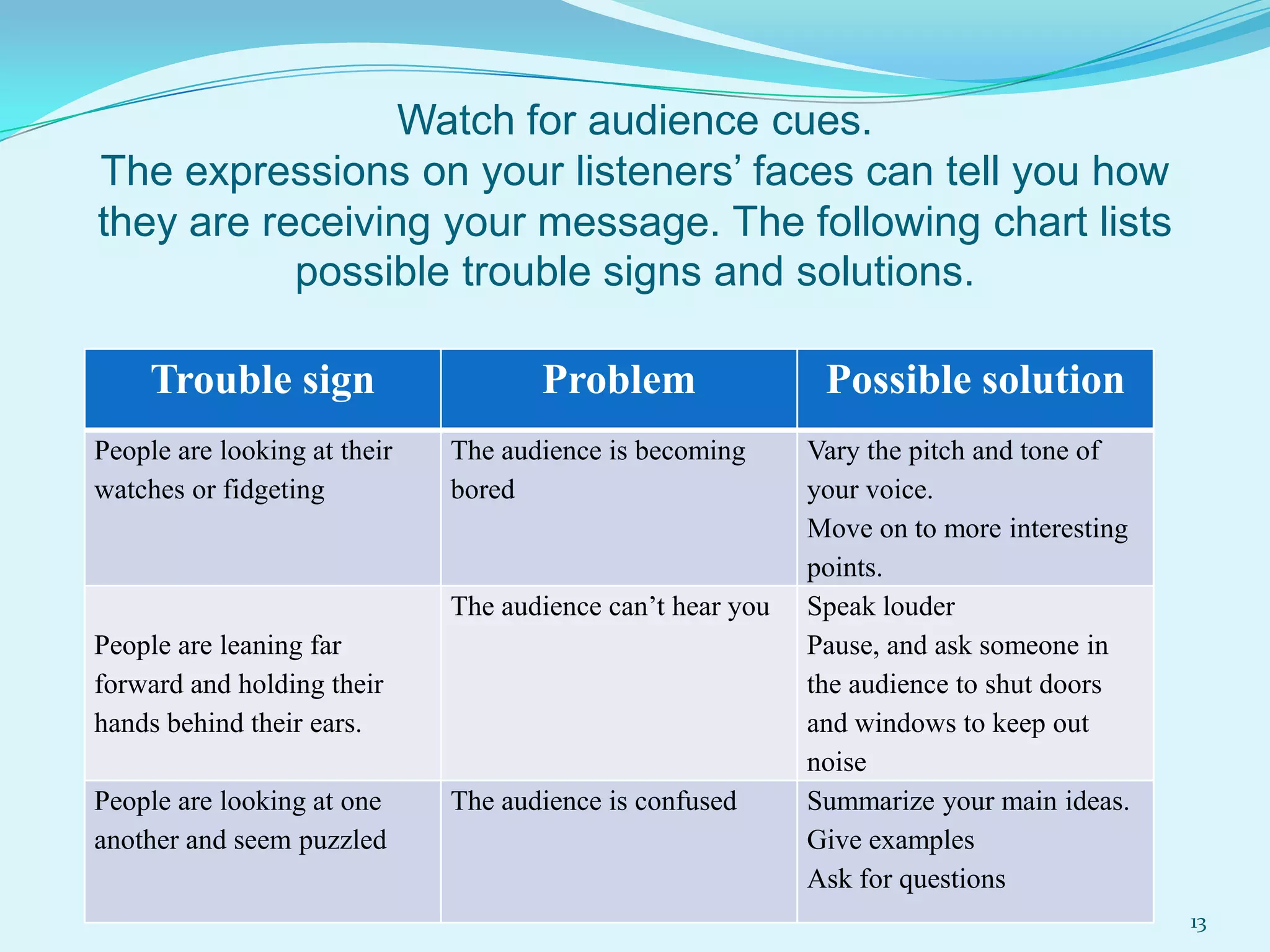
Watch for audience cues.
The expressions on your listeners’ faces can tell you how
they are receiving your message. The following chart lists
possible trouble signs and solutions.
Trouble sign
People are looking at their
watches or fidgeting

Problem
The audience is becoming
bored

The audience can’t hear you
People are leaning far
forward and holding their
hands behind their ears.
People are looking at one
another and seem puzzled

The audience is confused

Possible solution
Vary the pitch and tone of
your voice.
Move on to more interesting
points.
Speak louder
Pause, and ask someone in
the audience to shut doors
and windows to keep out
noise
Summarize your main ideas.
Give examples
Ask for questions
13

Lecture 8 giving speech.

  • 1.
  • 2.
     Warm up:How do I compose and deliver a speech? How do you feel about speaking in public? Whether you love the limelight or avoid it, you may need to deliver a speech as a class assignment, as an after-school activity, or as part of a campaign for a class office.  Speeches fifer from written compositions. Your audience must grasp the main point of your speech just by hearing your words once. They can not review what you have said as they could if they were reading. To get your messages across, you must use precise words, emphasize important ideas,, and write sentences with a pleasing sounds and rhythm. 2
  • 3.
    A speech Can inform,persuade, evaluate, and entertain Uses language that suits the occasion, audience, and purpose. Is clearly organized and easy for audience to follow. Uses rhythm, repetition, and variety to help keep an audience’s attention Is delivered in relaxed manner, with careful attention given to voice quality and audience reaction 3
  • 4.
    Follow these stepsas you prepare a speech:  Step1: Consider purpose and audience and choose a suitable topic  Make your speech fit the occasion and audience.  The occasion, purpose, and audience will determine your subject, your words, the organization of your ideas, the length of your talk. 4
  • 5.
    Here some questionsthat will help you plan your speech:  Where and why am I giving this speech? What is the       occasion? What is my purpose? Do I want my audience to laugh? To learn something? What age is my audience? What topic would suit them? What does my audience already know and not know about my subject? What information must I give them? How long should my speech be to maintain my audience’s interest? What language should I choose for this occasion and this audience? Do I need to be formal or informal? Once you have thought about these questions, you will be ready to plan, compose, and practice your speech. 5
  • 6.
    Step2: Organize ideas Step2: Organize ideas Arrange you ideas in either chronological order or order of importance. Use chronological, or time, order to talk about a series of events or a process, as in a speech about programming . Use order of importance to analyze a topic or to present argument in a persuasive speech.  Step 3: Use speech –making strategies  Use sentence variety. Make your speech interesting by varying the length and structure of your sentences. 6
  • 7.
    Applying for aStudent Visa When Do I Need to Apply for My Student Visa?  Students are encouraged to apply for their visa early to provide ample time for visa processing. Students may apply for their visa as soon as they are prepared to do so.  Students should note that Embassies and Consulates are able to issue your student visa 120 days or less, in advance of the course of study registration date. If you apply for your visa more than 120 days prior to your start date or registration date as provided on the Form I-20, the Embassy or Consulate will hold your application until it is able to issue the visa. Consular officials will use that extra time for application processing. 7
  • 8.
     Students areadvised of the Department of Homeland Security regulation which requires that all initial or beginning students enter the U.S. 30 days or less in advance of the course of study start/report date as shown on the Form I-20. Please consider this date carefully when making travel plans to the U.S.  A beginning student who wants an earlier entry into the U.S. (more than 30 days prior to the course start date), must qualify for, and obtain a visitor visa. A prospective student notation will be shown on his/her visitor visa and the traveler will need to make the intent to study clear to the U.S. immigration inspector at port of entry. Before beginning any studies, he or she must obtain approval for a change to Exchange Visitor status, 8
  • 9.
     Application forChange of Nonimmigrant Status and pay the fee. Also you must submit the required Form I-20 to the Department of Homeland Security office where the application is made. Please be aware that one can not begin studies until the change of classification is approved.  Continuing students may apply for a new visa at any time, as long as they have been maintaining student status and their SEVIS records are current. Continuing students may also enter the U.S. at any time before their classes start. 9
  • 10.
     Repeat keywords and phrases. Stress key points by repeating words and phrases and by summarizing ideas. Use parallelism. The use of similar words, phrases, and clauses to express similar ideas is called parallelism. When you use parallel structures in a speech, listeners will remember your words more easily.  Step 4: Practice your speech  Practice aloud. Rehearse your speech in front of a mirror while you time it. if possible, tape-record or videotape your speech, and ask your family and friends for advice on how to improve your performance. 10
  • 11.
     Memorize thespeech but outline key points on note cards.  Watching someone read a speech can be boring. Therefore, outline the main points of your speech on note cards and memorize the rest. That will help you look at your audience most of the time and glance down only occasionally at your note cards to remind you of your main point.  Step 5: Deliver your speech  Relax while delivering the speech. Stand up straight. Distribute your weight evenly on both feet. Don’t fidget or pace. Use natural gestures and facial expressions to emphasize your points. 11
  • 12.
     Look ataudience.  Make brief eye contract with individuals in different parts     of the room. Try to make each person think you are speaking directly to him or her. Another strategy is to find a face that inspires confidence and speak to that person. Your voice well Speak so that you can be understood and heard. Otherwise, you may lose your audience’s attention. Experienced speakers ask people to raise their hands if they cannot hear. Pause when appropriate. Give you audience at least three or four seconds to think about an idea before you go on the next one. Dramatic pauses help emphasize your important pointing. 12
  • 13.
    Watch for audiencecues. The expressions on your listeners’ faces can tell you how they are receiving your message. The following chart lists possible trouble signs and solutions. Trouble sign People are looking at their watches or fidgeting Problem The audience is becoming bored The audience can’t hear you People are leaning far forward and holding their hands behind their ears. People are looking at one another and seem puzzled The audience is confused Possible solution Vary the pitch and tone of your voice. Move on to more interesting points. Speak louder Pause, and ask someone in the audience to shut doors and windows to keep out noise Summarize your main ideas. Give examples Ask for questions 13