Modals

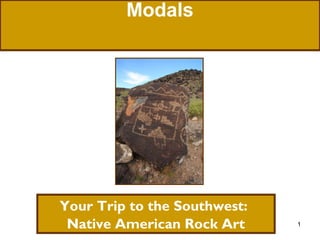
Your Trip to the Southwest:
Native American Rock Art

1
Use must or have to to express necessity.
In other areas, you have to hike up to caves
or into canyons to see the rock art.
Can you see the rock art from your car?
NO
What is necessary to see the rock art?

You have to leave the car and hike up to
caves or into canyons.
2
Use don’t have to when talking about lack of
necessity.
You don’t have to look far to find magnificent
petroglyphs because they seem to be on just
about every rock or cliff face.
Is it necessary to look far?

NO.
You don’t have to look far.
3
Should and ought to are used to express
advisability.
You should see the rock art in New Mexico.
Same meaning?
YES

You ought to see the rock art in New Mexico.

4
Should and ought to are used to express
advisability.
You should see
the rock art in
New Mexico.
You ought to
see the rock art
in New Mexico.

Both mean it’s a good
idea to see the rock art.

5
Practice 1
Write a sentence for each of the modals.
must have to don’t have to ought to should
1. ______________________________________.
2. ______________________________________.
3. ______________________________________.
4. ______________________________________.
5. ______________________________________.
6
7
The rock art spans thousands of years and an area
that includes almost all of the United States and
Mexico. However, the southwestern states contain an
unusually high number of images, often clustered
around old settlements. As you walk through these
areas, you may find figures of people, animals, or
plants carved into the rock. You can also see unique
geometric patterns. What were these patterns
supposed to represent? We may never know. The
artists could have been illustrating rain or lightning.
Or they may have been trying to depict emotions
such as joy or sadness. Whatever the meaning, the
beauty they had intended to convey is plain to see. 8
Use was / were supposed to when talking
about unknown or unfulfilled plans or
expectations in the past.
What were these patterns supposed to
represent?
We have no idea of the purpose of the
artist, so we can only guess.

Perhaps the rock art was supposed to
tell a story.
9
Progressive form of modals express a possibility
about something in progress, either now or in the
past.

The artist could have been illustrating rain.
modal + have been + -ing
When did the artist live?

in the past

What were they doing?

illustrating rain

Are we certain?

No.
Perhaps they were.
10
Practice 2 - Complete the sentences with the given
verbs and an appropriate modal. More than one modal
may be possible.
can learn
1. Scientists (learn)________________ a lot by
analyzing rock art from different areas.
2. Look! Those students are taking samples from the
rocks. They (study)___________________ the
must be studying
rock art.
3. The park ranger (give) ______________________
was supposed to give
a tour of the rock art today, but it’s been cancelled.
4. As they carved the rock, the prehistoric artists
(hope) ______________________ people in the
might have been hoping
future would see their art.

11
12
The reason why these prehistoric peoples created
the rock art remains a mystery. Many scientists
believe the artists must have created it for ceremonial
purposes. Others think they may have created it as a
form of language or to mark territorial claims. Some
people have even speculated the rock art could
depict visits from aliens or people from outer space,
but most scientists don’t think this is true. A much
simpler explanation is that the rock art could just be
the innocent drawings of ancient peoples. Whatever
the reason, we may never know, given the long time
period over which the rock art occurred and the vast
13
geographic area where it can be found.
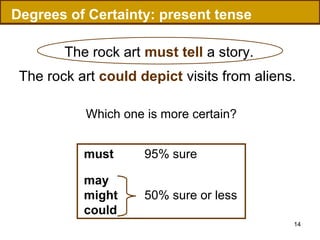
Degrees of Certainty: present tense
The rock art must tell a story.
The rock art could depict visits from aliens.
Which one is more certain?
must

95% sure

may
might
could

50% sure or less
14
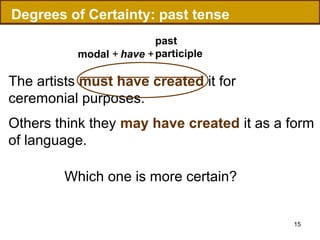
Degrees of Certainty: past tense
past
modal + have + participle

The artists must have created it for
ceremonial purposes.
Others think they may have created it as a form
of language.
Which one is more certain?

15
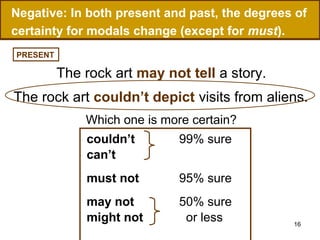
Negative: In both present and past, the degrees of
certainty for modals change (except for must).
PRESENT

The rock art may not tell a story.
The rock art couldn’t depict visits from aliens.
Which one is more certain?
couldn’t
can’t

99% sure

must not

95% sure

may not
might not

50% sure
or less

16
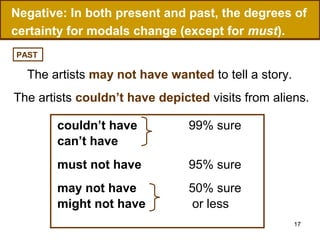
Negative: In both present and past, the degrees of
certainty for modals change (except for must).
PAST

The artists may not have wanted to tell a story.
The artists couldn’t have depicted visits from aliens.
couldn’t have
can’t have

99% sure

must not have

95% sure

may not have
might not have

50% sure
or less
17
Practice 3
Use Degrees of Certainty modals to answer the
questions in your own words. Many answers are
possible.
1. Why were the petroglyphs made?
2. What did the geometric patterns mean?
3. What is the most frequently seen image in
the rock art?
4. What image probably is not seen in the rock
art?
18
CREDITS

Copyright © 2009 Pearson Education and
its licensors. All rights reserved.
Images used under license from:
Shutterstock, Inc.

19

Modals lesson -8

  • 1.
    Modals Your Trip tothe Southwest: Native American Rock Art 1
  • 2.
    Use must orhave to to express necessity. In other areas, you have to hike up to caves or into canyons to see the rock art. Can you see the rock art from your car? NO What is necessary to see the rock art? You have to leave the car and hike up to caves or into canyons. 2
  • 3.
    Use don’t haveto when talking about lack of necessity. You don’t have to look far to find magnificent petroglyphs because they seem to be on just about every rock or cliff face. Is it necessary to look far? NO. You don’t have to look far. 3
  • 4.
    Should and oughtto are used to express advisability. You should see the rock art in New Mexico. Same meaning? YES You ought to see the rock art in New Mexico. 4
  • 5.
    Should and oughtto are used to express advisability. You should see the rock art in New Mexico. You ought to see the rock art in New Mexico. Both mean it’s a good idea to see the rock art. 5
  • 6.
    Practice 1 Write asentence for each of the modals. must have to don’t have to ought to should 1. ______________________________________. 2. ______________________________________. 3. ______________________________________. 4. ______________________________________. 5. ______________________________________. 6
  • 7.
  • 8.
    The rock artspans thousands of years and an area that includes almost all of the United States and Mexico. However, the southwestern states contain an unusually high number of images, often clustered around old settlements. As you walk through these areas, you may find figures of people, animals, or plants carved into the rock. You can also see unique geometric patterns. What were these patterns supposed to represent? We may never know. The artists could have been illustrating rain or lightning. Or they may have been trying to depict emotions such as joy or sadness. Whatever the meaning, the beauty they had intended to convey is plain to see. 8
  • 9.
    Use was /were supposed to when talking about unknown or unfulfilled plans or expectations in the past. What were these patterns supposed to represent? We have no idea of the purpose of the artist, so we can only guess. Perhaps the rock art was supposed to tell a story. 9
  • 10.
    Progressive form ofmodals express a possibility about something in progress, either now or in the past. The artist could have been illustrating rain. modal + have been + -ing When did the artist live? in the past What were they doing? illustrating rain Are we certain? No. Perhaps they were. 10
  • 11.
    Practice 2 -Complete the sentences with the given verbs and an appropriate modal. More than one modal may be possible. can learn 1. Scientists (learn)________________ a lot by analyzing rock art from different areas. 2. Look! Those students are taking samples from the rocks. They (study)___________________ the must be studying rock art. 3. The park ranger (give) ______________________ was supposed to give a tour of the rock art today, but it’s been cancelled. 4. As they carved the rock, the prehistoric artists (hope) ______________________ people in the might have been hoping future would see their art. 11
  • 12.
  • 13.
    The reason whythese prehistoric peoples created the rock art remains a mystery. Many scientists believe the artists must have created it for ceremonial purposes. Others think they may have created it as a form of language or to mark territorial claims. Some people have even speculated the rock art could depict visits from aliens or people from outer space, but most scientists don’t think this is true. A much simpler explanation is that the rock art could just be the innocent drawings of ancient peoples. Whatever the reason, we may never know, given the long time period over which the rock art occurred and the vast 13 geographic area where it can be found.
  • 14.
    Degrees of Certainty:present tense The rock art must tell a story. The rock art could depict visits from aliens. Which one is more certain? must 95% sure may might could 50% sure or less 14
  • 15.
    Degrees of Certainty:past tense past modal + have + participle The artists must have created it for ceremonial purposes. Others think they may have created it as a form of language. Which one is more certain? 15
  • 16.
    Negative: In bothpresent and past, the degrees of certainty for modals change (except for must). PRESENT The rock art may not tell a story. The rock art couldn’t depict visits from aliens. Which one is more certain? couldn’t can’t 99% sure must not 95% sure may not might not 50% sure or less 16
  • 17.
    Negative: In bothpresent and past, the degrees of certainty for modals change (except for must). PAST The artists may not have wanted to tell a story. The artists couldn’t have depicted visits from aliens. couldn’t have can’t have 99% sure must not have 95% sure may not have might not have 50% sure or less 17
  • 18.
    Practice 3 Use Degreesof Certainty modals to answer the questions in your own words. Many answers are possible. 1. Why were the petroglyphs made? 2. What did the geometric patterns mean? 3. What is the most frequently seen image in the rock art? 4. What image probably is not seen in the rock art? 18
  • 19.
    CREDITS Copyright © 2009Pearson Education and its licensors. All rights reserved. Images used under license from: Shutterstock, Inc. 19