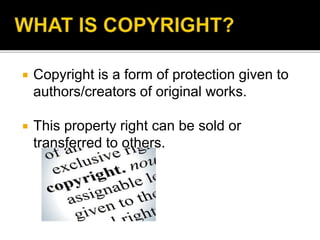
 Copyright is a form of protection given to
authors/creators of original works.
 This property right can be sold or
transferred to others.
 Copyright is a form of protection grounded
in the U.S. Constitution and granted by
law for original works of authorship.
 The current copyright law, the Copyright
Act of 1976, is codified in Title 17 of the
U.S. Code.
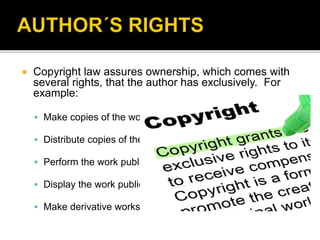
 Copyright law assures ownership, which comes with
several rights, that the author has exclusively. For
example:
 Make copies of the work
 Distribute copies of the work
 Perform the work publicly
 Display the work publicly
 Make derivative works
 Copyright holder may grant permission or
license anyone else to do these things,
without affecting their ownership of the
actual copyright in their work. For
example, an author may permit a
television adaptation of their book to be
made and broadcast .
 The law provides certain ways in which
copyright works may be used without the
need to first obtain permission from the
copyright holder - these include:
 Fair use (e.g. to make copies)
 Public domain
 Library privilege
 Copying for examinations and copying for
instruction
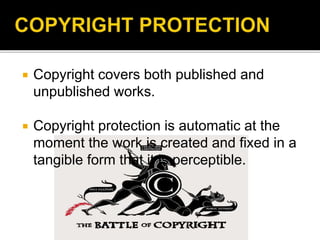
 Copyright covers both published and
unpublished works.
 Copyright protection is automatic at the
moment the work is created and fixed in a
tangible form that it is perceptible.
 Literary works
 Dramatic works
 Musical works
 Artistic works
Not everything is protected by copyright
law.
 Copyright does not protect facts, ideas,
systems, or methods of operation.
 Copyright protects original works of
authorship, while a patent protects
inventions or discoveries.
 A trademark protects words, phrases,
symbols, or designs identifying the source
of the goods or services of one party and
distinguishing them from those of others.
 They want to provide “universal access” to research,
education and culture.
 Copyright was created long before the emergence of
the Internet, and can make it hard to legally perform
actions we take for granted on the network: copy,
paste, edit source, and post to the Web.
 The default setting of copyright law requires all of
these actions to have explicit permission, granted in
advance, whether you’re an artist, teacher, scientist,
librarian, policymaker, or just a regular user.
 In order for Creative Commons to achieve the vision
of universal access. They provide a free, public, and
standardized infrastructure that creates a balancehttp://creativecommons.org/about
 Under the Teach Act, the Copyright law
provides educators with a separate set of
rights in addition to fair use, to display and
perform others´ works in the classroom.
 These rights are entitled in Section 110(1)
of the Copyright Act, and apply to any
original work an educator wants to use.
 Source 1: (n.d.). Retrieved from http://creativecommons.org/about
 Source 2: Copyright crash course. (n.d.). Retrieved from
http://copyright.lib.utexas.edu/index.html
 Source 3 : Copyright crash course. (n.d.). Retrieved from
http://copyright.lib.utexas.edu/teachact.html
 Source 4: What is copyright?. (n.d.). Retrieved from
http://www.staffs.ac.uk/legal/copyright/what_is_copyright/
 Source 5: Copyright in general. (n.d.). Retrieved from
http://www.copyright.gov/help/faq/faq-general.html
 Source 6: (n.d.). Retrieved from
http://www.plagiarismtoday.com/stopping-internet-plagiarism/your-
copyrights-online/1-what-is-a-copyright/
 Source 7: (n.d.). Retrieved from
http://www.copyrightkids.org/whatcopyframes.htm

Copyright act

  • 2.
     Copyright isa form of protection given to authors/creators of original works.  This property right can be sold or transferred to others.
  • 3.
     Copyright isa form of protection grounded in the U.S. Constitution and granted by law for original works of authorship.  The current copyright law, the Copyright Act of 1976, is codified in Title 17 of the U.S. Code.
  • 4.
     Copyright lawassures ownership, which comes with several rights, that the author has exclusively. For example:  Make copies of the work  Distribute copies of the work  Perform the work publicly  Display the work publicly  Make derivative works
  • 5.
     Copyright holdermay grant permission or license anyone else to do these things, without affecting their ownership of the actual copyright in their work. For example, an author may permit a television adaptation of their book to be made and broadcast .
  • 6.
     The lawprovides certain ways in which copyright works may be used without the need to first obtain permission from the copyright holder - these include:  Fair use (e.g. to make copies)  Public domain  Library privilege  Copying for examinations and copying for instruction
  • 7.
     Copyright coversboth published and unpublished works.  Copyright protection is automatic at the moment the work is created and fixed in a tangible form that it is perceptible.
  • 8.
     Literary works Dramatic works  Musical works  Artistic works
  • 9.
    Not everything isprotected by copyright law.  Copyright does not protect facts, ideas, systems, or methods of operation.
  • 10.
     Copyright protectsoriginal works of authorship, while a patent protects inventions or discoveries.  A trademark protects words, phrases, symbols, or designs identifying the source of the goods or services of one party and distinguishing them from those of others.
  • 11.
     They wantto provide “universal access” to research, education and culture.  Copyright was created long before the emergence of the Internet, and can make it hard to legally perform actions we take for granted on the network: copy, paste, edit source, and post to the Web.  The default setting of copyright law requires all of these actions to have explicit permission, granted in advance, whether you’re an artist, teacher, scientist, librarian, policymaker, or just a regular user.  In order for Creative Commons to achieve the vision of universal access. They provide a free, public, and standardized infrastructure that creates a balancehttp://creativecommons.org/about
  • 12.
     Under theTeach Act, the Copyright law provides educators with a separate set of rights in addition to fair use, to display and perform others´ works in the classroom.  These rights are entitled in Section 110(1) of the Copyright Act, and apply to any original work an educator wants to use.
  • 13.
     Source 1:(n.d.). Retrieved from http://creativecommons.org/about  Source 2: Copyright crash course. (n.d.). Retrieved from http://copyright.lib.utexas.edu/index.html  Source 3 : Copyright crash course. (n.d.). Retrieved from http://copyright.lib.utexas.edu/teachact.html  Source 4: What is copyright?. (n.d.). Retrieved from http://www.staffs.ac.uk/legal/copyright/what_is_copyright/  Source 5: Copyright in general. (n.d.). Retrieved from http://www.copyright.gov/help/faq/faq-general.html  Source 6: (n.d.). Retrieved from http://www.plagiarismtoday.com/stopping-internet-plagiarism/your- copyrights-online/1-what-is-a-copyright/  Source 7: (n.d.). Retrieved from http://www.copyrightkids.org/whatcopyframes.htm