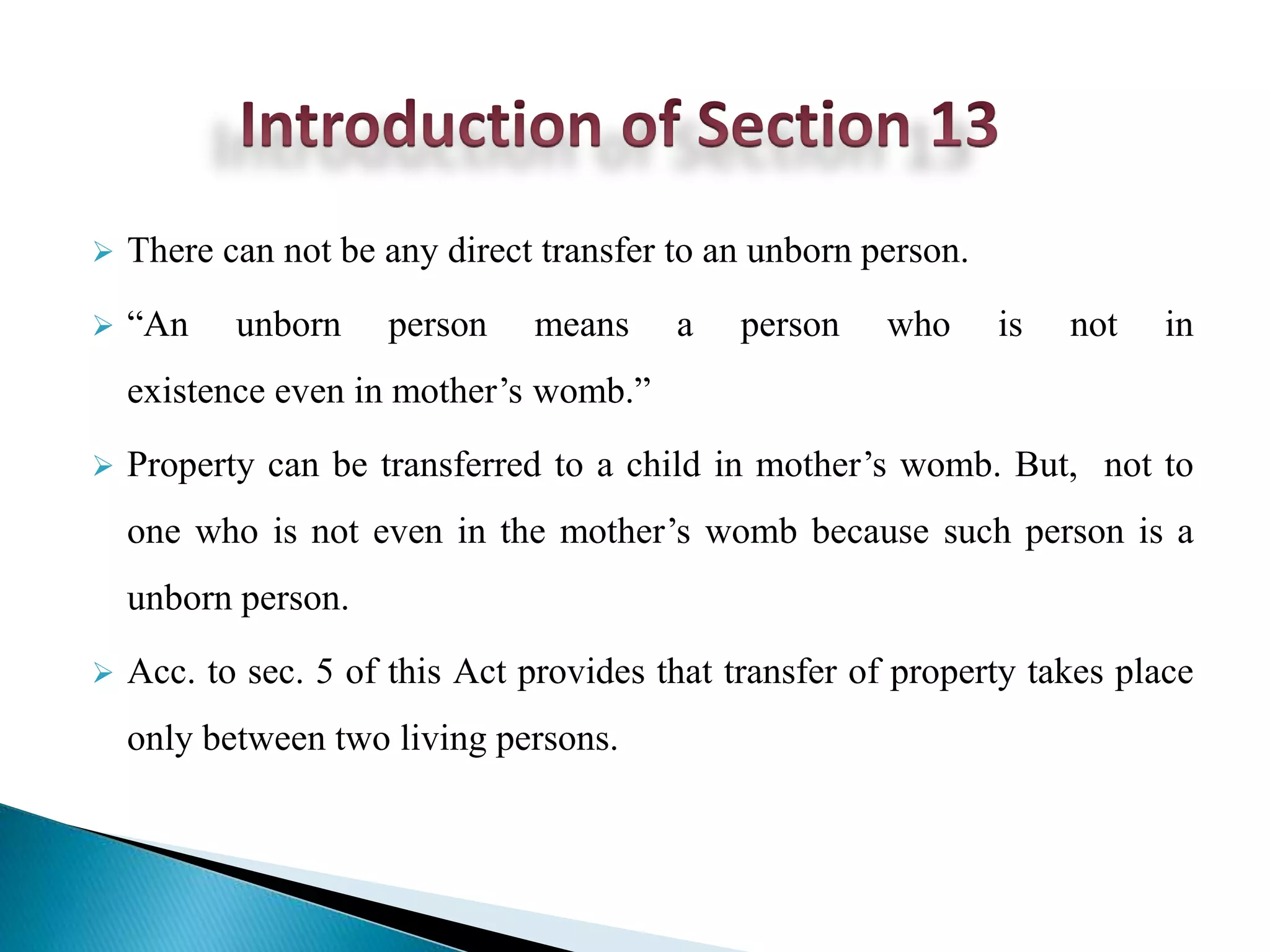
There can be no direct transfer of property to an unborn person who is not in existence, even in the mother's womb. However, property can be transferred to a child in the mother's womb. A living person can hold the property in trust until the unborn person comes into existence, at which point they will receive the full interest in the property. Only an absolute interest in the entire remaining property can be transferred to an unborn person, not a limited or life interest.
![ Prior life interest can be enjoyed by living persons during his life &
until the unborn comes into existence.
After the death of the living person holding property for life, the
interest would pass on ultimately to the unborn who, by that time,
comes into existence.
Living person who may hold the property in trust for the benefit of the
unborn.
For example:
A C D
B [unborn son of ‘A’]
(ultimate beneficiary)](https://image.slidesharecdn.com/set-201030064539/75/Section-13-Transfer-for-benefit-of-Unborn-perosn-3-2048.jpg)
![ Only absolute interest in the property may be transferred in favour of
an unborn person. Limited or life interest cannot be given to an unborn
person.
The unborn person must be given the whole of remaining interest of the
transferor in the property.
So that after the termination of prior life interest, the unborn gets the
whole.
Condition 2 : Only Absolute Interest may be given
X
For example: Y
EC
(unmarried )
[absolutely]](https://image.slidesharecdn.com/set-201030064539/75/Section-13-Transfer-for-benefit-of-Unborn-perosn-4-2048.jpg)