What is an
Extemporaneous
Speech?
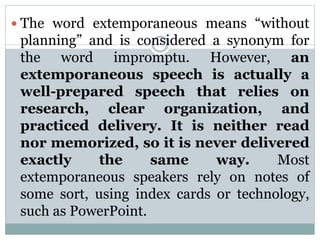
 The word extemporaneous means “without
planning” and is considered a synonym for
the word impromptu. However, an
extemporaneous speech is actually a
well-prepared speech that relies on
research, clear organization, and
practiced delivery. It is neither read
nor memorized, so it is never delivered
exactly the same way. Most
extemporaneous speakers rely on notes of
some sort, using index cards or technology,
such as PowerPoint.
Because extemporaneous speeches
are not read or memorized, the
extemporaneous speaker needs to
stay in the moment and be able to
“think on their feet”¾a process
which can be stressful, but can also
allow for a high level of spontaneity,
leading to a natural, conversational
style.
 Because they are composed almost
entirely in the moment,
extemporaneous speeches have a
higher level of spontaneity. However,
because they require extensive research
and preparation, they tend to have
significantly more depth, and therefore
are generally the preferred method for
speech delivery.
What Are the
Elements of an
Effective
Extemporaneous
Speech?
1. Speak About Something Worth Saying
 The first element of an effective extemporaneous speech
is having something to say that has meaning¾for
yourself and for your audience. Having an interesting
topic alone isn’t enough.
 Without innovative ideas, up-to-date information, and
thoughtful personal opinion, even the most eloquent
words coming out of your mouth won’t matter.
 When you’re preparing to deliver your speech
extemporaneously, it’s especially important that you
think clearly and thoroughly about the content of the
message. Because you’ll be choosing your words in the
moment, you will need to be an expert about your
message.
2. Speak with Sincerity
 As an extemporaneous speaker, you’ll be expected to
thoroughly believe in the message you’re conveying to
your audience. If you don’t believe in your message—if
you’re not sincerely convinced that your topic matters—
your audience will quickly pick up on your lack of
sincerity. Projecting insincerity is a sure-fire way to lose
your audience’s attention. Nothing is more unsettling to
the extemporaneous speaker than looking out at the
audience and seeing a roomful of blank expressions. To
help you maintain your composure and continue to think
on your feet throughout your speech, keep it real. Believe
in your topic.
3. Speak with Your Own Style
 Speaking in a natural, conversational style
means that you shouldn’t try to imitate the
speaking style of other speakers. Learn from
other speakers. Observe what they do that
works from them. Follow the rules for
preparing and delivering an effective
extemporary speech. But, when it comes to
style, figure out how to express a style that’s
authentic to you.
Practice and Rehearsal
Tips The following guidelines are tips for how to practice and rehearse
your extemporaneous speech:
 Write an easy-to-follow speech outline that includes all of the
essential elements of your speech.
 Create index cards to act as cues to keep you on track throughout your
speech. (Alternatively, use the note feature of your graphic
technology.)
 Never read from your index cards unless you’re reading a direct
quotation or a statistic.
 Rehearse with your graphic technology and/or other visual aids and
coordinate them with your talk.
 Display images from your graphic technology and/or other visual aids
only when you are talking about them.
 Develop your conversational speaking style.
 Rehearse in front of others and solicit feedback.
 Record and listen to a timed version of your practice speech.
 Prepare for your entire speech.
The Best Extemporaneous Speech Topics for
High School
 Is it essential to study?
 Should corporal punishment be removed from schools?
 Does taking coffee at night improve concentration?
 Will the world come to an end one day?
 Do social media relationships last?
 Is the growing population a threat to the existing
resources?
 Reasons why most ladies experience mood swings
 Should pregnant girls be allowed to continue with their
studies?
 Where do you see yourself in the next five years?
 Why do you think the world has both the poor and the
rich?
 Is it true that money is the root of all evil?
 Explain the significant role played by communication
in life
 Do you believe that there is heaven?
 Is it right for men to keep long hair?
 How did you feel on the best day of your life
 Why do people celebrate Christmas?
 Speak on the role of a mother
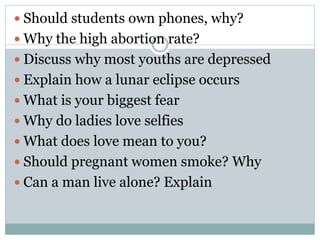
 Should students own phones, why?
 Why the high abortion rate?
 Discuss why most youths are depressed
 Explain how a lunar eclipse occurs
 What is your biggest fear
 Why do ladies love selfies
 What does love mean to you?
 Should pregnant women smoke? Why
 Can a man live alone? Explain

extemporaneous speech ppt.pptx

  • 5.
  • 6.
     The wordextemporaneous means “without planning” and is considered a synonym for the word impromptu. However, an extemporaneous speech is actually a well-prepared speech that relies on research, clear organization, and practiced delivery. It is neither read nor memorized, so it is never delivered exactly the same way. Most extemporaneous speakers rely on notes of some sort, using index cards or technology, such as PowerPoint.
  • 7.
    Because extemporaneous speeches arenot read or memorized, the extemporaneous speaker needs to stay in the moment and be able to “think on their feet”¾a process which can be stressful, but can also allow for a high level of spontaneity, leading to a natural, conversational style.
  • 8.
     Because theyare composed almost entirely in the moment, extemporaneous speeches have a higher level of spontaneity. However, because they require extensive research and preparation, they tend to have significantly more depth, and therefore are generally the preferred method for speech delivery.
  • 9.
    What Are the Elementsof an Effective Extemporaneous Speech?
  • 10.
    1. Speak AboutSomething Worth Saying  The first element of an effective extemporaneous speech is having something to say that has meaning¾for yourself and for your audience. Having an interesting topic alone isn’t enough.  Without innovative ideas, up-to-date information, and thoughtful personal opinion, even the most eloquent words coming out of your mouth won’t matter.  When you’re preparing to deliver your speech extemporaneously, it’s especially important that you think clearly and thoroughly about the content of the message. Because you’ll be choosing your words in the moment, you will need to be an expert about your message.
  • 11.
    2. Speak withSincerity  As an extemporaneous speaker, you’ll be expected to thoroughly believe in the message you’re conveying to your audience. If you don’t believe in your message—if you’re not sincerely convinced that your topic matters— your audience will quickly pick up on your lack of sincerity. Projecting insincerity is a sure-fire way to lose your audience’s attention. Nothing is more unsettling to the extemporaneous speaker than looking out at the audience and seeing a roomful of blank expressions. To help you maintain your composure and continue to think on your feet throughout your speech, keep it real. Believe in your topic.
  • 12.
    3. Speak withYour Own Style  Speaking in a natural, conversational style means that you shouldn’t try to imitate the speaking style of other speakers. Learn from other speakers. Observe what they do that works from them. Follow the rules for preparing and delivering an effective extemporary speech. But, when it comes to style, figure out how to express a style that’s authentic to you.
  • 13.
    Practice and Rehearsal TipsThe following guidelines are tips for how to practice and rehearse your extemporaneous speech:  Write an easy-to-follow speech outline that includes all of the essential elements of your speech.  Create index cards to act as cues to keep you on track throughout your speech. (Alternatively, use the note feature of your graphic technology.)  Never read from your index cards unless you’re reading a direct quotation or a statistic.  Rehearse with your graphic technology and/or other visual aids and coordinate them with your talk.  Display images from your graphic technology and/or other visual aids only when you are talking about them.  Develop your conversational speaking style.  Rehearse in front of others and solicit feedback.  Record and listen to a timed version of your practice speech.  Prepare for your entire speech.
  • 14.
    The Best ExtemporaneousSpeech Topics for High School  Is it essential to study?  Should corporal punishment be removed from schools?  Does taking coffee at night improve concentration?  Will the world come to an end one day?  Do social media relationships last?  Is the growing population a threat to the existing resources?  Reasons why most ladies experience mood swings
  • 15.
     Should pregnantgirls be allowed to continue with their studies?  Where do you see yourself in the next five years?  Why do you think the world has both the poor and the rich?  Is it true that money is the root of all evil?  Explain the significant role played by communication in life  Do you believe that there is heaven?  Is it right for men to keep long hair?  How did you feel on the best day of your life  Why do people celebrate Christmas?  Speak on the role of a mother
  • 16.
     Should studentsown phones, why?  Why the high abortion rate?  Discuss why most youths are depressed  Explain how a lunar eclipse occurs  What is your biggest fear  Why do ladies love selfies  What does love mean to you?  Should pregnant women smoke? Why  Can a man live alone? Explain