Moot
Court
○
A moot court competition simulates a court hearing
(usually an appeal against a final decision), in which
participants analyses a problem, research the relevant
law, prepare written submissions, and present oral
argument
Mooting
○ Mooting is not the same as public speaking or
debating, although it shares some common
elements with these activities. It is a
specialized application of the art of persuasive
advocacy. It has been part of the process of
training lawyers for centuries and plays an
important role in legal education.
Students, acting as lawyers or judges, “try” a
case before an appellate court. In addition to
acting as lawyers or judges, students are
assigned to serve as “law clerks, reporters,
or amicus brief writers”
(Knerr and Sommerman 2001, 4)
 To engage with and think deeply about
interesting and topical legal issues.
 To enhance their advocacy, legal research
and writing skills.
There are many reasons to moot.
Mooting enables students to…
 To work closely with and learn from
their peers.
 To demonstrate their interest in
advocacy and competence as an
advocate to prospective employers.
Significance
of Moot
Court
It is must for all
associated with the study of
law whether you want to be a
lawyer, a teacher, judge, a
corporate lawyer, legal
advisor.
Why everybody should participate?
♪ Your success as a law professional depends upon the following four
factors a. Your capacity to comprehend the problems on a given set
of facts and cull out the legal issue involved.
♪ Knowledge of existing provisions of law, applicable on those legal
issues.
♪ Capability to apply the law on those facts to solve the legal
problem.
♪ Your skill in persuading the concerned authority to take a view
which you want them to take
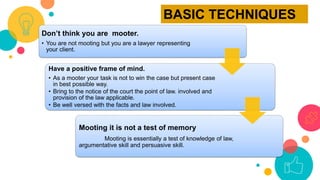
Don’t think you are mooter.
• You are not mooting but you are a lawyer representing
your client.
Have a positive frame of mind.
• As a mooter your task is not to win the case but present case
in best possible way.
• Bring to the notice of the court the point of law. involved and
provision of the law applicable.
• Be well versed with the facts and law involved.
Mooting it is not a test of memory
Mooting is essentially a test of knowledge of law,
argumentative skill and persuasive skill.
BASIC TECHNIQUES
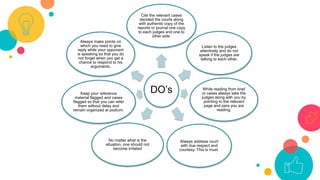
DO’s
Cite the relevant cases
decided the courts along
with authentic copy of the
reports or journal one copy
to each judges and one to
other side.
Listen to the judges
attentively and do not
speak if the judges are
talking to each other.
While reading from brief
or cases always take the
judges along with you by
pointing to the relevant
page and para you are
reading.
Always address court
with due respect and
courtesy. This is must.
No matter what is the
situation, one should not
become irritated
Keep your reference
material flagged and cases
flagged so that you can refer
them without delay and
remain organized at podium.
Always make points on
which you need to give
reply while your opponent
is speaking so that you do
not forget when you get a
chance to respond to his
arguments.
Don’ts
You should not
never express
personal opinion
on the case.
Don’t reply in hurry
Don’t read from your
brief.
Do not cite cases
without having law
reports with you or
at least their
photocopy.
Don’t cite text books
as final authority.
Always cite cases
decided by higher
courts.
Don’t interrupt a
judge while he
is speaking.

Moot moot court

  • 1.
  • 2.
    A moot courtcompetition simulates a court hearing (usually an appeal against a final decision), in which participants analyses a problem, research the relevant law, prepare written submissions, and present oral argument
  • 3.
    Mooting ○ Mooting isnot the same as public speaking or debating, although it shares some common elements with these activities. It is a specialized application of the art of persuasive advocacy. It has been part of the process of training lawyers for centuries and plays an important role in legal education.
  • 4.
    Students, acting aslawyers or judges, “try” a case before an appellate court. In addition to acting as lawyers or judges, students are assigned to serve as “law clerks, reporters, or amicus brief writers” (Knerr and Sommerman 2001, 4)
  • 5.
     To engagewith and think deeply about interesting and topical legal issues.  To enhance their advocacy, legal research and writing skills. There are many reasons to moot. Mooting enables students to…
  • 6.
     To workclosely with and learn from their peers.  To demonstrate their interest in advocacy and competence as an advocate to prospective employers.
  • 7.
    Significance of Moot Court It ismust for all associated with the study of law whether you want to be a lawyer, a teacher, judge, a corporate lawyer, legal advisor.
  • 8.
    Why everybody shouldparticipate? ♪ Your success as a law professional depends upon the following four factors a. Your capacity to comprehend the problems on a given set of facts and cull out the legal issue involved. ♪ Knowledge of existing provisions of law, applicable on those legal issues. ♪ Capability to apply the law on those facts to solve the legal problem. ♪ Your skill in persuading the concerned authority to take a view which you want them to take
  • 9.
    Don’t think youare mooter. • You are not mooting but you are a lawyer representing your client. Have a positive frame of mind. • As a mooter your task is not to win the case but present case in best possible way. • Bring to the notice of the court the point of law. involved and provision of the law applicable. • Be well versed with the facts and law involved. Mooting it is not a test of memory Mooting is essentially a test of knowledge of law, argumentative skill and persuasive skill. BASIC TECHNIQUES
  • 10.
    DO’s Cite the relevantcases decided the courts along with authentic copy of the reports or journal one copy to each judges and one to other side. Listen to the judges attentively and do not speak if the judges are talking to each other. While reading from brief or cases always take the judges along with you by pointing to the relevant page and para you are reading. Always address court with due respect and courtesy. This is must. No matter what is the situation, one should not become irritated Keep your reference material flagged and cases flagged so that you can refer them without delay and remain organized at podium. Always make points on which you need to give reply while your opponent is speaking so that you do not forget when you get a chance to respond to his arguments.
  • 11.
    Don’ts You should not neverexpress personal opinion on the case. Don’t reply in hurry Don’t read from your brief. Do not cite cases without having law reports with you or at least their photocopy. Don’t cite text books as final authority. Always cite cases decided by higher courts. Don’t interrupt a judge while he is speaking.

Editor's Notes

  • #7 Most students find mooting to be intellectually rewarding and highly enjoyable. It can be nerve-racking and frustrating but it is a lot of fun.