The document discusses the history and current competitive landscape of the Coca-Cola Company, highlighting its significant presence in the beverage industry with a diverse product portfolio served globally. It points out the challenges Coca-Cola faces, including market saturation and rising competition from various beverage brands, which necessitate strategic adaptations to maintain market leadership. The research aims to analyze Coca-Cola's strategies, compare them with competitors, and provide recommendations for sustaining growth and customer loyalty in a changing market.
![CHAPTER 1
INTRODUCTION
Founded in 1892, The Coca-Cola Company is an American corporation that has become a prominent
figure in the beverage industry by producing and selling syrup and concentrate for Coca-Cola, a fizzy
sweetened drink. With over 500 brands offered in more than 200 countries, Coca-Cola has broadened its
product range to appeal to a wide and varied global market. As the leading beverage manufacturer and
distributor in the world, Coca-Cola's products are consumed at a rate of 2 billion servings daily. The
company's broad range of products encompasses fizzy beverages, coffee, tea, fruit juice, energy drinks,
and bottled water, demonstrating its strategic ability to evolve and respond to shifting consumer tastes [1].
Despite being a key player, Coca-Cola encounters fierce rivalry from industry giants such as PepsiCo,
Nestle, Red Bull, Dr Pepper Snapple Group, and various upcoming domestic and international labels.
This demanding competitive environment requires ongoing creativity and tactical flexibility to maintain
its leadership in the market.
Coca-Cola, traditionally the dominant force in the soft drink sector, now confronts a pivotal obstacle as
the market reaches a point of saturation. It is crucial to uphold growth and customer allegiance. However,
in the midst of burgeoning beverage markets and changing consumer habits, the desire for a variety of
beverage choices has never been greater [2]. This transformation has prompted Coca-Cola to widen its
array of products and venture into new markets, employing a distinct management approach. This
approach has propelled Coca-Cola's range of offerings, which includes coffee, tea, fruit beverages, energy
drinks, and water, alongside its famous fizzy drinks, to attain global recognition and consumption levels.
Michael Porter, a professor at Harvard University, emphasizes the importance of strategy in establishing a
unique and valuable position in the market. He has identified three main strategies: becoming a cost
leader, differentiation, and concentration strategies. Differentiation strategy, specifically, involves
delivering distinctive products or services that are acknowledged by the entire industry. This strategy can
be either proactive or reactive [2]. Competitive strategy falls within enterprise strategy and directs the
plans and actions of specific strategic business units within the wider scope of the company's overall
strategy. The main challenge in competitive strategy is to secure and uphold a specific position for
products by comprehending the interplay between customer needs, competitors' products, and the
company's offerings. Developing a differentiation strategy involves aiming to stand out in the industry by
providing unique and valuable aspects that customers appreciate. Businesses employing this strategy seek
to convince customers to pay more for their products or services by offering distinctive and attractive](https://image.slidesharecdn.com/cocacolachapter1revised-241114165041-7a211559/85/Coca-Cola-Chapter-1-Revised-docxUpdated-BUS-PG-Electronic-ethics-application-form_2324-1-docx-1-320.jpg)
![CHAPTER 1
INTRODUCTION
Founded in 1892, The Coca-Cola Company is an American corporation that has become a prominent
figure in the beverage industry by producing and selling syrup and concentrate for Coca-Cola, a fizzy
sweetened drink. With over 500 brands offered in more than 200 countries, Coca-Cola has broadened its
product range to appeal to a wide and varied global market. As the leading beverage manufacturer and
distributor in the world, Coca-Cola's products are consumed at a rate of 2 billion servings daily. The
company's broad range of products encompasses fizzy beverages, coffee, tea, fruit juice, energy drinks,
and bottled water, demonstrating its strategic ability to evolve and respond to shifting consumer tastes [1].
Despite being a key player, Coca-Cola encounters fierce rivalry from industry giants such as PepsiCo,
Nestle, Red Bull, Dr Pepper Snapple Group, and various upcoming domestic and international labels.
This demanding competitive environment requires ongoing creativity and tactical flexibility to maintain
its leadership in the market.
Coca-Cola, traditionally the dominant force in the soft drink sector, now confronts a pivotal obstacle as
the market reaches a point of saturation. It is crucial to uphold growth and customer allegiance. However,
in the midst of burgeoning beverage markets and changing consumer habits, the desire for a variety of
beverage choices has never been greater [2]. This transformation has prompted Coca-Cola to widen its
array of products and venture into new markets, employing a distinct management approach. This
approach has propelled Coca-Cola's range of offerings, which includes coffee, tea, fruit beverages, energy
drinks, and water, alongside its famous fizzy drinks, to attain global recognition and consumption levels.
Michael Porter, a professor at Harvard University, emphasizes the importance of strategy in establishing a
unique and valuable position in the market. He has identified three main strategies: becoming a cost
leader, differentiation, and concentration strategies. Differentiation strategy, specifically, involves
delivering distinctive products or services that are acknowledged by the entire industry. This strategy can
be either proactive or reactive [2]. Competitive strategy falls within enterprise strategy and directs the
plans and actions of specific strategic business units within the wider scope of the company's overall
strategy. The main challenge in competitive strategy is to secure and uphold a specific position for
products by comprehending the interplay between customer needs, competitors' products, and the
company's offerings. Developing a differentiation strategy involves aiming to stand out in the industry by
providing unique and valuable aspects that customers appreciate. Businesses employing this strategy seek
to convince customers to pay more for their products or services by offering distinctive and attractive](https://image.slidesharecdn.com/cocacolachapter1revised-241114165041-7a211559/75/Coca-Cola-Chapter-1-Revised-docxUpdated-BUS-PG-Electronic-ethics-application-form_2324-1-docx-1-2048.jpg)
![attributes. The well-known saying "you get what you pay for" summarizes the core of the differentiation
strategy, in which companies strive to set themselves apart from rivals to achieve a competitive edge [3].
Problem Statement
Even though Coca-Cola has been a dominant force in the soft drink industry historically, it now has to
deal with significant challenges due to the market nearing saturation. As the marketplace becomes more
competitive and continues to evolve, the company needs to focus on maintaining high levels of growth
and customer loyalty. The beverage market's expansion and the diversification of consumer preferences
have heightened competition, leading to the emergence and popularity of various drink options. In
response to these challenges, Coca-Cola has adopted a diversified and distinct management strategy,
expanding its product range beyond traditional carbonated beverages. Nevertheless, maintaining its
market leadership in this dynamic environment is still a critical concern.
Purpose of the Study
The objective of this research is to conduct a thorough competitive analysis of Coca-Cola and its main
competitors in the beverage industry. The research aims to discover strategies that Coca-Cola can adopt to
uphold and improve its market dominance in light of escalating competition and market saturation.
Through evaluating the current market position, strengths, weaknesses, opportunities, and threats
encountered by Coca-Cola and its rivals, the research aims to offer practical recommendations for Coca-
Cola to uphold its position as the leading beverage manufacturer and distributor worldwide.
Research Questions:
1. How does Coca-Cola's competitive position compare to that of its major rivals in the beverage
industry, and what factors contribute to its current market leadership?
2. What specific strategies has Coca-Cola employed to maintain its market leadership, and how
effective have these strategies been in the face of competition?
3. Based on the competitive analysis, what recommendations can be made to Coca-Cola to sustain
and enhance its market leadership position in the future?
Hypothesis
H1: The success of Coca-Cola in the beverage industry is closely linked to its capability to set its
products and services apart from others.](https://image.slidesharecdn.com/cocacolachapter1revised-241114165041-7a211559/85/Coca-Cola-Chapter-1-Revised-docxUpdated-BUS-PG-Electronic-ethics-application-form_2324-1-docx-2-320.jpg)
![ H2: Customer loyalty towards Coca-Cola is affected by its capacity to provide distinct and
appealing features in its products.
H3: Coca-Cola's market share is connected to its marketing and branding strategies compared to
its competitors.
H4: The effectiveness of Coca-Cola's varied product lineup depends on its ability to fulfill the
increasing demand for a variety of beverage options.
Significance of the Study
The research holds significant importance for multiple reasons. To start with, it conducts a comprehensive
analysis of the competitive landscape within the beverage industry, illuminating the crucial factors that
impact market leadership. Additionally, it provides valuable insights into the strategic actions of Coca-
Cola's rivals, thus pinpointing potential risks and opportunities [4]. Lastly, the study adds to the existing
knowledge on strategic management and competitive analysis, presenting practical suggestions that
industry professionals can implement. Ultimately, the goal of this research is to aid Coca-Cola in
enhancing its strategies to maintain a competitive advantage in a constantly changing market.
LITERATURE REVIEW
GLOBAL MARKETING STRATEGY
The execution of global marketing relies heavily on choosing the appropriate marketing strategy, starting
with a plan that efficiently creates value for customers and builds lucrative partnerships [6]. Mesadag
(2000) asserts that global marketing is a specific type of worldwide marketing that doesn't exist in its
purest form. Its main characteristic is that it aims to cover a large number of nations by standardising its
marketing techniques throughout these nations. According to Svensson (2001), a company's corporate
strategy and global strategy are strongly linked. A company's corporate strategy directs how its resources
are allocated and how well its business operations execute overall in order to meet its predetermined goals
[6].
STRATEGIES ALLIANCES
The features or attributes of strategic partnerships or strategic alliances are frequently linked to
international cooperation plans amongst corporations. Businesses can get access to new services,
opportunity to enter new markets, enhanced brand awareness, and new client bases by forming strategic
partnerships with other businesses [7].](https://image.slidesharecdn.com/cocacolachapter1revised-241114165041-7a211559/85/Coca-Cola-Chapter-1-Revised-docxUpdated-BUS-PG-Electronic-ethics-application-form_2324-1-docx-3-320.jpg)
![MARKETING MIX
Kotler and Keller (2012) define marketing as a social and management process in which people and
groups create and trade products and value with other parties to get what they want and need. Conversely,
according to Kotler and Armstrong (2012), marketing is the process by which businesses add value for
clients and cultivate enduring bonds with them in order to obtain value for clients in return. The
marketing mix, according to Kotler and Armstrong (2012), is a collection of tactical marketing tools that
a business combines to produce the desired response in the target market. Alternatively, the term
"marketing mix" refers to the combination of tactical marketing tools that a business uses to produce the
desired response in the target market. In a marketing strategy known as the 4P, the marketing mix is made
up of four (four) elements: product, price, location (including distribution), and promotion.
The marketing mix theory was modified during its development to account for industrial conditions,
according to Lovelock and Wirtz (2011). The service industry identified additional 3Ps during this time,
which led to the creation of the 7Ps, which are as follows: Product, Price, Place (including distribution),
Promotion (promotion), Process (process), Physical environment (physical environment), and People
(people) [8]. Businesses need to evaluate all aspects of marketing mix plans, particularly when putting
them into practice and taking pricing into account. According to Kotler and Armstrong (2004), this
technique is known as "target costing." During the product development stage, the company can analyse
the product first to determine the ideal selling price for certain customers, then develop the product to
match that price [8].
SWOT ANALYSIS
The acronym for Strengths, Weaknesses, Opportunities, and Threats is SWOT. It is a framework for
strategic analysis that is used to determine the internal and external variables affecting a project, business,
or organisation. The SWOT analysis aids in identifying the advantages and disadvantages that may affect
a strategic choice. The following uses SWOT analysis (Puyt et al., 2020): This SWOT analysis made use
of the following patterns: Finding the Weaknesses and Strengths Within: being aware of the
organization's own strengths and shortcomings. Finding External Opportunities and concerns:
Determining what concerns need to be handled and what opportunities may be taken advantage of [9].
PESTLE MATRIX
A strategic framework called PESTLE analysis is used to find and examine significant outside variables
that may have an impact on an organization's or business's success. PESTLE assesses the outside world](https://image.slidesharecdn.com/cocacolachapter1revised-241114165041-7a211559/85/Coca-Cola-Chapter-1-Revised-docxUpdated-BUS-PG-Electronic-ethics-application-form_2324-1-docx-4-320.jpg)
![and pinpoints openings as well as possible dangers. Through the examination of these variables, an
enterprise may enhance its comprehension of its external milieu and formulate judicious choices to
sustain competitiveness while accomplishing its objectives. PESTLE stands for Political (politics),
Economic (economics), Social (culture), Technological (technology), Legal (legal), and Environmental
(environment). The effects of laws and rules from the government on the commercial environment are
referred to as political factors. This covers trade restrictions, labour regulations, taxation, and the stability
of the government. Macroeconomic indicators like inflation, currency rates, and economic growth are
examples of economic factors that can affect supply and demand in the market. These elements may have
an impact on the general state of the market, customer behaviour, and business profitability. A company's
operations may be impacted by sociocultural influences, which are defined as social values, beliefs, and
cultural conventions. These consist of societal trends, lifestyle modifications, and demography.
Technological developments can have an effect on a business's operations, services, and goods.
These consist of creativity, digitization, and robotics. Laws and regulations that might have an effect on a
company's operations are considered legal considerations. This covers legislation pertaining to
employment, intellectual property, and consumer protection. The effects of environmental laws and
concerns on the corporate environment are referred to as environmental factors. These consist of natural
catastrophes, sustainability, and climate change [10]. Conducting a PESTLE study may assist businesses
in understanding macro environmental aspects that may have an influence on their operations, allowing
them to make the best strategic decisions [10].
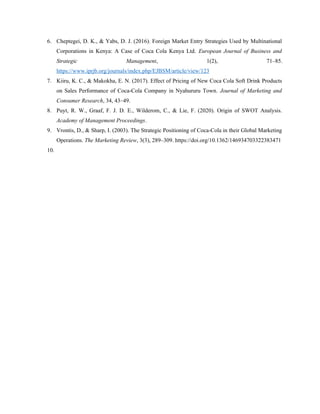
References
1. Edwards, J. (2018). Mastering Strategic Management: 1st Canadian Edition. Advances in Social
Science, Education and Humanities Research, volume 6072884.
2. Lacy-Nichols, J., Scrinis, G., & Carey, R. (2020). The evolution of Coca-Cola Australia’s soft
drink reformulation strategy 2003–2017: A thematic analysis of corporate documents. Food
Policy, 90(C).
3. Zhang, Z. (2019). Risk Analysis of Two Leader Drink Company: PepsiCo and Coca-Cola. Asian
Business Research, 4(3).
4. Nwokorie, O. V., & Devlieger, P. J. (2019). ‘We only got Coca-Cola’: Disability and the paradox
of (dis)empowerment in Southeast Nigeria. African Journal of Disability, 8.
5. Mialon, M., & Mialon, J. (2018). Analysis of corporate political activity strategies of the food
industry: evidence from France. Public Health Nutrition, 21(18).](https://image.slidesharecdn.com/cocacolachapter1revised-241114165041-7a211559/85/Coca-Cola-Chapter-1-Revised-docxUpdated-BUS-PG-Electronic-ethics-application-form_2324-1-docx-5-320.jpg)