
Collaborative consumption and creating
  shared value using online services:
Convergence of Social Media and Supply Chains

                Dr Suresh Sood

           Email: suresh.sood@uts.edu.au
                LinkedIn: sureshsood
                  Skype: sureshsood
                    Twitter: soody
           Google +: http://gplus.to/soody
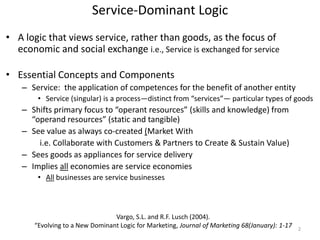
Service-Dominant Logic
• A logic that views service, rather than goods, as the focus of
  economic and social exchange i.e., Service is exchanged for service

• Essential Concepts and Components
    – Service: the application of competences for the benefit of another entity
        • Service (singular) is a process—distinct from “services”— particular types of goods
    – Shifts primary focus to “operant resources” (skills and knowledge) from
      “operand resources” (static and tangible)
    – See value as always co-created (Market With
        i.e. Collaborate with Customers & Partners to Create & Sustain Value)
    – Sees goods as appliances for service delivery
    – Implies all economies are service economies
        • All businesses are service businesses


                                 Vargo, S.L. and R.F. Lusch (2004).
       “Evolving to a New Dominant Logic for Marketing, Journal of Marketing 68(January): 1-17   2
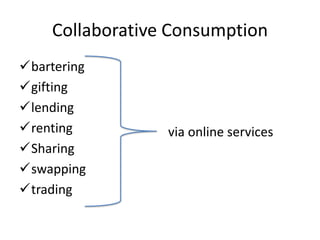
Collaborative Consumption
bartering
gifting
lending
renting         via online services
Sharing
swapping
trading
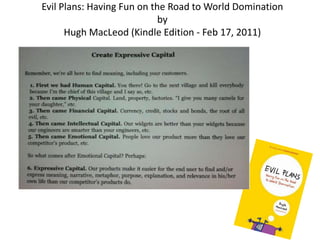
Evil Plans: Having Fun on the Road to World Domination
                            by
      Hugh MacLeod (Kindle Edition - Feb 17, 2011)
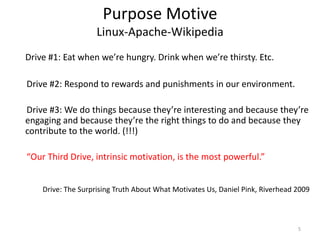
Purpose Motive
                    Linux-Apache-Wikipedia
Drive #1: Eat when we’re hungry. Drink when we’re thirsty. Etc.

Drive #2: Respond to rewards and punishments in our environment.

Drive #3: We do things because they’re interesting and because they’re
engaging and because they’re the right things to do and because they
contribute to the world. (!!!)

“Our Third Drive, intrinsic motivation, is the most powerful.”


    Drive: The Surprising Truth About What Motivates Us, Daniel Pink, Riverhead 2009


                                                                                5
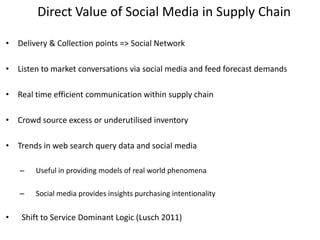
Direct Value of Social Media in Supply Chain

• Delivery & Collection points => Social Network

• Listen to market conversations via social media and feed forecast demands

• Real time efficient communication within supply chain

• Crowd source excess or underutilised inventory

• Trends in web search query data and social media

    –   Useful in providing models of real world phenomena

    –   Social media provides insights purchasing intentionality


•   Shift to Service Dominant Logic (Lusch 2011)
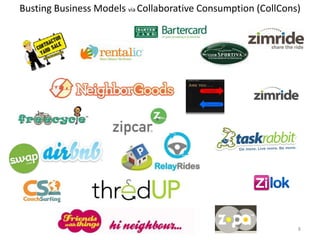
Busting Business Models via Collaborative Consumption (CollCons)


                                                               8
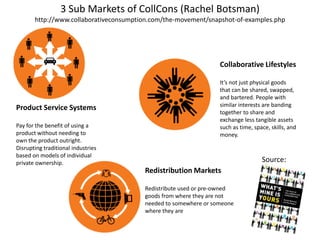
3 Sub Markets of CollCons (Rachel Botsman)
       http://www.collaborativeconsumption.com/the-movement/snapshot-of-examples.php


                                                                 Collaborative Lifestyles

                                                                 It’s not just physical goods
                                                                 that can be shared, swapped,
                                                                 and bartered. People with
                                                                 similar interests are banding
Product Service Systems
                                                                 together to share and
                                                                 exchange less tangible assets
Pay for the benefit of using a                                   such as time, space, skills, and
product without needing to                                       money.
own the product outright.
Disrupting traditional industries
based on models of individual
private ownership.                                                                Source:
                                        Redistribution Markets

                                        Redistribute used or pre-owned
                                        goods from where they are not
                                        needed to somewhere or someone
                                        where they are
http://meshing.it/companies
• platform facilitates carpooling and carsharing

• put passengers in touch with drivers – who are free to put

  a price on the rides they offer

• 100,000 passengers find rides through Comuto per month

• traffic has doubled since volcanic eruption in Iceland

                                                           11
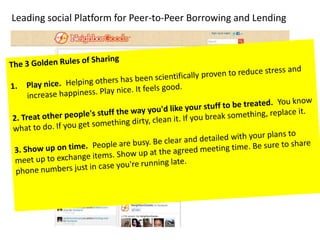
Leading social Platform for Peer-to-Peer Borrowing and Lending
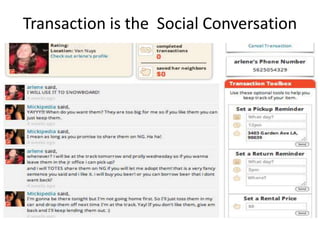
Transaction is the Social Conversation
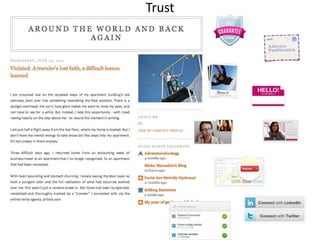
Trust
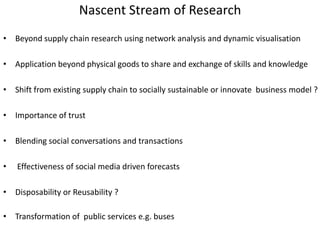
Nascent Stream of Research
• Beyond supply chain research using network analysis and dynamic visualisation

• Application beyond physical goods to share and exchange of skills and knowledge

• Shift from existing supply chain to socially sustainable or innovate business model ?

• Importance of trust

• Blending social conversations and transactions

•   Effectiveness of social media driven forecasts

• Disposability or Reusability ?

• Transformation of public services e.g. buses
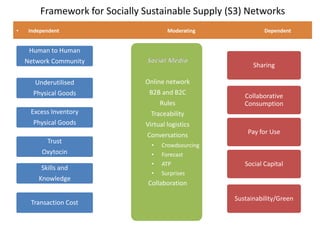
Framework for Socially Sustainable Supply (S3) Networks
•    Independent                        Moderating              Dependent


     Human to Human
    Network Community
                                                            Sharing

       Underutilised            Online network
      Physical Goods             B2B and B2C
                                                         Collaborative
                                      Rules              Consumption
     Excess Inventory             Traceability
      Physical Goods            Virtual logistics
                                 Conversations            Pay for Use
           Trust
                                  •   Crowdsourcing
         Oxytocin                 •   Forecast
                                  •   ATP                Social Capital
         Skills and
                                  •   Surprises
        Knowledge
                                 Collaboration

                                                      Sustainability/Green
     Transaction Cost
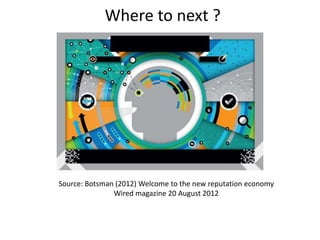
Where to next ?


Source: Botsman (2012) Welcome to the new reputation economy
               Wired magazine 20 August 2012
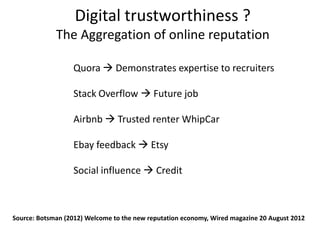
Digital trustworthiness ?
             The Aggregation of online reputation

                  Quora  Demonstrates expertise to recruiters

                  Stack Overflow  Future job

                  Airbnb  Trusted renter WhipCar

                  Ebay feedback  Etsy

                  Social influence  Credit


Source: Botsman (2012) Welcome to the new reputation economy, Wired magazine 20 August 2012
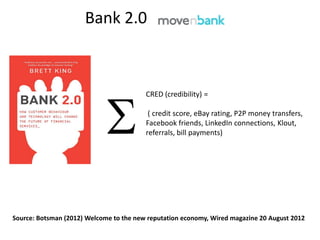
Bank 2.0


                                         CRED (credibility) =

                                          ( credit score, eBay rating, P2P money transfers,
                                         Facebook friends, LinkedIn connections, Klout,
                                         referrals, bill payments)


Source: Botsman (2012) Welcome to the new reputation economy, Wired magazine 20 August 2012
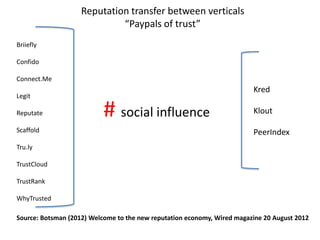
Reputation transfer between verticals
                             “Paypals of trust”
Briiefly

Confido

Connect.Me
                                                                         Kred
Legit

Reputate                   # social influence                            Klout

Scaffold                                                                 PeerIndex
Tru.ly

TrustCloud

TrustRank

WhyTrusted

Source: Botsman (2012) Welcome to the new reputation economy, Wired magazine 20 August 2012
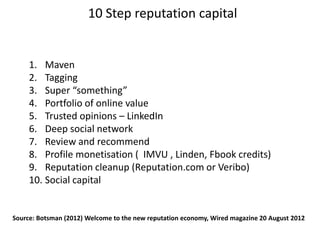
10 Step reputation capital


     1. Maven
     2. Tagging
     3. Super “something”
     4. Portfolio of online value
     5. Trusted opinions – LinkedIn
     6. Deep social network
     7. Review and recommend
     8. Profile monetisation ( IMVU , Linden, Fbook credits)
     9. Reputation cleanup (Reputation.com or Veribo)
     10. Social capital


Source: Botsman (2012) Welcome to the new reputation economy, Wired magazine 20 August 2012
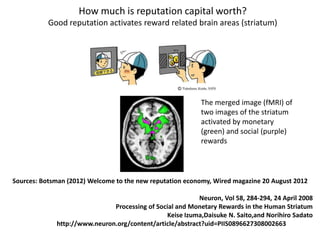
How much is reputation capital worth?
           Good reputation activates reward related brain areas (striatum)


                                                           The merged image (fMRI) of
                                                           two images of the striatum
                                                           activated by monetary
                                                           (green) and social (purple)
                                                           rewards


Sources: Botsman (2012) Welcome to the new reputation economy, Wired magazine 20 August 2012

                                                          Neuron, Vol 58, 284-294, 24 April 2008
                              Processing of Social and Monetary Rewards in the Human Striatum
                                               Keise Izuma,Daisuke N. Saito,and Norihiro Sadato
             http://www.neuron.org/content/article/abstract?uid=PIIS0896627308002663

Lecture 6 collaborative consumption and creating shared value using onlne services (24104) v1

  • 1.
    Collaborative consumption andcreating shared value using online services: Convergence of Social Media and Supply Chains Dr Suresh Sood Email: suresh.sood@uts.edu.au LinkedIn: sureshsood Skype: sureshsood Twitter: soody Google +: http://gplus.to/soody
  • 2.
    Service-Dominant Logic • Alogic that views service, rather than goods, as the focus of economic and social exchange i.e., Service is exchanged for service • Essential Concepts and Components – Service: the application of competences for the benefit of another entity • Service (singular) is a process—distinct from “services”— particular types of goods – Shifts primary focus to “operant resources” (skills and knowledge) from “operand resources” (static and tangible) – See value as always co-created (Market With i.e. Collaborate with Customers & Partners to Create & Sustain Value) – Sees goods as appliances for service delivery – Implies all economies are service economies • All businesses are service businesses Vargo, S.L. and R.F. Lusch (2004). “Evolving to a New Dominant Logic for Marketing, Journal of Marketing 68(January): 1-17 2
  • 3.
    Collaborative Consumption bartering gifting lending renting via online services Sharing swapping trading
  • 4.
    Evil Plans: HavingFun on the Road to World Domination by Hugh MacLeod (Kindle Edition - Feb 17, 2011)
  • 5.
    Purpose Motive Linux-Apache-Wikipedia Drive #1: Eat when we’re hungry. Drink when we’re thirsty. Etc. Drive #2: Respond to rewards and punishments in our environment. Drive #3: We do things because they’re interesting and because they’re engaging and because they’re the right things to do and because they contribute to the world. (!!!) “Our Third Drive, intrinsic motivation, is the most powerful.” Drive: The Surprising Truth About What Motivates Us, Daniel Pink, Riverhead 2009 5
  • 7.
    Direct Value ofSocial Media in Supply Chain • Delivery & Collection points => Social Network • Listen to market conversations via social media and feed forecast demands • Real time efficient communication within supply chain • Crowd source excess or underutilised inventory • Trends in web search query data and social media – Useful in providing models of real world phenomena – Social media provides insights purchasing intentionality • Shift to Service Dominant Logic (Lusch 2011)
  • 8.
    Busting Business Modelsvia Collaborative Consumption (CollCons) 8
  • 9.
    3 Sub Marketsof CollCons (Rachel Botsman) http://www.collaborativeconsumption.com/the-movement/snapshot-of-examples.php Collaborative Lifestyles It’s not just physical goods that can be shared, swapped, and bartered. People with similar interests are banding Product Service Systems together to share and exchange less tangible assets Pay for the benefit of using a such as time, space, skills, and product without needing to money. own the product outright. Disrupting traditional industries based on models of individual private ownership. Source: Redistribution Markets Redistribute used or pre-owned goods from where they are not needed to somewhere or someone where they are
  • 10.
  • 11.
    • platform facilitatescarpooling and carsharing • put passengers in touch with drivers – who are free to put a price on the rides they offer • 100,000 passengers find rides through Comuto per month • traffic has doubled since volcanic eruption in Iceland 11
  • 12.
    Leading social Platformfor Peer-to-Peer Borrowing and Lending
  • 13.
    Transaction is theSocial Conversation
  • 14.
  • 15.
    Nascent Stream ofResearch • Beyond supply chain research using network analysis and dynamic visualisation • Application beyond physical goods to share and exchange of skills and knowledge • Shift from existing supply chain to socially sustainable or innovate business model ? • Importance of trust • Blending social conversations and transactions • Effectiveness of social media driven forecasts • Disposability or Reusability ? • Transformation of public services e.g. buses
  • 16.
    Framework for SociallySustainable Supply (S3) Networks • Independent Moderating Dependent Human to Human Network Community Sharing Underutilised Online network Physical Goods B2B and B2C Collaborative Rules Consumption Excess Inventory Traceability Physical Goods Virtual logistics Conversations Pay for Use Trust • Crowdsourcing Oxytocin • Forecast • ATP Social Capital Skills and • Surprises Knowledge Collaboration Sustainability/Green Transaction Cost
  • 17.
    Where to next? Source: Botsman (2012) Welcome to the new reputation economy Wired magazine 20 August 2012
  • 18.
    Digital trustworthiness ? The Aggregation of online reputation Quora  Demonstrates expertise to recruiters Stack Overflow  Future job Airbnb  Trusted renter WhipCar Ebay feedback  Etsy Social influence  Credit Source: Botsman (2012) Welcome to the new reputation economy, Wired magazine 20 August 2012
  • 19.
    Bank 2.0 CRED (credibility) = ( credit score, eBay rating, P2P money transfers, Facebook friends, LinkedIn connections, Klout, referrals, bill payments) Source: Botsman (2012) Welcome to the new reputation economy, Wired magazine 20 August 2012
  • 20.
    Reputation transfer betweenverticals “Paypals of trust” Briiefly Confido Connect.Me Kred Legit Reputate # social influence Klout Scaffold PeerIndex Tru.ly TrustCloud TrustRank WhyTrusted Source: Botsman (2012) Welcome to the new reputation economy, Wired magazine 20 August 2012
  • 21.
    10 Step reputationcapital 1. Maven 2. Tagging 3. Super “something” 4. Portfolio of online value 5. Trusted opinions – LinkedIn 6. Deep social network 7. Review and recommend 8. Profile monetisation ( IMVU , Linden, Fbook credits) 9. Reputation cleanup (Reputation.com or Veribo) 10. Social capital Source: Botsman (2012) Welcome to the new reputation economy, Wired magazine 20 August 2012
  • 22.
    How much isreputation capital worth? Good reputation activates reward related brain areas (striatum) The merged image (fMRI) of two images of the striatum activated by monetary (green) and social (purple) rewards Sources: Botsman (2012) Welcome to the new reputation economy, Wired magazine 20 August 2012 Neuron, Vol 58, 284-294, 24 April 2008 Processing of Social and Monetary Rewards in the Human Striatum Keise Izuma,Daisuke N. Saito,and Norihiro Sadato http://www.neuron.org/content/article/abstract?uid=PIIS0896627308002663

Editor's Notes

  • #8 Social media = sharing and connecting people = media + networking : synergistic with supply chain and info sharingSocial Network = People including access to experts or products (via RFID)Listening provides risk identification e.g. early warning, combine with transactional dataCrowd source ideas
  • #9 Sharing and bartering of goods and services onlineAirbnbZipcartarnsportation serviceAdoption specific web-sharing categories:Home/place sharingCar sharingParking sharingClothes sharingLand/garden sharingTools/equipment sharingOffice-space sharing
  • #16 Supply chain networks = f(relationships) structure matters but relationships matter more