__ 
__ 
VIEWS ON 
COLLABORATIVE CONSUMPTION 
A Presentation based on the dissertation La location entre particuliers ou la remise en cause d’un modèle de consommation fondé 
sur la propriété - Alexandra Penel - Master Information & Communication - CELSA-Paris IV - July 2014
Collaborative consumption may frighten brands 
as it seems to radically question the model 
of our society.
It is said to point out “the slow down of 
today’s global economic model” 
Tout se loue sur Internet, mais à quel prix - Le Figaro - 09.02.2012
Of which it would initiate the end : 
“It is not a crisis, it is a world change.” 
Michel Serres
Companies would lose their power : 
”a lifestyle that puts the economic initiative 
into the hands of civil society.“ 
La révolution du partage - Le Monde - 20.09.2013
And Brands would be losing their sex appeal : 
“We are looking for functionality” 
Question de choix - France Info - 20.12.2013
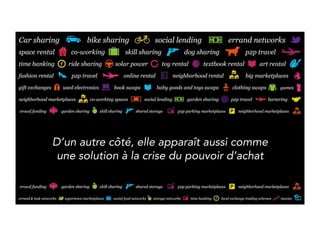
On the other hand, it might also be seen as 
a solution to the reduction in purchasing power.
To environmental damage : 
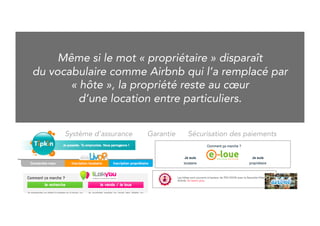
“Collaborative consumption comes 
alongside sustainable consumption” 
Kiwizz
Even to the immorality of our system: 
“Collaborative practices illustrate the birth of 
a world where help replaces selfishness.” 
La révolution du partage - Le Monde - 20.09.2013
Maybe because it would bring back together 
our capitalist system with socialist values.
“Perhaps what is the most exciting about 
Collaborative Consumption is that it fulfills 
both the hardened expectations on both sides of 
the socialist and capitalist ideological spectrum 
without being an ideology in itself.” 
What is mine is yours - Rachel Botsman & Roo Rogers
Whether it seduces or frightens, 
collaborative consumption is everyone’s concern, 
as it seems to disrupt the world we all know.
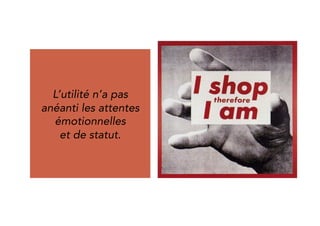
How far does 
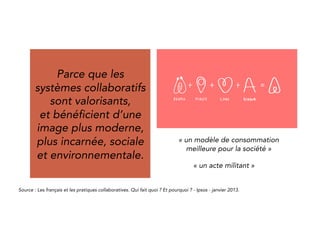
collaborative consumption 
create a new society model?
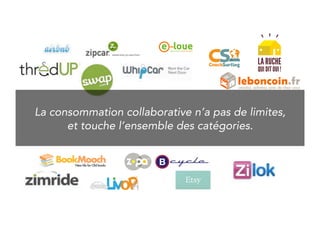
Collaborative consumption has no limits, 
and can be found in all categories.
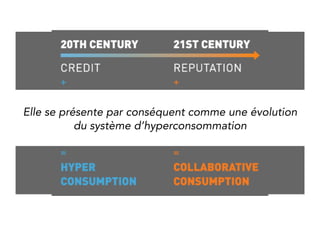
Therefore it presents itself as an evolution 
of the hyper-consumption system.
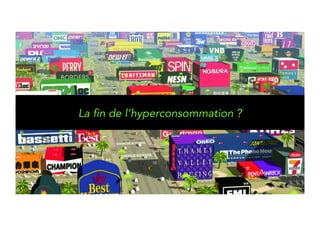
The end of hyper-consumption?
“We are not 
always happy to hyper-consume“ 
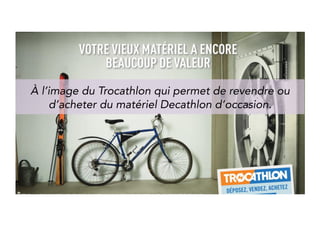
The Age of Acces - Jeremy Rifkin
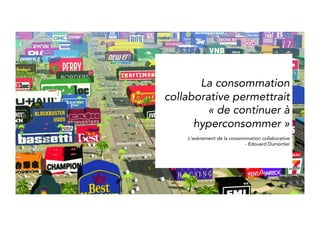
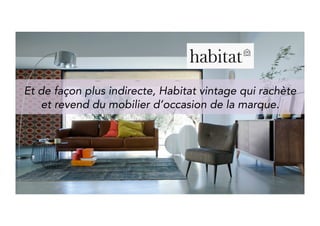
Collaborative 
consumption would be 
a way to “continue hyper-consumming” 
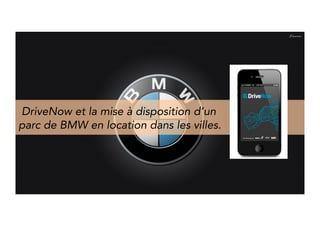
L’avènement de la consommation collaborative 
- Edouard Dumortier
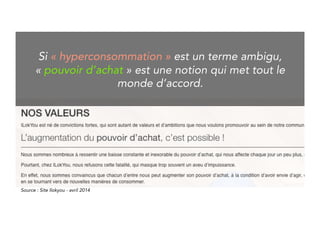
Whereas “hyper-consumption” is ambiguous, 
“purchasing power” brings everyone together. 
Source : Igobono - 2014
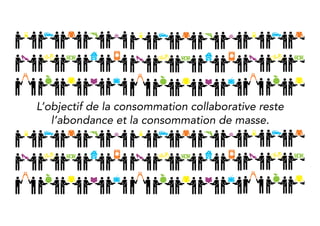
Therefore, collaborative consumption is a next step to a 
model based on abundance and mass-consumption.
SHARE 
The difference is it boasts 
moral values which today’s system would lack.
The end of ownership and 
the birth of the sharing era ?
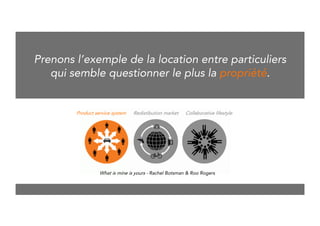
Let’s take the example of peer-to-peer renting, 
which seems to question ownership the most. 
Redistibution market 
Product service systemCollaborative lifestyle 
What is mine is yours - Rachel Botsman & Roo Rogers
Even if “owner” has disappeared from 
the vocabulary of brands like Airbnb (which has 
replaced it by « host »), ownership remains at the heart 
of peer-to-peer rental services. 
Insurance system 
Guaranty 
Safety technologies
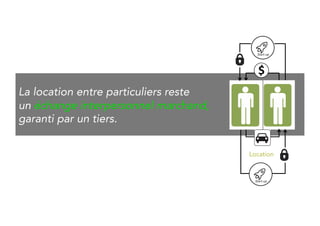
Peer-to-peer renting remains a 
trade exchange between 2 parties, 
secured by a third party. 
Start-up 
$ 
Location 
Start-up
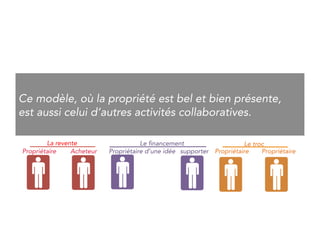
This model, where ownership remains dominant, 
also applies to other collaborative activities. 
Second hand market 
Owner 
Buyer 
Crowdfunding 
Swapping 
Idea owner 
Supporter 
Owner 
Owner
Ownership is questioned for only one side 
of the trading exchange: the consumer, 
who no longer needs to own in order to use.
For the owner, the goal is to make 
objects more profitable by extending their usage 
through renting, reselling, swapping…
Collaborative consumption is thus not 
a sharing of our goods, 
but the monetization of ownership.
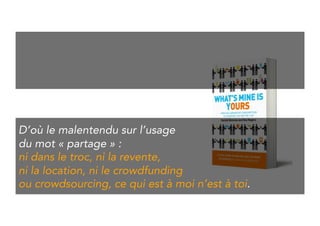
This explains the misunderstanding 
on the word « share » : 
be it trough swapping, reselling, 
renting, crowd funding or crowd sourcing, 
what is mine is actually never yours.
Rather than a model revolution, 
collaborative consumption is 
an evolution in the means of access.
Alongside these new access possibilities, 
arbitrations are becoming more and more sophisticated 
and consumers more and more experts.
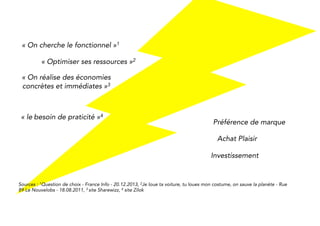
We might think that these arbitrations are made 
between the rational and the emotional.
“We are looking for functionality”1 
“Optimise resources”2 
“You can save concrete and 
immediate money“3 
“The need for 
convenience”4 
Brand preference 
Pleasure buying 
Investment 
Sources : 1Question de choix - France Info - 20.12.2013, 2Je loue ta voiture, tu loues mon costume, on sauve la planète - Rue 
89 Le Nouvelobs - 18.08.2011, 3 site Sharewizz, 4 site Zilok
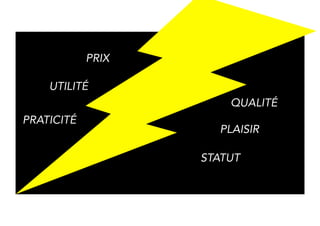
CONVENIENCE 
UTILITY 
PRICE 
QUALITY 
PLEASURE 
STATUS
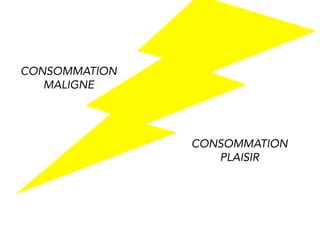
SMART 
CONSUMPTION 
PLAISIR 
INDULGENCE 
CONSUMPTION
Yet collaborative 
consumption 
intensifies the needs 
for quality and service.
Because it makes the 
access to brands 
considered as more 
qualitative 
than low-cost offers 
easier. 
“it gives you the opportunity to have 
access to some things that you 
wouldn’t have bought.” 
“Good value for money” 
“For occasional works, a handyman 
won’t invest in high performance tools 
because of the price. Yet the 
difference on usage and results 
between a 15€ and a 100€ grinder at 
is real. Peer-to-peer renting helps to 
avoid that.“ 
Source : qualitative group organized in April 2013, and exchange with peer-to-peer renters.
And because the 
peer-to-peer process 
requires a high level of 
service to secure the 
exchange. 
“There is a certain amount of bother.” 
“The fact that it’s between individuals 
is rather a handicap because there is a 
risk on quality.” 
“you need a trusted third party” 
Source : qualitative group organized in April 2013, and exchange with peer-to-peer renters.
Rather than the search for the lowest price 
or the sign of disenchantment about brands, 
collaborative practices are seen as 
an affordable way to have access to quality.
In this way, collaborative consumption 
probably threatens low-cost products 
more than premium brands.
Des arbitrages de 
Utility did not kill 
emotional and 
status needs. 
plus en plus 
conscients et 
sophistiqués.
Because collaborative 
technologies are 
valorising and benefit 
from a more modern, 
embodied, social and 
environmental image. 
Des arbitrages de 
plus en plus 
conscients et 
sophistiqués. 
“A better consumption model 
for society” 
“an activist practice” 
Source : qualitative group organized in April 2013, and exchange with peer-to-peer renters.
Because these 
solutions reveal our 
emotional relationship 
Des arbitrages de 
plus en plus 
conscients et 
sophistiqués. 
to some objects, 
rather than 
questioning it. 
“Me, I’d rather have an affordable 
dress, from Zara or H&M, 
but my own one.“ 
“I like to keep my books, but my man 
buys books and then throw them 
away.” 
“Some people have a convenient 
relation to their cars. And for others 
it is status.” 
Source : qualitative group organized in April 2013, and exchange with peer-to-peer renters.
Beyond a purely rational usage, 
our consumption choices remain a way to 
express status and reveal our relationship to 
objects.
In the end, collaborative practices don’t create 
«anti-consumers» who hate brands, 
but expert consumers, empowered by a diversity of 
solutions to satisfy their needs for quality and status.
Collaborative consumption is 
neither the end of capitalism and ownership, 
nor the end of a model based on consumption, 
nor the birth of a doubting consumer.
On the contrary, we can see it as the generalization of 
trade at the scale of individual, a society of hyper 
liberalism where every owner can be a business man 
and where capitalism has entered our sellers.
Which means, far from being a threat, 
it is an opportunity for the established brands.
1Secure peer-to-peer exc 
hanges
1 
It means 
to offer platforms which make peer-to-peer exchanges 
easier and which will ensure the quality of both 
deal and exchanged good.
Like Trocathlon that allows to sell and buy second-hand 
goods at Decathlon, France’s leading sports retailer.
Or indirectly, Habitat vintage which buys and sells 
old second hand furniture of its brand.
Widen2 the user target, beyond t 
he buyer target.
2 
It means 
to offer not only the purchase, 
but also the renting of the stocks.
DriveNow and the ability to rent a 
varied fleet of BMW cars in German cities.
Sh3are the conception of your 
projects
3It means 
switch from “client” to “shareholder”.
By offering to anyone the opportunity 
to finance a project.
Or by simply using the existing crowd sourcing 
platforms, like Popularise or Quirky to fund future 
projects and products.
M4ake your network more pr 
ofitable 
by creating services for the collaborative economy.
4 
It means 
to provide spaces in your network, 
where people could exchange, which is a way to deliver 
a new service, while driving new traffic to your store.
When will it be possible to withdraw or deliver 
swapped, rented, or second-hand products at your Post 
office, your usual retailer, or your newspaper seller?
5Widen your brand experi 
ence 
to new services.
5 
It means 
offering added services, next to purchase, 
and offering a global solution to your customers.
For example, when will it be possible to rent 
a steam stripper or a sander at Ikea ?
These are only 5 applications 
among a lot of future models …

Collaborative consumption Alexandra Penel english

  • 1.
    __ __ VIEWSON COLLABORATIVE CONSUMPTION A Presentation based on the dissertation La location entre particuliers ou la remise en cause d’un modèle de consommation fondé sur la propriété - Alexandra Penel - Master Information & Communication - CELSA-Paris IV - July 2014
  • 2.
    Collaborative consumption mayfrighten brands as it seems to radically question the model of our society.
  • 3.
    It is saidto point out “the slow down of today’s global economic model” Tout se loue sur Internet, mais à quel prix - Le Figaro - 09.02.2012
  • 4.
    Of which itwould initiate the end : “It is not a crisis, it is a world change.” Michel Serres
  • 5.
    Companies would losetheir power : ”a lifestyle that puts the economic initiative into the hands of civil society.“ La révolution du partage - Le Monde - 20.09.2013
  • 6.
    And Brands wouldbe losing their sex appeal : “We are looking for functionality” Question de choix - France Info - 20.12.2013
  • 7.
    On the otherhand, it might also be seen as a solution to the reduction in purchasing power.
  • 8.
    To environmental damage: “Collaborative consumption comes alongside sustainable consumption” Kiwizz
  • 9.
    Even to theimmorality of our system: “Collaborative practices illustrate the birth of a world where help replaces selfishness.” La révolution du partage - Le Monde - 20.09.2013
  • 10.
    Maybe because itwould bring back together our capitalist system with socialist values.
  • 11.
    “Perhaps what isthe most exciting about Collaborative Consumption is that it fulfills both the hardened expectations on both sides of the socialist and capitalist ideological spectrum without being an ideology in itself.” What is mine is yours - Rachel Botsman & Roo Rogers
  • 12.
    Whether it seducesor frightens, collaborative consumption is everyone’s concern, as it seems to disrupt the world we all know.
  • 13.
    How far does collaborative consumption create a new society model?
  • 14.
    Collaborative consumption hasno limits, and can be found in all categories.
  • 15.
    Therefore it presentsitself as an evolution of the hyper-consumption system.
  • 16.
    The end ofhyper-consumption?
  • 17.
    “We are not always happy to hyper-consume“ The Age of Acces - Jeremy Rifkin
  • 18.
    Collaborative consumption wouldbe a way to “continue hyper-consumming” L’avènement de la consommation collaborative - Edouard Dumortier
  • 19.
    Whereas “hyper-consumption” isambiguous, “purchasing power” brings everyone together. Source : Igobono - 2014
  • 20.
    Therefore, collaborative consumptionis a next step to a model based on abundance and mass-consumption.
  • 21.
    SHARE The differenceis it boasts moral values which today’s system would lack.
  • 23.
    The end ofownership and the birth of the sharing era ?
  • 24.
    Let’s take theexample of peer-to-peer renting, which seems to question ownership the most. Redistibution market Product service systemCollaborative lifestyle What is mine is yours - Rachel Botsman & Roo Rogers
  • 25.
    Even if “owner”has disappeared from the vocabulary of brands like Airbnb (which has replaced it by « host »), ownership remains at the heart of peer-to-peer rental services. Insurance system Guaranty Safety technologies
  • 26.
    Peer-to-peer renting remainsa trade exchange between 2 parties, secured by a third party. Start-up $ Location Start-up
  • 27.
    This model, whereownership remains dominant, also applies to other collaborative activities. Second hand market Owner Buyer Crowdfunding Swapping Idea owner Supporter Owner Owner
  • 28.
    Ownership is questionedfor only one side of the trading exchange: the consumer, who no longer needs to own in order to use.
  • 29.
    For the owner,the goal is to make objects more profitable by extending their usage through renting, reselling, swapping…
  • 30.
    Collaborative consumption isthus not a sharing of our goods, but the monetization of ownership.
  • 31.
    This explains themisunderstanding on the word « share » : be it trough swapping, reselling, renting, crowd funding or crowd sourcing, what is mine is actually never yours.
  • 32.
    Rather than amodel revolution, collaborative consumption is an evolution in the means of access.
  • 33.
    Alongside these newaccess possibilities, arbitrations are becoming more and more sophisticated and consumers more and more experts.
  • 34.
    We might thinkthat these arbitrations are made between the rational and the emotional.
  • 35.
    “We are lookingfor functionality”1 “Optimise resources”2 “You can save concrete and immediate money“3 “The need for convenience”4 Brand preference Pleasure buying Investment Sources : 1Question de choix - France Info - 20.12.2013, 2Je loue ta voiture, tu loues mon costume, on sauve la planète - Rue 89 Le Nouvelobs - 18.08.2011, 3 site Sharewizz, 4 site Zilok
  • 36.
    CONVENIENCE UTILITY PRICE QUALITY PLEASURE STATUS
  • 37.
    SMART CONSUMPTION PLAISIR INDULGENCE CONSUMPTION
  • 38.
    Yet collaborative consumption intensifies the needs for quality and service.
  • 39.
    Because it makesthe access to brands considered as more qualitative than low-cost offers easier. “it gives you the opportunity to have access to some things that you wouldn’t have bought.” “Good value for money” “For occasional works, a handyman won’t invest in high performance tools because of the price. Yet the difference on usage and results between a 15€ and a 100€ grinder at is real. Peer-to-peer renting helps to avoid that.“ Source : qualitative group organized in April 2013, and exchange with peer-to-peer renters.
  • 40.
    And because the peer-to-peer process requires a high level of service to secure the exchange. “There is a certain amount of bother.” “The fact that it’s between individuals is rather a handicap because there is a risk on quality.” “you need a trusted third party” Source : qualitative group organized in April 2013, and exchange with peer-to-peer renters.
  • 41.
    Rather than thesearch for the lowest price or the sign of disenchantment about brands, collaborative practices are seen as an affordable way to have access to quality.
  • 42.
    In this way,collaborative consumption probably threatens low-cost products more than premium brands.
  • 43.
    Des arbitrages de Utility did not kill emotional and status needs. plus en plus conscients et sophistiqués.
  • 44.
    Because collaborative technologiesare valorising and benefit from a more modern, embodied, social and environmental image. Des arbitrages de plus en plus conscients et sophistiqués. “A better consumption model for society” “an activist practice” Source : qualitative group organized in April 2013, and exchange with peer-to-peer renters.
  • 45.
    Because these solutionsreveal our emotional relationship Des arbitrages de plus en plus conscients et sophistiqués. to some objects, rather than questioning it. “Me, I’d rather have an affordable dress, from Zara or H&M, but my own one.“ “I like to keep my books, but my man buys books and then throw them away.” “Some people have a convenient relation to their cars. And for others it is status.” Source : qualitative group organized in April 2013, and exchange with peer-to-peer renters.
  • 46.
    Beyond a purelyrational usage, our consumption choices remain a way to express status and reveal our relationship to objects.
  • 47.
    In the end,collaborative practices don’t create «anti-consumers» who hate brands, but expert consumers, empowered by a diversity of solutions to satisfy their needs for quality and status.
  • 48.
    Collaborative consumption is neither the end of capitalism and ownership, nor the end of a model based on consumption, nor the birth of a doubting consumer.
  • 49.
    On the contrary,we can see it as the generalization of trade at the scale of individual, a society of hyper liberalism where every owner can be a business man and where capitalism has entered our sellers.
  • 50.
    Which means, farfrom being a threat, it is an opportunity for the established brands.
  • 51.
  • 52.
    1 It means to offer platforms which make peer-to-peer exchanges easier and which will ensure the quality of both deal and exchanged good.
  • 53.
    Like Trocathlon thatallows to sell and buy second-hand goods at Decathlon, France’s leading sports retailer.
  • 54.
    Or indirectly, Habitatvintage which buys and sells old second hand furniture of its brand.
  • 55.
    Widen2 the usertarget, beyond t he buyer target.
  • 56.
    2 It means to offer not only the purchase, but also the renting of the stocks.
  • 57.
    DriveNow and theability to rent a varied fleet of BMW cars in German cities.
  • 58.
    Sh3are the conceptionof your projects
  • 59.
    3It means switchfrom “client” to “shareholder”.
  • 60.
    By offering toanyone the opportunity to finance a project.
  • 61.
    Or by simplyusing the existing crowd sourcing platforms, like Popularise or Quirky to fund future projects and products.
  • 62.
    M4ake your networkmore pr ofitable by creating services for the collaborative economy.
  • 63.
    4 It means to provide spaces in your network, where people could exchange, which is a way to deliver a new service, while driving new traffic to your store.
  • 64.
    When will itbe possible to withdraw or deliver swapped, rented, or second-hand products at your Post office, your usual retailer, or your newspaper seller?
  • 65.
    5Widen your brandexperi ence to new services.
  • 66.
    5 It means offering added services, next to purchase, and offering a global solution to your customers.
  • 67.
    For example, whenwill it be possible to rent a steam stripper or a sander at Ikea ?
  • 68.
    These are only5 applications among a lot of future models …

Editor's Notes

  • #44 Par contre, la location entre particuliers traduit pour moi d’une consommation plus consciente, et plus sophistiquée. Plus conscients parce qu’elle porte de forte attente sociale. Si les consommateurs ne disent pas qu’elle est écologique, ils nous disent au moins qu’elle est sociale. Pourquoi, on n’a pas d’explication, mais le fait qu’ils le disent signifie qu’ils sont conscients de l’impact de leur consommation sur le monde qui les entoure. Plus sophistiqué car les consommateurs ont plus de possibilité et d’arbitrages à faire : non seulement ils doivent choisir un objet, mais ils doivent aussi choisir par quel moyen ils veulent accéder à l’objet.
  • #45 Par contre, la location entre particuliers traduit pour moi d’une consommation plus consciente, et plus sophistiquée. Plus conscients parce qu’elle porte de forte attente sociale. Si les consommateurs ne disent pas qu’elle est écologique, ils nous disent au moins qu’elle est sociale. Pourquoi, on n’a pas d’explication, mais le fait qu’ils le disent signifie qu’ils sont conscients de l’impact de leur consommation sur le monde qui les entoure. Plus sophistiqué car les consommateurs ont plus de possibilité et d’arbitrages à faire : non seulement ils doivent choisir un objet, mais ils doivent aussi choisir par quel moyen ils veulent accéder à l’objet.
  • #46 Par contre, la location entre particuliers traduit pour moi d’une consommation plus consciente, et plus sophistiquée. Plus conscients parce qu’elle porte de forte attente sociale. Si les consommateurs ne disent pas qu’elle est écologique, ils nous disent au moins qu’elle est sociale. Pourquoi, on n’a pas d’explication, mais le fait qu’ils le disent signifie qu’ils sont conscients de l’impact de leur consommation sur le monde qui les entoure. Plus sophistiqué car les consommateurs ont plus de possibilité et d’arbitrages à faire : non seulement ils doivent choisir un objet, mais ils doivent aussi choisir par quel moyen ils veulent accéder à l’objet.