HYPE User Forum
  14/15th June 2012
Haydn Shaughnessy
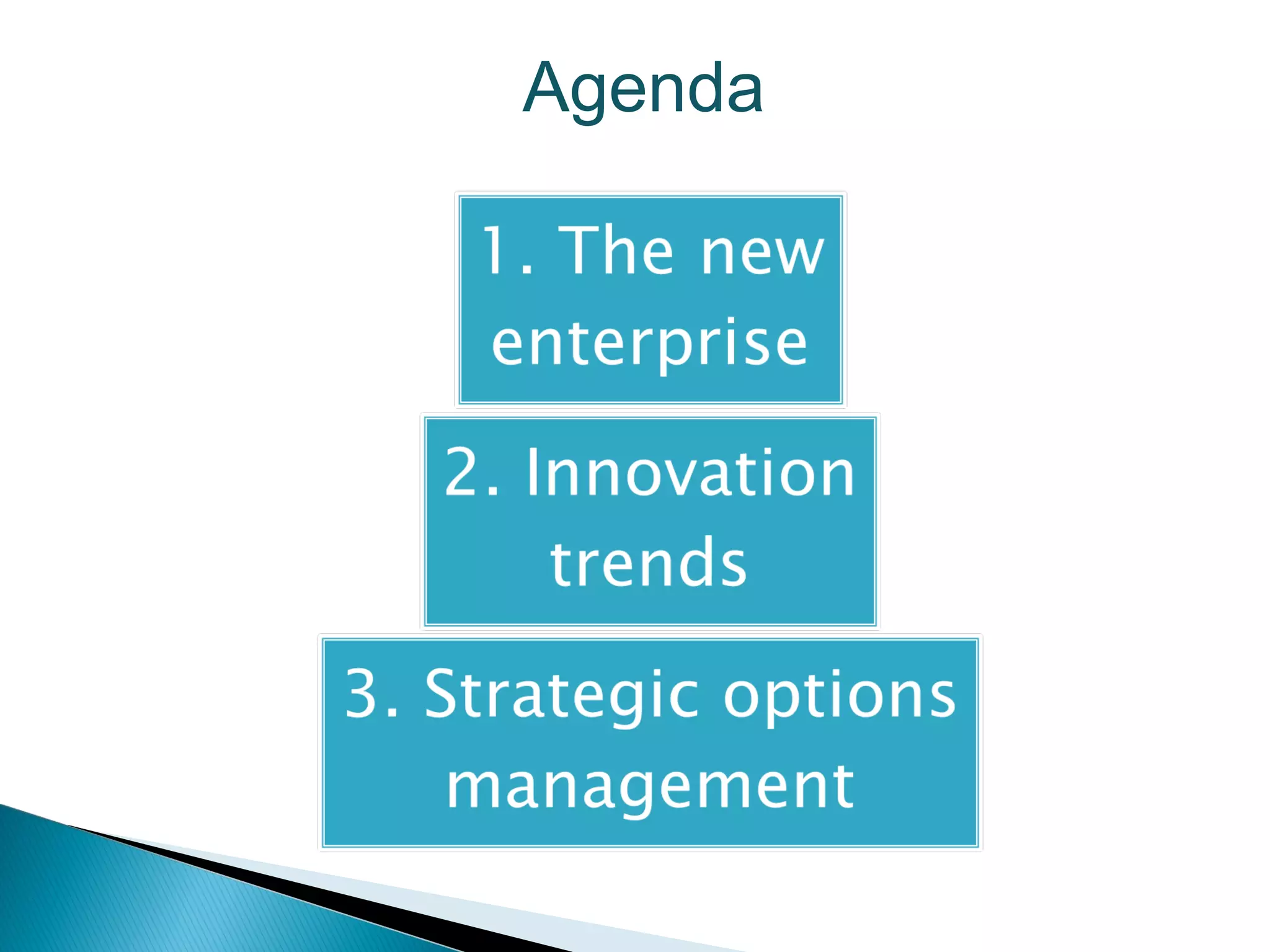
Agenda
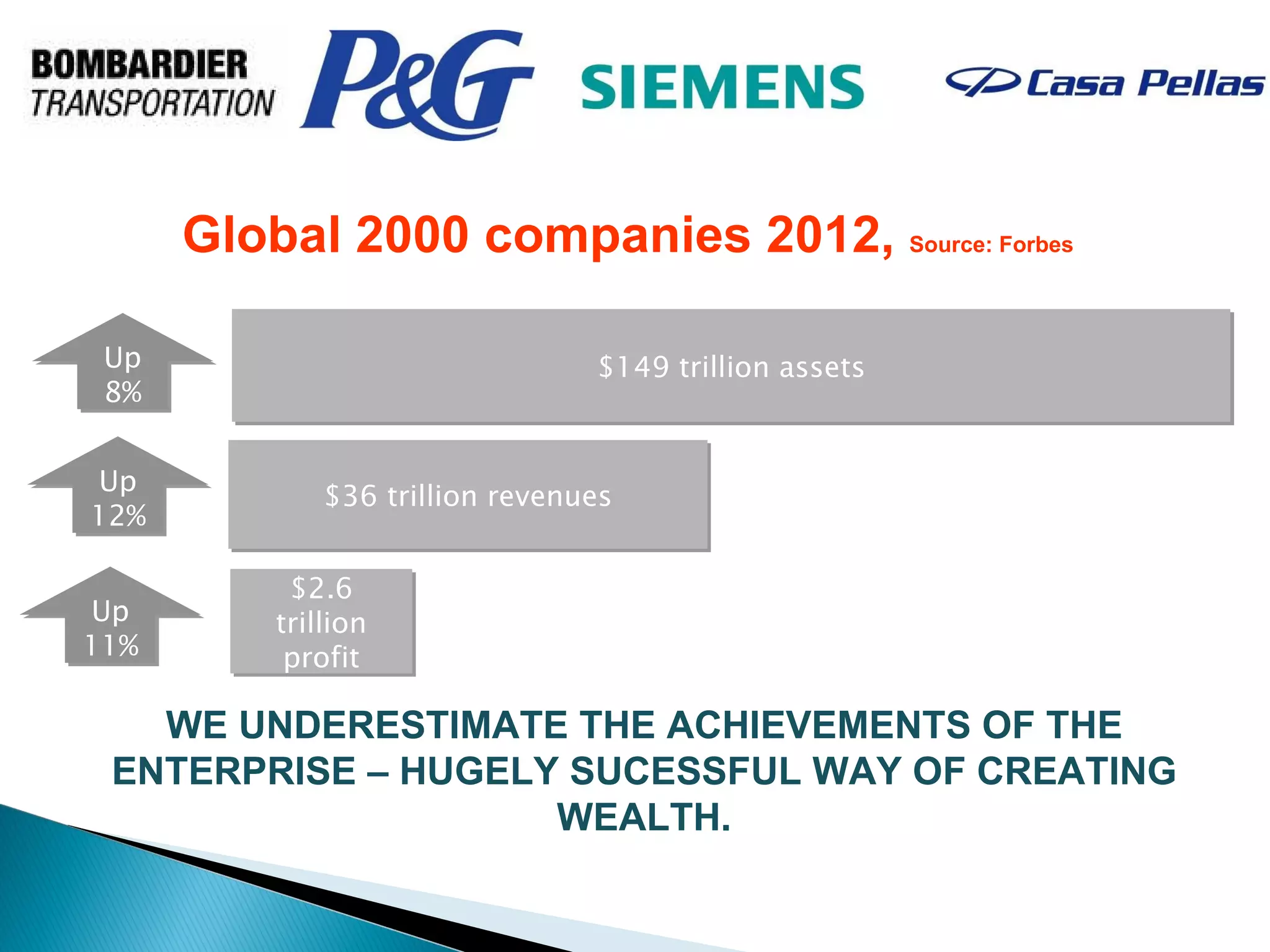
Global 2000 companies 2012, Source: Forbes

 Up                              $149 trillion assets
 8%


Up
              $36 trillion revenues
12%

           $2.6
Up        trillion
11%        profit

   WE UNDERESTIMATE THE ACHIEVEMENTS OF THE
 ENTERPRISE – HUGELY SUCESSFUL WAY OF CREATING
                    WEALTH.
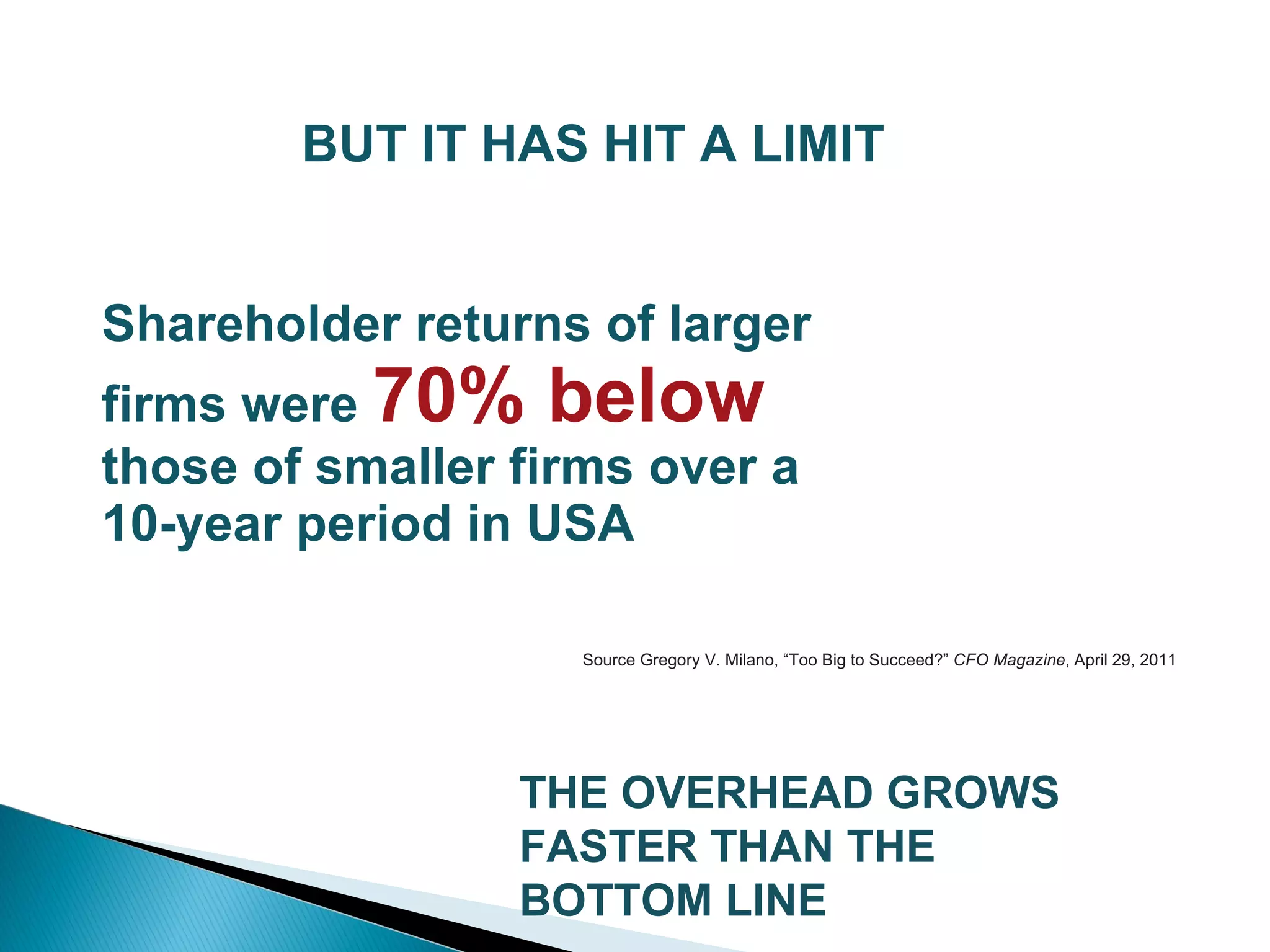
BUT IT HAS HIT A LIMIT


Shareholder returns of larger
firms were 70% below
those of smaller firms over a
10-year period in USA

                   Source Gregory V. Milano, “Too Big to Succeed?” CFO Magazine, April 29, 2011


                 THE OVERHEAD GROWS
                 FASTER THAN THE
                 BOTTOM LINE
Changes in the economy that bring pressures to
innovate


 2.The opportunity of the new globally connected
 middle class
   2. The global innovation race

       3. Digital – physical convergence (or-
       dematerialization)

             4. Disruption in the value chain

                 5. The loss of oligopoly power
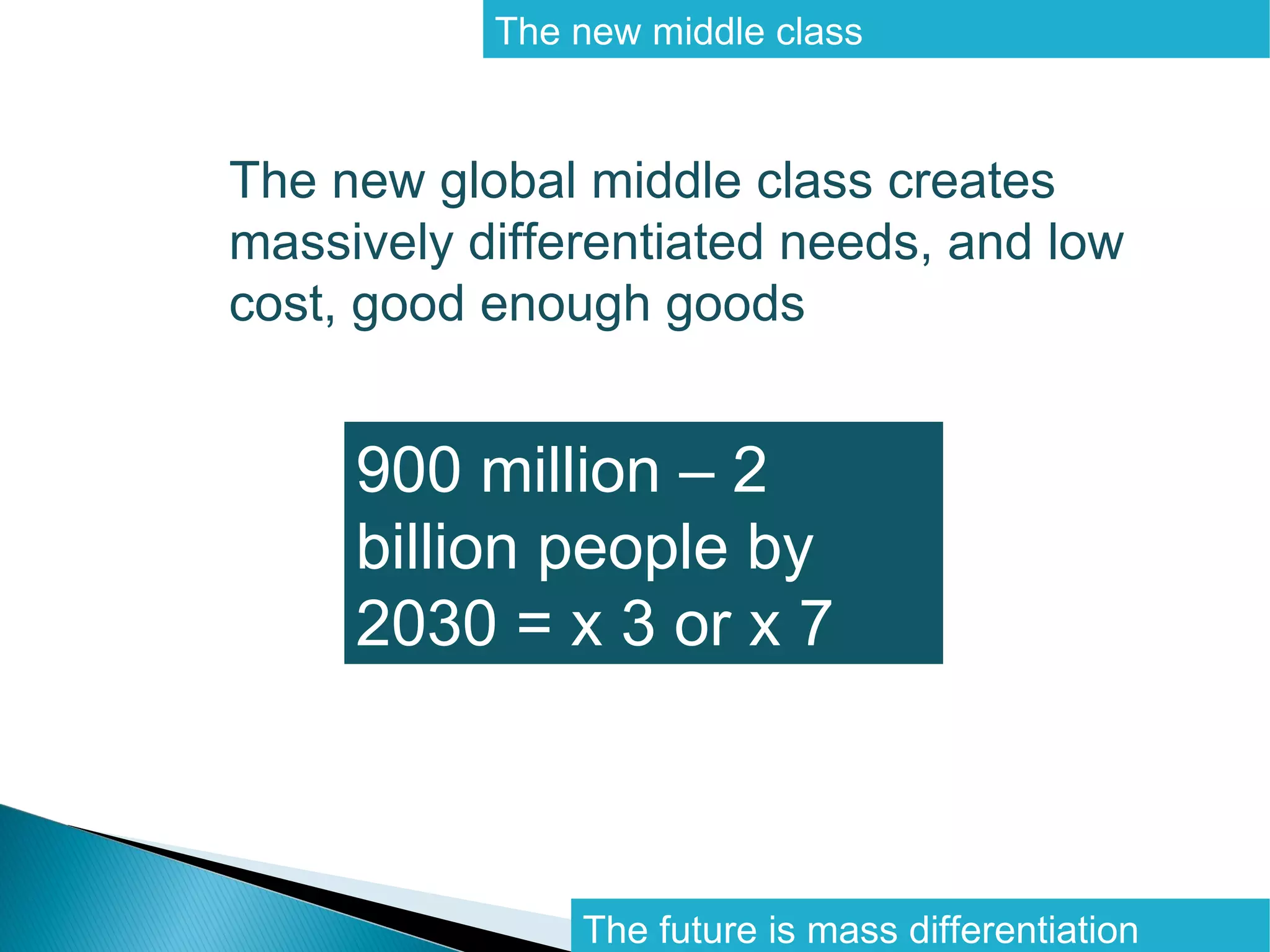
The new middle class


The new global middle class creates
massively differentiated needs, and low
cost, good enough goods


     900 million – 2
     billion people by
     2030 = x 3 or x 7


               The future is mass differentiation
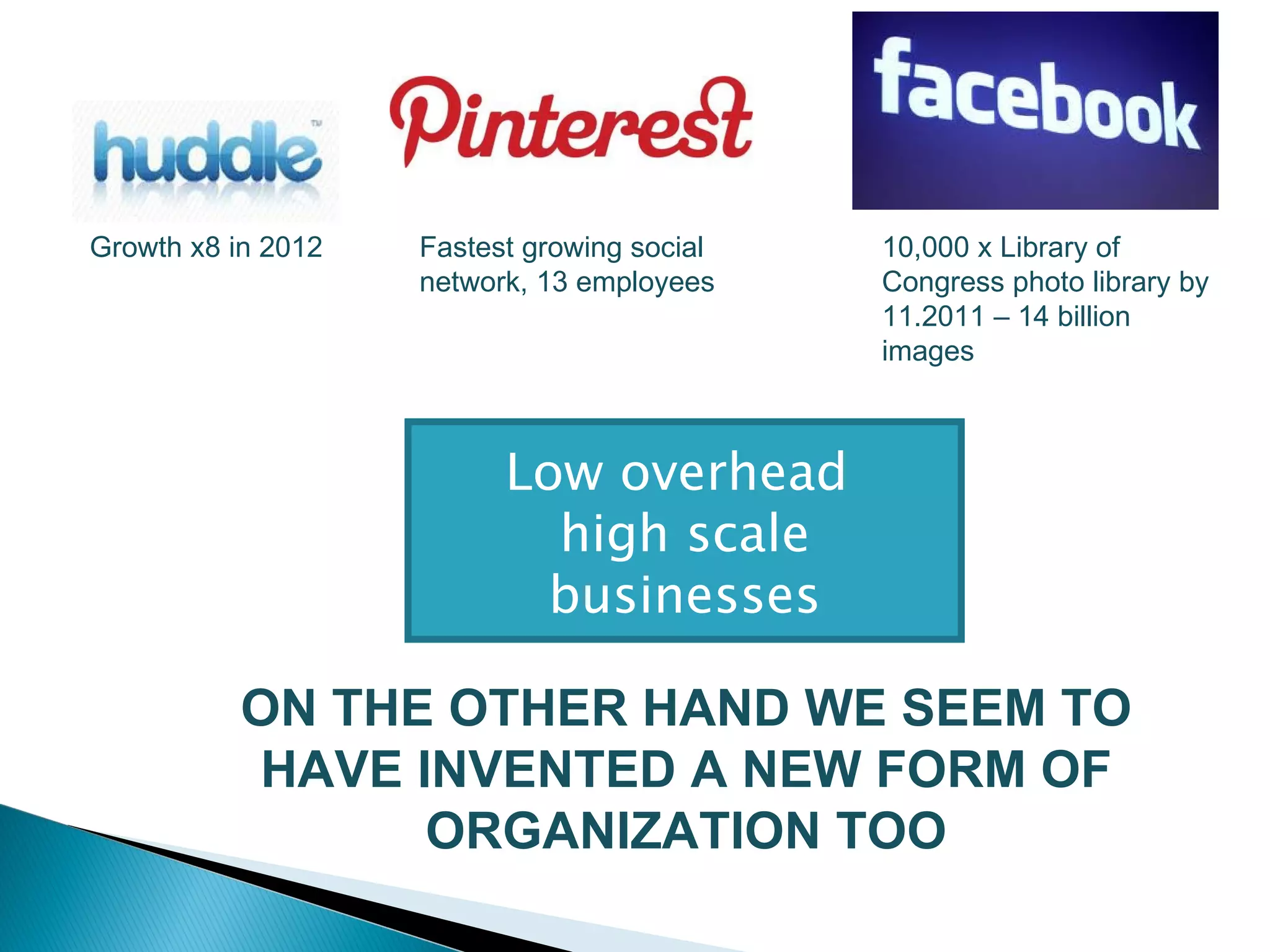
Growth x8 in 2012   Fastest growing social   10,000 x Library of
                    network, 13 employees    Congress photo library by
                                             11.2011 – 14 billion
                                             images


                          Low overhead
                            high scale
                            businesses

           ON THE OTHER HAND WE SEEM TO
            HAVE INVENTED A NEW FORM OF
                  ORGANIZATION TOO
The new
enterprise
operating model
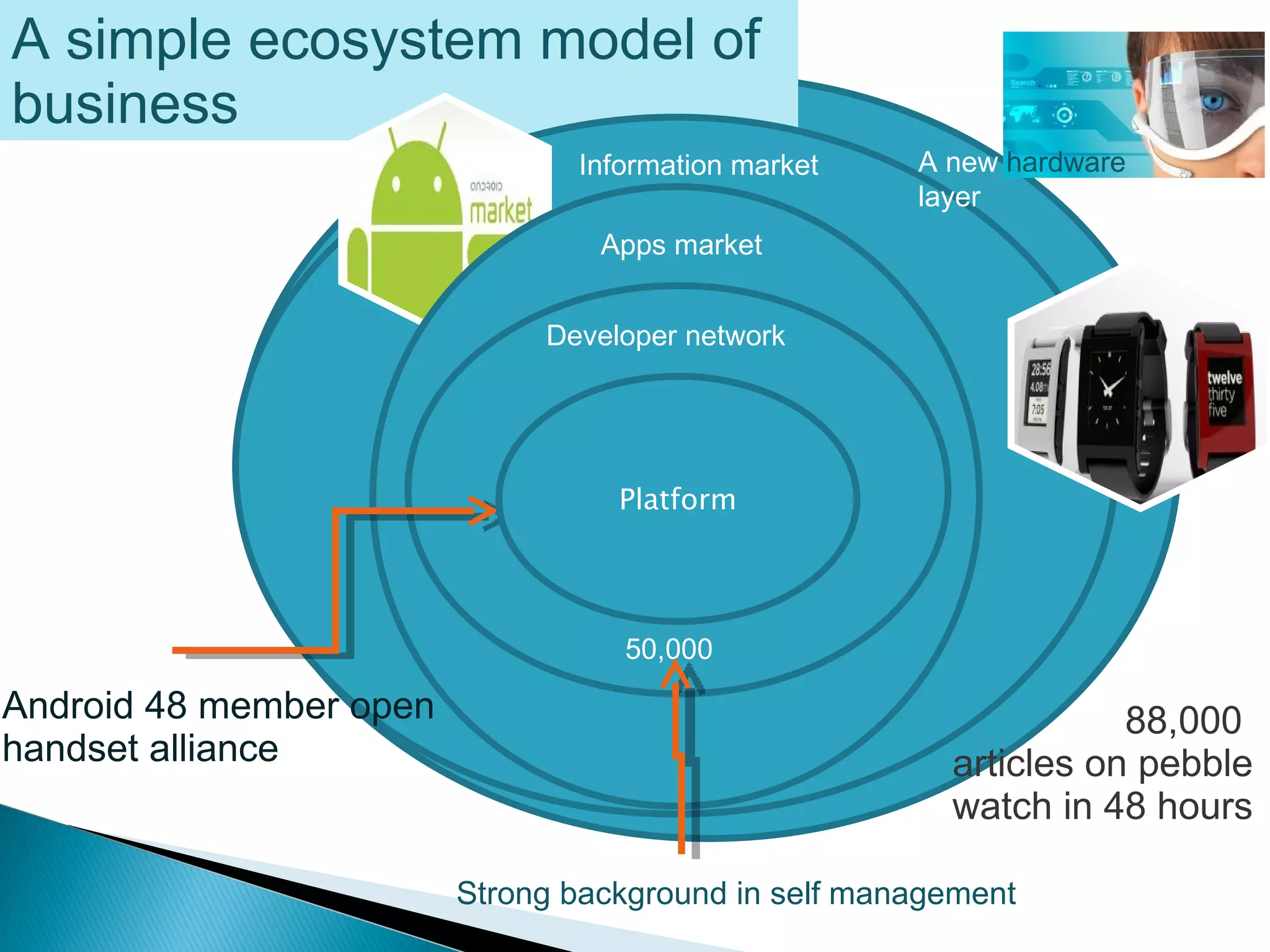
A simple ecosystem model of
business
                                Information market    A new hardware
                                                      layer
                                  Apps market


                              Developer network


                                   Platform


                                   50,000

Android 48 member open                                             88,000
handset alliance                                        articles on pebble
                                                        watch in 48 hours

                         Strong background in self management
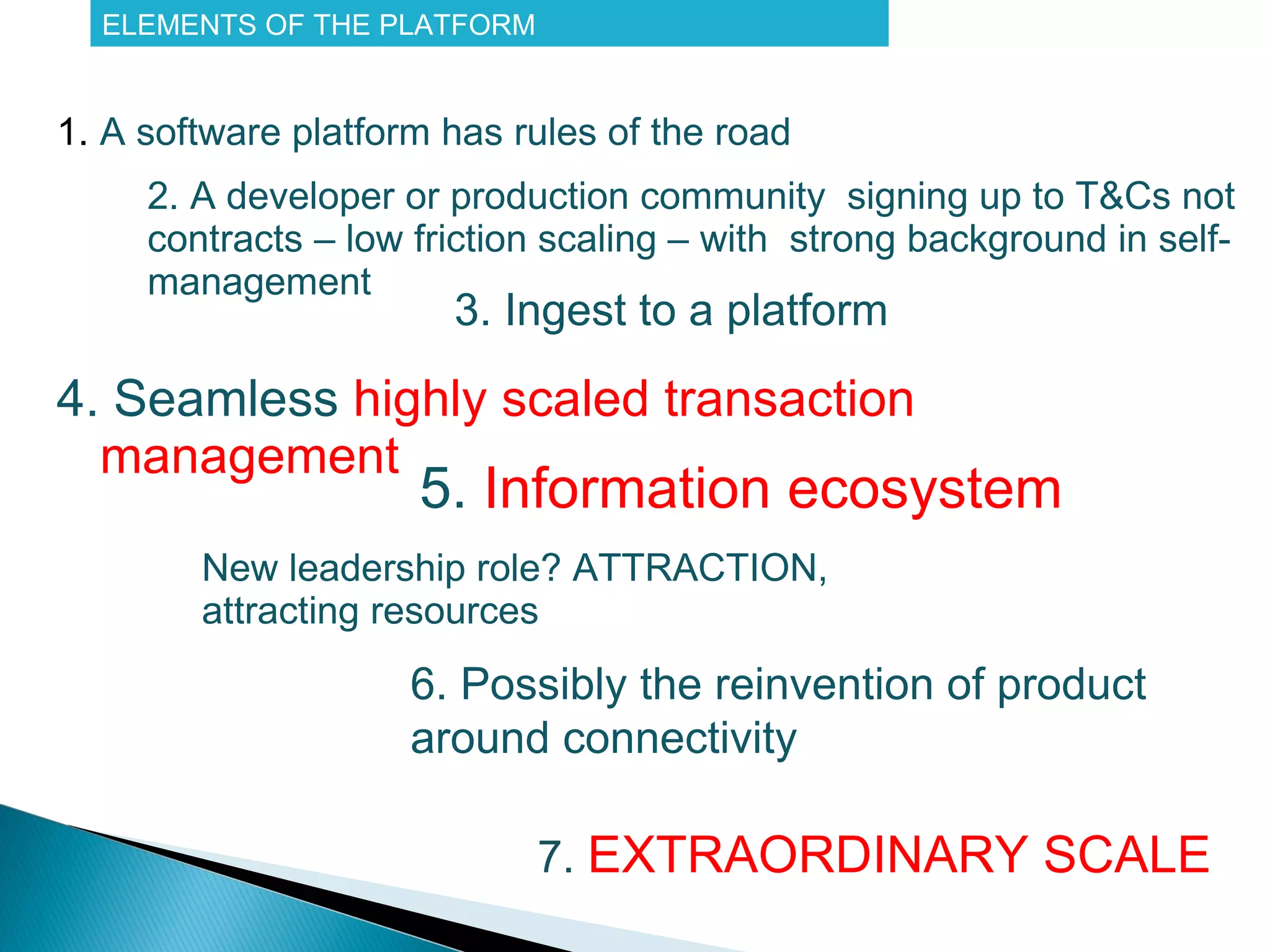
ELEMENTS OF THE PLATFORM


1. A software platform has rules of the road
     2. A developer or production community signing up to T&Cs not
     contracts – low friction scaling – with strong background in self-
     management
                      3. (Semi-) automated ingest to a platform

4. Seamless highly scaled transaction
  management
                     5. Information ecosystem
        New leadership role? ATTRACTION,
        attracting resources
                     6. Possibly the reinvention of product
                     around connectivity

                             7. EXTRAORDINARY SCALE
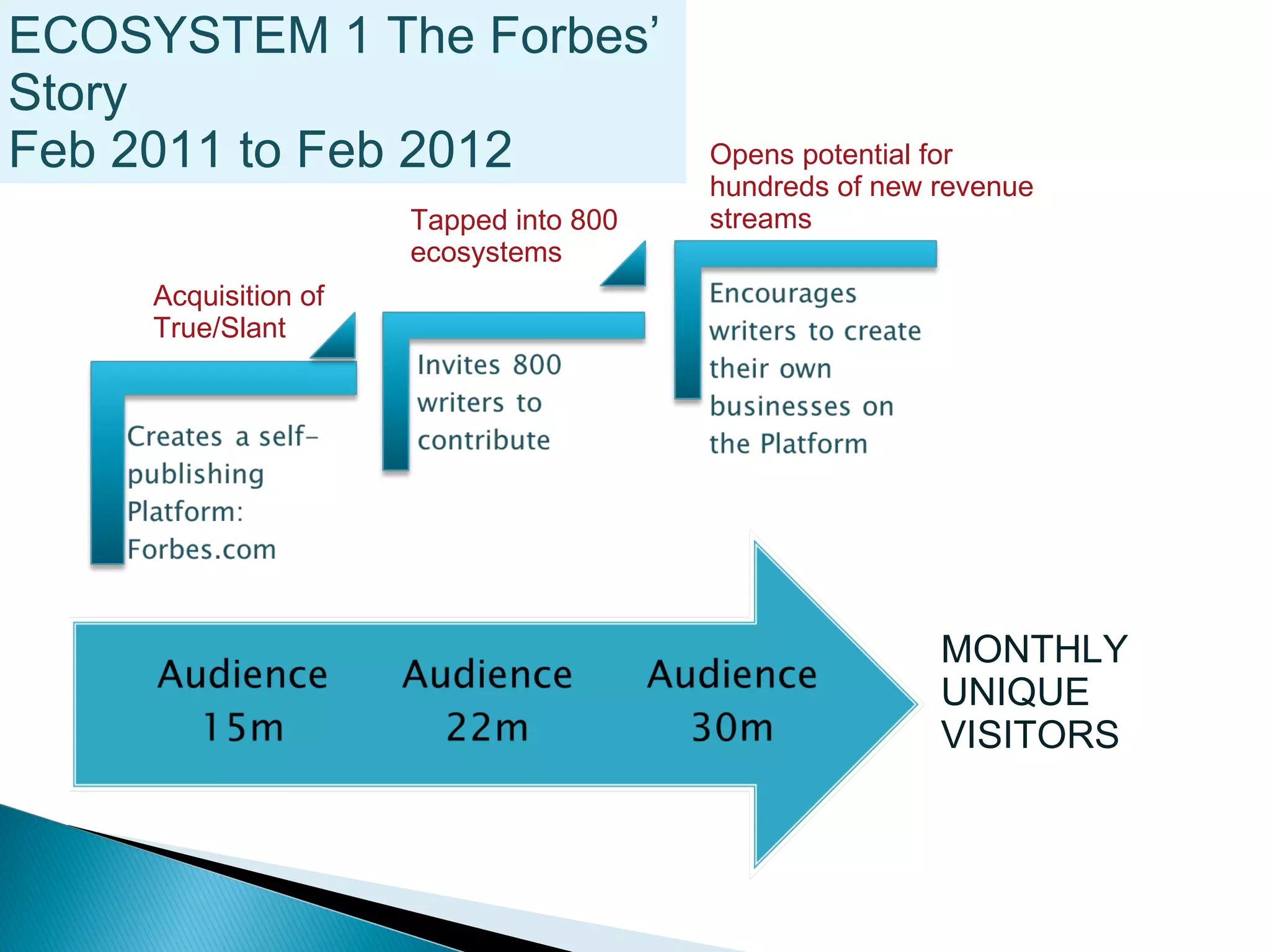
ECOSYSTEM 1 The Forbes’
Story
Feb 2011 to Feb 2012                    Opens potential for
                                        hundreds of new revenue
                      Tapped into 800   streams
                      ecosystems
     Acquisition of
     True/Slant


                                                        MONTHLY
                                                        UNIQUE
                                                        VISITORS
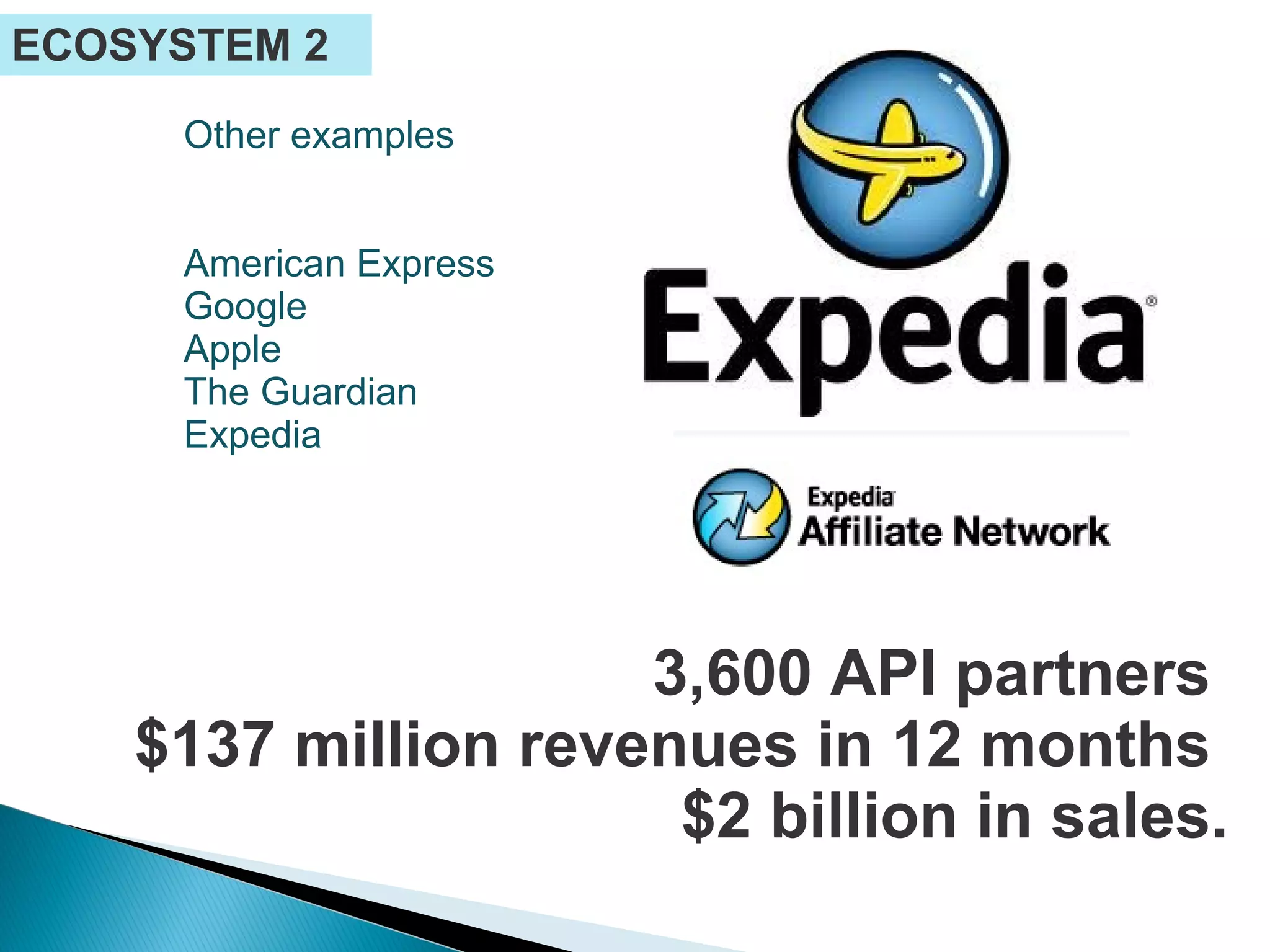
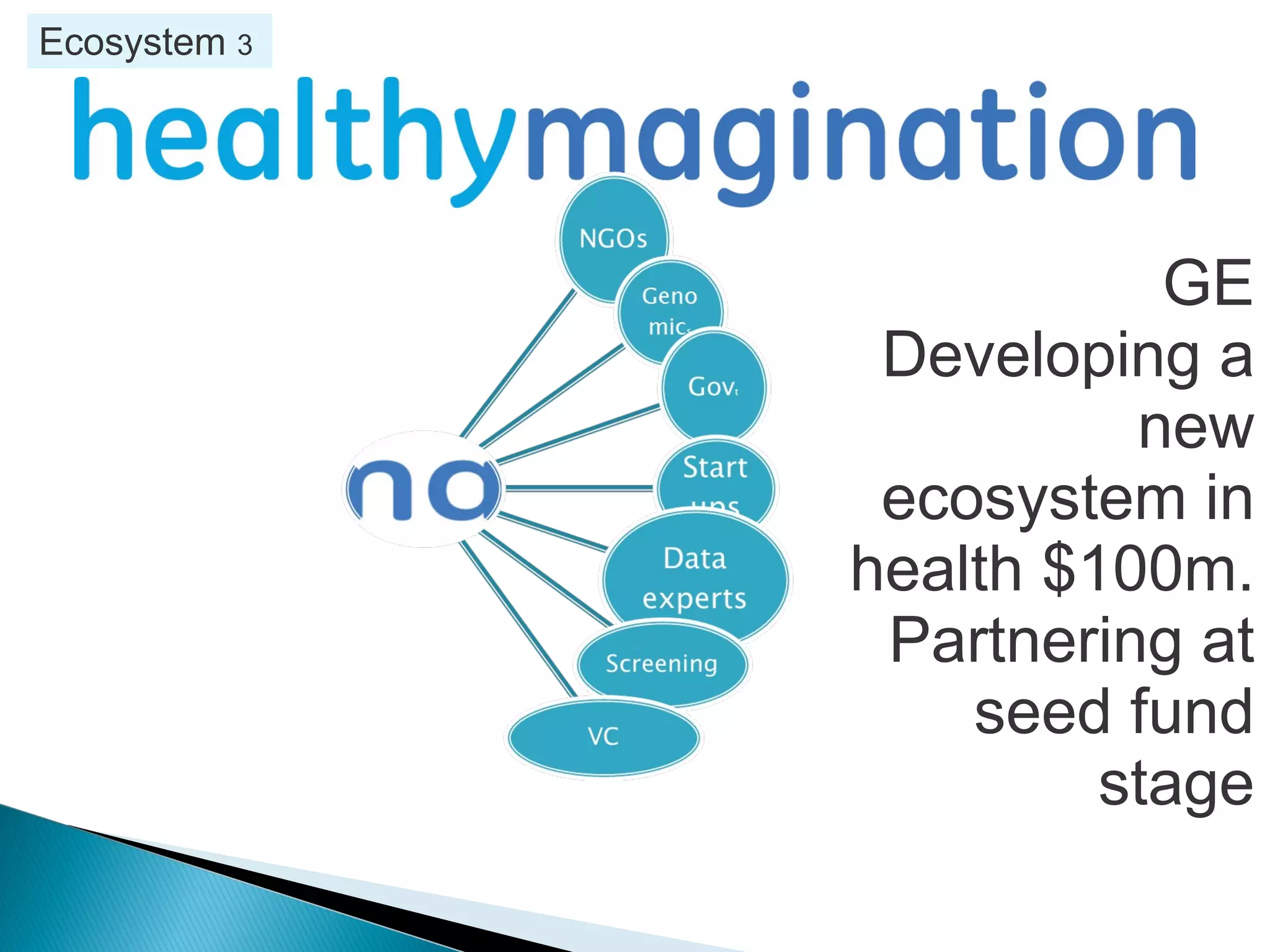
ECOSYSTEM 2
     Other examples


     American Express
     Google
     Apple
     The Guardian
     Expedia


                     3,600 API partners
    $137 million revenues in 12 months
                      $2 billion in sales.
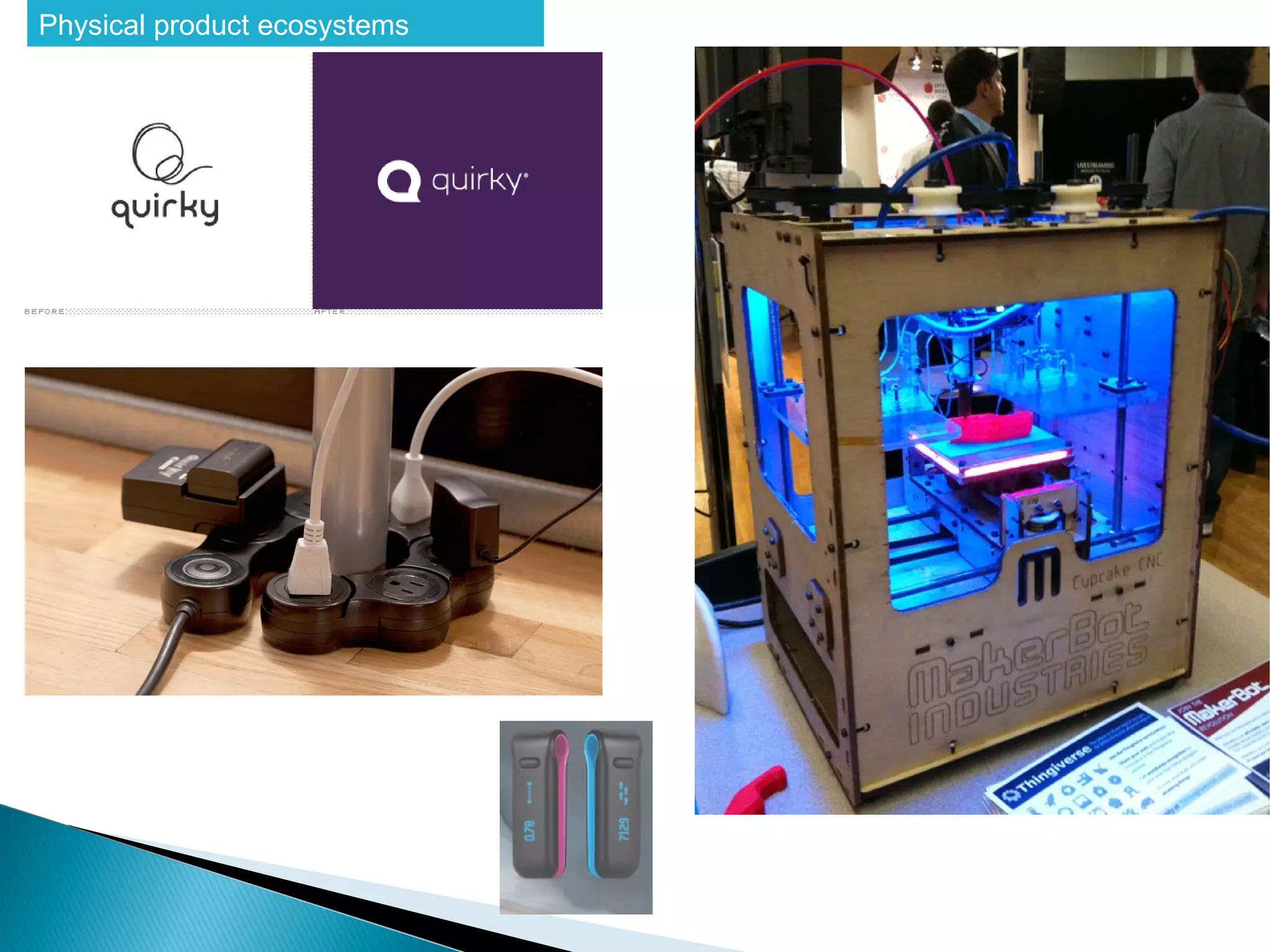
Physical product ecosystems
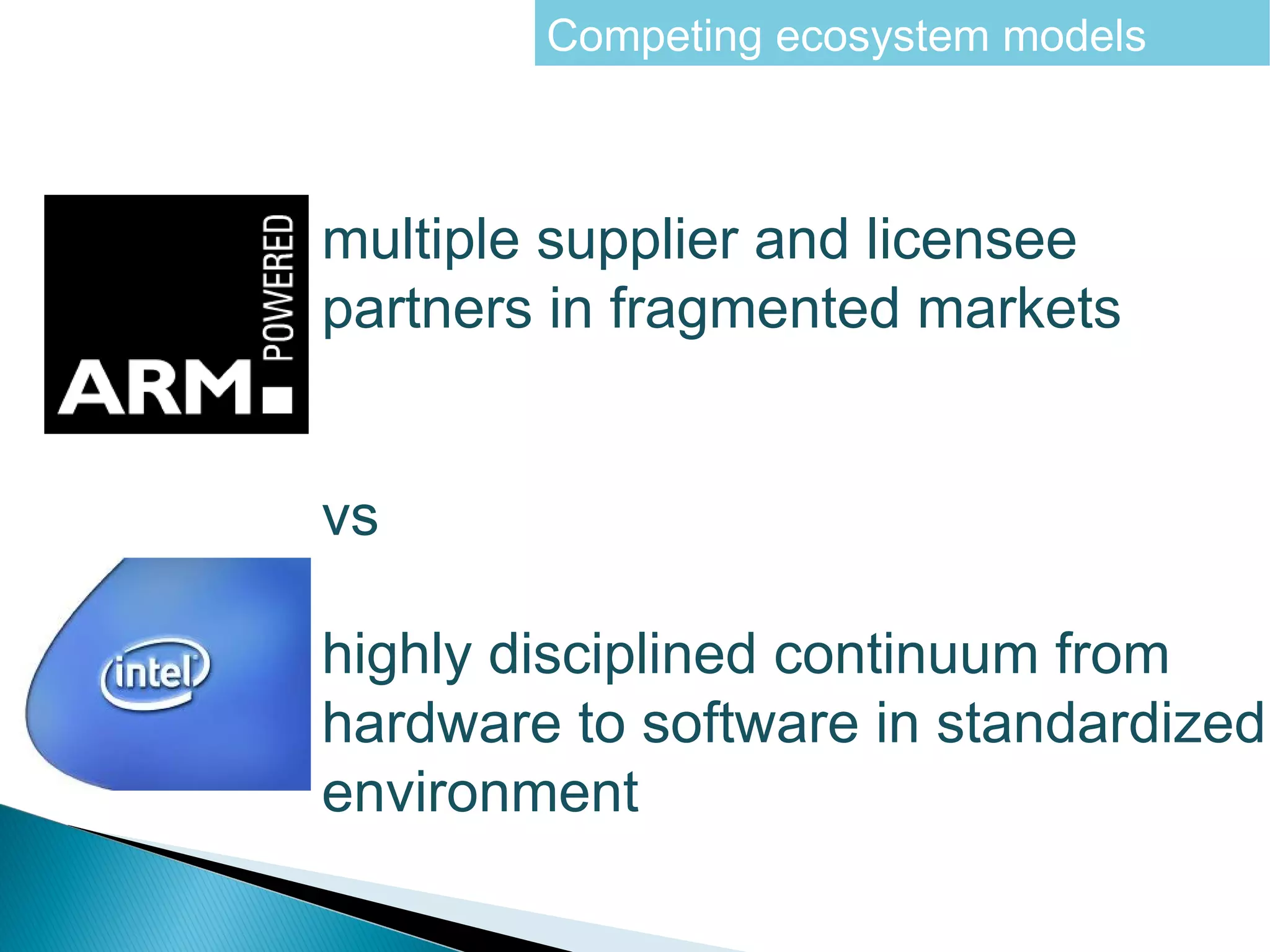
Competing ecosystem models


multiple supplier and licensee
partners in fragmented markets


vs

highly disciplined continuum from
hardware to software in standardized
environment
Today’s ecosystems


1. Ecosystems are closely related to mass differentiation

2. They gather around a platform – like iTunes, Android,
   quirky

3. Represent highly scaled interactions

4. Take place in OPEN environments among peers

5. Power dynamics are totally different from the large
   firm
AND MASS DIFFERENTATION IS?


The ability of large firms to serve
many micro markets with
relatively increases in overhead cost,
usually through multiple ecosystem
partners, providing exceptional
strategic options management.
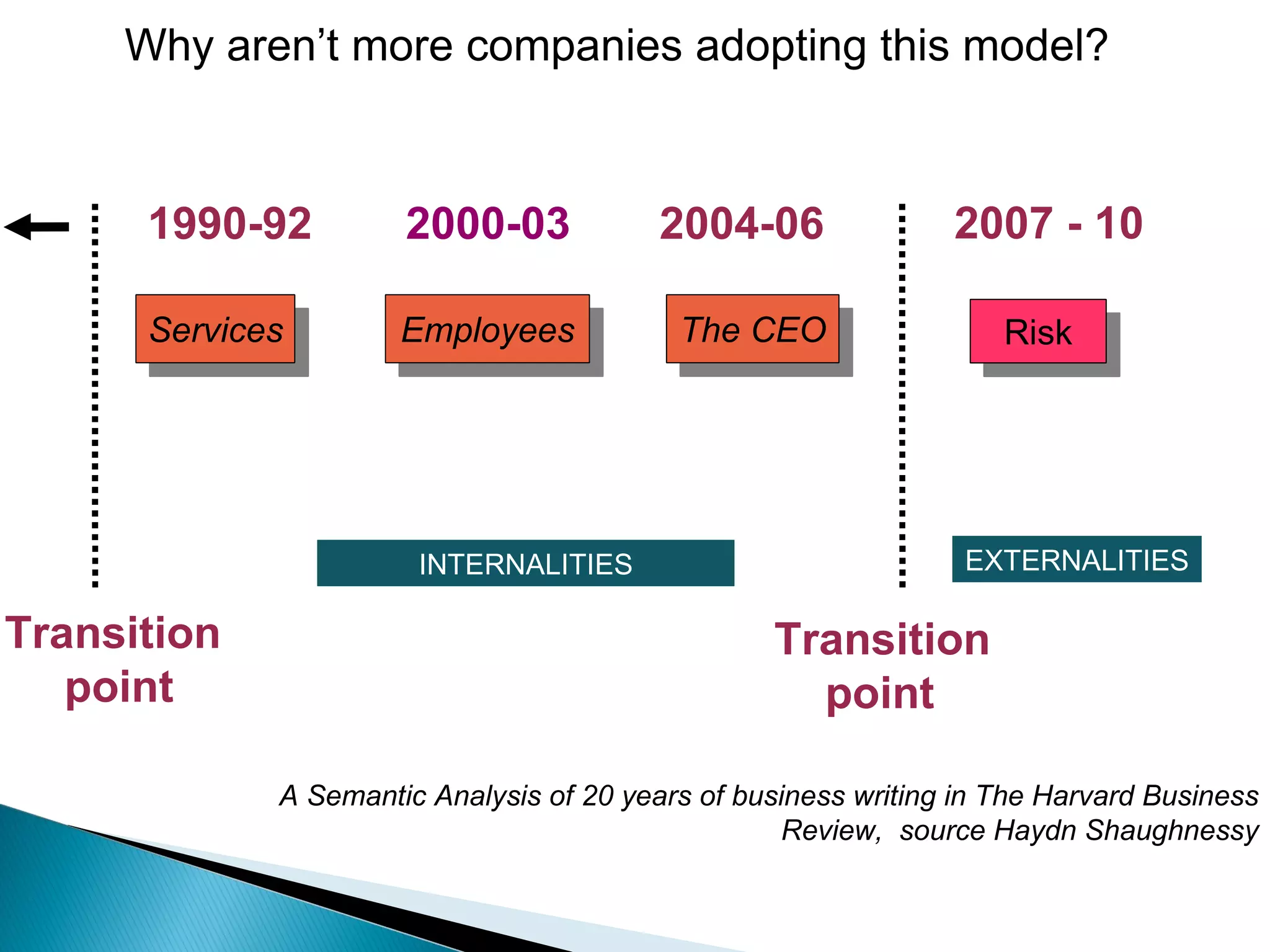
Why aren’t more companies adopting this model?


      1990-92         2000-03             2004-06               2007 - 10

      Services        Employees            The CEO                  Risk


                       INTERNALITIES                             EXTERNALITIES

Transition                                        Transition
   point                                            point

             A Semantic Analysis of 20 years of business writing in The Harvard Business
                                                   Review, source Haydn Shaughnessy
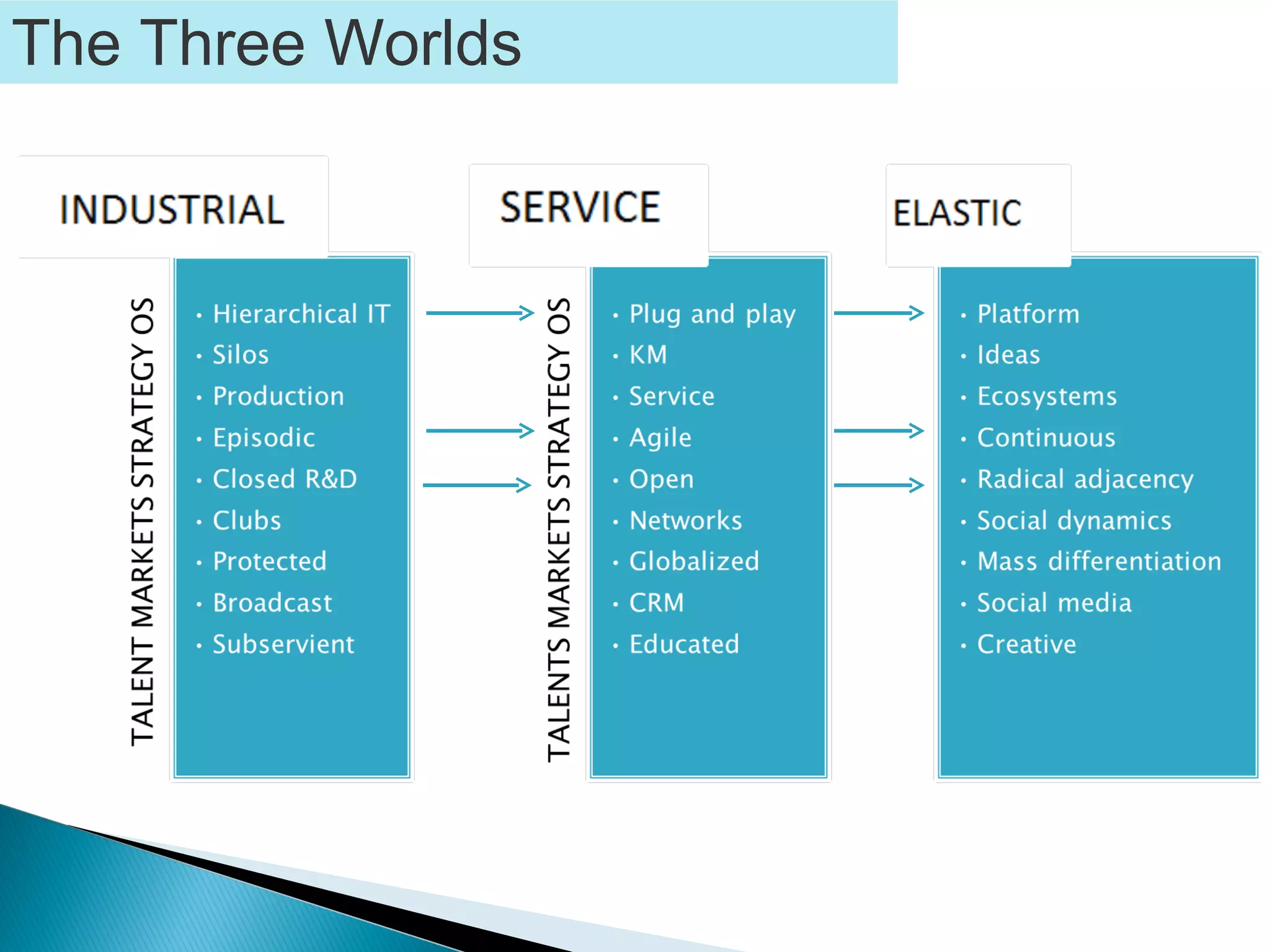
The Three Worlds
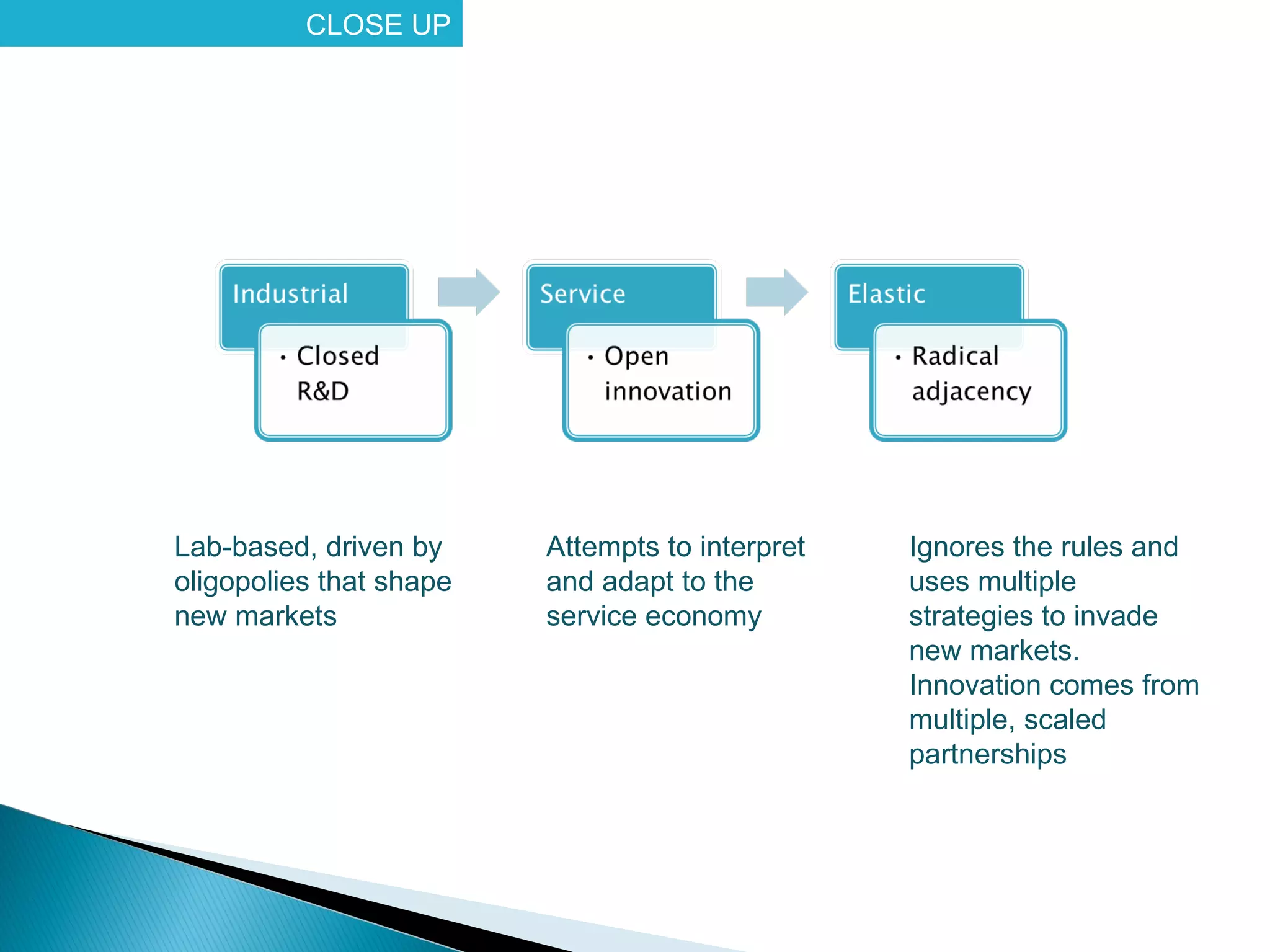
CLOSE UP


Lab-based, driven by     Attempts to interpret   Ignores the rules and
oligopolies that shape   and adapt to the        uses multiple
new markets              service economy         strategies to invade
                                                 new markets.
                                                 Innovation comes from
                                                 multiple, scaled
                                                 partnerships
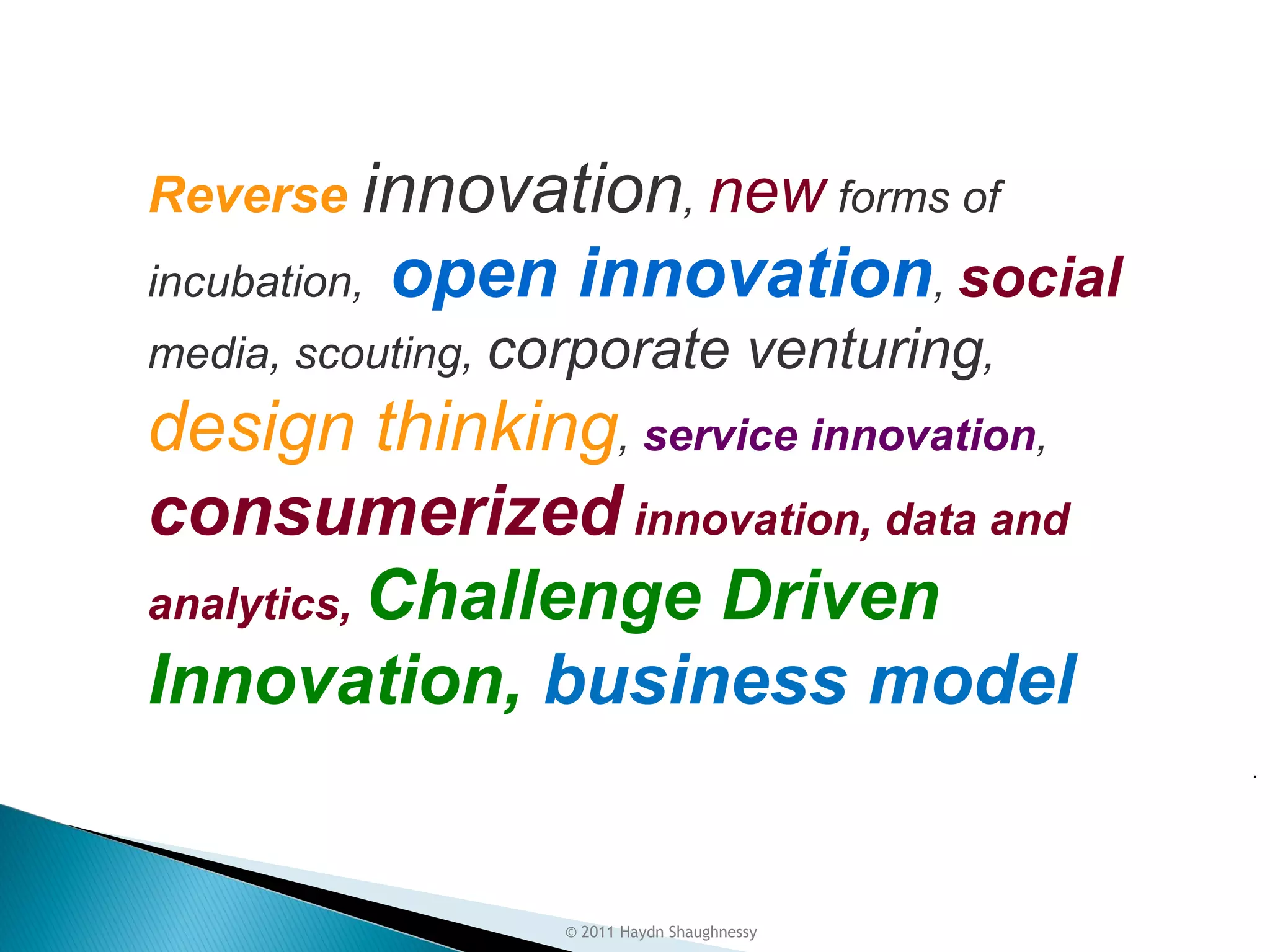
Most New Innovation Techniques
     Arise in Externalities


        Reverse innovation, new forms of
  
        incubation,   open innovation, social
        media, scouting, corporate                venturing,
        design thinking, service innovation,
        consumerized innovation, data and
        analytics, Challenge Driven
        Innovation, business model
                                                               .


                            © 2011 Haydn Shaughnessy
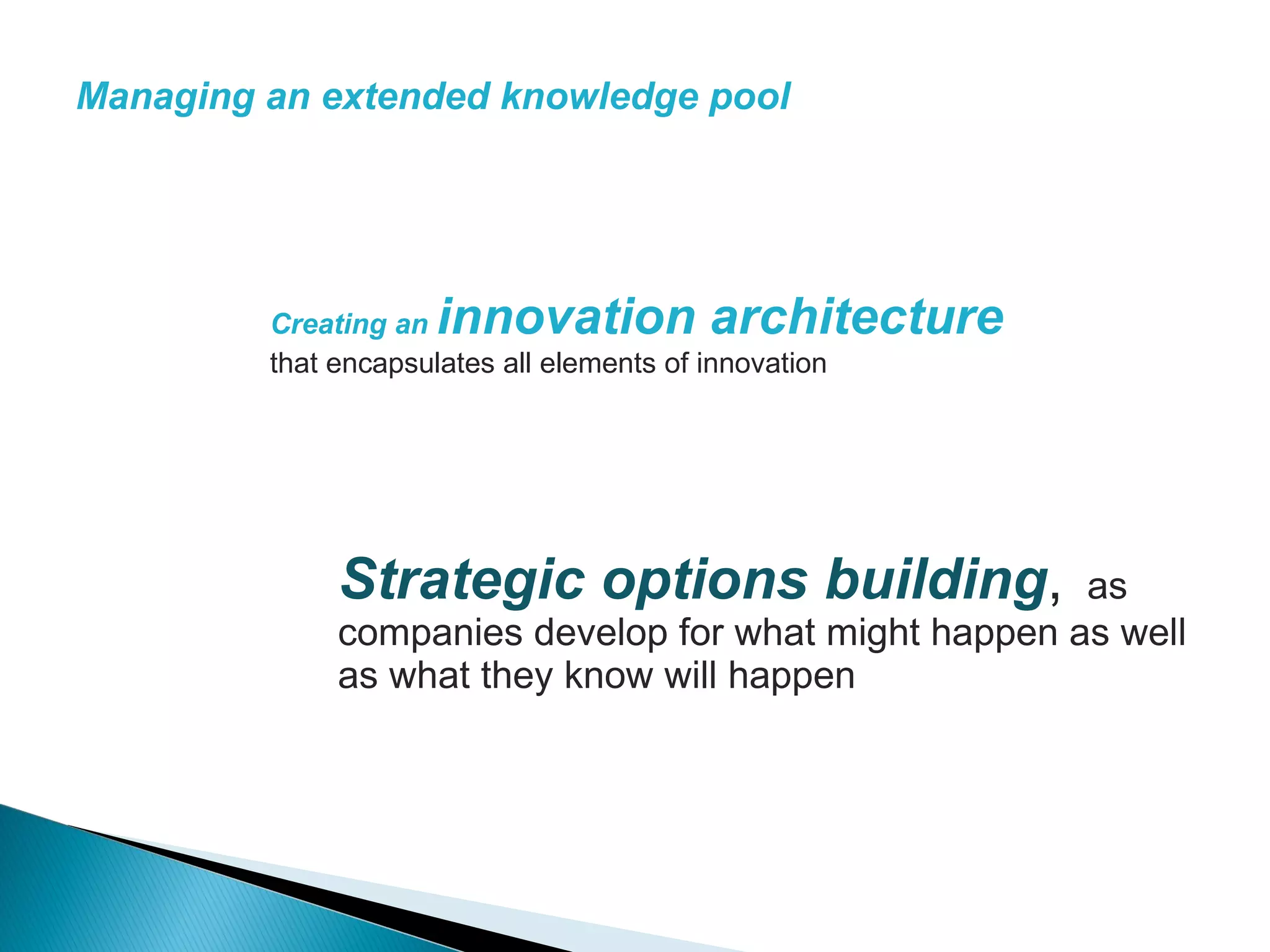
Managing an extended knowledge pool


         Creating an  innovation architecture
         that encapsulates all elements of innovation


              Strategic options building,              as
              companies develop for what might happen as well
              as what they know will happen
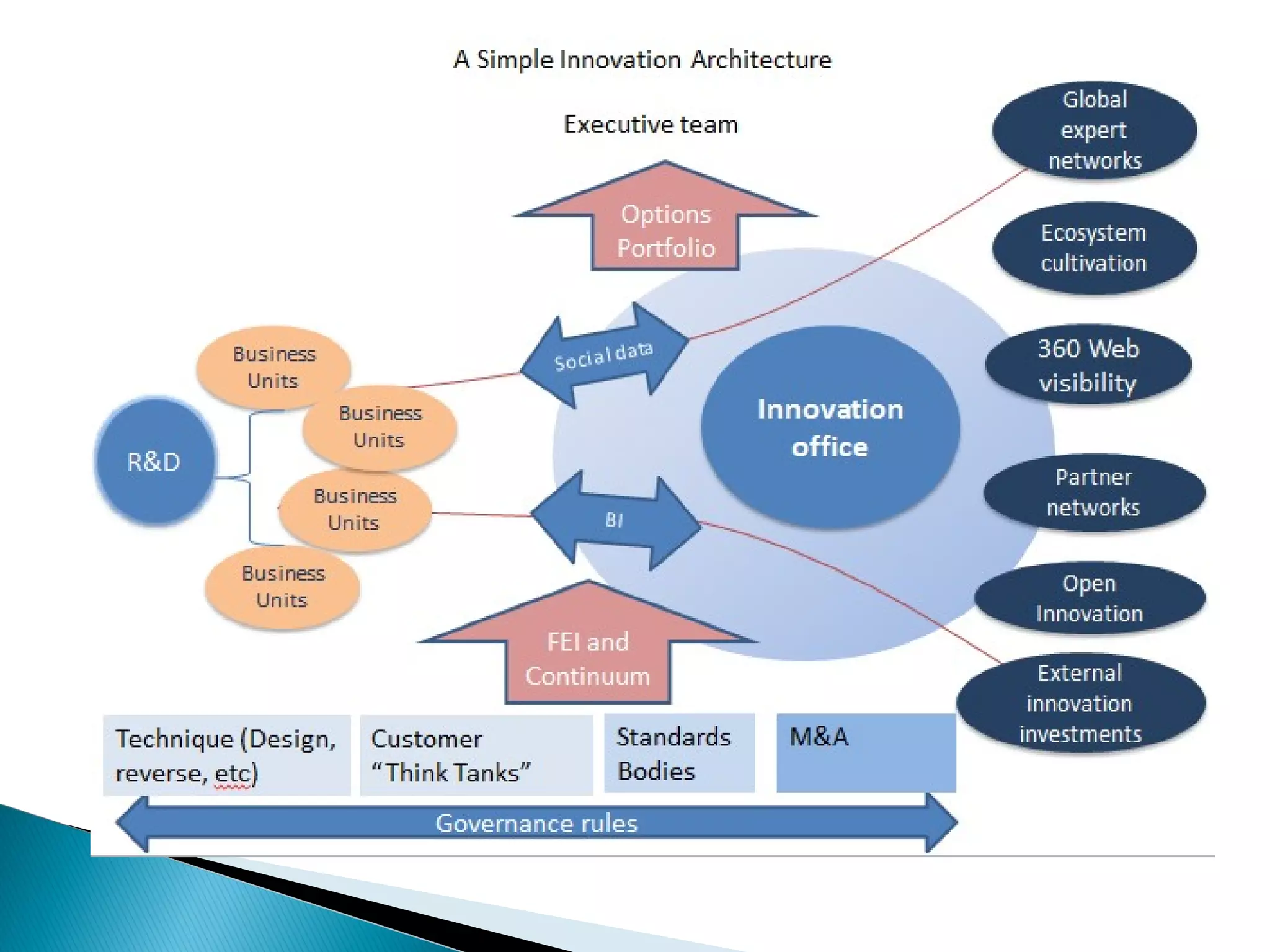
THE
INNOVATION
ARCHITECTURE
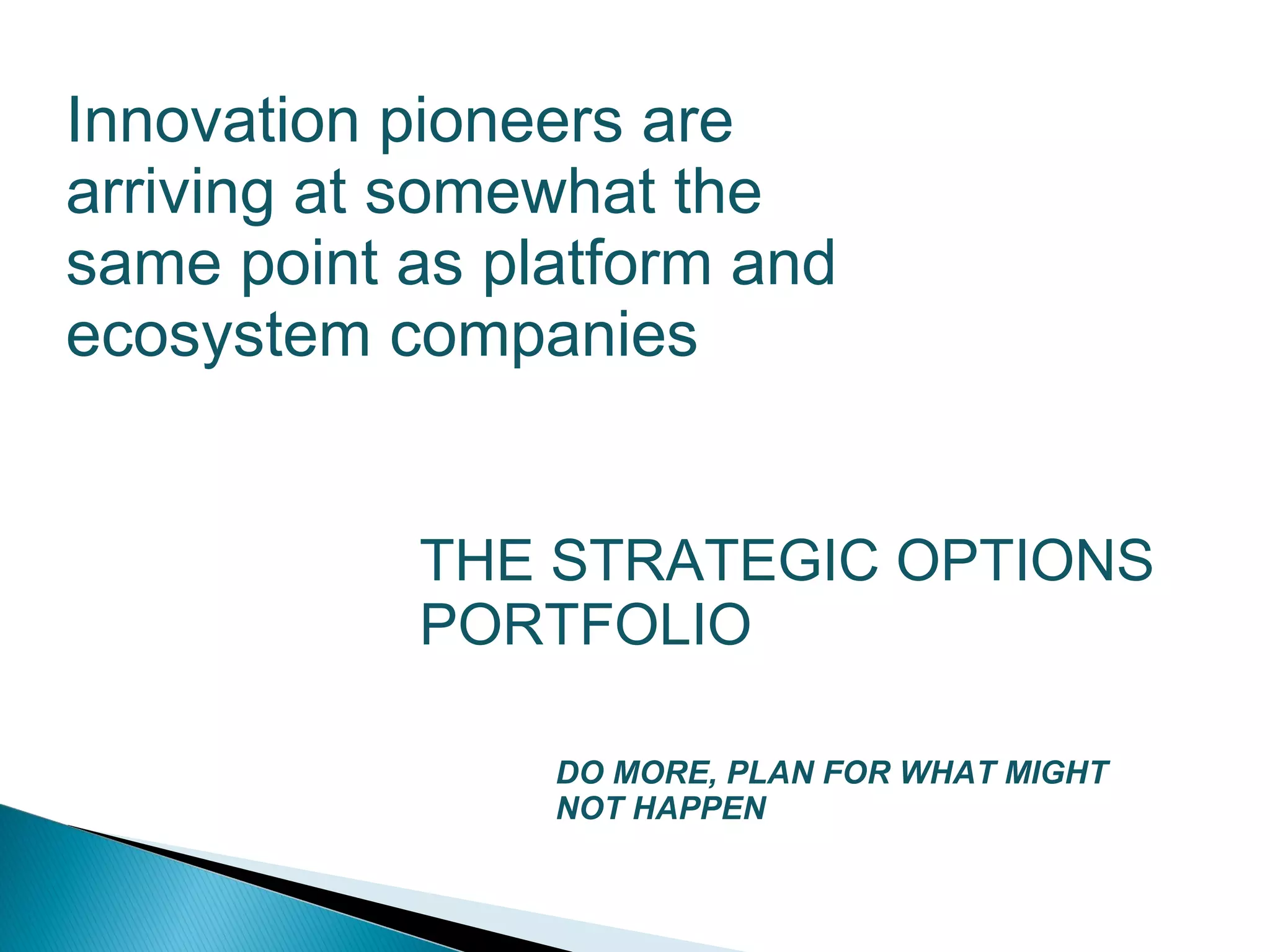
Innovation pioneers are
arriving at somewhat the
same point as platform and
ecosystem companies


           THE STRATEGIC OPTIONS
           PORTFOLIO

                DO MORE, PLAN FOR WHAT MIGHT
                NOT HAPPEN
STRATEGIC OPTIONS MANAGEMENT


         Nokia Siemens Networks


         We need to find a way
         to disrupt ourselves –
         in other words ways to
         transform.
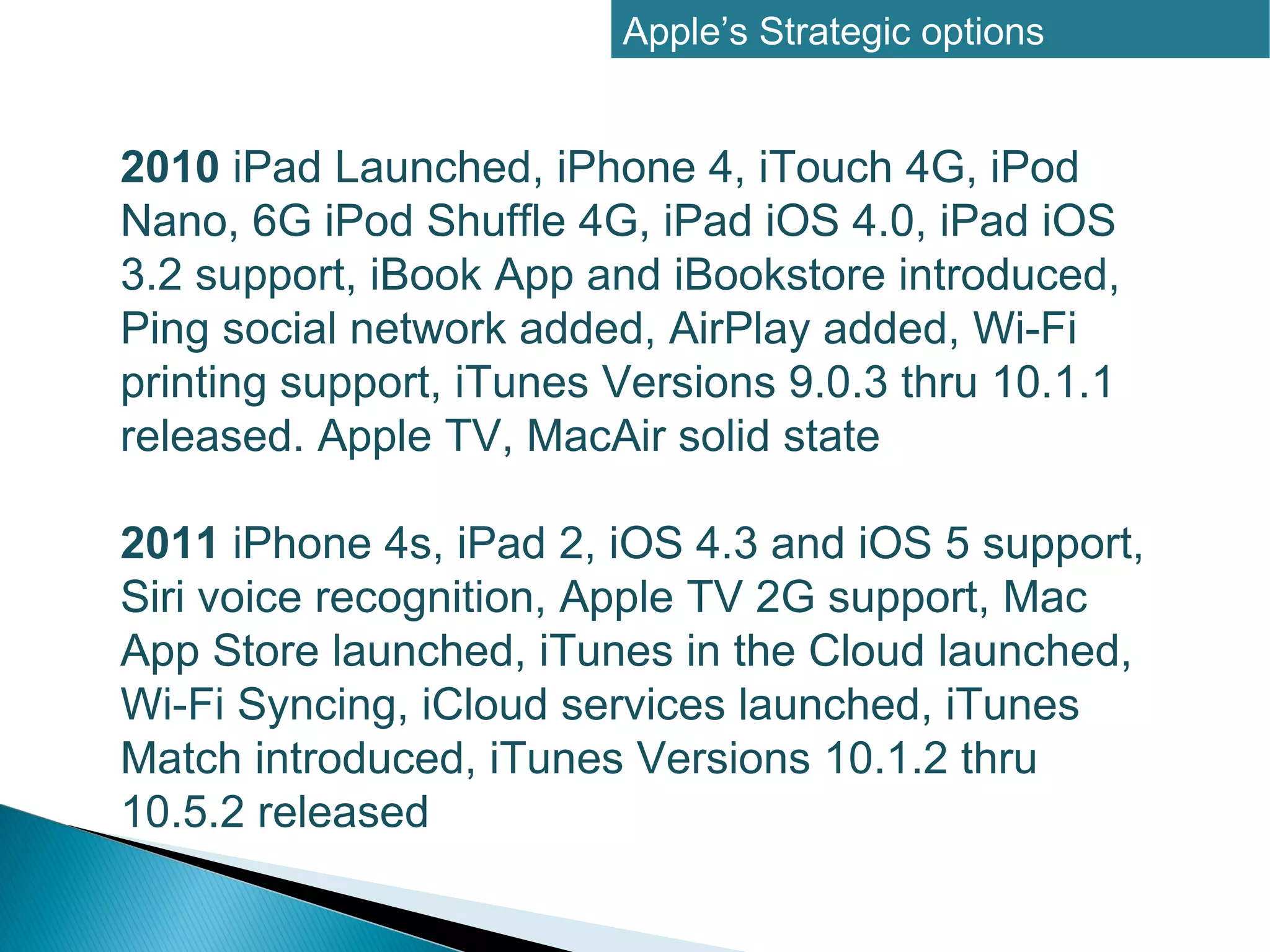
Apple’s Strategic options


2010 iPad Launched, iPhone 4, iTouch 4G, iPod
Nano, 6G iPod Shuffle 4G, iPad iOS 4.0, iPad iOS
3.2 support, iBook App and iBookstore introduced,
Ping social network added, AirPlay added, Wi-Fi
printing support, iTunes Versions 9.0.3 thru 10.1.1
released. Apple TV, MacAir solid state

2011 iPhone 4s, iPad 2, iOS 4.3 and iOS 5 support,
Siri voice recognition, Apple TV 2G support, Mac
App Store launched, iTunes in the Cloud launched,
Wi-Fi Syncing, iCloud services launched, iTunes
Match introduced, iTunes Versions 10.1.2 thru
10.5.2 released
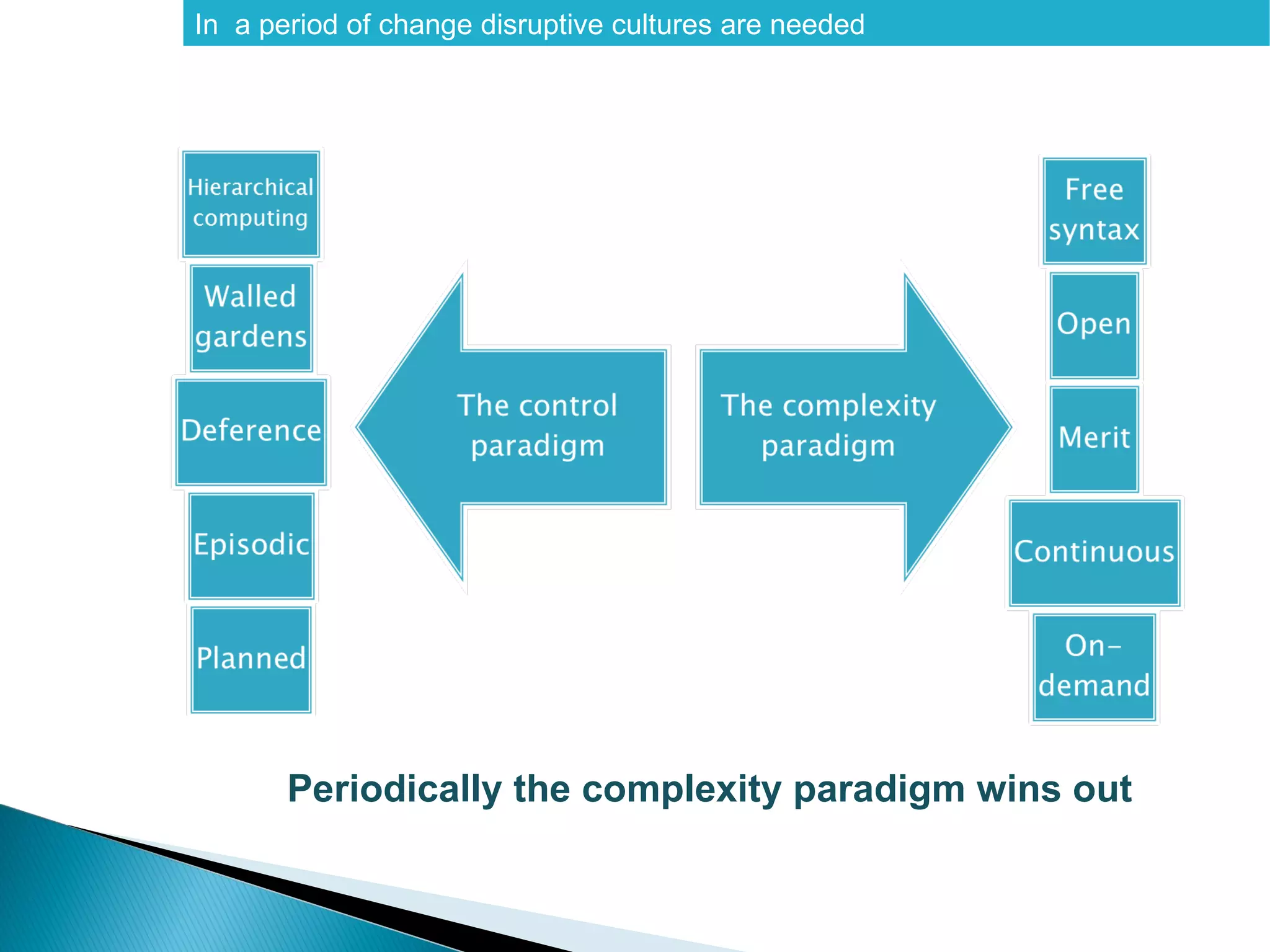
In a period of change disruptive cultures are needed


       Periodically the complexity paradigm wins out
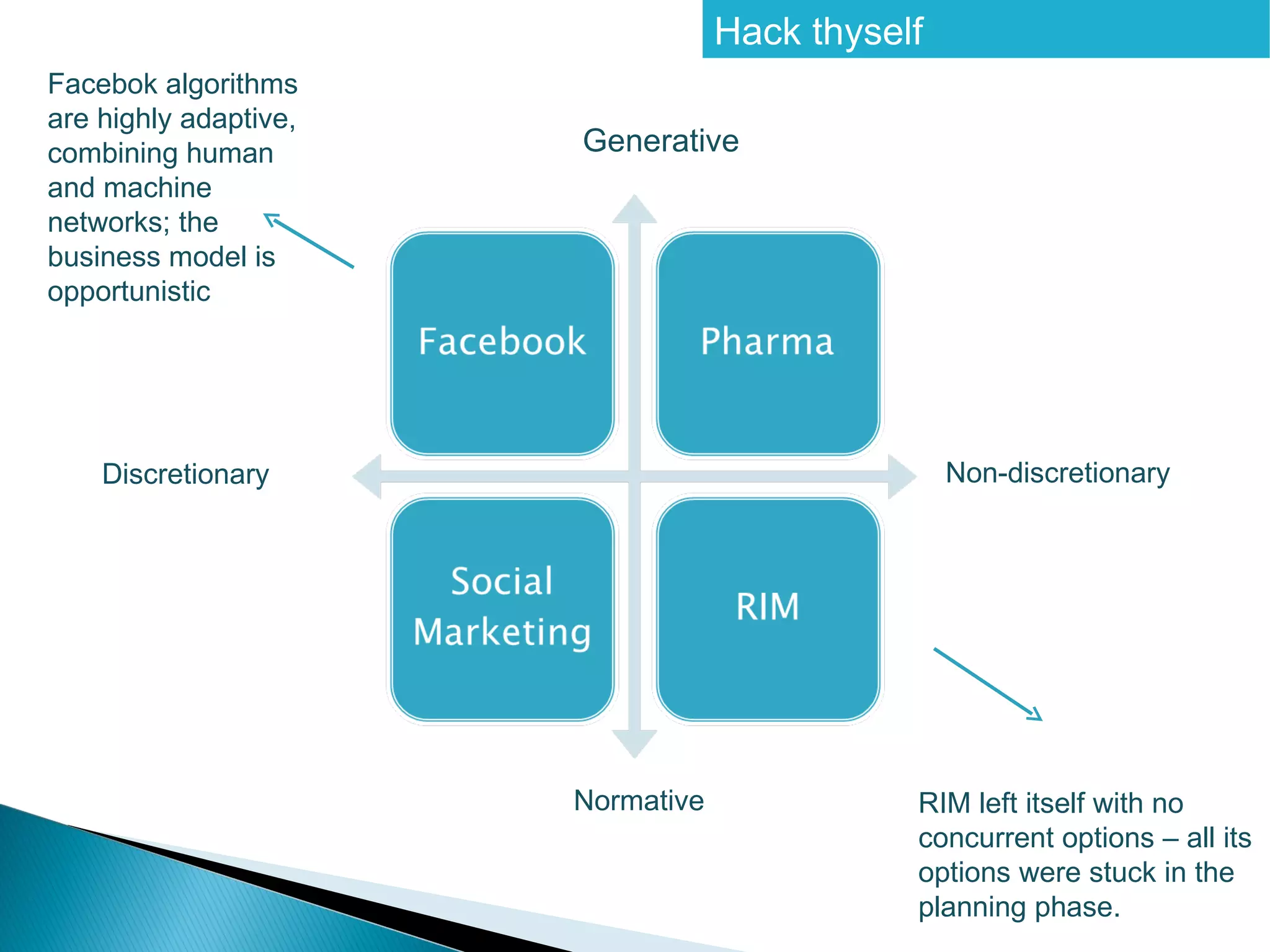
Hack thyself
Facebok algorithms
are highly adaptive,
combining human        Generative
and machine
networks; the
business model is
opportunistic


    Discretionary                                 Non-discretionaryy


                       Normative              RIM left itself with no
                                              concurrent options – all its
                                              options were stuck in the
                                              planning phase.
What gives you discretionary generative power


Is it the product

Is it market position

Is it ideation

Is it the platform?
IT IS HUMAN CAPABILITY


                     The business model
                     and the human
                     resource element is
                     ready for complexity – in
                     IT dependent sectors
WHAT SUPPORTS THIS CAPABILITY?


1. The Platform – innovators have this in
platforms like HYPE

2. Ecosystems – still difficult for large
companies to trust the external environment

3. Strategic options management – being able
to serve differentiated markets and products

4. Belief in a new form of scale
Conclusions


The future lies with ecosystems supported by
increasingly scaled and sophisticated platforms


    These platforms enable companies to serve globally
    differentiated markets in an elastic fashion, holding
    overhead down during growth
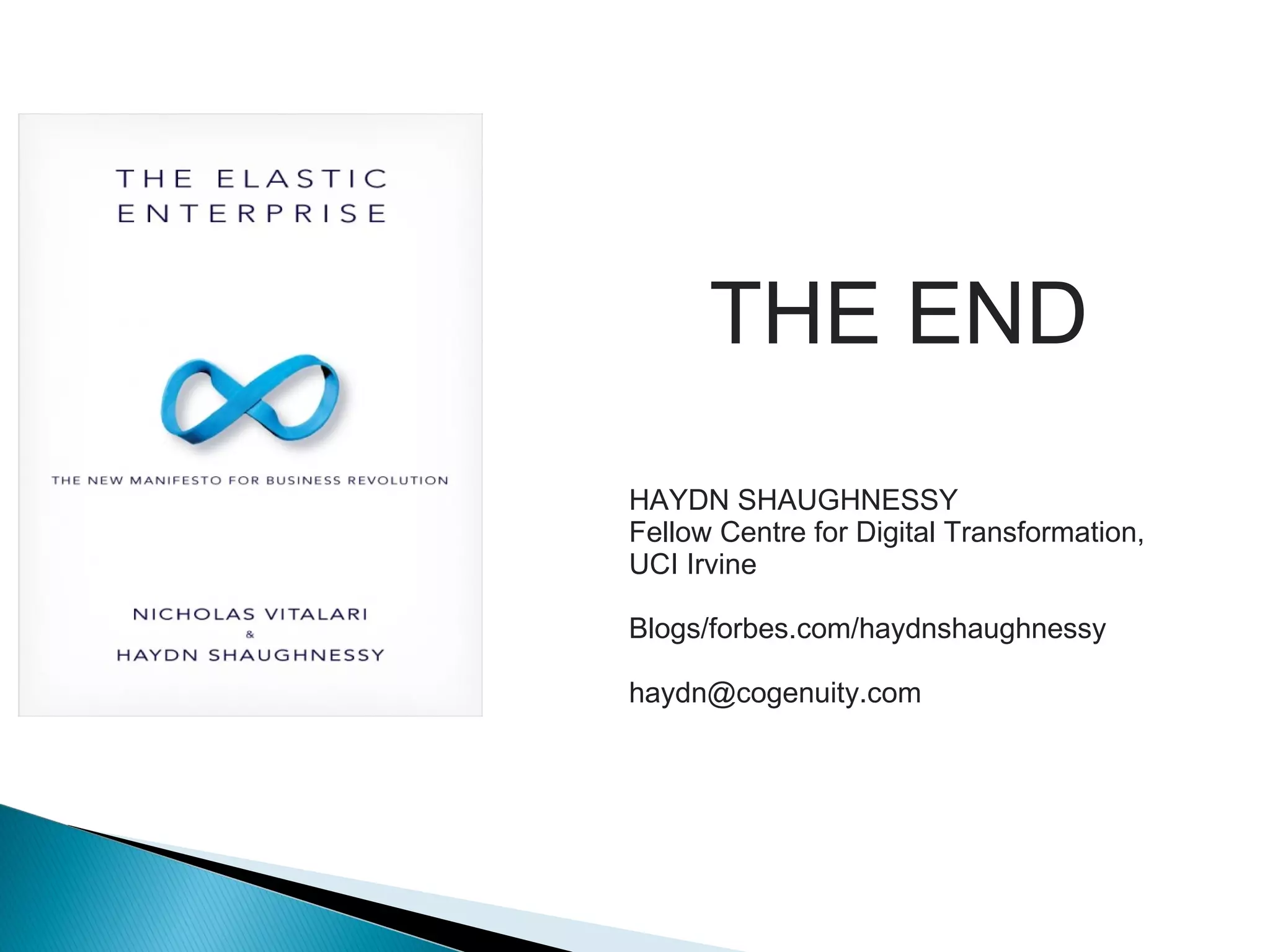
THE END
HAYDN SHAUGHNESSY
Fellow Centre for Digital Transformation,
UCI Irvine

Blogs/forbes.com/haydnshaughnessy

haydn@cogenuity.com

Haydn presentation transforming innovation

  • 1.
    HYPE User Forum 14/15th June 2012 Haydn Shaughnessy
  • 2.
  • 3.
    Global 2000 companies2012, Source: Forbes Up $149 trillion assets 8% Up $36 trillion revenues 12% $2.6 Up trillion 11% profit WE UNDERESTIMATE THE ACHIEVEMENTS OF THE ENTERPRISE – HUGELY SUCESSFUL WAY OF CREATING WEALTH.
  • 4.
    BUT IT HASHIT A LIMIT Shareholder returns of larger firms were 70% below those of smaller firms over a 10-year period in USA Source Gregory V. Milano, “Too Big to Succeed?” CFO Magazine, April 29, 2011 THE OVERHEAD GROWS FASTER THAN THE BOTTOM LINE
  • 5.
    Changes in theeconomy that bring pressures to innovate 2.The opportunity of the new globally connected middle class 2. The global innovation race 3. Digital – physical convergence (or- dematerialization) 4. Disruption in the value chain 5. The loss of oligopoly power
  • 6.
    The new middleclass The new global middle class creates massively differentiated needs, and low cost, good enough goods 900 million – 2 billion people by 2030 = x 3 or x 7 The future is mass differentiation
  • 7.
    Growth x8 in2012 Fastest growing social 10,000 x Library of network, 13 employees Congress photo library by 11.2011 – 14 billion images Low overhead high scale businesses ON THE OTHER HAND WE SEEM TO HAVE INVENTED A NEW FORM OF ORGANIZATION TOO
  • 8.
  • 9.
    A simple ecosystemmodel of business Information market A new hardware layer Apps market Developer network Platform 50,000 Android 48 member open 88,000 handset alliance articles on pebble watch in 48 hours Strong background in self management
  • 10.
    ELEMENTS OF THEPLATFORM 1. A software platform has rules of the road 2. A developer or production community signing up to T&Cs not contracts – low friction scaling – with strong background in self- management 3. (Semi-) automated ingest to a platform 4. Seamless highly scaled transaction management 5. Information ecosystem New leadership role? ATTRACTION, attracting resources 6. Possibly the reinvention of product around connectivity 7. EXTRAORDINARY SCALE
  • 11.
    ECOSYSTEM 1 TheForbes’ Story Feb 2011 to Feb 2012 Opens potential for hundreds of new revenue Tapped into 800 streams ecosystems Acquisition of True/Slant MONTHLY UNIQUE VISITORS
  • 12.
    ECOSYSTEM 2 Other examples American Express Google Apple The Guardian Expedia 3,600 API partners $137 million revenues in 12 months $2 billion in sales.
  • 13.
  • 14.
    Competing ecosystem models multiplesupplier and licensee partners in fragmented markets vs highly disciplined continuum from hardware to software in standardized environment
  • 15.
    Today’s ecosystems 1. Ecosystemsare closely related to mass differentiation 2. They gather around a platform – like iTunes, Android, quirky 3. Represent highly scaled interactions 4. Take place in OPEN environments among peers 5. Power dynamics are totally different from the large firm
  • 16.
    AND MASS DIFFERENTATIONIS? The ability of large firms to serve many micro markets with relatively increases in overhead cost, usually through multiple ecosystem partners, providing exceptional strategic options management.
  • 17.
    Why aren’t morecompanies adopting this model? 1990-92 2000-03 2004-06 2007 - 10 Services Employees The CEO Risk INTERNALITIES EXTERNALITIES Transition Transition point point A Semantic Analysis of 20 years of business writing in The Harvard Business Review, source Haydn Shaughnessy
  • 18.
  • 19.
    CLOSE UP Lab-based, drivenby Attempts to interpret Ignores the rules and oligopolies that shape and adapt to the uses multiple new markets service economy strategies to invade new markets. Innovation comes from multiple, scaled partnerships
  • 20.
    Most New InnovationTechniques Arise in Externalities Reverse innovation, new forms of    incubation, open innovation, social media, scouting, corporate venturing, design thinking, service innovation, consumerized innovation, data and analytics, Challenge Driven Innovation, business model . © 2011 Haydn Shaughnessy
  • 21.
    Managing an extendedknowledge pool Creating an innovation architecture that encapsulates all elements of innovation Strategic options building, as companies develop for what might happen as well as what they know will happen
  • 22.
  • 24.
    Innovation pioneers are arrivingat somewhat the same point as platform and ecosystem companies THE STRATEGIC OPTIONS PORTFOLIO DO MORE, PLAN FOR WHAT MIGHT NOT HAPPEN
  • 25.
    STRATEGIC OPTIONS MANAGEMENT Nokia Siemens Networks We need to find a way to disrupt ourselves – in other words ways to transform.
  • 26.
    Apple’s Strategic options 2010iPad Launched, iPhone 4, iTouch 4G, iPod Nano, 6G iPod Shuffle 4G, iPad iOS 4.0, iPad iOS 3.2 support, iBook App and iBookstore introduced, Ping social network added, AirPlay added, Wi-Fi printing support, iTunes Versions 9.0.3 thru 10.1.1 released. Apple TV, MacAir solid state 2011 iPhone 4s, iPad 2, iOS 4.3 and iOS 5 support, Siri voice recognition, Apple TV 2G support, Mac App Store launched, iTunes in the Cloud launched, Wi-Fi Syncing, iCloud services launched, iTunes Match introduced, iTunes Versions 10.1.2 thru 10.5.2 released
  • 27.
    In a periodof change disruptive cultures are needed Periodically the complexity paradigm wins out
  • 28.
    Hack thyself Facebok algorithms arehighly adaptive, combining human Generative and machine networks; the business model is opportunistic Discretionary Non-discretionaryy Normative RIM left itself with no concurrent options – all its options were stuck in the planning phase.
  • 29.
    What gives youdiscretionary generative power Is it the product Is it market position Is it ideation Is it the platform?
  • 30.
    IT IS HUMANCAPABILITY The business model and the human resource element is ready for complexity – in IT dependent sectors
  • 31.
    WHAT SUPPORTS THISCAPABILITY? 1. The Platform – innovators have this in platforms like HYPE 2. Ecosystems – still difficult for large companies to trust the external environment 3. Strategic options management – being able to serve differentiated markets and products 4. Belief in a new form of scale
  • 32.
    Conclusions The future lieswith ecosystems supported by increasingly scaled and sophisticated platforms These platforms enable companies to serve globally differentiated markets in an elastic fashion, holding overhead down during growth
  • 33.
    THE END HAYDN SHAUGHNESSY FellowCentre for Digital Transformation, UCI Irvine Blogs/forbes.com/haydnshaughnessy haydn@cogenuity.com