How Companies are Leading 
the Collaborative Economy 
By Jeremiah Owyang 
@jowyang 
Sept, 2014
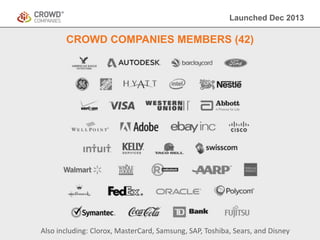
Launched Dec 2013 
CROWD COMPANIES MEMBERS (42) 
Also including: Clorox, MasterCard, Samsung, SAP, Toshiba, Sears, and Disney
Agenda: 
1) The Collaborative Economy movement 
2) Exercise: Why is it happening? 
3) The new business models 
4) Build your own business plan
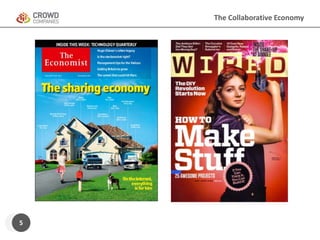
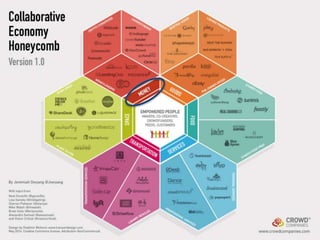
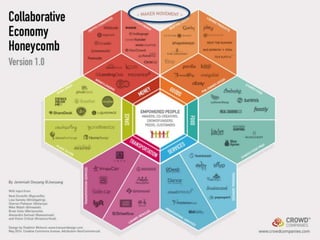
The Collaborative Economy 
5
6 
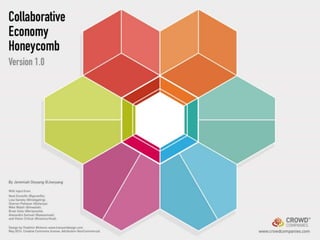
Collaborative Economy Terms 
• Collaborative Economy: The overall economic movement where 
people get what they need from each other. 
• Crowdfunding: A process where people fund new projects in 
exchange for perks or equity. 
• Maker Movement: A process where people build their own goods – 
rather than buying from traditional stores. 
• Sharing Economy: People share what they already have –rather 
than buy.
7 
Collaborative Economy Terms 
• On Demand Service: Easy to use apps and websites deliver goods 
and services within a push of a button 
• Access over ownership: On demand models that enable goods 
and services to emerge rather than purchasing. 
• Activate Idle Resources: A tenant that cars, drills, and homes are 
often not used –now we can quickly use on demand via mobile and 
social technologies. 
• Marketplaces (Two-sided): Software platform that enables the 
tractions of providers and partakers. (hosts and guests, drivers and 
riders).
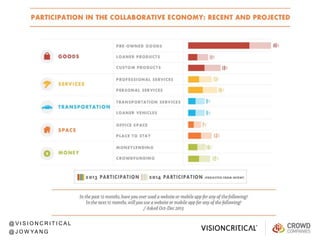
The Collaborative Economy 
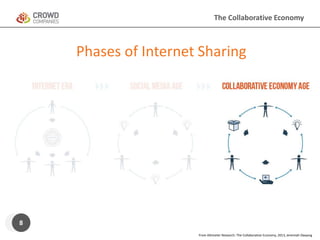
Phases of Internet Sharing 
8 
From Altimeter Research: The Collaborative Economy, 2013, Jeremiah Owyang
What role do corporations play 
if people get what they need 
from each other?
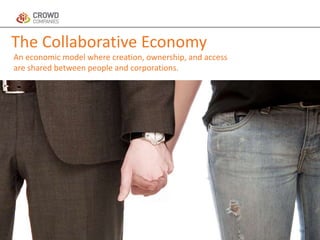
The Collaborative Economy 
An economic model where creation, ownership, and access 
are shared between people and corporations.
Is this a business disruption?
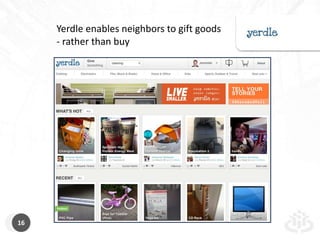
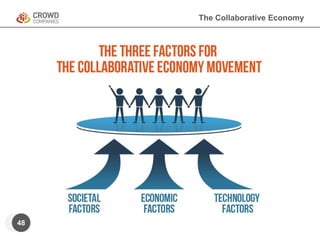
Yerdle enables neighbors to gift goods 
- rather than buy 
16
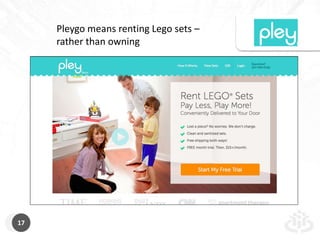
Pleygo means renting Lego sets – 
rather than owning 
17
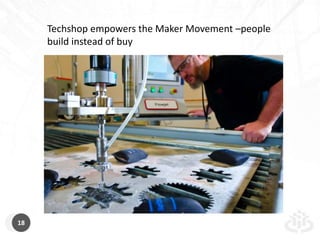
Techshop empowers the Maker Movement –people 
build instead of buy 
18
United States White House to host a 
Maker Faire 
19
21 
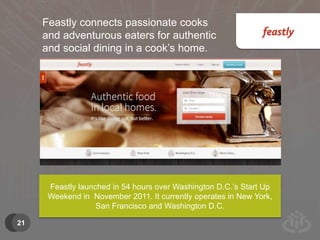
Feastly connects passionate cooks 
and adventurous eaters for authentic 
and social dining in a cook’s home. 
Feastly launched in 54 hours over Washington D.C.’s Start Up 
Weekend in November 2011. It currently operates in New York, 
San Francisco and Washington D.C.
Introduction 
22 
Cookening is a marketplace connecting 
traveling guests with local hosts for 
homecooked meals. 
Cookening facilitates local food experiences and meetings 
between strangers from different cultures over a homecooked 
meal.
23 
Munchery allows customers to order 
handmade meals by local chefs for 
same-day delivery. 
Munchery has served nearly 600,000 meals in the Bay Area.
24 
Leftover Swap facilitates trading or 
giving away of leftovers through their 
mobile app. 
Leftover Swap hopes to minimize the 40% of the food we use 
going to waste as well as the fact that 25% of people don’t know 
their neighbor’s names.
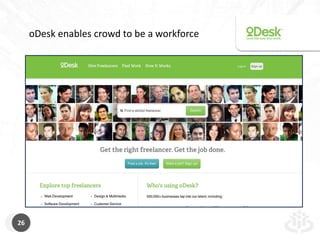
oDesk enables crowd to be a workforce 
26
27 
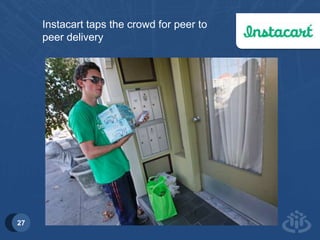
Instacart taps the crowd for peer to 
peer delivery
30 
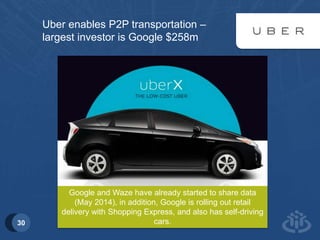
Uber enables P2P transportation – 
largest investor is Google $258m 
Google and Waze have already started to share data 
(May 2014), in addition, Google is rolling out retail 
delivery with Shopping Express, and also has self-driving 
cars.
API
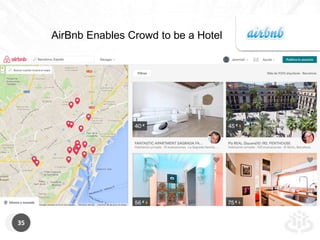
AirBnb Enables Crowd to be a Hotel 
35
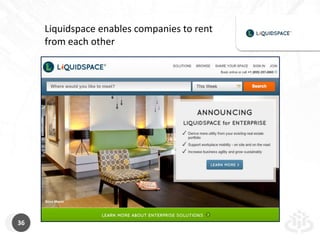
Liquidspace enables companies to rent 
from each other 
36
38 
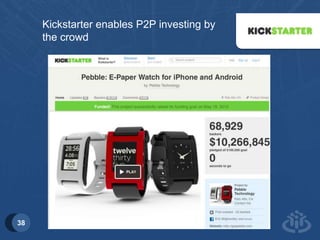
Kickstarter enables P2P investing by 
the crowd
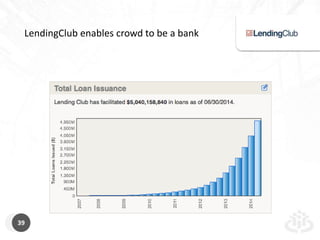
LendingClub enables crowd to be a bank 
39
42 
CHANGE 
• 9000 startups 
• Heavily funded 
• ADD GRAPHIC of bar chart
@V I S ION C R I T I C A L 
@JOWYA NG
The Collaborative Economy 
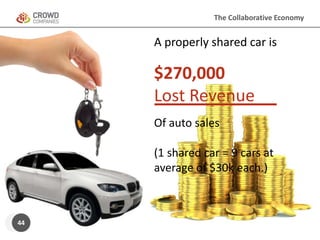
A properly shared car is 
$270,000 
Lost Revenue 
Of auto sales 
(1 shared car = 9 cars at 
average of $30k each.) 
44
Agenda: 
1) The Collaborative Economy movement 
2) Exercise: Why is it happening? 
3) The new business models 
4) Build your own business plan
Discussion: What’s causing 
this movement?
Discussion: What’s causing 
this movement? 
In your groups, document all the causes 
on paper, be prepared to present
The Collaborative Economy 
48
Agenda: 
1) The Collaborative Economy movement 
2) Exercise: Why is it happening? 
3) The new business models 
4) Build your own business plan
Collaborated with the Revolutionaries 
50
How can companies alter their 
business models and become 
resilient?
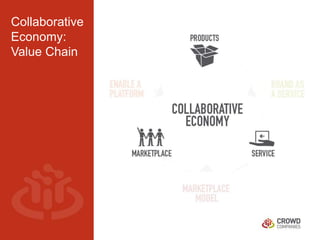
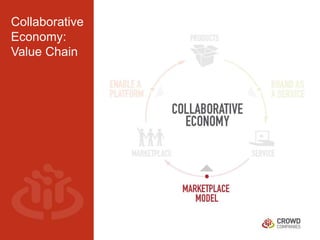
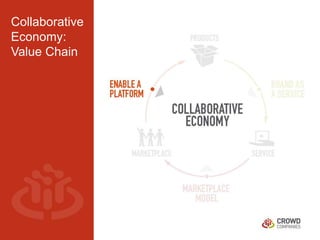
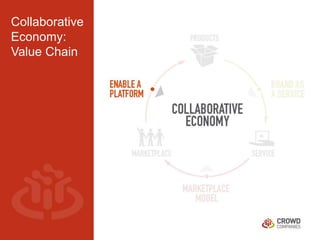
Collaborative 
Economy: 
Value Chain
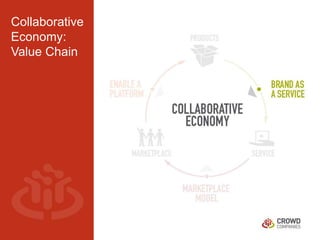
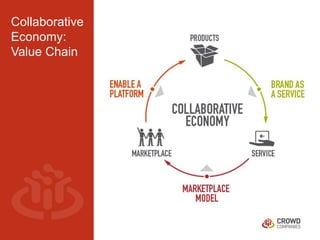
Collaborative 
Economy: 
Value Chain
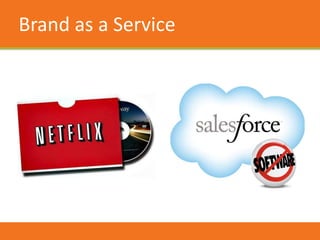
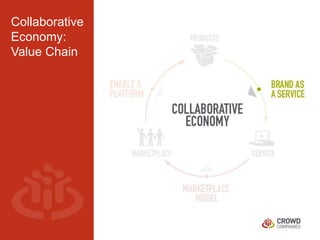
Brand as a Service
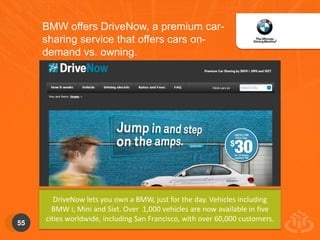
55 
BMW offers DriveNow, a premium car-sharing 
service that offers cars on-demand 
vs. owning. 
DriveNow lets you own a BMW, just for the day. Vehicles including 
BMW i, Mini and Sixt. Over 1,000 vehicles are now available in five 
cities worldwide, including San Francisco, with over 60,000 customers.
56 
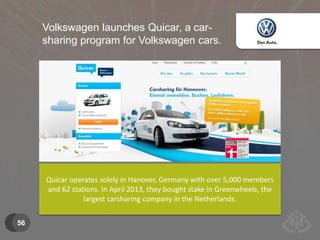
Volkswagen launches Quicar, a car-sharing 
program for Volkswagen cars. 
Quicar operates solely in Hanover, Germany with over 5,000 members 
and 62 stations. In April 2013, they bought stake in Greenwheels, the 
largest carsharing company in the Netherlands.
57 
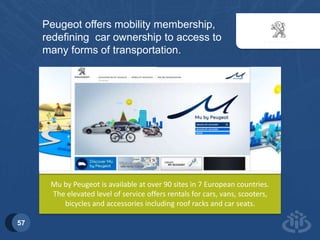
Peugeot offers mobility membership, 
redefining car ownership to access to 
many forms of transportation. 
Mu by Peugeot is available at over 90 sites in 7 European countries. 
The elevated level of service offers rentals for cars, vans, scooters, 
bicycles and accessories including roof racks and car seats.
Mobility as a Service
Introduction 
59 
ING offers a co-working space, Network 
Orange, in Downtown Toronto. 
Large corporations are finding value in collaborative spaces and 
launching groups like ING’s Network Orange.
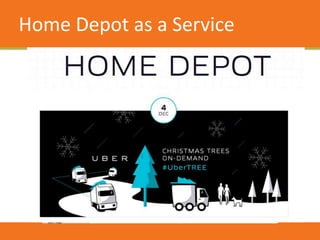
Home Depot as a Service
61 
Brand as a Service Needs 
• Inventory Management 
• CRM 
• Etc 
• LocalMotion
Collaborative 
Economy: 
Value Chain
Collaborative 
Economy: 
Value Chain
64 
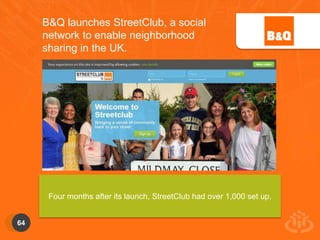
B&Q launches StreetClub, a social 
network to enable neighborhood 
sharing in the UK. 
Four months after its launch, StreetClub had over 1,000 set up.
65 
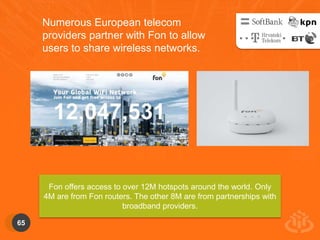
Numerous European telecom 
providers partner with Fon to allow 
users to share wireless networks. 
Fon offers access to over 12M hotspots around the world. Only 
4M are from Fon routers. The other 8M are from partnerships with 
broadband providers.
Introduction 
66 
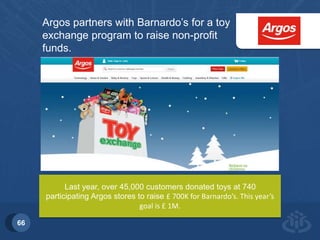
Argos partners with Barnardo’s for a toy 
exchange program to raise non-profit 
funds. 
Last year, over 45,000 customers donated toys at 740 
participating Argos stores to raise £ 700K for Barnardo’s. This year’s 
goal is £ 1M.
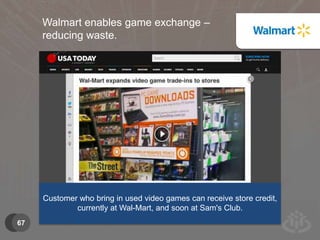
67 
Walmart enables game exchange – 
reducing waste. 
Customer who bring in used video games can receive store credit, 
currently at Wal-Mart, and soon at Sam's Club.
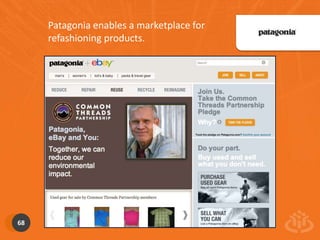
Patagonia enables a marketplace for 
refashioning products. 
68
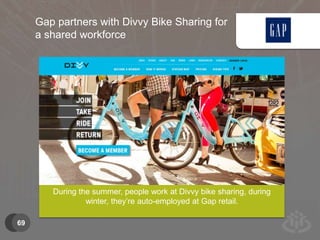
69 
Gap partners with Divvy Bike Sharing for 
a shared workforce 
During the summer, people work at Divvy bike sharing, during 
winter, they’re auto-employed at Gap retail.
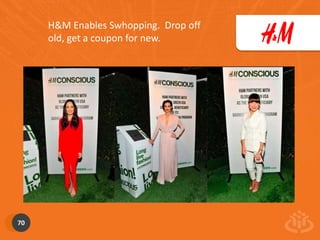
H&M Enables Swhopping. Drop off 
old, get a coupon for new. 
70
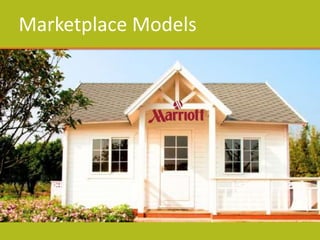
Marketplace Models
72 
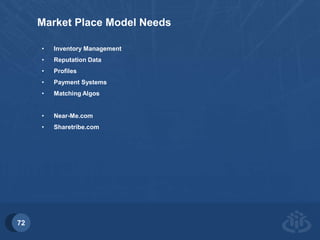
Market Place Model Needs 
• Inventory Management 
• Reputation Data 
• Profiles 
• Payment Systems 
• Matching Algos 
• Near-Me.com 
• Sharetribe.com
Collaborative 
Economy: 
Value Chain
Collaborative 
Economy: 
Value Chain
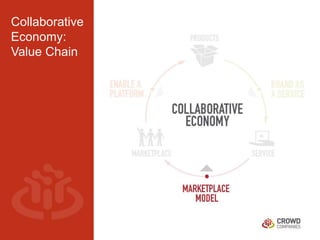
Enable a Platform
76 
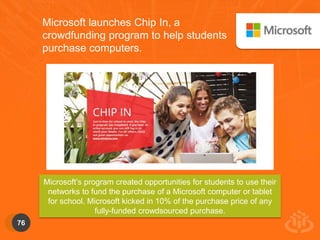
Microsoft launches Chip In, a 
crowdfunding program to help students 
purchase computers. 
Microsoft’s program created opportunities for students to use their 
networks to fund the purchase of a Microsoft computer or tablet 
for school. Microsoft kicked in 10% of the purchase price of any 
fully-funded crowdsourced purchase.
77 
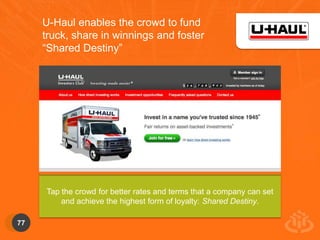
U-Haul enables the crowd to fund 
truck, share in winnings and foster 
“Shared Destiny” 
Tap the crowd for better rates and terms that a company can set 
and achieve the highest form of loyalty: Shared Destiny.
78 
QUOTES 
Crowdfunding is the highest 
form of loyalty: shared 
destiny
79 
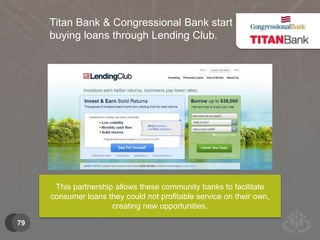
Titan Bank & Congressional Bank start 
buying loans through Lending Club. 
This partnership allows these community banks to facilitate 
consumer loans they could not profitable service on their own, 
creating new opportunities.
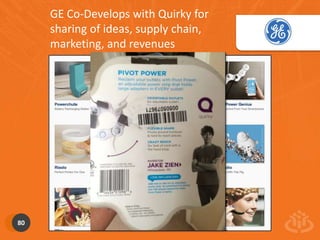
GE Co-Develops with Quirky for 
sharing of ideas, supply chain, 
marketing, and revenues 
80
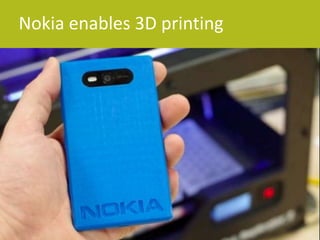
Co-Production with 3D Printers
Nokia enables 3D printing
83 
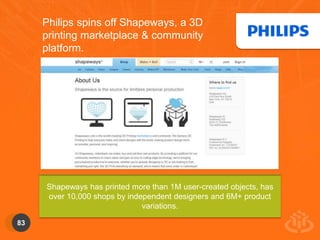
Philips spins off Shapeways, a 3D 
printing marketplace & community 
platform. 
Shapeways has printed more than 1M user-created objects, has 
over 10,000 shops by independent designers and 6M+ product 
variations.
Introduction 
84 
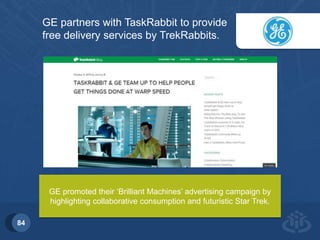
GE partners with TaskRabbit to provide 
free delivery services by TrekRabbits. 
GE promoted their ‘Brilliant Machines’ advertising campaign by 
highlighting collaborative consumption and futuristic Star Trek.
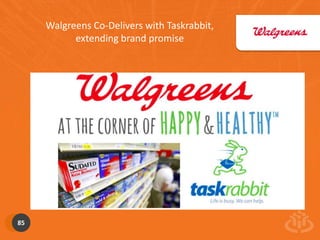
Walgreens Co-Delivers with Taskrabbit, 
extending brand promise 
85
86 
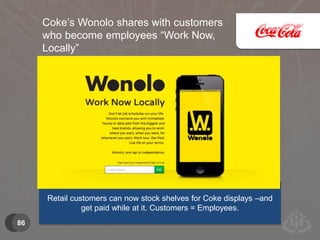
Coke’s Wonolo shares with customers 
who become employees “Work Now, 
Locally” 
Retail customers can now stock shelves for Coke displays –and 
get paid while at it. Customers = Employees.
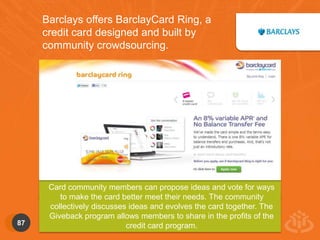
Barclays offers BarclayCard Ring, a 
credit card designed and built by 
community crowdsourcing. 
Card community members can propose ideas and vote for ways 
to make the card better meet their needs. The community 
collectively discusses ideas and evolves the card together. The 
Giveback program allows members to share in the profits of the 
87 credit card program.
88 
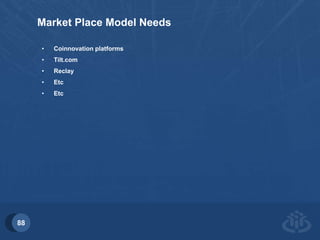
Market Place Model Needs 
• Coinnovation platforms 
• Tilt.com 
• Reclay 
• Etc 
• Etc
Collaborative 
Economy: 
Value Chain
Collaborative 
Economy: 
Value Chain
Collaborative 
Economy: 
Value Chain 
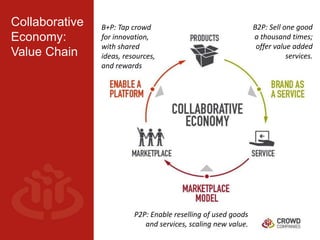
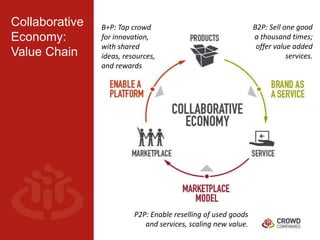
B2P: Sell one good 
a thousand times; 
offer value added 
services. 
B+P: Tap crowd 
for innovation, 
with shared 
ideas, resources, 
and rewards 
P2P: Enable reselling of used goods 
and services, scaling new value.
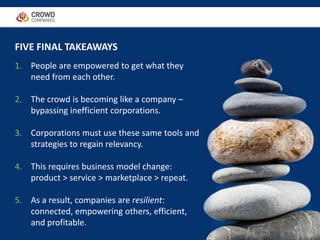
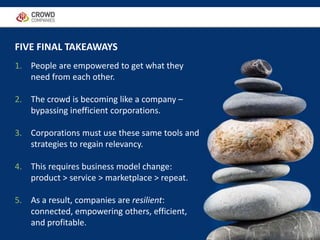
FIVE FINAL TAKEAWAYS 
1. People are empowered to get what they 
need from each other. 
2. The crowd is becoming like a company – 
bypassing inefficient corporations. 
3. Corporations must use these same tools and 
strategies to regain relevancy. 
4. This requires business model change: 
product > service > marketplace > repeat. 
5. As a result, companies are resilient: 
connected, empowering others, efficient, 
and profitable.
Agenda: 
1) The Collaborative Economy movement 
2) Exercise: Why is it happening? 
3) The new business models 
4) Build your own business plan
Develop your own Resilient 
business plan
Design a Resilient Business Model 
1) Which of the three business models fit your 
needs? 
2) What’s needed to make this happen? 
(technology, services, other resources, mindset 
changes) 
3) What are the risks and how will you mitigate? 
4) How will you measure success?
Design a Resilient Business Model 
1) Which of the three business models fit your 
needs? 
2) What’s needed to make this happen? 
(technology, services, other resources, mindset 
changes) 
3) What are the risks and how will you mitigate? 
4) How will you measure success?
Collaborative 
Economy: 
Value Chain 
B2P: Sell one good 
a thousand times; 
offer value added 
services. 
B+P: Tap crowd 
for innovation, 
with shared 
ideas, resources, 
and rewards 
P2P: Enable reselling of used goods 
and services, scaling new value.
Design a Resilient Business Model 
1) Which of the three business models fit your 
needs? 
2) What’s needed to make this happen? 
(technology, services, other resources, mindset 
changes) 
3) What are the risks and how will you mitigate? 
4) How will you measure success?
Design a Resilient Business Model 
1) Which of the three business models fit your 
needs? 
2) What’s needed to make this happen? 
(technology, services, other resources, mindset 
changes) 
3) What are the risks and how will you mitigate? 
4) How will you measure success?
Design a Resilient Business Model 
1) Which of the three business models fit your 
needs? 
2) What’s needed to make this happen? 
(technology, services, other resources, mindset 
changes) 
3) What are the risks and how will you mitigate? 
4) How will you measure success?
101 
FUTURE 
• APIs 
• Platforms 
• 3D printing 
• Airbnb future 
• People own less 
• Cant tell employees apart from customers
FIVE FINAL TAKEAWAYS 
1. People are empowered to get what they 
need from each other. 
2. The crowd is becoming like a company – 
bypassing inefficient corporations. 
3. Corporations must use these same tools and 
strategies to regain relevancy. 
4. This requires business model change: 
product > service > marketplace > repeat. 
5. As a result, companies are resilient: 
connected, empowering others, efficient, 
and profitable.
Welcome to the Collaborative Economy 
Crowd Companies 
Empowered People & Resilient Brands 
Jeremiah Owyang 
Founder 
@jowyang 
Jeremiah@CrowdCompanies.com
FEEDBACK FORM

Business model disruption and the next phase of the web

  • 1.
    How Companies areLeading the Collaborative Economy By Jeremiah Owyang @jowyang Sept, 2014
  • 3.
    Launched Dec 2013 CROWD COMPANIES MEMBERS (42) Also including: Clorox, MasterCard, Samsung, SAP, Toshiba, Sears, and Disney
  • 4.
    Agenda: 1) TheCollaborative Economy movement 2) Exercise: Why is it happening? 3) The new business models 4) Build your own business plan
  • 5.
  • 6.
    6 Collaborative EconomyTerms • Collaborative Economy: The overall economic movement where people get what they need from each other. • Crowdfunding: A process where people fund new projects in exchange for perks or equity. • Maker Movement: A process where people build their own goods – rather than buying from traditional stores. • Sharing Economy: People share what they already have –rather than buy.
  • 7.
    7 Collaborative EconomyTerms • On Demand Service: Easy to use apps and websites deliver goods and services within a push of a button • Access over ownership: On demand models that enable goods and services to emerge rather than purchasing. • Activate Idle Resources: A tenant that cars, drills, and homes are often not used –now we can quickly use on demand via mobile and social technologies. • Marketplaces (Two-sided): Software platform that enables the tractions of providers and partakers. (hosts and guests, drivers and riders).
  • 8.
    The Collaborative Economy Phases of Internet Sharing 8 From Altimeter Research: The Collaborative Economy, 2013, Jeremiah Owyang
  • 9.
    What role docorporations play if people get what they need from each other?
  • 10.
    The Collaborative Economy An economic model where creation, ownership, and access are shared between people and corporations.
  • 11.
    Is this abusiness disruption?
  • 16.
    Yerdle enables neighborsto gift goods - rather than buy 16
  • 17.
    Pleygo means rentingLego sets – rather than owning 17
  • 18.
    Techshop empowers theMaker Movement –people build instead of buy 18
  • 19.
    United States WhiteHouse to host a Maker Faire 19
  • 21.
    21 Feastly connectspassionate cooks and adventurous eaters for authentic and social dining in a cook’s home. Feastly launched in 54 hours over Washington D.C.’s Start Up Weekend in November 2011. It currently operates in New York, San Francisco and Washington D.C.
  • 22.
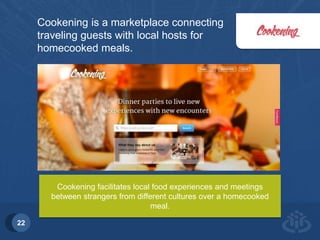
    Introduction 22 Cookeningis a marketplace connecting traveling guests with local hosts for homecooked meals. Cookening facilitates local food experiences and meetings between strangers from different cultures over a homecooked meal.
  • 23.
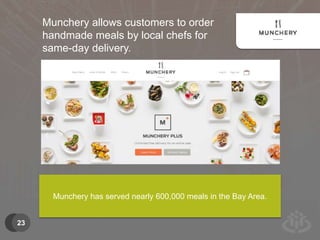
    23 Munchery allowscustomers to order handmade meals by local chefs for same-day delivery. Munchery has served nearly 600,000 meals in the Bay Area.
  • 24.
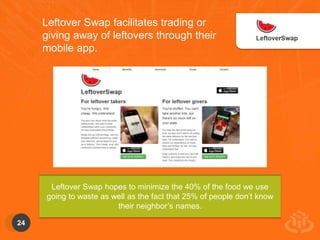
    24 Leftover Swapfacilitates trading or giving away of leftovers through their mobile app. Leftover Swap hopes to minimize the 40% of the food we use going to waste as well as the fact that 25% of people don’t know their neighbor’s names.
  • 26.
    oDesk enables crowdto be a workforce 26
  • 27.
    27 Instacart tapsthe crowd for peer to peer delivery
  • 30.
    30 Uber enablesP2P transportation – largest investor is Google $258m Google and Waze have already started to share data (May 2014), in addition, Google is rolling out retail delivery with Shopping Express, and also has self-driving cars.
  • 31.
  • 35.
    AirBnb Enables Crowdto be a Hotel 35
  • 36.
    Liquidspace enables companiesto rent from each other 36
  • 38.
    38 Kickstarter enablesP2P investing by the crowd
  • 39.
  • 42.
    42 CHANGE •9000 startups • Heavily funded • ADD GRAPHIC of bar chart
  • 43.
    @V I SION C R I T I C A L @JOWYA NG
  • 44.
    The Collaborative Economy A properly shared car is $270,000 Lost Revenue Of auto sales (1 shared car = 9 cars at average of $30k each.) 44
  • 45.
    Agenda: 1) TheCollaborative Economy movement 2) Exercise: Why is it happening? 3) The new business models 4) Build your own business plan
  • 46.
  • 47.
    Discussion: What’s causing this movement? In your groups, document all the causes on paper, be prepared to present
  • 48.
  • 49.
    Agenda: 1) TheCollaborative Economy movement 2) Exercise: Why is it happening? 3) The new business models 4) Build your own business plan
  • 50.
    Collaborated with theRevolutionaries 50
  • 51.
    How can companiesalter their business models and become resilient?
  • 52.
  • 53.
  • 54.
    Brand as aService
  • 55.
    55 BMW offersDriveNow, a premium car-sharing service that offers cars on-demand vs. owning. DriveNow lets you own a BMW, just for the day. Vehicles including BMW i, Mini and Sixt. Over 1,000 vehicles are now available in five cities worldwide, including San Francisco, with over 60,000 customers.
  • 56.
    56 Volkswagen launchesQuicar, a car-sharing program for Volkswagen cars. Quicar operates solely in Hanover, Germany with over 5,000 members and 62 stations. In April 2013, they bought stake in Greenwheels, the largest carsharing company in the Netherlands.
  • 57.
    57 Peugeot offersmobility membership, redefining car ownership to access to many forms of transportation. Mu by Peugeot is available at over 90 sites in 7 European countries. The elevated level of service offers rentals for cars, vans, scooters, bicycles and accessories including roof racks and car seats.
  • 58.
  • 59.
    Introduction 59 INGoffers a co-working space, Network Orange, in Downtown Toronto. Large corporations are finding value in collaborative spaces and launching groups like ING’s Network Orange.
  • 60.
    Home Depot asa Service
  • 61.
    61 Brand asa Service Needs • Inventory Management • CRM • Etc • LocalMotion
  • 62.
  • 63.
  • 64.
    64 B&Q launchesStreetClub, a social network to enable neighborhood sharing in the UK. Four months after its launch, StreetClub had over 1,000 set up.
  • 65.
    65 Numerous Europeantelecom providers partner with Fon to allow users to share wireless networks. Fon offers access to over 12M hotspots around the world. Only 4M are from Fon routers. The other 8M are from partnerships with broadband providers.
  • 66.
    Introduction 66 Argospartners with Barnardo’s for a toy exchange program to raise non-profit funds. Last year, over 45,000 customers donated toys at 740 participating Argos stores to raise £ 700K for Barnardo’s. This year’s goal is £ 1M.
  • 67.
    67 Walmart enablesgame exchange – reducing waste. Customer who bring in used video games can receive store credit, currently at Wal-Mart, and soon at Sam's Club.
  • 68.
    Patagonia enables amarketplace for refashioning products. 68
  • 69.
    69 Gap partnerswith Divvy Bike Sharing for a shared workforce During the summer, people work at Divvy bike sharing, during winter, they’re auto-employed at Gap retail.
  • 70.
    H&M Enables Swhopping.Drop off old, get a coupon for new. 70
  • 71.
  • 72.
    72 Market PlaceModel Needs • Inventory Management • Reputation Data • Profiles • Payment Systems • Matching Algos • Near-Me.com • Sharetribe.com
  • 73.
  • 74.
  • 75.
  • 76.
    76 Microsoft launchesChip In, a crowdfunding program to help students purchase computers. Microsoft’s program created opportunities for students to use their networks to fund the purchase of a Microsoft computer or tablet for school. Microsoft kicked in 10% of the purchase price of any fully-funded crowdsourced purchase.
  • 77.
    77 U-Haul enablesthe crowd to fund truck, share in winnings and foster “Shared Destiny” Tap the crowd for better rates and terms that a company can set and achieve the highest form of loyalty: Shared Destiny.
  • 78.
    78 QUOTES Crowdfundingis the highest form of loyalty: shared destiny
  • 79.
    79 Titan Bank& Congressional Bank start buying loans through Lending Club. This partnership allows these community banks to facilitate consumer loans they could not profitable service on their own, creating new opportunities.
  • 80.
    GE Co-Develops withQuirky for sharing of ideas, supply chain, marketing, and revenues 80
  • 81.
  • 82.
  • 83.
    83 Philips spinsoff Shapeways, a 3D printing marketplace & community platform. Shapeways has printed more than 1M user-created objects, has over 10,000 shops by independent designers and 6M+ product variations.
  • 84.
    Introduction 84 GEpartners with TaskRabbit to provide free delivery services by TrekRabbits. GE promoted their ‘Brilliant Machines’ advertising campaign by highlighting collaborative consumption and futuristic Star Trek.
  • 85.
    Walgreens Co-Delivers withTaskrabbit, extending brand promise 85
  • 86.
    86 Coke’s Wonoloshares with customers who become employees “Work Now, Locally” Retail customers can now stock shelves for Coke displays –and get paid while at it. Customers = Employees.
  • 87.
    Barclays offers BarclayCardRing, a credit card designed and built by community crowdsourcing. Card community members can propose ideas and vote for ways to make the card better meet their needs. The community collectively discusses ideas and evolves the card together. The Giveback program allows members to share in the profits of the 87 credit card program.
  • 88.
    88 Market PlaceModel Needs • Coinnovation platforms • Tilt.com • Reclay • Etc • Etc
  • 89.
  • 90.
  • 91.
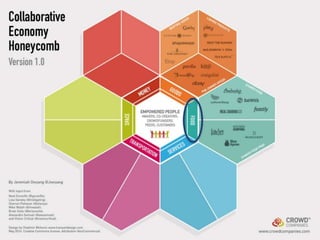
    Collaborative Economy: ValueChain B2P: Sell one good a thousand times; offer value added services. B+P: Tap crowd for innovation, with shared ideas, resources, and rewards P2P: Enable reselling of used goods and services, scaling new value.
  • 92.
    FIVE FINAL TAKEAWAYS 1. People are empowered to get what they need from each other. 2. The crowd is becoming like a company – bypassing inefficient corporations. 3. Corporations must use these same tools and strategies to regain relevancy. 4. This requires business model change: product > service > marketplace > repeat. 5. As a result, companies are resilient: connected, empowering others, efficient, and profitable.
  • 93.
    Agenda: 1) TheCollaborative Economy movement 2) Exercise: Why is it happening? 3) The new business models 4) Build your own business plan
  • 94.
    Develop your ownResilient business plan
  • 95.
    Design a ResilientBusiness Model 1) Which of the three business models fit your needs? 2) What’s needed to make this happen? (technology, services, other resources, mindset changes) 3) What are the risks and how will you mitigate? 4) How will you measure success?
  • 96.
    Design a ResilientBusiness Model 1) Which of the three business models fit your needs? 2) What’s needed to make this happen? (technology, services, other resources, mindset changes) 3) What are the risks and how will you mitigate? 4) How will you measure success?
  • 97.
    Collaborative Economy: ValueChain B2P: Sell one good a thousand times; offer value added services. B+P: Tap crowd for innovation, with shared ideas, resources, and rewards P2P: Enable reselling of used goods and services, scaling new value.
  • 98.
    Design a ResilientBusiness Model 1) Which of the three business models fit your needs? 2) What’s needed to make this happen? (technology, services, other resources, mindset changes) 3) What are the risks and how will you mitigate? 4) How will you measure success?
  • 99.
    Design a ResilientBusiness Model 1) Which of the three business models fit your needs? 2) What’s needed to make this happen? (technology, services, other resources, mindset changes) 3) What are the risks and how will you mitigate? 4) How will you measure success?
  • 100.
    Design a ResilientBusiness Model 1) Which of the three business models fit your needs? 2) What’s needed to make this happen? (technology, services, other resources, mindset changes) 3) What are the risks and how will you mitigate? 4) How will you measure success?
  • 101.
    101 FUTURE •APIs • Platforms • 3D printing • Airbnb future • People own less • Cant tell employees apart from customers
  • 102.
    FIVE FINAL TAKEAWAYS 1. People are empowered to get what they need from each other. 2. The crowd is becoming like a company – bypassing inefficient corporations. 3. Corporations must use these same tools and strategies to regain relevancy. 4. This requires business model change: product > service > marketplace > repeat. 5. As a result, companies are resilient: connected, empowering others, efficient, and profitable.
  • 104.
    Welcome to theCollaborative Economy Crowd Companies Empowered People & Resilient Brands Jeremiah Owyang Founder @jowyang Jeremiah@CrowdCompanies.com
  • 105.

Editor's Notes

  • #57 #productasaservice #carsharing #auto #city Links: http://mydrivemedia.com.au/quicar-share-a-volkswagen-has-5000-members/ https://web.quicar.de/ http://carsharingus.blogspot.com/2013/04/volkswagen-purchases-60-stake-in.html
  • #58 #productasaservice #carsharing #auto #city Links: http://europe.autonews.com/article/20130530/ANE/130529917/ford-joins-europe-car-sharing-sector-as-demand-surges#axzz2g2cML9TF *great article on a number of carshare companies in Europe http://www.mu.peugeot.co.uk/ http://wardsauto.com/ar/peugeot_mu_rental_091216 http://www.autoevolution.com/news/mu-by-peugeot-pilot-scheme-launched-in-the-uk-22107.html http://www.autoevolution.com/news/peugeot-introduces-mu-mobility-program-iphone-app-18438.html
  • #59 http://www.mu.peugeot.co.uk/discover-mu-by-peugeot/
  • #60 #coworking #finance Links: http://www.ingdirect.ca/en/networkorange/ http://www.bizbash.com/toronto-meeting-venues-ing-direct-cafe-network-orange-second-floor/gallery/72064#sthash.1flfISAx.dpbs
  • #71 http://campaigns.ebay.com/patagonia/
  • #72 An example: Right now, people are bypassing hotels to stay at unique experiences using websites like Airbnb. Rather than stand by the wayside, we discovered a new market opportunity for Loic’s guest room to be certified as Marriott certified. A large brand brings TRUST Marriot would then funnel trusted guests, perhaps from a loyalty program, and even offer maid, food, or concierge services. Everyone wins: Loic gets a trusted guest, the guest gets a local experience at a certified home, and Marriot gets a cut of the transactions –that they wouldn’t have missed out on completely.
  • #73 #sharedfoodprep #food http://www.blueapron.com/ http://techcrunch.com/2014/04/30/blue-apron-closes-50m-led-by-stripes-group-at-450m-valuation/
  • #74 Next, let’s talk about shifting services to now becoming marketplaces. We call this ‘Motivating a marketplace”. The naming is specific, you can’t own the marketplace, you can’t manage it, you simply must help usher them along, in this use case, the goal is to get the people to do these actions among themselves. If your company offers services, like a hospitality company serves guests, then learn how to tap into the marketplaces that are already forming in the sharing economy. There’s a number of new activities that people can perform, including to resell, co-owning, swapping goods, lending to each other, or gifting.
  • #75 In this third phase. Companies who have marketplaces, must activate them to build their future products. We call this “provide a platform” And it means that companies must empower their crowds to build future products and services. This is the hardest level –but yields the most benefits. Lots of of “co” words that are part of the collaboration mindset It doesn’t exist, but we see parts of it We see many startups already doing this: -Ideation sites like uservoice co-ideate new products -Kickstsarter co-funds new ideas -Quickly co-builds new products But imagine if this was extended to co distribution, co marketing, co selling, and even co revenue sharing? In this case, it may be Hard to tell the diference between employees and customers as new products are built from the crowd. But the costs of buidling are leveraged by the crowd, reducing the costs of the company In this radical state, the non essential parts of the company reduce, and perhaps the most important remaining parts are the brand, and perhaps an ecommerce engine. In this future state: “The CROWD BECOMES THE COMPANY.“
  • #76 Image from http://productnation.in/5-key-considerations-for-platform-approach/
  • #77 #crowdfunding #technology Links: https://www.windowschipin.com/ http://www.microsoft.com/en-us/news/press/2013/jun13/06-03windowschipinpr.aspx http://mashable.com/2013/06/04/microsoft-student-chip-in/
  • #78 #collaboration #workspace #hotel #coworking Links: http://www.smartplanet.com/blog/design-architecture/how-marriott-is-designing-a-smarter-business-hotel/8828 http://www.workspring.com/
  • #79 #sharedfoodprep #food http://www.blueapron.com/ http://techcrunch.com/2014/04/30/blue-apron-closes-50m-led-by-stripes-group-at-450m-valuation/
  • #80 #crowdfunding #finance Links: http://online.wsj.com/article/PR-CO-20130620-905342.html?mod=wsj_share_twitter http://www.bizjournals.com/sanfrancisco/blog/2013/06/lending-club-community-banks-loans.html?page=all http://www.informilo.com/20130916/peer-peer-lending-platforms-begin-partnering-banks-873
  • #102 #sharedfoodprep #food http://www.blueapron.com/ http://techcrunch.com/2014/04/30/blue-apron-closes-50m-led-by-stripes-group-at-450m-valuation/
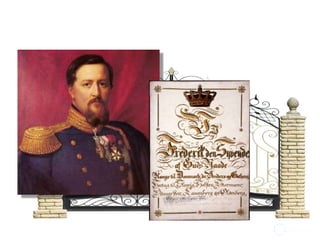
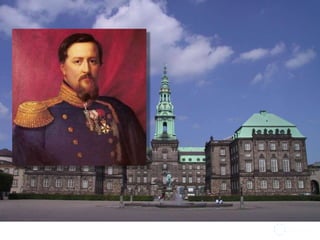
  • #104 So what happened to fred who met the revolutionaries at the gate? Fred is a hero, he saved bloodshed, gave them people what they wanted –yet stayed in the palace I’m pleased to share, that his lineage is the second oldest monarchy in the world Not only is denmark the second happiest country in the world, He’s revered as a national icon, and his family is taken care of by the nation, and they’re still in the palace. Fred let go of his throne -- to gain the kingdom And if you want to collaborate in the economy. , then you must….