Laurea with multiple Centre of Excellence
awards in the Helsinki Metropolitan Area


                    REGIONAL POLICY AND
          DESIGN IN OPEN USER-DRIVEN ECOSYSTEMS
                    Director Tuija Hirvikoski, PhD, Laurea University of Applied Sciences
                                                     European Network of Living Labs
                                                   Helsinki, the World Design Capital 2012
                                                http://wdchelsinki2012.fi/en/wdc-helsinki-2012
                                                          Design Days 2012
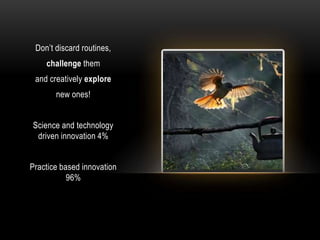
Don‟t discard routines,
    challenge them
 and creatively explore
       new ones!


Science and technology
 driven innovation 4%


Practice based innovation
           96%
Service Design
is a systematic way to
approach service
development and
innovation both
analytically and
intuitively
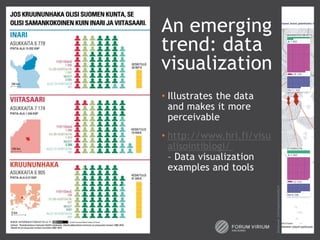
An emerging
trend: data
visualization
• Illustrates the data
  and makes it more
  perceivable
• http://www.hri.fi/visu
  alisointiblogi/
  – Data visualization
  examples and tools


                           Datakuvat: Informaatiomuotoilu.fi
DESIGN THINKING AND METHODS – WHY?
It catalyses people to innovate and see opportunities in a new way…
creates a virtuous circle of learning - helps us to share abstract ideas
and to spot the promising connections between things.. enables us to
escape the constraints dominating bureaucracies and to avoid pitfalls of
traditional boarders.
By quickly developing multiple perspectives and integrating strategic intent with
execution, strategic design advances society‟s ability to work in integrated
fashion with complex issues in dynamic context.

Design methods can help governments and public authorities, who traditionally
spend billions on research and development , to invest in themselves by
developing new ways of tackling wicked problems and creating public
innovation.

Best of all, strategic design allows   people to act while the government facilitates .

                          Helsinki Design Lab http://www.dexigner.com/news/24189
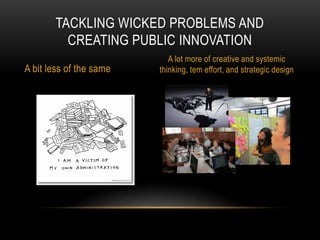
TACKLING WICKED PROBLEMS AND
         CREATING PUBLIC INNOVATION
                            A lot more of creative and systemic
A bit less of the same   thinking, tem effort, and strategic design
http://www.dexigner.com/directory/detail/19311.html
                                     Helsinki Design Lab is an initiative by Sitra, The Finnish
                                     Innovation Fund, to advance strategic design as a way to re-
                                     examine, re-think, and re-design the systems we've inherited
                                     from the past. We assist decision-makers to view challenges from a
                                     big-picture perspective, and provide guidance toward more complete
                                     solutions that consider all aspects of a problem


http://www.dexigner.com/news/24189

   “STRATEGIC DESIGN IS A WAY TO SPECIFY THE
 INTENTIONS THAT WE WANT TO ACCOMPLISH AND
  STEWARD EFFORTS TOWARDS THE REALISATION
                OF THOSE AIMS.”
Inspiring creativity,
innovation and design in
    regions and cities
Inspiring Creativity,
innovation and design in
    Regions and cities


       Applying
      Living Labs
       thinking
Creativity and Design
Can
 Local and regional
     authorities
         Be
Creative and design?
Can
Policymakers and civil
      servants
         Be
Creative and design?
Can
 Citizens and users
         Be
Creative and design?
Can
         You
         Be
Creative and design?
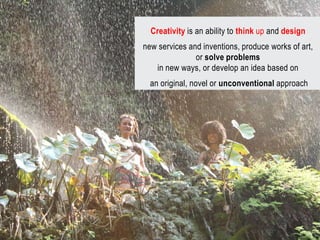
Creativity is an ability to think up and design
new services and inventions, produce works of art,
               or solve problems
   in new ways, or develop an idea based on
  an original, novel or unconventional approach
Creativity is the
road less travelled
but one we need to
explore to get to a
  better and more
 innovative place
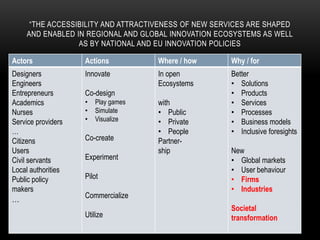
“THE ACCESSIBILITY AND ATTRACTIVENESS OF NEW SERVICES ARE SHAPED
    AND ENABLED IN REGIONAL AND GLOBAL INNOVATION ECOSYSTEMS AS WELL
                 AS BY NATIONAL AND EU INNOVATION POLICIES

Actors              Actions          Where / how     Why / for
Designers           Innovate         In open         Better
Engineers                            Ecosystems      • Solutions
Entrepreneurs       Co-design                        • Products
Academics           •   Play games   with            • Services
Nurses              •   Simulate     • Public        • Processes
Service providers   •   Visualize    • Private       • Business models
…                                    • People        • Inclusive foresights
Citizens            Co-create        Partner-
Users                                ship            New
Civil servants      Experiment                       • Global markets
Local authorities                                    • User behaviour
Public policy       Pilot                            • Firms
makers                                               • Industries
                    Commercialize
…
                                                     Societal
                    Utilize                          transformation
Cultivating
Urban
Innovations
Cities and regions
Set the agenda for
information infrastructure
for everything, from
service to security to
energy
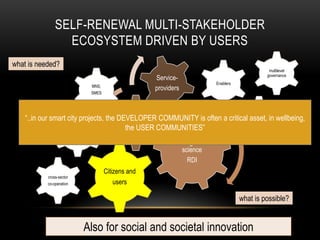
SELF-RENEWAL MULTI-STAKEHOLDER
                  ECOSYSTEM DRIVEN BY USERS
what is needed?
                                                                                                            multilevel
                                                                                                           governance
                                                                Service-
                                                                                       Enablers
                                          MNS,
                                                                providers
                                          SMES


    “..in our smart city projects, the DEVELOPER COMMUNITY is often a critical Public sectorin wellbeing,
                                                                               asset,
                                        Education
                                         the USER COMMUNITIES”
                           third sector
                                                                      convergence of
                                                                         science
                                                                           RDI
                                                 Citizens and
            cross-sector
            co-operation                            users

                                                                                                  what is possible?


                                    Also for social and societal innovation
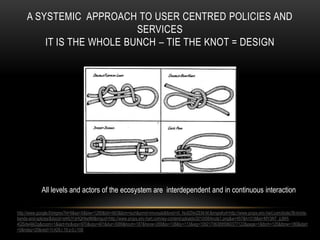
A SYSTEMIC APPROACH TO USER CENTRED POLICIES AND
                           SERVICES
         IT IS THE WHOLE BUNCH – TIE THE KNOT = DESIGN


             All levels and actors of the ecosystem are interdependent and in continuous interaction

http://www.google.fi/imgres?hl=fi&sa=X&biw=1280&bih=663&tbm=isch&prmd=imvnsab&tbnid=i5_Nu9ZNnZEM-M:&imgrefurl=http://www.props.eric-hart.com/tools/36-knots-
bends-and-splices/&docid=st4IUYsHQHtw8M&imgurl=http://www.props.eric-hart.com/wp-content/uploads/2010/08/knots1.png&w=457&h=318&ei=MY3NT_jLBKf-
4QSdw4jkDg&zoom=1&iact=hc&vpx=970&vpy=401&dur=3089&hovh=187&hovw=269&tx=138&ty=113&sig=109217063895960377122&page=1&tbnh=125&tbnw=180&start
=0&ndsp=20&ved=1t:429,r:19,s:0,i:108
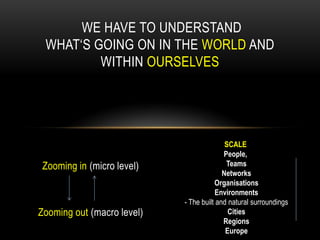
WE HAVE TO UNDERSTAND
 WHAT„S GOING ON IN THE WORLD AND
         WITHIN OURSELVES


                                           SCALE
                                          People,
 Zooming in (micro level)                  Teams
                                          Networks
                                       Organisations
                                        Environments
                            - The built and natural surroundings
Zooming out (macro level)                   Cities
                                          Regions
                                           Europe
ALL LEVELS ARE INTERDEPENDENT

What does systemic / holistic innovation and
            design look like?
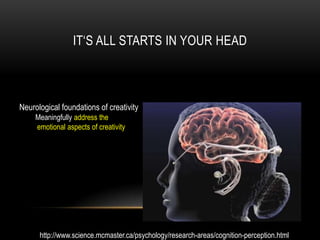
IT„S ALL STARTS IN YOUR HEAD


Neurological foundations of creativity
     Meaningfully address the
     emotional aspects of creativity


      http://www.science.mcmaster.ca/psychology/research-areas/cognition-perception.html
ORGANIZING FOR COLLABORATIVE
INNOVATION – HOW?
J. Dyer, H. Gregersen, & C.M. Christensen,     T.Hirvikoski, A Systemic Approach to Successful
The Innovator’s DNA: Mastering the Five        Innovation Ecosystems.
Skills of Disruptive Innovators
                                               Virtuous Circle of Innovation
• Associating – making connections
    across seemingly unrelated questions,      •   Visionary and Holistic approach
    problems, or ideas
                                               •   Complementary interaction &
• Questioning – a passion for inquiry              integrating ideas and knowledge
• Observing – carefully watch                  •   Resistance of pressures & Tolerance
    customers, technologies, firms, etc.
                                                   of inconveniences and frustration
• Networking – find and test ideas
    through a diverse network of individuals   •   Generation of tangible and
                                                   intangible energy
• Experimenting – try out new
    experiences and ideas
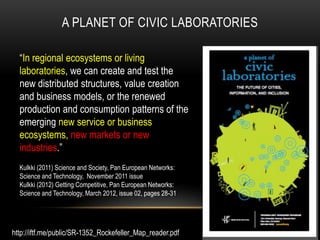
A PLANET OF CIVIC LABORATORIES

  “In regional ecosystems or living
  laboratories, we can create and test the
  new distributed structures, value creation
  and business models, or the renewed
  production and consumption patterns of the
  emerging new service or business
  ecosystems, new markets or new
  industries.”
  Kulkki (2011) Science and Society, Pan European Networks:
  Science and Technology, November 2011 issue
  Kulkki (2012) Getting Competitive, Pan European Networks:
  Science and Technology, March 2012, issue 02, pages 28-31


http://iftf.me/public/SR-1352_Rockefeller_Map_reader.pdf
Kulkki (2011) Science and Society, Pan European Networks: Science and Technology, November 2011 issue
Kulkki (2012) Getting Competitive, Pan European Networks: Science and Technology, March 2012, issue 02,
pages 28-31


INNOVATIVE REGIONAL POLICY,
OPEN GOVERNMENT POLICY,
POLICY AND RESEARCH INTEGRATION, AND DECISIONS
-TO SUPPORT THE BOTTOM-UP DEVELOPMENT,
-TO PROVIDE GOOD EDUCATION OR
-TO APPLY THE PUBLIC PRE-COMMERCIAL PROCUREMENT

WILL HELP THE TRANSFORMATIVE INNOVATION TO
EMERGE.
REGIONS AND CITIES ARE PLACES FOR LIFE..
                            There people and organisations encounter and solve major
                            societal challenges
                             •   The Synergise Finland development project (Sitra) is an
                                 example of how these elements where present when
                                 addressing the concept of new work and the idea of new
                                 demography. Immediate democracy is based on increased
                                 openness and the flexibility of administration; it means
                                 that operations are spontaneously introduced by the
                                 public. The New Democracy forum experimented with
                                 participatory budgeting, crowd sourcing of information
                                 requests and a social hub, where people can meet and
                                 work together.
                             •   www.sitra.fi/uusi-demokratia
                             •   http://ominvoimin.com/ominvoimin-raportti-valmistui/


http://iftf.me/public/SR-
1352_Rockefeller_Map_rea
der.pdf
“WHEN THEY HAVE A PROBLEM, THEY ASK
  EVERYONE” *
  Crowd-funding Platforms                                      Because
                                                   They know that people are
                                                     willing to be of service


                                                      The open, user-driven
                                                           innovation:


* http://www.nytimes.com/2008/07/22/science/22inno.html?_r=2&pagewanted=all
DISTRIBUTED LEADERSHIP BASED ON TRUST AND SHARED
  RESPONSIBILITIES AMONG FIRMS, PUBLIC AUTHORITIES,
                ACADEMIA AND PEOPLE.
Help firms and people to design and produce
new services                                  Living Lab thinking in real life e.g.
• cities and regions as places and            •   the city of Barcelona as a Living Lab
    engines for globally competitive and      •   the Consciousness Academy in
    open, ecosystem-based, human-                 Friesland
    centric RDI in real-life contexts, such   •    the city of Oulu which is successfully
    as living laboratories that engage            renewing their social and health care
    people. When solving societal                 system in close collaboration with the
    challenges, we co-design,                     citizens.
    experiment and pilot new services,        •   Helsinki Living Labs: FVH + Aalto +
    technologies and businesses in the            Laurea + ….
    ecosystems..
                                                   •   Open innovation portfolio since since
                                                       1990s
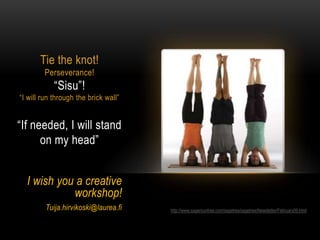
Tie the knot!
        Perseverance!
            “Sisu”!
“I will run through the brick wall”


“If needed, I will stand
      on my head”


  I wish you a creative
            workshop!
         Tuija.hirvikoski@laurea.fi   http://www.sagerountree.com/sagetree/sagetree/Newsletter/February09.html

Design days 2012

  • 1.
    Laurea with multipleCentre of Excellence awards in the Helsinki Metropolitan Area REGIONAL POLICY AND DESIGN IN OPEN USER-DRIVEN ECOSYSTEMS Director Tuija Hirvikoski, PhD, Laurea University of Applied Sciences European Network of Living Labs Helsinki, the World Design Capital 2012 http://wdchelsinki2012.fi/en/wdc-helsinki-2012 Design Days 2012
  • 2.
    Don‟t discard routines, challenge them and creatively explore new ones! Science and technology driven innovation 4% Practice based innovation 96%
  • 3.
    Service Design is asystematic way to approach service development and innovation both analytically and intuitively
  • 4.
    An emerging trend: data visualization •Illustrates the data and makes it more perceivable • http://www.hri.fi/visu alisointiblogi/ – Data visualization examples and tools Datakuvat: Informaatiomuotoilu.fi
  • 5.
    DESIGN THINKING ANDMETHODS – WHY? It catalyses people to innovate and see opportunities in a new way… creates a virtuous circle of learning - helps us to share abstract ideas and to spot the promising connections between things.. enables us to escape the constraints dominating bureaucracies and to avoid pitfalls of traditional boarders. By quickly developing multiple perspectives and integrating strategic intent with execution, strategic design advances society‟s ability to work in integrated fashion with complex issues in dynamic context. Design methods can help governments and public authorities, who traditionally spend billions on research and development , to invest in themselves by developing new ways of tackling wicked problems and creating public innovation. Best of all, strategic design allows people to act while the government facilitates . Helsinki Design Lab http://www.dexigner.com/news/24189
  • 6.
    TACKLING WICKED PROBLEMSAND CREATING PUBLIC INNOVATION A lot more of creative and systemic A bit less of the same thinking, tem effort, and strategic design
  • 7.
    http://www.dexigner.com/directory/detail/19311.html Helsinki Design Lab is an initiative by Sitra, The Finnish Innovation Fund, to advance strategic design as a way to re- examine, re-think, and re-design the systems we've inherited from the past. We assist decision-makers to view challenges from a big-picture perspective, and provide guidance toward more complete solutions that consider all aspects of a problem http://www.dexigner.com/news/24189 “STRATEGIC DESIGN IS A WAY TO SPECIFY THE INTENTIONS THAT WE WANT TO ACCOMPLISH AND STEWARD EFFORTS TOWARDS THE REALISATION OF THOSE AIMS.”
  • 8.
    Inspiring creativity, innovation anddesign in regions and cities
  • 9.
    Inspiring Creativity, innovation anddesign in Regions and cities Applying Living Labs thinking
  • 10.
  • 11.
    Can Local andregional authorities Be Creative and design?
  • 12.
    Can Policymakers and civil servants Be Creative and design?
  • 13.
    Can Citizens andusers Be Creative and design?
  • 14.
    Can You Be Creative and design?
  • 15.
    Creativity is anability to think up and design new services and inventions, produce works of art, or solve problems in new ways, or develop an idea based on an original, novel or unconventional approach
  • 16.
    Creativity is the roadless travelled but one we need to explore to get to a better and more innovative place
  • 17.
    “THE ACCESSIBILITY ANDATTRACTIVENESS OF NEW SERVICES ARE SHAPED AND ENABLED IN REGIONAL AND GLOBAL INNOVATION ECOSYSTEMS AS WELL AS BY NATIONAL AND EU INNOVATION POLICIES Actors Actions Where / how Why / for Designers Innovate In open Better Engineers Ecosystems • Solutions Entrepreneurs Co-design • Products Academics • Play games with • Services Nurses • Simulate • Public • Processes Service providers • Visualize • Private • Business models … • People • Inclusive foresights Citizens Co-create Partner- Users ship New Civil servants Experiment • Global markets Local authorities • User behaviour Public policy Pilot • Firms makers • Industries Commercialize … Societal Utilize transformation
  • 18.
  • 19.
    Cities and regions Setthe agenda for information infrastructure for everything, from service to security to energy
  • 20.
    SELF-RENEWAL MULTI-STAKEHOLDER ECOSYSTEM DRIVEN BY USERS what is needed? multilevel governance Service- Enablers MNS, providers SMES “..in our smart city projects, the DEVELOPER COMMUNITY is often a critical Public sectorin wellbeing, asset, Education the USER COMMUNITIES” third sector convergence of science RDI Citizens and cross-sector co-operation users what is possible? Also for social and societal innovation
  • 21.
    A SYSTEMIC APPROACHTO USER CENTRED POLICIES AND SERVICES IT IS THE WHOLE BUNCH – TIE THE KNOT = DESIGN All levels and actors of the ecosystem are interdependent and in continuous interaction http://www.google.fi/imgres?hl=fi&sa=X&biw=1280&bih=663&tbm=isch&prmd=imvnsab&tbnid=i5_Nu9ZNnZEM-M:&imgrefurl=http://www.props.eric-hart.com/tools/36-knots- bends-and-splices/&docid=st4IUYsHQHtw8M&imgurl=http://www.props.eric-hart.com/wp-content/uploads/2010/08/knots1.png&w=457&h=318&ei=MY3NT_jLBKf- 4QSdw4jkDg&zoom=1&iact=hc&vpx=970&vpy=401&dur=3089&hovh=187&hovw=269&tx=138&ty=113&sig=109217063895960377122&page=1&tbnh=125&tbnw=180&start =0&ndsp=20&ved=1t:429,r:19,s:0,i:108
  • 22.
    WE HAVE TOUNDERSTAND WHAT„S GOING ON IN THE WORLD AND WITHIN OURSELVES SCALE People, Zooming in (micro level) Teams Networks Organisations Environments - The built and natural surroundings Zooming out (macro level) Cities Regions Europe
  • 23.
    ALL LEVELS AREINTERDEPENDENT What does systemic / holistic innovation and design look like?
  • 24.
    IT„S ALL STARTSIN YOUR HEAD Neurological foundations of creativity Meaningfully address the emotional aspects of creativity http://www.science.mcmaster.ca/psychology/research-areas/cognition-perception.html
  • 25.
    ORGANIZING FOR COLLABORATIVE INNOVATION– HOW? J. Dyer, H. Gregersen, & C.M. Christensen, T.Hirvikoski, A Systemic Approach to Successful The Innovator’s DNA: Mastering the Five Innovation Ecosystems. Skills of Disruptive Innovators Virtuous Circle of Innovation • Associating – making connections across seemingly unrelated questions, • Visionary and Holistic approach problems, or ideas • Complementary interaction & • Questioning – a passion for inquiry integrating ideas and knowledge • Observing – carefully watch • Resistance of pressures & Tolerance customers, technologies, firms, etc. of inconveniences and frustration • Networking – find and test ideas through a diverse network of individuals • Generation of tangible and intangible energy • Experimenting – try out new experiences and ideas
  • 26.
    A PLANET OFCIVIC LABORATORIES “In regional ecosystems or living laboratories, we can create and test the new distributed structures, value creation and business models, or the renewed production and consumption patterns of the emerging new service or business ecosystems, new markets or new industries.” Kulkki (2011) Science and Society, Pan European Networks: Science and Technology, November 2011 issue Kulkki (2012) Getting Competitive, Pan European Networks: Science and Technology, March 2012, issue 02, pages 28-31 http://iftf.me/public/SR-1352_Rockefeller_Map_reader.pdf
  • 27.
    Kulkki (2011) Scienceand Society, Pan European Networks: Science and Technology, November 2011 issue Kulkki (2012) Getting Competitive, Pan European Networks: Science and Technology, March 2012, issue 02, pages 28-31 INNOVATIVE REGIONAL POLICY, OPEN GOVERNMENT POLICY, POLICY AND RESEARCH INTEGRATION, AND DECISIONS -TO SUPPORT THE BOTTOM-UP DEVELOPMENT, -TO PROVIDE GOOD EDUCATION OR -TO APPLY THE PUBLIC PRE-COMMERCIAL PROCUREMENT WILL HELP THE TRANSFORMATIVE INNOVATION TO EMERGE.
  • 28.
    REGIONS AND CITIESARE PLACES FOR LIFE.. There people and organisations encounter and solve major societal challenges • The Synergise Finland development project (Sitra) is an example of how these elements where present when addressing the concept of new work and the idea of new demography. Immediate democracy is based on increased openness and the flexibility of administration; it means that operations are spontaneously introduced by the public. The New Democracy forum experimented with participatory budgeting, crowd sourcing of information requests and a social hub, where people can meet and work together. • www.sitra.fi/uusi-demokratia • http://ominvoimin.com/ominvoimin-raportti-valmistui/ http://iftf.me/public/SR- 1352_Rockefeller_Map_rea der.pdf
  • 29.
    “WHEN THEY HAVEA PROBLEM, THEY ASK EVERYONE” * Crowd-funding Platforms Because They know that people are willing to be of service The open, user-driven innovation: * http://www.nytimes.com/2008/07/22/science/22inno.html?_r=2&pagewanted=all
  • 30.
    DISTRIBUTED LEADERSHIP BASEDON TRUST AND SHARED RESPONSIBILITIES AMONG FIRMS, PUBLIC AUTHORITIES, ACADEMIA AND PEOPLE. Help firms and people to design and produce new services Living Lab thinking in real life e.g. • cities and regions as places and • the city of Barcelona as a Living Lab engines for globally competitive and • the Consciousness Academy in open, ecosystem-based, human- Friesland centric RDI in real-life contexts, such • the city of Oulu which is successfully as living laboratories that engage renewing their social and health care people. When solving societal system in close collaboration with the challenges, we co-design, citizens. experiment and pilot new services, • Helsinki Living Labs: FVH + Aalto + technologies and businesses in the Laurea + …. ecosystems.. • Open innovation portfolio since since 1990s
  • 31.
    Tie the knot! Perseverance! “Sisu”! “I will run through the brick wall” “If needed, I will stand on my head” I wish you a creative workshop! Tuija.hirvikoski@laurea.fi http://www.sagerountree.com/sagetree/sagetree/Newsletter/February09.html

Editor's Notes

  • #3 This presentation discusses the abstract notions of Service Design and Strategic Design, in conjunction with real life experiences from the European Network of Living Labs (ENoLL) community, mainly from Finland, who is moving towards a human-oriented society, and its capital Helsinki, the World Design Capital 2012 and from Barcelona, the Mobil World Capital 2012.http://wdchelsinki2012.fi/en/wdc-helsinki-2012http://mobileworldcapital.com/
  • #6 The growing enthusiasm in applying design thinking and methods to public and social policy challenges may be, among other reasons, because design thinking catalyses people to innovate and see opportunities in a new way. With the help of design methods, we can create a virtuous circle of learning whilst methods like visualisation may help us to share abstract ideas. Moreover, they help us to spot the promising connections between things or they enable us to escape the constraints dominating bureaucracies and to avoid pitfalls of traditional boarders. By quickly developing multiple perspectives and integrating strategic intent with execution, strategic design advances society’s ability to work in integrated fashion with complex issues in dynamic context. Design methods can help governments and public authorities, who traditionally spend billions on research and development, to invest in themselves by developing new ways of tackling wicked problems and creating public innovation. Best of all, strategic design allows people to act while the government facilitates.
  • #8 Today, a growing number of cities and regions are using design to peer into large-scale systems and developing strategies that enable us to create transformative societal innovationHelsinki Design Lab is an initiative by Sitra, The Finnish Innovation Fund, to advance strategic design as a way to re-examine, re-think, and re-design the systems we've inherited from the past. We assist decision-makers to view challenges from a big-picture perspective, and provide guidance toward more complete solutions that consider all aspects of a problem“Strategic design is a way to specify the intentions that we want to accomplish and steward efforts towards the realisation of those aims.”
  • #21 In order to make the innovation to flourish, Public-Private-People partnership, multilevel governance and cross-sector co-operation is needed. Public pre-procurement, legislative changes, and financial support will help, however it is the individuals who are the sine qua non of any transformation. People centred innovation - It means that public policy can link people to opportunities, infrastructures, competencies and incentives. Then, through the flow of feedback among the different stakeholders and functions the ecosystem will get a change to continuously renew itself. As a consequence, major societal innovation may take place and new industries may emerge. This type of comprehensive approach is not easy, but it may be the best way to tackle the aging as a Grand Challenge or to perceive it as a “Major Opportunity”. That is what ENoLL is for, and the new PPPP initiative, driven by ENoLL is aiming at. - Give the “Butterfly Effect” a chance to change the world!
  • #27 Zooming out Over the next decade, cities will continue to grow larger and more rapidly. At the same time, new technologies will unlock massive streams of data about cities and their residents. As these forces collide, they will turn every city into a unique civic laboratory—a place where technology is adapted in novel ways to meet local needs. This ten-year forecast map, <The Future of Cities, Information, and Inclusion> (download pdf), charts the important intersections between urbanization and digitalization that will shape this global urban experiment, and the key tensions that will arise. The explosive growth of cities is an economic opportunity with the potential to lift billions out of poverty. Yet the speed of change and lack of pro-poor foresight has led to a swarm of urban problems—poor housing conditions, inadequate education and health care, and racial and ethnic inequalities. The coming decade holds an opportunity to harness information to improve government services, alleviate poverty and inequality, and empower the poor. Key uncertainties are coming into view:What economic opportunities will urban information provide to excluded groups?What new exclusions might arise from new kinds of data about the city and its citizens?How will communities leverage urban information to improve service delivery, transparency, and citizen engagement?As information technology spreads beyond the desktop into every corner of citizens' lives, it will provide a new set of tools for poor and excluded groups to re-engineer their relationship with government, the built environment, and each other.Funded by a grant from the Rockefeller Foundation, IFTF has identified this challenge—harnessing data for development and inclusion—as a critical cross-sectoral urban issue for the next decade and beyond. Realizing the opportunity from urban data will require combinatorial local innovation: continuous, rapid, dirt-cheap cycles of prototyping and testing. Already, the world’s urban poor are creating many usage and service innovations enabled by the basic capabilities of mobile phones. The future won’t just be a flow of advanced technologies from North to South, but a complex web of nimble experiments and good ideas. These experiments will create new templates for commons creation, design and planning, markets and governance at the scale of individual citizens, networks of citizens and institutions, and entire cityscapes. This map anticipates some of these templates, and points to emerging intersections of urban challenges and digital innovations.This groundbreaking forecast describes thirteen such future intersections of urban information and social change:1. Quantified Communities2. Crowdsourced Public Services3. Actionable Data Streams4. Pro-Poor Interfaces5. Local, Social Commerce6. Hyperlocal Soapboxes7. Transparent Resource Webs8. On-Demand Resilience9. Computational Leadership Clouds10. Zoomable Panoramas11. Continuous Counting12. Anticipatory Health13. Democratized Public Safety
  • #28 By “zooming out,” we can reflect on how Europe may create new global lead markets and globally competitive RDI with entrepreneurial strategies around societal challenges, as Professor Seija Kulkki encourages us to do. Regions and cities can help to develop globally competitive and regionally anchored firms, markets and industries. “In regional ecosystems or living laboratories, we can create and test the new distributed structures, value creation and business models, or the renewed production and consumption patterns of the emerging new service or business ecosystems, new markets or new industries.” Innovative regional policy, open government policy,policy and research integration, and decisions to support the bottom-up development, to provide good education or to apply the public pre-commercial procurement will help the transformative innovation to emerge.Kulkki (2011) Science and Society, Pan European Networks: Science and Technology, November 2011 issue Kulkki (2012) Getting Competitive, Pan European Networks: Science and Technology, March 2012, issue 02, pages 28-31 http://www.sciencebusiness.net/Assets/27d0282a-3275-4f02-8a3c-b93c2815208c.pdf
  • #29 Regions and cities are places for life. There, people and organisations encounter and solve major societal challenges. The most critical challenges we face are those which are most interconnected or systemic in nature. Therefore, today’s challenge lies in our capacity to rewrite assumptions inherited from previous eras of prosperity and to create ways of collaborating across traditional social and knowledge borders and keeping dialogue alive in order to actively work towards common goals. The Synergise Finland development project (Sitra) is an example of how these elements where present when addressing the concept of new work and the idea of new demography. Immediate democracy is based on increased openness and the flexibility of administration; it means that operations are spontaneously introduced by the public. The New Democracy forum experimented with participatory budgeting, crows sourcing of information requests and a social hub, where people can meet and work together.Synergise Finland forum New democracy: www.sitra.fi/uusi-demokratiaThe Ominvoiminreport (onlyavailable in Finnish): http://ominvoimin.com/ominvoimin-raportti-valmistui/ The open ecosystem approach encourages regions and cities to engage firms, public agencies, academia, even local schools and interested laymen in a strategic dialogue and collective action to find new possibilities and to design new solutions to help develop globally competitive but regionally anchored firms, markets and industries.
  • #30 In order to cope in the complex and rapidly changing environments, innovative cities and regions as smart societies apply holistic and systemic thinking, they benefit from the proximity of the social innovation community by applying on the open, user-driven innovation: “When they have a problem, they ask everyone”. They know that people are willing to be of service, so they inspire individuals to contribute to the innovation processes Due to the fact that many of today’s problems are structural in nature, with little or no precedent, their policy and strategic design is based on systemic thinking, it is human centric and it applies collective and collaborative RDI and design. – Whilst, in Finland, these principles have been applied successfully in the Innovation policy, in the more micro level the Higher education institutions have supported these policy aims in practice by integrating the RDI with learning. Laurea’s Service Design and Innovation and Aalto Design Factory are great examples on how both design and co-creation works at all levels. http://www.nytimes.com/2008/07/22/science/22inno.html?_r=2&pagewanted=all 
  • #31 In addition, cities and regions should view themselves as places and engines for globally competitive and open, ecosystem-based, human-centric RDI in real-life contexts, such as living laboratories that engage people. When solving societal challenges, we co-design, experiment and pilot new services, technologies and businesses in the ecosystems. Cities and regions, as rural or urban Living Laboratories, are places where distributed leadership based on trust and shared responsibilities among firms, public authorities, academia and people help firms and people to design and produce new services. The way Living Lab thinking has been applied by the city of Barcelona or how the Consciousness Academy in Friesland puts the citizen into the centre of the development policy, are great examples of citizen empowerment. Similarly, the city of Oulu is successfully renewing their social and health care system in close collaboration with the citizens.