CEMENT
CONCRETE
Add a Footer 2
INDEX
Introduction
Ingredients and market survey
Properties
Quality Control
Concrete Mix Design
Production of Concrete
Factors affecting its strength
Tests
Storage of materials
Concrete Chemicals
Types(Plain and reinforced)
Uses
INTRODUCTION
Cement Concrete is a major building material
used in modern building constructions. It is
used in all parts of the building like
foundations, superstructure and roofs. It is
obtained by mixing cementitious materials,
water, and aggregates(and sometimes
admixtures) in required proportions which
when mixed and allowed to cure hardens into
a rock like mass known as concrete.
3
Add a Footer 4
INGREDIENTS
Concrete is a composite material
comprising a matrix of aggregate and
binder that hold the mixture together.
The constituent are -:
• Cement
• Water
• Aggregates
• Admixture
Add a Footer 5
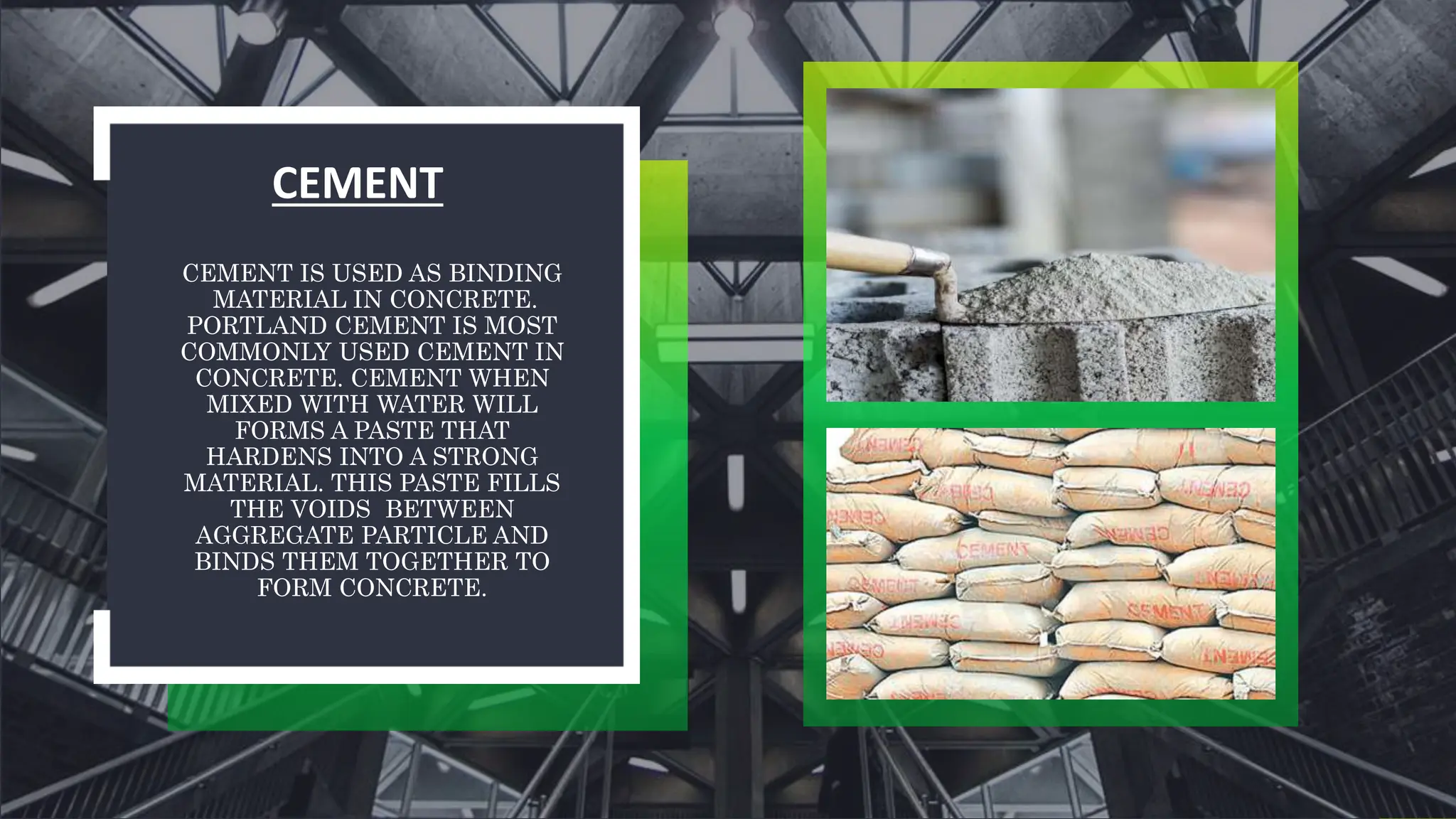
CEMENT IS USED AS BINDING
MATERIAL IN CONCRETE.
PORTLAND CEMENT IS MOST
COMMONLY USED CEMENT IN
CONCRETE. CEMENT WHEN
MIXED WITH WATER WILL
FORMS A PASTE THAT
HARDENS INTO A STRONG
MATERIAL. THIS PASTE FILLS
THE VOIDS BETWEEN
AGGREGATE PARTICLE AND
BINDS THEM TOGETHER TO
FORM CONCRETE.
CEMENT
Add a Footer 6
WATER
There are two main purposes of water in concrete
that is to hydrate the cement and make concrete
workable.
There are certain things that should be kept in mind
while using the water that is –
• Water used for mixing and curing should be clean
and free form injurious amount oil, alkalis, acid,
salt and organic materials.
• Ph value should not be less than 6 of the water
used.
Add a Footer 7
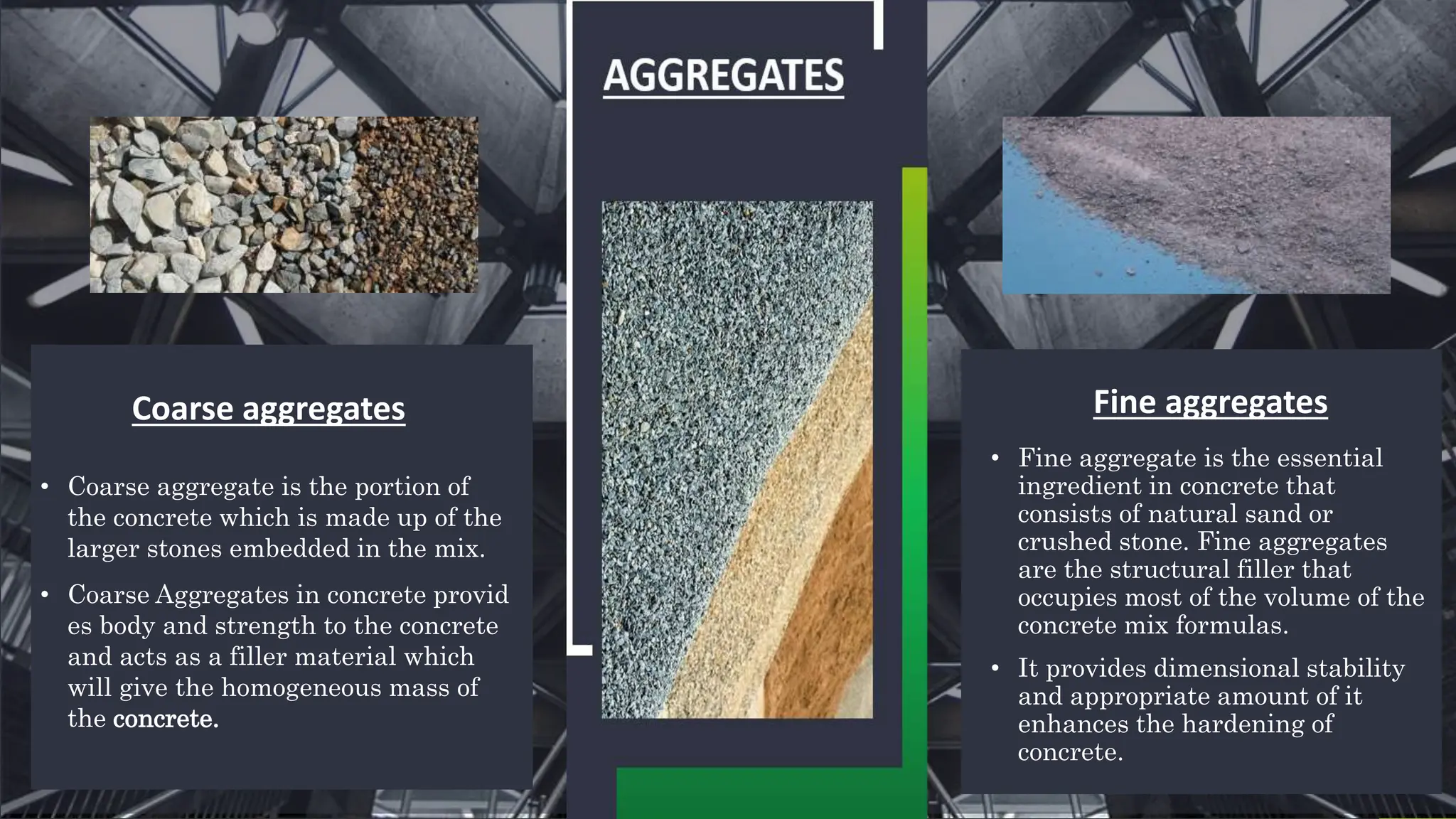
Coarse aggregates
• Coarse aggregate is the portion of
the concrete which is made up of the
larger stones embedded in the mix.
• Coarse Aggregates in concrete provid
es body and strength to the concrete
and acts as a filler material which
will give the homogeneous mass of
the concrete.
Fine aggregates
• Fine aggregate is the essential
ingredient in concrete that
consists of natural sand or
crushed stone. Fine aggregates
are the structural filler that
occupies most of the volume of the
concrete mix formulas.
• It provides dimensional stability
and appropriate amount of it
enhances the hardening of
concrete.
Add a Footer 8
ADMIXTURES
• Admixture are the material in form of
power or fluid that are added to
concrete to give it certain
characteristics that can’t be obtainable
with plane concrete mixes.
• There are no. of type of admixture,
some of the are :
1. water reducing
2. Plasticising
3. Air entrainment
4. Retarders
5. Accelerators
Price
• Cement :
340 rupees – 380 rupees per bag of 50 kg ( depends on the quality)
• Sand :
River sand – 50 rupees (per cubic feet)
M sand – 55 rupees (per cubic feet)
• Aggregate :
Mix aggregate - 52 rupees (per cubic feet)
Small aggregate ( jeera gitti) – 40 rupees (per cubic feet)
MARKET SURVEY
Add a Footer 9
Add a Footer
1.It possesses a high compressive strength.
2.It is a corrosion resistance material and atmospheric agent
has no appreciable effect on it.
3.It hardens with age the process of hardening continues for
a long time after the concrete has attained sufficient
strength. It is this property of cement concrete which gives it
a distinct place among building materials.
4.It is more economical than steel.
5.It binds rapidly with steel and as it is weak in tension, the
steel reinforcement is placed in cement concrete at suitable
places to take up the tensile stresses. This is termed as the
reinforced cement concrete or simply as R.C.C.
PROPERTIES OF CEMENT
CONCRETE
10
Add a Footer
properties of cement concrete are influenced by many factors
mainly due to mix property of cement , aggregates and water.
ratio of these materials control the various concrete properties
which are discussed below.
1.compressive strength of concrete.
2.tensile strength of concrete.
3.shrinkage of concrete.
4.modular ratio.
5.poissons ratio.
6.durability of concrete.
7.creeps
FACTORS AFFECTING
PROPERTIES
11
Add a Footer
Compressive strength of concrete is the most
important properties of concrete.
• The characteristic strength that is in concrete
grade is measured by 28 days cylinder/cube
strength.
• Standard cylinder 150 x 300 mm or 1500x300
club with aggregate size of which is not
exceeding 25mm is used to determine the
strength.
COMPRESSIVE STRENGTH OF
CONCRETE
12
Add a Footer
• the estimate of flexure tensile strength or the
modulus of the rupture or the cracking strnegth
of concrete from cube compressive strength from
cube compressive strength is obtained by the
relation.
• the tensile strength of he concrete in direct
tension is obtained experimentally by split
cylinder. its varies between 1/8 to 1/12 of the
cube compressive strength.
TENSILE STRENGTH OF
CONCRETE
13
• the property diminishing in volume during
the process of drying and hardening causes
shrinkage.
• it depends mainly on the duration of
exposure. if this strain is prevented it
produces tensile stress in the concrete and
hence concrete develops crack.
SHRINKAGE OF CONCRETE
14
• Poisson's ratio varies between 0.1 for
high strength and 0.2 for weak mixes.
• It is normally taken as 0.15 for
strength design and 0.2 serviceable
criteria.
POISSON’S RATIO
Compressive Strength is determined by
loading properly prepared and cured cubic,
cylindrical or prismatic specimens under
compression.
The Factors Affecting the Compressive
Strength of Concrete are -
1. Water Cement Ratio
2. Quality of cement and chemical constituents
3. Storage of cement
4. Aggregate
5. Water Moisture in aggregate
6. Slump
7. Degree of compaction
8. Temperature at the time of molding cubes
9. Curing efficiency
10. Curing temperature
11. Moisture content at the time of cube tests
12. Direction of loading
13. Duration of loading
14. Degree of lateral restraint
15. Compression machine and operation factor
Different concretes require different degrees of durability depending on the exposure
environment and properties desired. The ability of concrete to withstand the conditions for
which it is designed without deterioration for a long period of years is known as durability.
concrete will remain durable if: The cement paste structure is dense and of low
permeability Under extreme condition, it has entrained air to resist freeze-thaw cycle. It is
made with graded aggregate that are strong and inert The ingredients in the mix contain
minimum impurities such as alkalis, Chlorides, sulphates and silt. Following are the factors
affecting durability of concrete-
• Cement Content • Moisture
• Aggregate Quality • Temperature
• Water Quality • Abrasion
• Concrete Compaction • Carbonation
• Curing Period • Permeability
• Carbonation • Wetting and Drying Cycles
• Freezing and Thawing • Alkali-Aggregate Reaction
• Sulfate Attack • Organic Acids
DURABILITY
15
COMPRESSIVE STRENGTH
16
WORKABILITY
Workability is the most important property of freshly mixed concrete. In
simple words, workability means the ease of placement and workable
concrete means the concrete which can be placed and can be compacted
easily without any segregation. Workability is a vital property of concrete and
related with compaction as well as strength.
Factors Affecting Workability-
1. Method and duration of transportation
2. Quantity and characteristics of cementing materials
3. Aggregate grading, shape and surface
4. Texture
5. Quantity and characteristics of chemical
6. Admixtures
7. Amount of water
8. Amount of entrained air
9. Concrete & ambient air temperature.
1. Larger maximum particle size (25mm) and 2.
proportion of the larger particles. 3. High specific
gravity of coarse aggregate. 4. decrease in the
number of fine particles. 5. Particle shape and
texture. 6. Water/cement ratio. Some of the
factors affecting segregation . Consistency is the
fluidity or degree of wetness of concrete. 1.It is
generally dependent on the shear resistance of
the mass. 2.It is a major factor in indicating the
workability of freshly mixed concrete.
SEGREGATION
Add a Footer 17
CONCRETE MIX DESIGN
Cement
Fine Aggregate
Water
Air
Coarse Aggregate
Admixtures
18
Concrete Mix Design means,
determination of the proportion of the
concrete ingredients i.e.
• Cement,
• Water,
• Fine Aggregate, and
• Coarse Aggregate
which would produce concrete possessing
specified properties such as workability,
strength and durability with maximum
overall economy.
Concrete Mix Design
Add a Footer 19
The characteristic strength of concrete is
defined as the strength of concrete below which
not more than 5% of the test result are expected
to fall.
Grade of concrete
For Example:-
M 20
• M refers to MIX.
• 20 refers to characteristic compressive
strength of cube (150mm*150mmm*150mm)
at 28 days in N/mm2.
Add a Footer 20
Types of Mixes
• Nominal Mix:- The Wide use of concrete as
construction material has led to the use of
mixes of fixed proportions, which ensure
adequate strength. These mixes are called
Nominal Mix.
Nominal mix concrete may be used for grade
M 5, M 7.5, M 10, M 15, and M 20.
• Mix Design:- The concrete mix produced
under quality control keeping in view the
strength, durability, and workability is called
the Mix Design.
Add a Footer 21
Mix Design
FACTORS INFLUENCING THE CHOICE OF
MIX DESIGN
• Grade Of Concrete
• Type Of Cement
• Maximum nominal size of Aggregate
• Grading Of Combined Aggregate
• Maximum Water/Cement ratio
• Workability
• Durability
• Quality Control
Add a Footer 22
Mix Design
METHODS OF CONCRETE MIX DESIGN
• I.S. Method (Indian Standard Method)
• A.C.I. Method (American Concrete Institute
Method)
• Road Note-4 Method (U.K. Method)
• IRC-44 Method
• Arbitrary Method
• Maximum Density Method
• DOE (British Method)
Add a Footer 23
Indian standard method
steps
1. TARGET MEAN STRENGTH
2. SELECTION OF W/C RATIO
3. DETERMINATION OF WATER CONTENT
4. CALCUATION OF CEMENT CONTENT
5. CALCULATION OF MASS OF FINE AGGREGATE
AND COARSE AGGREGATE
Add a Footer 24
Indian standard method
Step 1: Target Strength for Mix Proportioning
f’ck = fck + (t*s)
• f’ck= Target Mean Strength
at 28 Days
• fck= Characteristic Strength
at 28 Days
• t = Tolerance factor= 1.65
(I.S. 10262)
• s = Standard Deviation
Step 2: SELECTION OF WATER CEMENT RATIO
Different cements, supplementary cementitious materials and
aggregates of different maximum size, grading, surface texture,
shape and other characteristics may produce concretes of
different compressive strength for the same free water-cement
ratio.
Add a Footer 25
Add a Footer 26
Add a Footer 27
Add a Footer 27
PRODUCTION
Batching is the process of measuring concrete mix
ingredients by either mass or volume and introducing
them into the mixer. To produce concrete of uniform
quality, the ingredients must be measured accurately
for each batch.
• Volume batching
• Weight batching
BATCHING
28
Add a Footer 29
Volume batching:- This method is generally adopted for small jobs .
• Gauge boxes are used for measuring the fine and coarse aggregate.
• The volume of gauge box is equal to the volume of one bag of cement.
Weigh Batching:- • Batching by weight is more preferable to volume batching ,as it is more
accurate and leads to more uniform proportioning. • It does not have uncertainties associated with
bulking.
It’s equipment falls into 3 general categories :
I. Manual :-
In case of manual batching all weighing and batching of concrete are done manually. It is used for
small jobs.
I. Semi automatic:-
In it, the aggregate bin gates are opened by manually operated switches and gates are closed
automatically when the material has been delivered. Contains interlock which prevents charging
and discharging.
III. Fully automatic:-
In it, the material are electrically activates by a single switch and complete autographic record are
made of the weight of each material. The batching plant comprises 2,3,4 or 6 compartment bins of
several capacities. The weigh batchers and discharging are provided below the bins.
Add a Footer
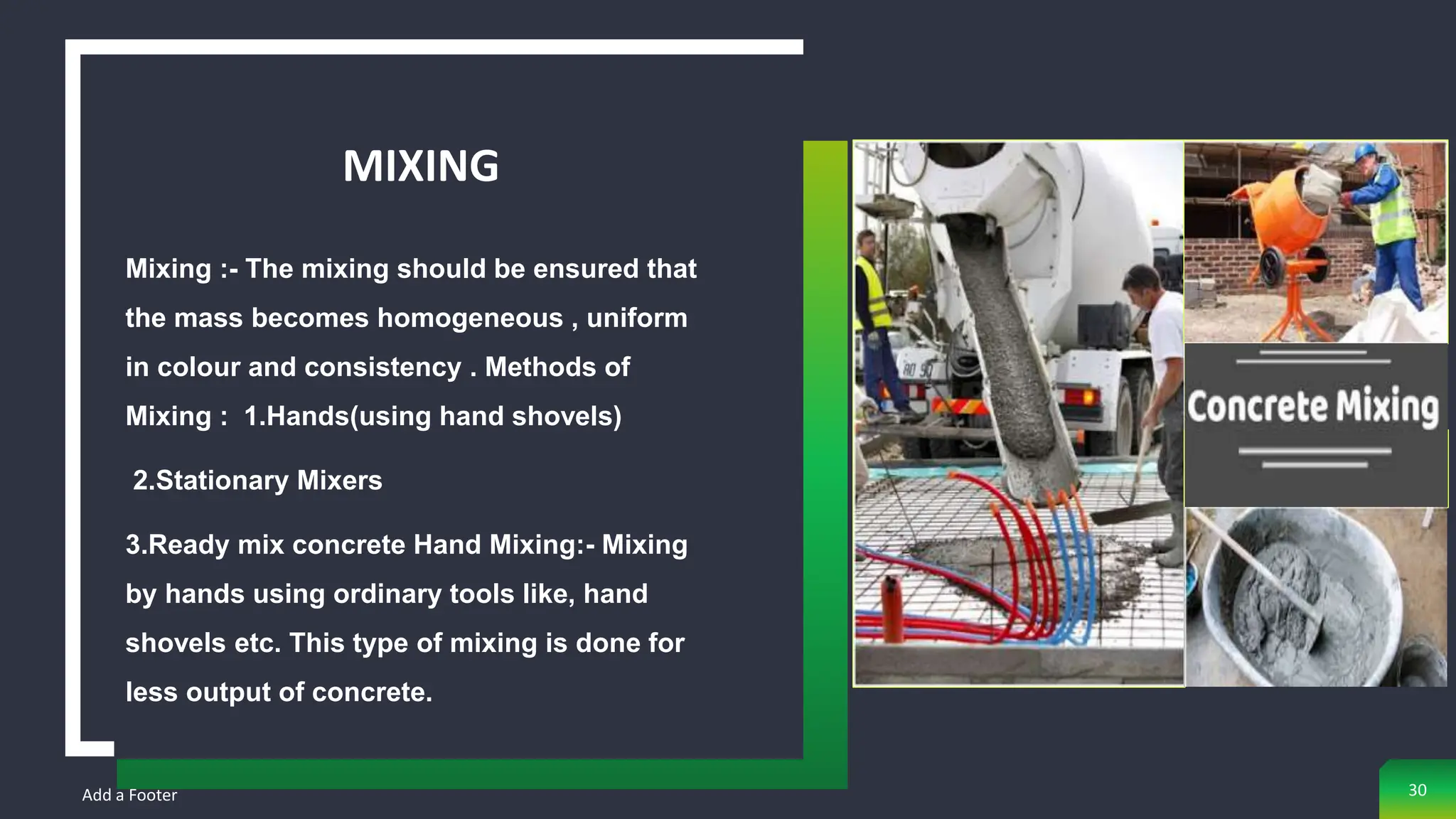
Mixing :- The mixing should be ensured that
the mass becomes homogeneous , uniform
in colour and consistency . Methods of
Mixing : 1.Hands(using hand shovels)
2.Stationary Mixers
3.Ready mix concrete Hand Mixing:- Mixing
by hands using ordinary tools like, hand
shovels etc. This type of mixing is done for
less output of concrete.
MIXING
30
Add a Footer
Procedure
31
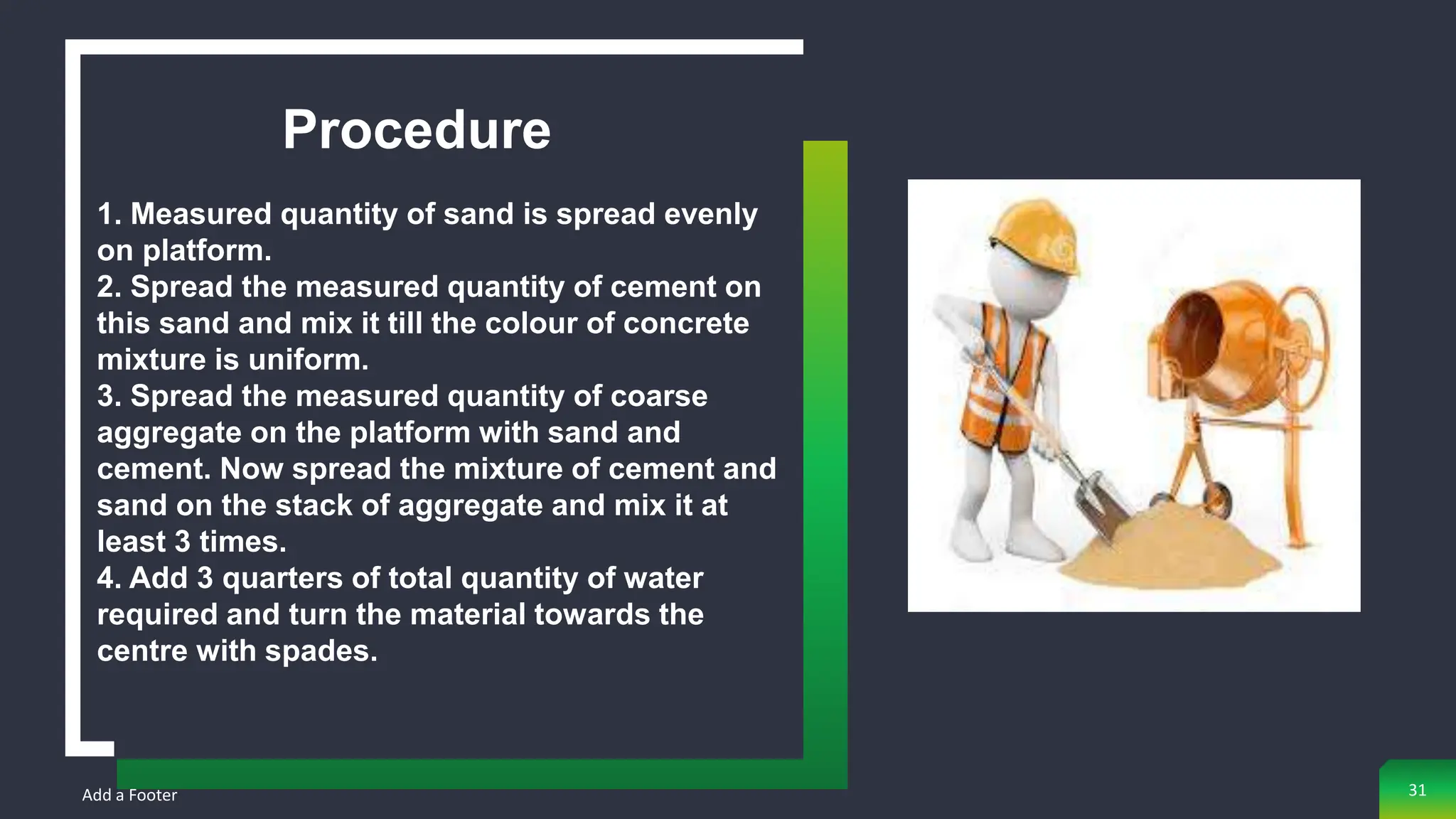
1. Measured quantity of sand is spread evenly
on platform.
2. Spread the measured quantity of cement on
this sand and mix it till the colour of concrete
mixture is uniform.
3. Spread the measured quantity of coarse
aggregate on the platform with sand and
cement. Now spread the mixture of cement and
sand on the stack of aggregate and mix it at
least 3 times.
4. Add 3 quarters of total quantity of water
required and turn the material towards the
centre with spades.
Add a Footer 32
Add a Footer 32
Stationary Mixers:-
Concrete is sometime mixed at jobsite in a stationary mixer having a size of 9 cubic meter .
These mixers may be of :
Tilting type mixer:-
It consist a conical drum which rotates on an inclinable axis.
It has only one opening.
The drum charged directly and discharged by tilting and reversing the drum.
Non tilting type mixer:-
The mixing drum is cylindrical in shape and revolves two – horizontal axis.
It has opening on both sides.
The ingredients are charged in from one opening.
For discharging concrete chute is introducing to other opening by operating a lever.
Agitator Trucks:- A vehicle carrying a drum or agitator body, in which freshly mixed concrete can be conveyed
from the point of mixing to that of placing, the drum being rotated continuously to agitate the
contents.
Non-agitating Trucks:- Used for: Transport concrete on short hauls(small distance) over smooth roadways.
Truck-mixed concrete :- Used for: Intermittent (periodic) production of concrete at jobsite,
or small quantities.
Add a Footer
1) Mortar Pan : Concrete is carried in small Quantities
2) Wheelbarrows and Buggies: The capacity of
wheelbarrows varies from 70 to 80 litres. Suitable for
concrete road construction where concrete is
deposited at or below mixer level.
3) Belt Conveyors: Conveying concrete horizontally or
higher/lower level.
4) Cranes and Buckets: • Used for Work above ground
level , Buckets use with Cranes, cableways, and
helicopters.
5) Pumps: Conveying concrete from central discharge
point to formwork.
6) Transit Mixer: Used for transporting the concrete over
long distance .
TRANSPORTING
33
Add a Footer 34
Add a Footer 34
Foundation bed
1. To construct a foundation we have to
excavate earth trenches.
2. After excavation of trenches we check the
bed of the earth trench
3. The bed of the trench should be free from
roots, organic matters and loose earth
4. Trenche is wetted by spraying water to
avoid the loss of water from concrete
5. The chutes are used for placing concrete in
deep trenches.
Columns and deep beams
1. While placing of concrete in columns or
deep beams it is not suggested to allow the
free fall of concrete more than a meter
unless the mix is designed to be dropped
2. The free fall of concrete results in
segregation.
3. Then we use the tremie pipe to dropped
cement concrete to the cover blocks and
we also use the sloping board.
It is a process of depositing a fresh concrete
on its final position.
Before placing concrete form work must be
checked for its rigidity and cleanliness .
Concrete should not be dropped from height
as it causes segregation or piled up in heaps
The wheel barrow or vibrating needle should
not be allowed to run over the placed concrete.
PLACING
Add a Footer
Compaction is the process of removing entrapped air bubbles from the fresh
concrete and improving the packing of aggregates to form dense concrete. If air
bubbles present in structure or placed concrete Then honey combing or blow
holes are caused in concrete. This effects the strength of concrete The
approximate air content in fresh concrete is 25% which is reduced to 2-5% by
compaction.
HAND COMPACTION
It is a type of compaction done by manually. There are three types in this
compaction process
1. Rodding A single steel rod is used for pocking the fresh Concrete.
2. Ramming A flat metal piece attached to a hammer is used to hit on the
surface of concrete. Compaction process of this type is done in floor
construction
3. Tamping In thin cross sectional surface tamping is done tamping in the
surface of the concrete with a wooden bar is used.
COMPACTION
35
Add a Footer 36
Add a Footer 36
Add a Footer 36
Vibration takes place on the surface of the
concrete.
1. Form vibrator This is used for vibrating thin
section of concrete members.
2. Table vibrator Vibrating tables are used for the
compaction of concrete in the production of
precast member.
3. Platform vibrator It is used in smaller thickness
structures construction like slabs. The
compaction of concrete is done by applying
vibration at the surface the platform vibrator
consists of metal platform attached with
vibrating motors.
4. Screed vibrator Screed is also used for the
compaction of concrete up to a depth of
100mm the screed consists of a long beam
attached to a frame and vibrating motor.
Vibration takes place inside the concrete mix.
Needle vibrator Poker vibrators essentially consist
of vibrating needle which is inserted into the fresh
concrete A loosely kept mass attached with the
cable inside the needle hits on the inner surface of
the hallow needle on rotation driven by a motor the
hitting action generates vibration in the needle.
The compaction of concrete takes place due to the
vibration of the needle.
EXTERNAL VIBRATOR
INTERNAL VIBRATOR
Add a Footer
• Curing can be defined as a procedure for insuring the
hydration of the Portland cement in newly-placed
concrete.
• It generally implies control of moisture loss and
sometimes of temperature.
Need for curing:-
• Causes Hydration reaction of cement with water.
• Loss of water by evaporation can be prevented.
• Maintain conductive Temperature .
• For completing of Hydration reaction.
• For capillary segmentation .
CURING
37
Add a Footer 38
Add a Footer 38
Add a Footer 38
Add a Footer 38
There are two ways to cure:-
Cure by applying water Use a fine spray of water
over the concrete the concrete must be moist all
of the time. Hosing it once or twice a day and
letting it dry in between is no good this way can
use a lot of water.
Cure by keeping the moisture :-
Overlap the sheets and hold them down with
sand, rocks or timber Regularly check that the
concrete is still moist under the sheets.
Curing compounds:-
Curing compounds can be applied to concrete
soon after finishing. They are sprayed or painted
on the surface and help slow the loss of water.
They are effective but very expensive.
Add a Footer 39
Add a Footer 39
Add a Footer 39
Add a Footer 39
BLEEDING in concrete is a phenomenon in
which free water in the mix rises up to the
surface and forms a paste of cement on the
surface known as “laitance” .
BLEEDING
• Segregation is the cause of bleeding
in the concrete mix.
• Segregation is the cause of bleeding
in the concrete mix.
• Bleeding will be more frequent on the
surface of concrete, when water to
cement ratio is higher.
Causes Of Bleeding In Concrete
• Due to bleeding concrete loses its homogeneity.
• Bleeding is responsible for causing permeability in
concrete.
• As far as safety is concerned, water that
accumulates below the reinforcing bars, reduces
the bond between the reinforcement and concrete.
• In the process of bleeding the accumulation of
water creates a water voids and reduces bond
between the aggregate and cement paste.
• Due to bleeding pumping ability of concrete is
reduced.
• Increase in the water-cement ratio at the top.
• The accumulation of water at the top, results in
delayed surface finishing.
EFFECTS OF BLEEDING
Add a Footer 40
Add a Footer 40
Add a Footer 40
Add a Footer 40
Add a Footer 40
Segregation is the cause of bleeding in the
concrete mix.
METHODS OF REDUCING BLEEDING
1) Add minimum water content in the
concrete mix, use chemical admixtures to
reduce demand to water for a required
workability.
2) Design the concrete mix properly.
3) Use fly ash or other supplementary
cementitious materials.
4) Using air entraining admixtures is very
effective in reducing the bleeding.
5) Add more cement in the mix.
6) Increase the amount of fine aggregate if
sand is coarser (fineness modulus of 2.5 to
2.8 best suited) in mix and reduce aggregate
proportionally.
FINISHING
• The finish can be strictly functional or
decorative.
• Finishing makes concrete attractive and
serviceable.
• The final texture, hardness and joint
pattern on slabs, floors, sidewalks, patios
and driveways depend on the concrete's
end use.
Add a Footer 41
TEST
Add a Footer 42
SLUMP TEST
• It is to determine workability of the concrete.
• SLUMP MEAN
• Slump is the vertical settlement of fresh concrete
after the mould has been withdrawn.
• It is measured as the difference between the height
of the mould and highest point of the subsided
concrete.
• NOT SUITABLE
• For very wet or very dry concrete mixes.
• Aggregate size is greater than 40 mm.
• SUITABLE
• For concrete of medium to high workabilities, ie
slump value of 25 mm to 125 mm.
Add a Footer 43
COMPACTION FACTOR TEST
• It is to detemine workahility of the concrete.
APPARATUS
• Hoppers with polished surface have hinged doors at the bottom.
• Cylindrical mould
• Trowel
• Rod
NOT SUITABLE
• For very low workable concrete because such concrete
cannot be fully compacted.
Add a Footer 44
VEBE TEST
APPARATUS
• Vibrating table
• Elastic supports
• Cylindrical container
• Metal cone open at both ends
• Iron rod
SUITABLE
• For concrete mixes with low or very low
workability.
NOT SUTTABLE
• For concrete of higher workability, i.e. Slump
above 75 mm.
Add a Footer 45
HARDENED CONCRETE
COMPRESSIVE STRENGTH
• It is conducted to determine the strength of the concrete.
DIFFERENT TESTS FOR COMPRESSIVE STRENGTH
• Cube Test
• Cylinder Test
Add a Footer 46
CYLINDER TEST
• It is conducted to determine the strength of the concrete.
• Cylinder module of 150mm diameter x
300 mm height
• Compression testing machine
• Weighing balance
Add a Footer 47
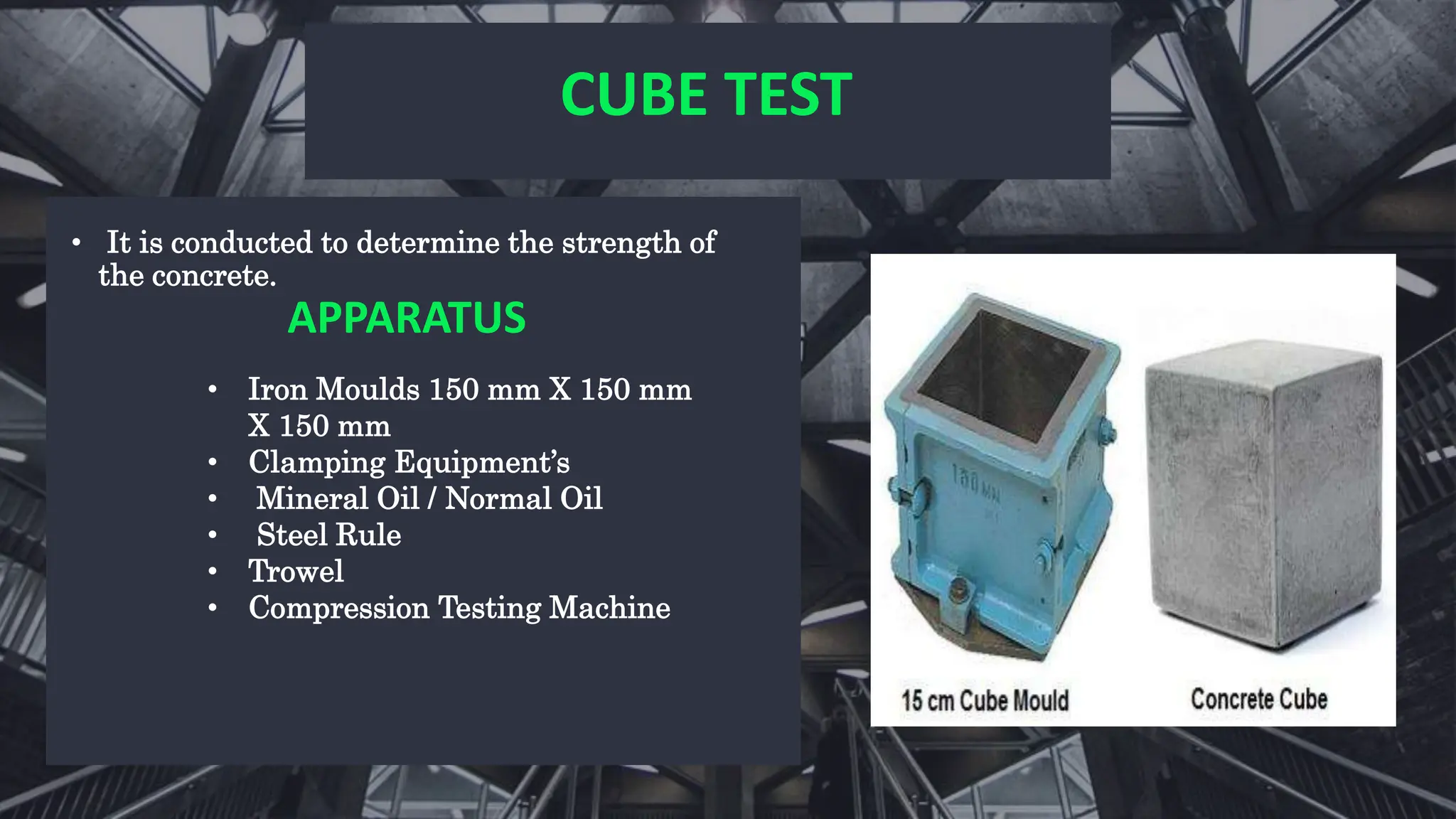
CUBE TEST
• It is conducted to determine the strength of
the concrete.
APPARATUS
• Iron Moulds 150 mm X 150 mm
X 150 mm
• Clamping Equipment’s
• Mineral Oil / Normal Oil
• Steel Rule
• Trowel
• Compression Testing Machine
Add a Footer 48
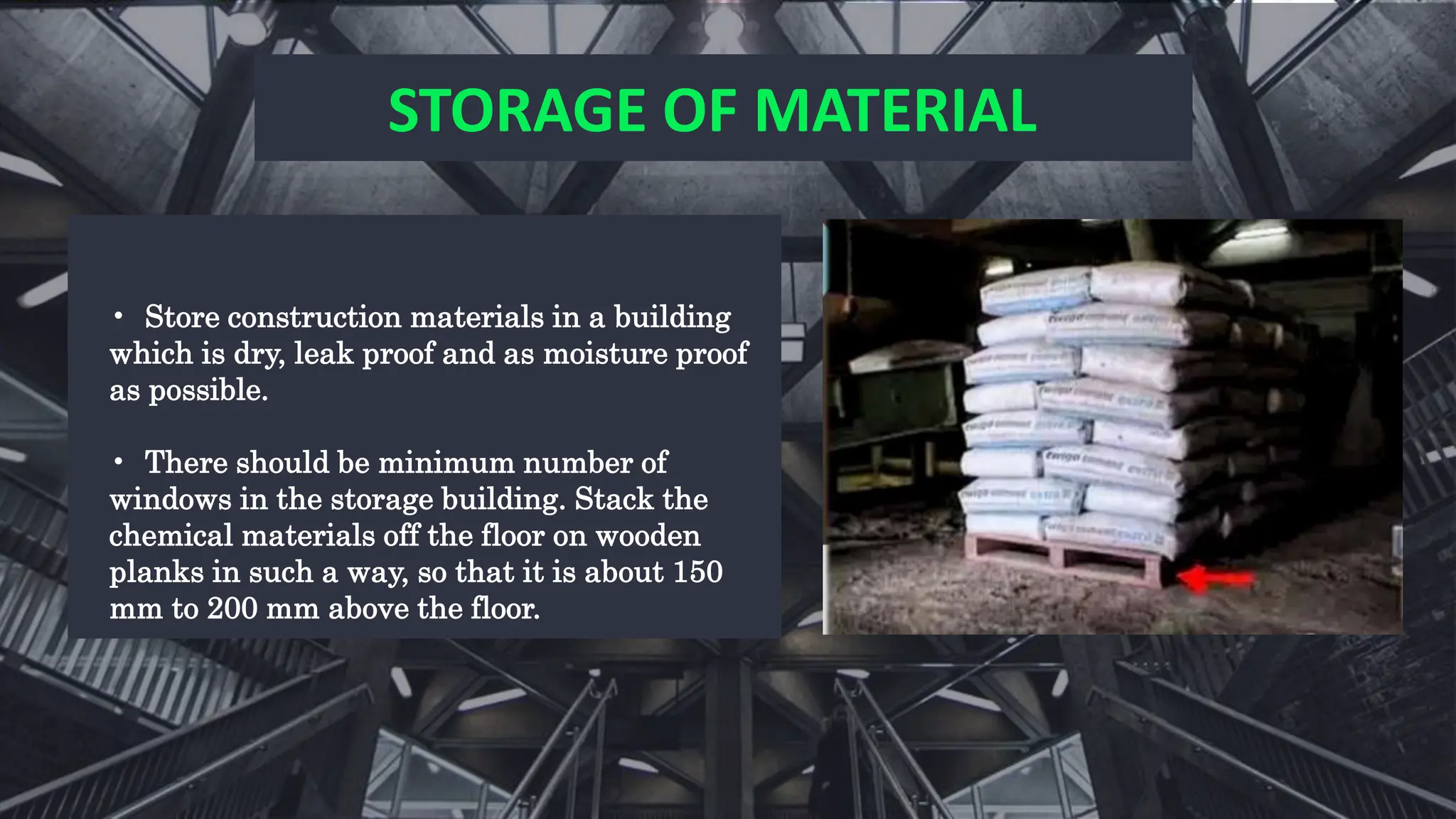
STORAGE OF MATERIAL
• Store construction materials in a building
which is dry, leak proof and as moisture proof
as possible.
• There should be minimum number of
windows in the storage building. Stack the
chemical materials off the floor on wooden
planks in such a way, so that it is about 150
mm to 200 mm above the floor.
Add a Footer 49
CONCRETE CHEMICALS
CONSTRUCTION CHEMICALS
Construction chemicals, as the name suggests are chemicals used in construction activities. These chemicals have
an extensive functional scope in the field of construction. They can be used in ongoing construction projects for
speeding up the work or in new construction ventures or for repairing and retrofitting existing buildings or for
enhancing durability and providing strength to the structures. Construction chemicals are used along with various
building materials at the construction site to improve workability, to increase efficiency, add effectiveness and to
protect the part of any structure, or to accelerate the speed of construction work.
1. Admixtures, 2. Plasasticizersrs, 3.Superplasticizers, 4.Retarders and Retarding Plasticizers
5.Accelerators and Accelerating Plasticizers, 6.Air-entraining Admixtures
7.Pozzolan IC or Mineral Admixtures, 8.Damp-proofing and Waterproofing Admixtures
9.Gas forming Admixtures, 10.Air-detraining Admixtures, 11.Alkali-aggregate
12.Expansion Inhibiting Admixtures, 13.Workability Admixtures, 14.Grouting Admixtures,
15.Corrosionsion Inhibiting Admixtures, 16.Bonding Admixtures Fungicidal, Germicidal, Insecticidal Admixtures,
17.Colouring Admixtures
Add a Footer 50
ADMIXTURES
• An admixture is a substance which can be
added to concrete to achieve or modify its
properties. Admixtures are added to the
concrete, in addition to cement, water and
aggregate, typically immediately before or
during the mixing process.
•
• Admixtures can be used to reduce the cost of
building with concrete, or to ensure certain
required properties or quality of the cured
concrete. If problems arise with the concrete
during the construction process, admixtures
can be used as an emergency measure to try
and prevent failure.
Fig. Liquid admixtures, from left to right:
antiwashout admixture, shrinkage reducer, water
reducer, foaming agent, corrosion inhibitor, and air-
entraining admixture.
TYPES OF
CONCRETE
Add a Footer 51
Add a Footer 52
LIGHT WEIGHT CONCRETE
• Made up of light weight
aggregates(expanded shale, foamed
slag, etc.)
• These aggregates can also be
prepared artificially by heating
special clays at 1000 which expands
and becomes light weight.
• Used as filling-concrete in
bathrooms, terraces, etc.
• It also acts as thermal insulation
compared to normal concrete.
FLYASH CONCRETE
• Concrete using flyash obtained from
lignite or other materials is called
flyash concrete.
• Flyash can replace cement or fine
aggregates or both. The addition of
flyash is said to improve the
impermeability, corrosion resistance
and sulphate resistance of concrete.
Add a Footer 53
HIGH STRENGTH CONCRETE/HIGH PERFORMANCE
CONNCRETE
• Concrete with strength over 40N/mm sq.
• It satisfies the requirements which cannot be
achieved by normal concrete. These performances
can be high strength, low shrinkage, self
compaction, high fire resistance, etc.
• They may have strength up to 80N/mm sq..
• Materials used are- cement, coarse and fine
aggregates In required quantity, water,
superplasticizers(high water reducing agents) and
supplementary cementing materials like silica fume,
blast furnace slag, etc.
SILICA FUME CONCRETE
• Silica fume is very finely divided silica obtained as a
byproduct in industry. Concrete to which Silica Fume
is added is called “silica fume concrete”.
• Silica fumes consist of very fine particles. Hence it is
found that if we mix silica fumes with concrete the
minute pore spaces can be reduced resulting in high
strength concrete.
• Silica fume is also a pozzolana which will contribute
to the strength.
Add a Footer 54
PLAIN CONCRETE
• The plain concrete will have no reinforcement in
it.
• The main constituents are the cement,
aggregates, and water.
• Most commonly used mix design is 1:2:4 which
is the normal mix design.
• The density of the plain concrete will vary
between 2200 and 2500 Kg/meter cube.
• The compressive strength is 200 to 500 kg/cm2.
These types of concrete are mainly used in the
construction of the pavements and the
buildings, especially in areas where there is
less demand of high tensile strength.
• The durability given by these type of concrete
is satisfactory to high extent.
Add a Footer 55
PRECAST CONCRETE
• Various structural elements can be made and
cast in the factory as per the specifications and
bought to the site at the time of assembly. Such
concrete units are called as the precast concrete.
• The examples of precast concrete units are
concrete blocks, the staircase units, precast walls
and poles, concrete lintels and many other
elements.
• These units have the advantage of acquiring
speedy construction as only assemblage is
necessary.
• As the manufacturing is done at site, quality is
assured. The only precaution taken is for their
transportation.
AIR ENTRAINED CONCRETE
• It is a specially prepared plain concrete in which
air is entrained in the form of thousands of
uniformly distributed particles.
• The Volume of air thus, entrained may range
between 3-6 percent of the concrete.
• The air entrainment is achieved by adding a small
quantity of foaming or gas-forming agents at the
mixing stage.
• Fatty acids, fatty alcohols, and resins are some
common air entraining agents.
• Air entrained concrete is more resistant to
Scaling
Deterioration due to freezing and thawing
Abrasion
Add a Footer 56
GLASS CONCRETE
• When the recycled glass is used
as an aggregate in the concrete,
this type of concrete is known as
Glass Concrete.
• They provide better thermal
insulation and also have a great
appealing look as compared to
other types.
• This concrete will increase the
aesthetic appeal of the concrete.
RAPID STRENGTH
CONCRETE
As the name implies these
concretes will acquire strength
with few hours after its
manufacture.
Hence the formwork removal is
made easy and hence the
building construction is covered
fastly.
These have a wide spread
application in the road repairs as
they can be reused after few
hours.
This type of concrete is mostly used in
underwater construction and in repairing
of roads.
VACCUM CONCRETE
• In this type, more quantity of
water is added to the concrete
mix, and then the mixture is
poured into the formwork.
• The excess water is then
removed from the concrete with
the help of a vacuum pump.
That is why it is called vacuum
concrete.
• This technique is used to attain
the strength of concrete early. It
will attain the compressive
strength within the period of 10
days as compared to 28 days of
ordinary concrete.
Add a Footer 57
REINFORCED CEMENT
CONCRETE
• Reinforced Cement Concrete (RCC) is a composite
building material consisting of structural concrete
reinforced with a reinforcing material like steel. The
most common reinforcement used is steel, due to
its complimentary properties and it is called steel
reinforced cement concrete or simply Reinforced Cement
Concrete.
• Steel bars embedded in concrete are called as ‘reinforcing
bars or reinforcement’. You can read what makes steel
suitable for reinforced concrete here. Reinforcing bars
are available in two major grades, mild steel and high
yield strength steel. Steel fabric made from cold drawn
steel wires welded to form a mesh are also used as
reinforcement in RCC.
Add a Footer 58
Plain concrete is strong in compression, but it is weak in
bending. Too weak that its tensile strength is around
one tenth of its compressive strength. When plain
concrete member is subjected to bending, it develops
cracks and ruptures. For the same reason plain concrete
is not used where bending action can occur. Tensile
strength is defined as the ability to resist bending
forces.
Bending forces causes tensile stresses in flexural
members like beams and columns. Plain concrete when
reinforced with steel, which is more than hundred times
stronger than concrete in tension, the overall capacity of
plain concrete in bending is enhanced.
The steel bars compensate the concrete’s incapability for
tensile resistance, effectively taking up all the tension,
acting monolithically with concrete. So, when concrete
and steel bars combine to act against forces result in
good strength. Similar to how human bones reinforces
the flesh and mass around it.
Add a Footer 59
ADVANTAGES OF USING REINFORCED CONCRETE
Concrete and steel bars: Since RCC have both the elements with the properties of concrete which is strong in compression
and steel good in tension it gives the advantage of both.
Casted into any shape: Fresh concrete will be in the form of fluid and so it can be poured and casted into any shape. It gives
easiness to the engineer to decide the shape of structure based on architectural aspects
Resistant to fire and weather: RCC with proper cover will withstand to fire for about 3 – 4 hours. RCC will also survive any type of
weather with proper quality control and durability considerations.
Maintenance: After the completion of work low maintenance is needed for concrete structures compared to the other (steel and
timber) type of structures.
Availability: Steel and Concrete are a commonly used construction material and so it is easily available to prepare reinforced
cement concrete.
Economical: It is economical compared to the other materials like steel structure.
Rigidity: Reinforced Concrete members are good in rigidity due to their stiffness.
Add a Footer 60
USES
Add a Footer 61
PLAIN CEMENT CONCRETE
• The objective of plain cement concrete alias PCC
is to arrange a firm impermeable bed to RCC in
the foundation where the soil is soft and flexible.
It is mostly applied over brick flat soling or
devoid of brick flat soling. Plain cement concrete
is commonly used for foundations.
• As concrete on the bed flooring, under the
column footings.
• As a solid to get a hard and uniform surface on
the surface of the window and ventilator.
• Coping -To counter concrete on parapets and
composite walls.
Add a Footer 62
PLAIN CEMENT CONCRETE
• To flag the area around the buildings.
• Pavement Making - it is used in rigid Pavement construction (
reinforced-less rigid pavements).The surface course can vary in
thickness but is usually between 150 mm (6 inches) (for light
loading) and 300 mm (12 inches) (for heavy loads and high traffic).
• For making tennis courts, basketball courts etc.
• Plinth protection reduces direct water entering into the soil close to
the plinth wall. In other word , the area surrounding the building is
usually known as the plinth protection. A plinth protection usually is
done by pouring an approximate 75 – 100 mm layer of plain cement
concrete along the edge of the building.
• 9. Storm / sewer on drains, small retaining walls and in small scale
canal construction. 10.It is also used in some stone masonry works
Add a Footer 63
REINFORCED CEMENT CONCRETE
• R.C.C. is used as a structural element, the
common structural elements in a building where
R.C.C. is used are:
a) Footings
b) Columns
c) Beams and lintels
d) Chejjas , roofs and slabs.
e) Stairs
• R.C.C. is used for the construction of storage
structures like
a) Water tanks
b) Dams
c) Bins
d) Silos and bunkers.
• It is used for pre-casting
a) Railway sleepers
b) Electric poles
Add a Footer 64
REINFORCED CEMENT CONCRETE
• It is used for the construction of big structures like
a) Bridges
b) Retaining walls
c) Docks and harbors
d) Under water structures.
• R.C.C. is used for constructing tall structures like
a) Multistorey buildings
b) Chimneys
c) Towers.
• It is used for paving
a) Roads
b) Airports.
• R.C.C. is used in building atomic plants to prevent
danger of radiation. For this purpose R.C.C. walls built
are 1.5 m to 2.0 m thick
GROUP MEMBERS
Shreya Chandra
Shreya Singh
Shrasti Gautam
Shubham Kumar
Shubhangi Sonkar
Sudeep Srivastava
Sunil Yadav
Add a Footer 65
THANK YOU
Add a Footer 66

CEMENT CONCRETE (1) (1)construction and materials

  • 1.
  • 2.
    Add a Footer2 INDEX Introduction Ingredients and market survey Properties Quality Control Concrete Mix Design Production of Concrete Factors affecting its strength Tests Storage of materials Concrete Chemicals Types(Plain and reinforced) Uses
  • 3.
    INTRODUCTION Cement Concrete isa major building material used in modern building constructions. It is used in all parts of the building like foundations, superstructure and roofs. It is obtained by mixing cementitious materials, water, and aggregates(and sometimes admixtures) in required proportions which when mixed and allowed to cure hardens into a rock like mass known as concrete. 3
  • 4.
    Add a Footer4 INGREDIENTS Concrete is a composite material comprising a matrix of aggregate and binder that hold the mixture together. The constituent are -: • Cement • Water • Aggregates • Admixture
  • 5.
    Add a Footer5 CEMENT IS USED AS BINDING MATERIAL IN CONCRETE. PORTLAND CEMENT IS MOST COMMONLY USED CEMENT IN CONCRETE. CEMENT WHEN MIXED WITH WATER WILL FORMS A PASTE THAT HARDENS INTO A STRONG MATERIAL. THIS PASTE FILLS THE VOIDS BETWEEN AGGREGATE PARTICLE AND BINDS THEM TOGETHER TO FORM CONCRETE. CEMENT
  • 6.
    Add a Footer6 WATER There are two main purposes of water in concrete that is to hydrate the cement and make concrete workable. There are certain things that should be kept in mind while using the water that is – • Water used for mixing and curing should be clean and free form injurious amount oil, alkalis, acid, salt and organic materials. • Ph value should not be less than 6 of the water used.
  • 7.
    Add a Footer7 Coarse aggregates • Coarse aggregate is the portion of the concrete which is made up of the larger stones embedded in the mix. • Coarse Aggregates in concrete provid es body and strength to the concrete and acts as a filler material which will give the homogeneous mass of the concrete. Fine aggregates • Fine aggregate is the essential ingredient in concrete that consists of natural sand or crushed stone. Fine aggregates are the structural filler that occupies most of the volume of the concrete mix formulas. • It provides dimensional stability and appropriate amount of it enhances the hardening of concrete.
  • 8.
    Add a Footer8 ADMIXTURES • Admixture are the material in form of power or fluid that are added to concrete to give it certain characteristics that can’t be obtainable with plane concrete mixes. • There are no. of type of admixture, some of the are : 1. water reducing 2. Plasticising 3. Air entrainment 4. Retarders 5. Accelerators
  • 9.
    Price • Cement : 340rupees – 380 rupees per bag of 50 kg ( depends on the quality) • Sand : River sand – 50 rupees (per cubic feet) M sand – 55 rupees (per cubic feet) • Aggregate : Mix aggregate - 52 rupees (per cubic feet) Small aggregate ( jeera gitti) – 40 rupees (per cubic feet) MARKET SURVEY Add a Footer 9
  • 10.
    Add a Footer 1.Itpossesses a high compressive strength. 2.It is a corrosion resistance material and atmospheric agent has no appreciable effect on it. 3.It hardens with age the process of hardening continues for a long time after the concrete has attained sufficient strength. It is this property of cement concrete which gives it a distinct place among building materials. 4.It is more economical than steel. 5.It binds rapidly with steel and as it is weak in tension, the steel reinforcement is placed in cement concrete at suitable places to take up the tensile stresses. This is termed as the reinforced cement concrete or simply as R.C.C. PROPERTIES OF CEMENT CONCRETE 10
  • 11.
    Add a Footer propertiesof cement concrete are influenced by many factors mainly due to mix property of cement , aggregates and water. ratio of these materials control the various concrete properties which are discussed below. 1.compressive strength of concrete. 2.tensile strength of concrete. 3.shrinkage of concrete. 4.modular ratio. 5.poissons ratio. 6.durability of concrete. 7.creeps FACTORS AFFECTING PROPERTIES 11
  • 12.
    Add a Footer Compressivestrength of concrete is the most important properties of concrete. • The characteristic strength that is in concrete grade is measured by 28 days cylinder/cube strength. • Standard cylinder 150 x 300 mm or 1500x300 club with aggregate size of which is not exceeding 25mm is used to determine the strength. COMPRESSIVE STRENGTH OF CONCRETE 12
  • 13.
    Add a Footer •the estimate of flexure tensile strength or the modulus of the rupture or the cracking strnegth of concrete from cube compressive strength from cube compressive strength is obtained by the relation. • the tensile strength of he concrete in direct tension is obtained experimentally by split cylinder. its varies between 1/8 to 1/12 of the cube compressive strength. TENSILE STRENGTH OF CONCRETE 13
  • 14.
    • the propertydiminishing in volume during the process of drying and hardening causes shrinkage. • it depends mainly on the duration of exposure. if this strain is prevented it produces tensile stress in the concrete and hence concrete develops crack. SHRINKAGE OF CONCRETE 14 • Poisson's ratio varies between 0.1 for high strength and 0.2 for weak mixes. • It is normally taken as 0.15 for strength design and 0.2 serviceable criteria. POISSON’S RATIO
  • 15.
    Compressive Strength isdetermined by loading properly prepared and cured cubic, cylindrical or prismatic specimens under compression. The Factors Affecting the Compressive Strength of Concrete are - 1. Water Cement Ratio 2. Quality of cement and chemical constituents 3. Storage of cement 4. Aggregate 5. Water Moisture in aggregate 6. Slump 7. Degree of compaction 8. Temperature at the time of molding cubes 9. Curing efficiency 10. Curing temperature 11. Moisture content at the time of cube tests 12. Direction of loading 13. Duration of loading 14. Degree of lateral restraint 15. Compression machine and operation factor Different concretes require different degrees of durability depending on the exposure environment and properties desired. The ability of concrete to withstand the conditions for which it is designed without deterioration for a long period of years is known as durability. concrete will remain durable if: The cement paste structure is dense and of low permeability Under extreme condition, it has entrained air to resist freeze-thaw cycle. It is made with graded aggregate that are strong and inert The ingredients in the mix contain minimum impurities such as alkalis, Chlorides, sulphates and silt. Following are the factors affecting durability of concrete- • Cement Content • Moisture • Aggregate Quality • Temperature • Water Quality • Abrasion • Concrete Compaction • Carbonation • Curing Period • Permeability • Carbonation • Wetting and Drying Cycles • Freezing and Thawing • Alkali-Aggregate Reaction • Sulfate Attack • Organic Acids DURABILITY 15 COMPRESSIVE STRENGTH
  • 16.
    16 WORKABILITY Workability is themost important property of freshly mixed concrete. In simple words, workability means the ease of placement and workable concrete means the concrete which can be placed and can be compacted easily without any segregation. Workability is a vital property of concrete and related with compaction as well as strength. Factors Affecting Workability- 1. Method and duration of transportation 2. Quantity and characteristics of cementing materials 3. Aggregate grading, shape and surface 4. Texture 5. Quantity and characteristics of chemical 6. Admixtures 7. Amount of water 8. Amount of entrained air 9. Concrete & ambient air temperature. 1. Larger maximum particle size (25mm) and 2. proportion of the larger particles. 3. High specific gravity of coarse aggregate. 4. decrease in the number of fine particles. 5. Particle shape and texture. 6. Water/cement ratio. Some of the factors affecting segregation . Consistency is the fluidity or degree of wetness of concrete. 1.It is generally dependent on the shear resistance of the mass. 2.It is a major factor in indicating the workability of freshly mixed concrete. SEGREGATION
  • 17.
    Add a Footer17 CONCRETE MIX DESIGN Cement Fine Aggregate Water Air Coarse Aggregate Admixtures
  • 18.
    18 Concrete Mix Designmeans, determination of the proportion of the concrete ingredients i.e. • Cement, • Water, • Fine Aggregate, and • Coarse Aggregate which would produce concrete possessing specified properties such as workability, strength and durability with maximum overall economy. Concrete Mix Design
  • 19.
    Add a Footer19 The characteristic strength of concrete is defined as the strength of concrete below which not more than 5% of the test result are expected to fall. Grade of concrete For Example:- M 20 • M refers to MIX. • 20 refers to characteristic compressive strength of cube (150mm*150mmm*150mm) at 28 days in N/mm2.
  • 20.
    Add a Footer20 Types of Mixes • Nominal Mix:- The Wide use of concrete as construction material has led to the use of mixes of fixed proportions, which ensure adequate strength. These mixes are called Nominal Mix. Nominal mix concrete may be used for grade M 5, M 7.5, M 10, M 15, and M 20. • Mix Design:- The concrete mix produced under quality control keeping in view the strength, durability, and workability is called the Mix Design.
  • 21.
    Add a Footer21 Mix Design FACTORS INFLUENCING THE CHOICE OF MIX DESIGN • Grade Of Concrete • Type Of Cement • Maximum nominal size of Aggregate • Grading Of Combined Aggregate • Maximum Water/Cement ratio • Workability • Durability • Quality Control
  • 22.
    Add a Footer22 Mix Design METHODS OF CONCRETE MIX DESIGN • I.S. Method (Indian Standard Method) • A.C.I. Method (American Concrete Institute Method) • Road Note-4 Method (U.K. Method) • IRC-44 Method • Arbitrary Method • Maximum Density Method • DOE (British Method)
  • 23.
    Add a Footer23 Indian standard method steps 1. TARGET MEAN STRENGTH 2. SELECTION OF W/C RATIO 3. DETERMINATION OF WATER CONTENT 4. CALCUATION OF CEMENT CONTENT 5. CALCULATION OF MASS OF FINE AGGREGATE AND COARSE AGGREGATE
  • 24.
    Add a Footer24 Indian standard method Step 1: Target Strength for Mix Proportioning f’ck = fck + (t*s) • f’ck= Target Mean Strength at 28 Days • fck= Characteristic Strength at 28 Days • t = Tolerance factor= 1.65 (I.S. 10262) • s = Standard Deviation Step 2: SELECTION OF WATER CEMENT RATIO Different cements, supplementary cementitious materials and aggregates of different maximum size, grading, surface texture, shape and other characteristics may produce concretes of different compressive strength for the same free water-cement ratio.
  • 25.
  • 26.
  • 27.
    Add a Footer27 Add a Footer 27 PRODUCTION
  • 28.
    Batching is theprocess of measuring concrete mix ingredients by either mass or volume and introducing them into the mixer. To produce concrete of uniform quality, the ingredients must be measured accurately for each batch. • Volume batching • Weight batching BATCHING 28
  • 29.
    Add a Footer29 Volume batching:- This method is generally adopted for small jobs . • Gauge boxes are used for measuring the fine and coarse aggregate. • The volume of gauge box is equal to the volume of one bag of cement. Weigh Batching:- • Batching by weight is more preferable to volume batching ,as it is more accurate and leads to more uniform proportioning. • It does not have uncertainties associated with bulking. It’s equipment falls into 3 general categories : I. Manual :- In case of manual batching all weighing and batching of concrete are done manually. It is used for small jobs. I. Semi automatic:- In it, the aggregate bin gates are opened by manually operated switches and gates are closed automatically when the material has been delivered. Contains interlock which prevents charging and discharging. III. Fully automatic:- In it, the material are electrically activates by a single switch and complete autographic record are made of the weight of each material. The batching plant comprises 2,3,4 or 6 compartment bins of several capacities. The weigh batchers and discharging are provided below the bins.
  • 30.
    Add a Footer Mixing:- The mixing should be ensured that the mass becomes homogeneous , uniform in colour and consistency . Methods of Mixing : 1.Hands(using hand shovels) 2.Stationary Mixers 3.Ready mix concrete Hand Mixing:- Mixing by hands using ordinary tools like, hand shovels etc. This type of mixing is done for less output of concrete. MIXING 30
  • 31.
    Add a Footer Procedure 31 1.Measured quantity of sand is spread evenly on platform. 2. Spread the measured quantity of cement on this sand and mix it till the colour of concrete mixture is uniform. 3. Spread the measured quantity of coarse aggregate on the platform with sand and cement. Now spread the mixture of cement and sand on the stack of aggregate and mix it at least 3 times. 4. Add 3 quarters of total quantity of water required and turn the material towards the centre with spades.
  • 32.
    Add a Footer32 Add a Footer 32 Stationary Mixers:- Concrete is sometime mixed at jobsite in a stationary mixer having a size of 9 cubic meter . These mixers may be of : Tilting type mixer:- It consist a conical drum which rotates on an inclinable axis. It has only one opening. The drum charged directly and discharged by tilting and reversing the drum. Non tilting type mixer:- The mixing drum is cylindrical in shape and revolves two – horizontal axis. It has opening on both sides. The ingredients are charged in from one opening. For discharging concrete chute is introducing to other opening by operating a lever. Agitator Trucks:- A vehicle carrying a drum or agitator body, in which freshly mixed concrete can be conveyed from the point of mixing to that of placing, the drum being rotated continuously to agitate the contents. Non-agitating Trucks:- Used for: Transport concrete on short hauls(small distance) over smooth roadways. Truck-mixed concrete :- Used for: Intermittent (periodic) production of concrete at jobsite, or small quantities.
  • 33.
    Add a Footer 1)Mortar Pan : Concrete is carried in small Quantities 2) Wheelbarrows and Buggies: The capacity of wheelbarrows varies from 70 to 80 litres. Suitable for concrete road construction where concrete is deposited at or below mixer level. 3) Belt Conveyors: Conveying concrete horizontally or higher/lower level. 4) Cranes and Buckets: • Used for Work above ground level , Buckets use with Cranes, cableways, and helicopters. 5) Pumps: Conveying concrete from central discharge point to formwork. 6) Transit Mixer: Used for transporting the concrete over long distance . TRANSPORTING 33
  • 34.
    Add a Footer34 Add a Footer 34 Foundation bed 1. To construct a foundation we have to excavate earth trenches. 2. After excavation of trenches we check the bed of the earth trench 3. The bed of the trench should be free from roots, organic matters and loose earth 4. Trenche is wetted by spraying water to avoid the loss of water from concrete 5. The chutes are used for placing concrete in deep trenches. Columns and deep beams 1. While placing of concrete in columns or deep beams it is not suggested to allow the free fall of concrete more than a meter unless the mix is designed to be dropped 2. The free fall of concrete results in segregation. 3. Then we use the tremie pipe to dropped cement concrete to the cover blocks and we also use the sloping board. It is a process of depositing a fresh concrete on its final position. Before placing concrete form work must be checked for its rigidity and cleanliness . Concrete should not be dropped from height as it causes segregation or piled up in heaps The wheel barrow or vibrating needle should not be allowed to run over the placed concrete. PLACING
  • 35.
    Add a Footer Compactionis the process of removing entrapped air bubbles from the fresh concrete and improving the packing of aggregates to form dense concrete. If air bubbles present in structure or placed concrete Then honey combing or blow holes are caused in concrete. This effects the strength of concrete The approximate air content in fresh concrete is 25% which is reduced to 2-5% by compaction. HAND COMPACTION It is a type of compaction done by manually. There are three types in this compaction process 1. Rodding A single steel rod is used for pocking the fresh Concrete. 2. Ramming A flat metal piece attached to a hammer is used to hit on the surface of concrete. Compaction process of this type is done in floor construction 3. Tamping In thin cross sectional surface tamping is done tamping in the surface of the concrete with a wooden bar is used. COMPACTION 35
  • 36.
    Add a Footer36 Add a Footer 36 Add a Footer 36 Vibration takes place on the surface of the concrete. 1. Form vibrator This is used for vibrating thin section of concrete members. 2. Table vibrator Vibrating tables are used for the compaction of concrete in the production of precast member. 3. Platform vibrator It is used in smaller thickness structures construction like slabs. The compaction of concrete is done by applying vibration at the surface the platform vibrator consists of metal platform attached with vibrating motors. 4. Screed vibrator Screed is also used for the compaction of concrete up to a depth of 100mm the screed consists of a long beam attached to a frame and vibrating motor. Vibration takes place inside the concrete mix. Needle vibrator Poker vibrators essentially consist of vibrating needle which is inserted into the fresh concrete A loosely kept mass attached with the cable inside the needle hits on the inner surface of the hallow needle on rotation driven by a motor the hitting action generates vibration in the needle. The compaction of concrete takes place due to the vibration of the needle. EXTERNAL VIBRATOR INTERNAL VIBRATOR
  • 37.
    Add a Footer •Curing can be defined as a procedure for insuring the hydration of the Portland cement in newly-placed concrete. • It generally implies control of moisture loss and sometimes of temperature. Need for curing:- • Causes Hydration reaction of cement with water. • Loss of water by evaporation can be prevented. • Maintain conductive Temperature . • For completing of Hydration reaction. • For capillary segmentation . CURING 37
  • 38.
    Add a Footer38 Add a Footer 38 Add a Footer 38 Add a Footer 38 There are two ways to cure:- Cure by applying water Use a fine spray of water over the concrete the concrete must be moist all of the time. Hosing it once or twice a day and letting it dry in between is no good this way can use a lot of water. Cure by keeping the moisture :- Overlap the sheets and hold them down with sand, rocks or timber Regularly check that the concrete is still moist under the sheets. Curing compounds:- Curing compounds can be applied to concrete soon after finishing. They are sprayed or painted on the surface and help slow the loss of water. They are effective but very expensive.
  • 39.
    Add a Footer39 Add a Footer 39 Add a Footer 39 Add a Footer 39 BLEEDING in concrete is a phenomenon in which free water in the mix rises up to the surface and forms a paste of cement on the surface known as “laitance” . BLEEDING • Segregation is the cause of bleeding in the concrete mix. • Segregation is the cause of bleeding in the concrete mix. • Bleeding will be more frequent on the surface of concrete, when water to cement ratio is higher. Causes Of Bleeding In Concrete • Due to bleeding concrete loses its homogeneity. • Bleeding is responsible for causing permeability in concrete. • As far as safety is concerned, water that accumulates below the reinforcing bars, reduces the bond between the reinforcement and concrete. • In the process of bleeding the accumulation of water creates a water voids and reduces bond between the aggregate and cement paste. • Due to bleeding pumping ability of concrete is reduced. • Increase in the water-cement ratio at the top. • The accumulation of water at the top, results in delayed surface finishing. EFFECTS OF BLEEDING
  • 40.
    Add a Footer40 Add a Footer 40 Add a Footer 40 Add a Footer 40 Add a Footer 40 Segregation is the cause of bleeding in the concrete mix. METHODS OF REDUCING BLEEDING 1) Add minimum water content in the concrete mix, use chemical admixtures to reduce demand to water for a required workability. 2) Design the concrete mix properly. 3) Use fly ash or other supplementary cementitious materials. 4) Using air entraining admixtures is very effective in reducing the bleeding. 5) Add more cement in the mix. 6) Increase the amount of fine aggregate if sand is coarser (fineness modulus of 2.5 to 2.8 best suited) in mix and reduce aggregate proportionally. FINISHING • The finish can be strictly functional or decorative. • Finishing makes concrete attractive and serviceable. • The final texture, hardness and joint pattern on slabs, floors, sidewalks, patios and driveways depend on the concrete's end use.
  • 41.
    Add a Footer41 TEST
  • 42.
    Add a Footer42 SLUMP TEST • It is to determine workability of the concrete. • SLUMP MEAN • Slump is the vertical settlement of fresh concrete after the mould has been withdrawn. • It is measured as the difference between the height of the mould and highest point of the subsided concrete. • NOT SUITABLE • For very wet or very dry concrete mixes. • Aggregate size is greater than 40 mm. • SUITABLE • For concrete of medium to high workabilities, ie slump value of 25 mm to 125 mm.
  • 43.
    Add a Footer43 COMPACTION FACTOR TEST • It is to detemine workahility of the concrete. APPARATUS • Hoppers with polished surface have hinged doors at the bottom. • Cylindrical mould • Trowel • Rod NOT SUITABLE • For very low workable concrete because such concrete cannot be fully compacted.
  • 44.
    Add a Footer44 VEBE TEST APPARATUS • Vibrating table • Elastic supports • Cylindrical container • Metal cone open at both ends • Iron rod SUITABLE • For concrete mixes with low or very low workability. NOT SUTTABLE • For concrete of higher workability, i.e. Slump above 75 mm.
  • 45.
    Add a Footer45 HARDENED CONCRETE COMPRESSIVE STRENGTH • It is conducted to determine the strength of the concrete. DIFFERENT TESTS FOR COMPRESSIVE STRENGTH • Cube Test • Cylinder Test
  • 46.
    Add a Footer46 CYLINDER TEST • It is conducted to determine the strength of the concrete. • Cylinder module of 150mm diameter x 300 mm height • Compression testing machine • Weighing balance
  • 47.
    Add a Footer47 CUBE TEST • It is conducted to determine the strength of the concrete. APPARATUS • Iron Moulds 150 mm X 150 mm X 150 mm • Clamping Equipment’s • Mineral Oil / Normal Oil • Steel Rule • Trowel • Compression Testing Machine
  • 48.
    Add a Footer48 STORAGE OF MATERIAL • Store construction materials in a building which is dry, leak proof and as moisture proof as possible. • There should be minimum number of windows in the storage building. Stack the chemical materials off the floor on wooden planks in such a way, so that it is about 150 mm to 200 mm above the floor.
  • 49.
    Add a Footer49 CONCRETE CHEMICALS CONSTRUCTION CHEMICALS Construction chemicals, as the name suggests are chemicals used in construction activities. These chemicals have an extensive functional scope in the field of construction. They can be used in ongoing construction projects for speeding up the work or in new construction ventures or for repairing and retrofitting existing buildings or for enhancing durability and providing strength to the structures. Construction chemicals are used along with various building materials at the construction site to improve workability, to increase efficiency, add effectiveness and to protect the part of any structure, or to accelerate the speed of construction work. 1. Admixtures, 2. Plasasticizersrs, 3.Superplasticizers, 4.Retarders and Retarding Plasticizers 5.Accelerators and Accelerating Plasticizers, 6.Air-entraining Admixtures 7.Pozzolan IC or Mineral Admixtures, 8.Damp-proofing and Waterproofing Admixtures 9.Gas forming Admixtures, 10.Air-detraining Admixtures, 11.Alkali-aggregate 12.Expansion Inhibiting Admixtures, 13.Workability Admixtures, 14.Grouting Admixtures, 15.Corrosionsion Inhibiting Admixtures, 16.Bonding Admixtures Fungicidal, Germicidal, Insecticidal Admixtures, 17.Colouring Admixtures
  • 50.
    Add a Footer50 ADMIXTURES • An admixture is a substance which can be added to concrete to achieve or modify its properties. Admixtures are added to the concrete, in addition to cement, water and aggregate, typically immediately before or during the mixing process. • • Admixtures can be used to reduce the cost of building with concrete, or to ensure certain required properties or quality of the cured concrete. If problems arise with the concrete during the construction process, admixtures can be used as an emergency measure to try and prevent failure. Fig. Liquid admixtures, from left to right: antiwashout admixture, shrinkage reducer, water reducer, foaming agent, corrosion inhibitor, and air- entraining admixture.
  • 51.
  • 52.
    Add a Footer52 LIGHT WEIGHT CONCRETE • Made up of light weight aggregates(expanded shale, foamed slag, etc.) • These aggregates can also be prepared artificially by heating special clays at 1000 which expands and becomes light weight. • Used as filling-concrete in bathrooms, terraces, etc. • It also acts as thermal insulation compared to normal concrete. FLYASH CONCRETE • Concrete using flyash obtained from lignite or other materials is called flyash concrete. • Flyash can replace cement or fine aggregates or both. The addition of flyash is said to improve the impermeability, corrosion resistance and sulphate resistance of concrete.
  • 53.
    Add a Footer53 HIGH STRENGTH CONCRETE/HIGH PERFORMANCE CONNCRETE • Concrete with strength over 40N/mm sq. • It satisfies the requirements which cannot be achieved by normal concrete. These performances can be high strength, low shrinkage, self compaction, high fire resistance, etc. • They may have strength up to 80N/mm sq.. • Materials used are- cement, coarse and fine aggregates In required quantity, water, superplasticizers(high water reducing agents) and supplementary cementing materials like silica fume, blast furnace slag, etc. SILICA FUME CONCRETE • Silica fume is very finely divided silica obtained as a byproduct in industry. Concrete to which Silica Fume is added is called “silica fume concrete”. • Silica fumes consist of very fine particles. Hence it is found that if we mix silica fumes with concrete the minute pore spaces can be reduced resulting in high strength concrete. • Silica fume is also a pozzolana which will contribute to the strength.
  • 54.
    Add a Footer54 PLAIN CONCRETE • The plain concrete will have no reinforcement in it. • The main constituents are the cement, aggregates, and water. • Most commonly used mix design is 1:2:4 which is the normal mix design. • The density of the plain concrete will vary between 2200 and 2500 Kg/meter cube. • The compressive strength is 200 to 500 kg/cm2. These types of concrete are mainly used in the construction of the pavements and the buildings, especially in areas where there is less demand of high tensile strength. • The durability given by these type of concrete is satisfactory to high extent.
  • 55.
    Add a Footer55 PRECAST CONCRETE • Various structural elements can be made and cast in the factory as per the specifications and bought to the site at the time of assembly. Such concrete units are called as the precast concrete. • The examples of precast concrete units are concrete blocks, the staircase units, precast walls and poles, concrete lintels and many other elements. • These units have the advantage of acquiring speedy construction as only assemblage is necessary. • As the manufacturing is done at site, quality is assured. The only precaution taken is for their transportation. AIR ENTRAINED CONCRETE • It is a specially prepared plain concrete in which air is entrained in the form of thousands of uniformly distributed particles. • The Volume of air thus, entrained may range between 3-6 percent of the concrete. • The air entrainment is achieved by adding a small quantity of foaming or gas-forming agents at the mixing stage. • Fatty acids, fatty alcohols, and resins are some common air entraining agents. • Air entrained concrete is more resistant to Scaling Deterioration due to freezing and thawing Abrasion
  • 56.
    Add a Footer56 GLASS CONCRETE • When the recycled glass is used as an aggregate in the concrete, this type of concrete is known as Glass Concrete. • They provide better thermal insulation and also have a great appealing look as compared to other types. • This concrete will increase the aesthetic appeal of the concrete. RAPID STRENGTH CONCRETE As the name implies these concretes will acquire strength with few hours after its manufacture. Hence the formwork removal is made easy and hence the building construction is covered fastly. These have a wide spread application in the road repairs as they can be reused after few hours. This type of concrete is mostly used in underwater construction and in repairing of roads. VACCUM CONCRETE • In this type, more quantity of water is added to the concrete mix, and then the mixture is poured into the formwork. • The excess water is then removed from the concrete with the help of a vacuum pump. That is why it is called vacuum concrete. • This technique is used to attain the strength of concrete early. It will attain the compressive strength within the period of 10 days as compared to 28 days of ordinary concrete.
  • 57.
    Add a Footer57 REINFORCED CEMENT CONCRETE • Reinforced Cement Concrete (RCC) is a composite building material consisting of structural concrete reinforced with a reinforcing material like steel. The most common reinforcement used is steel, due to its complimentary properties and it is called steel reinforced cement concrete or simply Reinforced Cement Concrete. • Steel bars embedded in concrete are called as ‘reinforcing bars or reinforcement’. You can read what makes steel suitable for reinforced concrete here. Reinforcing bars are available in two major grades, mild steel and high yield strength steel. Steel fabric made from cold drawn steel wires welded to form a mesh are also used as reinforcement in RCC.
  • 58.
    Add a Footer58 Plain concrete is strong in compression, but it is weak in bending. Too weak that its tensile strength is around one tenth of its compressive strength. When plain concrete member is subjected to bending, it develops cracks and ruptures. For the same reason plain concrete is not used where bending action can occur. Tensile strength is defined as the ability to resist bending forces. Bending forces causes tensile stresses in flexural members like beams and columns. Plain concrete when reinforced with steel, which is more than hundred times stronger than concrete in tension, the overall capacity of plain concrete in bending is enhanced. The steel bars compensate the concrete’s incapability for tensile resistance, effectively taking up all the tension, acting monolithically with concrete. So, when concrete and steel bars combine to act against forces result in good strength. Similar to how human bones reinforces the flesh and mass around it.
  • 59.
    Add a Footer59 ADVANTAGES OF USING REINFORCED CONCRETE Concrete and steel bars: Since RCC have both the elements with the properties of concrete which is strong in compression and steel good in tension it gives the advantage of both. Casted into any shape: Fresh concrete will be in the form of fluid and so it can be poured and casted into any shape. It gives easiness to the engineer to decide the shape of structure based on architectural aspects Resistant to fire and weather: RCC with proper cover will withstand to fire for about 3 – 4 hours. RCC will also survive any type of weather with proper quality control and durability considerations. Maintenance: After the completion of work low maintenance is needed for concrete structures compared to the other (steel and timber) type of structures. Availability: Steel and Concrete are a commonly used construction material and so it is easily available to prepare reinforced cement concrete. Economical: It is economical compared to the other materials like steel structure. Rigidity: Reinforced Concrete members are good in rigidity due to their stiffness.
  • 60.
    Add a Footer60 USES
  • 61.
    Add a Footer61 PLAIN CEMENT CONCRETE • The objective of plain cement concrete alias PCC is to arrange a firm impermeable bed to RCC in the foundation where the soil is soft and flexible. It is mostly applied over brick flat soling or devoid of brick flat soling. Plain cement concrete is commonly used for foundations. • As concrete on the bed flooring, under the column footings. • As a solid to get a hard and uniform surface on the surface of the window and ventilator. • Coping -To counter concrete on parapets and composite walls.
  • 62.
    Add a Footer62 PLAIN CEMENT CONCRETE • To flag the area around the buildings. • Pavement Making - it is used in rigid Pavement construction ( reinforced-less rigid pavements).The surface course can vary in thickness but is usually between 150 mm (6 inches) (for light loading) and 300 mm (12 inches) (for heavy loads and high traffic). • For making tennis courts, basketball courts etc. • Plinth protection reduces direct water entering into the soil close to the plinth wall. In other word , the area surrounding the building is usually known as the plinth protection. A plinth protection usually is done by pouring an approximate 75 – 100 mm layer of plain cement concrete along the edge of the building. • 9. Storm / sewer on drains, small retaining walls and in small scale canal construction. 10.It is also used in some stone masonry works
  • 63.
    Add a Footer63 REINFORCED CEMENT CONCRETE • R.C.C. is used as a structural element, the common structural elements in a building where R.C.C. is used are: a) Footings b) Columns c) Beams and lintels d) Chejjas , roofs and slabs. e) Stairs • R.C.C. is used for the construction of storage structures like a) Water tanks b) Dams c) Bins d) Silos and bunkers. • It is used for pre-casting a) Railway sleepers b) Electric poles
  • 64.
    Add a Footer64 REINFORCED CEMENT CONCRETE • It is used for the construction of big structures like a) Bridges b) Retaining walls c) Docks and harbors d) Under water structures. • R.C.C. is used for constructing tall structures like a) Multistorey buildings b) Chimneys c) Towers. • It is used for paving a) Roads b) Airports. • R.C.C. is used in building atomic plants to prevent danger of radiation. For this purpose R.C.C. walls built are 1.5 m to 2.0 m thick
  • 65.
    GROUP MEMBERS Shreya Chandra ShreyaSingh Shrasti Gautam Shubham Kumar Shubhangi Sonkar Sudeep Srivastava Sunil Yadav Add a Footer 65
  • 66.
    THANK YOU Add aFooter 66