Improvement Of Properties Of Concrete By
Adding Fibers
)An Experimental Studying(
PROJECTTITLEPROJECTTITLE
Concrete is one of the most versatile building material.
Concrete is strong under compression yet weak under
tension, brittle and limited ductility material.
Therefore, a form of reinforcement is needed, steel bars
reinforce concrete against tension only locally.
 Cracks in reinforced concrete members extend freely
until encountering a rebar.
The need for Multidirectional and closely spaced
reinforcement for concrete arises.
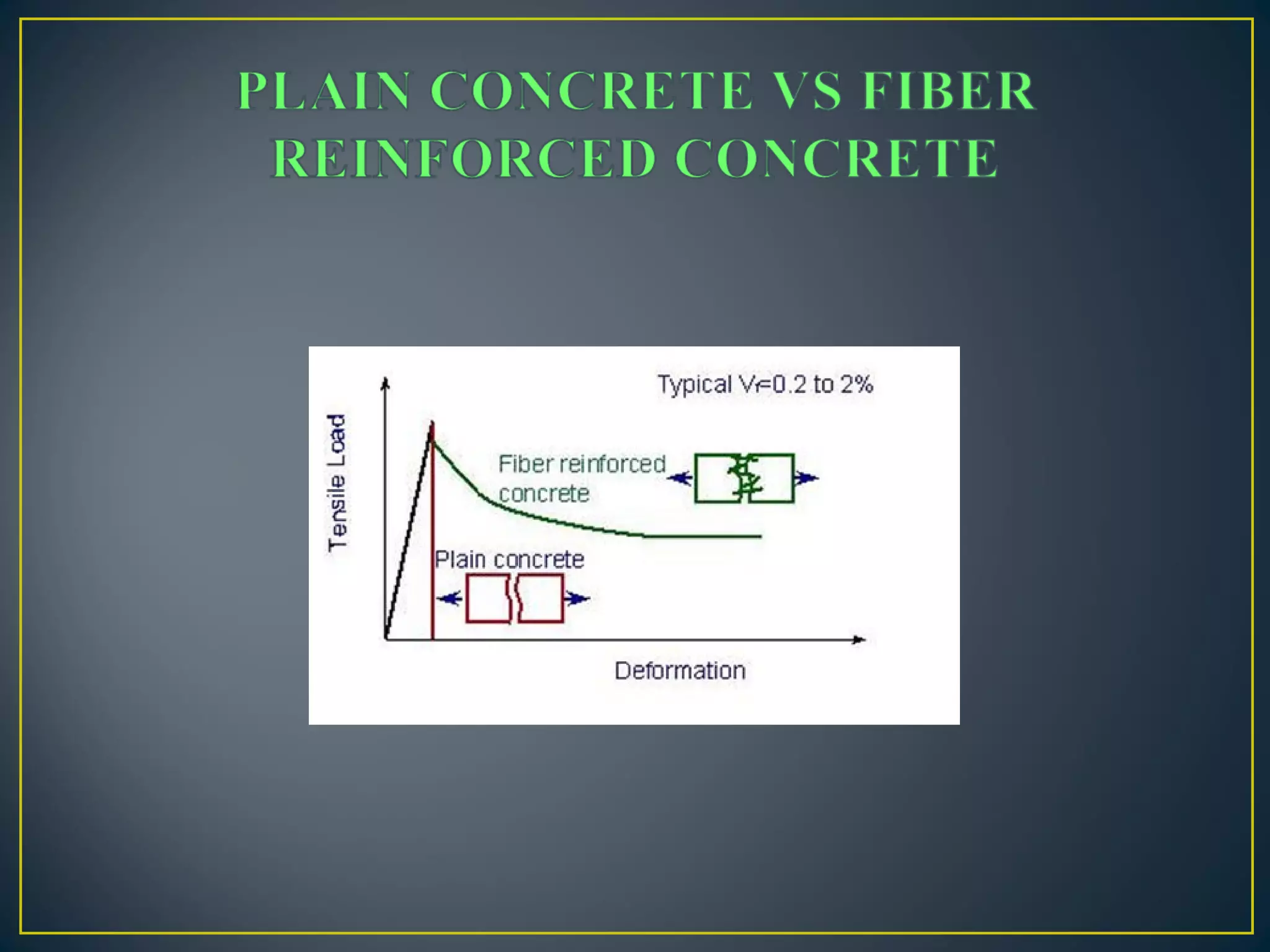
FRC is a concrete mix that contains short discrete fibers
that are uniformly distributed and randomly oriented.
INTRODUCTION
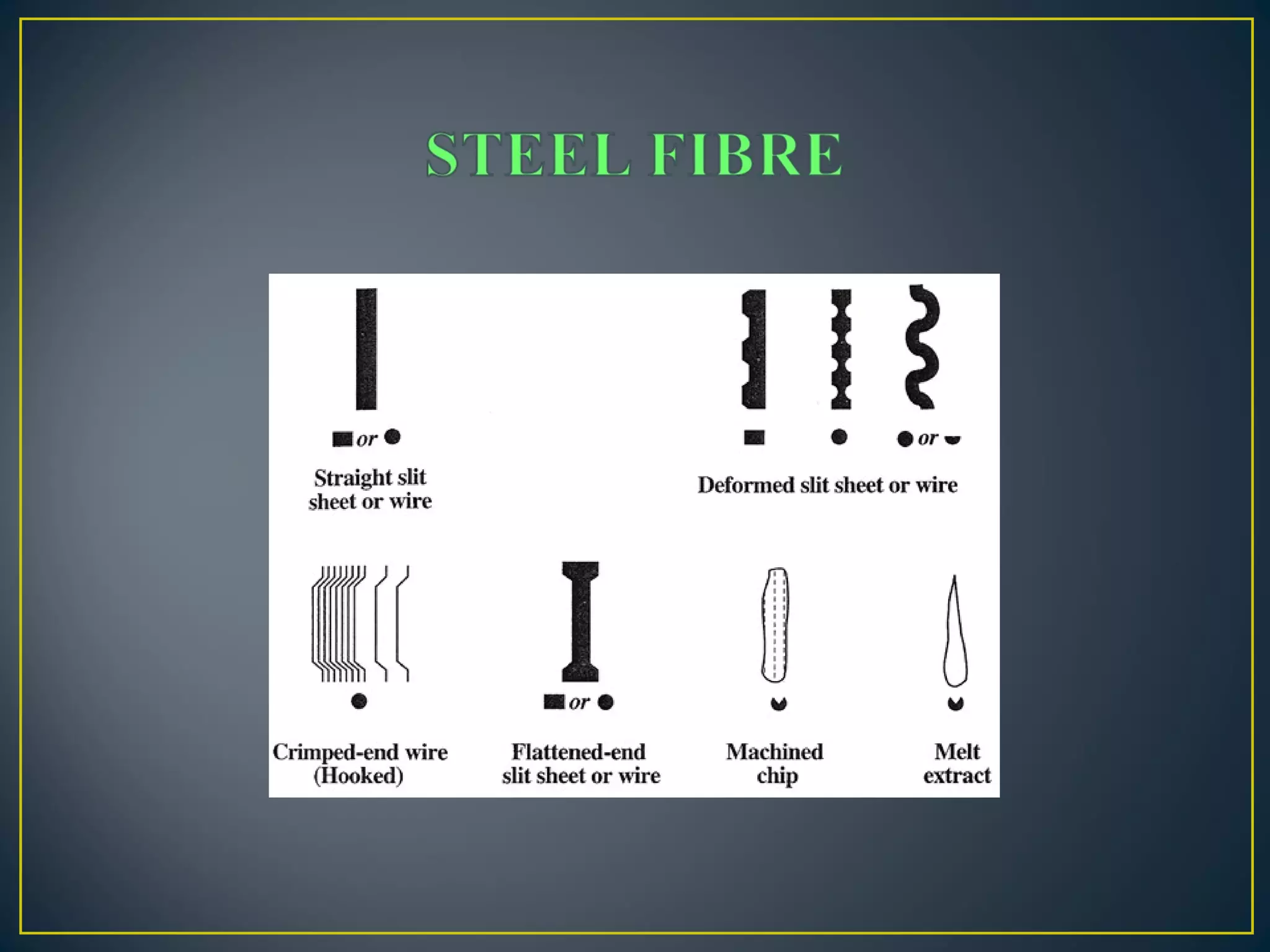
Steel Fibre
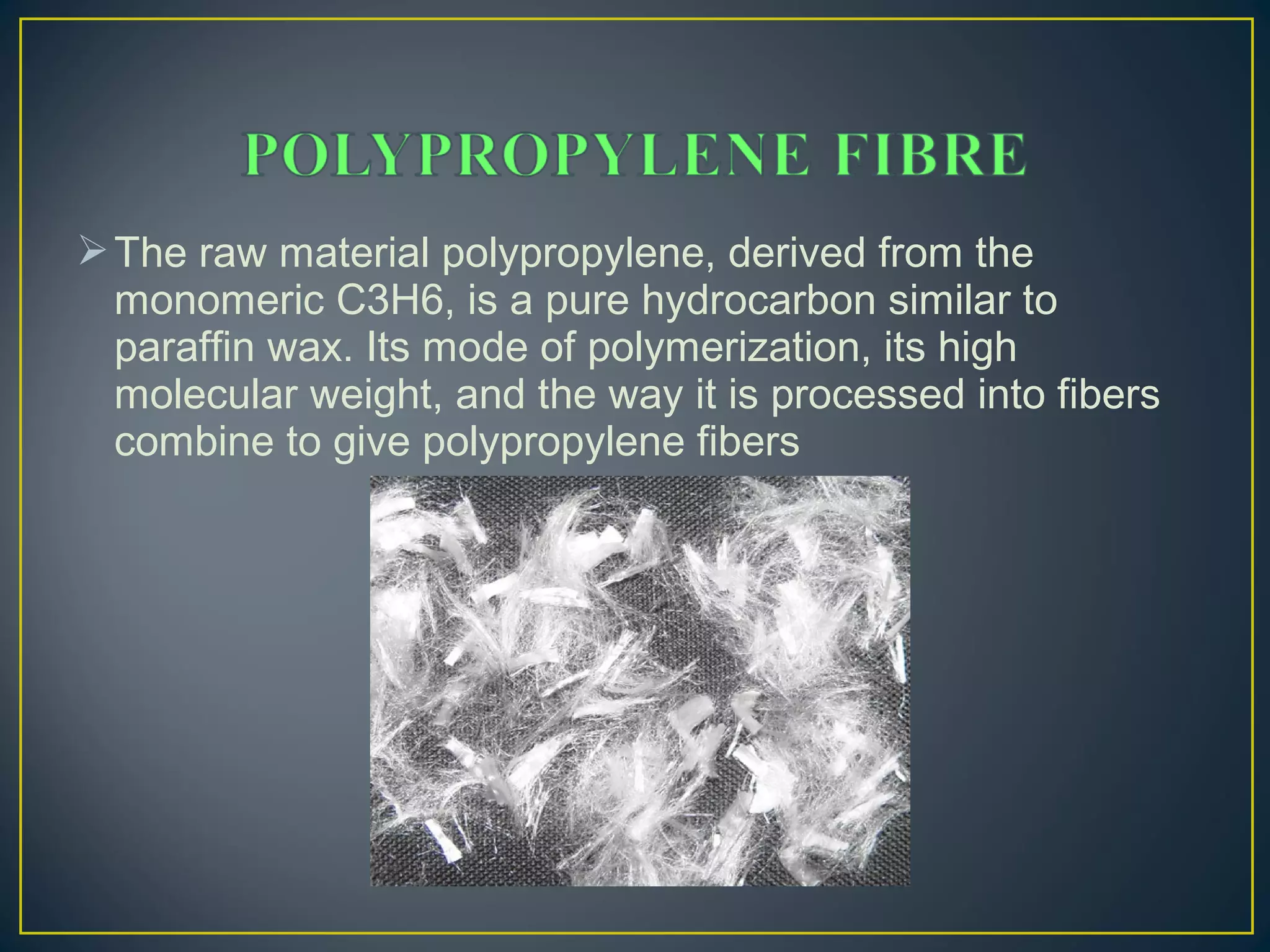
Polypropylene Fibre
Carbon Fibre
Glass Fibre
Steel fibers are the most common fibers used in concrete
.They may be produced either by cutting wires, shearing
sheets or from a hot melt extract.
Steel fibers have high modulus of elasticity which is 10
times that of concrete, reasonably good bond and high
elongation at fracture. Steel fibers range in length from
0.25 inches to 3.0 inches.
The raw material polypropylene, derived from the
monomeric C3H6, is a pure hydrocarbon similar to
paraffin wax. Its mode of polymerization, its high
molecular weight, and the way it is processed into fibers
combine to give polypropylene fibers
The concept of using fibers in concrete to improve
resistance to cracking and fragmentation is old and
intuitive.
During the last 30 years different types of fibers and
FIBRE materials were introduced and are being
continuously introduced in the market as new
applications. These fibers can be made of metals,
natural, glass or organic materials.
The philosophical objective of the thesis is to contribute
to the knowledge of the properties of FIBRE reinforced
concrete (FRC), helping to extend the use of the material
to structural design.
Study of the effect of using polypropylene FIBRE and
Steel FIBRE on concrete compressive and split tensile
strength.
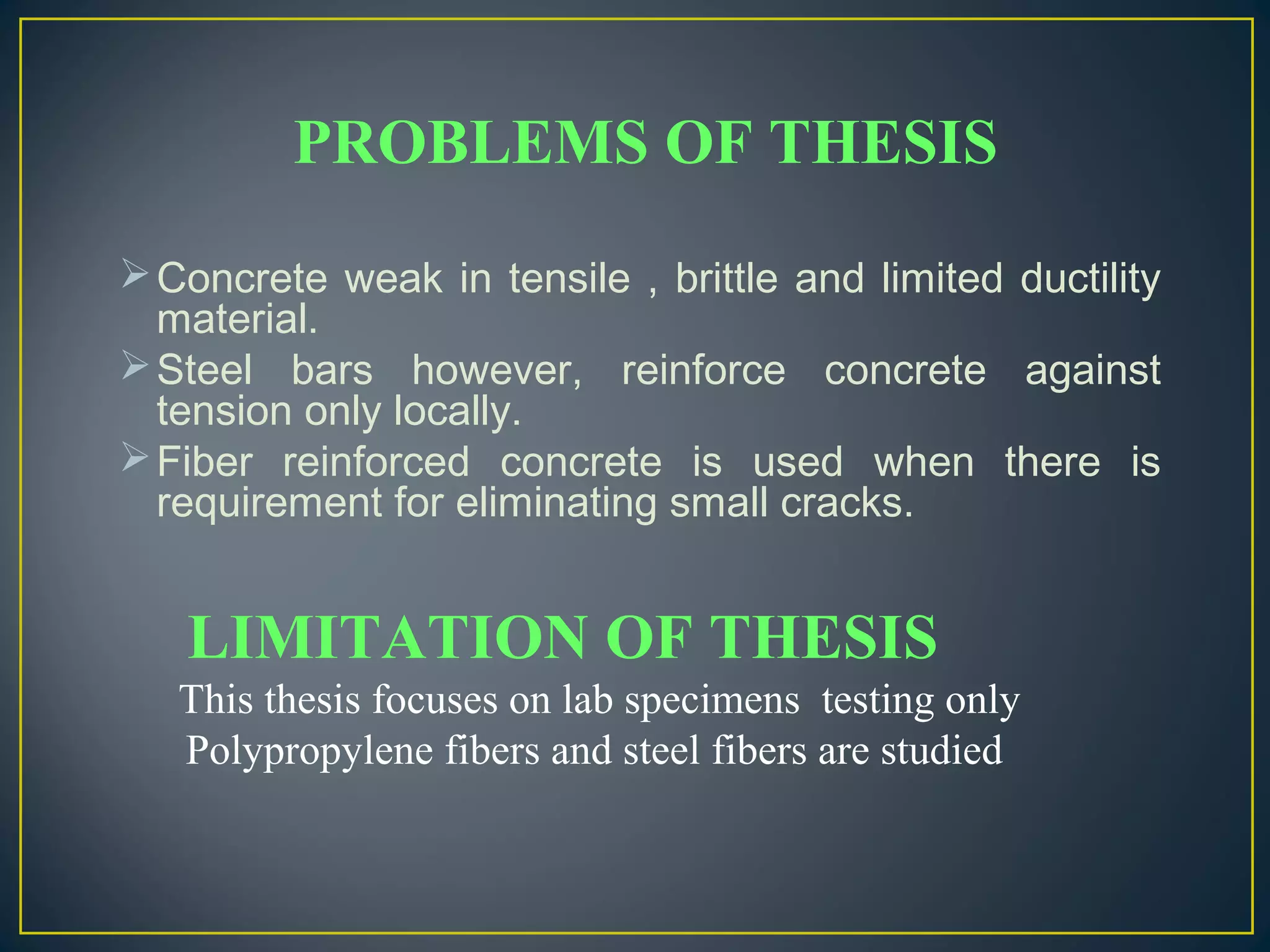
Concrete weak in tensile , brittle and limited ductility
material.
Steel bars however, reinforce concrete against
tension only locally.
Fiber reinforced concrete is used when there is
requirement for eliminating small cracks.
LIMITATION OF THESIS
This thesis focuses on lab specimens testing only
Polypropylene fibers and steel fibers are studied
PROBLEMS OF THESIS
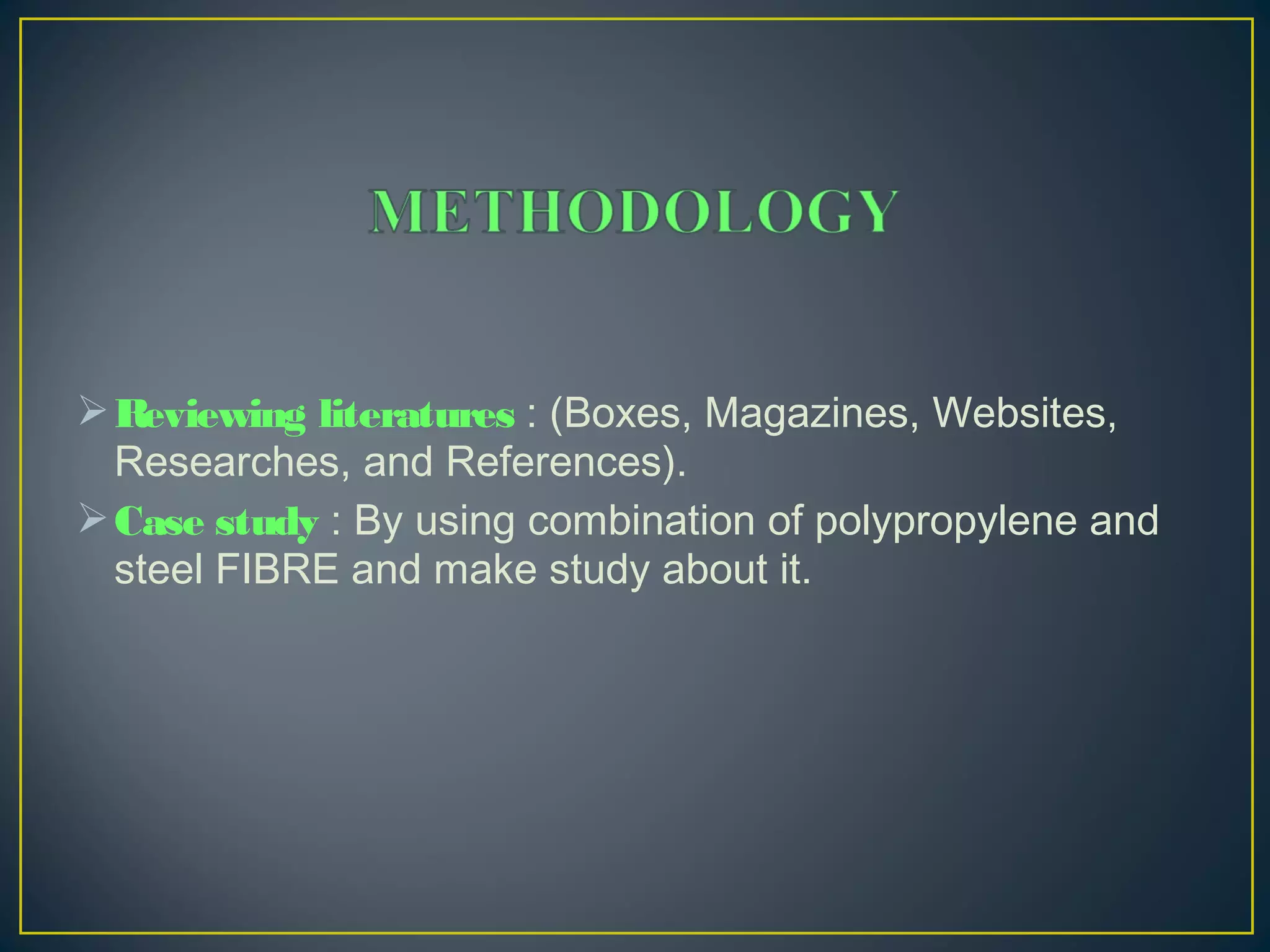
Reviewing literatures : (Boxes, Magazines, Websites,
Researches, and References).
Case study : By using combination of polypropylene and
steel FIBRE and make study about it.
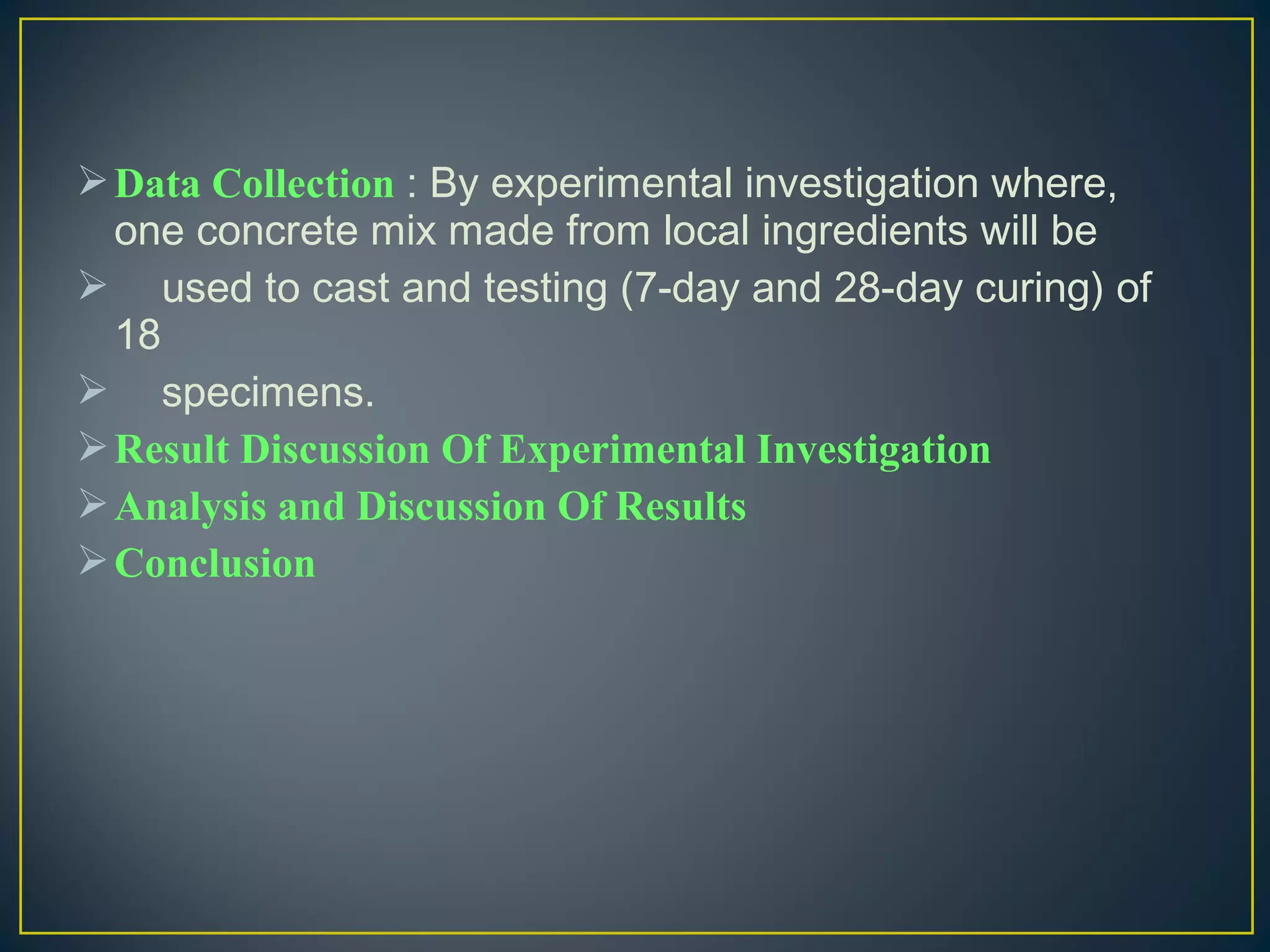
Data Collection : By experimental investigation where,
one concrete mix made from local ingredients will be
 used to cast and testing (7-day and 28-day curing) of
18
 specimens.
Result Discussion Of Experimental Investigation
Analysis and Discussion Of Results
Conclusion
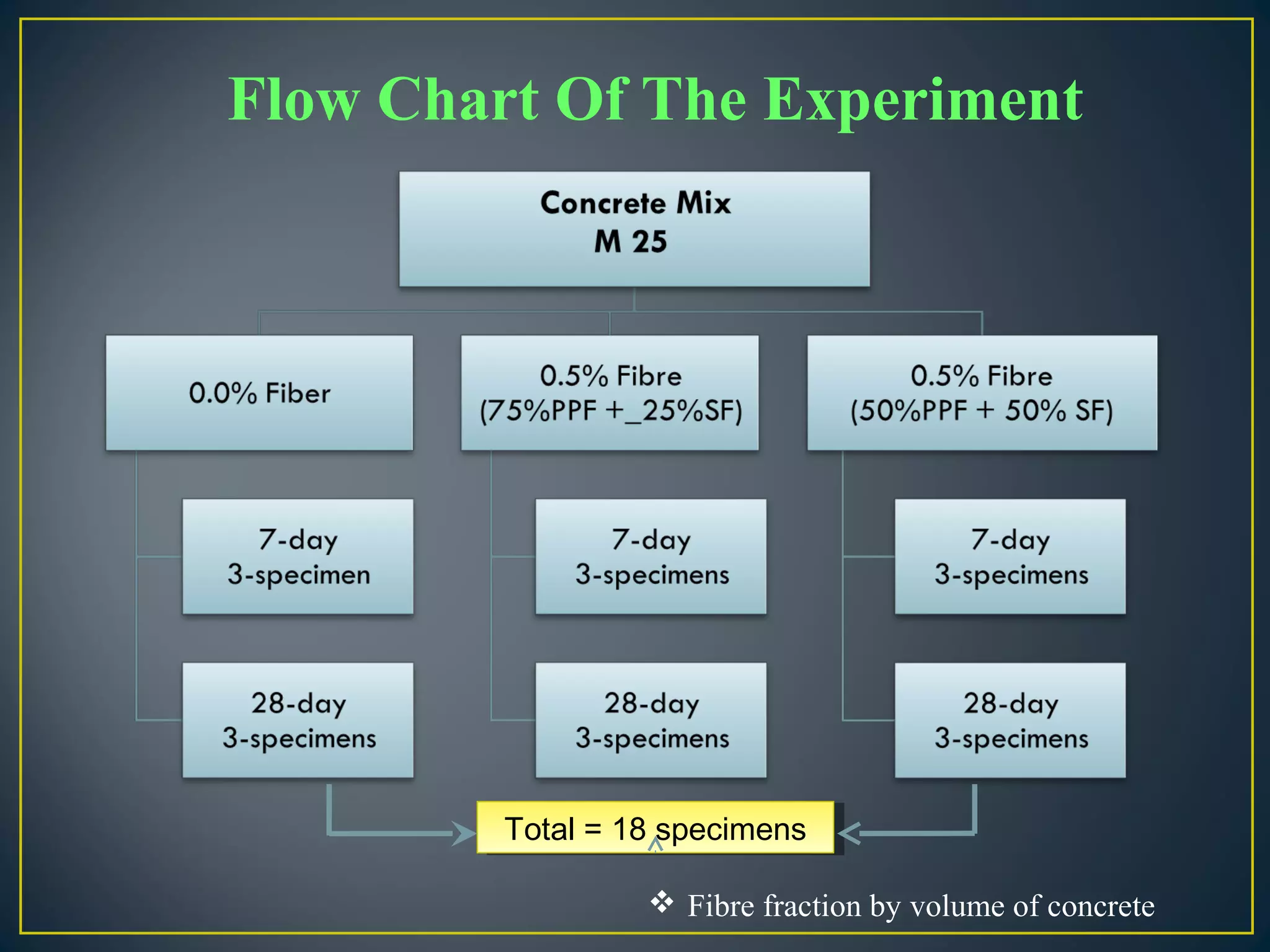
Flow Chart Of The Experiment
Total = 18 specimensTotal = 18 specimens
 Fibre fraction by volume of concrete
MATERIALS USED IN AN EXPERIMENTAL
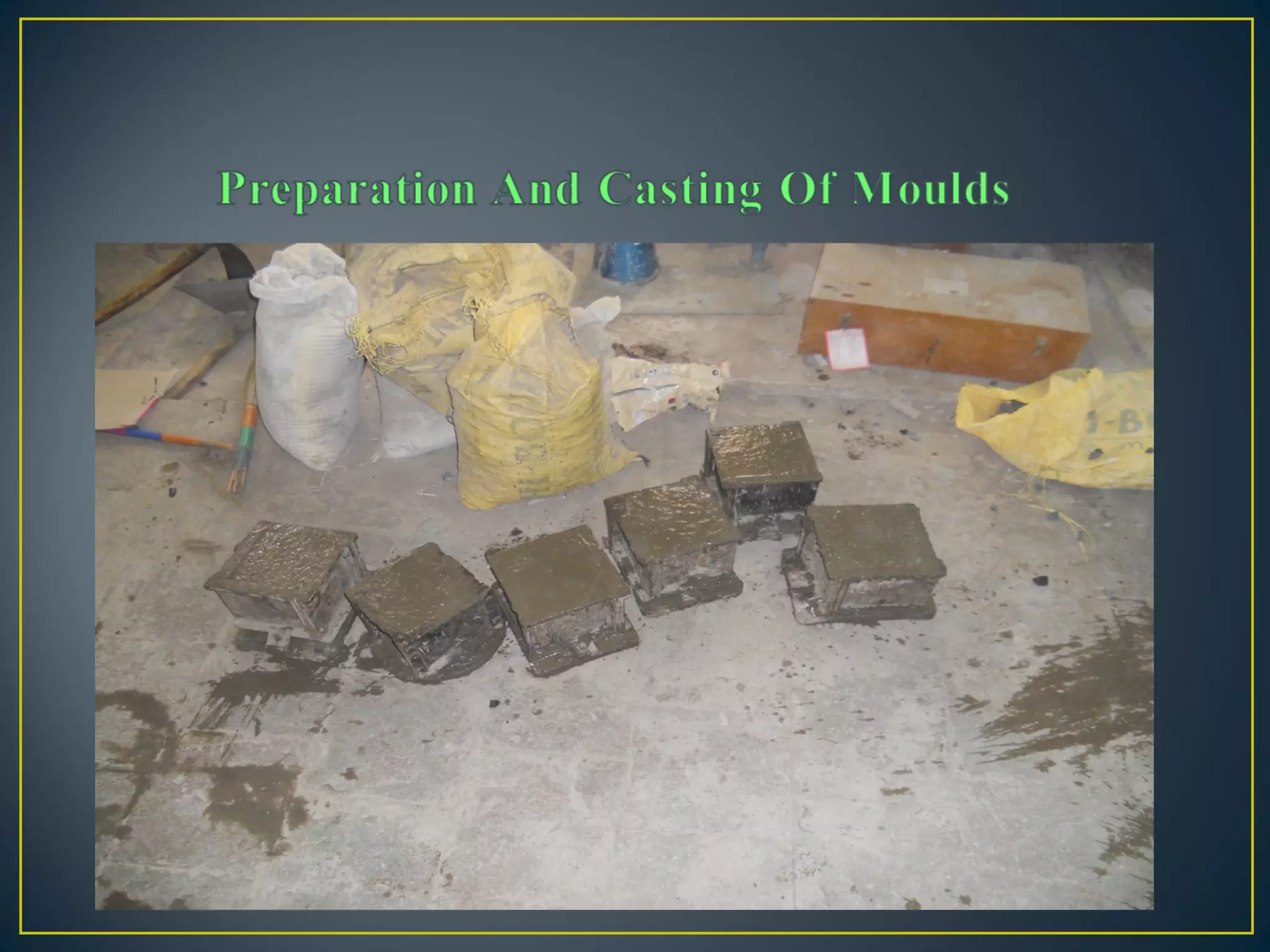
Specimens Casting
 Preparation of materials
Cement
The cement used in preparing the specimens was Ordinary
Portland Cement (OPC) 53 grade Ultra Tech cement.
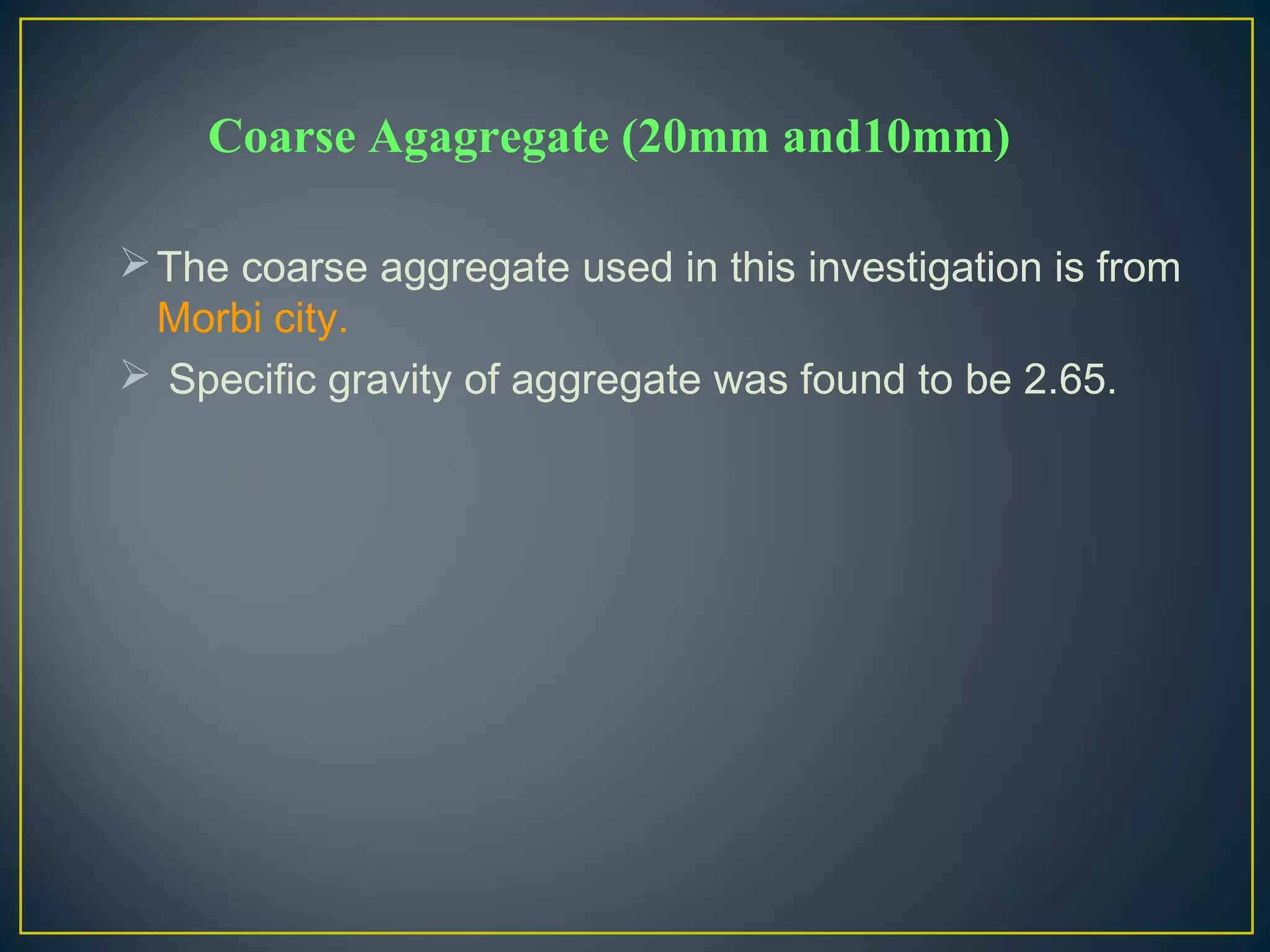
The coarse aggregate used in this investigation is from
Morbi city.
 Specific gravity of aggregate was found to be 2.65.
Coarse Agagregate (20mm and10mm)
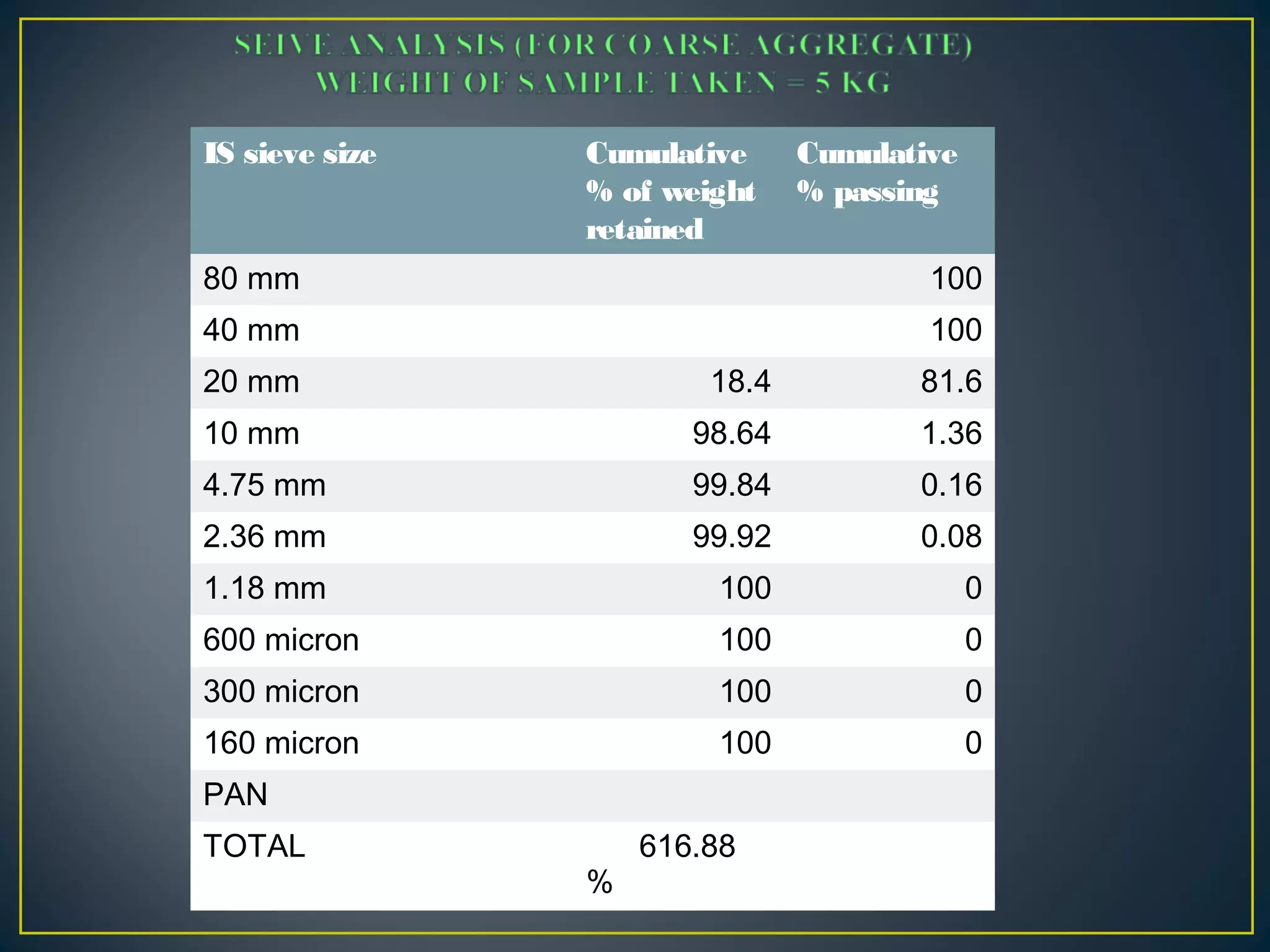
IS sieve size Cumulative
% of weight
retained
Cumulative
% passing
80 mm 100
40 mm 100
20 mm 18.4 81.6
10 mm 98.64 1.36
4.75 mm 99.84 0.16
2.36 mm 99.92 0.08
1.18 mm 100 0
600 micron 100 0
300 micron 100 0
160 micron 100 0
PAN
TOTAL 616.88
%
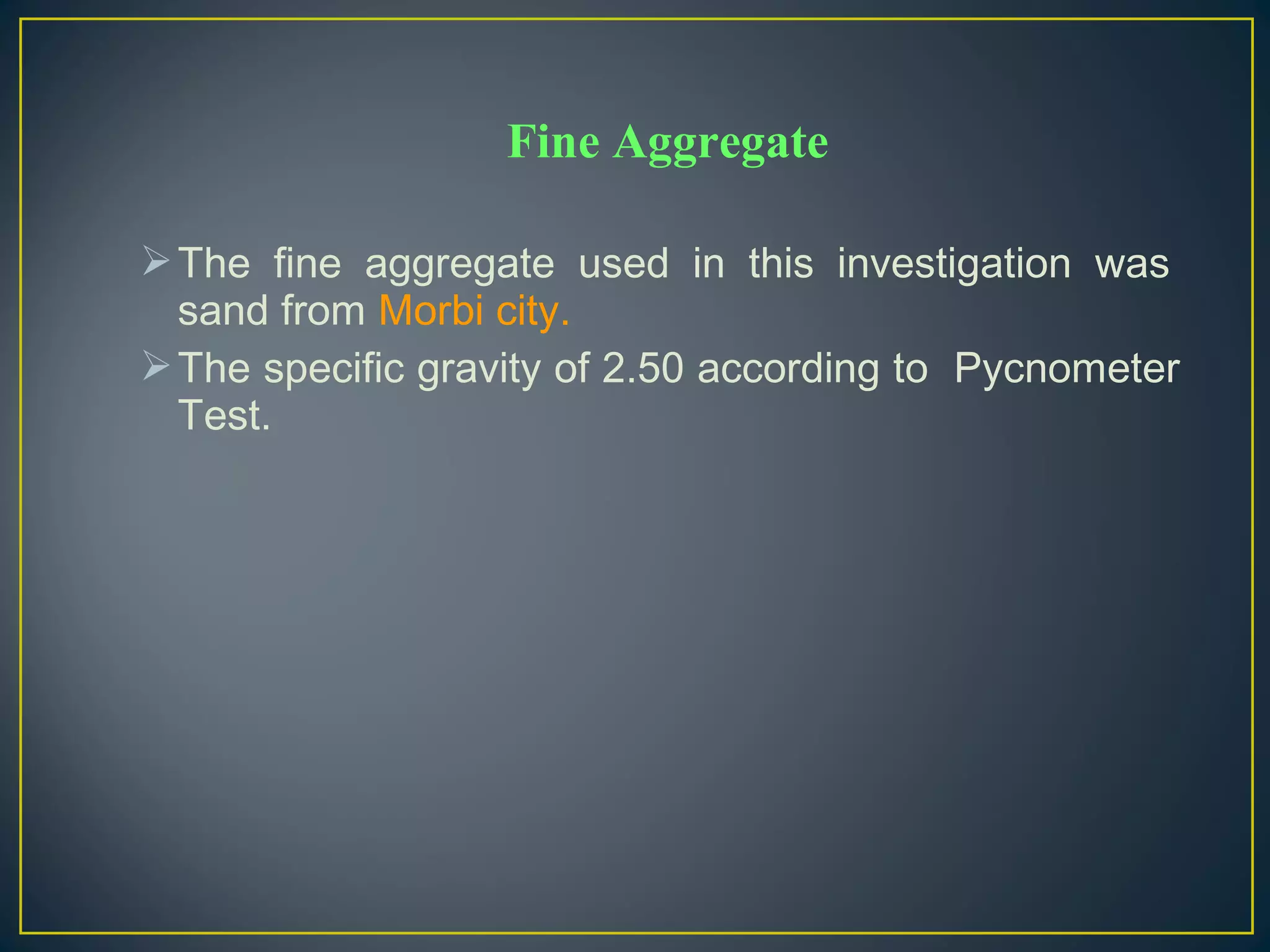
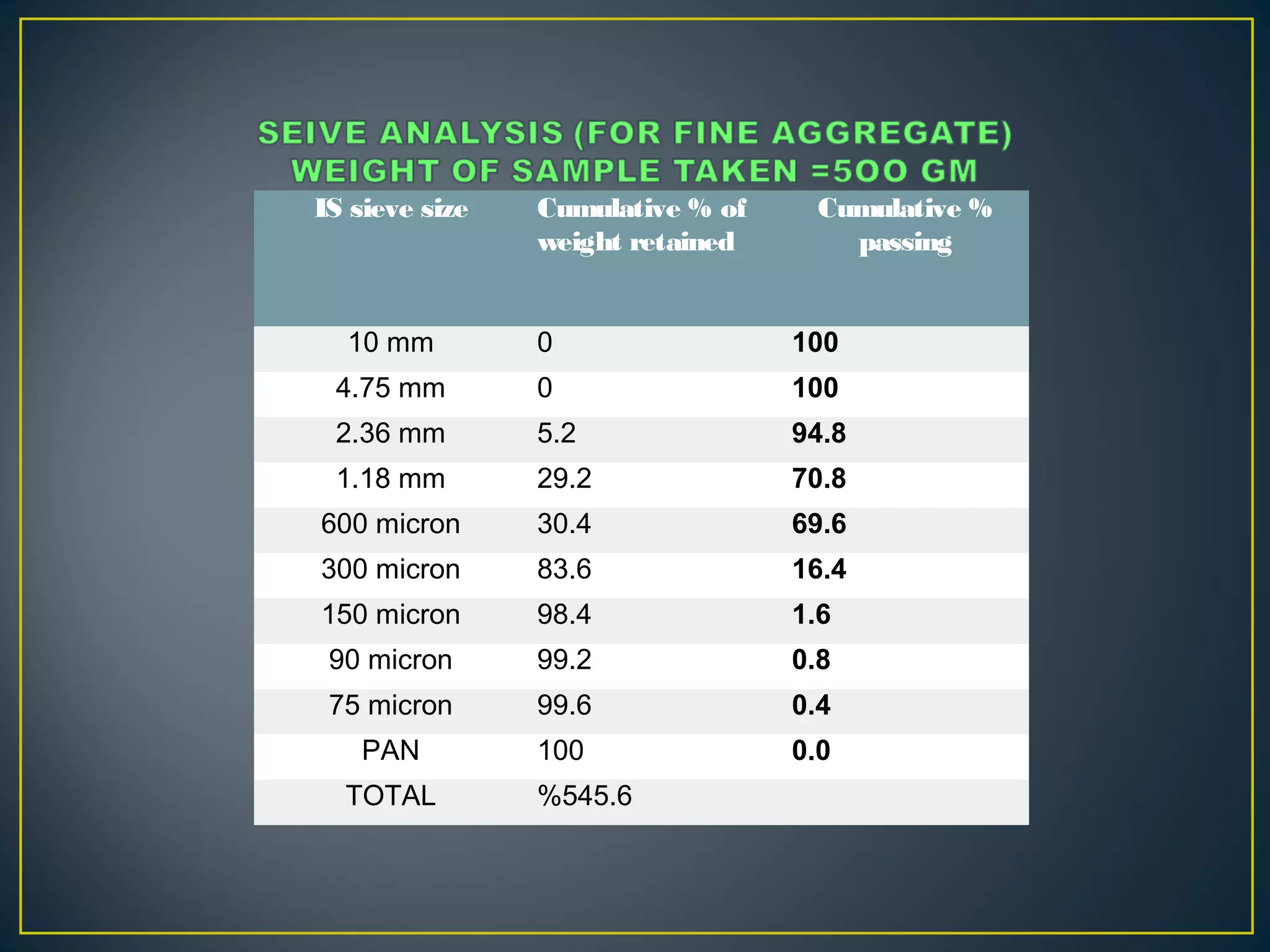
The fine aggregate used in this investigation was
sand from Morbi city.
The specific gravity of 2.50 according to Pycnometer
Test.
Fine Aggregate
IS sieve size Cumulative % of
weight retained
Cumulative %
passing
10 mm 0 100
4.75 mm 0 100
2.36 mm 5.2 94.8
1.18 mm 29.2 70.8
600 micron 30.4 69.6
300 micron 83.6 16.4
150 micron 98.4 1.6
90 micron 99.2 0.8
75 micron 99.6 0.4
PAN 100 0.0
TOTAL %545.6  
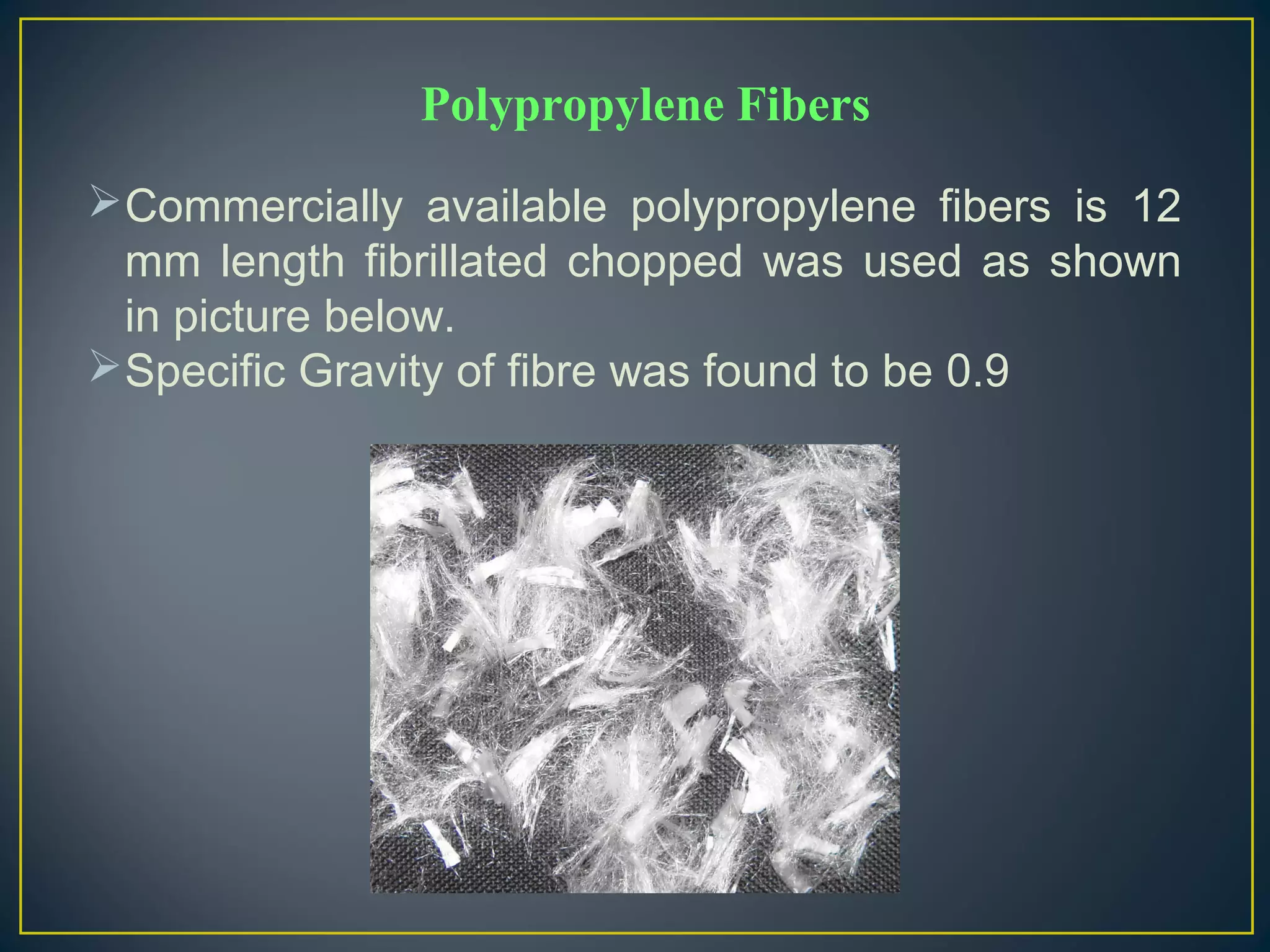
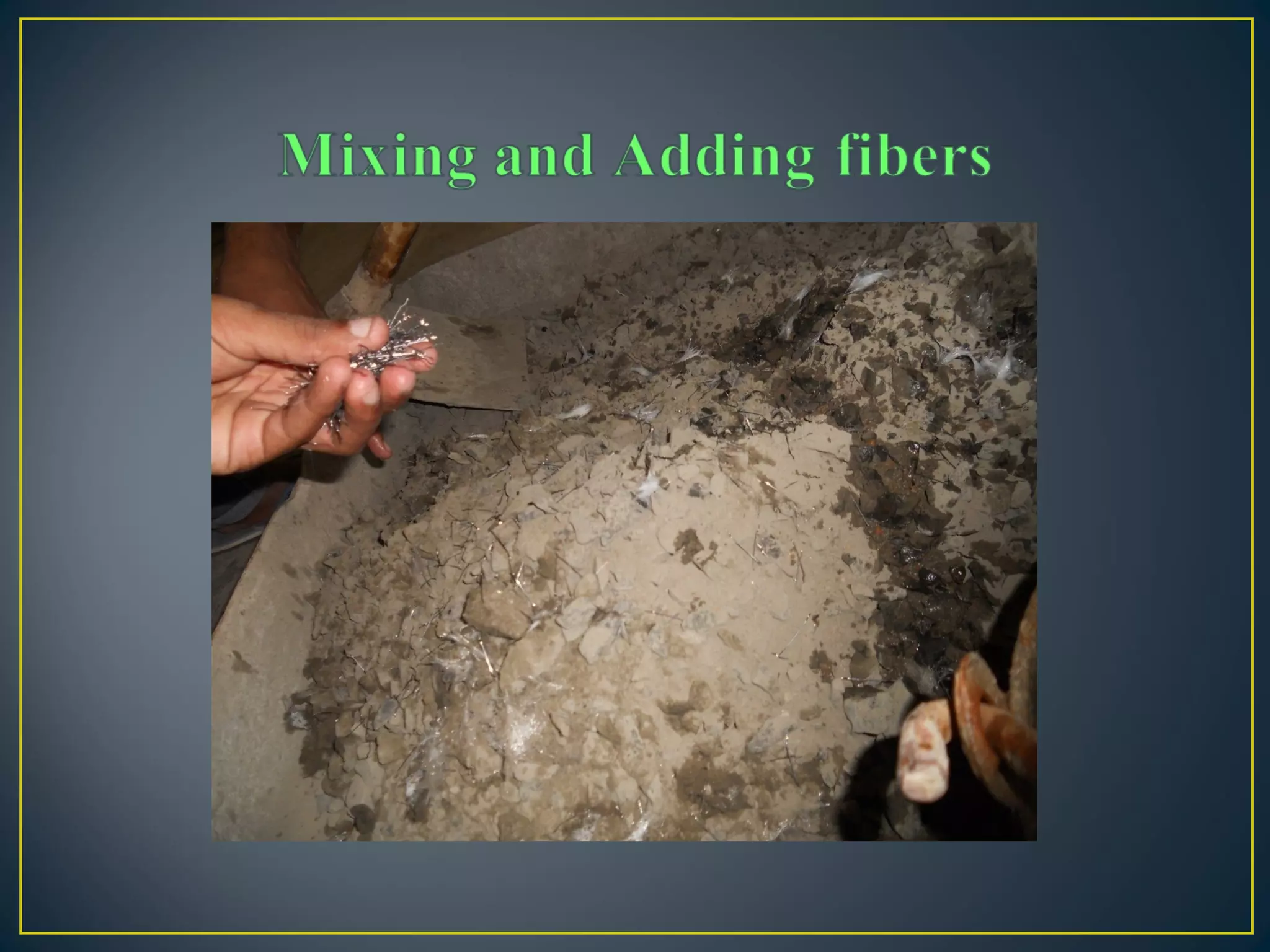
Commercially available polypropylene fibers is 12
mm length fibrillated chopped was used as shown
in picture below.
Specific Gravity of fibre was found to be 0.9
Polypropylene Fibers
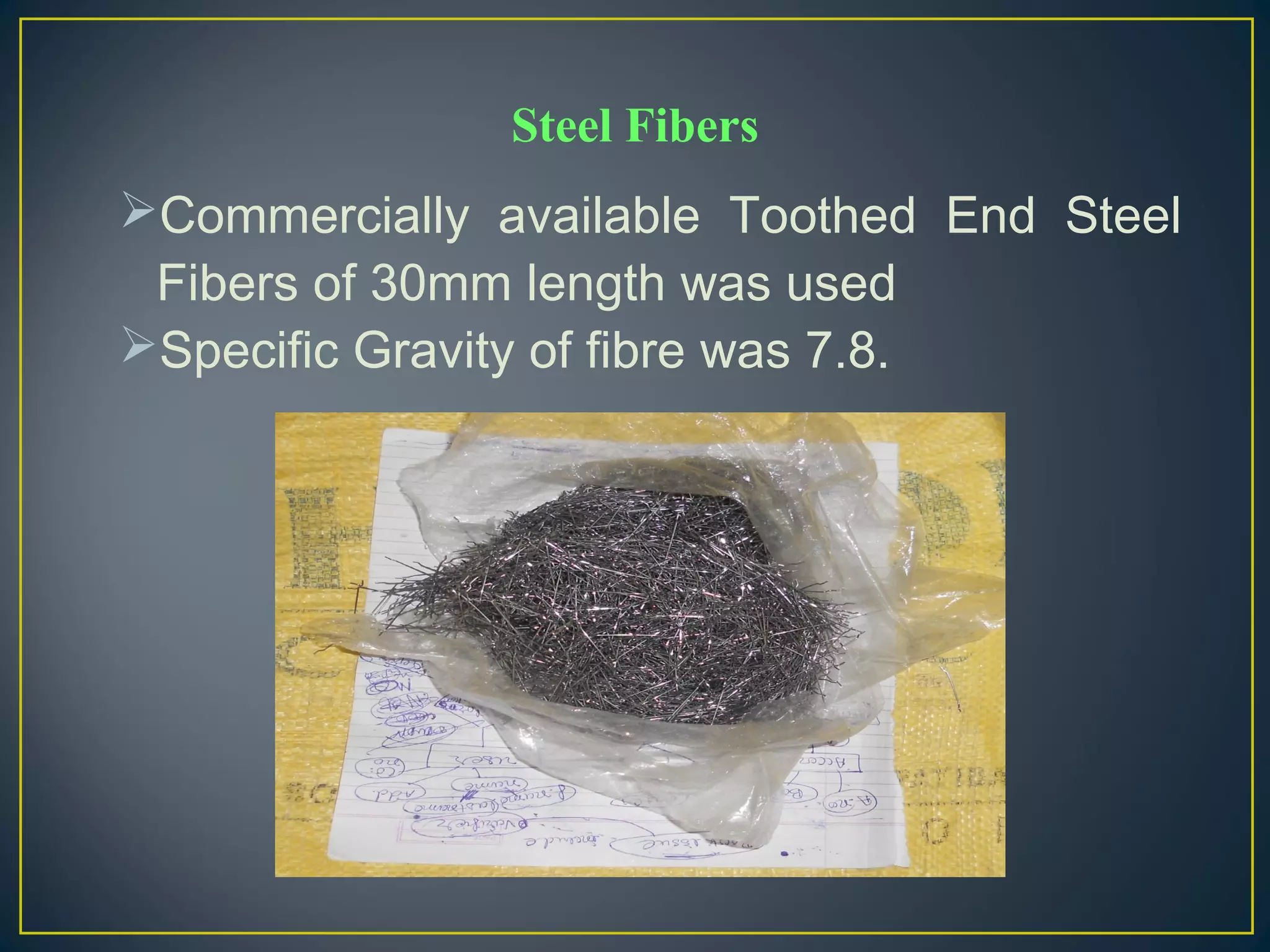
Commercially available Toothed End Steel
Fibers of 30mm length was used
Specific Gravity of fibre was 7.8.
Steel Fibers
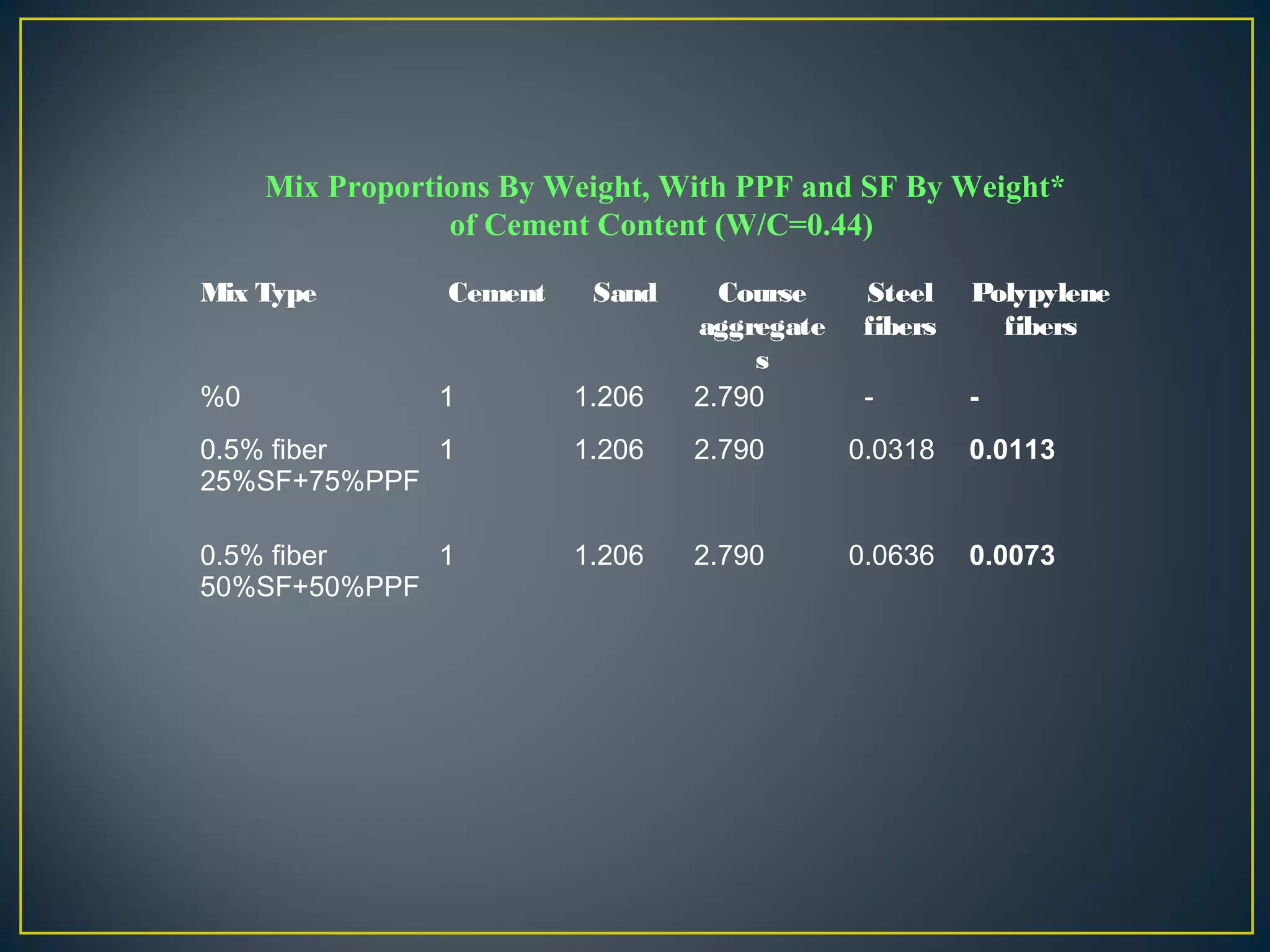
Mix Type Cement Sand Course
aggregate
s
Steel
fibers
Polypylene
fibers
%0 1 1.206 2.790 - -
0.5% fiber
25%SF+75%PPF
1 1.206 2.790 0.0318 0.0113
0.5% fiber
50%SF+50%PPF
1 1.206 2.790 0.0636 0.0073
Mix Proportions By Weight, With PPF and SF By Weight*
of Cement Content (W/C=0.44)
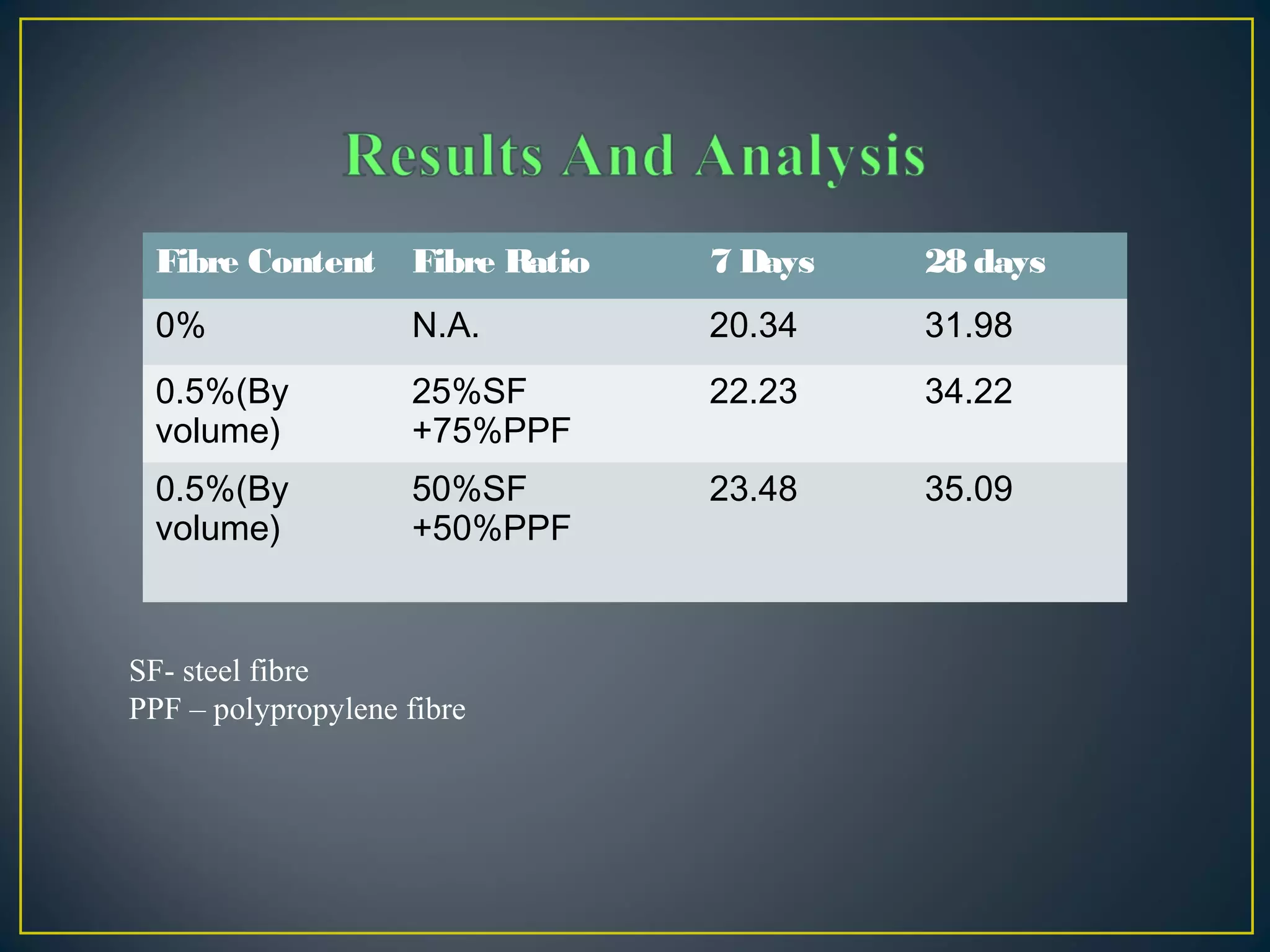
Fibre Content Fibre Ratio 7 Days 28 days
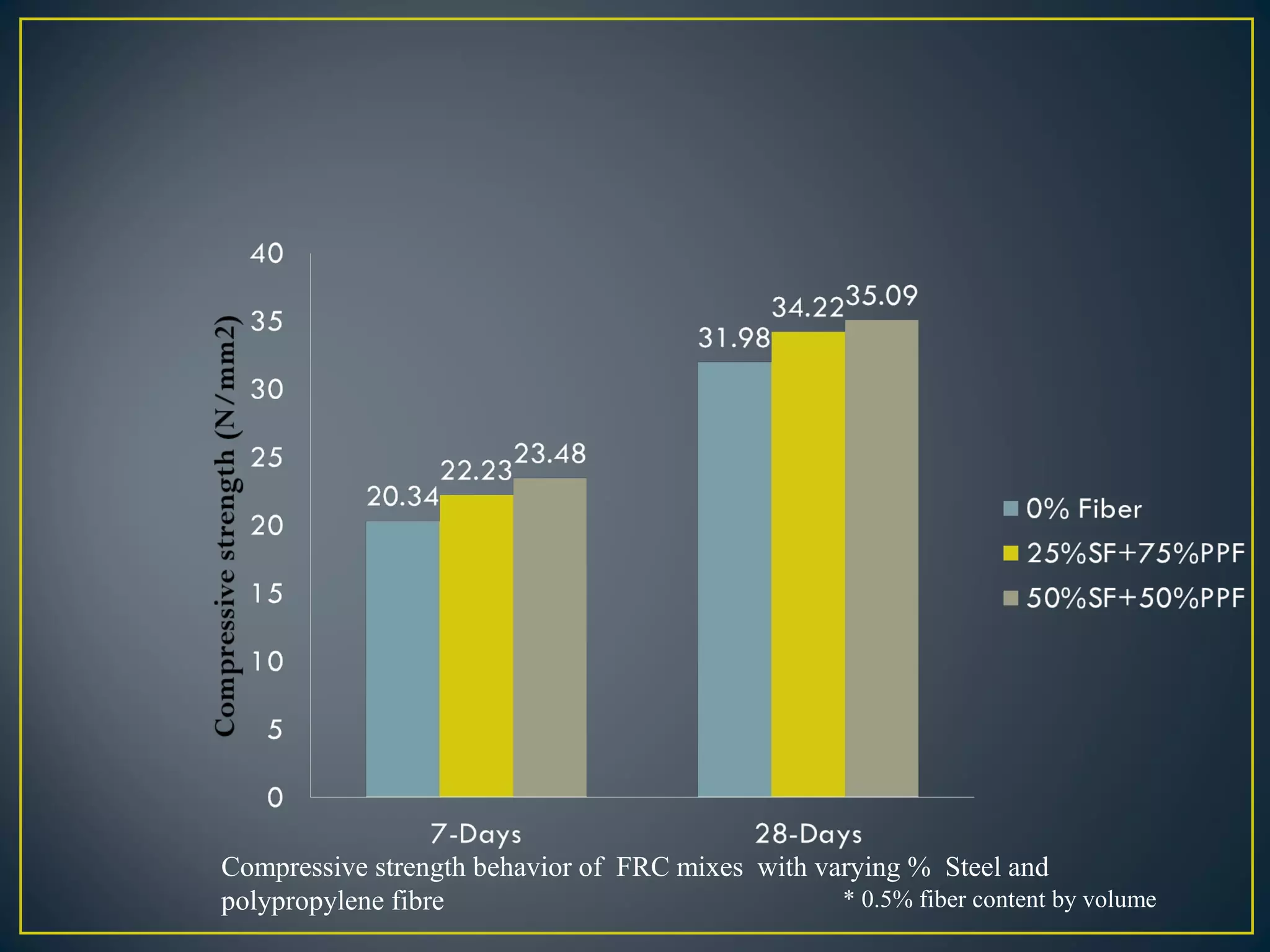
0% N.A. 20.34 31.98
0.5%(By
volume)
25%SF
+75%PPF
22.23 34.22
0.5%(By
volume)
50%SF
+50%PPF
23.48 35.09
SF- steel fibre
PPF – polypropylene fibre
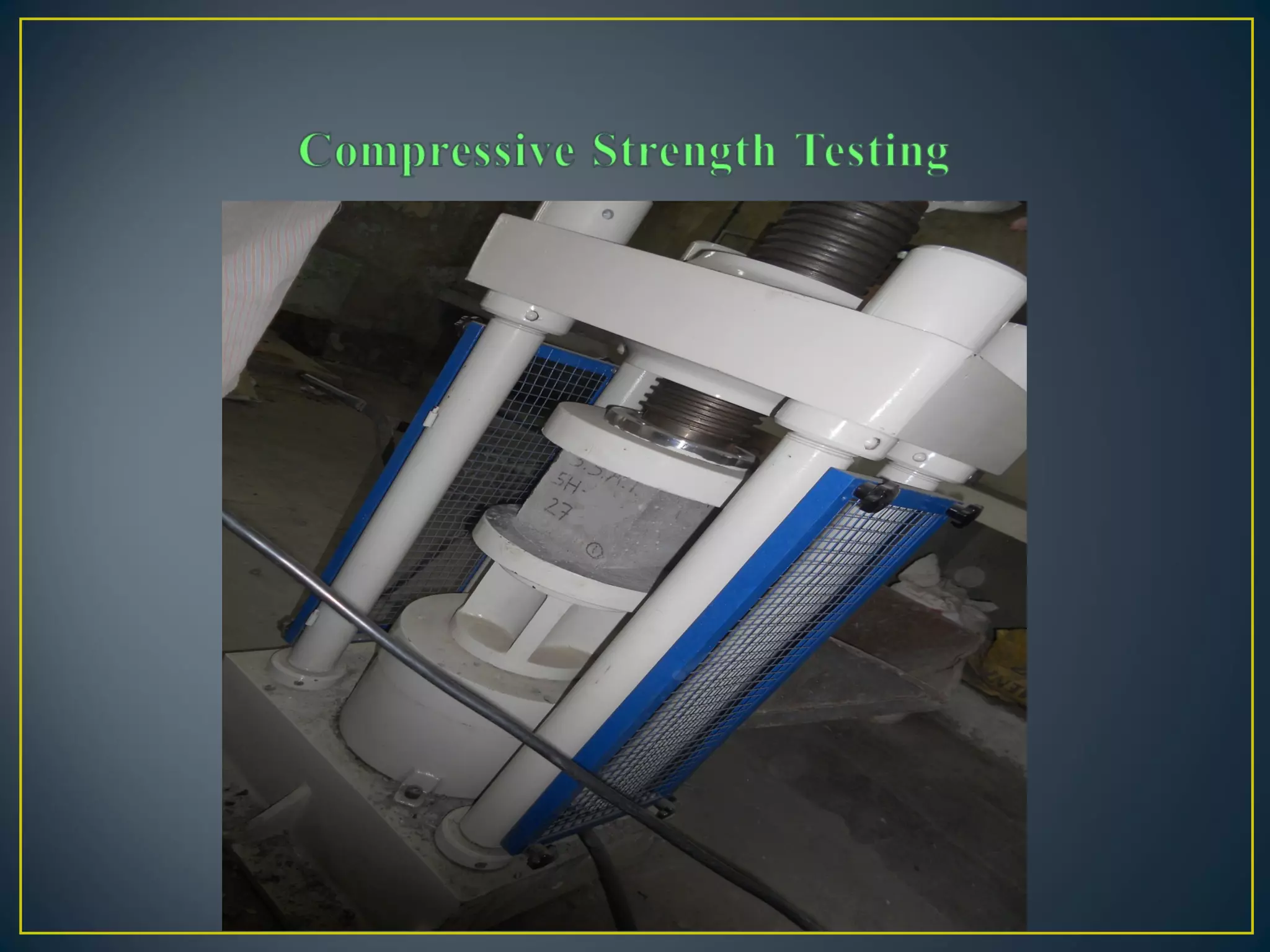
Compressive strength behavior of FRC mixes with varying % Steel and
polypropylene fibre * 0.5% fiber content by volume
Fiber Percentage
Fraction)%(
Compressiv
e Strength
7-day
)MPa(
Compressive
Strength
28-day
)MPa(
Percentage
)%(
28-day
7-day
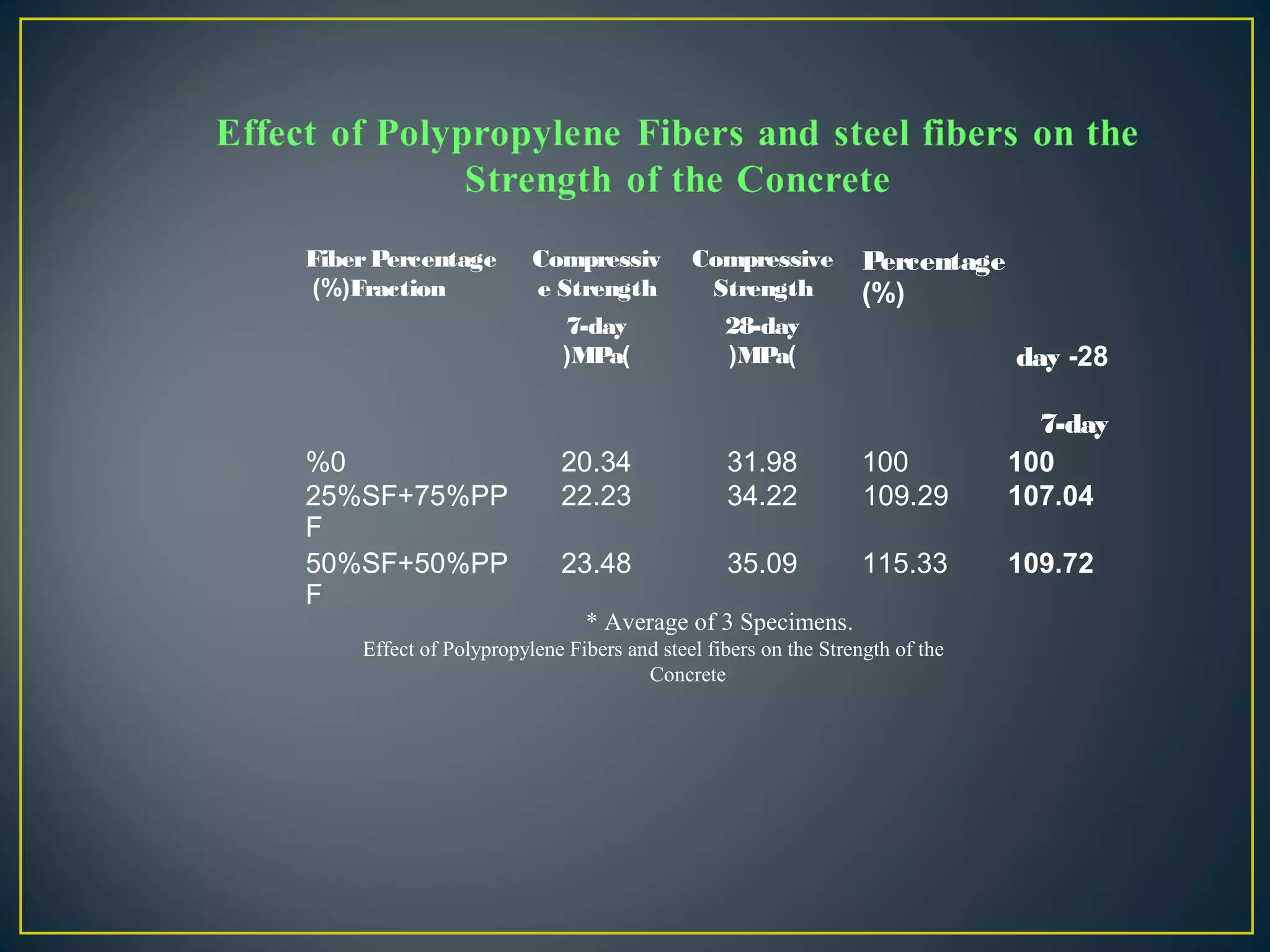
%0 20.34 31.98 100 100
25%SF+75%PP
F
22.23 34.22 109.29 107.04
50%SF+50%PP
F
23.48 35.09 115.33 109.72
* Average of 3 Specimens.
Effect of Polypropylene Fibers and steel fibers on the Strength of the
Concrete
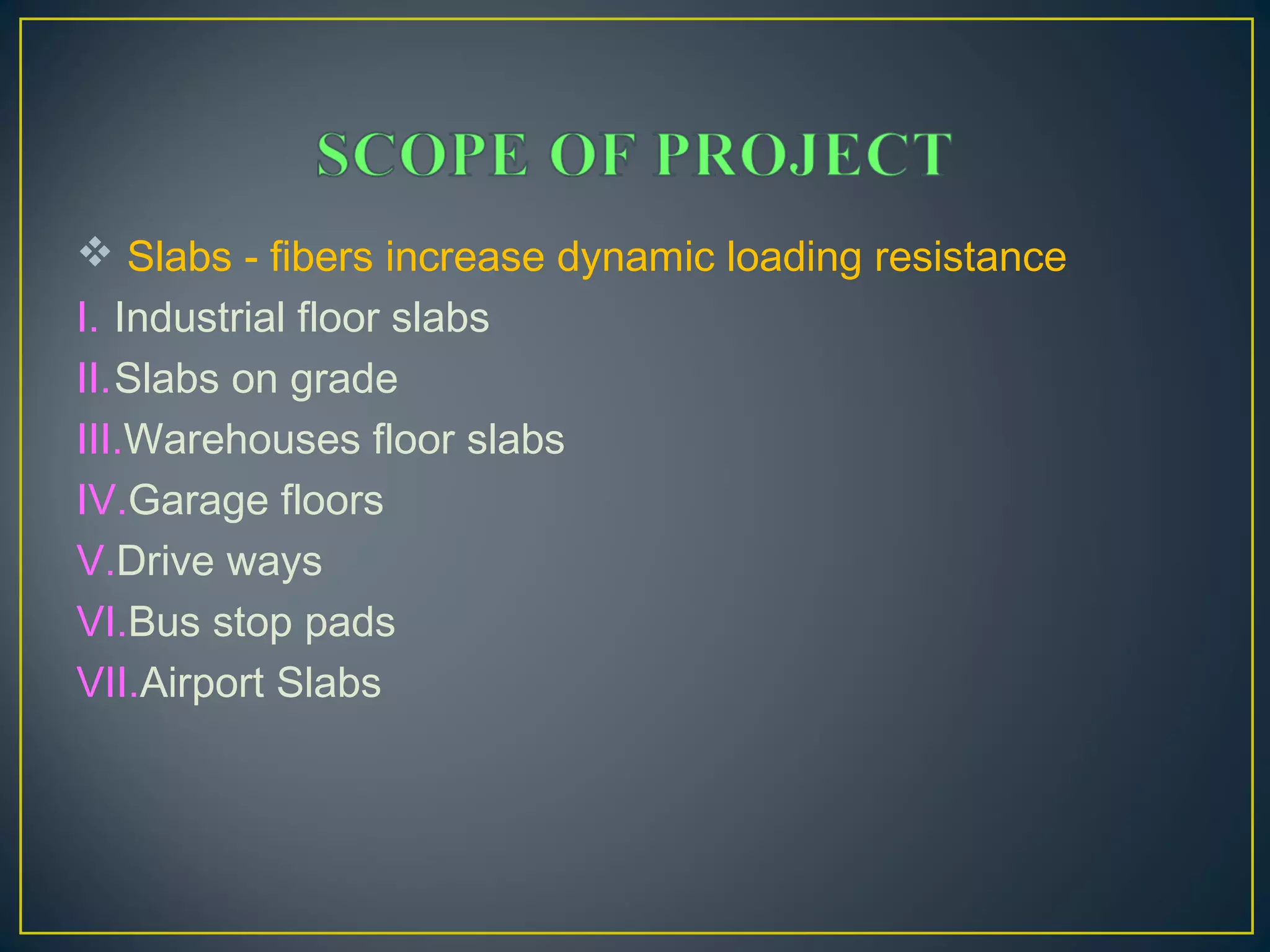
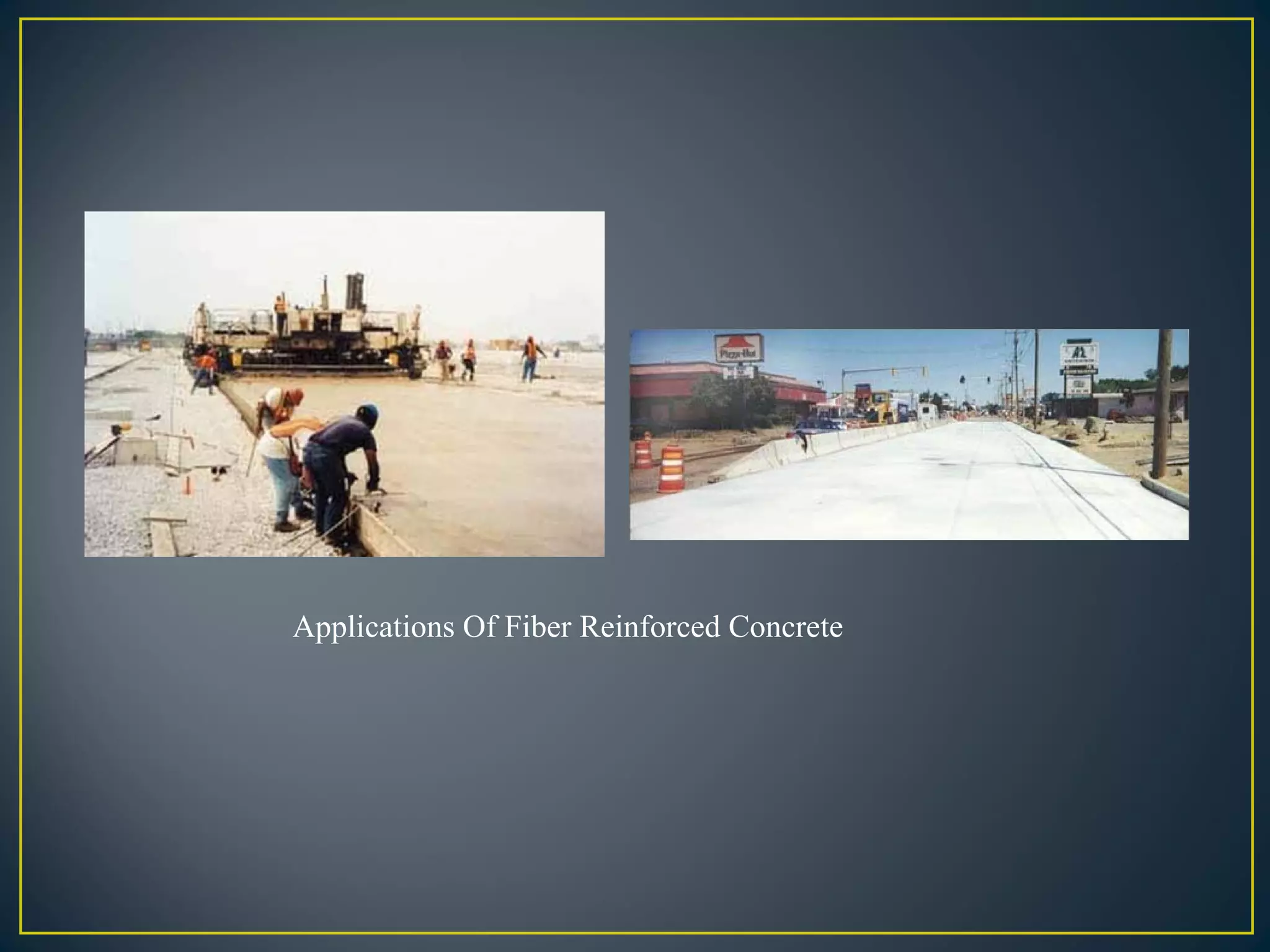
 Slabs - fibers increase dynamic loading resistance
I. Industrial floor slabs
II.Slabs on grade
III.Warehouses floor slabs
IV.Garage floors
V.Drive ways
VI.Bus stop pads
VII.Airport Slabs
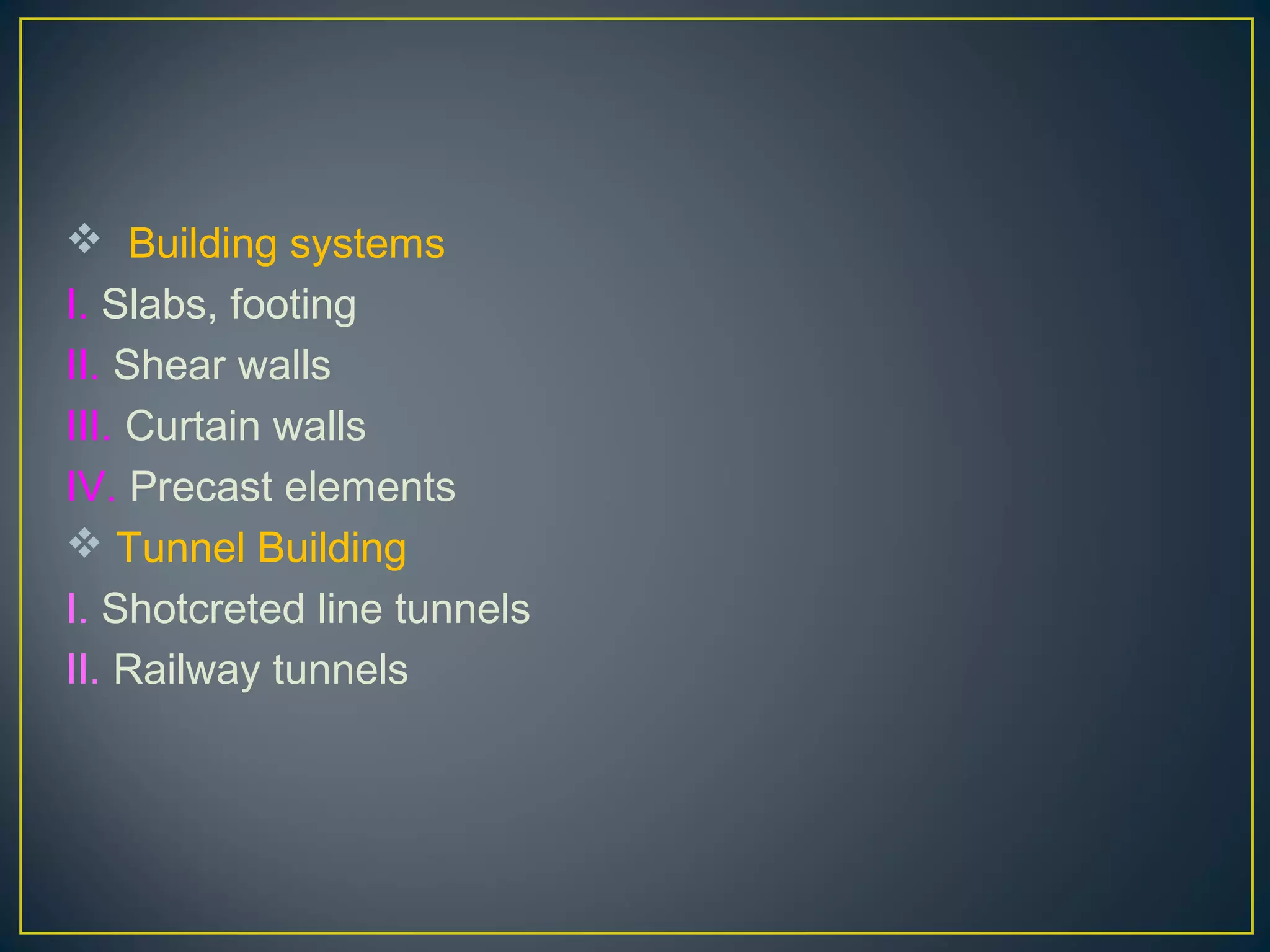
 Building systems
I. Slabs, footing
II. Shear walls
III. Curtain walls
IV. Precast elements
 Tunnel Building
I. Shotcreted line tunnels
II. Railway tunnels
Applications Of Fiber Reinforced Concrete
1) Hannant, D. J., “Fiber Cements and Fiber
Concretes”, John Wiley & Sons Ltd., 1978.
2) Fiber Reinforced Concrete (Portland cement
association),1990.
3) "Fiber Reinforced Concrete Developments And
Innovation" James I. Daniel and Surendra P.
Shah, American Concrete Institute Detroit,
Michigan,1994 .
4) www.concrete fiber.com
Will be working on improving Tensile strength by using
different proportions.
Will be working on Flexural strength by using different
proportions.
Guided by : Prof. K.B. Vaghela
Prepared by :
Shailesh Kataria
Divyesh Kalsariya
Ravi Kant Pandey
Shailesh Kalsariya
Improvement of properties of concrete by adding fibers

Improvement of properties of concrete by adding fibers

  • 1.
    Improvement Of PropertiesOf Concrete By Adding Fibers )An Experimental Studying( PROJECTTITLEPROJECTTITLE
  • 2.
    Concrete is oneof the most versatile building material. Concrete is strong under compression yet weak under tension, brittle and limited ductility material. Therefore, a form of reinforcement is needed, steel bars reinforce concrete against tension only locally.  Cracks in reinforced concrete members extend freely until encountering a rebar. The need for Multidirectional and closely spaced reinforcement for concrete arises. FRC is a concrete mix that contains short discrete fibers that are uniformly distributed and randomly oriented. INTRODUCTION
  • 4.
  • 5.
    Steel fibers arethe most common fibers used in concrete .They may be produced either by cutting wires, shearing sheets or from a hot melt extract. Steel fibers have high modulus of elasticity which is 10 times that of concrete, reasonably good bond and high elongation at fracture. Steel fibers range in length from 0.25 inches to 3.0 inches.

  • 7.
    The raw materialpolypropylene, derived from the monomeric C3H6, is a pure hydrocarbon similar to paraffin wax. Its mode of polymerization, its high molecular weight, and the way it is processed into fibers combine to give polypropylene fibers
  • 8.
    The concept ofusing fibers in concrete to improve resistance to cracking and fragmentation is old and intuitive. During the last 30 years different types of fibers and FIBRE materials were introduced and are being continuously introduced in the market as new applications. These fibers can be made of metals, natural, glass or organic materials.
  • 9.
    The philosophical objectiveof the thesis is to contribute to the knowledge of the properties of FIBRE reinforced concrete (FRC), helping to extend the use of the material to structural design. Study of the effect of using polypropylene FIBRE and Steel FIBRE on concrete compressive and split tensile strength.
  • 10.
    Concrete weak intensile , brittle and limited ductility material. Steel bars however, reinforce concrete against tension only locally. Fiber reinforced concrete is used when there is requirement for eliminating small cracks. LIMITATION OF THESIS This thesis focuses on lab specimens testing only Polypropylene fibers and steel fibers are studied PROBLEMS OF THESIS
  • 11.
    Reviewing literatures :(Boxes, Magazines, Websites, Researches, and References). Case study : By using combination of polypropylene and steel FIBRE and make study about it.
  • 12.
    Data Collection :By experimental investigation where, one concrete mix made from local ingredients will be  used to cast and testing (7-day and 28-day curing) of 18  specimens. Result Discussion Of Experimental Investigation Analysis and Discussion Of Results Conclusion
  • 13.
    Flow Chart OfThe Experiment Total = 18 specimensTotal = 18 specimens  Fibre fraction by volume of concrete
  • 14.
    MATERIALS USED INAN EXPERIMENTAL Specimens Casting  Preparation of materials Cement The cement used in preparing the specimens was Ordinary Portland Cement (OPC) 53 grade Ultra Tech cement.
  • 15.
    The coarse aggregateused in this investigation is from Morbi city.  Specific gravity of aggregate was found to be 2.65. Coarse Agagregate (20mm and10mm)
  • 16.
    IS sieve sizeCumulative % of weight retained Cumulative % passing 80 mm 100 40 mm 100 20 mm 18.4 81.6 10 mm 98.64 1.36 4.75 mm 99.84 0.16 2.36 mm 99.92 0.08 1.18 mm 100 0 600 micron 100 0 300 micron 100 0 160 micron 100 0 PAN TOTAL 616.88 %
  • 17.
    The fine aggregateused in this investigation was sand from Morbi city. The specific gravity of 2.50 according to Pycnometer Test. Fine Aggregate
  • 18.
    IS sieve sizeCumulative % of weight retained Cumulative % passing 10 mm 0 100 4.75 mm 0 100 2.36 mm 5.2 94.8 1.18 mm 29.2 70.8 600 micron 30.4 69.6 300 micron 83.6 16.4 150 micron 98.4 1.6 90 micron 99.2 0.8 75 micron 99.6 0.4 PAN 100 0.0 TOTAL %545.6  
  • 19.
    Commercially available polypropylenefibers is 12 mm length fibrillated chopped was used as shown in picture below. Specific Gravity of fibre was found to be 0.9 Polypropylene Fibers
  • 20.
    Commercially available ToothedEnd Steel Fibers of 30mm length was used Specific Gravity of fibre was 7.8. Steel Fibers
  • 21.
    Mix Type CementSand Course aggregate s Steel fibers Polypylene fibers %0 1 1.206 2.790 - - 0.5% fiber 25%SF+75%PPF 1 1.206 2.790 0.0318 0.0113 0.5% fiber 50%SF+50%PPF 1 1.206 2.790 0.0636 0.0073 Mix Proportions By Weight, With PPF and SF By Weight* of Cement Content (W/C=0.44)
  • 25.
    Fibre Content FibreRatio 7 Days 28 days 0% N.A. 20.34 31.98 0.5%(By volume) 25%SF +75%PPF 22.23 34.22 0.5%(By volume) 50%SF +50%PPF 23.48 35.09 SF- steel fibre PPF – polypropylene fibre
  • 26.
    Compressive strength behaviorof FRC mixes with varying % Steel and polypropylene fibre * 0.5% fiber content by volume
  • 27.
    Fiber Percentage Fraction)%( Compressiv e Strength 7-day )MPa( Compressive Strength 28-day )MPa( Percentage )%( 28-day 7-day %020.34 31.98 100 100 25%SF+75%PP F 22.23 34.22 109.29 107.04 50%SF+50%PP F 23.48 35.09 115.33 109.72 * Average of 3 Specimens. Effect of Polypropylene Fibers and steel fibers on the Strength of the Concrete
  • 28.
     Slabs -fibers increase dynamic loading resistance I. Industrial floor slabs II.Slabs on grade III.Warehouses floor slabs IV.Garage floors V.Drive ways VI.Bus stop pads VII.Airport Slabs
  • 29.
     Building systems I.Slabs, footing II. Shear walls III. Curtain walls IV. Precast elements  Tunnel Building I. Shotcreted line tunnels II. Railway tunnels
  • 30.
    Applications Of FiberReinforced Concrete
  • 31.
    1) Hannant, D.J., “Fiber Cements and Fiber Concretes”, John Wiley & Sons Ltd., 1978. 2) Fiber Reinforced Concrete (Portland cement association),1990. 3) "Fiber Reinforced Concrete Developments And Innovation" James I. Daniel and Surendra P. Shah, American Concrete Institute Detroit, Michigan,1994 . 4) www.concrete fiber.com
  • 32.
    Will be workingon improving Tensile strength by using different proportions. Will be working on Flexural strength by using different proportions.
  • 33.
    Guided by :Prof. K.B. Vaghela Prepared by : Shailesh Kataria Divyesh Kalsariya Ravi Kant Pandey Shailesh Kalsariya