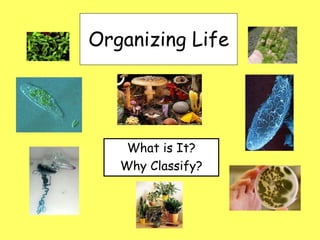
Organizing Life
What is It?
Why Classify?
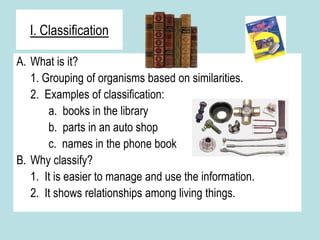
I. Classification
A. What is it?
1. Grouping of organisms based on similarities.
2. Examples of classification:
a. books in the library
b. parts in an auto shop
c. names in the phone book
B. Why classify?
1. It is easier to manage and use the information.
2. It shows relationships among living things.
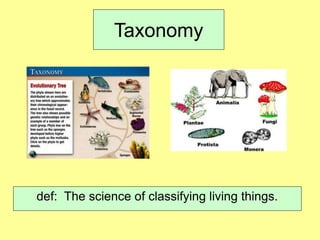
Taxonomy
def: The science of classifying living things.
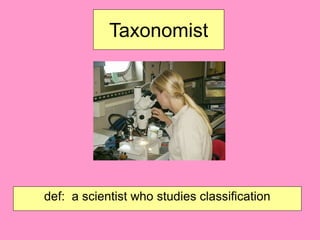
Taxonomist
def: a scientist who studies classification
Early
taxonomists…
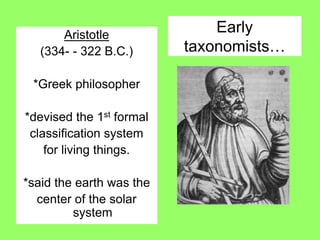
Aristotle
(334- - 322 B.C.)
*Greek philosopher
*devised the 1st formal
classification system
for living things.
*said the earth was the
center of the solar
system
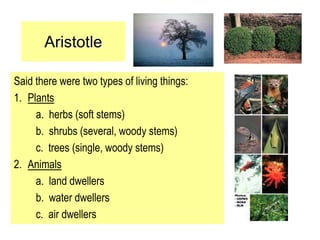
Aristotle
Said there were two types of living things:
1. Plants
a. herbs (soft stems)
b. shrubs (several, woody stems)
c. trees (single, woody stems)
2. Animals
a. land dwellers
b. water dwellers
c. air dwellers
Problems with Aristotle’s System
– Frog- Half of life is in water (tadpole), half is
on land
– Didn’t know about bacteria or one celled
organisms (no microscopes)
Early taxonomists…
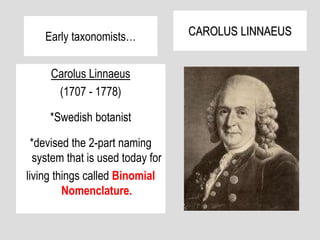
Carolus Linnaeus
(1707 - 1778)
*Swedish botanist
*devised the 2-part naming
system that is used today for
living things called Binomial
Nomenclature.
CAROLUS LINNAEUS
Carolus Linnaeus
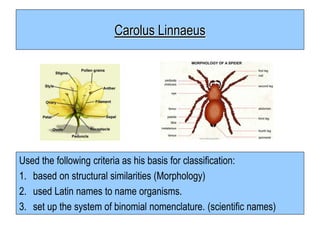
Used the following criteria as his basis for classification:
1. based on structural similarities (Morphology)
2. used Latin names to name organisms.
3. set up the system of binomial nomenclature. (scientific names)
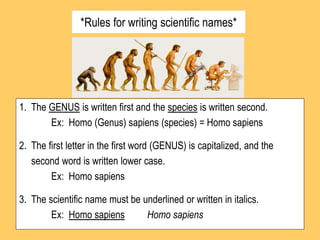
*Rules for writing scientific names*
1. The GENUS is written first and the species is written second.
Ex: Homo (Genus) sapiens (species) = Homo sapiens
2. The first letter in the first word (GENUS) is capitalized, and the
second word is written lower case.
Ex: Homo sapiens
3. The scientific name must be underlined or written in italics.
Ex: Homo sapiens Homo sapiens
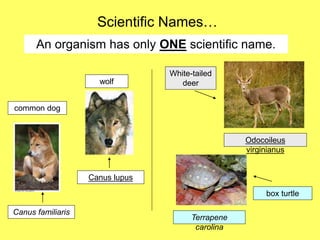
Scientific Names…
An organism has only ONE scientific name.
common dog
Canus familiaris
wolf
Canus lupus
box turtle
Terrapene
carolina
Odocoileus
virginianus
White-tailed
deer
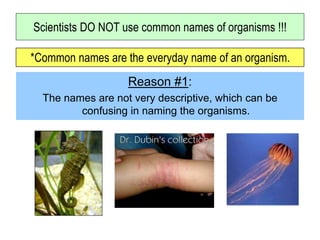
Scientists DO NOT use common names of organisms !!!
*Common names are the everyday name of an organism.
Reason #1:
The names are not very descriptive, which can be
confusing in naming the organisms.
*Common names are the everyday name of an organism.
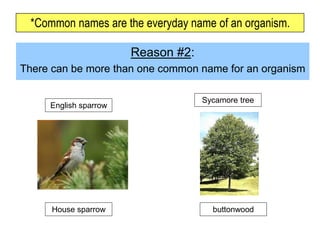
Reason #2:
There can be more than one common name for an organism
English sparrow
House sparrow
Sycamore tree
buttonwood
Tools of Classification
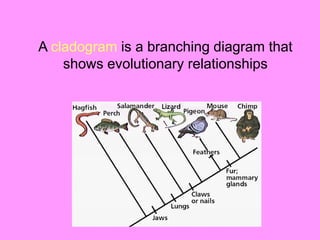
A cladogram is a branching diagram that
shows evolutionary relationships
Dichotomous Keys
• Aid in identifying unknown organisms
• Pairs of statements with two choices of
characteristics
• Only one choice will apply to the unknown
organism
• This will lead to another pair of
characteristics.. And so on…
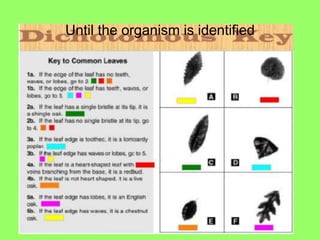
Until the organism is identified
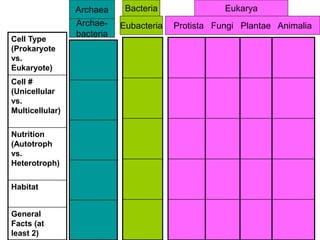
Archaea
Archae-
bacteria
Bacteria
Eubacteria
Eukarya
Protista Fungi Plantae Animalia
Cell Type
(Prokaryote
vs.
Eukaryote)
Cell #
(Unicellular
vs.
Multicellular)
Nutrition
(Autotroph
vs.
Heterotroph)
Habitat
General
Facts (at
least 2)
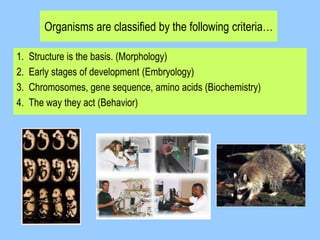
Organisms are classified by the following criteria…
1. Structure is the basis. (Morphology)
2. Early stages of development (Embryology)
3. Chromosomes, gene sequence, amino acids (Biochemistry)
4. The way they act (Behavior)
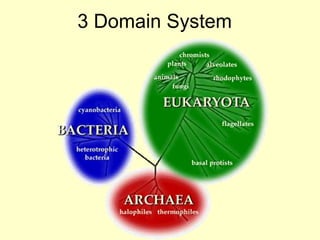
3 Domain System
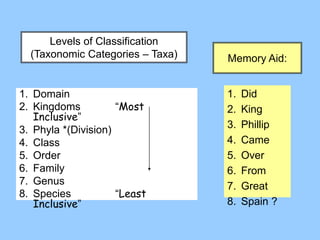
Levels of Classification
(Taxonomic Categories – Taxa)
1. Domain
2. Kingdoms “Most
Inclusive”
3. Phyla *(Division)
4. Class
5. Order
6. Family
7. Genus
8. Species “Least
Inclusive”
1. Did
2. King
3. Phillip
4. Came
5. Over
6. From
7. Great
8. Spain ?
Memory Aid:
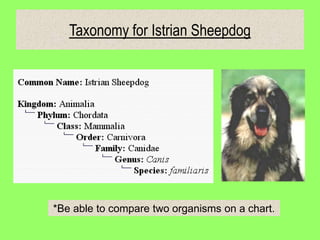
Taxonomy for Istrian Sheepdog
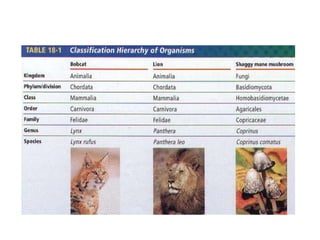
*Be able to compare two organisms on a chart.
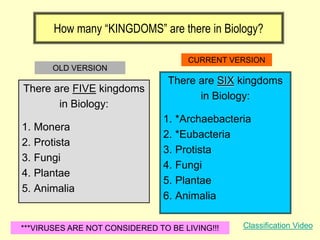
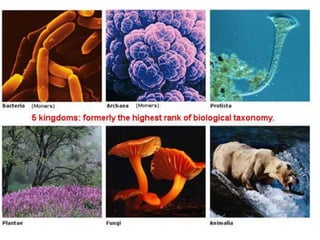
How many “KINGDOMS” are there in Biology?
There are FIVE kingdoms
in Biology:
1. Monera
2. Protista
3. Fungi
4. Plantae
5. Animalia
There are SIX kingdoms
in Biology:
1. *Archaebacteria
2. *Eubacteria
3. Protista
4. Fungi
5. Plantae
6. Animalia
OLD VERSION
CURRENT VERSION
***VIRUSES ARE NOT CONSIDERED TO BE LIVING!!! Classification Video
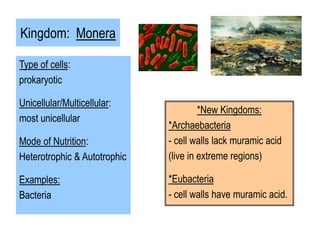
Kingdom: Monera
Type of cells:
prokaryotic
Unicellular/Multicellular:
most unicellular
Mode of Nutrition:
Heterotrophic & Autotrophic
Examples:
Bacteria
*New Kingdoms:
*Archaebacteria
- cell walls lack muramic acid
(live in extreme regions)
*Eubacteria
- cell walls have muramic acid.
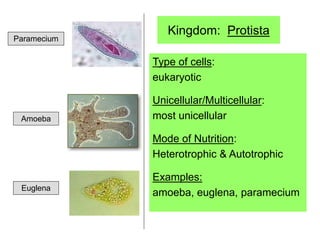
Kingdom: Protista
Type of cells:
eukaryotic
Unicellular/Multicellular:
most unicellular
Mode of Nutrition:
Heterotrophic & Autotrophic
Examples:
amoeba, euglena, paramecium
Paramecium
Amoeba
Euglena
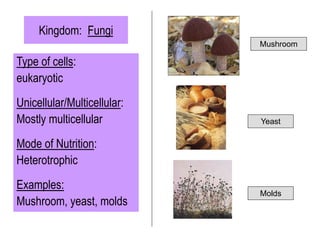
Kingdom: Fungi
Type of cells:
eukaryotic
Unicellular/Multicellular:
Mostly multicellular
Mode of Nutrition:
Heterotrophic
Examples:
Mushroom, yeast, molds
Mushroom
Yeast
Molds
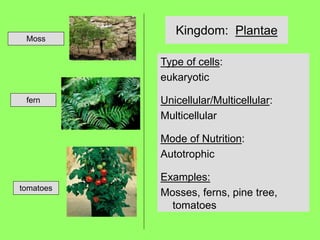
Kingdom: Plantae
Type of cells:
eukaryotic
Unicellular/Multicellular:
Multicellular
Mode of Nutrition:
Autotrophic
Examples:
Mosses, ferns, pine tree,
tomatoes
Moss
fern
tomatoes
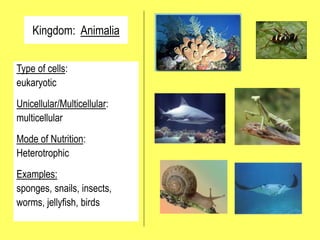
Kingdom: Animalia
Type of cells:
eukaryotic
Unicellular/Multicellular:
multicellular
Mode of Nutrition:
Heterotrophic
Examples:
sponges, snails, insects,
worms, jellyfish, birds

8542089.pptfffffffffhhhhhhhhhhhhhhffffffffff

  • 1.
    Organizing Life What isIt? Why Classify?
  • 2.
    I. Classification A. Whatis it? 1. Grouping of organisms based on similarities. 2. Examples of classification: a. books in the library b. parts in an auto shop c. names in the phone book B. Why classify? 1. It is easier to manage and use the information. 2. It shows relationships among living things.
  • 3.
    Taxonomy def: The scienceof classifying living things.
  • 4.
    Taxonomist def: a scientistwho studies classification
  • 5.
    Early taxonomists… Aristotle (334- - 322B.C.) *Greek philosopher *devised the 1st formal classification system for living things. *said the earth was the center of the solar system
  • 6.
    Aristotle Said there weretwo types of living things: 1. Plants a. herbs (soft stems) b. shrubs (several, woody stems) c. trees (single, woody stems) 2. Animals a. land dwellers b. water dwellers c. air dwellers
  • 7.
    Problems with Aristotle’sSystem – Frog- Half of life is in water (tadpole), half is on land – Didn’t know about bacteria or one celled organisms (no microscopes)
  • 8.
    Early taxonomists… Carolus Linnaeus (1707- 1778) *Swedish botanist *devised the 2-part naming system that is used today for living things called Binomial Nomenclature. CAROLUS LINNAEUS
  • 9.
    Carolus Linnaeus Used thefollowing criteria as his basis for classification: 1. based on structural similarities (Morphology) 2. used Latin names to name organisms. 3. set up the system of binomial nomenclature. (scientific names)
  • 10.
    *Rules for writingscientific names* 1. The GENUS is written first and the species is written second. Ex: Homo (Genus) sapiens (species) = Homo sapiens 2. The first letter in the first word (GENUS) is capitalized, and the second word is written lower case. Ex: Homo sapiens 3. The scientific name must be underlined or written in italics. Ex: Homo sapiens Homo sapiens
  • 11.
    Scientific Names… An organismhas only ONE scientific name. common dog Canus familiaris wolf Canus lupus box turtle Terrapene carolina Odocoileus virginianus White-tailed deer
  • 12.
    Scientists DO NOTuse common names of organisms !!! *Common names are the everyday name of an organism. Reason #1: The names are not very descriptive, which can be confusing in naming the organisms.
  • 13.
    *Common names arethe everyday name of an organism. Reason #2: There can be more than one common name for an organism English sparrow House sparrow Sycamore tree buttonwood
  • 14.
  • 15.
    A cladogram isa branching diagram that shows evolutionary relationships
  • 16.
    Dichotomous Keys • Aidin identifying unknown organisms • Pairs of statements with two choices of characteristics • Only one choice will apply to the unknown organism • This will lead to another pair of characteristics.. And so on…
  • 17.
    Until the organismis identified
  • 18.
    Archaea Archae- bacteria Bacteria Eubacteria Eukarya Protista Fungi PlantaeAnimalia Cell Type (Prokaryote vs. Eukaryote) Cell # (Unicellular vs. Multicellular) Nutrition (Autotroph vs. Heterotroph) Habitat General Facts (at least 2)
  • 19.
    Organisms are classifiedby the following criteria… 1. Structure is the basis. (Morphology) 2. Early stages of development (Embryology) 3. Chromosomes, gene sequence, amino acids (Biochemistry) 4. The way they act (Behavior)
  • 20.
  • 21.
    Levels of Classification (TaxonomicCategories – Taxa) 1. Domain 2. Kingdoms “Most Inclusive” 3. Phyla *(Division) 4. Class 5. Order 6. Family 7. Genus 8. Species “Least Inclusive” 1. Did 2. King 3. Phillip 4. Came 5. Over 6. From 7. Great 8. Spain ? Memory Aid:
  • 22.
    Taxonomy for IstrianSheepdog *Be able to compare two organisms on a chart.
  • 24.
    How many “KINGDOMS”are there in Biology? There are FIVE kingdoms in Biology: 1. Monera 2. Protista 3. Fungi 4. Plantae 5. Animalia There are SIX kingdoms in Biology: 1. *Archaebacteria 2. *Eubacteria 3. Protista 4. Fungi 5. Plantae 6. Animalia OLD VERSION CURRENT VERSION ***VIRUSES ARE NOT CONSIDERED TO BE LIVING!!! Classification Video
  • 25.
    Kingdom: Monera Type ofcells: prokaryotic Unicellular/Multicellular: most unicellular Mode of Nutrition: Heterotrophic & Autotrophic Examples: Bacteria *New Kingdoms: *Archaebacteria - cell walls lack muramic acid (live in extreme regions) *Eubacteria - cell walls have muramic acid.
  • 27.
    Kingdom: Protista Type ofcells: eukaryotic Unicellular/Multicellular: most unicellular Mode of Nutrition: Heterotrophic & Autotrophic Examples: amoeba, euglena, paramecium Paramecium Amoeba Euglena
  • 28.
    Kingdom: Fungi Type ofcells: eukaryotic Unicellular/Multicellular: Mostly multicellular Mode of Nutrition: Heterotrophic Examples: Mushroom, yeast, molds Mushroom Yeast Molds
  • 29.
    Kingdom: Plantae Type ofcells: eukaryotic Unicellular/Multicellular: Multicellular Mode of Nutrition: Autotrophic Examples: Mosses, ferns, pine tree, tomatoes Moss fern tomatoes
  • 30.
    Kingdom: Animalia Type ofcells: eukaryotic Unicellular/Multicellular: multicellular Mode of Nutrition: Heterotrophic Examples: sponges, snails, insects, worms, jellyfish, birds