Public-Key Cryptography &
 Message Authentication
Authentication

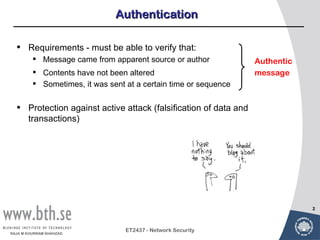
  •    Requirements - must be able to verify that:
          Message came from apparent source or author               Authentic
          Contents have not been altered                            message
          Sometimes, it was sent at a certain time or sequence


  •    Protection against active attack (falsification of data and
       transactions)


                                                                                 2


                                  ET2437 - Network Security
RAJA M KHURRAM SHAHZAD
Approaches to Message Authentication

  •    Authentication Using Conventional Encryption
          Only the sender and receiver should share a key

  •    Message Authentication without Message Encryption
          An authentication tag is generated and appended to each message


  •    Message Authentication Code - MAC
          The use of secret key to generate a small block of data, MAC
         Or
          Calculate the MAC as a function of the message and the key.
          MAC = F(K, M)


                                                                             3


                                  ET2437 - Network Security
RAJA M KHURRAM SHAHZAD
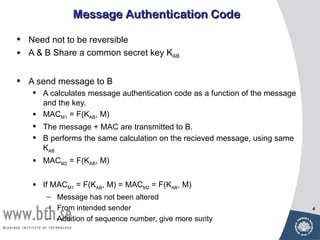
Message Authentication Code

•   Need not to be reversible
•   A & B Share a common secret key KAB


•   A send message to B
     A calculates message authentication code as a function of the message
      and the key.
     MACM1 = F(KAB, M)
     The message + MAC are transmitted to B.
     B performs the same calculation on the recieved message, using same
      KAB
     MACM2 = F(KAB, M)


     If MACM1 = F(KAB, M) = MACM2 = F(KAB, M)
        – Message has not been altered
        – From intended sender                                                4

        – Addition of sequence number, give more surity
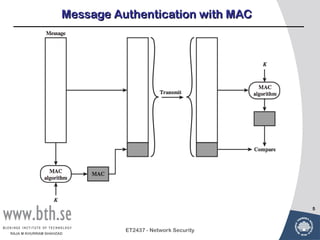
Message Authentication with MAC


                                                           5


                               ET2437 - Network Security
RAJA M KHURRAM SHAHZAD
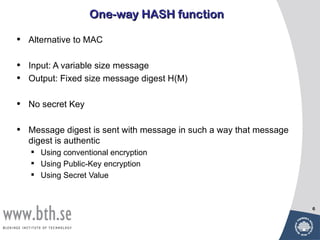
One-way HASH function

•   Alternative to MAC

•   Input: A variable size message
•   Output: Fixed size message digest H(M)

•   No secret Key

•   Message digest is sent with message in such a way that message
    digest is authentic
     Using conventional encryption
     Using Public-Key encryption
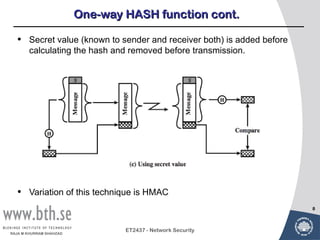
     Using Secret Value


                                                                     6
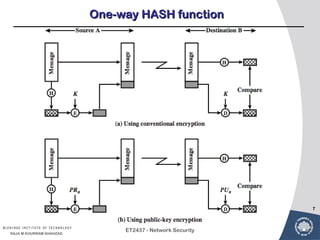
One-way HASH function


                                                          7


                              ET2437 - Network Security
RAJA M KHURRAM SHAHZAD
One-way HASH function cont.

  •    Secret value (known to sender and receiver both) is added before
       calculating the hash and removed before transmission.


  •    Variation of this technique is HMAC
                                                                          8


                                 ET2437 - Network Security
RAJA M KHURRAM SHAHZAD
Secure HASH Functions

  •    Purpose of the one-way or secure HASH function is to produce a
       ”fingerprint” of a file, message or block of data

  •    Properties of a HASH function H :
         § H can be applied to a block of data at any size
         § H produces a fixed length output
         § H(x) is easy to compute for any given x.
         § For any given value h, it is computationally in-feasible to find x such
           that H(x) = h  one-way property / pre-image resistant
         § For any given block x, it is computationally infeasible to find
           y ≠ x with H(y) = H(x)  weak collision resistance
         § It is computationally infeasible to find any pair (x, y) such that
           H(x) = H(y)      strong collision resistance
                                                                                     9


                                    ET2437 - Network Security
RAJA M KHURRAM SHAHZAD
Block cipher VS Hash function

  •    Block cipher – symmetric encryption method:
          input: blocks of plain-text of a fixed length
          output: blocks of cipher-text of the same length


  •    Hash function – both symmetric and asymmetric encryption method
          input: binary string of arbitrary length
          output: string of some fixed length


                                                                         10


                                    ET2437 - Network Security
RAJA M KHURRAM SHAHZAD
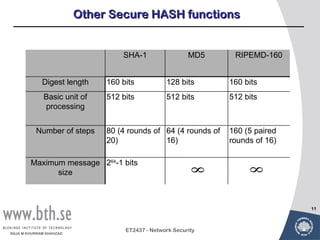
Other Secure HASH functions


                                  SHA-1                  MD5     RIPEMD-160


             Digest length    160 bits           128 bits       160 bits
              Basic unit of   512 bits           512 bits       512 bits
              processing


          Number of steps     80 (4 rounds of 64 (4 rounds of   160 (5 paired
                              20)             16)               rounds of 16)

        Maximum message 264-1 bits
              size


                                                                                11


                                   ET2437 - Network Security
RAJA M KHURRAM SHAHZAD
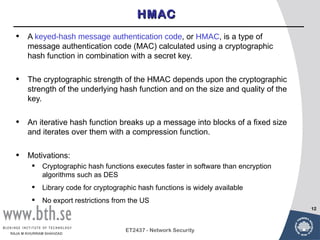
HMAC
  •    A keyed-hash message authentication code, or HMAC, is a type of
       message authentication code (MAC) calculated using a cryptographic
       hash function in combination with a secret key.


  •    The cryptographic strength of the HMAC depends upon the cryptographic
       strength of the underlying hash function and on the size and quality of the
       key.


  •    An iterative hash function breaks up a message into blocks of a fixed size
       and iterates over them with a compression function.


  •    Motivations:
            Cryptographic hash functions executes faster in software than encryption
             algorithms such as DES
            Library code for cryptographic hash functions is widely available
            No export restrictions from the US
                                                                                        12


                                       ET2437 - Network Security
RAJA M KHURRAM SHAHZAD
HMAC

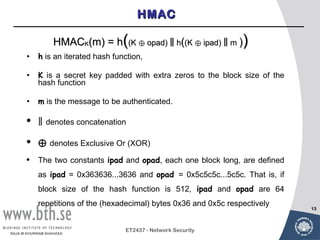
                  HMACK(m) = h((K ⊕ opad) ‖ h((K ⊕ ipad) ‖ m ))
      •    h is an iterated hash function,

      •    K is a secret key padded with extra zeros to the block size of the
           hash function

      •    m is the message to be authenticated.

      •    ‖ denotes concatenation

      •    ⊕ denotes Exclusive Or (XOR)
      •    The two constants ipad and opad, each one block long, are defined
           as ipad = 0x363636...3636 and opad = 0x5c5c5c...5c5c. That is, if
           block size of the hash function is 512, ipad and opad are 64
           repetitions of the (hexadecimal) bytes 0x36 and 0x5c respectively
                                                                                13


                                    ET2437 - Network Security
RAJA M KHURRAM SHAHZAD
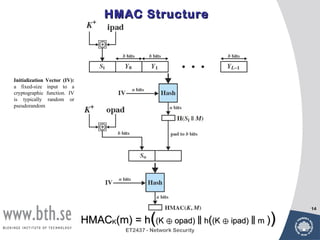
HMAC Structure


Initialization Vector (IV):
a fixed-size input to a
cryptographic function. IV
is typically random or
pseudorandom


                                                                              14

                              HMACK(m) = h((K ⊕ opad) ‖ h((K ⊕ ipad) ‖ m ))
                                        ET2437 - Network Security
Public Key / Asymmetric Encryption

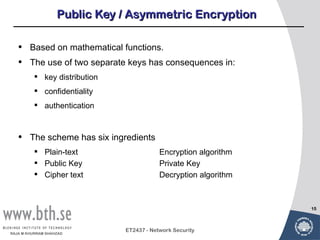
   •    Based on mathematical functions.
   •    The use of two separate keys has consequences in:
           key distribution
           confidentiality
           authentication


   •    The scheme has six ingredients
           Plain-text                     Encryption algorithm
           Public Key                     Private Key
           Cipher text                    Decryption algorithm


                                                                  15


                               ET2437 - Network Security
RAJA M KHURRAM SHAHZAD
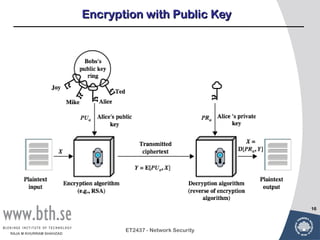
Encryption with Public Key


                                                            16


                                ET2437 - Network Security
RAJA M KHURRAM SHAHZAD
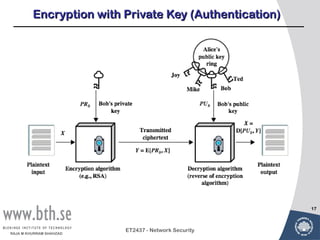
Encryption with Private Key (Authentication)


                                                        17


                         ET2437 - Network Security
RAJA M KHURRAM SHAHZAD
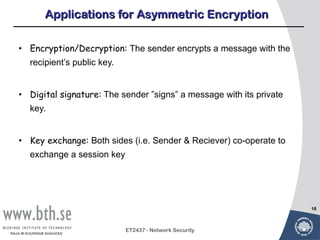
Applications for Asymmetric Encryption

   •    Encryption/Decryption: The sender encrypts a message with the
        recipient’s public key.


   •    Digital signature: The sender ”signs” a message with its private
        key.


   •    Key exchange: Both sides (i.e. Sender & Reciever) co-operate to
        exchange a session key


                                                                           18


                                  ET2437 - Network Security
RAJA M KHURRAM SHAHZAD
Requirements for Asymmetric Encryption

 1. Computationally easy for a party B to generate a pair (PUblic key
    PUb, PRivate key PRb)
 2. Easy for sender to generate cipher-text: C = E(Pub, M)
 3. Easy for the receiver to decrypt cipher-text using private key:
               M = D(PRb, C) = D[PRb, E(PUb, M)]

 5. Computationally in-feasible to determine Private Key (PRb) knowing
      Public Key (PUb)

 6. Computationally infeasible to recover message M, knowing PUb and
      cipher-text C
 7. Either of the two related keys can be used for encryption, with the
    other used for decryption:
                                                                          19
                         M = D[PUb, E(PRb,M) = D[PRb, E(PUb,M)]
                                  ET2437 - Network Security
RAJA M KHURRAM SHAHZAD
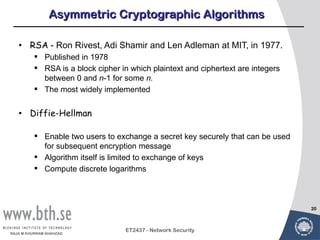
Asymmetric Cryptographic Algorithms

   •    RSA - Ron Rivest, Adi Shamir and Len Adleman at MIT, in 1977.
           Published in 1978
           RSA is a block cipher in which plaintext and ciphertext are integers
            between 0 and n-1 for some n.
           The most widely implemented


   •    Diffie-Hellman

           Enable two users to exchange a secret key securely that can be used
            for subsequent encryption message
           Algorithm itself is limited to exchange of keys
           Compute discrete logarithms


                                                                                   20


                                    ET2437 - Network Security
RAJA M KHURRAM SHAHZAD
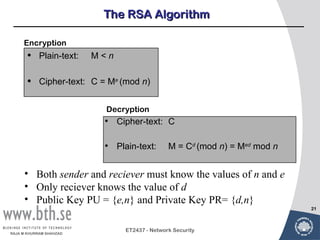
The RSA Algorithm

     Encryption
       •    Plain-text:   M<n

       •    Cipher-text: C = Me (mod n)


                            Decryption
                           • Cipher-text: C

                           • Plain-text:        M = Cd (mod n) = Med mod n


     • Both sender and reciever must know the values of n and e
     • Only reciever knows the value of d
     • Public Key PU = {e,n} and Private Key PR= {d,n}
                                                                             21


                                 ET2437 - Network Security
RAJA M KHURRAM SHAHZAD
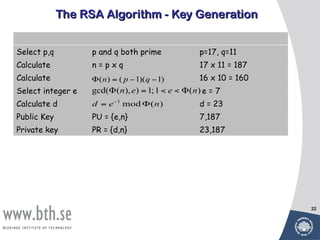
The RSA Algorithm - Key Generation


Select p,q         p and q both prime   p=17, q=11
Calculate          n=pxq                17 x 11 = 187
Calculate                               16 x 10 = 160
Select integer e                        e=7
Calculate d                             d = 23
Public Key         PU = {e,n}           7,187
Private key        PR = {d,n}           23,187


                                                        22
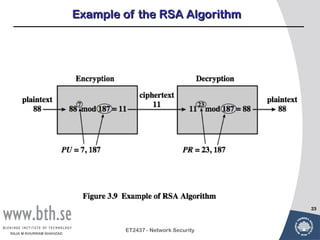
Example of the RSA Algorithm


                                                             23


                                 ET2437 - Network Security
RAJA M KHURRAM SHAHZAD
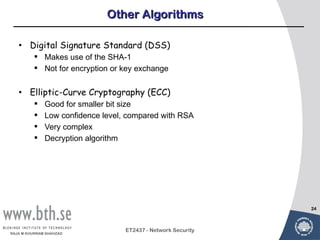
Other Algorithms

   •    Digital Signature Standard (DSS)
           Makes use of the SHA-1
           Not for encryption or key exchange


   •    Elliptic-Curve Cryptography (ECC)
             Good for smaller bit size
             Low confidence level, compared with RSA
             Very complex
             Decryption algorithm


                                                               24


                                   ET2437 - Network Security
RAJA M KHURRAM SHAHZAD
25


                         ET2437 - Network Security
RAJA M KHURRAM SHAHZAD

Lecture 3b public key_encryption

  • 1.
    Public-Key Cryptography & Message Authentication
  • 2.
    Authentication • Requirements - must be able to verify that:  Message came from apparent source or author Authentic  Contents have not been altered message  Sometimes, it was sent at a certain time or sequence • Protection against active attack (falsification of data and transactions) 2 ET2437 - Network Security RAJA M KHURRAM SHAHZAD
  • 3.
    Approaches to MessageAuthentication • Authentication Using Conventional Encryption  Only the sender and receiver should share a key • Message Authentication without Message Encryption  An authentication tag is generated and appended to each message • Message Authentication Code - MAC  The use of secret key to generate a small block of data, MAC Or  Calculate the MAC as a function of the message and the key.  MAC = F(K, M) 3 ET2437 - Network Security RAJA M KHURRAM SHAHZAD
  • 4.
    Message Authentication Code • Need not to be reversible • A & B Share a common secret key KAB • A send message to B  A calculates message authentication code as a function of the message and the key.  MACM1 = F(KAB, M)  The message + MAC are transmitted to B.  B performs the same calculation on the recieved message, using same KAB  MACM2 = F(KAB, M)  If MACM1 = F(KAB, M) = MACM2 = F(KAB, M) – Message has not been altered – From intended sender 4 – Addition of sequence number, give more surity
  • 5.
    Message Authentication withMAC 5 ET2437 - Network Security RAJA M KHURRAM SHAHZAD
  • 6.
    One-way HASH function • Alternative to MAC • Input: A variable size message • Output: Fixed size message digest H(M) • No secret Key • Message digest is sent with message in such a way that message digest is authentic  Using conventional encryption  Using Public-Key encryption  Using Secret Value 6
  • 7.
    One-way HASH function 7 ET2437 - Network Security RAJA M KHURRAM SHAHZAD
  • 8.
    One-way HASH functioncont. • Secret value (known to sender and receiver both) is added before calculating the hash and removed before transmission. • Variation of this technique is HMAC 8 ET2437 - Network Security RAJA M KHURRAM SHAHZAD
  • 9.
    Secure HASH Functions • Purpose of the one-way or secure HASH function is to produce a ”fingerprint” of a file, message or block of data • Properties of a HASH function H : § H can be applied to a block of data at any size § H produces a fixed length output § H(x) is easy to compute for any given x. § For any given value h, it is computationally in-feasible to find x such that H(x) = h  one-way property / pre-image resistant § For any given block x, it is computationally infeasible to find y ≠ x with H(y) = H(x)  weak collision resistance § It is computationally infeasible to find any pair (x, y) such that H(x) = H(y)  strong collision resistance 9 ET2437 - Network Security RAJA M KHURRAM SHAHZAD
  • 10.
    Block cipher VSHash function • Block cipher – symmetric encryption method:  input: blocks of plain-text of a fixed length  output: blocks of cipher-text of the same length • Hash function – both symmetric and asymmetric encryption method  input: binary string of arbitrary length  output: string of some fixed length 10 ET2437 - Network Security RAJA M KHURRAM SHAHZAD
  • 11.
    Other Secure HASHfunctions SHA-1 MD5 RIPEMD-160 Digest length 160 bits 128 bits 160 bits Basic unit of 512 bits 512 bits 512 bits processing Number of steps 80 (4 rounds of 64 (4 rounds of 160 (5 paired 20) 16) rounds of 16) Maximum message 264-1 bits size 11 ET2437 - Network Security RAJA M KHURRAM SHAHZAD
  • 12.
    HMAC • A keyed-hash message authentication code, or HMAC, is a type of message authentication code (MAC) calculated using a cryptographic hash function in combination with a secret key. • The cryptographic strength of the HMAC depends upon the cryptographic strength of the underlying hash function and on the size and quality of the key. • An iterative hash function breaks up a message into blocks of a fixed size and iterates over them with a compression function. • Motivations:  Cryptographic hash functions executes faster in software than encryption algorithms such as DES  Library code for cryptographic hash functions is widely available  No export restrictions from the US 12 ET2437 - Network Security RAJA M KHURRAM SHAHZAD
  • 13.
    HMAC HMACK(m) = h((K ⊕ opad) ‖ h((K ⊕ ipad) ‖ m )) • h is an iterated hash function, • K is a secret key padded with extra zeros to the block size of the hash function • m is the message to be authenticated. • ‖ denotes concatenation • ⊕ denotes Exclusive Or (XOR) • The two constants ipad and opad, each one block long, are defined as ipad = 0x363636...3636 and opad = 0x5c5c5c...5c5c. That is, if block size of the hash function is 512, ipad and opad are 64 repetitions of the (hexadecimal) bytes 0x36 and 0x5c respectively 13 ET2437 - Network Security RAJA M KHURRAM SHAHZAD
  • 14.
    HMAC Structure Initialization Vector(IV): a fixed-size input to a cryptographic function. IV is typically random or pseudorandom 14 HMACK(m) = h((K ⊕ opad) ‖ h((K ⊕ ipad) ‖ m )) ET2437 - Network Security
  • 15.
    Public Key /Asymmetric Encryption • Based on mathematical functions. • The use of two separate keys has consequences in:  key distribution  confidentiality  authentication • The scheme has six ingredients  Plain-text Encryption algorithm  Public Key Private Key  Cipher text Decryption algorithm 15 ET2437 - Network Security RAJA M KHURRAM SHAHZAD
  • 16.
    Encryption with PublicKey 16 ET2437 - Network Security RAJA M KHURRAM SHAHZAD
  • 17.
    Encryption with PrivateKey (Authentication) 17 ET2437 - Network Security RAJA M KHURRAM SHAHZAD
  • 18.
    Applications for AsymmetricEncryption • Encryption/Decryption: The sender encrypts a message with the recipient’s public key. • Digital signature: The sender ”signs” a message with its private key. • Key exchange: Both sides (i.e. Sender & Reciever) co-operate to exchange a session key 18 ET2437 - Network Security RAJA M KHURRAM SHAHZAD
  • 19.
    Requirements for AsymmetricEncryption 1. Computationally easy for a party B to generate a pair (PUblic key PUb, PRivate key PRb) 2. Easy for sender to generate cipher-text: C = E(Pub, M) 3. Easy for the receiver to decrypt cipher-text using private key: M = D(PRb, C) = D[PRb, E(PUb, M)] 5. Computationally in-feasible to determine Private Key (PRb) knowing Public Key (PUb) 6. Computationally infeasible to recover message M, knowing PUb and cipher-text C 7. Either of the two related keys can be used for encryption, with the other used for decryption: 19 M = D[PUb, E(PRb,M) = D[PRb, E(PUb,M)] ET2437 - Network Security RAJA M KHURRAM SHAHZAD
  • 20.
    Asymmetric Cryptographic Algorithms • RSA - Ron Rivest, Adi Shamir and Len Adleman at MIT, in 1977.  Published in 1978  RSA is a block cipher in which plaintext and ciphertext are integers between 0 and n-1 for some n.  The most widely implemented • Diffie-Hellman  Enable two users to exchange a secret key securely that can be used for subsequent encryption message  Algorithm itself is limited to exchange of keys  Compute discrete logarithms 20 ET2437 - Network Security RAJA M KHURRAM SHAHZAD
  • 21.
    The RSA Algorithm Encryption • Plain-text: M<n • Cipher-text: C = Me (mod n) Decryption • Cipher-text: C • Plain-text: M = Cd (mod n) = Med mod n • Both sender and reciever must know the values of n and e • Only reciever knows the value of d • Public Key PU = {e,n} and Private Key PR= {d,n} 21 ET2437 - Network Security RAJA M KHURRAM SHAHZAD
  • 22.
    The RSA Algorithm- Key Generation Select p,q p and q both prime p=17, q=11 Calculate n=pxq 17 x 11 = 187 Calculate 16 x 10 = 160 Select integer e e=7 Calculate d d = 23 Public Key PU = {e,n} 7,187 Private key PR = {d,n} 23,187 22
  • 23.
    Example of theRSA Algorithm 23 ET2437 - Network Security RAJA M KHURRAM SHAHZAD
  • 24.
    Other Algorithms • Digital Signature Standard (DSS)  Makes use of the SHA-1  Not for encryption or key exchange • Elliptic-Curve Cryptography (ECC)  Good for smaller bit size  Low confidence level, compared with RSA  Very complex  Decryption algorithm 24 ET2437 - Network Security RAJA M KHURRAM SHAHZAD
  • 25.
    25 ET2437 - Network Security RAJA M KHURRAM SHAHZAD