Double Ratchet Algorithm
IIIT Lucknow
Submitted by: Akash Papnai
Submitted to: Dr. Dhananjoy Dey
<date/time> <footer> 2
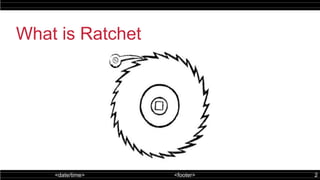
What is Ratchet
<date/time> <footer> 3
Introduction
 The Double Ratchet algorithm is used by two parties to exchange encrypted
messages based on a shared secret key. Typically the parties will use some key
agreement protocol (such as X3DH) to agree on the shared secret key. Following
this, the parties will use the Double Ratchet to send and receive encrypted
messages.
 The parties derive new keys for every Double Ratchet message so that earlier keys
cannot be calculated from later ones. The parties also send Diffie-Hellman public
values attached to their messages. The results of Diffie-Hellman calculations are
mixed into the derived keys so that later keys cannot be calculated from earlier ones.
These properties gives some protection to earlier or later encrypted messages in
case of a compromise of a party's keys.
<date/time> <footer> 4
KDF Chain
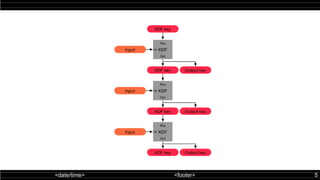
 We define a KDF as a cryptographic function that takes a secret and
random KDF key and some input data and returns output data.
 We use the term KDF chain when some of the output from a KDF is used
as an output key and some is used to replace the KDF key, which can
then be used with another input.
<date/time> <footer> 5
<date/time> <footer> 6
Properties of KDF Chain
 Resilience
 Forward Security
 Break-in Recovery
<date/time> <footer> 7
Symmetric-key Ratchet
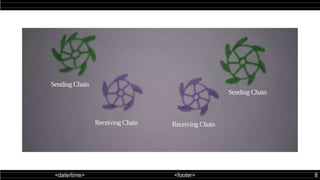
 The sending and receiving chains advance as each message is sent and
received. Their output keys are used to encrypt and decrypt messages.
This is called the symmetric-key ratchet
 The KDF inputs for the sending and receiving chains are constant, so
these chains don't provide break-in recovery.
 Calculating the next chain key and message key from a given chain key
is a single ratchet step in the symmetric-key ratchet.
<date/time> <footer> 8
<date/time> <footer> 9
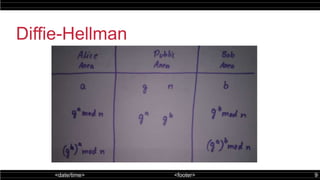
Diffie-Hellman
<date/time> <footer> 10
Double Ratchet
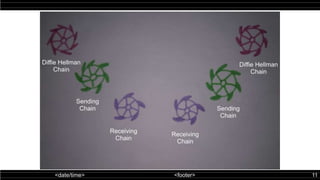
 Combining the symmetric-key and DH ratchets gives the Double Ratchet.
 When a message is sent or received, a symmetric-key ratchet step is applied to
the sending or receiving chain to derive the message key.
 When a new ratchet public key is received, a DH ratchet step is performed prior
to the symmetric-key ratchet to replace the chain keys.
<date/time> <footer> 11
<date/time> <footer> 12
Thank you

The Double Ratchet Algorithm

  • 1.
    Double Ratchet Algorithm IIITLucknow Submitted by: Akash Papnai Submitted to: Dr. Dhananjoy Dey
  • 2.
  • 3.
    <date/time> <footer> 3 Introduction The Double Ratchet algorithm is used by two parties to exchange encrypted messages based on a shared secret key. Typically the parties will use some key agreement protocol (such as X3DH) to agree on the shared secret key. Following this, the parties will use the Double Ratchet to send and receive encrypted messages.  The parties derive new keys for every Double Ratchet message so that earlier keys cannot be calculated from later ones. The parties also send Diffie-Hellman public values attached to their messages. The results of Diffie-Hellman calculations are mixed into the derived keys so that later keys cannot be calculated from earlier ones. These properties gives some protection to earlier or later encrypted messages in case of a compromise of a party's keys.
  • 4.
    <date/time> <footer> 4 KDFChain  We define a KDF as a cryptographic function that takes a secret and random KDF key and some input data and returns output data.  We use the term KDF chain when some of the output from a KDF is used as an output key and some is used to replace the KDF key, which can then be used with another input.
  • 5.
  • 6.
    <date/time> <footer> 6 Propertiesof KDF Chain  Resilience  Forward Security  Break-in Recovery
  • 7.
    <date/time> <footer> 7 Symmetric-keyRatchet  The sending and receiving chains advance as each message is sent and received. Their output keys are used to encrypt and decrypt messages. This is called the symmetric-key ratchet  The KDF inputs for the sending and receiving chains are constant, so these chains don't provide break-in recovery.  Calculating the next chain key and message key from a given chain key is a single ratchet step in the symmetric-key ratchet.
  • 8.
  • 9.
  • 10.
    <date/time> <footer> 10 DoubleRatchet  Combining the symmetric-key and DH ratchets gives the Double Ratchet.  When a message is sent or received, a symmetric-key ratchet step is applied to the sending or receiving chain to derive the message key.  When a new ratchet public key is received, a DH ratchet step is performed prior to the symmetric-key ratchet to replace the chain keys.
  • 11.
  • 12.