Formal Versus Informal Logic
Deductive Versus Inductive
Forms of Reasoning
Two basic categories
of human reasoning
• Deduction: reasoning from general premises, which are
known or presumed to be known, to more specific, certain
conclusions.
• Induction: reasoning from specific cases to more general,
but uncertain, conclusions.
• Both deductive and inductive arguments occur frequently
and naturally…both forms of reasoning can be equally
compelling and persuasive, and neither form is preferred
over the other (Hollihan & Baske, 1994).
Deduction Vs. Induction
Deduction:
• commonly associated
with “formal logic.”
• involves reasoning
from known premises,
or premises presumed
to be true, to a certain
conclusion.
• the conclusions
reached are certain,
inevitable,
inescapable.
Induction
• commonly known as
“informal logic,” or
“everyday argument”
• involves drawing
uncertain inferences,
based on probabalistic
reasoning.
• the conclusions
reached are probable,
reasonable, plausible,
believable.
Deductive Versus
Inductive Reasoning
Deduction
• It is the form or structure
of a deductive argument
that determines its validity
• the fundamental property
of a valid, deductive
argument is that if the
premises are true, then
the conclusion necessarily
follows.
• The conclusion is said to
be “entailed” in, or
contained in, the premises.
– example: use of DNA
testing to establish
paternity
Induction
• By contrast, the form or
structure of an inductive
argument has little to do with
its perceived believability or
credibility, apart from making
the argument seem more
clear or more well-organized.
• The receiver (or a 3rd party)
determines the worth of an
inductive argument
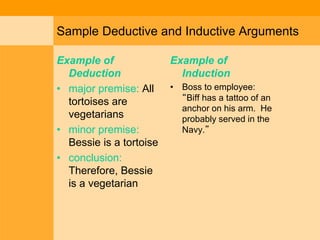
Sample Deductive and Inductive Arguments
Example of
Deduction
• major premise: All
tortoises are
vegetarians
• minor premise:
Bessie is a tortoise
• conclusion:
Therefore, Bessie
is a vegetarian
Example of
Induction
• Boss to employee:
“Biff has a tattoo of an
anchor on his arm. He
probably served in the
Navy.”
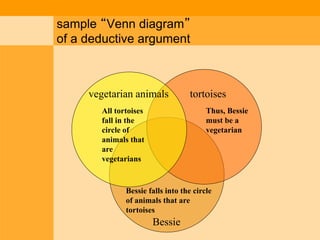
Bessie
tortoises
vegetarian animals
sample “Venn diagram”
of a deductive argument
All tortoises
fall in the
circle of
animals that
are
vegetarians
Bessie falls into the circle
of animals that are
tortoises
Thus, Bessie
must be a
vegetarian
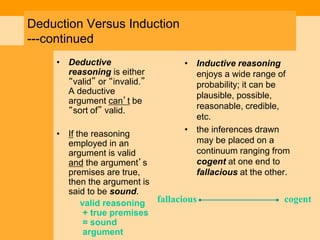
Deduction Versus Induction
---continued
• Deductive
reasoning is either
“valid” or “invalid.”
A deductive
argument can’t be
“sort of” valid.
• If the reasoning
employed in an
argument is valid
and the argument’s
premises are true,
then the argument is
said to be sound.
valid reasoning
+ true premises
= sound
argument
• Inductive reasoning
enjoys a wide range of
probability; it can be
plausible, possible,
reasonable, credible,
etc.
• the inferences drawn
may be placed on a
continuum ranging from
cogent at one end to
fallacious at the other.
fallacious cogent
Deduction Versus Induction
--still more
• Deductive reasoning is
commonly found in the
natural sciences or
“hard” sciences, less so
in everyday arguments
• Occasionally, everyday
arguments do involve
deductive reasoning:
Example: “Two or more
persons are required to
drive in the diamond
lane. You don’t have
two or more persons.
Therefore you may not
drive in the diamond
lane”
• Inductive reasoning is
found in the courtroom,
the boardroom, the
classroom, and
throughout the media
• Most, but not all everyday
arguments are based on
induction
– Examples: The
“reasonable person”
standard in civil law, and
the “beyond a
reasonable doubt”
standard in criminal law

APReasoning.ppt

  • 1.
    Formal Versus InformalLogic Deductive Versus Inductive Forms of Reasoning
  • 2.
    Two basic categories ofhuman reasoning • Deduction: reasoning from general premises, which are known or presumed to be known, to more specific, certain conclusions. • Induction: reasoning from specific cases to more general, but uncertain, conclusions. • Both deductive and inductive arguments occur frequently and naturally…both forms of reasoning can be equally compelling and persuasive, and neither form is preferred over the other (Hollihan & Baske, 1994).
  • 3.
    Deduction Vs. Induction Deduction: •commonly associated with “formal logic.” • involves reasoning from known premises, or premises presumed to be true, to a certain conclusion. • the conclusions reached are certain, inevitable, inescapable. Induction • commonly known as “informal logic,” or “everyday argument” • involves drawing uncertain inferences, based on probabalistic reasoning. • the conclusions reached are probable, reasonable, plausible, believable.
  • 4.
    Deductive Versus Inductive Reasoning Deduction •It is the form or structure of a deductive argument that determines its validity • the fundamental property of a valid, deductive argument is that if the premises are true, then the conclusion necessarily follows. • The conclusion is said to be “entailed” in, or contained in, the premises. – example: use of DNA testing to establish paternity Induction • By contrast, the form or structure of an inductive argument has little to do with its perceived believability or credibility, apart from making the argument seem more clear or more well-organized. • The receiver (or a 3rd party) determines the worth of an inductive argument
  • 5.
    Sample Deductive andInductive Arguments Example of Deduction • major premise: All tortoises are vegetarians • minor premise: Bessie is a tortoise • conclusion: Therefore, Bessie is a vegetarian Example of Induction • Boss to employee: “Biff has a tattoo of an anchor on his arm. He probably served in the Navy.”
  • 6.
    Bessie tortoises vegetarian animals sample “Venndiagram” of a deductive argument All tortoises fall in the circle of animals that are vegetarians Bessie falls into the circle of animals that are tortoises Thus, Bessie must be a vegetarian
  • 7.
    Deduction Versus Induction ---continued •Deductive reasoning is either “valid” or “invalid.” A deductive argument can’t be “sort of” valid. • If the reasoning employed in an argument is valid and the argument’s premises are true, then the argument is said to be sound. valid reasoning + true premises = sound argument • Inductive reasoning enjoys a wide range of probability; it can be plausible, possible, reasonable, credible, etc. • the inferences drawn may be placed on a continuum ranging from cogent at one end to fallacious at the other. fallacious cogent
  • 8.
    Deduction Versus Induction --stillmore • Deductive reasoning is commonly found in the natural sciences or “hard” sciences, less so in everyday arguments • Occasionally, everyday arguments do involve deductive reasoning: Example: “Two or more persons are required to drive in the diamond lane. You don’t have two or more persons. Therefore you may not drive in the diamond lane” • Inductive reasoning is found in the courtroom, the boardroom, the classroom, and throughout the media • Most, but not all everyday arguments are based on induction – Examples: The “reasonable person” standard in civil law, and the “beyond a reasonable doubt” standard in criminal law