Wallaga University
College of Computational and Natural Science
Department of Statistics
Research Proposal
Title: Effectiveness of Computer Literacy in Teaching and Learning
Process: A Case Study of Wallaga University (College of Natural and
Computational Science Students)
Prepared by: Lensa Habtamu Mitiku
ID:1405862
Advisor: Ararso Shifara (MSc.)
January, 2025 G.C
Nekemte Oromia, Ethiopia
Acknowledgment
I want to express my deepest gratitude to Mr. Ararso Shifara (MSc) for his invaluable support
and guidance throughout the development of this research proposal. His insightful feedback,
encouragement, and expertise have been instrumental in shaping the direction and quality of this
work. I am truly grateful for his mentorship and for dedicating his time and effort to ensure the
success of this proposal. His unwavering support has motivated me, and I deeply appreciate his
contributions to this academic endeavor.
i | P a g e
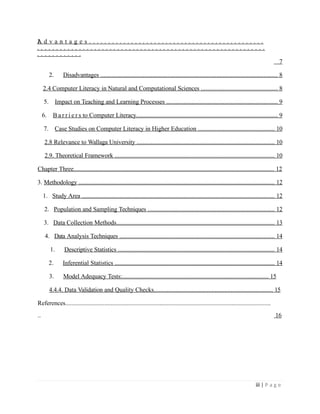
Table of Content
Contents Page
Acknowledgment ............................................................................................................................. i
Table of Content.............................................................................................................................. ii
List of Tables.................................................................................................................................. iv
Abstract ...........................................................................................................................................
v
Chapter One .................................................................................................................................... 1
1. Introduction................................................................................................................................. 1
1. Background ........................................................................................................................... 1
2. Statement of the Problem ...................................................................................................... 3
3. Objectives of the Study ......................................................................................................... 4
1. General Objective ........................................................................................................... 4
2. Specific Objectives ......................................................................................................... 4
4. Significance of the Study ...................................................................................................... 4
5. Scope of the Study................................................................................................................. 4
Chapter 2 .........................................................................................................................................
6
2. Review of Literature ................................................................................................................... 6
2.1. Introduction to Computer Literacy in Education ................................................................. 6
2. Use of Computers in Education ............................................................................................ 6
1. Digital Learning Tools and Resources............................................................................ 6
2. Online Learning and Distance Education ....................................................................... 7
3. Collaborative Tools and Communication ....................................................................... 7
4. Assessment and Feedback .............................................................................................. 7
5. Preparing Students for the Workforce ............................................................................ 7
3. Advantages and Disadvantages of Computers in Education ................................................. 7
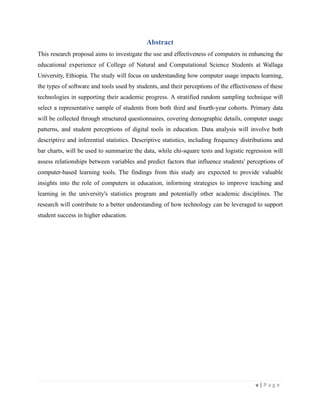
ii | P a g e
1.
A d v a n t a g e s . . . . . . . . . . . . . . . . . . . . . . . . . . . . . . . . . . . . . . . . . . . . . .
. . . . . . . . . . . . . . . . . . . . . . . . . . . . . . . . . . . . . . . . . . . . . . . . . . . . . . . . . . . .
. . . . . . . . . . . .
7
2. Disadvantages ................................................................................................................. 8
2.4 Computer Literacy in Natural and Computational Sciences ................................................. 8
5. Impact on Teaching and Learning Processes ....................................................................... 9
6. B a r r i e r s to Computer Literacy.............................................................................................. 9
7. Case Studies on Computer Literacy in Higher Education ................................................. 10
2.8 Relevance to Wallaga University ........................................................................................ 10
2.9. Theoretical Framework ...................................................................................................... 10
Chapter Three................................................................................................................................ 12
3. Methodology ............................................................................................................................. 12
1. Study Area ........................................................................................................................... 12
2. Population and Sampling Techniques ................................................................................. 12
3. Data Collection Methods..................................................................................................... 13
4. Data Analysis Techniques ................................................................................................... 14
1. Descriptive Statistics .................................................................................................... 14
2. Inferential Statistics ...................................................................................................... 14
3. Model Adequacy Tests:................................................................................................. 15
4.4.4. Data Validation and Quality Checks............................................................................ 15
References...................................................................................................................................
.. 16
iii | P a g e
List of Tables
Table 1: Population and Sample Size............................................................................................ 13
iv | P a g e
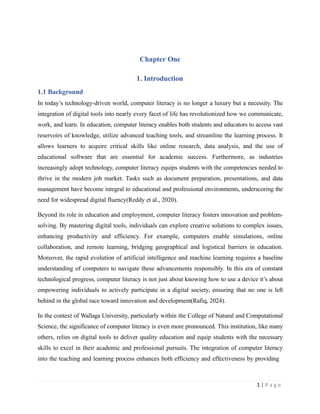
Abstract
This research proposal aims to investigate the use and effectiveness of computers in enhancing the
educational experience of College of Natural and Computational Science Students at Wallaga
University, Ethiopia. The study will focus on understanding how computer usage impacts learning,
the types of software and tools used by students, and their perceptions of the effectiveness of these
technologies in supporting their academic progress. A stratified random sampling technique will
select a representative sample of students from both third and fourth-year cohorts. Primary data
will be collected through structured questionnaires, covering demographic details, computer usage
patterns, and student perceptions of digital tools in education. Data analysis will involve both
descriptive and inferential statistics. Descriptive statistics, including frequency distributions and
bar charts, will be used to summarize the data, while chi-square tests and logistic regression will
assess relationships between variables and predict factors that influence students' perceptions of
computer-based learning tools. The findings from this study are expected to provide valuable
insights into the role of computers in education, informing strategies to improve teaching and
learning in the university's statistics program and potentially other academic disciplines. The
research will contribute to a better understanding of how technology can be leveraged to support
student success in higher education.
v | P a g e
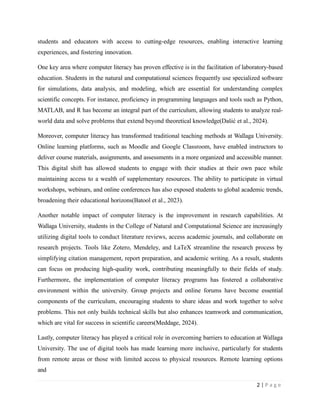
Chapter One
1. Introduction
1.1 Background
In today’s technology-driven world, computer literacy is no longer a luxury but a necessity. The
integration of digital tools into nearly every facet of life has revolutionized how we communicate,
work, and learn. In education, computer literacy enables both students and educators to access vast
reservoirs of knowledge, utilize advanced teaching tools, and streamline the learning process. It
allows learners to acquire critical skills like online research, data analysis, and the use of
educational software that are essential for academic success. Furthermore, as industries
increasingly adopt technology, computer literacy equips students with the competencies needed to
thrive in the modern job market. Tasks such as document preparation, presentations, and data
management have become integral to educational and professional environments, underscoring the
need for widespread digital fluency(Reddy et al., 2020).
Beyond its role in education and employment, computer literacy fosters innovation and problem-
solving. By mastering digital tools, individuals can explore creative solutions to complex issues,
enhancing productivity and efficiency. For example, computers enable simulations, online
collaboration, and remote learning, bridging geographical and logistical barriers in education.
Moreover, the rapid evolution of artificial intelligence and machine learning requires a baseline
understanding of computers to navigate these advancements responsibly. In this era of constant
technological progress, computer literacy is not just about knowing how to use a device it’s about
empowering individuals to actively participate in a digital society, ensuring that no one is left
behind in the global race toward innovation and development(Rafiq, 2024).
In the context of Wallaga University, particularly within the College of Natural and Computational
Science, the significance of computer literacy is even more pronounced. This institution, like many
others, relies on digital tools to deliver quality education and equip students with the necessary
skills to excel in their academic and professional pursuits. The integration of computer literacy
into the teaching and learning process enhances both efficiency and effectiveness by providing
1 | P a g e
students and educators with access to cutting-edge resources, enabling interactive learning
experiences, and fostering innovation.
One key area where computer literacy has proven effective is in the facilitation of laboratory-based
education. Students in the natural and computational sciences frequently use specialized software
for simulations, data analysis, and modeling, which are essential for understanding complex
scientific concepts. For instance, proficiency in programming languages and tools such as Python,
MATLAB, and R has become an integral part of the curriculum, allowing students to analyze real-
world data and solve problems that extend beyond theoretical knowledge(Dašić et al., 2024).
Moreover, computer literacy has transformed traditional teaching methods at Wallaga University.
Online learning platforms, such as Moodle and Google Classroom, have enabled instructors to
deliver course materials, assignments, and assessments in a more organized and accessible manner.
This digital shift has allowed students to engage with their studies at their own pace while
maintaining access to a wealth of supplementary resources. The ability to participate in virtual
workshops, webinars, and online conferences has also exposed students to global academic trends,
broadening their educational horizons(Batool et al., 2023).
Another notable impact of computer literacy is the improvement in research capabilities. At
Wallaga University, students in the College of Natural and Computational Science are increasingly
utilizing digital tools to conduct literature reviews, access academic journals, and collaborate on
research projects. Tools like Zotero, Mendeley, and LaTeX streamline the research process by
simplifying citation management, report preparation, and academic writing. As a result, students
can focus on producing high-quality work, contributing meaningfully to their fields of study.
Furthermore, the implementation of computer literacy programs has fostered a collaborative
environment within the university. Group projects and online forums have become essential
components of the curriculum, encouraging students to share ideas and work together to solve
problems. This not only builds technical skills but also enhances teamwork and communication,
which are vital for success in scientific careers(Meddage, 2024).
Lastly, computer literacy has played a critical role in overcoming barriers to education at Wallaga
University. The use of digital tools has made learning more inclusive, particularly for students
from remote areas or those with limited access to physical resources. Remote learning options
and
2 | P a g e
online libraries have bridged the gap, ensuring that all students, regardless of their location or
circumstances, have the opportunity to excel academically.
1.2 Statement of the Problem
In today’s rapidly evolving technological era, computer literacy has become a critical skill for
academic success and professional growth. Despite its significance, there remains a gap in its
effective integration into the teaching and learning processes, particularly in higher education
institutions. At Wallaga University, challenges such as limited access to resources, insufficient
training, and varying levels of proficiency among students hinder the effective utilization of
computers in education. These challenges are especially pronounced among College of Natural
and Computational Science Students, who are expected to engage in more advanced coursework,
research, and project-based learning that heavily relies on digital tools and computer skills(Thelma
et al., 2024).
The lack of consistent and effective computer literacy impacts not only the quality of education
but also students' preparedness for the technology-driven job market. Among College of Natural
and Computational Science Students, this gap becomes more critical and transition into
professional roles or higher education, where advanced computer skills are essential for success.
Without adequate computer proficiency, these students may struggle to access information, utilize
modern software for analysis, or develop the critical problem-solving abilities necessary for their
academic and professional futures. This study seeks to address these gaps by evaluating the
effectiveness of computer literacy in the teaching and learning processes at Wallaga University,
focusing on College of Natural and Computational Science Students, to identify specific
challenges and propose targeted strategies for improvement.
Despite the increasing availability of technology, gaps persist in its effective use in education. This
study seeks to address key questions:
 What percentage of the student population possesses computer skills?
 How do computers contribute to teaching and learning processes?
 What challenges hinder the integration of computers into education?
 Which fields benefit most from computer literacy?
3 | P a g e
3. Objectives of the Study
1. General Objective
To evaluate the effectiveness of computer literacy in enhancing the teaching and learning processes
for College of Natural and Computational Science Students at Wallaga University.
2. Specific Objectives
 To assess the current level of computer literacy among College of Natural and
Computational Science Students.
 To identify how computer skills are utilized in coursework, research, and project-based
activities.
 To evaluate the impact of computer literacy on academic performance and learning
outcomes.
 To determine the challenges faced by College of Natural and Computational Science
Students in accessing and using computers effectively.
 To explore the role of computer literacy in preparing students for the technology-driven
job market.
 To propose strategies to improve computer literacy and integrate it more effectively into
the curriculum for advanced students.
4. Significance of the Study
The study highlights the transformative impact of computer literacy on education. It aims to:
 Motivate effective computer usage in teaching and learning.
 Provide foundational information for future research.
 Raise awareness about the role of technology in improving educational quality.
 Develop positive attitudes towards integrating computers in education.
1.5 Scope of the Study
This study focuses exclusively on the College of Natural and Computational Science at Wallaga
University, with an emphasis on evaluating the computer literacy levels of its students and the
effectiveness of this literacy in the teaching and learning processes. The research is confined to
4 | P a g e
assessing how students' proficiency in using computers and related digital tools influences their
academic performance, research activities, and overall learning outcomes.
The study targets undergraduate students enrolled in programs within the college, including but
not limited to biology, chemistry, physics, mathematics, Statistics, and related disciplines. It
explores their ability to use essential software, perform data analysis, and engage with e-learning
platforms and research tools. Additionally, it examines how faculty members integrate digital
resources into their teaching strategies and how these practices impact the students' learning
experiences.
The research is limited to evaluating specific variables such as access to digital tools, frequency of
use, skill levels in essential software (e.g., MATLAB, Python, SPSS), and the ability to utilize
online academic resources. It also includes a review of the infrastructure available at Wallaga
University, such as computer labs, internet access, and e-learning systems, to determine how these
factors support or hinder effective teaching and learning.
Geographically, the scope of the study is restricted to the main campus of Wallaga University,
focusing solely on the College of Natural and Computational Science. The temporal scope is
limited to the academic year in which the study is conducted, providing a snapshot of the current
state of computer literacy and its impact within this timeframe.
This study does not extend to other colleges within Wallaga University or to graduate programs,
as its primary aim is to provide a focused analysis of undergraduate students within the College
of Natural and Computational Science. Additionally, while the research considers the influence
of digital infrastructure, it does not delve into external factors such as government policies or
funding at a national level.
5 | P a g e
Chapter 2
2. Review of Literature
2.1. Introduction to Computer Literacy in Education
Computer literacy, broadly defined as the ability to use digital tools effectively, has become an
indispensable component of modern education. The advent of technology has transformed
traditional learning methods, replacing static, textbook-based teaching with dynamic, interactive,
and technology-enhanced instruction. Scholars such as (Santos & Gomes, 2023) emphasize that
computer literacy is critical for bridging the gap between theoretical knowledge and practical
application in today’s digitized world. This importance is underscored by the increasing reliance
on online platforms, digital libraries, and virtual classrooms, which provide access to vast
knowledge resources previously inaccessible to many students.
Research further reveals that students proficient in digital tools are more likely to succeed
academically because they can leverage resources such as online journals, interactive e-books, and
educational software. Moreover, digital competence fosters self-directed learning, enabling
students to adapt to diverse learning styles and paces.
2. Use of Computers in Education
The integration of computers in education has revolutionized how students and educators’ access
and process information. From digital learning tools to online education platforms, computers have
become essential for improving learning experiences and teaching efficiency. In particular, digital
literacy is vital for both students and educators to navigate these tools effectively(Dr Shaheen
Parveen & Shaikh Imran Ramzan, 2024).
1. Digital Learning Tools and Resources
Computers provide students with access to a wide array of educational content, including
textbooks, research papers, and multimedia tutorials. Platforms such as Khan Academy and
Coursera allow students to learn at their own pace. Additionally, educational software like
GeoGebra and physics simulations offer interactive learning experiences, fostering deeper
understanding of complex subjects (Likovič & Rojko, 2022).
6 | P a g e
2. Online Learning and Distance Education
Online education has expanded learning opportunities for students worldwide. Platforms like edX
and Moodle allow institutions to offer flexible learning options, which is particularly beneficial
for students in remote areas. The rise of hybrid learning models, which combine online and face-
to-face interactions, caters to diverse student needs and learning preferences.
3. Collaborative Tools and Communication
Computers enhance communication and collaboration among students and educators. Tools like
Zoom, Google Drive, and Microsoft Teams enable real-time communication and teamwork,
promoting collaborative learning and problem-solving. These platforms also facilitate
personalized feedback from instructors, further improving learning outcomes.
4. Assessment and Feedback
Computers streamline assessment processes by enabling online quizzes and instant feedback. This
not only saves time for teachers but also helps students track their progress and address
weaknesses promptly. Data analysis tools can further assist in identifying student trends,
allowing for more personalized learning.
5. Preparing Students for the Workforce
Digital literacy skills are crucial for success in today’s job market. Students develop competencies
such as word processing, data analysis, and coding, which are essential for various career paths.
Integrating technology into education ensures that students are well-prepared for the modern
workforce.
3. Advantages and Disadvantages of Computers in Education
1. Advantages
 Access to Information: Students have instant access to vast educational resources online,
enhancing learning opportunities.
 Enhanced Learning Methods: Digital tools support interactive learning, such as
simulations and multimedia presentations, accommodating diverse learning styles.
 Collaboration and Communication: Computers enable efficient collaboration through
online tools, promoting teamwork and effective communication.
7 | P a g e
 Personalized Learning: Adaptive learning platforms allow students to learn at their own
pace, improving retention and understanding.
2.3.2 Disadvantages
 Overreliance on Technology: Overuse of digital tools may reduce critical thinking and
problem-solving skills.
 Digital Divide: Unequal access to technology can create educational disparities,
particularly for students from lower-income backgrounds.
 Health Concerns: Prolonged screen time may lead to physical issues such as eye strain
and poor posture.
 Technical Issues: Software glitches and poor internet connectivity can disrupt the learning
process, causing frustration for both students and teachers.
2.4 Computer Literacy in Natural and Computational Sciences
In natural and computational sciences, computer literacy plays a specialized role. Unlike general
education, which often focuses on basic computing skills like typing and internet navigation, the
sciences demand proficiency in advanced tools. For example, programming languages such as
Python, R, and MATLAB are essential for solving mathematical problems, conducting statistical
analysis, and running scientific simulations. Tools like AutoCAD and GIS are integral in
disciplines like environmental science and engineering (Sharin, 2018).
(Reddy et al., 2020) point out that computer literacy enables students to conduct in-depth data
analysis, develop algorithms, and visualize complex models that are crucial for understanding
phenomena in physics, biology, and chemistry. In addition, proficiency in open-access resources
like Open Science Framework (OSF) and software like Jupyter Notebooks is transforming how
students collaborate and share research.
Wallaga University’s College of Natural and Computational Science is no exception. Students in
these disciplines are expected to utilize such tools effectively to solve real-world problems,
reinforcing the necessity of high computer literacy levels within this educational context.
8 | P a g e
2.5. Impact on Teaching and Learning Processes
Computer literacy significantly impacts how teaching and learning processes are conducted. For
instructors, digital tools provide innovative teaching methods that enhance student engagement.
Research by (Bhat, 2024) shows that educators who integrate tools such as virtual labs, interactive
simulations, and augmented reality in their classrooms achieve better learning outcomes. These
technologies create an immersive learning experience, allowing students to experiment and learn
in a controlled, virtual environment.
For students, access to e-learning platforms like Moodle and Google Classroom streamlines
communication with instructors, simplifies the submission of assignments, and facilitates timely
feedback. Additionally, collaborative tools such as Microsoft Teams and Zoom have enabled group
work and interactive sessions, even in remote settings. (Reddy et al., 2020) argue that such
technologies are particularly valuable in resource-constrained environments, where physical lab
facilities may be limited.
2.6. Barriers to Computer Literacy
Despite its benefits, significant barriers hinder the effective implementation of computer literacy
in education. A study by (Heena & Nidhi, 2022) reveals that disparities in access to digital tools
create a digital divide among students. In regions like Wallaga, where internet infrastructure and
computer access may be inconsistent, students from disadvantaged backgrounds often struggle to
keep up.
Moreover, differences in prior exposure to technology can lead to varying levels of confidence and
competence among students. For example, students from urban areas may have more experience
with computers than those from rural regions. This lack of uniformity often results in unequal
participation and performance in tech-based academic activities.
Insufficient faculty training is another obstacle. Educators who are not well-versed in digital tools
may hesitate to incorporate them into their teaching, limiting the benefits of technology-enhanced
learning. Addressing these barriers requires comprehensive training programs, improved
infrastructure, and policies to ensure equitable access to technology.
9 | P a g e
2.7. Case Studies on Computer Literacy in Higher Education
Case studies from similar institutions provide valuable insights into the role of computer literacy
in higher education. Tibebu and Dawit (Tibebu et al., 2010) conducted research at Addis Ababa
University and found that students with higher digital competencies excelled in research-intensive
courses. These students could efficiently navigate online academic databases, write research
papers using tools like LaTeX, and perform statistical analyses with SPSS and R.
Similarly, (Profile, 2024) studied the impact of computer literacy on students at Makerere
University. Their findings indicate that integrating digital skills training into the curriculum
resulted in improved problem-solving abilities and a significant boost in employability after
graduation. The study highlights the importance of practical, hands-on training in building digital
proficiency.
These findings underline the need for Wallaga University to adopt similar strategies, particularly
within the College of Natural and Computational Science, where practical applications of
computer literacy are crucial for academic and professional success.
2.8 Relevance to Wallaga University
Wallaga University, like many institutions in developing regions, faces challenges in fully
integrating computer literacy into its academic programs. Preliminary observations suggest that
while some students in the College of Natural and Computational Science possess a basic
understanding of digital tools, many struggle with advanced applications critical to their fields of
study.
For example, while students may know how to use general-purpose software like Microsoft Word
or Excel, they may lack the skills to perform advanced data analysis or simulations necessary for
research. This gap underscores the importance of targeted interventions, such as workshops,
tutorials, and access to modern computing facilities. Additionally, the university’s infrastructure,
including computer labs and internet access, plays a critical role in determining how effectively
computer literacy can be developed. This study will examine how these resources are utilized and
identify areas for improvement
2.9. Theoretical Framework
This research is grounded in two key theoretical models:
10 | P a g e
 Technology Acceptance Model (TAM): This model explains how students and educators
perceive and adopt technology. By analyzing factors such as perceived ease of use and
usefulness, the study can assess why certain digital tools are embraced or avoided.
 Bloom’s Taxonomy of Learning Domains: This framework helps evaluate how computer
literacy enhances cognitive (knowledge), affective (attitudes), and psychomotor (skills)
learning outcomes.
11 | P a g e
Chapter Three
3. Methodology
12 | P a g e
1. Study Area
The proposed research will be conducted at Wallaga University, located in Ethiopia,
approximately 315 km south of Addis Ababa. Established in 2006, Wallaga University has earned
recognition for its commitment to high-quality education and its diverse student body. The
university provides an ideal environment for this study, as it offers a wide range of academic
programs, including those in the field of statistics, where computer-based learning tools are
increasingly integrated into the curriculum. This study will focus on third and fourth-year statistics
students who are more likely to have had significant exposure to computer usage in their
academic work.
2. Population and Sampling Techniques
The study will target College of Natural and Computational Science Students at Wallaga
University. To ensure a representative sample, stratified random sampling will be used. This
method ensures that students from both cohorts are proportionally represented in the sample,
allowing for a more accurate reflection of the population's characteristics.
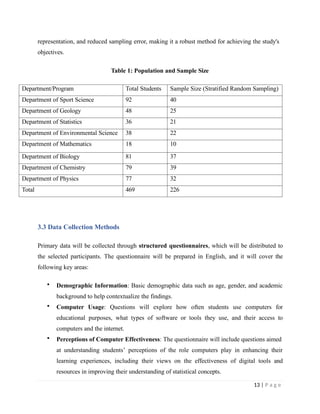
The study targets students from the College of Natural and Computational Science at Wallaga
University, encompassing eight departments: Sport Science, Geology, Statistics, Environmental
Science, Mathematics, Biology, Chemistry, and Physics, with a total population of 469 students.
To ensure proportional representation and minimize bias, the study employs stratified random
sampling, selecting a total sample of 226 students proportionally distributed across the
departments. This method ensures that each department’s unique characteristics are adequately
reflected in the sample, enhancing the accuracy and reliability of the findings. Random selection
within each department is carried out using techniques such as lottery or random number
generators. This approach offers several advantages, including inclusivity, accurate population
representation, and reduced sampling error, making it a robust method for achieving the study's
objectives.
Table 1: Population and Sample Size
13 | P a g e
Department/Program Total Students Sample Size (Stratified Random Sampling)
Department of Sport Science 92 40
Department of Geology 48 25
Department of Statistics 36 21
Department of Environmental Science 38 22
Department of Mathematics 18 10
Department of Biology 81 37
Department of Chemistry 79 39
Department of Physics 77 32
Total 469 226
3.3 Data Collection Methods
Primary data will be collected through structured questionnaires, which will be distributed to
the selected participants. The questionnaire will be prepared in English, and it will cover the
following key areas:
 Demographic Information: Basic demographic data such as age, gender, and academic
background to help contextualize the findings.
 Computer Usage: Questions will explore how often students use computers for
educational purposes, what types of software or tools they use, and their access to
computers and the internet.
 Perceptions of Computer Effectiveness: The questionnaire will include questions aimed
at understanding students’ perceptions of the role computers play in enhancing their
learning experiences, including their views on the effectiveness of digital tools and
resources in improving their understanding of statistical concepts.
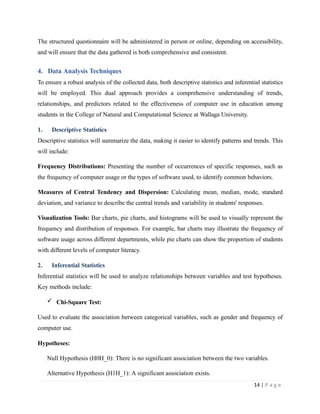
The structured questionnaire will be administered in person or online, depending on accessibility,
and will ensure that the data gathered is both comprehensive and consistent.
4. Data Analysis Techniques
To ensure a robust analysis of the collected data, both descriptive statistics and inferential statistics
will be employed. This dual approach provides a comprehensive understanding of trends,
relationships, and predictors related to the effectiveness of computer use in education among
students in the College of Natural and Computational Science at Wallaga University.
1. Descriptive Statistics
Descriptive statistics will summarize the data, making it easier to identify patterns and trends. This
will include:
Frequency Distributions: Presenting the number of occurrences of specific responses, such as
the frequency of computer usage or the types of software used, to identify common behaviors.
Measures of Central Tendency and Dispersion: Calculating mean, median, mode, standard
deviation, and variance to describe the central trends and variability in students' responses.
Visualization Tools: Bar charts, pie charts, and histograms will be used to visually represent the
frequency and distribution of responses. For example, bar charts may illustrate the frequency of
software usage across different departments, while pie charts can show the proportion of students
with different levels of computer literacy.
2. Inferential Statistics
Inferential statistics will be used to analyze relationships between variables and test hypotheses.
Key methods include:
 Chi-Square Test:
Used to evaluate the association between categorical variables, such as gender and frequency of
computer use.
Hypotheses:
Null Hypothesis (H0H_0): There is no significant association between the two variables.
Alternative Hypothesis (H1H_1): A significant association exists.
14 | P a g e
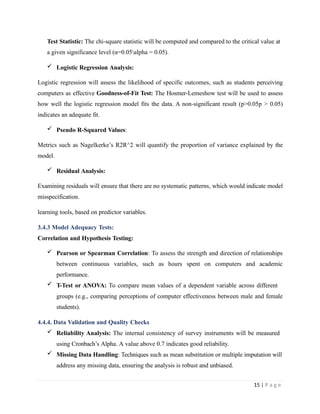
Test Statistic: The chi-square statistic will be computed and compared to the critical value at
a given significance level (α=0.05alpha = 0.05).
 Logistic Regression Analysis:
Logistic regression will assess the likelihood of specific outcomes, such as students perceiving
computers as effective Goodness-of-Fit Test: The Hosmer-Lemeshow test will be used to assess
how well the logistic regression model fits the data. A non-significant result (p>0.05p > 0.05)
indicates an adequate fit.
 Pseudo R-Squared Values:
Metrics such as Nagelkerke’s R2R^2 will quantify the proportion of variance explained by the
model.
 Residual Analysis:
Examining residuals will ensure that there are no systematic patterns, which would indicate model
misspecification.
learning tools, based on predictor variables.
3.4.3 Model Adequacy Tests:
Correlation and Hypothesis Testing:
 Pearson or Spearman Correlation: To assess the strength and direction of relationships
between continuous variables, such as hours spent on computers and academic
performance.
 T-Test or ANOVA: To compare mean values of a dependent variable across different
groups (e.g., comparing perceptions of computer effectiveness between male and female
students).
4.4.4. Data Validation and Quality Checks
 Reliability Analysis: The internal consistency of survey instruments will be measured
using Cronbach’s Alpha. A value above 0.7 indicates good reliability.
 Missing Data Handling: Techniques such as mean substitution or multiple imputation will
address any missing data, ensuring the analysis is robust and unbiased.
15 | P a g e
References
Batool, S., Mehrukh, N., & Waseem, M. (2023). Comparing the Impact of Online Learning
Platforms and Traditional Classroom Settings on Student Performance and Satisfaction.
Global Educational Studies Review, VIII(II), 343–354.
https://doi.org/10.31703/gesr.2023(viii-ii).31
Bhat, I. H. (2024). The impact of video-based learning on student engagement and motivation.
Innovation in the University 4.0 System Based on Smart Technologies, December, 39–53.
https://doi.org/10.1201/9781003425809-3
Dašić, D., Kostadinović, M. I., Vlajković, M., & Pavlović, M. (2024). Digital Literacy in the
Service of Science and Scientific Knowledge. International Journal of Cognitive Research
in Science, Engineering and Education, 12(1), 219–227. https://doi.org/10.23947/2334-8496-
2024-12-1-219-227
Dr Shaheen Parveen, & Shaikh Imran Ramzan. (2024). The Role of Digital Technologies in
Education: Benefits and Challenges. International Research Journal on Advanced
Engineering and Management (IRJAEM), 2(06), 2029–2037.
https://doi.org/10.47392/irjaem.2024.0299
Heena, C., & Nidhi, B. (2022). Barriers Affecting the Effectiveness of Digital Literacy Training
Programs (DLTPs) for Marginalised Populations: A Systematic Literature Review. Journal
of Technical Education and Training, 14(1),
110–127. https://doi.org/10.30880/jtet.2022.14.01.010
Likovič, A., & Rojko, K. (2022). E-Learning and a Case Study of Coursera and edX Online
Platforms. Research in Social Change, 14(1), 94–120. https://doi.org/10.2478/rsc-2022-0008
Meddage, D. N. R. (2024). Impact of Computer Literacy on Academic Performance of Higher
National Diploma Students Excluding HNDIT International Journal of Research Publication
and Reviews Impact of Computer Literacy on Academic Performance of Higher National
Diploma Students Exclu. February.
Profile, S. E. E. (2024). E-learning Platforms and Access to Education : A Case Study of
Makerere.
October.
16 | P a g e
Rafiq, S. (2024). Al-Mahdi Research Journal ( MRJ ) Saleem Iqbal. May.
Reddy, P., Sharma, B., & Chaudhary, K. (2020). Digital literacy: A review of literature.
International Journal of Technoethics, 11(2), 65–94.
https://doi.org/10.4018/IJT.20200701.oa1
Santos, M. R., & Gomes, M. M. F. (2023). Lifelong Digital Learning: “Computer Literacy,”
“Digital Literacy,” and “Digital Competence” As Dimensions for Digital Skills. Revista de
Gestao Social e Ambiental, 18(1), 1–16. https://doi.org/10.24857/RGSA.V18N1-028
Sharin, R. (2018). Authors.
Thelma, C. C., Sain, Z. H., & Shogbesan, Y. O. (2024). Digital Literacy in Education : Preparing
Students for the Future Workforce. August. https://doi.org/10.5281/ZENODO.13347718
Tibebu, D., Bandyopadhyay, T., & Negash, S. (2010). ICT integration efforts in higher education
in developing economies: The case of Addis Ababa University Ethiopia. Cases on Digital
Technologies in Higher Education: Issues and Challenges, March 2017, 279–303.
https://doi.org/10.4018/978-1-61520-869-2.ch019
17 | P a g e

Updated Lensa Research Proposal (1).pptx

  • 1.
    Wallaga University College ofComputational and Natural Science Department of Statistics Research Proposal Title: Effectiveness of Computer Literacy in Teaching and Learning Process: A Case Study of Wallaga University (College of Natural and Computational Science Students) Prepared by: Lensa Habtamu Mitiku ID:1405862 Advisor: Ararso Shifara (MSc.) January, 2025 G.C Nekemte Oromia, Ethiopia
  • 2.
    Acknowledgment I want toexpress my deepest gratitude to Mr. Ararso Shifara (MSc) for his invaluable support and guidance throughout the development of this research proposal. His insightful feedback, encouragement, and expertise have been instrumental in shaping the direction and quality of this work. I am truly grateful for his mentorship and for dedicating his time and effort to ensure the success of this proposal. His unwavering support has motivated me, and I deeply appreciate his contributions to this academic endeavor. i | P a g e
  • 3.
    Table of Content ContentsPage Acknowledgment ............................................................................................................................. i Table of Content.............................................................................................................................. ii List of Tables.................................................................................................................................. iv Abstract ........................................................................................................................................... v Chapter One .................................................................................................................................... 1 1. Introduction................................................................................................................................. 1 1. Background ........................................................................................................................... 1 2. Statement of the Problem ...................................................................................................... 3 3. Objectives of the Study ......................................................................................................... 4 1. General Objective ........................................................................................................... 4 2. Specific Objectives ......................................................................................................... 4 4. Significance of the Study ...................................................................................................... 4 5. Scope of the Study................................................................................................................. 4 Chapter 2 ......................................................................................................................................... 6 2. Review of Literature ................................................................................................................... 6 2.1. Introduction to Computer Literacy in Education ................................................................. 6 2. Use of Computers in Education ............................................................................................ 6 1. Digital Learning Tools and Resources............................................................................ 6 2. Online Learning and Distance Education ....................................................................... 7 3. Collaborative Tools and Communication ....................................................................... 7 4. Assessment and Feedback .............................................................................................. 7 5. Preparing Students for the Workforce ............................................................................ 7 3. Advantages and Disadvantages of Computers in Education ................................................. 7 ii | P a g e
  • 4.
    1. A d va n t a g e s . . . . . . . . . . . . . . . . . . . . . . . . . . . . . . . . . . . . . . . . . . . . . . . . . . . . . . . . . . . . . . . . . . . . . . . . . . . . . . . . . . . . . . . . . . . . . . . . . . . . . . . . . . . . . . . . . . . . . . 7 2. Disadvantages ................................................................................................................. 8 2.4 Computer Literacy in Natural and Computational Sciences ................................................. 8 5. Impact on Teaching and Learning Processes ....................................................................... 9 6. B a r r i e r s to Computer Literacy.............................................................................................. 9 7. Case Studies on Computer Literacy in Higher Education ................................................. 10 2.8 Relevance to Wallaga University ........................................................................................ 10 2.9. Theoretical Framework ...................................................................................................... 10 Chapter Three................................................................................................................................ 12 3. Methodology ............................................................................................................................. 12 1. Study Area ........................................................................................................................... 12 2. Population and Sampling Techniques ................................................................................. 12 3. Data Collection Methods..................................................................................................... 13 4. Data Analysis Techniques ................................................................................................... 14 1. Descriptive Statistics .................................................................................................... 14 2. Inferential Statistics ...................................................................................................... 14 3. Model Adequacy Tests:................................................................................................. 15 4.4.4. Data Validation and Quality Checks............................................................................ 15 References................................................................................................................................... .. 16 iii | P a g e
  • 5.
    List of Tables Table1: Population and Sample Size............................................................................................ 13 iv | P a g e
  • 6.
    Abstract This research proposalaims to investigate the use and effectiveness of computers in enhancing the educational experience of College of Natural and Computational Science Students at Wallaga University, Ethiopia. The study will focus on understanding how computer usage impacts learning, the types of software and tools used by students, and their perceptions of the effectiveness of these technologies in supporting their academic progress. A stratified random sampling technique will select a representative sample of students from both third and fourth-year cohorts. Primary data will be collected through structured questionnaires, covering demographic details, computer usage patterns, and student perceptions of digital tools in education. Data analysis will involve both descriptive and inferential statistics. Descriptive statistics, including frequency distributions and bar charts, will be used to summarize the data, while chi-square tests and logistic regression will assess relationships between variables and predict factors that influence students' perceptions of computer-based learning tools. The findings from this study are expected to provide valuable insights into the role of computers in education, informing strategies to improve teaching and learning in the university's statistics program and potentially other academic disciplines. The research will contribute to a better understanding of how technology can be leveraged to support student success in higher education. v | P a g e
  • 7.
    Chapter One 1. Introduction 1.1Background In today’s technology-driven world, computer literacy is no longer a luxury but a necessity. The integration of digital tools into nearly every facet of life has revolutionized how we communicate, work, and learn. In education, computer literacy enables both students and educators to access vast reservoirs of knowledge, utilize advanced teaching tools, and streamline the learning process. It allows learners to acquire critical skills like online research, data analysis, and the use of educational software that are essential for academic success. Furthermore, as industries increasingly adopt technology, computer literacy equips students with the competencies needed to thrive in the modern job market. Tasks such as document preparation, presentations, and data management have become integral to educational and professional environments, underscoring the need for widespread digital fluency(Reddy et al., 2020). Beyond its role in education and employment, computer literacy fosters innovation and problem- solving. By mastering digital tools, individuals can explore creative solutions to complex issues, enhancing productivity and efficiency. For example, computers enable simulations, online collaboration, and remote learning, bridging geographical and logistical barriers in education. Moreover, the rapid evolution of artificial intelligence and machine learning requires a baseline understanding of computers to navigate these advancements responsibly. In this era of constant technological progress, computer literacy is not just about knowing how to use a device it’s about empowering individuals to actively participate in a digital society, ensuring that no one is left behind in the global race toward innovation and development(Rafiq, 2024). In the context of Wallaga University, particularly within the College of Natural and Computational Science, the significance of computer literacy is even more pronounced. This institution, like many others, relies on digital tools to deliver quality education and equip students with the necessary skills to excel in their academic and professional pursuits. The integration of computer literacy into the teaching and learning process enhances both efficiency and effectiveness by providing 1 | P a g e
  • 8.
    students and educatorswith access to cutting-edge resources, enabling interactive learning experiences, and fostering innovation. One key area where computer literacy has proven effective is in the facilitation of laboratory-based education. Students in the natural and computational sciences frequently use specialized software for simulations, data analysis, and modeling, which are essential for understanding complex scientific concepts. For instance, proficiency in programming languages and tools such as Python, MATLAB, and R has become an integral part of the curriculum, allowing students to analyze real- world data and solve problems that extend beyond theoretical knowledge(Dašić et al., 2024). Moreover, computer literacy has transformed traditional teaching methods at Wallaga University. Online learning platforms, such as Moodle and Google Classroom, have enabled instructors to deliver course materials, assignments, and assessments in a more organized and accessible manner. This digital shift has allowed students to engage with their studies at their own pace while maintaining access to a wealth of supplementary resources. The ability to participate in virtual workshops, webinars, and online conferences has also exposed students to global academic trends, broadening their educational horizons(Batool et al., 2023). Another notable impact of computer literacy is the improvement in research capabilities. At Wallaga University, students in the College of Natural and Computational Science are increasingly utilizing digital tools to conduct literature reviews, access academic journals, and collaborate on research projects. Tools like Zotero, Mendeley, and LaTeX streamline the research process by simplifying citation management, report preparation, and academic writing. As a result, students can focus on producing high-quality work, contributing meaningfully to their fields of study. Furthermore, the implementation of computer literacy programs has fostered a collaborative environment within the university. Group projects and online forums have become essential components of the curriculum, encouraging students to share ideas and work together to solve problems. This not only builds technical skills but also enhances teamwork and communication, which are vital for success in scientific careers(Meddage, 2024). Lastly, computer literacy has played a critical role in overcoming barriers to education at Wallaga University. The use of digital tools has made learning more inclusive, particularly for students from remote areas or those with limited access to physical resources. Remote learning options and 2 | P a g e
  • 9.
    online libraries havebridged the gap, ensuring that all students, regardless of their location or circumstances, have the opportunity to excel academically. 1.2 Statement of the Problem In today’s rapidly evolving technological era, computer literacy has become a critical skill for academic success and professional growth. Despite its significance, there remains a gap in its effective integration into the teaching and learning processes, particularly in higher education institutions. At Wallaga University, challenges such as limited access to resources, insufficient training, and varying levels of proficiency among students hinder the effective utilization of computers in education. These challenges are especially pronounced among College of Natural and Computational Science Students, who are expected to engage in more advanced coursework, research, and project-based learning that heavily relies on digital tools and computer skills(Thelma et al., 2024). The lack of consistent and effective computer literacy impacts not only the quality of education but also students' preparedness for the technology-driven job market. Among College of Natural and Computational Science Students, this gap becomes more critical and transition into professional roles or higher education, where advanced computer skills are essential for success. Without adequate computer proficiency, these students may struggle to access information, utilize modern software for analysis, or develop the critical problem-solving abilities necessary for their academic and professional futures. This study seeks to address these gaps by evaluating the effectiveness of computer literacy in the teaching and learning processes at Wallaga University, focusing on College of Natural and Computational Science Students, to identify specific challenges and propose targeted strategies for improvement. Despite the increasing availability of technology, gaps persist in its effective use in education. This study seeks to address key questions:  What percentage of the student population possesses computer skills?  How do computers contribute to teaching and learning processes?  What challenges hinder the integration of computers into education?  Which fields benefit most from computer literacy? 3 | P a g e
  • 10.
    3. Objectives ofthe Study 1. General Objective To evaluate the effectiveness of computer literacy in enhancing the teaching and learning processes for College of Natural and Computational Science Students at Wallaga University. 2. Specific Objectives  To assess the current level of computer literacy among College of Natural and Computational Science Students.  To identify how computer skills are utilized in coursework, research, and project-based activities.  To evaluate the impact of computer literacy on academic performance and learning outcomes.  To determine the challenges faced by College of Natural and Computational Science Students in accessing and using computers effectively.  To explore the role of computer literacy in preparing students for the technology-driven job market.  To propose strategies to improve computer literacy and integrate it more effectively into the curriculum for advanced students. 4. Significance of the Study The study highlights the transformative impact of computer literacy on education. It aims to:  Motivate effective computer usage in teaching and learning.  Provide foundational information for future research.  Raise awareness about the role of technology in improving educational quality.  Develop positive attitudes towards integrating computers in education. 1.5 Scope of the Study This study focuses exclusively on the College of Natural and Computational Science at Wallaga University, with an emphasis on evaluating the computer literacy levels of its students and the effectiveness of this literacy in the teaching and learning processes. The research is confined to 4 | P a g e
  • 11.
    assessing how students'proficiency in using computers and related digital tools influences their academic performance, research activities, and overall learning outcomes. The study targets undergraduate students enrolled in programs within the college, including but not limited to biology, chemistry, physics, mathematics, Statistics, and related disciplines. It explores their ability to use essential software, perform data analysis, and engage with e-learning platforms and research tools. Additionally, it examines how faculty members integrate digital resources into their teaching strategies and how these practices impact the students' learning experiences. The research is limited to evaluating specific variables such as access to digital tools, frequency of use, skill levels in essential software (e.g., MATLAB, Python, SPSS), and the ability to utilize online academic resources. It also includes a review of the infrastructure available at Wallaga University, such as computer labs, internet access, and e-learning systems, to determine how these factors support or hinder effective teaching and learning. Geographically, the scope of the study is restricted to the main campus of Wallaga University, focusing solely on the College of Natural and Computational Science. The temporal scope is limited to the academic year in which the study is conducted, providing a snapshot of the current state of computer literacy and its impact within this timeframe. This study does not extend to other colleges within Wallaga University or to graduate programs, as its primary aim is to provide a focused analysis of undergraduate students within the College of Natural and Computational Science. Additionally, while the research considers the influence of digital infrastructure, it does not delve into external factors such as government policies or funding at a national level. 5 | P a g e
  • 12.
    Chapter 2 2. Reviewof Literature 2.1. Introduction to Computer Literacy in Education Computer literacy, broadly defined as the ability to use digital tools effectively, has become an indispensable component of modern education. The advent of technology has transformed traditional learning methods, replacing static, textbook-based teaching with dynamic, interactive, and technology-enhanced instruction. Scholars such as (Santos & Gomes, 2023) emphasize that computer literacy is critical for bridging the gap between theoretical knowledge and practical application in today’s digitized world. This importance is underscored by the increasing reliance on online platforms, digital libraries, and virtual classrooms, which provide access to vast knowledge resources previously inaccessible to many students. Research further reveals that students proficient in digital tools are more likely to succeed academically because they can leverage resources such as online journals, interactive e-books, and educational software. Moreover, digital competence fosters self-directed learning, enabling students to adapt to diverse learning styles and paces. 2. Use of Computers in Education The integration of computers in education has revolutionized how students and educators’ access and process information. From digital learning tools to online education platforms, computers have become essential for improving learning experiences and teaching efficiency. In particular, digital literacy is vital for both students and educators to navigate these tools effectively(Dr Shaheen Parveen & Shaikh Imran Ramzan, 2024). 1. Digital Learning Tools and Resources Computers provide students with access to a wide array of educational content, including textbooks, research papers, and multimedia tutorials. Platforms such as Khan Academy and Coursera allow students to learn at their own pace. Additionally, educational software like GeoGebra and physics simulations offer interactive learning experiences, fostering deeper understanding of complex subjects (Likovič & Rojko, 2022). 6 | P a g e
  • 13.
    2. Online Learningand Distance Education Online education has expanded learning opportunities for students worldwide. Platforms like edX and Moodle allow institutions to offer flexible learning options, which is particularly beneficial for students in remote areas. The rise of hybrid learning models, which combine online and face- to-face interactions, caters to diverse student needs and learning preferences. 3. Collaborative Tools and Communication Computers enhance communication and collaboration among students and educators. Tools like Zoom, Google Drive, and Microsoft Teams enable real-time communication and teamwork, promoting collaborative learning and problem-solving. These platforms also facilitate personalized feedback from instructors, further improving learning outcomes. 4. Assessment and Feedback Computers streamline assessment processes by enabling online quizzes and instant feedback. This not only saves time for teachers but also helps students track their progress and address weaknesses promptly. Data analysis tools can further assist in identifying student trends, allowing for more personalized learning. 5. Preparing Students for the Workforce Digital literacy skills are crucial for success in today’s job market. Students develop competencies such as word processing, data analysis, and coding, which are essential for various career paths. Integrating technology into education ensures that students are well-prepared for the modern workforce. 3. Advantages and Disadvantages of Computers in Education 1. Advantages  Access to Information: Students have instant access to vast educational resources online, enhancing learning opportunities.  Enhanced Learning Methods: Digital tools support interactive learning, such as simulations and multimedia presentations, accommodating diverse learning styles.  Collaboration and Communication: Computers enable efficient collaboration through online tools, promoting teamwork and effective communication. 7 | P a g e
  • 14.
     Personalized Learning:Adaptive learning platforms allow students to learn at their own pace, improving retention and understanding. 2.3.2 Disadvantages  Overreliance on Technology: Overuse of digital tools may reduce critical thinking and problem-solving skills.  Digital Divide: Unequal access to technology can create educational disparities, particularly for students from lower-income backgrounds.  Health Concerns: Prolonged screen time may lead to physical issues such as eye strain and poor posture.  Technical Issues: Software glitches and poor internet connectivity can disrupt the learning process, causing frustration for both students and teachers. 2.4 Computer Literacy in Natural and Computational Sciences In natural and computational sciences, computer literacy plays a specialized role. Unlike general education, which often focuses on basic computing skills like typing and internet navigation, the sciences demand proficiency in advanced tools. For example, programming languages such as Python, R, and MATLAB are essential for solving mathematical problems, conducting statistical analysis, and running scientific simulations. Tools like AutoCAD and GIS are integral in disciplines like environmental science and engineering (Sharin, 2018). (Reddy et al., 2020) point out that computer literacy enables students to conduct in-depth data analysis, develop algorithms, and visualize complex models that are crucial for understanding phenomena in physics, biology, and chemistry. In addition, proficiency in open-access resources like Open Science Framework (OSF) and software like Jupyter Notebooks is transforming how students collaborate and share research. Wallaga University’s College of Natural and Computational Science is no exception. Students in these disciplines are expected to utilize such tools effectively to solve real-world problems, reinforcing the necessity of high computer literacy levels within this educational context. 8 | P a g e
  • 15.
    2.5. Impact onTeaching and Learning Processes Computer literacy significantly impacts how teaching and learning processes are conducted. For instructors, digital tools provide innovative teaching methods that enhance student engagement. Research by (Bhat, 2024) shows that educators who integrate tools such as virtual labs, interactive simulations, and augmented reality in their classrooms achieve better learning outcomes. These technologies create an immersive learning experience, allowing students to experiment and learn in a controlled, virtual environment. For students, access to e-learning platforms like Moodle and Google Classroom streamlines communication with instructors, simplifies the submission of assignments, and facilitates timely feedback. Additionally, collaborative tools such as Microsoft Teams and Zoom have enabled group work and interactive sessions, even in remote settings. (Reddy et al., 2020) argue that such technologies are particularly valuable in resource-constrained environments, where physical lab facilities may be limited. 2.6. Barriers to Computer Literacy Despite its benefits, significant barriers hinder the effective implementation of computer literacy in education. A study by (Heena & Nidhi, 2022) reveals that disparities in access to digital tools create a digital divide among students. In regions like Wallaga, where internet infrastructure and computer access may be inconsistent, students from disadvantaged backgrounds often struggle to keep up. Moreover, differences in prior exposure to technology can lead to varying levels of confidence and competence among students. For example, students from urban areas may have more experience with computers than those from rural regions. This lack of uniformity often results in unequal participation and performance in tech-based academic activities. Insufficient faculty training is another obstacle. Educators who are not well-versed in digital tools may hesitate to incorporate them into their teaching, limiting the benefits of technology-enhanced learning. Addressing these barriers requires comprehensive training programs, improved infrastructure, and policies to ensure equitable access to technology. 9 | P a g e
  • 16.
    2.7. Case Studieson Computer Literacy in Higher Education Case studies from similar institutions provide valuable insights into the role of computer literacy in higher education. Tibebu and Dawit (Tibebu et al., 2010) conducted research at Addis Ababa University and found that students with higher digital competencies excelled in research-intensive courses. These students could efficiently navigate online academic databases, write research papers using tools like LaTeX, and perform statistical analyses with SPSS and R. Similarly, (Profile, 2024) studied the impact of computer literacy on students at Makerere University. Their findings indicate that integrating digital skills training into the curriculum resulted in improved problem-solving abilities and a significant boost in employability after graduation. The study highlights the importance of practical, hands-on training in building digital proficiency. These findings underline the need for Wallaga University to adopt similar strategies, particularly within the College of Natural and Computational Science, where practical applications of computer literacy are crucial for academic and professional success. 2.8 Relevance to Wallaga University Wallaga University, like many institutions in developing regions, faces challenges in fully integrating computer literacy into its academic programs. Preliminary observations suggest that while some students in the College of Natural and Computational Science possess a basic understanding of digital tools, many struggle with advanced applications critical to their fields of study. For example, while students may know how to use general-purpose software like Microsoft Word or Excel, they may lack the skills to perform advanced data analysis or simulations necessary for research. This gap underscores the importance of targeted interventions, such as workshops, tutorials, and access to modern computing facilities. Additionally, the university’s infrastructure, including computer labs and internet access, plays a critical role in determining how effectively computer literacy can be developed. This study will examine how these resources are utilized and identify areas for improvement 2.9. Theoretical Framework This research is grounded in two key theoretical models: 10 | P a g e
  • 17.
     Technology AcceptanceModel (TAM): This model explains how students and educators perceive and adopt technology. By analyzing factors such as perceived ease of use and usefulness, the study can assess why certain digital tools are embraced or avoided.  Bloom’s Taxonomy of Learning Domains: This framework helps evaluate how computer literacy enhances cognitive (knowledge), affective (attitudes), and psychomotor (skills) learning outcomes. 11 | P a g e
  • 18.
    Chapter Three 3. Methodology 12| P a g e 1. Study Area The proposed research will be conducted at Wallaga University, located in Ethiopia, approximately 315 km south of Addis Ababa. Established in 2006, Wallaga University has earned recognition for its commitment to high-quality education and its diverse student body. The university provides an ideal environment for this study, as it offers a wide range of academic programs, including those in the field of statistics, where computer-based learning tools are increasingly integrated into the curriculum. This study will focus on third and fourth-year statistics students who are more likely to have had significant exposure to computer usage in their academic work. 2. Population and Sampling Techniques The study will target College of Natural and Computational Science Students at Wallaga University. To ensure a representative sample, stratified random sampling will be used. This method ensures that students from both cohorts are proportionally represented in the sample, allowing for a more accurate reflection of the population's characteristics. The study targets students from the College of Natural and Computational Science at Wallaga University, encompassing eight departments: Sport Science, Geology, Statistics, Environmental Science, Mathematics, Biology, Chemistry, and Physics, with a total population of 469 students. To ensure proportional representation and minimize bias, the study employs stratified random sampling, selecting a total sample of 226 students proportionally distributed across the departments. This method ensures that each department’s unique characteristics are adequately reflected in the sample, enhancing the accuracy and reliability of the findings. Random selection within each department is carried out using techniques such as lottery or random number generators. This approach offers several advantages, including inclusivity, accurate population
  • 19.
    representation, and reducedsampling error, making it a robust method for achieving the study's objectives. Table 1: Population and Sample Size 13 | P a g e Department/Program Total Students Sample Size (Stratified Random Sampling) Department of Sport Science 92 40 Department of Geology 48 25 Department of Statistics 36 21 Department of Environmental Science 38 22 Department of Mathematics 18 10 Department of Biology 81 37 Department of Chemistry 79 39 Department of Physics 77 32 Total 469 226 3.3 Data Collection Methods Primary data will be collected through structured questionnaires, which will be distributed to the selected participants. The questionnaire will be prepared in English, and it will cover the following key areas:  Demographic Information: Basic demographic data such as age, gender, and academic background to help contextualize the findings.  Computer Usage: Questions will explore how often students use computers for educational purposes, what types of software or tools they use, and their access to computers and the internet.  Perceptions of Computer Effectiveness: The questionnaire will include questions aimed at understanding students’ perceptions of the role computers play in enhancing their learning experiences, including their views on the effectiveness of digital tools and resources in improving their understanding of statistical concepts.
  • 20.
    The structured questionnairewill be administered in person or online, depending on accessibility, and will ensure that the data gathered is both comprehensive and consistent. 4. Data Analysis Techniques To ensure a robust analysis of the collected data, both descriptive statistics and inferential statistics will be employed. This dual approach provides a comprehensive understanding of trends, relationships, and predictors related to the effectiveness of computer use in education among students in the College of Natural and Computational Science at Wallaga University. 1. Descriptive Statistics Descriptive statistics will summarize the data, making it easier to identify patterns and trends. This will include: Frequency Distributions: Presenting the number of occurrences of specific responses, such as the frequency of computer usage or the types of software used, to identify common behaviors. Measures of Central Tendency and Dispersion: Calculating mean, median, mode, standard deviation, and variance to describe the central trends and variability in students' responses. Visualization Tools: Bar charts, pie charts, and histograms will be used to visually represent the frequency and distribution of responses. For example, bar charts may illustrate the frequency of software usage across different departments, while pie charts can show the proportion of students with different levels of computer literacy. 2. Inferential Statistics Inferential statistics will be used to analyze relationships between variables and test hypotheses. Key methods include:  Chi-Square Test: Used to evaluate the association between categorical variables, such as gender and frequency of computer use. Hypotheses: Null Hypothesis (H0H_0): There is no significant association between the two variables. Alternative Hypothesis (H1H_1): A significant association exists. 14 | P a g e
  • 21.
    Test Statistic: Thechi-square statistic will be computed and compared to the critical value at a given significance level (α=0.05alpha = 0.05).  Logistic Regression Analysis: Logistic regression will assess the likelihood of specific outcomes, such as students perceiving computers as effective Goodness-of-Fit Test: The Hosmer-Lemeshow test will be used to assess how well the logistic regression model fits the data. A non-significant result (p>0.05p > 0.05) indicates an adequate fit.  Pseudo R-Squared Values: Metrics such as Nagelkerke’s R2R^2 will quantify the proportion of variance explained by the model.  Residual Analysis: Examining residuals will ensure that there are no systematic patterns, which would indicate model misspecification. learning tools, based on predictor variables. 3.4.3 Model Adequacy Tests: Correlation and Hypothesis Testing:  Pearson or Spearman Correlation: To assess the strength and direction of relationships between continuous variables, such as hours spent on computers and academic performance.  T-Test or ANOVA: To compare mean values of a dependent variable across different groups (e.g., comparing perceptions of computer effectiveness between male and female students). 4.4.4. Data Validation and Quality Checks  Reliability Analysis: The internal consistency of survey instruments will be measured using Cronbach’s Alpha. A value above 0.7 indicates good reliability.  Missing Data Handling: Techniques such as mean substitution or multiple imputation will address any missing data, ensuring the analysis is robust and unbiased. 15 | P a g e
  • 22.
    References Batool, S., Mehrukh,N., & Waseem, M. (2023). Comparing the Impact of Online Learning Platforms and Traditional Classroom Settings on Student Performance and Satisfaction. Global Educational Studies Review, VIII(II), 343–354. https://doi.org/10.31703/gesr.2023(viii-ii).31 Bhat, I. H. (2024). The impact of video-based learning on student engagement and motivation. Innovation in the University 4.0 System Based on Smart Technologies, December, 39–53. https://doi.org/10.1201/9781003425809-3 Dašić, D., Kostadinović, M. I., Vlajković, M., & Pavlović, M. (2024). Digital Literacy in the Service of Science and Scientific Knowledge. International Journal of Cognitive Research in Science, Engineering and Education, 12(1), 219–227. https://doi.org/10.23947/2334-8496- 2024-12-1-219-227 Dr Shaheen Parveen, & Shaikh Imran Ramzan. (2024). The Role of Digital Technologies in Education: Benefits and Challenges. International Research Journal on Advanced Engineering and Management (IRJAEM), 2(06), 2029–2037. https://doi.org/10.47392/irjaem.2024.0299 Heena, C., & Nidhi, B. (2022). Barriers Affecting the Effectiveness of Digital Literacy Training Programs (DLTPs) for Marginalised Populations: A Systematic Literature Review. Journal of Technical Education and Training, 14(1), 110–127. https://doi.org/10.30880/jtet.2022.14.01.010 Likovič, A., & Rojko, K. (2022). E-Learning and a Case Study of Coursera and edX Online Platforms. Research in Social Change, 14(1), 94–120. https://doi.org/10.2478/rsc-2022-0008 Meddage, D. N. R. (2024). Impact of Computer Literacy on Academic Performance of Higher National Diploma Students Excluding HNDIT International Journal of Research Publication and Reviews Impact of Computer Literacy on Academic Performance of Higher National Diploma Students Exclu. February. Profile, S. E. E. (2024). E-learning Platforms and Access to Education : A Case Study of Makerere. October. 16 | P a g e
  • 23.
    Rafiq, S. (2024).Al-Mahdi Research Journal ( MRJ ) Saleem Iqbal. May. Reddy, P., Sharma, B., & Chaudhary, K. (2020). Digital literacy: A review of literature. International Journal of Technoethics, 11(2), 65–94. https://doi.org/10.4018/IJT.20200701.oa1 Santos, M. R., & Gomes, M. M. F. (2023). Lifelong Digital Learning: “Computer Literacy,” “Digital Literacy,” and “Digital Competence” As Dimensions for Digital Skills. Revista de Gestao Social e Ambiental, 18(1), 1–16. https://doi.org/10.24857/RGSA.V18N1-028 Sharin, R. (2018). Authors. Thelma, C. C., Sain, Z. H., & Shogbesan, Y. O. (2024). Digital Literacy in Education : Preparing Students for the Future Workforce. August. https://doi.org/10.5281/ZENODO.13347718 Tibebu, D., Bandyopadhyay, T., & Negash, S. (2010). ICT integration efforts in higher education in developing economies: The case of Addis Ababa University Ethiopia. Cases on Digital Technologies in Higher Education: Issues and Challenges, March 2017, 279–303. https://doi.org/10.4018/978-1-61520-869-2.ch019 17 | P a g e