Week-3
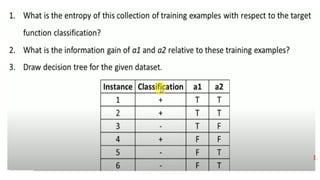
• Write aprogram to demonstrate the working of the Decision Tree-Based Id3
algorithm.
Use an appropriate data set for building the decision tree and apply this
knowledge to classify a new sample.
• Decision Tree is a supervised learning technique that can be used for both
classification and Regression problems, but mostly it is preferred for solving
Classification problems.
•It is a tree-structured classifier, where internal nodes represent the features of
a dataset, branches represent the decision rules and each leaf node represents
the outcome.
2.
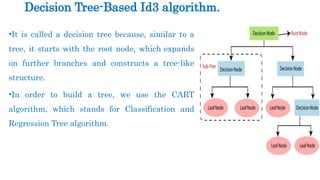
• In aDecision tree, there are two nodes, which are the Decision
Node and Leaf Node.
• Decision nodes are used to make any decision and have multiple
branches, whereas Leaf nodes are the output of those decisions and
do not contain any further branches.
• It is a graphical representation for getting all the possible solutions
to a problem/decision based on given conditions.
Decision Tree-Based Id3 algorithm.
3.
Decision Tree-Based Id3algorithm.
•It is called a decision tree because, similar to a
tree, it starts with the root node, which expands
on further branches and constructs a tree-like
structure.
•In order to build a tree, we use the CART
algorithm, which stands for Classification and
Regression Tree algorithm.
4.
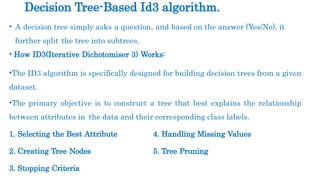
• A decisiontree simply asks a question, and based on the answer (Yes/No), it
further split the tree into subtrees.
• How ID3(Iterative Dichotomiser 3) Works:
•The ID3 algorithm is specifically designed for building decision trees from a given
dataset.
•The primary objective is to construct a tree that best explains the relationship
between attributes in the data and their corresponding class labels.
1. Selecting the Best Attribute 4. Handling Missing Values
2. Creating Tree Nodes 5. Tree Pruning
3. Stopping Criteria
Decision Tree-Based Id3 algorithm.
5.
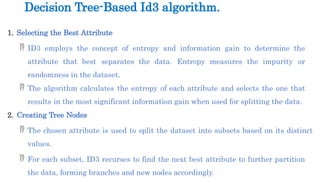
1. Selecting theBest Attribute
ID3 employs the concept of entropy and information gain to determine the
attribute that best separates the data. Entropy measures the impurity or
randomness in the dataset.
The algorithm calculates the entropy of each attribute and selects the one that
results in the most significant information gain when used for splitting the data.
2. Creating Tree Nodes
The chosen attribute is used to split the dataset into subsets based on its distinct
values.
For each subset, ID3 recurses to find the next best attribute to further partition
the data, forming branches and new nodes accordingly.
Decision Tree-Based Id3 algorithm.
6.
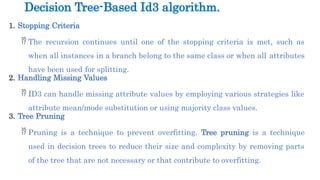
1. Stopping Criteria
The recursion continues until one of the stopping criteria is met, such as
when all instances in a branch belong to the same class or when all attributes
have been used for splitting.
2. Handling Missing Values
ID3 can handle missing attribute values by employing various strategies like
attribute mean/mode substitution or using majority class values.
3. Tree Pruning
Pruning is a technique to prevent overfitting. Tree pruning is a technique
used in decision trees to reduce their size and complexity by removing parts
of the tree that are not necessary or that contribute to overfitting.
Decision Tree-Based Id3 algorithm.
7.
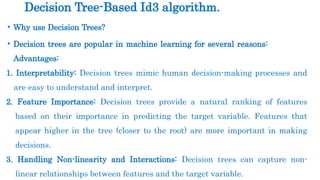
• Why useDecision Trees?
• Decision trees are popular in machine learning for several reasons:
Advantages:
1. Interpretability: Decision trees mimic human decision-making processes and
are easy to understand and interpret.
2. Feature Importance: Decision trees provide a natural ranking of features
based on their importance in predicting the target variable. Features that
appear higher in the tree (closer to the root) are more important in making
decisions.
3. Handling Non-linearity and Interactions: Decision trees can capture non-
linear relationships between features and the target variable.
Decision Tree-Based Id3 algorithm.
8.
4. Handling MixedData Types: Decision trees can handle both numerical and
categorical data without the need for pre-processing like normalization or
one-hot encoding.
5. Robustness to Outliers and Irrelevant Features: Decision trees are robust to
outliers and can handle noisy data well.
6. Scalability: Decision trees can scale well to large datasets with many
features and samples.
7. No Assumptions about Data Distribution: Decision trees make no
assumptions about the underlying distribution of the data.
8. Easy to Handle Missing Values: Decision trees can handle missing values in the data
without requiring imputation.
Decision Tree-Based Id3 algorithm.
9.
9. Versatility: Decisiontrees can be used for both classification and regression
tasks.
• Disadvantages and Limitations:
1. Overfitting: Decision trees are prone to overfitting, especially with deep trees.
2. High Variance: Small changes in the training data can lead to significantly
different decision trees. Makes decision trees unstable.
3. Bias towards Features with Many Levels: Decision trees tend to bias towards
features with a large number of levels.
4. Difficulty in Learning XOR, Parity, and Multiplexer Problems: Decision
trees struggle to learn certain logical functions like XOR, parity, and
Decision Tree-Based Id3 algorithm.
10.
5. Not Suitablefor Regression on Continuous Variables: While decision trees can
handle regression tasks, they may not perform well when the target variable
has a high degree of continuity.
6. Inability to Extrapolate: Decision trees cannot extrapolate beyond the range of
values seen in the training data.
7. Greedy Nature: Decision trees use a greedy approach to select attributes at
each node.
8. Difficulty with Imbalanced Classes: Decision trees may produce biased trees
when dealing with imbalanced class distributions.
Decision Tree-Based Id3 algorithm.
11.
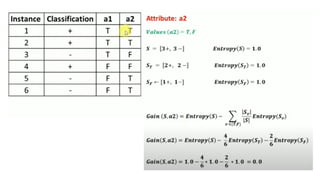
• Formulas linkedto the main theoretical ideas in the ID3 algorithm :
1. Entropy
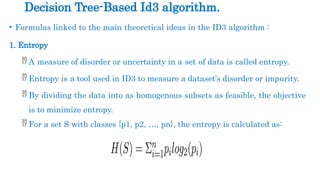
A measure of disorder or uncertainty in a set of data is called entropy.
Entropy is a tool used in ID3 to measure a dataset’s disorder or impurity.
By dividing the data into as homogenous subsets as feasible, the objective
is to minimize entropy.
For a set S with classes {p1, p2, …, pn}, the entropy is calculated as:
Decision Tree-Based Id3 algorithm.
12.
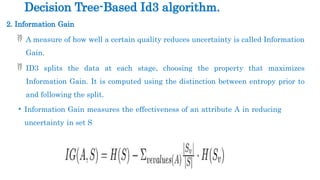
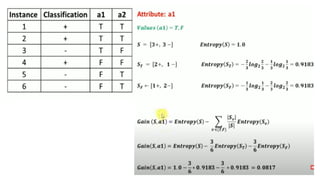
2. Information Gain
A measure of how well a certain quality reduces uncertainty is called Information
Gain.
ID3 splits the data at each stage, choosing the property that maximizes
Information Gain. It is computed using the distinction between entropy prior to
and following the split.
• Information Gain measures the effectiveness of an attribute A in reducing
uncertainty in set S
Decision Tree-Based Id3 algorithm.
13.
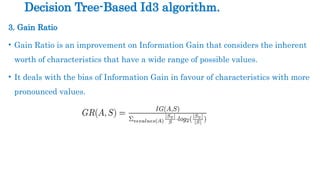
3. Gain Ratio
•Gain Ratio is an improvement on Information Gain that considers the inherent
worth of characteristics that have a wide range of possible values.
• It deals with the bias of Information Gain in favour of characteristics with more
pronounced values.
Decision Tree-Based Id3 algorithm.
18.
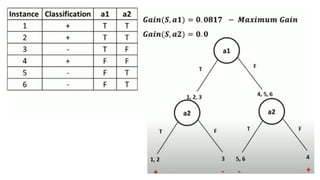
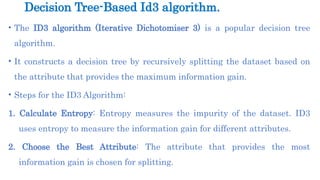
• The ID3algorithm (Iterative Dichotomiser 3) is a popular decision tree
algorithm.
• It constructs a decision tree by recursively splitting the dataset based on
the attribute that provides the maximum information gain.
• Steps for the ID3 Algorithm:
1. Calculate Entropy: Entropy measures the impurity of the dataset. ID3
uses entropy to measure the information gain for different attributes.
2. Choose the Best Attribute: The attribute that provides the most
information gain is chosen for splitting.
Decision Tree-Based Id3 algorithm.
19.
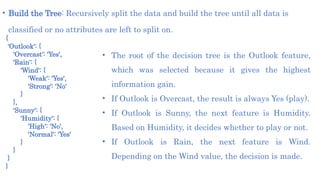
• Build theTree: Recursively split the data and build the tree until all data is
classified or no attributes are left to split on.
{
'Outlook': {
'Overcast': 'Yes',
'Rain': {
'Wind': {
'Weak': 'Yes',
'Strong': 'No'
}
},
'Sunny': {
'Humidity': {
'High': 'No',
'Normal': 'Yes'
}
}
}
}
• The root of the decision tree is the Outlook feature,
which was selected because it gives the highest
information gain.
• If Outlook is Overcast, the result is always Yes (play).
• If Outlook is Sunny, the next feature is Humidity.
Based on Humidity, it decides whether to play or not.
• If Outlook is Rain, the next feature is Wind.
Depending on the Wind value, the decision is made.
#4 Selecting the Best Attribute
ID3 employs the concept of entropy and information gain to determine the attribute that best separates the data. Entropy measures the impurity or randomness in the dataset.
The algorithm calculates the entropy of each attribute and selects the one that results in the most significant information gain when used for splitting the data.
Creating Tree Nodes
The chosen attribute is used to split the dataset into subsets based on its distinct values.
For each subset, ID3 recurses to find the next best attribute to further partition the data, forming branches and new nodes accordingly.
Stopping Criteria
The recursion continues until one of the stopping criteria is met, such as when all instances in a branch belong to the same class or when all attributes have been used for splitting.
Handling Missing Values
ID3 can handle missing attribute values by employing various strategies like attribute mean/mode substitution or using majority class values.
Tree Pruning
Pruning is a technique to prevent overfitting. While not directly included in ID3, post- processing techniques or variations like C4.5 incorporate pruning to improve the tree’s generalization. (Tree pruning is a technique used in decision trees to reduce their size and complexity by removing parts of the tree that are not necessary or that contribute to overfitting.)
#9 Various extensions and ensemble methods, such as Random Forests, Gradient Boosting Machines, and XG Boost, build upon decision trees to further enhance their performance.
#12 Uncertainity - A state where the outcome is unknown or unpredictable.