Introduction to Software Engineering 
Muhammad Nasir 
Requirements Modeling – 
Scenario, Information and 
Analysis classes (2) 
m.nasir@iiu.edu.pk
Agenda 
 Class Based Modeling 
 Identify Analysis Classes
Class Base Modeling 
 Class-based modeling represents the 
objects that the system will manipulate 
 The operations (also called methods or 
services) that will be applied to the 
objects to effect the manipulation 
 The relationships between the objects, 
and the collaborations that occur 
between the classes that are defined.
Identifying Analysis Classes 
 If you look around a room, there is a 
set of physical objects that can be 
easily identified, classified, and 
defined (in terms of attributes and 
operations). 
 But when you “look around” the 
problem space of a software 
application, the classes (and objects) 
may be more difficult to comprehend.
Identifying Analysis Classes 
 We can begin to identify classes by 
examining the usage scenarios 
developed as part of the requirements 
model 
 Classes are determined by underlining 
each noun or noun phrase and 
entering it into a simple table. 
Synonyms should be noted to avoid 
repetition.
Identifying Analysis Classes
Guidelines for Identifying Classes 
 External entities (e.g., other systems, devices, 
people) that produce or consume information to be 
used by a computer-based system. 
 Things (e.g., reports, displays, letters, signals) that 
are part of the information domain for the problem. 
 Occurrences or events (e.g., a property transfer or 
the completion of a series of robot movements) that 
occur within the context of system operation. 
 Roles (e.g., manager, engineer, salesperson) 
played by people who interact with the system.
Guidelines for Identifying Classes 
 Organizational units (e.g., division, group, 
team) that are relevant to an application. 
 Places (e.g., manufacturing floor or loading 
dock) that establish the context of the 
problem and the overall function of the 
system. 
 Structures (e.g., sensors, four-wheeled 
vehicles, or computers) that define a class 
of objects or related classes of objects.
Class-Responsibility- 
Collaborator (CRC) Modeling 
 Class-responsibility-collaborator 
(CRC) modeling provides a simple 
means for identifying and organizing 
the classes that are relevant to system 
or product requirements.
Class-Responsibility- 
Collaborator (CRC) Modeling 
 A CRC model is really a collection of 
standard index cards that represent classes. 
 The cards are divided into three sections. 
Along the top of the card you write the name 
of the class. 
 In the body of the card you list the class 
responsibilities on the left and the 
collaborators on the right.
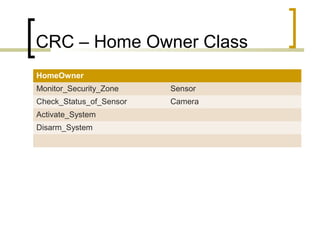
CRC – Home Owner Class 
HomeOwner 
Monitor_Security_Zone Sensor 
Check_Status_of_Sensor Camera 
Activate_System 
Disarm_System
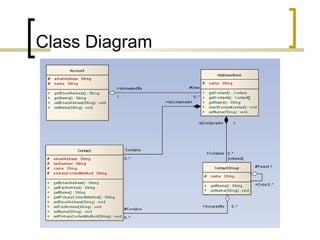
Class Diagram
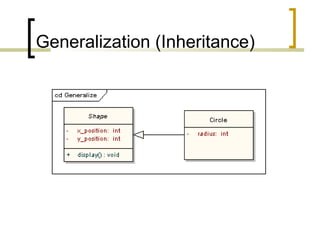
Generalization (Inheritance)
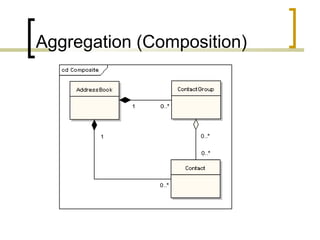
Aggregation (Composition)
The End 
 Thanks for listening 
 Questions would be appreciated.

Lecture 15 requirements modeling - scenario, information and analysis classes (2)

  • 1.
    Introduction to SoftwareEngineering Muhammad Nasir Requirements Modeling – Scenario, Information and Analysis classes (2) m.nasir@iiu.edu.pk
  • 2.
    Agenda  ClassBased Modeling  Identify Analysis Classes
  • 3.
    Class Base Modeling  Class-based modeling represents the objects that the system will manipulate  The operations (also called methods or services) that will be applied to the objects to effect the manipulation  The relationships between the objects, and the collaborations that occur between the classes that are defined.
  • 4.
    Identifying Analysis Classes  If you look around a room, there is a set of physical objects that can be easily identified, classified, and defined (in terms of attributes and operations).  But when you “look around” the problem space of a software application, the classes (and objects) may be more difficult to comprehend.
  • 5.
    Identifying Analysis Classes  We can begin to identify classes by examining the usage scenarios developed as part of the requirements model  Classes are determined by underlining each noun or noun phrase and entering it into a simple table. Synonyms should be noted to avoid repetition.
  • 6.
  • 7.
    Guidelines for IdentifyingClasses  External entities (e.g., other systems, devices, people) that produce or consume information to be used by a computer-based system.  Things (e.g., reports, displays, letters, signals) that are part of the information domain for the problem.  Occurrences or events (e.g., a property transfer or the completion of a series of robot movements) that occur within the context of system operation.  Roles (e.g., manager, engineer, salesperson) played by people who interact with the system.
  • 8.
    Guidelines for IdentifyingClasses  Organizational units (e.g., division, group, team) that are relevant to an application.  Places (e.g., manufacturing floor or loading dock) that establish the context of the problem and the overall function of the system.  Structures (e.g., sensors, four-wheeled vehicles, or computers) that define a class of objects or related classes of objects.
  • 9.
    Class-Responsibility- Collaborator (CRC)Modeling  Class-responsibility-collaborator (CRC) modeling provides a simple means for identifying and organizing the classes that are relevant to system or product requirements.
  • 10.
    Class-Responsibility- Collaborator (CRC)Modeling  A CRC model is really a collection of standard index cards that represent classes.  The cards are divided into three sections. Along the top of the card you write the name of the class.  In the body of the card you list the class responsibilities on the left and the collaborators on the right.
  • 11.
    CRC – HomeOwner Class HomeOwner Monitor_Security_Zone Sensor Check_Status_of_Sensor Camera Activate_System Disarm_System
  • 12.
  • 13.
  • 14.
  • 15.
    The End Thanks for listening  Questions would be appreciated.