CON 121
Concrete Aggregate


Session 3
Fine and Coarse Concrete Aggregates
Standards and Evaluation
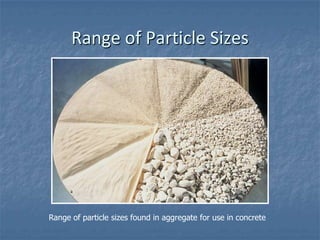
Range of Particle Sizes


Range of particle sizes found in aggregate for use in concrete
Grading of Aggregate
Grading is the particle-size distribution of an aggregate
as determined by a sieve analysis using wire mesh
sieves with square openings.

ASTM C 33:

Fine aggregate―7 standard sieves with openings from
  0.15 mm to 9.5 mm                             (No.
  100 to 3/8 in.)
Coarse aggregate―13 sieves with openings from 1.18
  mm to 100 mm                    (0.046 in. to 4 in.)
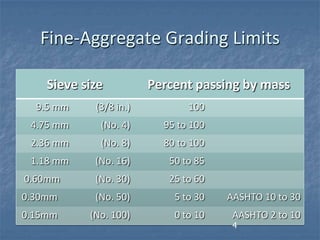
Fine-Aggregate Grading Limits

    Sieve size          Percent passing by mass
  9.5 mm    (3/8 in.)          100
 4.75 mm     (No. 4)      95 to 100
 2.36 mm     (No. 8)      80 to 100
 1.18 mm    (No. 16)       50 to 85
0.60mm      (No. 30)       25 to 60
0.30mm      (No. 50)        5 to 30   AASHTO 10 to 30
0.15mm     (No. 100)        0 to 10    AASHTO 2 to 10
                                       4
Fineness Modulus (FM)
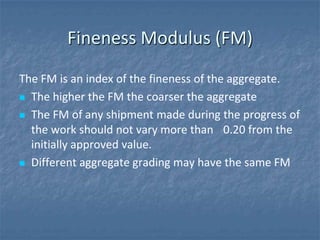
The FM is an index of the fineness of the aggregate.
 The higher the FM the coarser the aggregate

 The FM of any shipment made during the progress of
  the work should not vary more than 0.20 from the
  initially approved value.
 Different aggregate grading may have the same FM
Fineness Modulus (FM)
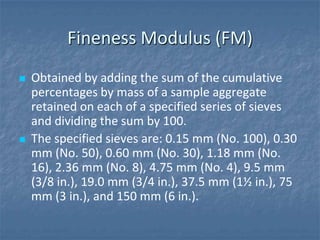
   Obtained by adding the sum of the cumulative
    percentages by mass of a sample aggregate
    retained on each of a specified series of sieves
    and dividing the sum by 100.
   The specified sieves are: 0.15 mm (No. 100), 0.30
    mm (No. 50), 0.60 mm (No. 30), 1.18 mm (No.
    16), 2.36 mm (No. 8), 4.75 mm (No. 4), 9.5 mm
    (3/8 in.), 19.0 mm (3/4 in.), 37.5 mm (1½ in.), 75
    mm (3 in.), and 150 mm (6 in.).
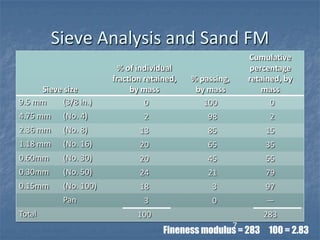
Sieve Analysis and Sand FM
                                                              Cumulative
                          % of individual                      percentage
                        fraction retained,   % passing,       retained, by
     Sieve size              by mass          by mass             mass
9.5 mm     (3/8 in.)             0              100                 0
4.75 mm     (No. 4)             2                98                2
2.36 mm     (No. 8)            13                85               15
1.18 mm     (No. 16)           20                65               35
0.60mm      (No. 30)           20                45               55
0.30mm      (No. 50)           24                21               79
0.15mm      (No. 100)          18                 3               97
            Pan                 3                 0               —
Total                          100                                283
                                                          7
                                      Fineness modulus = 283 100 = 2.83
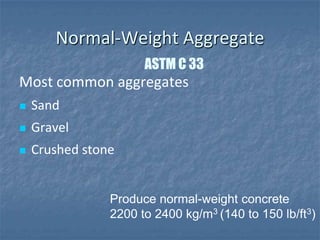
Normal-Weight Aggregate
                      ASTM C 33
Most common aggregates
   Sand
   Gravel
   Crushed stone


                Produce normal-weight concrete
                2200 to 2400 kg/m3 (140 to 150 lb/ft3)
Lightweight Aggregate
                       ASTM C 330
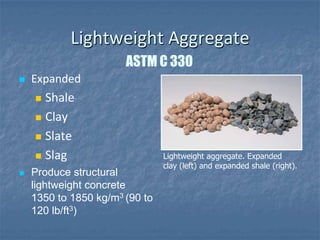
   Expanded
     Shale
     Clay

     Slate

     Slag                      Lightweight aggregate. Expanded
                                clay (left) and expanded shale (right).
   Produce structural
    lightweight concrete
    1350 to 1850 kg/m3 (90 to
    120 lb/ft3)
Lightweight Aggregate

   Pumice        Produce lightweight insulating
   Scoria        concrete— 250 to 1450 kg/m3
                  (15 to 90 lb/ft3)
   Perlite
   Vermiculite
   Diatomite
Heavyweight Aggregate
        ASTM C 637, C 638 (Radiation Shielding)
   Barite
   Limonite
                   Produce high-density concrete up
   Magnetite
                   to 6400 kg/m3 (400 lb/ft3)
   Ilmenite
   Hematite
   Iron
   Steel punchings or shot
                                        11
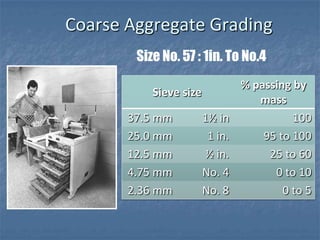
Coarse Aggregate Grading
        Size No. 57 : 1in. To No.4
                                 % passing by
           Sieve size
                                    mass
       37.5 mm          1½ in              100
       25.0 mm           1 in.       95 to 100
       12.5 mm           ½ in.        25 to 60
       4.75 mm          No. 4          0 to 10
       2.36 mm          No. 8            0 to 5
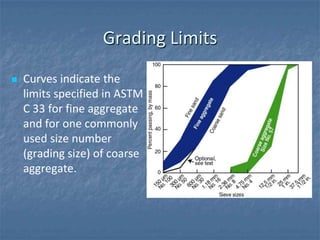
Grading Limits
   Curves indicate the
    limits specified in ASTM
    C 33 for fine aggregate
    and for one commonly
    used size number
    (grading size) of coarse
    aggregate.
Maximum Size vs. Nominal Maximum
       Size of Aggregate
   Maximum size ― is the smallest sieve that all
    of a particular aggregate must pass through.
   Nominal maximum size ― is the standard
    sieve opening immediately smaller than the
    smallest through which all of the aggregate
    must pass.
   The nominal maximum-size sieve may retain
    5% to 15%
Nominal Maximum Size of Aggregate

   Size should not exceed ―
        1/5 then narrowest dimension between sides of
         forms
        3/4 clear spacing between rebars and between
         rebars and the form
        1/3 depth of slabs
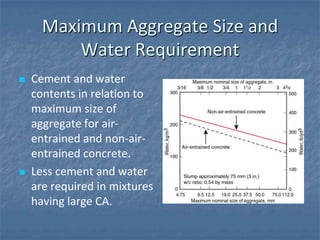
Maximum Aggregate Size and
          Water Requirement
   Cement and water
    contents in relation to
    maximum size of
    aggregate for air-
    entrained and non-air-
    entrained concrete.
   Less cement and water
    are required in mixtures
    having large CA.
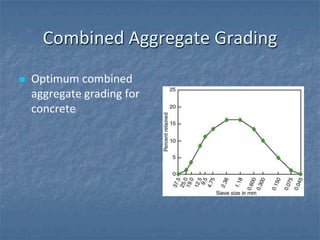
Combined Aggregate Grading
   Optimum combined
    aggregate grading for
    concrete
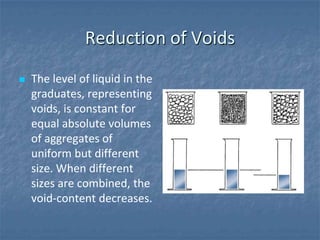
Reduction of Voids
   The level of liquid in the
    graduates, representing
    voids, is constant for
    equal absolute volumes
    of aggregates of
    uniform but different
    size. When different
    sizes are combined, the
    void-content decreases.
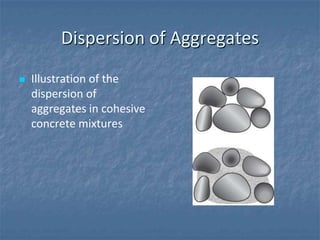
Dispersion of Aggregates
   Illustration of the
    dispersion of
    aggregates in cohesive
    concrete mixtures
MDOT Types of Approved Aggregates

   Natural Aggregates
   Slag Aggregates
   Manufactured Aggregates
   Natural Sands
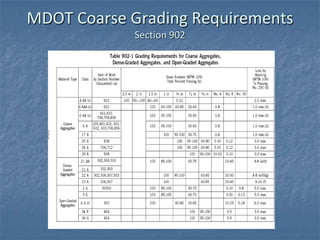
MDOT Coarse Grading Requirements
            Section 902
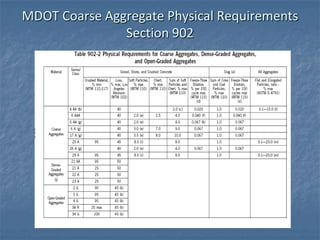
MDOT Coarse Aggregate Physical Requirements
               Section 902
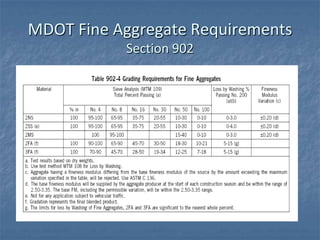
MDOT Fine Aggregate Requirements
           Section 902
Standards and Evaluation
Please return to Blackboard and watch the following
videos:
 Video 1: Fine Aggregates

 Video 2: Grading Limits

 Video 3: Gap Graded Aggregate

 Video 4: Maximum Size of Aggregate

 Video 5: Nominal Maximum Size of Aggregate

 Video 6: Reduction of Voids

CON 121 Session 3 - Standards and Evaluation

  • 1.
    CON 121 Concrete Aggregate Session3 Fine and Coarse Concrete Aggregates Standards and Evaluation
  • 2.
    Range of ParticleSizes Range of particle sizes found in aggregate for use in concrete
  • 3.
    Grading of Aggregate Gradingis the particle-size distribution of an aggregate as determined by a sieve analysis using wire mesh sieves with square openings. ASTM C 33: Fine aggregate―7 standard sieves with openings from 0.15 mm to 9.5 mm (No. 100 to 3/8 in.) Coarse aggregate―13 sieves with openings from 1.18 mm to 100 mm (0.046 in. to 4 in.)
  • 4.
    Fine-Aggregate Grading Limits Sieve size Percent passing by mass 9.5 mm (3/8 in.) 100 4.75 mm (No. 4) 95 to 100 2.36 mm (No. 8) 80 to 100 1.18 mm (No. 16) 50 to 85 0.60mm (No. 30) 25 to 60 0.30mm (No. 50) 5 to 30 AASHTO 10 to 30 0.15mm (No. 100) 0 to 10 AASHTO 2 to 10 4
  • 5.
    Fineness Modulus (FM) TheFM is an index of the fineness of the aggregate.  The higher the FM the coarser the aggregate  The FM of any shipment made during the progress of the work should not vary more than 0.20 from the initially approved value.  Different aggregate grading may have the same FM
  • 6.
    Fineness Modulus (FM)  Obtained by adding the sum of the cumulative percentages by mass of a sample aggregate retained on each of a specified series of sieves and dividing the sum by 100.  The specified sieves are: 0.15 mm (No. 100), 0.30 mm (No. 50), 0.60 mm (No. 30), 1.18 mm (No. 16), 2.36 mm (No. 8), 4.75 mm (No. 4), 9.5 mm (3/8 in.), 19.0 mm (3/4 in.), 37.5 mm (1½ in.), 75 mm (3 in.), and 150 mm (6 in.).
  • 7.
    Sieve Analysis andSand FM Cumulative % of individual percentage fraction retained, % passing, retained, by Sieve size by mass by mass mass 9.5 mm (3/8 in.) 0 100 0 4.75 mm (No. 4) 2 98 2 2.36 mm (No. 8) 13 85 15 1.18 mm (No. 16) 20 65 35 0.60mm (No. 30) 20 45 55 0.30mm (No. 50) 24 21 79 0.15mm (No. 100) 18 3 97 Pan 3 0 — Total 100 283 7 Fineness modulus = 283 100 = 2.83
  • 8.
    Normal-Weight Aggregate ASTM C 33 Most common aggregates  Sand  Gravel  Crushed stone Produce normal-weight concrete 2200 to 2400 kg/m3 (140 to 150 lb/ft3)
  • 9.
    Lightweight Aggregate ASTM C 330  Expanded  Shale  Clay  Slate  Slag Lightweight aggregate. Expanded clay (left) and expanded shale (right).  Produce structural lightweight concrete 1350 to 1850 kg/m3 (90 to 120 lb/ft3)
  • 10.
    Lightweight Aggregate  Pumice Produce lightweight insulating  Scoria concrete— 250 to 1450 kg/m3 (15 to 90 lb/ft3)  Perlite  Vermiculite  Diatomite
  • 11.
    Heavyweight Aggregate ASTM C 637, C 638 (Radiation Shielding)  Barite  Limonite Produce high-density concrete up  Magnetite to 6400 kg/m3 (400 lb/ft3)  Ilmenite  Hematite  Iron  Steel punchings or shot 11
  • 12.
    Coarse Aggregate Grading Size No. 57 : 1in. To No.4 % passing by Sieve size mass 37.5 mm 1½ in 100 25.0 mm 1 in. 95 to 100 12.5 mm ½ in. 25 to 60 4.75 mm No. 4 0 to 10 2.36 mm No. 8 0 to 5
  • 13.
    Grading Limits  Curves indicate the limits specified in ASTM C 33 for fine aggregate and for one commonly used size number (grading size) of coarse aggregate.
  • 14.
    Maximum Size vs.Nominal Maximum Size of Aggregate  Maximum size ― is the smallest sieve that all of a particular aggregate must pass through.  Nominal maximum size ― is the standard sieve opening immediately smaller than the smallest through which all of the aggregate must pass.  The nominal maximum-size sieve may retain 5% to 15%
  • 15.
    Nominal Maximum Sizeof Aggregate  Size should not exceed ―  1/5 then narrowest dimension between sides of forms  3/4 clear spacing between rebars and between rebars and the form  1/3 depth of slabs
  • 16.
    Maximum Aggregate Sizeand Water Requirement  Cement and water contents in relation to maximum size of aggregate for air- entrained and non-air- entrained concrete.  Less cement and water are required in mixtures having large CA.
  • 17.
    Combined Aggregate Grading  Optimum combined aggregate grading for concrete
  • 18.
    Reduction of Voids  The level of liquid in the graduates, representing voids, is constant for equal absolute volumes of aggregates of uniform but different size. When different sizes are combined, the void-content decreases.
  • 19.
    Dispersion of Aggregates  Illustration of the dispersion of aggregates in cohesive concrete mixtures
  • 20.
    MDOT Types ofApproved Aggregates  Natural Aggregates  Slag Aggregates  Manufactured Aggregates  Natural Sands
  • 21.
    MDOT Coarse GradingRequirements Section 902
  • 22.
    MDOT Coarse AggregatePhysical Requirements Section 902
  • 23.
    MDOT Fine AggregateRequirements Section 902
  • 24.
    Standards and Evaluation Pleasereturn to Blackboard and watch the following videos:  Video 1: Fine Aggregates  Video 2: Grading Limits  Video 3: Gap Graded Aggregate  Video 4: Maximum Size of Aggregate  Video 5: Nominal Maximum Size of Aggregate  Video 6: Reduction of Voids