Tata Projects Limited
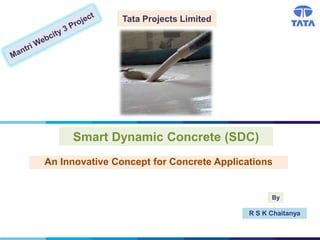
Smart Dynamic Concrete (SDC)
R S K Chaitanya
By
An Innovative Concept for Concrete Applications
1. What was the Highest Grade of Concrete Used So far
In India ?
In the World ?
2. Concept of SCC was developed in Japan in the 1980’s,
used in precast concrete.
3. What is SDC ?
Facts and Figures
1. What was the Highest Grade of Concrete Used So far
In India ?
In the World ?
2. Concept of SCC was developed in Japan in the 1980’s,
used in precast concrete.
3. SDC replaces the concept of SCC
Facts and Figures
Introduction
M- 120 was Used so far in India.
M-200 was Used in Japan.
When Height of structure increases “Modulus of Elasticity” matters.
In “Burj Khalifa” sway was 900mm from centre at Peak.
Coefficient of thermal expansion is less in Lime aggregate and more in
normal aggregate.
Reynolds Number – Comes in Concrete Technology.
Plastic Mix to Fluid Mix.
Apart from Sp.gravity of materials - particle size matters in Concrete
20mm – 90 microns – 45 microns.
(Cement) (Fly ash)
Revometers are using for the same.
Pumping of Concrete : 200m – 300m – 623m (Burj Khalifa) with
400BHP Pump
Dynamic Load will push Concrete. If you reduce the friction in a pipe line,
can pump to more heights.
Horizontal Pumping was done up to 1.5 Km.
Revology of Mix.
World started thinking concrete as “Chemical”
Introduction
SDC
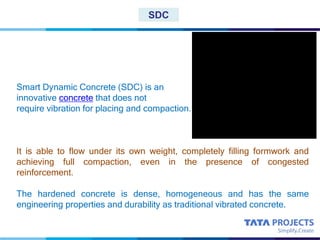
Smart Dynamic Concrete (SDC) is an
innovative concrete that does not
require vibration for placing and compaction.
It is able to flow under its own weight, completely filling formwork and
achieving full compaction, even in the presence of congested
reinforcement.
The hardened concrete is dense, homogeneous and has the same
engineering properties and durability as traditional vibrated concrete.
SDC
Smart Dynamic Concrete offers a rapid rate of concrete placement,
with faster construction times and ease of flow around congested
reinforcement.
The fluidity and segregation resistance of SDC ensures a high level of
homogeneity, minimal concrete voids and uniform concrete strength,
providing the potential for a superior level of finish and durability to the
structure.
SDC is often produced with low water-cement ratio providing the potential
for high early strength, earlier demoulding and faster use of elements and
structures.
Contents
1. Market Needs and Challenges
2. SDC – Features and Benefits
3. Specifications of SDC
4. SDC References
5. Value Proposition
1. Market Needs and Challenges
Challenges and Customer needs
Speed of Construction
 Use of variety of binders for concrete
 New technologies in formwork
 Availability of skilled labour
Crusher Dust and variations
 Longer workability retention
 Strength development
 Durability of Concrete
1. Market Needs and Challenges
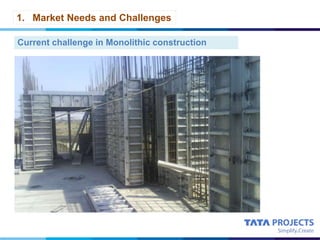
Current challenge in Monolithic construction
1. Market Needs and Challenges
Challenges in Concrete Placement Issue 1 : Compaction
1. Market Needs and Challenges
Current challenge in Monolithic construction
Issues with high flow concrete
Productivity loss
Repair
1. Market Needs and Challenges
Issue 2 : Management of Skilled Workforce
Management of Skilled Work force
Workmanship Control !!!
1. Market Needs and Challenges
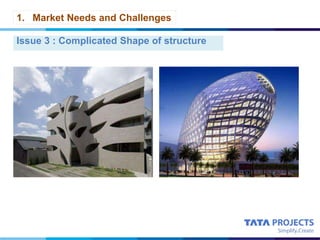
Issue 3 : Complicated Shape of structure
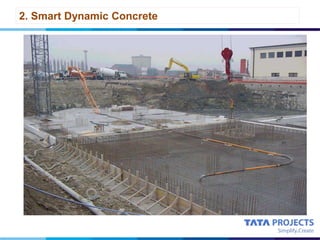
2. Smart Dynamic Concrete
The Everyday Concrete
The new state of the art technology allows to produce a concrete that is
 Without aid of Vibration
 Can be used in grades 20-40 Mpa
 with optimum cementious content
 resulting in overall savings in construction –save time and money
 This concrete adds economical, ecological and ergonomicalvalues to
concrete
2. Smart Dynamic Concrete
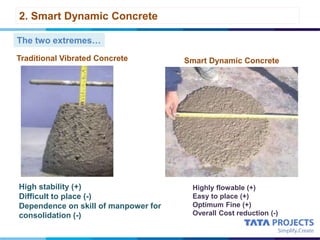
The two extremes…
Traditional Vibrated Concrete Smart Dynamic Concrete
High stability (+)
Difficult to place (-)
Dependence on skill of manpower for
consolidation (-)
Highly flowable (+)
Easy to place (+)
Optimum Fine (+)
Overall Cost reduction (-)
2. Smart Dynamic Concrete
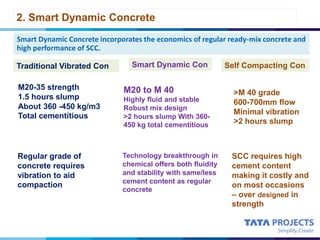
Smart Dynamic Concrete incorporates the economics of regular ready-mix concrete and
high performance of SCC.
Traditional Vibrated Con Smart Dynamic Con Self Compacting Con
M20-35 strength
1.5 hours slump
About 360 -450 kg/m3
Total cementitious
Regular grade of
concrete requires
vibration to aid
compaction
M20 to M 40
Highly fluid and stable
Robust mix design
>2 hours slump With 360-
450 kg total cementitious
Technology breakthrough in
chemical offers both fluidity
and stability with same/less
cement content as regular
concrete
>M 40 grade
600-700mm flow
Minimal vibration
>2 hours slump
SCC requires high
cement content
making it costly and
on most occasions
– over designed in
strength
2. Benefits of SDC
Binder
Content
Aggr
content
Admixture Admix
%
Slump
flow
Strength Strength Strength
3 Days 7 Days 28 Days
400 Kgs 1750 Kgs Glenium
8600 series
0.8% 600
mm
15 28 42
For M 30
Early de shuttering-16hrs
Early strength- <50% in 3 days
Binder –Portland Slag Cement with
Improves Cycle Time
Economical SCC Mix
3. SDC Specification in India
SDC is low fines Self Compacting concrete
SCC for M20 –M40 branded as SDC
Space between reinforcement should be greater than 100 mm
Less than 100 mm –classical SCC is recommended
Testing criteria that should be fulfilled for SDC as per EFNARC at the time of
pour
Filling ability –Slump Flow SF1 Value
Viscosity –T500 Value & VF2
Segregation Resistance –V Funnel @ 5 minutes
Passing Ability –Not required to test for Space between reinforcement > 100 mm
(Source: According to EFNARC guidelines)
No vibration to allowed
3. SDC Performance Requirement @ the Time of Pour
Test Criteria Test Methods Specification
Filling Ability Slump Flow (SF1) mm 550 to 650
Viscosité VS2 (T500) sec ≥ 2
Viscosity V Funnel VF2 sec 5 to 25
Segregation Resistance V Funnel@ 5 Minutes sec ±3
Site Lab Level Test
Test Near Pouring Point
Test Criteria Test Methods Specification
Filling Ability Slump Flow (SF1) mm 550 to 650
Visual Stability Index VSI value sec 0 or 1
Slump-flow
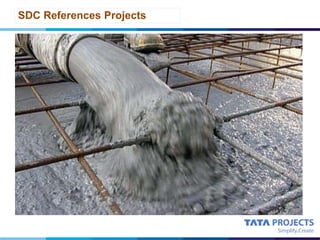
SDC References Projects
If Grade of Concrete Increases :
More space – Lesser Structure Size
Feasibility to plan more heights
More Earthquake Resistance.
Durability of Concrete :
Carbonisation of concrete – CO2 enters in to concrete and
dissolves with cement becomes “carbonic acid”.
Micro Silica reduces porosity of concrete – 5 to 6% increase in
concrete does not effect strength.
5. Value Proposition
More fillers of filling voids of cement reduces porosity of concrete.
We Can replace Cement with Flyash by 50 to 55%.
GGBFS – Ground Granulated Blast Furnace Slag can use up to 50
to 70%.
RCPT – Rapid Chloride Penetration Test measures in Culhoms.
Keep in mind durability than strength – achieve raft of M-30
strength of 30 N/mm2 in 60 days rather than 28 days.
RCPT – Rapid Chloride Penetration Test measures in Culhoms.
Air content will be one of the durability check for green concrete.
5. Value Proposition
World advancing towards higher grade of concretes – M 200
Where we are ????
Concrete is no more semi solid mix– its time to think it as Chemical.
Are we ready ????
We are using modular shuttering but as we are imagining 550 -
600mm Slump ???
Is Recent Nepal natural calamity teaches us - In Future Earthquake
resistance structures required or not ???
We need to start thinking !!!!
Conclusion
Thank You

Smart Dynamic Concrete

  • 1.
    Tata Projects Limited SmartDynamic Concrete (SDC) R S K Chaitanya By An Innovative Concept for Concrete Applications
  • 2.
    1. What wasthe Highest Grade of Concrete Used So far In India ? In the World ? 2. Concept of SCC was developed in Japan in the 1980’s, used in precast concrete. 3. What is SDC ? Facts and Figures
  • 3.
    1. What wasthe Highest Grade of Concrete Used So far In India ? In the World ? 2. Concept of SCC was developed in Japan in the 1980’s, used in precast concrete. 3. SDC replaces the concept of SCC Facts and Figures
  • 4.
    Introduction M- 120 wasUsed so far in India. M-200 was Used in Japan. When Height of structure increases “Modulus of Elasticity” matters. In “Burj Khalifa” sway was 900mm from centre at Peak. Coefficient of thermal expansion is less in Lime aggregate and more in normal aggregate. Reynolds Number – Comes in Concrete Technology. Plastic Mix to Fluid Mix. Apart from Sp.gravity of materials - particle size matters in Concrete
  • 5.
    20mm – 90microns – 45 microns. (Cement) (Fly ash) Revometers are using for the same. Pumping of Concrete : 200m – 300m – 623m (Burj Khalifa) with 400BHP Pump Dynamic Load will push Concrete. If you reduce the friction in a pipe line, can pump to more heights. Horizontal Pumping was done up to 1.5 Km. Revology of Mix. World started thinking concrete as “Chemical” Introduction
  • 6.
    SDC Smart Dynamic Concrete(SDC) is an innovative concrete that does not require vibration for placing and compaction. It is able to flow under its own weight, completely filling formwork and achieving full compaction, even in the presence of congested reinforcement. The hardened concrete is dense, homogeneous and has the same engineering properties and durability as traditional vibrated concrete.
  • 7.
    SDC Smart Dynamic Concreteoffers a rapid rate of concrete placement, with faster construction times and ease of flow around congested reinforcement. The fluidity and segregation resistance of SDC ensures a high level of homogeneity, minimal concrete voids and uniform concrete strength, providing the potential for a superior level of finish and durability to the structure. SDC is often produced with low water-cement ratio providing the potential for high early strength, earlier demoulding and faster use of elements and structures.
  • 8.
    Contents 1. Market Needsand Challenges 2. SDC – Features and Benefits 3. Specifications of SDC 4. SDC References 5. Value Proposition
  • 9.
    1. Market Needsand Challenges Challenges and Customer needs Speed of Construction  Use of variety of binders for concrete  New technologies in formwork  Availability of skilled labour Crusher Dust and variations  Longer workability retention  Strength development  Durability of Concrete
  • 10.
    1. Market Needsand Challenges Current challenge in Monolithic construction
  • 11.
    1. Market Needsand Challenges Challenges in Concrete Placement Issue 1 : Compaction
  • 12.
    1. Market Needsand Challenges Current challenge in Monolithic construction Issues with high flow concrete Productivity loss Repair
  • 13.
    1. Market Needsand Challenges Issue 2 : Management of Skilled Workforce Management of Skilled Work force Workmanship Control !!!
  • 14.
    1. Market Needsand Challenges Issue 3 : Complicated Shape of structure
  • 15.
  • 16.
    2. Smart DynamicConcrete The Everyday Concrete The new state of the art technology allows to produce a concrete that is  Without aid of Vibration  Can be used in grades 20-40 Mpa  with optimum cementious content  resulting in overall savings in construction –save time and money  This concrete adds economical, ecological and ergonomicalvalues to concrete
  • 17.
    2. Smart DynamicConcrete The two extremes… Traditional Vibrated Concrete Smart Dynamic Concrete High stability (+) Difficult to place (-) Dependence on skill of manpower for consolidation (-) Highly flowable (+) Easy to place (+) Optimum Fine (+) Overall Cost reduction (-)
  • 18.
    2. Smart DynamicConcrete Smart Dynamic Concrete incorporates the economics of regular ready-mix concrete and high performance of SCC. Traditional Vibrated Con Smart Dynamic Con Self Compacting Con M20-35 strength 1.5 hours slump About 360 -450 kg/m3 Total cementitious Regular grade of concrete requires vibration to aid compaction M20 to M 40 Highly fluid and stable Robust mix design >2 hours slump With 360- 450 kg total cementitious Technology breakthrough in chemical offers both fluidity and stability with same/less cement content as regular concrete >M 40 grade 600-700mm flow Minimal vibration >2 hours slump SCC requires high cement content making it costly and on most occasions – over designed in strength
  • 19.
    2. Benefits ofSDC Binder Content Aggr content Admixture Admix % Slump flow Strength Strength Strength 3 Days 7 Days 28 Days 400 Kgs 1750 Kgs Glenium 8600 series 0.8% 600 mm 15 28 42 For M 30 Early de shuttering-16hrs Early strength- <50% in 3 days Binder –Portland Slag Cement with Improves Cycle Time Economical SCC Mix
  • 20.
    3. SDC Specificationin India SDC is low fines Self Compacting concrete SCC for M20 –M40 branded as SDC Space between reinforcement should be greater than 100 mm Less than 100 mm –classical SCC is recommended Testing criteria that should be fulfilled for SDC as per EFNARC at the time of pour Filling ability –Slump Flow SF1 Value Viscosity –T500 Value & VF2 Segregation Resistance –V Funnel @ 5 minutes Passing Ability –Not required to test for Space between reinforcement > 100 mm (Source: According to EFNARC guidelines) No vibration to allowed
  • 21.
    3. SDC PerformanceRequirement @ the Time of Pour Test Criteria Test Methods Specification Filling Ability Slump Flow (SF1) mm 550 to 650 Viscosité VS2 (T500) sec ≥ 2 Viscosity V Funnel VF2 sec 5 to 25 Segregation Resistance V Funnel@ 5 Minutes sec ±3 Site Lab Level Test Test Near Pouring Point Test Criteria Test Methods Specification Filling Ability Slump Flow (SF1) mm 550 to 650 Visual Stability Index VSI value sec 0 or 1
  • 22.
  • 23.
  • 25.
    If Grade ofConcrete Increases : More space – Lesser Structure Size Feasibility to plan more heights More Earthquake Resistance. Durability of Concrete : Carbonisation of concrete – CO2 enters in to concrete and dissolves with cement becomes “carbonic acid”. Micro Silica reduces porosity of concrete – 5 to 6% increase in concrete does not effect strength. 5. Value Proposition
  • 26.
    More fillers offilling voids of cement reduces porosity of concrete. We Can replace Cement with Flyash by 50 to 55%. GGBFS – Ground Granulated Blast Furnace Slag can use up to 50 to 70%. RCPT – Rapid Chloride Penetration Test measures in Culhoms. Keep in mind durability than strength – achieve raft of M-30 strength of 30 N/mm2 in 60 days rather than 28 days. RCPT – Rapid Chloride Penetration Test measures in Culhoms. Air content will be one of the durability check for green concrete. 5. Value Proposition
  • 27.
    World advancing towardshigher grade of concretes – M 200 Where we are ???? Concrete is no more semi solid mix– its time to think it as Chemical. Are we ready ???? We are using modular shuttering but as we are imagining 550 - 600mm Slump ??? Is Recent Nepal natural calamity teaches us - In Future Earthquake resistance structures required or not ??? We need to start thinking !!!! Conclusion
  • 28.