






RESEARCH
Methodology
Lecture – 04 Scientific Based Of Research
By-Deepak Sharma
M.Sc. Chemistry Sem-III (Analytical & Organic)
M.Sc. (Analytical Chemistry), GATE, GSET
Research Scholar at HNGU
Asst. Professor (Department of Chemistry)
HVHP
Institute of P.G
Studies and Research
LECTURE CONTENT
SCIENTIFIC BASED OF
RESEARCH01
RESEARCH
APPROACHES02
SIGNIFICANCE OF
RESEARCH03
Deepak Sharma
Deepak Sharma
What do you know
about scientific
research?
SCIENTIFIC
BASED OF
RESEARCH
SCIENTIFIC BASED OF RESEARCH
Deepak Sharma
1. For clear perception about research one should know the
meaning of scientific method.
2. Scientific method is the pursuit of truth as determined by
logical considerations.
3. The ideal of science is to achieve a systematic interrelation
of facts. Scientific method attempts to achieve this ideal by
experimentation, observation, logical arguments from
accepted postulates and a combination of these three in
varying proportions.
Deepak Sharma
• The scientific method is based on certain basic postulates which
can be stated as follows. It…
 relies on empirical evidence,
 utilizes relevant concepts,
 is committed to only objective considerations,
 presupposes ethical neutrality,
 results into probabilistic predictions,
 is made known to all concerned through replication, and
 aims at formulating most general axioms.
SCIENTIFIC BASED OF RESEARCH
• Thus, scientific method implies an objective, logical and systematic method, i.e., a
method free from personal bias or prejudice, a method to ascertain demonstrable
qualities of a phenomenon capable of being verified, a method wherein the researcher
is guided by the rules of logical reasoning, a method wherein the investigation proceeds
in an orderly manner and a method that implies internal consistency.
Deepak Sharma
SCIENTIFIC BASED OF RESEARCH
Deepak Sharma
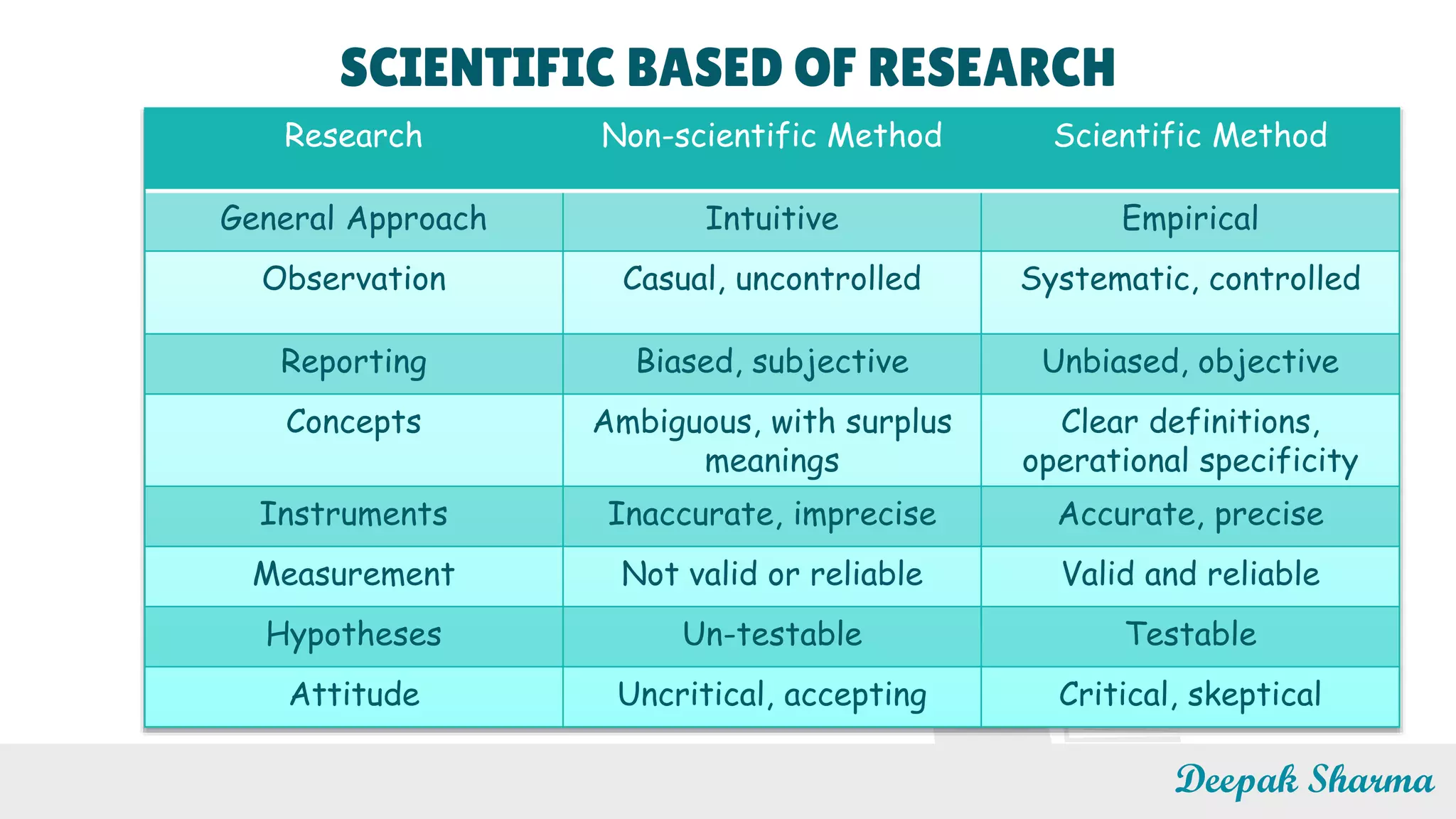
Research Non-scientific Method Scientific Method
General Approach Intuitive Empirical
Observation Casual, uncontrolled Systematic, controlled
Reporting Biased, subjective Unbiased, objective
Concepts Ambiguous, with surplus
meanings
Clear definitions,
operational specificity
Instruments Inaccurate, imprecise Accurate, precise
Measurement Not valid or reliable Valid and reliable
Hypotheses Un-testable Testable
Attitude Uncritical, accepting Critical, skeptical
RESEARCH
APPROACHES
Deepak Sharma
Deepak Sharma
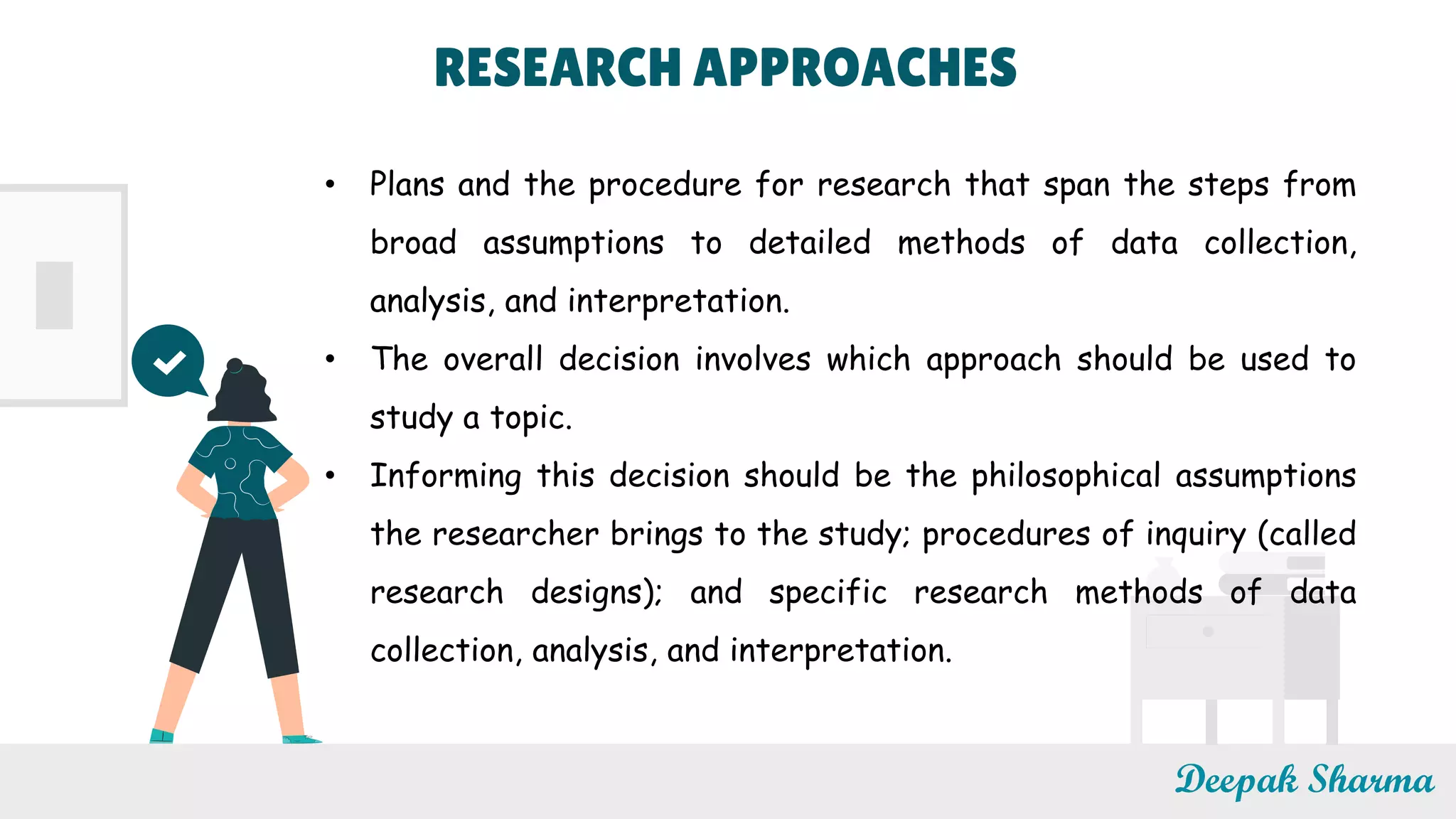
• Plans and the procedure for research that span the steps from
broad assumptions to detailed methods of data collection,
analysis, and interpretation.
• The overall decision involves which approach should be used to
study a topic.
• Informing this decision should be the philosophical assumptions
the researcher brings to the study; procedures of inquiry (called
research designs); and specific research methods of data
collection, analysis, and interpretation.
RESEARCH APPROACHES
RESEARCH APPROACHES
Deepak Sharma
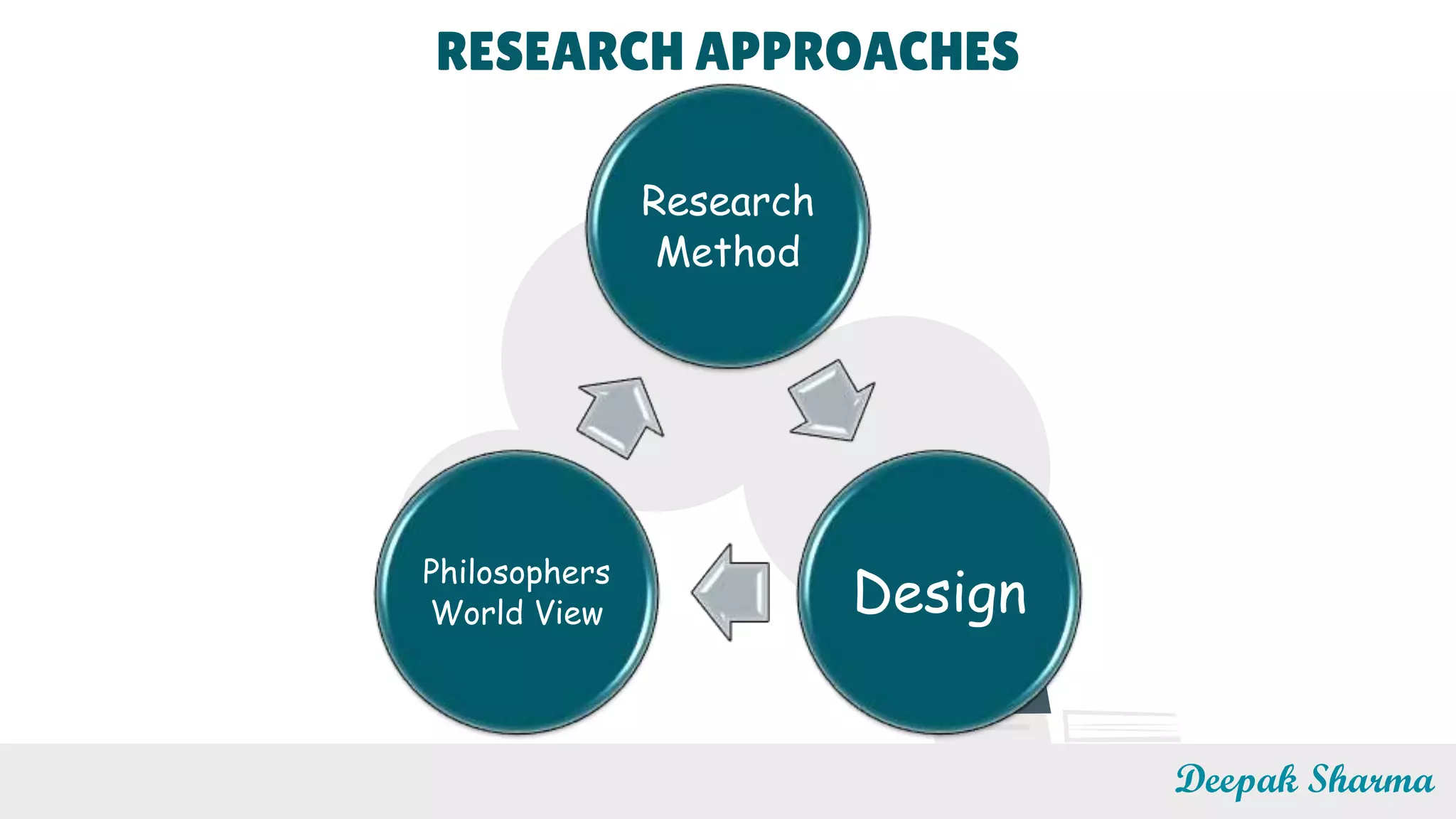
Research
Method
Design
Philosophers
World View
RESEARCH APPROACHES
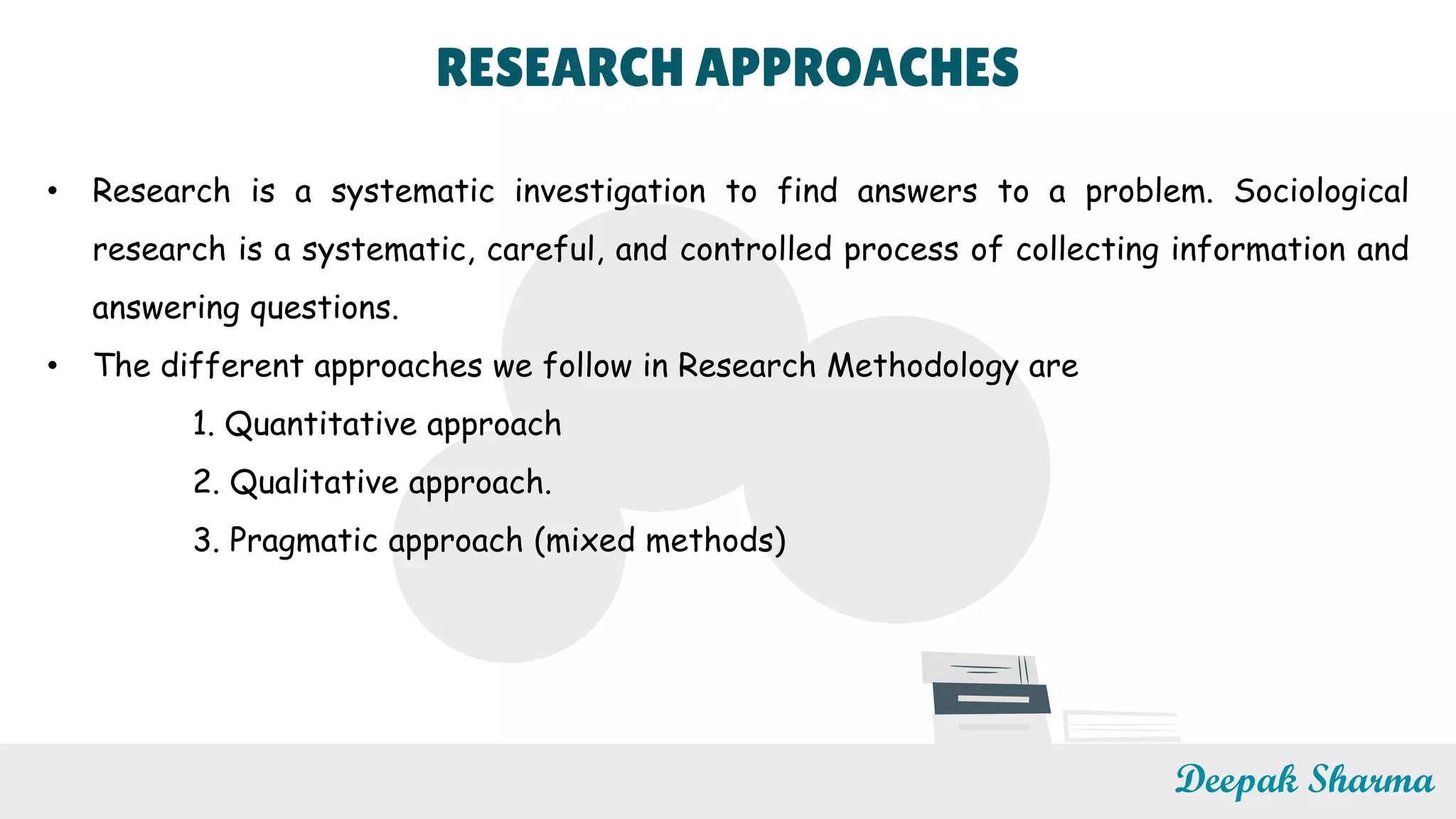
• Research is a systematic investigation to find answers to a problem. Sociological
research is a systematic, careful, and controlled process of collecting information and
answering questions.
• The different approaches we follow in Research Methodology are
1. Quantitative approach
2. Qualitative approach.
3. Pragmatic approach (mixed methods)
Deepak Sharma
1Quantitative
Approach
Deepak Sharma
Deepak Sharma
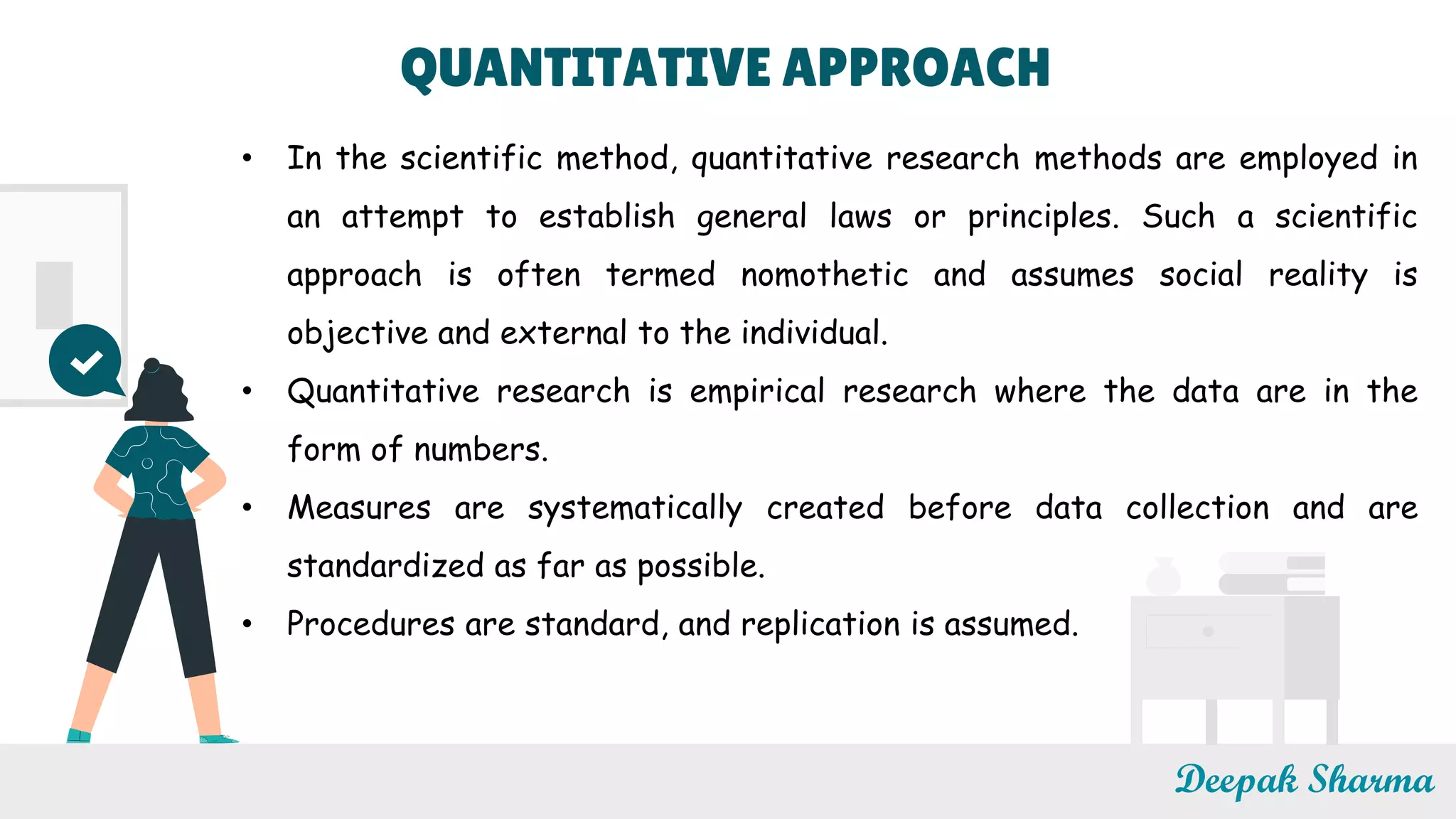
• In the scientific method, quantitative research methods are employed in
an attempt to establish general laws or principles. Such a scientific
approach is often termed nomothetic and assumes social reality is
objective and external to the individual.
• Quantitative research is empirical research where the data are in the
form of numbers.
• Measures are systematically created before data collection and are
standardized as far as possible.
• Procedures are standard, and replication is assumed.
QUANTITATIVE APPROACH
Deepak Sharma
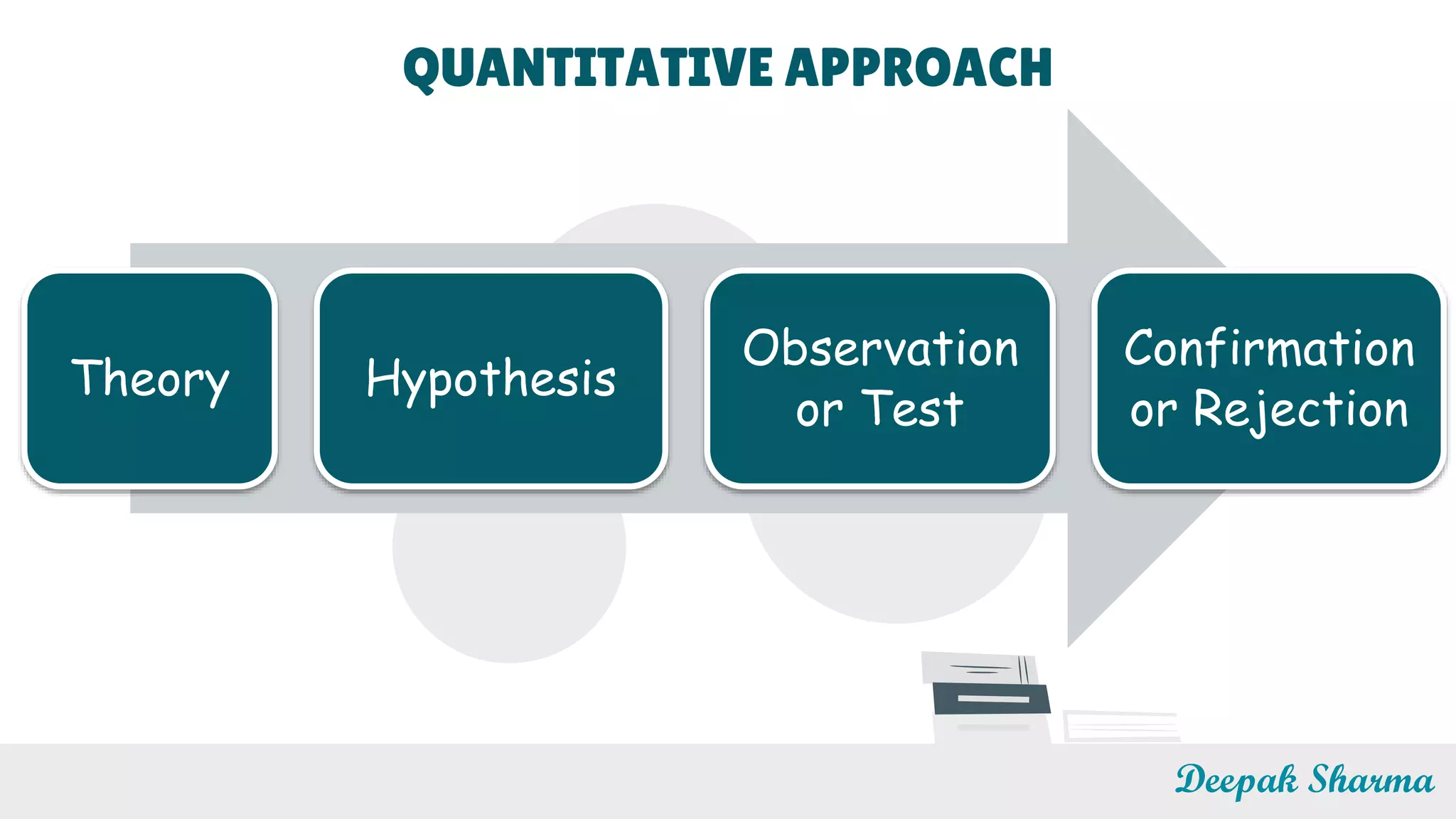
Theory Hypothesis
Observation
or Test
Confirmation
or Rejection
QUANTITATIVE APPROACH
• In the quantitative approach the generation of data is in quantitative form which can be
subjected to meticulous quantitative analysis in a formal and rigid fashion.
• This approach can be further sub-classified into inferential, experimental and simulation
approaches to research.
• It is often assumed that quantitative approaches draw on positivist ontologies.
• Quantitative approaches are strongly associated with objectivity. For Example, the
interviews may be structured and analyzed in a quantitative manner.
• Numeric data is collected or when nonnumeric answers are categorized and coded in
numeric form. Numerical data obtained through quantitative data approach facilitates
comparisons between subjects or groups, as well as allow the determination of the extent
of agreement or disagreement between respondents.
Deepak Sharma
STRENGTHS OF QUANTITATIVE RESEARCH
• The quantitative as survey approach has significant advantages like it can be
administered and evaluated quickly.
• Responses can be tabulated within a short timeframe. Quantitative data, which is
collected rigorously, using the appropriate methods and analyzed critically shows more
reliability.
• Quantitative research design is an excellent way of finalizing results and proving or
disproving a hypothesis.
• After statistical analysis of the results, a comprehensive answer is reached, and the
results can be legitimately discussed and published.
• Quantitative experiments also filter out external factors, if properly designed, and so
the results gained can be seen as real and unbiased.
Deepak Sharma
WEAKNESSES OF QUANTITATIVE RESEARCH
• Quantitative research has drawbacks to take account of people's unique ability to
interpret their experiences, construct their own meanings and act on these.
• Quantitative experiments can be difficult and expensive and require a lot of time to
perform.
• They must be carefully planned to ensure that there is complete randomization and
correct designation of control groups.
• Quantitative studies usually require extensive statistical analysis, which can be difficult,
due to most scientists not being statisticians. The field of statistical study is a whole
scientific discipline and can be difficult for non-mathematicians.
Deepak Sharma
WEAKNESSES OF QUANTITATIVE RESEARCH
• Quantitative research design also tends to generate only proved or unproven results,
with there being very little room for grey areas and uncertainty. For the social sciences,
education, anthropology and psychology, human nature is a lot more complex than just a
simple yes or no response.
• The research studying the perceptions and beliefs cannot be meaningfully reduced to
numbers.
• Quantitative research is weak in understanding the context or setting in which people
behave, something that qualitative research makes up for.
Deepak Sharma
2Qualitative
Research
Deepak Sharma
Deepak Sharma
• Qualitative, observational studies refer to traditions that base
their research upon qualitative data (as opposed to quantitative
research) and do not actively and purposely manipulate the
phenomenon under investigation.
• Grounded theory studies and ethnographic methods are
examples of this mode of research.
QUALITATIVE RESEARCH
• Qualitative Research is primarily exploratory research and it has the aim of
understanding experience as nearly as possible as its study subjects feel it. It is used
to gain an understanding of underlying reasons, opinions, and motivations of subjects.
• It provides insights into the problem or helps to develop ideas or hypotheses for
potential quantitative research.
• Generally, the techniques of focus group interviews, projective techniques and depth
interviews are used.
• Data from qualitative studies describes the qualities or characteristics of something.
Deepak Sharma
QUALITATIVE RESEARCH
• Qualitative research studies can provide the details about human behavior, emotion
and personality characteristics that quantitative studies cannot match.
• Qualitative data includes information about user behaviors, needs, desires, routines
and a variety of other information that is essential in designing a product that will
actually fit into a user’s life.
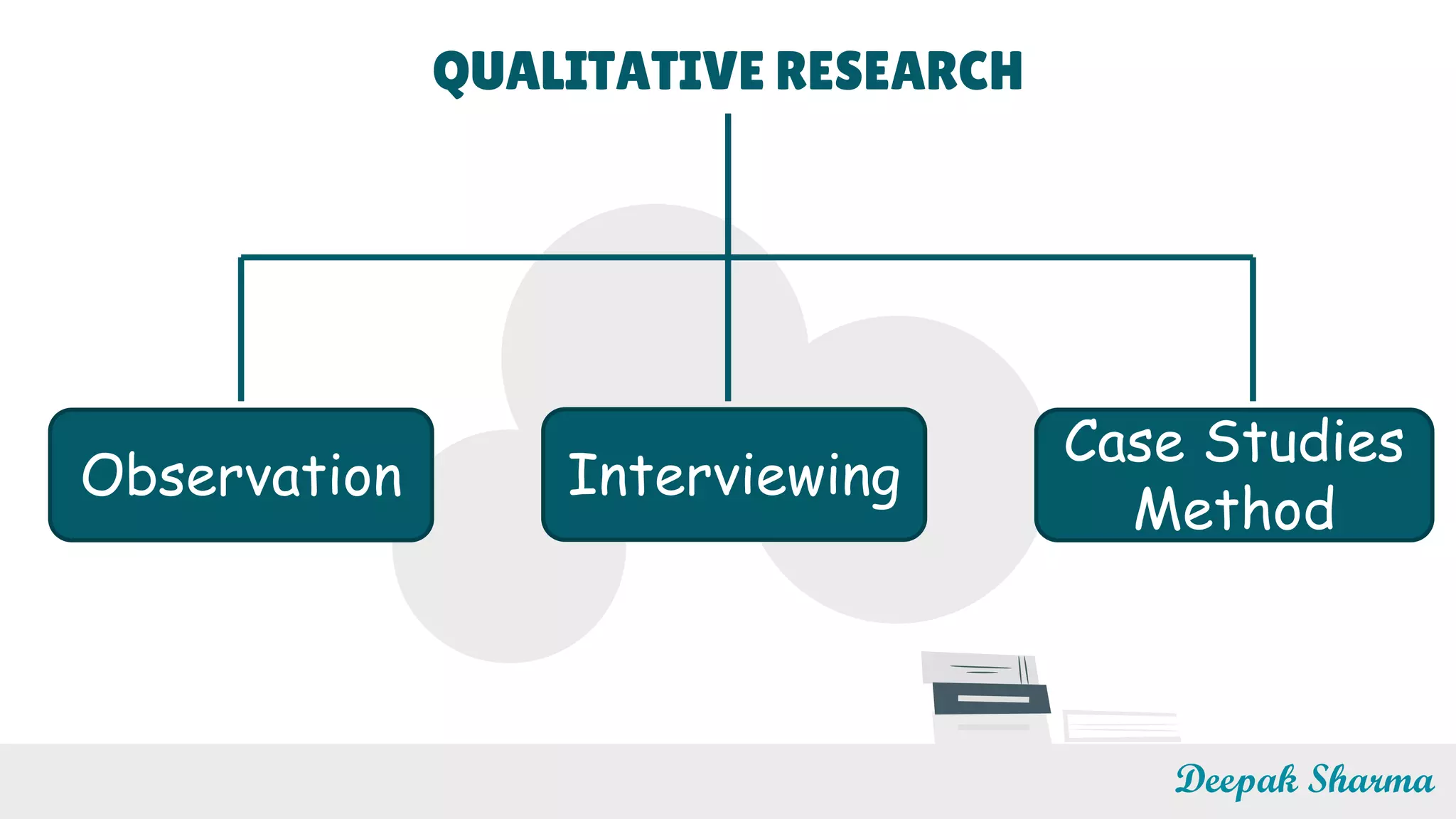
• Qualitative data are usually gathered by observation, interviews or focus groups,
projective techniques, but may also be gathered from written documents and through
case studies.
Deepak Sharma
QUALITATIVE RESEARCH
• In qualitative research there is more emphasis on describes the qualities or
characteristics of human behavior, emotion, personality characteristics, user
behaviors, needs, desires, and routines. Participants in qualitative studies often involve
smaller numbers of tools include and utilizes open-ended questionnaires interview
guides.
• This type of research is best used to answer how and why questions and is not well
suited to generalizables what, when and who questions.
Deepak Sharma
QUALITATIVE RESEARCH
Deepak Sharma
Observation Interviewing
Case Studies
Method
STRENGTHS OF QUALITATIVE APPROACH
• Qualitative techniques are extremely useful when a subject is too complex be answered
by a simple yes or no hypothesis.
• These types of designs are much easier to plan and carry out cultural assessment i.e.,
ability to probe for underlying values, beliefs, and assumptions.
• The broader scope covered by these designs ensures that some useful data is always
generated, whereas an unproved hypothesis in a quantitative experiment can mean that a
lot of time has been wasted. Qualitative research methods are not as dependent upon
sample sizes as quantitative methods; a case study, for example, can generate meaningful
results with a small sample group.
Deepak Sharma
WEAKNESS OF QUALITATIVE APPROACH
• Qualitative methods require a lot of careful thought and planning, to ensure that the
results obtained are as accurate as possible.
• Qualitative data cannot be mathematically analyzed in the same comprehensive way as
quantitative results, so can only give a guide to general trends.
• It is a lot more open to personal opinion and judgment, and so can only ever give
observations rather than results.
• Any qualitative research design is usually unique and cannot be exactly recreated,
meaning that they do lack the ability to be replicated.
Deepak Sharma
3Pragmatic
approach (Mixed
Methods)
Deepak Sharma
Deepak Sharma
• Researcher can use any of the methods, techniques and
procedures typically associated with quantitative or qualitative
research but researcher should be aware that every research
method has its limitations and that the different approaches can
be complementary.
Pragmatic approach (Mixed Methods)
PRAGMATIC APPROACH (MIXED METHODS)
• Researcher can use different methods at the same time or one after the other.
• For example, Researcher can start his research work based on empirical evidence with
qualitative research like focus group discussion and then use the findings to construct a
questionnaire to measure attitudes in a large scale sample with the aim of carrying out
statistical analysis.
• Depending on which measures have been used, the data collected is analyzed in the
appropriate manner.
• Mixing different approaches has the advantages of enabling triangulation, which is a
common feature of mixed research methods studies.
Deepak Sharma
STRENGTHS OF PRAGMATIC APPROACH
• Provides strengths that counterbalance the weaknesses of both quantitative and
qualitative research.
• By using both types of research, the strengths of each approach can make up for the
weaknesses of the other.
• Provides a more complete and comprehensive understanding of the research problem by
combining both quantitative and qualitative approaches.
Deepak Sharma
WEAKNESS OF PRAGMATIC APPROACH
• The research design can be very complex.
• Takes much more time and resources to plan and implement this type of research.
• It may be difficult to plan and implement one method by drawing on the findings of
another.
• It may be unclear how to resolve discrepancies that arise in the interpretation of the
findings.
Deepak Sharma
SIGNIFICANCE
OF RESEARCH
Deepak Sharma
SIGNIFICANCE OF RESEARCH
• “All progress is born of inquiry. Doubt is often better than overconfidence, for it leads
to inquiry, and inquiry leads to invention” is a famous Hudson Maxim in context of which
the significance of research can well be understood.
• Increased amounts of research make progress possible.
• Research inculcates scientific and inductive thinking and it promotes the development of
logical habits of thinking and organization.
• The role of research in several fields of applied economics, whether related to business
or to the economy as a whole, has greatly increased in modern times.
Deepak Sharma
SIGNIFICANCE OF RESEARCH
• The increasingly complex nature of business and government has focused attention on
the use of research in solving operational problems.
• Research, as an aid to economic policy, has gained added importance, both for
government and business.
• Research provides the basis for nearly all government policies in our economic system.
• For instance, government’s budgets rest in part on an analysis of the needs and desires
of the people and on the availability of revenues to meet these needs.
• The cost of needs has to be equated to probable revenues and this is a field where
research is most needed.
Deepak Sharma
SIGNIFICANCE OF RESEARCH
• Decision-making may not be a part of research, but research certainly facilitates the
decisions of the policy maker. Government has also to chalk out programmers for dealing
with all facets of the country’s existence and most of these will be related directly or
indirectly to economic conditions.
• The plight of cultivators, the problems of big and small business and industry, working
conditions, trade union activities, the problems of distribution, even the size and nature
of defense services are matters requiring research.
• Thus, research is considered necessary with regard to the allocation of nation’s
resources.
Deepak Sharma
SIGNIFICANCE OF RESEARCH
• These day nearly all governments maintain large staff of research technicians or experts
to carry on this work. Thus, in the context of government, research as a tool to economic
policy has three distinct phases of operation, viz.,
(i) investigation of economic structure through continual compilation of facts;
(ii) diagnosis of events that are taking place and the analysis of the forces underlying them;
(iii) the prognosis, i.e., the prediction of future developments.
• Research has also its special significance in solving various operational and planning
problems of business and industry.
Deepak Sharma
SIGNIFICANCE OF RESEARCH
• In addition to what has been stated above, the significance of research can also be
understood keeping in view the following points:
(a) To those students who are to write a master’s or Ph.D. thesis, research may mean a
careerism or a way to attain a high position in the social structure;
(b) To professionals in research methodology, research may mean a source of livelihood;
(c) To philosophers and thinkers, research may mean the outlet for new ideas and insights;
(d) To literary men and women, research may mean the development of new styles and
creative work;
(e) To analysts and intellectuals, research may mean the generalisations of new theories.
Deepak Sharma
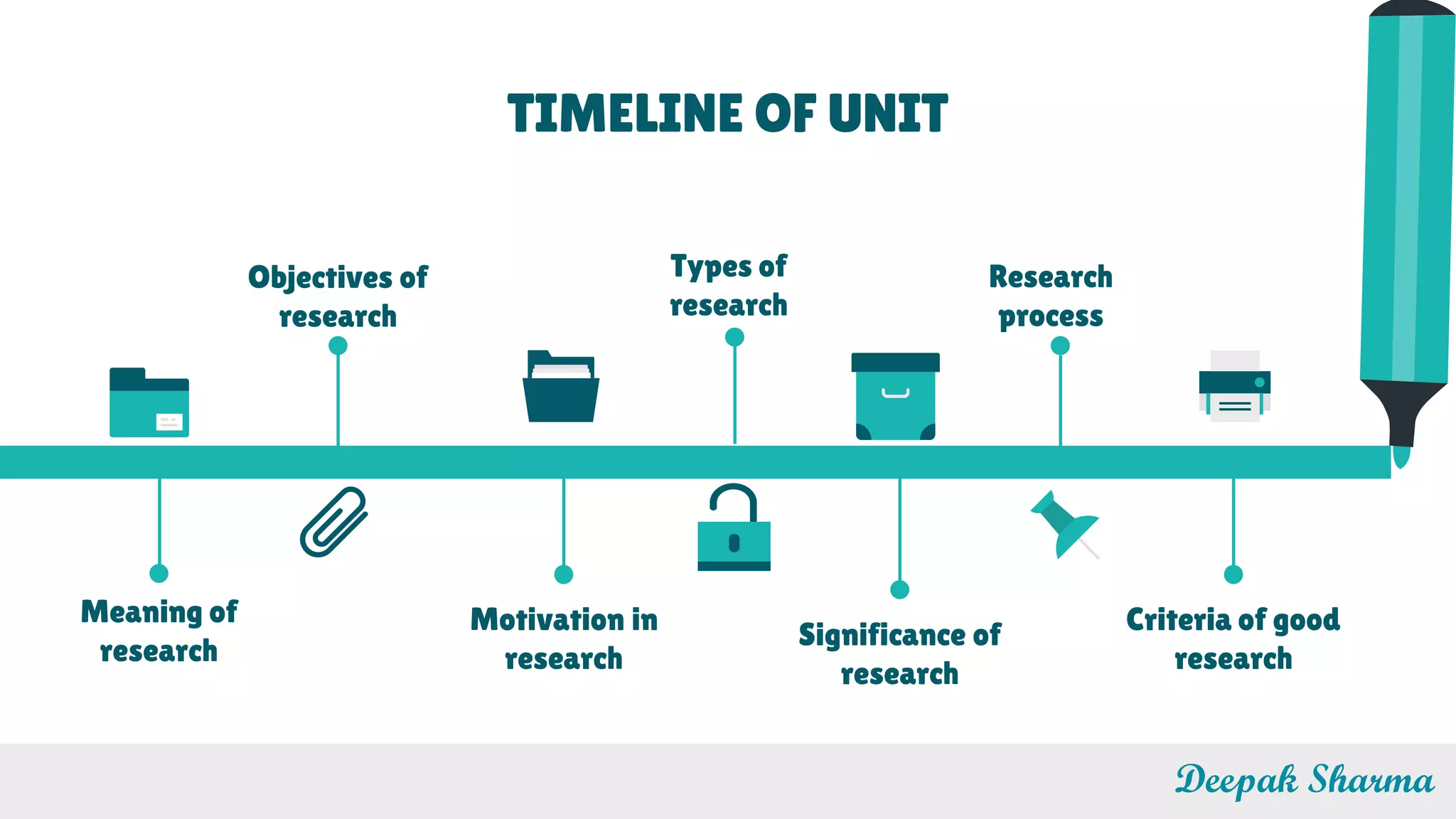
TIMELINE OF UNIT
Meaning of
research
Motivation in
research
Criteria of good
research
Objectives of
research
Research
process
Types of
research
Significance of
research
Deepak Sharma
CREDITS: This presentation template was created by
Slidesgo, including icons by Flaticon, and infographics &
images by Freepik
THANKS
Do you have any
questions?
Please keep this slide for attribution.

Lecture 04 Scientific Based of Research and Research Approches

  • 1.
    RESEARCH Methodology Lecture – 04Scientific Based Of Research By-Deepak Sharma M.Sc. Chemistry Sem-III (Analytical & Organic) M.Sc. (Analytical Chemistry), GATE, GSET Research Scholar at HNGU Asst. Professor (Department of Chemistry) HVHP Institute of P.G Studies and Research
  • 2.
    LECTURE CONTENT SCIENTIFIC BASEDOF RESEARCH01 RESEARCH APPROACHES02 SIGNIFICANCE OF RESEARCH03 Deepak Sharma
  • 3.
    Deepak Sharma What doyou know about scientific research? SCIENTIFIC BASED OF RESEARCH
  • 4.
    SCIENTIFIC BASED OFRESEARCH Deepak Sharma 1. For clear perception about research one should know the meaning of scientific method. 2. Scientific method is the pursuit of truth as determined by logical considerations. 3. The ideal of science is to achieve a systematic interrelation of facts. Scientific method attempts to achieve this ideal by experimentation, observation, logical arguments from accepted postulates and a combination of these three in varying proportions.
  • 5.
    Deepak Sharma • Thescientific method is based on certain basic postulates which can be stated as follows. It…  relies on empirical evidence,  utilizes relevant concepts,  is committed to only objective considerations,  presupposes ethical neutrality,  results into probabilistic predictions,  is made known to all concerned through replication, and  aims at formulating most general axioms. SCIENTIFIC BASED OF RESEARCH
  • 6.
    SCIENTIFIC BASED OFRESEARCH • Thus, scientific method implies an objective, logical and systematic method, i.e., a method free from personal bias or prejudice, a method to ascertain demonstrable qualities of a phenomenon capable of being verified, a method wherein the researcher is guided by the rules of logical reasoning, a method wherein the investigation proceeds in an orderly manner and a method that implies internal consistency. Deepak Sharma
  • 7.
    SCIENTIFIC BASED OFRESEARCH Deepak Sharma Research Non-scientific Method Scientific Method General Approach Intuitive Empirical Observation Casual, uncontrolled Systematic, controlled Reporting Biased, subjective Unbiased, objective Concepts Ambiguous, with surplus meanings Clear definitions, operational specificity Instruments Inaccurate, imprecise Accurate, precise Measurement Not valid or reliable Valid and reliable Hypotheses Un-testable Testable Attitude Uncritical, accepting Critical, skeptical
  • 8.
  • 9.
    Deepak Sharma • Plansand the procedure for research that span the steps from broad assumptions to detailed methods of data collection, analysis, and interpretation. • The overall decision involves which approach should be used to study a topic. • Informing this decision should be the philosophical assumptions the researcher brings to the study; procedures of inquiry (called research designs); and specific research methods of data collection, analysis, and interpretation. RESEARCH APPROACHES
  • 10.
  • 11.
    RESEARCH APPROACHES • Researchis a systematic investigation to find answers to a problem. Sociological research is a systematic, careful, and controlled process of collecting information and answering questions. • The different approaches we follow in Research Methodology are 1. Quantitative approach 2. Qualitative approach. 3. Pragmatic approach (mixed methods) Deepak Sharma
  • 12.
  • 13.
    Deepak Sharma • Inthe scientific method, quantitative research methods are employed in an attempt to establish general laws or principles. Such a scientific approach is often termed nomothetic and assumes social reality is objective and external to the individual. • Quantitative research is empirical research where the data are in the form of numbers. • Measures are systematically created before data collection and are standardized as far as possible. • Procedures are standard, and replication is assumed. QUANTITATIVE APPROACH
  • 14.
    QUANTITATIVE APPROACH Deepak Sharma TheoryHypothesis Observation or Test Confirmation or Rejection
  • 15.
    QUANTITATIVE APPROACH • Inthe quantitative approach the generation of data is in quantitative form which can be subjected to meticulous quantitative analysis in a formal and rigid fashion. • This approach can be further sub-classified into inferential, experimental and simulation approaches to research. • It is often assumed that quantitative approaches draw on positivist ontologies. • Quantitative approaches are strongly associated with objectivity. For Example, the interviews may be structured and analyzed in a quantitative manner. • Numeric data is collected or when nonnumeric answers are categorized and coded in numeric form. Numerical data obtained through quantitative data approach facilitates comparisons between subjects or groups, as well as allow the determination of the extent of agreement or disagreement between respondents. Deepak Sharma
  • 16.
    STRENGTHS OF QUANTITATIVERESEARCH • The quantitative as survey approach has significant advantages like it can be administered and evaluated quickly. • Responses can be tabulated within a short timeframe. Quantitative data, which is collected rigorously, using the appropriate methods and analyzed critically shows more reliability. • Quantitative research design is an excellent way of finalizing results and proving or disproving a hypothesis. • After statistical analysis of the results, a comprehensive answer is reached, and the results can be legitimately discussed and published. • Quantitative experiments also filter out external factors, if properly designed, and so the results gained can be seen as real and unbiased. Deepak Sharma
  • 17.
    WEAKNESSES OF QUANTITATIVERESEARCH • Quantitative research has drawbacks to take account of people's unique ability to interpret their experiences, construct their own meanings and act on these. • Quantitative experiments can be difficult and expensive and require a lot of time to perform. • They must be carefully planned to ensure that there is complete randomization and correct designation of control groups. • Quantitative studies usually require extensive statistical analysis, which can be difficult, due to most scientists not being statisticians. The field of statistical study is a whole scientific discipline and can be difficult for non-mathematicians. Deepak Sharma
  • 18.
    WEAKNESSES OF QUANTITATIVERESEARCH • Quantitative research design also tends to generate only proved or unproven results, with there being very little room for grey areas and uncertainty. For the social sciences, education, anthropology and psychology, human nature is a lot more complex than just a simple yes or no response. • The research studying the perceptions and beliefs cannot be meaningfully reduced to numbers. • Quantitative research is weak in understanding the context or setting in which people behave, something that qualitative research makes up for. Deepak Sharma
  • 19.
  • 20.
    Deepak Sharma • Qualitative,observational studies refer to traditions that base their research upon qualitative data (as opposed to quantitative research) and do not actively and purposely manipulate the phenomenon under investigation. • Grounded theory studies and ethnographic methods are examples of this mode of research. QUALITATIVE RESEARCH
  • 21.
    QUALITATIVE RESEARCH • QualitativeResearch is primarily exploratory research and it has the aim of understanding experience as nearly as possible as its study subjects feel it. It is used to gain an understanding of underlying reasons, opinions, and motivations of subjects. • It provides insights into the problem or helps to develop ideas or hypotheses for potential quantitative research. • Generally, the techniques of focus group interviews, projective techniques and depth interviews are used. • Data from qualitative studies describes the qualities or characteristics of something. Deepak Sharma
  • 22.
    QUALITATIVE RESEARCH • Qualitativeresearch studies can provide the details about human behavior, emotion and personality characteristics that quantitative studies cannot match. • Qualitative data includes information about user behaviors, needs, desires, routines and a variety of other information that is essential in designing a product that will actually fit into a user’s life. • Qualitative data are usually gathered by observation, interviews or focus groups, projective techniques, but may also be gathered from written documents and through case studies. Deepak Sharma
  • 23.
    QUALITATIVE RESEARCH • Inqualitative research there is more emphasis on describes the qualities or characteristics of human behavior, emotion, personality characteristics, user behaviors, needs, desires, and routines. Participants in qualitative studies often involve smaller numbers of tools include and utilizes open-ended questionnaires interview guides. • This type of research is best used to answer how and why questions and is not well suited to generalizables what, when and who questions. Deepak Sharma
  • 24.
    QUALITATIVE RESEARCH Deepak Sharma ObservationInterviewing Case Studies Method
  • 25.
    STRENGTHS OF QUALITATIVEAPPROACH • Qualitative techniques are extremely useful when a subject is too complex be answered by a simple yes or no hypothesis. • These types of designs are much easier to plan and carry out cultural assessment i.e., ability to probe for underlying values, beliefs, and assumptions. • The broader scope covered by these designs ensures that some useful data is always generated, whereas an unproved hypothesis in a quantitative experiment can mean that a lot of time has been wasted. Qualitative research methods are not as dependent upon sample sizes as quantitative methods; a case study, for example, can generate meaningful results with a small sample group. Deepak Sharma
  • 26.
    WEAKNESS OF QUALITATIVEAPPROACH • Qualitative methods require a lot of careful thought and planning, to ensure that the results obtained are as accurate as possible. • Qualitative data cannot be mathematically analyzed in the same comprehensive way as quantitative results, so can only give a guide to general trends. • It is a lot more open to personal opinion and judgment, and so can only ever give observations rather than results. • Any qualitative research design is usually unique and cannot be exactly recreated, meaning that they do lack the ability to be replicated. Deepak Sharma
  • 27.
  • 28.
    Deepak Sharma • Researchercan use any of the methods, techniques and procedures typically associated with quantitative or qualitative research but researcher should be aware that every research method has its limitations and that the different approaches can be complementary. Pragmatic approach (Mixed Methods)
  • 29.
    PRAGMATIC APPROACH (MIXEDMETHODS) • Researcher can use different methods at the same time or one after the other. • For example, Researcher can start his research work based on empirical evidence with qualitative research like focus group discussion and then use the findings to construct a questionnaire to measure attitudes in a large scale sample with the aim of carrying out statistical analysis. • Depending on which measures have been used, the data collected is analyzed in the appropriate manner. • Mixing different approaches has the advantages of enabling triangulation, which is a common feature of mixed research methods studies. Deepak Sharma
  • 30.
    STRENGTHS OF PRAGMATICAPPROACH • Provides strengths that counterbalance the weaknesses of both quantitative and qualitative research. • By using both types of research, the strengths of each approach can make up for the weaknesses of the other. • Provides a more complete and comprehensive understanding of the research problem by combining both quantitative and qualitative approaches. Deepak Sharma
  • 31.
    WEAKNESS OF PRAGMATICAPPROACH • The research design can be very complex. • Takes much more time and resources to plan and implement this type of research. • It may be difficult to plan and implement one method by drawing on the findings of another. • It may be unclear how to resolve discrepancies that arise in the interpretation of the findings. Deepak Sharma
  • 32.
  • 33.
    SIGNIFICANCE OF RESEARCH •“All progress is born of inquiry. Doubt is often better than overconfidence, for it leads to inquiry, and inquiry leads to invention” is a famous Hudson Maxim in context of which the significance of research can well be understood. • Increased amounts of research make progress possible. • Research inculcates scientific and inductive thinking and it promotes the development of logical habits of thinking and organization. • The role of research in several fields of applied economics, whether related to business or to the economy as a whole, has greatly increased in modern times. Deepak Sharma
  • 34.
    SIGNIFICANCE OF RESEARCH •The increasingly complex nature of business and government has focused attention on the use of research in solving operational problems. • Research, as an aid to economic policy, has gained added importance, both for government and business. • Research provides the basis for nearly all government policies in our economic system. • For instance, government’s budgets rest in part on an analysis of the needs and desires of the people and on the availability of revenues to meet these needs. • The cost of needs has to be equated to probable revenues and this is a field where research is most needed. Deepak Sharma
  • 35.
    SIGNIFICANCE OF RESEARCH •Decision-making may not be a part of research, but research certainly facilitates the decisions of the policy maker. Government has also to chalk out programmers for dealing with all facets of the country’s existence and most of these will be related directly or indirectly to economic conditions. • The plight of cultivators, the problems of big and small business and industry, working conditions, trade union activities, the problems of distribution, even the size and nature of defense services are matters requiring research. • Thus, research is considered necessary with regard to the allocation of nation’s resources. Deepak Sharma
  • 36.
    SIGNIFICANCE OF RESEARCH •These day nearly all governments maintain large staff of research technicians or experts to carry on this work. Thus, in the context of government, research as a tool to economic policy has three distinct phases of operation, viz., (i) investigation of economic structure through continual compilation of facts; (ii) diagnosis of events that are taking place and the analysis of the forces underlying them; (iii) the prognosis, i.e., the prediction of future developments. • Research has also its special significance in solving various operational and planning problems of business and industry. Deepak Sharma
  • 37.
    SIGNIFICANCE OF RESEARCH •In addition to what has been stated above, the significance of research can also be understood keeping in view the following points: (a) To those students who are to write a master’s or Ph.D. thesis, research may mean a careerism or a way to attain a high position in the social structure; (b) To professionals in research methodology, research may mean a source of livelihood; (c) To philosophers and thinkers, research may mean the outlet for new ideas and insights; (d) To literary men and women, research may mean the development of new styles and creative work; (e) To analysts and intellectuals, research may mean the generalisations of new theories. Deepak Sharma
  • 38.
    TIMELINE OF UNIT Meaningof research Motivation in research Criteria of good research Objectives of research Research process Types of research Significance of research Deepak Sharma
  • 39.
    CREDITS: This presentationtemplate was created by Slidesgo, including icons by Flaticon, and infographics & images by Freepik THANKS Do you have any questions? Please keep this slide for attribution.