Lecture No. 02
Couse title:
Atomic Spectroscopy
Topic: Spectroscopic Notations
Course instructor: Dr. Salma Amir
GFCW Peshawar
Spectroscopic Notations
 Spectroscopists of the late 19th and early 20th century created a system of
spectroscopic notation to describe the observed line spectra. Quantum
numbers were invented to provide an quantitative description of observed
(and unobserved) transitions. These together provide a short-hand
description of the state of the electrons in an atom or ion.
 The spectroscopic notion is a method of describing the quantum state of an
atom using the principal quantum number, the orbital quantum number and
the total angular momentum quantum number. The total angular momentum
can be determined by taking the sum of the orbital quantum number and the
spin quantum number.
Quantum Numbers
 Four quantum numbers suffice to describe any electron in an atom.
These are:
 n, the principal quantum number., n takes on integral values
1, 2, 3, ... .
 l, the azimuthal quantum number., l takes on the integral values
0, 1, 2, ... , n-2, n-1.
 m, the magnetic quantum number. m takes on the integral values
-l , -(l-1), ..., -1, 0, 1, ..., (l-1), l.
 s, the spin quantum number. This describes the spin of the electron,
and is either +1/2 or -1/2.
Quantum Numbers for Atoms
 As with electrons, 4 quantum numbers suffice to describe the electronic state
of an atom or ion.
 L is the total orbital angular momentum. L corresponds to the term of the ion
(S terms have L=0, P terms have L=1, etc.). In the case of more than one
electron in the outer shell, the value of L takes on all possible values of L=Σ li
 The quantum number S is the absolute value of the total electron spin, S= Σsi.
Each electron has a spin of +/- 1/2. S is integral for an even number of
electrons, and half integral for an odd number. S=0 for a closed shell.
 J represents the total angular momentum of the atom of ion. It is the vector
sum of L and S. For a hydrogenic ion, L=0, S=1/2, and J=1/2. For more
complex atom, J takes on the values L+S…….L-S,
 M, the Magnetic quantum number, takes on values of J, J-1, ..., 0, ..., -J-1, -J.
Spectroscopic notations
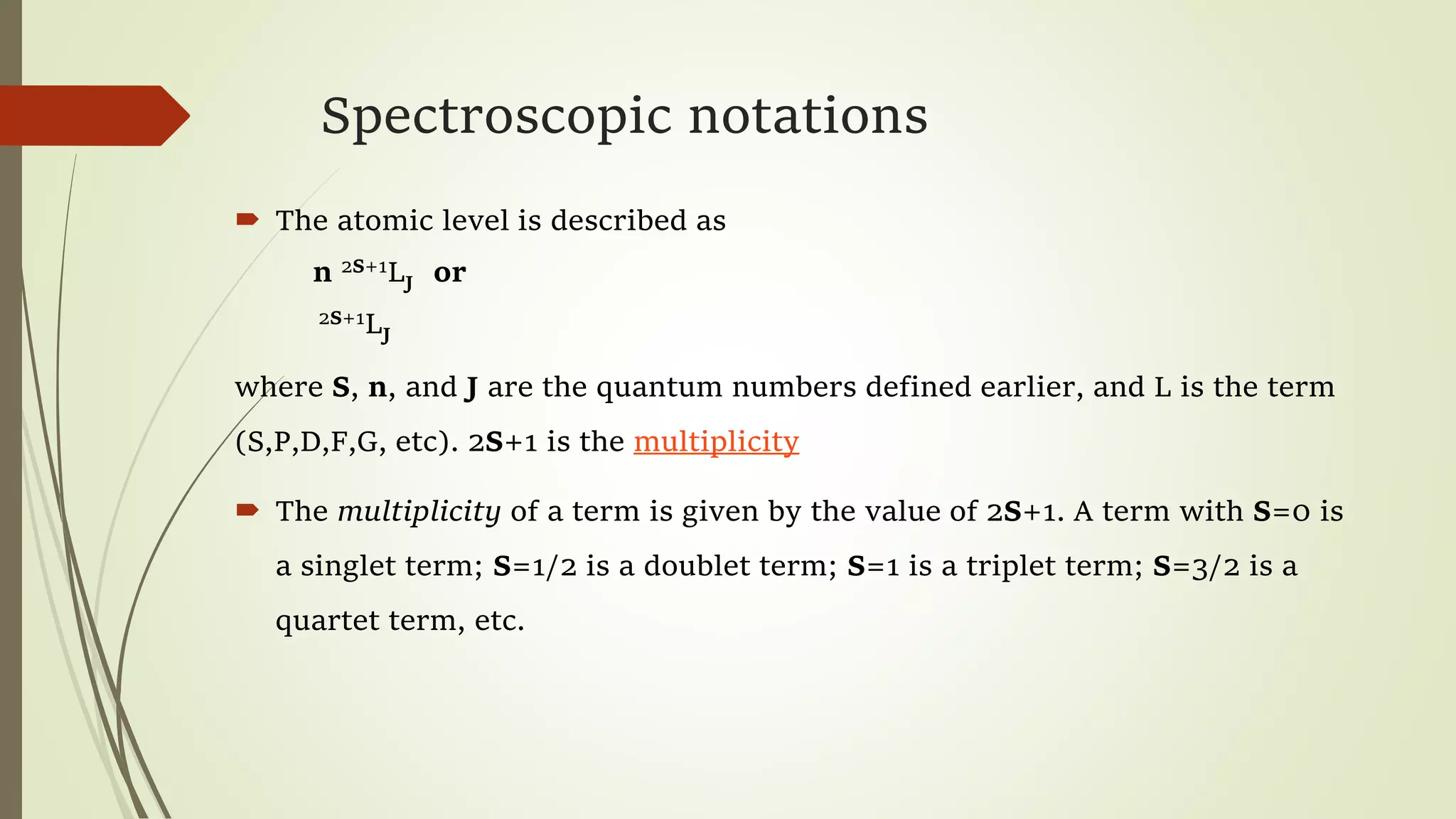
 The atomic level is described as
n 2S+1LJ or
2S+1LJ
where S, n, and J are the quantum numbers defined earlier, and L is the term
(S,P,D,F,G, etc). 2S+1 is the multiplicity
 The multiplicity of a term is given by the value of 2S+1. A term with S=0 is
a singlet term; S=1/2 is a doublet term; S=1 is a triplet term; S=3/2 is a
quartet term, etc.
Spectroscopic notation for Helium (He)

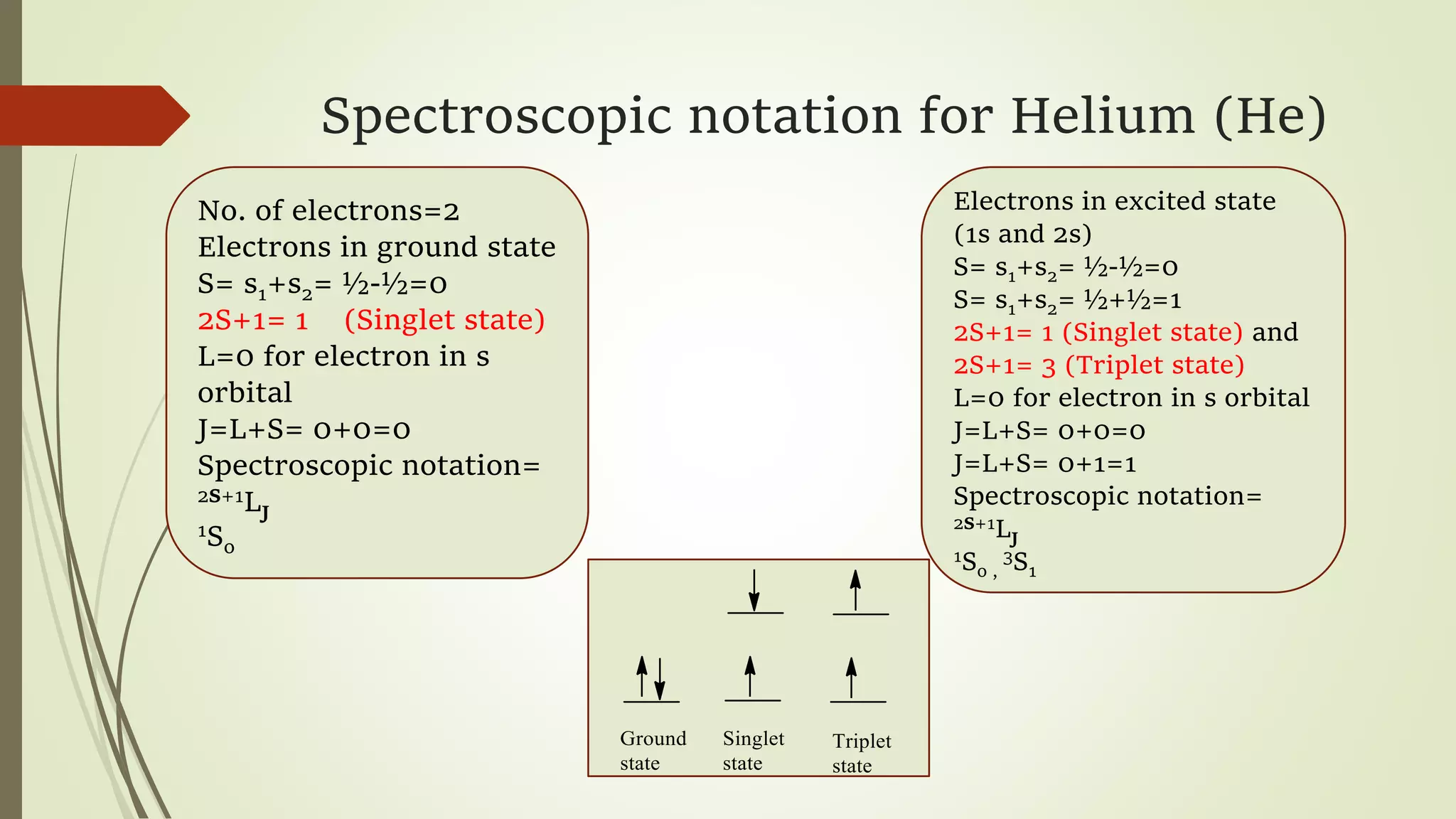
No. of electrons=2
Electrons in ground state
S= s1+s2= ½-½=0
2S+1= 1 (Singlet state)
L=0 for electron in s
orbital
J=L+S= 0+0=0
Spectroscopic notation=
2S+1LJ
1So
Electrons in excited state
(1s and 2s)
S= s1+s2= ½-½=0
S= s1+s2= ½+½=1
2S+1= 1 (Singlet state) and
2S+1= 3 (Triplet state)
L=0 for electron in s orbital
J=L+S= 0+0=0
J=L+S= 0+1=1
Spectroscopic notation=
2S+1LJ
1So ,
3S1

Lecture 02.; spectroscopic notations by Dr. Salma Amir

  • 1.
    Lecture No. 02 Cousetitle: Atomic Spectroscopy Topic: Spectroscopic Notations Course instructor: Dr. Salma Amir GFCW Peshawar
  • 2.
    Spectroscopic Notations  Spectroscopistsof the late 19th and early 20th century created a system of spectroscopic notation to describe the observed line spectra. Quantum numbers were invented to provide an quantitative description of observed (and unobserved) transitions. These together provide a short-hand description of the state of the electrons in an atom or ion.  The spectroscopic notion is a method of describing the quantum state of an atom using the principal quantum number, the orbital quantum number and the total angular momentum quantum number. The total angular momentum can be determined by taking the sum of the orbital quantum number and the spin quantum number.
  • 3.
    Quantum Numbers  Fourquantum numbers suffice to describe any electron in an atom. These are:  n, the principal quantum number., n takes on integral values 1, 2, 3, ... .  l, the azimuthal quantum number., l takes on the integral values 0, 1, 2, ... , n-2, n-1.  m, the magnetic quantum number. m takes on the integral values -l , -(l-1), ..., -1, 0, 1, ..., (l-1), l.  s, the spin quantum number. This describes the spin of the electron, and is either +1/2 or -1/2.
  • 4.
    Quantum Numbers forAtoms  As with electrons, 4 quantum numbers suffice to describe the electronic state of an atom or ion.  L is the total orbital angular momentum. L corresponds to the term of the ion (S terms have L=0, P terms have L=1, etc.). In the case of more than one electron in the outer shell, the value of L takes on all possible values of L=Σ li  The quantum number S is the absolute value of the total electron spin, S= Σsi. Each electron has a spin of +/- 1/2. S is integral for an even number of electrons, and half integral for an odd number. S=0 for a closed shell.  J represents the total angular momentum of the atom of ion. It is the vector sum of L and S. For a hydrogenic ion, L=0, S=1/2, and J=1/2. For more complex atom, J takes on the values L+S…….L-S,  M, the Magnetic quantum number, takes on values of J, J-1, ..., 0, ..., -J-1, -J.
  • 5.
    Spectroscopic notations  Theatomic level is described as n 2S+1LJ or 2S+1LJ where S, n, and J are the quantum numbers defined earlier, and L is the term (S,P,D,F,G, etc). 2S+1 is the multiplicity  The multiplicity of a term is given by the value of 2S+1. A term with S=0 is a singlet term; S=1/2 is a doublet term; S=1 is a triplet term; S=3/2 is a quartet term, etc.
  • 6.
    Spectroscopic notation forHelium (He)  No. of electrons=2 Electrons in ground state S= s1+s2= ½-½=0 2S+1= 1 (Singlet state) L=0 for electron in s orbital J=L+S= 0+0=0 Spectroscopic notation= 2S+1LJ 1So Electrons in excited state (1s and 2s) S= s1+s2= ½-½=0 S= s1+s2= ½+½=1 2S+1= 1 (Singlet state) and 2S+1= 3 (Triplet state) L=0 for electron in s orbital J=L+S= 0+0=0 J=L+S= 0+1=1 Spectroscopic notation= 2S+1LJ 1So , 3S1