Complex
Variables &
Transforms
Instructor: Dr. Naila Amir
MATH- 232
Complex numbers
▪ Complex Numbers and Their Properties
▪ Complex Plane
▪ Polar Form of Complex Numbers
▪ Powers of Complex Numbers
▪ Roots of Complex Numbers
▪ Sets of Points in the Complex Plane
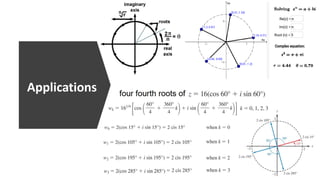
▪ Applications
We can find integer powers of a complex number 𝑧 by using results of multiplication
and division in polar form. If 𝑧 = 𝑟(cos 𝜃 + 𝑖 sin 𝜃), then
𝑎 𝑧2
= 𝑧𝑧 = 𝑟2
cos(𝜃 + 𝜃) + 𝑖 sin (𝜃 + 𝜃) = 𝑟2
cos 2𝜃 + 𝑖 sin 2𝜃 ,
𝑏 𝑧3
= 𝑧2
𝑧 = 𝑟3
cos(2𝜃 + 𝜃) + 𝑖 sin (2𝜃 + 𝜃) = 𝑟3
cos 3𝜃 + 𝑖 sin 3𝜃 ,
𝑐 𝑧4
= 𝑧3
𝑧 = 𝑟4
cos(3𝜃 + 𝜃) + 𝑖 sin (3𝜃 + 𝜃) = 𝑟4
cos 4𝜃 + 𝑖 sin 4𝜃 ,
and so on. Also,
1
𝑧
=
1
𝑟
cos( 0 − 𝜃) + 𝑖 sin( 0 − 𝜃) = 𝑟−1
cos( − 𝜃) + 𝑖 sin( − 𝜃) .
Similarly,
1
𝑧2
= 𝑧−2 = 𝑟−2 cos( − 2𝜃) + 𝑖 sin( − 2𝜃) .
Integer Powers of 𝒛
Continuing in the same manner, we obtain a formula for the 𝑛th power of 𝑧 for any
integer 𝑛 as:
𝑧𝑛
= 𝑟𝑛
cos 𝑛𝜃 + 𝑖 sin 𝑛𝜃 = 𝑟𝑛
cis 𝑛𝜃 = 𝑟𝑛
𝑒𝑖𝑛𝜃
. ∗
Eq. (∗) is the general form of the De Moivre's theorem which is stated as:
“If 𝑧 = cos 𝜃 + 𝑖 sin 𝜃 such that 𝑧 = 𝑟 = 1 the for any integer 𝑛
𝑧𝑛
= cos 𝑛𝜃 + 𝑖 sin 𝑛𝜃 = cis 𝑛𝜃 = 𝑒𝑖𝑛𝜃
. ”
Note: This theorem is also valid if 𝑛 is a rational number.
Integer Powers of 𝒛
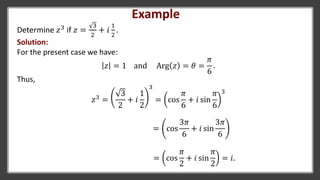
Determine 𝑧3 if 𝑧 =
3
2
+ 𝑖
1
2
.
Solution:
For the present case we have:
𝑧 = 1 and Arg 𝑧 = 𝜃 =
𝜋
6
.
Thus,
𝑧3
=
3
2
+ 𝑖
1
2
3
= cos
𝜋
6
+ 𝑖 sin
𝜋
6
3
= cos
3𝜋
6
+ 𝑖 sin
3𝜋
6
= cos
𝜋
2
+ 𝑖 sin
𝜋
2
= 𝑖.
Example
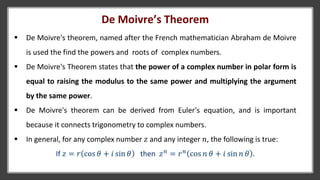
De Moivre’s Theorem
▪ De Moivre's theorem, named after the French mathematician Abraham de Moivre
is used the find the powers and roots of complex numbers.
▪ De Moivre's Theorem states that the power of a complex number in polar form is
equal to raising the modulus to the same power and multiplying the argument
by the same power.
▪ De Moivre's theorem can be derived from Euler's equation, and is important
because it connects trigonometry to complex numbers.
▪ In general, for any complex number 𝑧 and any integer 𝑛, the following is true:
If 𝑧 = 𝑟 cos 𝜃 + 𝑖 sin 𝜃 then 𝑧𝑛
= 𝑟𝑛
cos 𝑛 𝜃 + 𝑖 sin 𝑛 𝜃 .
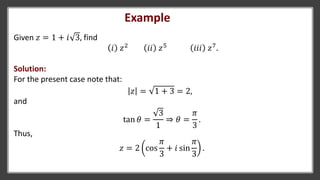
Given 𝑧 = 1 + 𝑖 3, find
𝑖 𝑧2 𝑖𝑖 𝑧5 𝑖𝑖𝑖 𝑧7.
Solution:
For the present case note that:
𝑧 = 1 + 3 = 2,
and
tan 𝜃 =
3
1
⇒ 𝜃 =
𝜋
3
.
Thus,
𝑧 = 2 cos
𝜋
3
+ 𝑖 sin
𝜋
3
.
Example
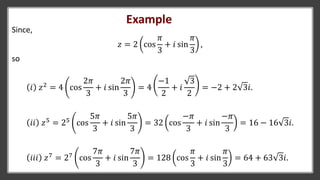
Since,
𝑧 = 2 cos
𝜋
3
+ 𝑖 sin
𝜋
3
,
so
𝑖 𝑧2
= 4 cos
2𝜋
3
+ 𝑖 sin
2𝜋
3
= 4
−1
2
+ 𝑖
3
2
= −2 + 2 3𝑖.
𝑖𝑖 𝑧5
= 25
cos
5𝜋
3
+ 𝑖 sin
5𝜋
3
= 32 cos
−𝜋
3
+ 𝑖 sin
−𝜋
3
= 16 − 16 3𝑖.
𝑖𝑖𝑖 𝑧7
= 27
cos
7𝜋
3
+ 𝑖 sin
7𝜋
3
= 128 cos
𝜋
3
+ 𝑖 sin
𝜋
3
= 64 + 63 3𝑖.
Example
Book: A First Course in Complex Analysis with Applications by Dennis G.
Zill and Patrick D. Shanahan.
Chapter: 1
Exercise: 1.3
Q # 1 – 38.
Practice Questions
Applications
Complex Numbers
Book: A First Course in Complex Analysis with Applications by
Dennis G. Zill and Patrick D. Shanahan.
• Chapter: 1
• Sections: 1.4, 1.6
Applications of De Moivre’s Theorem
▪ To express cos 𝑛𝜃 and sin 𝑛𝜃 as finite sums of trigonometric
functions of 𝜃, where 𝑛 is a positive integer.
▪ To express powers of cos 𝜃 (or sin 𝜃) in a series of cosines (or
sines) of multiples 𝜃.
▪ To find 𝑛th roots of a complex number.
Roots of a Complex Number
Suppose 𝑟 cos 𝜃 + 𝑖 sin 𝜃 and 𝜌 cos 𝜑 + 𝑖 sin 𝜑 are polar forms of the complex
numbers 𝑧 and 𝜔 respectively. Then, the equation: 𝜔𝑛 = 𝑧, becomes:
𝜌𝑛
cos 𝑛𝜑 + 𝑖 sin 𝑛𝜑 = 𝑟 cos 𝜃 + 𝑖 sin 𝜃 (1)
From (1), we can conclude that:
𝜌𝑛 = 𝑟 (2)
and
cos 𝑛𝜑 + 𝑖 sin 𝑛𝜑 = cos 𝜃 + 𝑖 sin 𝜃 (3)
From (2), we define:𝜌 = 𝑟1/𝑛 to be the unique positive 𝑛th root of the positive
real number 𝑟. From (3), the definition of equality of two complex numbers
implies that:
cos 𝑛𝜑 = cos 𝜃 and sin 𝑛𝜑 = sin 𝜃 .
These equalities, in turn, indicate that the arguments 𝜃 and 𝜑 are related bythe
equation 𝑛𝜑 = 𝜃 + 2𝑘𝜋, where 𝑘 is an integer.
Roots of a Complex Number
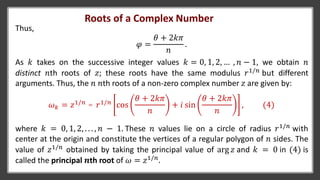
Thus,
𝜑 =
𝜃 + 2𝑘𝜋
𝑛
.
As 𝑘 takes on the successive integer values 𝑘 = 0, 1, 2, … , 𝑛 − 1, we obtain 𝑛
distinct 𝑛th roots of 𝑧; these roots have the same modulus 𝑟1/𝑛
but different
arguments. Thus, the 𝑛 𝑛th roots of a non-zero complex number 𝑧 are given by:
𝜔𝑘 = 𝑧1/𝑛 = 𝑟1/𝑛 cos
𝜃 + 2𝑘𝜋
𝑛
+ 𝑖 sin
𝜃 + 2𝑘𝜋
𝑛
, (4)
where 𝑘 = 0, 1, 2, . . . , 𝑛 − 1. These 𝑛 values lie on a circle of radius 𝑟1/𝑛 with
center at the origin and constitute the vertices of a regular polygon of 𝑛 sides. The
value of 𝑧1/𝑛
obtained by taking the principal value of arg 𝑧 and 𝑘 = 0 in (4) is
called the principal 𝒏th root of 𝜔 = 𝑧1/𝑛.
Example
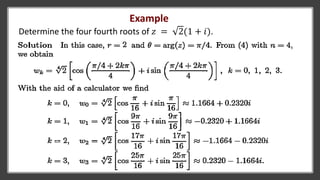
Determine the four fourth roots of 𝑧 = 2(1 + 𝑖).
Example
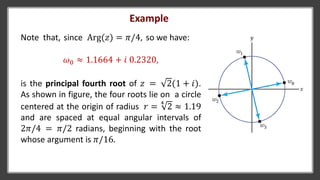
Note that, since Arg(𝑧) = 𝜋/4, so we have:
𝜔0 ≈ 1.1664 + 𝑖 0.2320,
is the principal fourth root of 𝑧 = 2(1 + 𝑖).
As shown in figure, the four roots lie on a circle
centered at the origin of radius 𝑟 =
4
2 ≈ 1.19
and are spaced at equal angular intervals of
2𝜋/4 = 𝜋/2 radians, beginning with the root
whose argument is 𝜋/16.
Example
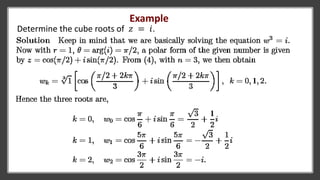
Determine the cube roots of 𝑧 = 𝑖.
Example
Note that, since Arg(𝑧) = 𝜋/2, so we have:
𝜔0 ≈ 0.8660 + 0.5𝑖,
is the principal cubic root of 𝑧 = 𝑖.
As shown in figure, the three roots lie on a circle
centered at the origin of radius 𝑟 ≈ 1 and are
spaced at equal angular intervals of 2𝜋/3
radians, beginning with the root whose
argument is 𝜋/6.
Quadratic Formula
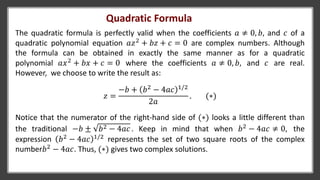
The quadratic formula is perfectly valid when the coefficients 𝑎 ≠ 0, 𝑏, and 𝑐 of a
quadratic polynomial equation 𝑎𝑧2
+ 𝑏𝑧 + 𝑐 = 0 are complex numbers. Although
the formula can be obtained in exactly the same manner as for a quadratic
polynomial 𝑎𝑥2
+ 𝑏𝑥 + 𝑐 = 0 where the coefficients 𝑎 ≠ 0, 𝑏, and 𝑐 are real.
However, we choose to write the result as:
𝑧 =
−𝑏 + 𝑏2
− 4𝑎𝑐 1/2
2𝑎
. (∗)
Notice that the numerator of the right-hand side of (∗) looks a little different than
the traditional −𝑏 ± 𝑏2 − 4𝑎𝑐 . Keep in mind that when 𝑏2
− 4𝑎𝑐 ≠ 0, the
expression 𝑏2
− 4𝑎𝑐 1/2
represents the set of two square roots of the complex
number𝑏2
− 4𝑎𝑐. Thus, (∗) gives two complex solutions.
Example
Solve the quadratic equation 𝑧2
+ 1 − 𝑖 𝑧 − 3𝑖 = 0.
Solution:
Using quadratic formula with 𝑎 = 1, 𝑏 = 1 − 𝑖, and 𝑐 = −3𝑖, we have:
𝑧 =
− 1 − 𝑖 + 1 − 𝑖 2
− 4(−3𝑖) 1/2
2
=
−1 + 𝑖 + 10𝑖 1/2
2
.
To compute 10𝑖 1/2
we will use the procedure for finding roots of any complex
numbers. For the present case 𝑧 = 10𝑖 with 𝑟 = 10 and 𝜃 = 𝜋/2. We are required
to determine two square roots of 10𝑖. Here 𝑛 = 2 and 𝑘 = 0,1. Thus, the two square
roots of 10𝑖 are given as:
𝜔0 = 10 cos
𝜋
4
+ 𝑖 sin
𝜋
4
= 5 1 + 𝑖 ,
and
𝜔1 = 10 cos
5𝜋
4
+ 𝑖 sin
5𝜋
4
= − 5 1 + 𝑖 .
Example
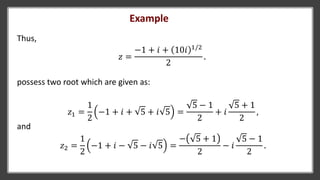
Thus,
𝑧 =
−1 + 𝑖 + 10𝑖 1/2
2
.
possess two root which are given as:
𝑧1 =
1
2
−1 + 𝑖 + 5 + 𝑖 5 =
5 − 1
2
+ 𝑖
5 + 1
2
,
and
𝑧2 =
1
2
−1 + 𝑖 − 5 − 𝑖 5 =
− 5 + 1
2
− 𝑖
5 − 1
2
.
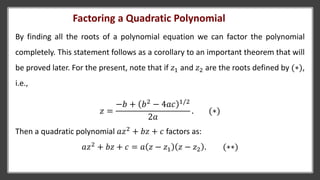
Factoring a Quadratic Polynomial
By finding all the roots of a polynomial equation we can factor the polynomial
completely. This statement follows as a corollary to an important theorem that will
be proved later. For the present, note that if 𝑧1 and 𝑧2 are the roots defined by (∗),
i.e.,
𝑧 =
−𝑏 + 𝑏2
− 4𝑎𝑐 1/2
2𝑎
. (∗)
Then a quadratic polynomial 𝑎𝑧2 + 𝑏𝑧 + 𝑐 factors as:
𝑎𝑧2 + 𝑏𝑧 + 𝑐 = 𝑎 𝑧 − 𝑧1 𝑧 − 𝑧2 . (∗∗)
Example
Factorize the quadratic polynomial 𝑧2
+ 1 − 𝑖 𝑧 − 3𝑖 .
Solution:
Using equation (**), we have
𝑧2
+ 1 − 𝑖 𝑧 − 3𝑖 = 𝑧 − 𝑧1 𝑧 − 𝑧2
= 𝑧 −
5 − 1
2
− 𝑖
5 + 1
2
𝑧 +
5 + 1
2
+ 𝑖
5 + 1
2
.
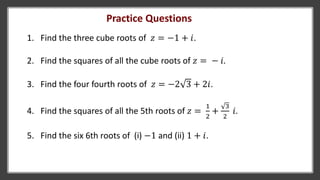
Practice Questions
1. Find the three cube roots of 𝑧 = −1 + 𝑖.
2. Find the squares of all the cube roots of 𝑧 = − 𝑖.
3. Find the four fourth roots of 𝑧 = −2 3 + 2𝑖.
4. Find the squares of all the 5th roots of 𝑧 =
1
2
+
3
2
𝑖.
5. Find the six 6th roots of (i) −1 and (ii) 1 + 𝑖.
Book: A First Course in Complex Analysis with Applications by Dennis G.
Zill and Patrick D. Shanahan.
Chapter: 1
Exercise: 1.4
Q # 1 – 20, 25 – 26.
Exercise: 1.6
Q # 1 –12.
Practice Questions
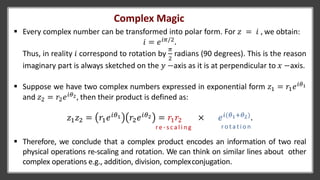
Complex Magic
▪ Every complex number can be transformed into polar form. For 𝑧 = 𝑖 , we obtain:
𝑖 = 𝑒𝑖𝜋/2
.
Thus, in reality 𝑖 correspond to rotation by
𝜋
2
radians (90 degrees). This is the reason
imaginary part is always sketched on the 𝑦 −axis as it is at perpendicular to 𝑥 −axis.
▪ Suppose we have two complex numbers expressed in exponential form 𝑧1 = 𝑟1𝑒𝑖𝜃1
and 𝑧2 = 𝑟2𝑒𝑖𝜃2, then their product is defined as:
𝑧1𝑧2 = 𝑟1𝑒𝑖𝜃1 𝑟2𝑒𝑖𝜃2 = 𝑟1𝑟2 × 𝑒𝑖(𝜃1+𝜃2)
.
r e - s c a l i n g
▪ Therefore, we conclude that a complex product encodes an information of two real
physical operations re-scaling and rotation. We can think on similar lines about other
complex operations e.g., addition, division, complexconjugation.
ro t a t i o n
Complex Magic
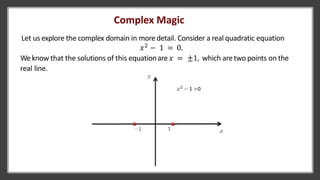
Let us explore the complex domain in moredetail. Consider a real quadratic equation
𝑥2
− 1 = 0.
Weknow that the solutions of this equationare𝑥 = ±1, which aretwo points on the
real line.
Complex Magic
▪ Now consider the complex equation
𝑧2
− 1 = 0.
▪ How many solutions does this complex equation has?
▪ Of course, two: 𝑧 = ±1, two points on the complex plane. If the answers are same, then
we might believe thatboth equations are same !!!.
▪ It is certainly nottrue.
▪ The beauty of secondequation can only be seenif wesubstitute 𝑧 = 𝑥 + 𝑖𝑦, into the
equation,i.e,
(𝑥 + 𝑖𝑦)2
− 1 = 0
𝑥2
− 𝑦2
+ 2𝑖𝑥𝑦 − 1 = 0
𝑥2
− 𝑦2
− 1 + 𝑖2𝑥𝑦 = 0
which gives rise to two equations:
𝑥2
− 𝑦2
= 1 and 2𝑥𝑦 = 0,
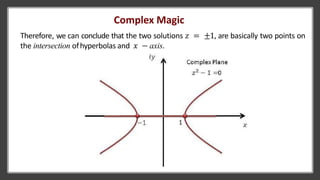
▪ The first is an equation of a hyperbola and the other is an equation of 𝑥 − or𝑦 −axis.
Complex Magic
Therefore, we can conclude that the two solutions 𝑧 = ±1, are basically two points on
the intersection ofhyperbolas and 𝑥 − axis.
Some important facts about complex numbers
1. Space of allcomplex numbers ℂ, is a vectorspace.
2.
1
𝑧
=
ҧ
𝑧
𝑧 2 , where 𝑧 = 𝑥 + 𝑖𝑦.
3. 𝑧1 + 𝑧2 ≤ 𝑧1 + 𝑧2 . (triangular inequality)
4. An 𝑛th degree complex polynomial equation has n complex roots. On the other
hand, an 𝑛th degree real polynomial equation may or may not have 𝑛 real roots.
5. If 𝑧 = 𝑥 + 𝑖𝑦 we define 𝑒𝑧 = 𝑒𝑥+𝑖𝑦 = 𝑒𝑥 cos 𝑦 + 𝑖 sin 𝑦 .
6. 𝑒𝑧
is never zero.
7. 𝑒𝑧
= 𝑒𝑥
, where 𝑧 = 𝑥 + 𝑖𝑦.

Lecture # 4 (Complex Numbers).pdf deep learning

  • 1.
  • 2.
    Complex numbers ▪ ComplexNumbers and Their Properties ▪ Complex Plane ▪ Polar Form of Complex Numbers ▪ Powers of Complex Numbers ▪ Roots of Complex Numbers ▪ Sets of Points in the Complex Plane ▪ Applications
  • 3.
    We can findinteger powers of a complex number 𝑧 by using results of multiplication and division in polar form. If 𝑧 = 𝑟(cos 𝜃 + 𝑖 sin 𝜃), then 𝑎 𝑧2 = 𝑧𝑧 = 𝑟2 cos(𝜃 + 𝜃) + 𝑖 sin (𝜃 + 𝜃) = 𝑟2 cos 2𝜃 + 𝑖 sin 2𝜃 , 𝑏 𝑧3 = 𝑧2 𝑧 = 𝑟3 cos(2𝜃 + 𝜃) + 𝑖 sin (2𝜃 + 𝜃) = 𝑟3 cos 3𝜃 + 𝑖 sin 3𝜃 , 𝑐 𝑧4 = 𝑧3 𝑧 = 𝑟4 cos(3𝜃 + 𝜃) + 𝑖 sin (3𝜃 + 𝜃) = 𝑟4 cos 4𝜃 + 𝑖 sin 4𝜃 , and so on. Also, 1 𝑧 = 1 𝑟 cos( 0 − 𝜃) + 𝑖 sin( 0 − 𝜃) = 𝑟−1 cos( − 𝜃) + 𝑖 sin( − 𝜃) . Similarly, 1 𝑧2 = 𝑧−2 = 𝑟−2 cos( − 2𝜃) + 𝑖 sin( − 2𝜃) . Integer Powers of 𝒛
  • 4.
    Continuing in thesame manner, we obtain a formula for the 𝑛th power of 𝑧 for any integer 𝑛 as: 𝑧𝑛 = 𝑟𝑛 cos 𝑛𝜃 + 𝑖 sin 𝑛𝜃 = 𝑟𝑛 cis 𝑛𝜃 = 𝑟𝑛 𝑒𝑖𝑛𝜃 . ∗ Eq. (∗) is the general form of the De Moivre's theorem which is stated as: “If 𝑧 = cos 𝜃 + 𝑖 sin 𝜃 such that 𝑧 = 𝑟 = 1 the for any integer 𝑛 𝑧𝑛 = cos 𝑛𝜃 + 𝑖 sin 𝑛𝜃 = cis 𝑛𝜃 = 𝑒𝑖𝑛𝜃 . ” Note: This theorem is also valid if 𝑛 is a rational number. Integer Powers of 𝒛
  • 5.
    Determine 𝑧3 if𝑧 = 3 2 + 𝑖 1 2 . Solution: For the present case we have: 𝑧 = 1 and Arg 𝑧 = 𝜃 = 𝜋 6 . Thus, 𝑧3 = 3 2 + 𝑖 1 2 3 = cos 𝜋 6 + 𝑖 sin 𝜋 6 3 = cos 3𝜋 6 + 𝑖 sin 3𝜋 6 = cos 𝜋 2 + 𝑖 sin 𝜋 2 = 𝑖. Example
  • 6.
    De Moivre’s Theorem ▪De Moivre's theorem, named after the French mathematician Abraham de Moivre is used the find the powers and roots of complex numbers. ▪ De Moivre's Theorem states that the power of a complex number in polar form is equal to raising the modulus to the same power and multiplying the argument by the same power. ▪ De Moivre's theorem can be derived from Euler's equation, and is important because it connects trigonometry to complex numbers. ▪ In general, for any complex number 𝑧 and any integer 𝑛, the following is true: If 𝑧 = 𝑟 cos 𝜃 + 𝑖 sin 𝜃 then 𝑧𝑛 = 𝑟𝑛 cos 𝑛 𝜃 + 𝑖 sin 𝑛 𝜃 .
  • 7.
    Given 𝑧 =1 + 𝑖 3, find 𝑖 𝑧2 𝑖𝑖 𝑧5 𝑖𝑖𝑖 𝑧7. Solution: For the present case note that: 𝑧 = 1 + 3 = 2, and tan 𝜃 = 3 1 ⇒ 𝜃 = 𝜋 3 . Thus, 𝑧 = 2 cos 𝜋 3 + 𝑖 sin 𝜋 3 . Example
  • 8.
    Since, 𝑧 = 2cos 𝜋 3 + 𝑖 sin 𝜋 3 , so 𝑖 𝑧2 = 4 cos 2𝜋 3 + 𝑖 sin 2𝜋 3 = 4 −1 2 + 𝑖 3 2 = −2 + 2 3𝑖. 𝑖𝑖 𝑧5 = 25 cos 5𝜋 3 + 𝑖 sin 5𝜋 3 = 32 cos −𝜋 3 + 𝑖 sin −𝜋 3 = 16 − 16 3𝑖. 𝑖𝑖𝑖 𝑧7 = 27 cos 7𝜋 3 + 𝑖 sin 7𝜋 3 = 128 cos 𝜋 3 + 𝑖 sin 𝜋 3 = 64 + 63 3𝑖. Example
  • 9.
    Book: A FirstCourse in Complex Analysis with Applications by Dennis G. Zill and Patrick D. Shanahan. Chapter: 1 Exercise: 1.3 Q # 1 – 38. Practice Questions
  • 10.
  • 11.
    Complex Numbers Book: AFirst Course in Complex Analysis with Applications by Dennis G. Zill and Patrick D. Shanahan. • Chapter: 1 • Sections: 1.4, 1.6
  • 12.
    Applications of DeMoivre’s Theorem ▪ To express cos 𝑛𝜃 and sin 𝑛𝜃 as finite sums of trigonometric functions of 𝜃, where 𝑛 is a positive integer. ▪ To express powers of cos 𝜃 (or sin 𝜃) in a series of cosines (or sines) of multiples 𝜃. ▪ To find 𝑛th roots of a complex number.
  • 13.
    Roots of aComplex Number Suppose 𝑟 cos 𝜃 + 𝑖 sin 𝜃 and 𝜌 cos 𝜑 + 𝑖 sin 𝜑 are polar forms of the complex numbers 𝑧 and 𝜔 respectively. Then, the equation: 𝜔𝑛 = 𝑧, becomes: 𝜌𝑛 cos 𝑛𝜑 + 𝑖 sin 𝑛𝜑 = 𝑟 cos 𝜃 + 𝑖 sin 𝜃 (1) From (1), we can conclude that: 𝜌𝑛 = 𝑟 (2) and cos 𝑛𝜑 + 𝑖 sin 𝑛𝜑 = cos 𝜃 + 𝑖 sin 𝜃 (3) From (2), we define:𝜌 = 𝑟1/𝑛 to be the unique positive 𝑛th root of the positive real number 𝑟. From (3), the definition of equality of two complex numbers implies that: cos 𝑛𝜑 = cos 𝜃 and sin 𝑛𝜑 = sin 𝜃 . These equalities, in turn, indicate that the arguments 𝜃 and 𝜑 are related bythe equation 𝑛𝜑 = 𝜃 + 2𝑘𝜋, where 𝑘 is an integer.
  • 14.
    Roots of aComplex Number Thus, 𝜑 = 𝜃 + 2𝑘𝜋 𝑛 . As 𝑘 takes on the successive integer values 𝑘 = 0, 1, 2, … , 𝑛 − 1, we obtain 𝑛 distinct 𝑛th roots of 𝑧; these roots have the same modulus 𝑟1/𝑛 but different arguments. Thus, the 𝑛 𝑛th roots of a non-zero complex number 𝑧 are given by: 𝜔𝑘 = 𝑧1/𝑛 = 𝑟1/𝑛 cos 𝜃 + 2𝑘𝜋 𝑛 + 𝑖 sin 𝜃 + 2𝑘𝜋 𝑛 , (4) where 𝑘 = 0, 1, 2, . . . , 𝑛 − 1. These 𝑛 values lie on a circle of radius 𝑟1/𝑛 with center at the origin and constitute the vertices of a regular polygon of 𝑛 sides. The value of 𝑧1/𝑛 obtained by taking the principal value of arg 𝑧 and 𝑘 = 0 in (4) is called the principal 𝒏th root of 𝜔 = 𝑧1/𝑛.
  • 15.
    Example Determine the fourfourth roots of 𝑧 = 2(1 + 𝑖).
  • 16.
    Example Note that, sinceArg(𝑧) = 𝜋/4, so we have: 𝜔0 ≈ 1.1664 + 𝑖 0.2320, is the principal fourth root of 𝑧 = 2(1 + 𝑖). As shown in figure, the four roots lie on a circle centered at the origin of radius 𝑟 = 4 2 ≈ 1.19 and are spaced at equal angular intervals of 2𝜋/4 = 𝜋/2 radians, beginning with the root whose argument is 𝜋/16.
  • 17.
    Example Determine the cuberoots of 𝑧 = 𝑖.
  • 18.
    Example Note that, sinceArg(𝑧) = 𝜋/2, so we have: 𝜔0 ≈ 0.8660 + 0.5𝑖, is the principal cubic root of 𝑧 = 𝑖. As shown in figure, the three roots lie on a circle centered at the origin of radius 𝑟 ≈ 1 and are spaced at equal angular intervals of 2𝜋/3 radians, beginning with the root whose argument is 𝜋/6.
  • 19.
    Quadratic Formula The quadraticformula is perfectly valid when the coefficients 𝑎 ≠ 0, 𝑏, and 𝑐 of a quadratic polynomial equation 𝑎𝑧2 + 𝑏𝑧 + 𝑐 = 0 are complex numbers. Although the formula can be obtained in exactly the same manner as for a quadratic polynomial 𝑎𝑥2 + 𝑏𝑥 + 𝑐 = 0 where the coefficients 𝑎 ≠ 0, 𝑏, and 𝑐 are real. However, we choose to write the result as: 𝑧 = −𝑏 + 𝑏2 − 4𝑎𝑐 1/2 2𝑎 . (∗) Notice that the numerator of the right-hand side of (∗) looks a little different than the traditional −𝑏 ± 𝑏2 − 4𝑎𝑐 . Keep in mind that when 𝑏2 − 4𝑎𝑐 ≠ 0, the expression 𝑏2 − 4𝑎𝑐 1/2 represents the set of two square roots of the complex number𝑏2 − 4𝑎𝑐. Thus, (∗) gives two complex solutions.
  • 20.
    Example Solve the quadraticequation 𝑧2 + 1 − 𝑖 𝑧 − 3𝑖 = 0. Solution: Using quadratic formula with 𝑎 = 1, 𝑏 = 1 − 𝑖, and 𝑐 = −3𝑖, we have: 𝑧 = − 1 − 𝑖 + 1 − 𝑖 2 − 4(−3𝑖) 1/2 2 = −1 + 𝑖 + 10𝑖 1/2 2 . To compute 10𝑖 1/2 we will use the procedure for finding roots of any complex numbers. For the present case 𝑧 = 10𝑖 with 𝑟 = 10 and 𝜃 = 𝜋/2. We are required to determine two square roots of 10𝑖. Here 𝑛 = 2 and 𝑘 = 0,1. Thus, the two square roots of 10𝑖 are given as: 𝜔0 = 10 cos 𝜋 4 + 𝑖 sin 𝜋 4 = 5 1 + 𝑖 , and 𝜔1 = 10 cos 5𝜋 4 + 𝑖 sin 5𝜋 4 = − 5 1 + 𝑖 .
  • 21.
    Example Thus, 𝑧 = −1 +𝑖 + 10𝑖 1/2 2 . possess two root which are given as: 𝑧1 = 1 2 −1 + 𝑖 + 5 + 𝑖 5 = 5 − 1 2 + 𝑖 5 + 1 2 , and 𝑧2 = 1 2 −1 + 𝑖 − 5 − 𝑖 5 = − 5 + 1 2 − 𝑖 5 − 1 2 .
  • 22.
    Factoring a QuadraticPolynomial By finding all the roots of a polynomial equation we can factor the polynomial completely. This statement follows as a corollary to an important theorem that will be proved later. For the present, note that if 𝑧1 and 𝑧2 are the roots defined by (∗), i.e., 𝑧 = −𝑏 + 𝑏2 − 4𝑎𝑐 1/2 2𝑎 . (∗) Then a quadratic polynomial 𝑎𝑧2 + 𝑏𝑧 + 𝑐 factors as: 𝑎𝑧2 + 𝑏𝑧 + 𝑐 = 𝑎 𝑧 − 𝑧1 𝑧 − 𝑧2 . (∗∗)
  • 23.
    Example Factorize the quadraticpolynomial 𝑧2 + 1 − 𝑖 𝑧 − 3𝑖 . Solution: Using equation (**), we have 𝑧2 + 1 − 𝑖 𝑧 − 3𝑖 = 𝑧 − 𝑧1 𝑧 − 𝑧2 = 𝑧 − 5 − 1 2 − 𝑖 5 + 1 2 𝑧 + 5 + 1 2 + 𝑖 5 + 1 2 .
  • 24.
    Practice Questions 1. Findthe three cube roots of 𝑧 = −1 + 𝑖. 2. Find the squares of all the cube roots of 𝑧 = − 𝑖. 3. Find the four fourth roots of 𝑧 = −2 3 + 2𝑖. 4. Find the squares of all the 5th roots of 𝑧 = 1 2 + 3 2 𝑖. 5. Find the six 6th roots of (i) −1 and (ii) 1 + 𝑖.
  • 25.
    Book: A FirstCourse in Complex Analysis with Applications by Dennis G. Zill and Patrick D. Shanahan. Chapter: 1 Exercise: 1.4 Q # 1 – 20, 25 – 26. Exercise: 1.6 Q # 1 –12. Practice Questions
  • 26.
    Complex Magic ▪ Everycomplex number can be transformed into polar form. For 𝑧 = 𝑖 , we obtain: 𝑖 = 𝑒𝑖𝜋/2 . Thus, in reality 𝑖 correspond to rotation by 𝜋 2 radians (90 degrees). This is the reason imaginary part is always sketched on the 𝑦 −axis as it is at perpendicular to 𝑥 −axis. ▪ Suppose we have two complex numbers expressed in exponential form 𝑧1 = 𝑟1𝑒𝑖𝜃1 and 𝑧2 = 𝑟2𝑒𝑖𝜃2, then their product is defined as: 𝑧1𝑧2 = 𝑟1𝑒𝑖𝜃1 𝑟2𝑒𝑖𝜃2 = 𝑟1𝑟2 × 𝑒𝑖(𝜃1+𝜃2) . r e - s c a l i n g ▪ Therefore, we conclude that a complex product encodes an information of two real physical operations re-scaling and rotation. We can think on similar lines about other complex operations e.g., addition, division, complexconjugation. ro t a t i o n
  • 27.
    Complex Magic Let usexplore the complex domain in moredetail. Consider a real quadratic equation 𝑥2 − 1 = 0. Weknow that the solutions of this equationare𝑥 = ±1, which aretwo points on the real line.
  • 28.
    Complex Magic ▪ Nowconsider the complex equation 𝑧2 − 1 = 0. ▪ How many solutions does this complex equation has? ▪ Of course, two: 𝑧 = ±1, two points on the complex plane. If the answers are same, then we might believe thatboth equations are same !!!. ▪ It is certainly nottrue. ▪ The beauty of secondequation can only be seenif wesubstitute 𝑧 = 𝑥 + 𝑖𝑦, into the equation,i.e, (𝑥 + 𝑖𝑦)2 − 1 = 0 𝑥2 − 𝑦2 + 2𝑖𝑥𝑦 − 1 = 0 𝑥2 − 𝑦2 − 1 + 𝑖2𝑥𝑦 = 0 which gives rise to two equations: 𝑥2 − 𝑦2 = 1 and 2𝑥𝑦 = 0, ▪ The first is an equation of a hyperbola and the other is an equation of 𝑥 − or𝑦 −axis.
  • 29.
    Complex Magic Therefore, wecan conclude that the two solutions 𝑧 = ±1, are basically two points on the intersection ofhyperbolas and 𝑥 − axis.
  • 30.
    Some important factsabout complex numbers 1. Space of allcomplex numbers ℂ, is a vectorspace. 2. 1 𝑧 = ҧ 𝑧 𝑧 2 , where 𝑧 = 𝑥 + 𝑖𝑦. 3. 𝑧1 + 𝑧2 ≤ 𝑧1 + 𝑧2 . (triangular inequality) 4. An 𝑛th degree complex polynomial equation has n complex roots. On the other hand, an 𝑛th degree real polynomial equation may or may not have 𝑛 real roots. 5. If 𝑧 = 𝑥 + 𝑖𝑦 we define 𝑒𝑧 = 𝑒𝑥+𝑖𝑦 = 𝑒𝑥 cos 𝑦 + 𝑖 sin 𝑦 . 6. 𝑒𝑧 is never zero. 7. 𝑒𝑧 = 𝑒𝑥 , where 𝑧 = 𝑥 + 𝑖𝑦.