Understanding GPU MemoryPerhaad Mistry & Dana Schaa,Northeastern University Computer ArchitectureResearch Lab, with Benedict R. Gaster, AMD© 2011
Instructor NotesThis lecture begins with an example of how a wide-memory bus is utilized in GPUsThe impact of memory coalescing and memory bank conflicts are also described along with examples on current hardwareThis lecture is important because achieving high memory bandwidth is often the most important requirement for many GPU applications2Perhaad Mistry & Dana Schaa, Northeastern Univ Computer Architecture Research Lab, with Ben Gaster, AMD © 2011
TopicsIntroduction to GPU bus addressingCoalescing memory accessesIntroduction to memory banksMemory bank conflicts3Perhaad Mistry & Dana Schaa, Northeastern Univ Computer Architecture Research Lab, with Ben Gaster, AMD © 2011
ExampleArray X is a pointer to an array of integers (4-bytes each) located at address 0x00001232A thread wants to access the data at X[0]inttmp = X[0];0x0000123200x0000123612X0x000012323...4560x000012487....4Perhaad Mistry & Dana Schaa, Northeastern Univ Computer Architecture Research Lab, with Ben Gaster, AMD © 2011
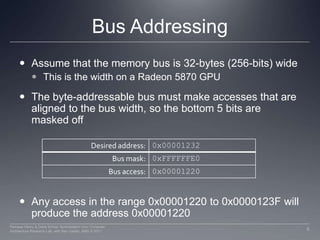
Bus AddressingAssume that the memory bus is 32-bytes (256-bits) wideThis is the width on a Radeon 5870 GPUThe byte-addressable bus must make accesses that are aligned to the bus width, so the bottom 5 bits are masked offAny access in the range 0x00001220 to 0x0000123F will produce the address 0x00001220 5Perhaad Mistry & Dana Schaa, Northeastern Univ Computer Architecture Research Lab, with Ben Gaster, AMD © 2011
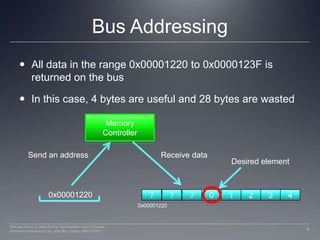
Bus AddressingAll data in the range 0x00001220 to 0x0000123F is returned on the busIn this case, 4 bytes are useful and 28 bytes are wastedMemory ControllerSend an addressReceive dataDesired element???012340x000012200x000012206Perhaad Mistry & Dana Schaa, Northeastern Univ Computer Architecture Research Lab, with Ben Gaster, AMD © 2011
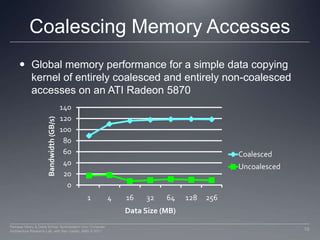
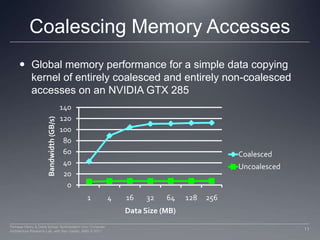
Coalescing Memory AccessesTo fully utilize the bus, GPUs combine the accesses of multiple threads into fewer requests when possibleConsider the following OpenCL kernel code:Assuming that array X is the same array from the example, the first 16 threads will access addresses 0x00001232 through 0x00001272If each request was sent out individually, there would be 16 accesses total, with 64 useful bytes of data and 448 wasted bytesNotice that each access in the same 32-byte range would return exactly the same data inttmp = X[get_global_id(0)]; 7Perhaad Mistry & Dana Schaa, Northeastern Univ Computer Architecture Research Lab, with Ben Gaster, AMD © 2011
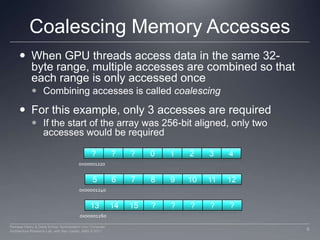
Coalescing Memory AccessesWhen GPU threads access data in the same 32-byte range, multiple accesses are combined so that each range is only accessed onceCombining accesses is called coalescingFor this example, only 3 accesses are requiredIf the start of the array was 256-bit aligned, only two accesses would be required???012340x00001220567891011120x00001240131415?????0x000012608Perhaad Mistry & Dana Schaa, Northeastern Univ Computer Architecture Research Lab, with Ben Gaster, AMD © 2011
Coalescing Memory AccessesRecall that for AMD hardware, 64 threads are part of a wavefront and must execute the same instruction in a SIMD mannerFor the AMD 5870 GPU, memory accesses of 16 consecutive threads are evaluated together and can be coalesced to fully utilize the busThis unit is called a quarter-wavefront and is the important hardware scheduling unit for memory accesses9Perhaad Mistry & Dana Schaa, Northeastern Univ Computer Architecture Research Lab, with Ben Gaster, AMD © 2011
Coalescing Memory AccessesGlobal memory performance for a simple data copying kernel of entirely coalesced and entirely non-coalesced accesses on an ATI Radeon 587010Perhaad Mistry & Dana Schaa, Northeastern Univ Computer Architecture Research Lab, with Ben Gaster, AMD © 2011
Coalescing Memory AccessesGlobal memory performance for a simple data copying kernel of entirely coalesced and entirely non-coalesced accesses on an NVIDIA GTX 28511Perhaad Mistry & Dana Schaa, Northeastern Univ Computer Architecture Research Lab, with Ben Gaster, AMD © 2011
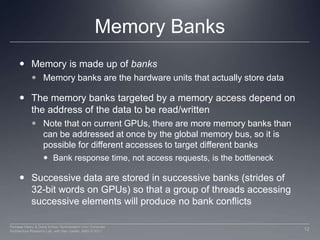
Memory BanksMemory is made up of banks Memory banks are the hardware units that actually store dataThe memory banks targeted by a memory access depend on the address of the data to be read/writtenNote that on current GPUs, there are more memory banks than can be addressed at once by the global memory bus, so it is possible for different accesses to target different banksBank response time, not access requests, is the bottleneckSuccessive data are stored in successive banks (strides of 32-bit words on GPUs) so that a group of threads accessing successive elements will produce no bank conflicts12Perhaad Mistry & Dana Schaa, Northeastern Univ Computer Architecture Research Lab, with Ben Gaster, AMD © 2011
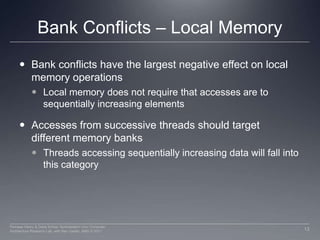
Bank Conflicts – Local MemoryBank conflicts have the largest negative effect on local memory operationsLocal memory does not require that accesses are to sequentially increasing elementsAccesses from successive threads should target different memory banksThreads accessing sequentially increasing data will fall into this category13Perhaad Mistry & Dana Schaa, Northeastern Univ Computer Architecture Research Lab, with Ben Gaster, AMD © 2011
Bank Conflicts – Local MemoryOn AMD, a wavefront that generates bank conflicts stalls until all local memory operations completeThe hardware does not hide the stall by switching to another wavefrontThe following examples show local memory access patterns and whether conflicts are generatedFor readability, only 8 memory banks are shown14Perhaad Mistry & Dana Schaa, Northeastern Univ Computer Architecture Research Lab, with Ben Gaster, AMD © 2011
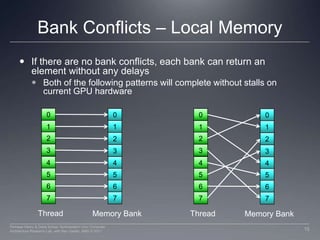
Bank Conflicts – Local MemoryIf there are no bank conflicts, each bank can return an element without any delaysBoth of the following patterns will complete without stalls on current GPU hardware00001111222233334444555566667777ThreadMemory BankThreadMemory Bank15Perhaad Mistry & Dana Schaa, Northeastern Univ Computer Architecture Research Lab, with Ben Gaster, AMD © 2011
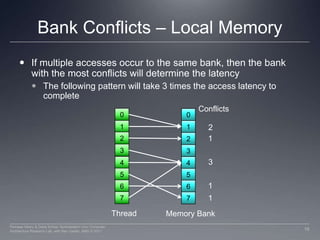
Bank Conflicts – Local MemoryIf multiple accesses occur to the same bank, then the bank with the most conflicts will determine the latencyThe following pattern will take 3 times the access latency to completeConflicts001121223334455166177ThreadMemory Bank16Perhaad Mistry & Dana Schaa, Northeastern Univ Computer Architecture Research Lab, with Ben Gaster, AMD © 2011
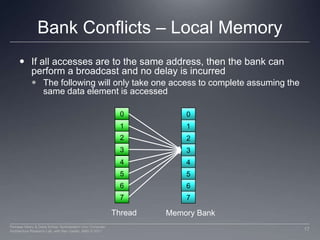
Bank Conflicts – Local MemoryIf all accesses are to the same address, then the bank can perform a broadcast and no delay is incurredThe following will only take one access to complete assuming the same data element is accessed0011223344556677ThreadMemory Bank17Perhaad Mistry & Dana Schaa, Northeastern Univ Computer Architecture Research Lab, with Ben Gaster, AMD © 2011
Bank Conflicts – Global MemoryBank conflicts in global memory rely on the same principles, however the global memory bus makes the impact of conflicts more subtle Since accessing data in global memory requires that an entire bus-line be read, bank conflicts within a work-group have a similar effect as non-coalesced accessesIf threads reading from global memory had a bank conflict then by definition it manifest as a non-coalesced accessNot all non-coalesced accesses are bank conflicts, howeverThe ideal case for global memory is when different work-groups read from different banksIn reality, this is a very low-level optimization and should not be prioritized when first writing a program18Perhaad Mistry & Dana Schaa, Northeastern Univ Computer Architecture Research Lab, with Ben Gaster, AMD © 2011
SummaryGPU memory is different than CPU memoryThe goal is high throughput instead of low-latencyMemory access patterns have a huge impact on bus utilizationLow utilization means low performanceHaving coalesced memory accesses and avoiding bank conflicts are required for high performance codeSpecific hardware information (such as bus width, number of memory banks, and number of threads that coalesce memory requests) is GPU-specific and can be found in vendor documentation19Perhaad Mistry & Dana Schaa, Northeastern Univ Computer Architecture Research Lab, with Ben Gaster, AMD © 2011

Lec06 memory

  • 1.
    Understanding GPU MemoryPerhaadMistry & Dana Schaa,Northeastern University Computer ArchitectureResearch Lab, with Benedict R. Gaster, AMD© 2011
  • 2.
    Instructor NotesThis lecturebegins with an example of how a wide-memory bus is utilized in GPUsThe impact of memory coalescing and memory bank conflicts are also described along with examples on current hardwareThis lecture is important because achieving high memory bandwidth is often the most important requirement for many GPU applications2Perhaad Mistry & Dana Schaa, Northeastern Univ Computer Architecture Research Lab, with Ben Gaster, AMD © 2011
  • 3.
    TopicsIntroduction to GPUbus addressingCoalescing memory accessesIntroduction to memory banksMemory bank conflicts3Perhaad Mistry & Dana Schaa, Northeastern Univ Computer Architecture Research Lab, with Ben Gaster, AMD © 2011
  • 4.
    ExampleArray X isa pointer to an array of integers (4-bytes each) located at address 0x00001232A thread wants to access the data at X[0]inttmp = X[0];0x0000123200x0000123612X0x000012323...4560x000012487....4Perhaad Mistry & Dana Schaa, Northeastern Univ Computer Architecture Research Lab, with Ben Gaster, AMD © 2011
  • 5.
    Bus AddressingAssume thatthe memory bus is 32-bytes (256-bits) wideThis is the width on a Radeon 5870 GPUThe byte-addressable bus must make accesses that are aligned to the bus width, so the bottom 5 bits are masked offAny access in the range 0x00001220 to 0x0000123F will produce the address 0x00001220 5Perhaad Mistry & Dana Schaa, Northeastern Univ Computer Architecture Research Lab, with Ben Gaster, AMD © 2011
  • 6.
    Bus AddressingAll datain the range 0x00001220 to 0x0000123F is returned on the busIn this case, 4 bytes are useful and 28 bytes are wastedMemory ControllerSend an addressReceive dataDesired element???012340x000012200x000012206Perhaad Mistry & Dana Schaa, Northeastern Univ Computer Architecture Research Lab, with Ben Gaster, AMD © 2011
  • 7.
    Coalescing Memory AccessesTofully utilize the bus, GPUs combine the accesses of multiple threads into fewer requests when possibleConsider the following OpenCL kernel code:Assuming that array X is the same array from the example, the first 16 threads will access addresses 0x00001232 through 0x00001272If each request was sent out individually, there would be 16 accesses total, with 64 useful bytes of data and 448 wasted bytesNotice that each access in the same 32-byte range would return exactly the same data inttmp = X[get_global_id(0)]; 7Perhaad Mistry & Dana Schaa, Northeastern Univ Computer Architecture Research Lab, with Ben Gaster, AMD © 2011
  • 8.
    Coalescing Memory AccessesWhenGPU threads access data in the same 32-byte range, multiple accesses are combined so that each range is only accessed onceCombining accesses is called coalescingFor this example, only 3 accesses are requiredIf the start of the array was 256-bit aligned, only two accesses would be required???012340x00001220567891011120x00001240131415?????0x000012608Perhaad Mistry & Dana Schaa, Northeastern Univ Computer Architecture Research Lab, with Ben Gaster, AMD © 2011
  • 9.
    Coalescing Memory AccessesRecallthat for AMD hardware, 64 threads are part of a wavefront and must execute the same instruction in a SIMD mannerFor the AMD 5870 GPU, memory accesses of 16 consecutive threads are evaluated together and can be coalesced to fully utilize the busThis unit is called a quarter-wavefront and is the important hardware scheduling unit for memory accesses9Perhaad Mistry & Dana Schaa, Northeastern Univ Computer Architecture Research Lab, with Ben Gaster, AMD © 2011
  • 10.
    Coalescing Memory AccessesGlobalmemory performance for a simple data copying kernel of entirely coalesced and entirely non-coalesced accesses on an ATI Radeon 587010Perhaad Mistry & Dana Schaa, Northeastern Univ Computer Architecture Research Lab, with Ben Gaster, AMD © 2011
  • 11.
    Coalescing Memory AccessesGlobalmemory performance for a simple data copying kernel of entirely coalesced and entirely non-coalesced accesses on an NVIDIA GTX 28511Perhaad Mistry & Dana Schaa, Northeastern Univ Computer Architecture Research Lab, with Ben Gaster, AMD © 2011
  • 12.
    Memory BanksMemory ismade up of banks Memory banks are the hardware units that actually store dataThe memory banks targeted by a memory access depend on the address of the data to be read/writtenNote that on current GPUs, there are more memory banks than can be addressed at once by the global memory bus, so it is possible for different accesses to target different banksBank response time, not access requests, is the bottleneckSuccessive data are stored in successive banks (strides of 32-bit words on GPUs) so that a group of threads accessing successive elements will produce no bank conflicts12Perhaad Mistry & Dana Schaa, Northeastern Univ Computer Architecture Research Lab, with Ben Gaster, AMD © 2011
  • 13.
    Bank Conflicts –Local MemoryBank conflicts have the largest negative effect on local memory operationsLocal memory does not require that accesses are to sequentially increasing elementsAccesses from successive threads should target different memory banksThreads accessing sequentially increasing data will fall into this category13Perhaad Mistry & Dana Schaa, Northeastern Univ Computer Architecture Research Lab, with Ben Gaster, AMD © 2011
  • 14.
    Bank Conflicts –Local MemoryOn AMD, a wavefront that generates bank conflicts stalls until all local memory operations completeThe hardware does not hide the stall by switching to another wavefrontThe following examples show local memory access patterns and whether conflicts are generatedFor readability, only 8 memory banks are shown14Perhaad Mistry & Dana Schaa, Northeastern Univ Computer Architecture Research Lab, with Ben Gaster, AMD © 2011
  • 15.
    Bank Conflicts –Local MemoryIf there are no bank conflicts, each bank can return an element without any delaysBoth of the following patterns will complete without stalls on current GPU hardware00001111222233334444555566667777ThreadMemory BankThreadMemory Bank15Perhaad Mistry & Dana Schaa, Northeastern Univ Computer Architecture Research Lab, with Ben Gaster, AMD © 2011
  • 16.
    Bank Conflicts –Local MemoryIf multiple accesses occur to the same bank, then the bank with the most conflicts will determine the latencyThe following pattern will take 3 times the access latency to completeConflicts001121223334455166177ThreadMemory Bank16Perhaad Mistry & Dana Schaa, Northeastern Univ Computer Architecture Research Lab, with Ben Gaster, AMD © 2011
  • 17.
    Bank Conflicts –Local MemoryIf all accesses are to the same address, then the bank can perform a broadcast and no delay is incurredThe following will only take one access to complete assuming the same data element is accessed0011223344556677ThreadMemory Bank17Perhaad Mistry & Dana Schaa, Northeastern Univ Computer Architecture Research Lab, with Ben Gaster, AMD © 2011
  • 18.
    Bank Conflicts –Global MemoryBank conflicts in global memory rely on the same principles, however the global memory bus makes the impact of conflicts more subtle Since accessing data in global memory requires that an entire bus-line be read, bank conflicts within a work-group have a similar effect as non-coalesced accessesIf threads reading from global memory had a bank conflict then by definition it manifest as a non-coalesced accessNot all non-coalesced accesses are bank conflicts, howeverThe ideal case for global memory is when different work-groups read from different banksIn reality, this is a very low-level optimization and should not be prioritized when first writing a program18Perhaad Mistry & Dana Schaa, Northeastern Univ Computer Architecture Research Lab, with Ben Gaster, AMD © 2011
  • 19.
    SummaryGPU memory isdifferent than CPU memoryThe goal is high throughput instead of low-latencyMemory access patterns have a huge impact on bus utilizationLow utilization means low performanceHaving coalesced memory accesses and avoiding bank conflicts are required for high performance codeSpecific hardware information (such as bus width, number of memory banks, and number of threads that coalesce memory requests) is GPU-specific and can be found in vendor documentation19Perhaad Mistry & Dana Schaa, Northeastern Univ Computer Architecture Research Lab, with Ben Gaster, AMD © 2011

Editor's Notes

  • #5 This is the start of an example explaining how GPU’s wide memory buses work.
  • #7 The desired element is at 0x00001232 as shown 2 slides back.