Programming Multiple DevicesPerhaad Mistry & Dana Schaa,Northeastern University Computer ArchitectureResearch Lab, with Benedict R. Gaster, AMD© 2011
Instructor NotesThis lecture describes the different ways to work with multiple devices in OpenCL (i.e., within a single context and using multiple contexts), and the tradeoffs associated with each approachThe lecture concludes with a quick discussion of heterogeneous load-balancing issues when working with multiple devices2Perhaad Mistry & Dana Schaa, Northeastern Univ Computer Architecture Research Lab, with Ben Gaster, AMD © 2011
Approaches to Multiple DevicesSingle context, multiple devicesStandard way to work with multiple devices in OpenCLMultiple contexts, multiple devicesComputing on a cluster, multiple systems, etc.Considerations for CPU-GPU heterogeneous computing3Perhaad Mistry & Dana Schaa, Northeastern Univ Computer Architecture Research Lab, with Ben Gaster, AMD © 2011
Single Context, Multiple DevicesNomenclature:“clEnqueue*” is used to describe any of the clEnqueue commands (i.e., those that interact with a device)E.g. clEnqueueNDRangeKernel(), clEnqueueReadImage()“clEnqueueRead*” and “clEnqueueWrite*” are used to describe reading/writing to either buffers or imagesE.g. clEnqueueReadBuffer(), clEnqueueWriteImage()4Perhaad Mistry & Dana Schaa, Northeastern Univ Computer Architecture Research Lab, with Ben Gaster, AMD © 2011
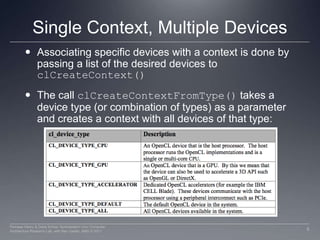
Single Context, Multiple DevicesAssociating specific devices with a context is done by passing a list of the desired devices to clCreateContext()The call clCreateContextFromType() takes a device type (or combination of types) as a parameter and creates a context with all devices of that type:5Perhaad Mistry & Dana Schaa, Northeastern Univ Computer Architecture Research Lab, with Ben Gaster, AMD © 2011
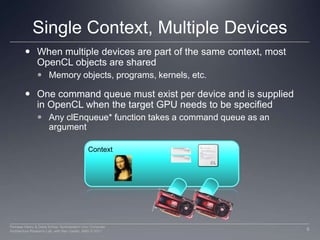
Single Context, Multiple DevicesWhen multiple devices are part of the same context, most OpenCL objects are sharedMemory objects, programs, kernels, etc.One command queue must exist per device and is supplied in OpenCL when the target GPU needs to be specifiedAny clEnqueue* function takes a command queue as an argumentContext6Perhaad Mistry & Dana Schaa, Northeastern Univ Computer Architecture Research Lab, with Ben Gaster, AMD © 2011
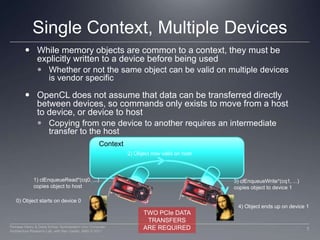
Single Context, Multiple DevicesWhile memory objects are common to a context, they must be explicitly written to a device before being used Whether or not the same object can be valid on multiple devices is vendor specificOpenCL does not assume that data can be transferred directly between devices, so commands only exists to move from a host to device, or device to hostCopying from one device to another requires an intermediate transfer to the hostContext2) Object now valid on host1) clEnqueueRead*(cq0, ...) copies object to host3) clEnqueueWrite*(cq1, ...) copies object to device 10) Object starts on device 04) Object ends up on device 1TWO PCIe DATA TRANSFERS ARE REQUIRED7Perhaad Mistry & Dana Schaa, Northeastern Univ Computer Architecture Research Lab, with Ben Gaster, AMD © 2011
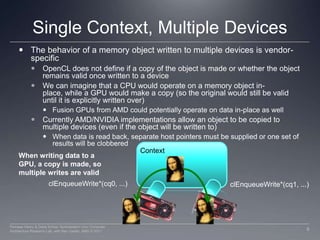
Single Context, Multiple DevicesThe behavior of a memory object written to multiple devices is vendor-specificOpenCL does not define if a copy of the object is made or whether the object remains valid once written to a deviceWe can imagine that a CPU would operate on a memory object in-place, while a GPU would make a copy (so the original would still be valid until it is explicitly written over)Fusion GPUs from AMD could potentially operate on data in-place as wellCurrently AMD/NVIDIA implementations allow an object to be copied to multiple devices (even if the object will be written to)When data is read back, separate host pointers must be supplied or one set of results will be clobberedContextWhen writing data to a GPU, a copy is made, so multiple writes are valid clEnqueueWrite*(cq0, ...)clEnqueueWrite*(cq1, ...)8Perhaad Mistry & Dana Schaa, Northeastern Univ Computer Architecture Research Lab, with Ben Gaster, AMD © 2011
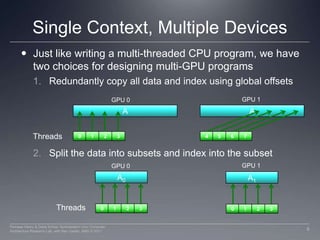
Single Context, Multiple DevicesJust like writing a multi-threaded CPU program, we have two choices for designing multi-GPU programsRedundantly copy all data and index using global offsetsSplit the data into subsets and index into the subsetGPU 1GPU 0AAThreads01234567GPU 1GPU 0A0A1Threads012301239Perhaad Mistry & Dana Schaa, Northeastern Univ Computer Architecture Research Lab, with Ben Gaster, AMD © 2011
Single Context, Multiple DevicesOpenCL provides mechanisms to help with both multi-device techniquesclEnqueueNDRangeKernel() optionally takes offsets that are used when computing the global ID of a threadNote that for this technique to work, any objects that are written to will have to be synchronized manuallySubBufferswere introduced in OpenCL 1.1 to allow a buffer to be split into multiple objectsThis allows reading/writing to offsets within a buffer to avoid manually splitting and recombining data10Perhaad Mistry & Dana Schaa, Northeastern Univ Computer Architecture Research Lab, with Ben Gaster, AMD © 2011
Single Context, Multiple DevicesOpenCLevents are used to synchronize execution on different devices within a contextEach clEnqueue* function generates an event that identifies the operationEach clEnqueue* function also takes an optional list of events that must complete before that operation should occurclEnqueueWaitForEvents() is the specific call to wait for a list of events to completeEvents are also used for profiling and were covered in more detail in Lecture 1111Perhaad Mistry & Dana Schaa, Northeastern Univ Computer Architecture Research Lab, with Ben Gaster, AMD © 2011
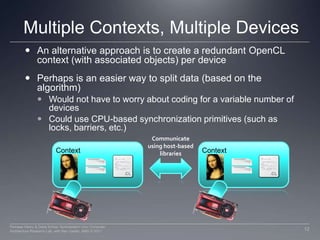
Multiple Contexts, Multiple DevicesAn alternative approach is to create a redundant OpenCL context (with associated objects) per devicePerhaps is an easier way to split data (based on the algorithm)Would not have to worry about coding for a variable number of devicesCould use CPU-based synchronization primitives (such as locks, barriers, etc.)Communicate using host-based librariesContextContext12Perhaad Mistry & Dana Schaa, Northeastern Univ Computer Architecture Research Lab, with Ben Gaster, AMD © 2011
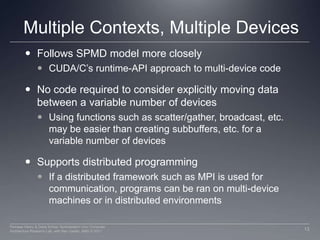
Follows SPMD model more closelyCUDA/C’s runtime-API approach to multi-device codeNo code required to consider explicitly moving data between a variable number of devicesUsing functions such as scatter/gather, broadcast, etc. may be easier than creating subbuffers, etc. for a variable number of devicesSupports distributed programmingIf a distributed framework such as MPI is used for communication, programs can be ran on multi-device machines or in distributed environmentsMultiple Contexts, Multiple Devices13Perhaad Mistry & Dana Schaa, Northeastern Univ Computer Architecture Research Lab, with Ben Gaster, AMD © 2011
In addition to PCI-Express transfers required to move data between host and device, extra memory and network communication may be requiredHost libraries (e.g., pthreads, MPI) must be used for synchronization and communicationMultiple Contexts, Multiple Devices14Perhaad Mistry & Dana Schaa, Northeastern Univ Computer Architecture Research Lab, with Ben Gaster, AMD © 2011
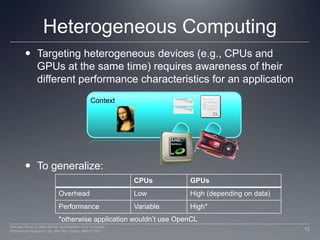
Heterogeneous ComputingTargeting heterogeneous devices (e.g., CPUs and GPUs at the same time) requires awareness of their different performance characteristics for an applicationTo generalize:Context*otherwise application wouldn’t use OpenCL15Perhaad Mistry & Dana Schaa, Northeastern Univ Computer Architecture Research Lab, with Ben Gaster, AMD © 2011
Heterogeneous ComputingFactors to considerScheduling overhead What is the startup time of each device?Location of data Which device is the data currently resident on?Data must be transferred across the PCI-Express busGranularity of workloadsHow should the problem be divided?What is the ratio of startup time to actual workExecution performance relative to other devicesHow should the work be distributed?16Perhaad Mistry & Dana Schaa, Northeastern Univ Computer Architecture Research Lab, with Ben Gaster, AMD © 2011
Heterogeneous ComputingGranularity of scheduling units must be weighedWorkload sizes that are too large may execute slowly on a device, stalling overall completionWorkload sizes that are too small may be dominated by startup overheadApproach to load-balancing #1:Begin scheduling small workload sizesProfile execution times on each device Extrapolate execution profiles for larger workload sizesSchedule with larger workload sizes to avoid unnecessary overhead	Approach to load-balancing #2:If one device is much faster than anything else in the system, just run on that device17Perhaad Mistry & Dana Schaa, Northeastern Univ Computer Architecture Research Lab, with Ben Gaster, AMD © 2011
SummaryThere are different approaches to multi-device programmingSingle context, multiple devicesCan only communicate with devices recognized by one vendorCode must be written for a general number of devicesMultiple contexts, multiple devicesMore like distributed programmingCode can be written for a single device (or multiple devices), with explicit movement of data between contexts18Perhaad Mistry & Dana Schaa, Northeastern Univ Computer Architecture Research Lab, with Ben Gaster, AMD © 2011

Lec13 multidevice

  • 1.
    Programming Multiple DevicesPerhaadMistry & Dana Schaa,Northeastern University Computer ArchitectureResearch Lab, with Benedict R. Gaster, AMD© 2011
  • 2.
    Instructor NotesThis lecturedescribes the different ways to work with multiple devices in OpenCL (i.e., within a single context and using multiple contexts), and the tradeoffs associated with each approachThe lecture concludes with a quick discussion of heterogeneous load-balancing issues when working with multiple devices2Perhaad Mistry & Dana Schaa, Northeastern Univ Computer Architecture Research Lab, with Ben Gaster, AMD © 2011
  • 3.
    Approaches to MultipleDevicesSingle context, multiple devicesStandard way to work with multiple devices in OpenCLMultiple contexts, multiple devicesComputing on a cluster, multiple systems, etc.Considerations for CPU-GPU heterogeneous computing3Perhaad Mistry & Dana Schaa, Northeastern Univ Computer Architecture Research Lab, with Ben Gaster, AMD © 2011
  • 4.
    Single Context, MultipleDevicesNomenclature:“clEnqueue*” is used to describe any of the clEnqueue commands (i.e., those that interact with a device)E.g. clEnqueueNDRangeKernel(), clEnqueueReadImage()“clEnqueueRead*” and “clEnqueueWrite*” are used to describe reading/writing to either buffers or imagesE.g. clEnqueueReadBuffer(), clEnqueueWriteImage()4Perhaad Mistry & Dana Schaa, Northeastern Univ Computer Architecture Research Lab, with Ben Gaster, AMD © 2011
  • 5.
    Single Context, MultipleDevicesAssociating specific devices with a context is done by passing a list of the desired devices to clCreateContext()The call clCreateContextFromType() takes a device type (or combination of types) as a parameter and creates a context with all devices of that type:5Perhaad Mistry & Dana Schaa, Northeastern Univ Computer Architecture Research Lab, with Ben Gaster, AMD © 2011
  • 6.
    Single Context, MultipleDevicesWhen multiple devices are part of the same context, most OpenCL objects are sharedMemory objects, programs, kernels, etc.One command queue must exist per device and is supplied in OpenCL when the target GPU needs to be specifiedAny clEnqueue* function takes a command queue as an argumentContext6Perhaad Mistry & Dana Schaa, Northeastern Univ Computer Architecture Research Lab, with Ben Gaster, AMD © 2011
  • 7.
    Single Context, MultipleDevicesWhile memory objects are common to a context, they must be explicitly written to a device before being used Whether or not the same object can be valid on multiple devices is vendor specificOpenCL does not assume that data can be transferred directly between devices, so commands only exists to move from a host to device, or device to hostCopying from one device to another requires an intermediate transfer to the hostContext2) Object now valid on host1) clEnqueueRead*(cq0, ...) copies object to host3) clEnqueueWrite*(cq1, ...) copies object to device 10) Object starts on device 04) Object ends up on device 1TWO PCIe DATA TRANSFERS ARE REQUIRED7Perhaad Mistry & Dana Schaa, Northeastern Univ Computer Architecture Research Lab, with Ben Gaster, AMD © 2011
  • 8.
    Single Context, MultipleDevicesThe behavior of a memory object written to multiple devices is vendor-specificOpenCL does not define if a copy of the object is made or whether the object remains valid once written to a deviceWe can imagine that a CPU would operate on a memory object in-place, while a GPU would make a copy (so the original would still be valid until it is explicitly written over)Fusion GPUs from AMD could potentially operate on data in-place as wellCurrently AMD/NVIDIA implementations allow an object to be copied to multiple devices (even if the object will be written to)When data is read back, separate host pointers must be supplied or one set of results will be clobberedContextWhen writing data to a GPU, a copy is made, so multiple writes are valid clEnqueueWrite*(cq0, ...)clEnqueueWrite*(cq1, ...)8Perhaad Mistry & Dana Schaa, Northeastern Univ Computer Architecture Research Lab, with Ben Gaster, AMD © 2011
  • 9.
    Single Context, MultipleDevicesJust like writing a multi-threaded CPU program, we have two choices for designing multi-GPU programsRedundantly copy all data and index using global offsetsSplit the data into subsets and index into the subsetGPU 1GPU 0AAThreads01234567GPU 1GPU 0A0A1Threads012301239Perhaad Mistry & Dana Schaa, Northeastern Univ Computer Architecture Research Lab, with Ben Gaster, AMD © 2011
  • 10.
    Single Context, MultipleDevicesOpenCL provides mechanisms to help with both multi-device techniquesclEnqueueNDRangeKernel() optionally takes offsets that are used when computing the global ID of a threadNote that for this technique to work, any objects that are written to will have to be synchronized manuallySubBufferswere introduced in OpenCL 1.1 to allow a buffer to be split into multiple objectsThis allows reading/writing to offsets within a buffer to avoid manually splitting and recombining data10Perhaad Mistry & Dana Schaa, Northeastern Univ Computer Architecture Research Lab, with Ben Gaster, AMD © 2011
  • 11.
    Single Context, MultipleDevicesOpenCLevents are used to synchronize execution on different devices within a contextEach clEnqueue* function generates an event that identifies the operationEach clEnqueue* function also takes an optional list of events that must complete before that operation should occurclEnqueueWaitForEvents() is the specific call to wait for a list of events to completeEvents are also used for profiling and were covered in more detail in Lecture 1111Perhaad Mistry & Dana Schaa, Northeastern Univ Computer Architecture Research Lab, with Ben Gaster, AMD © 2011
  • 12.
    Multiple Contexts, MultipleDevicesAn alternative approach is to create a redundant OpenCL context (with associated objects) per devicePerhaps is an easier way to split data (based on the algorithm)Would not have to worry about coding for a variable number of devicesCould use CPU-based synchronization primitives (such as locks, barriers, etc.)Communicate using host-based librariesContextContext12Perhaad Mistry & Dana Schaa, Northeastern Univ Computer Architecture Research Lab, with Ben Gaster, AMD © 2011
  • 13.
    Follows SPMD modelmore closelyCUDA/C’s runtime-API approach to multi-device codeNo code required to consider explicitly moving data between a variable number of devicesUsing functions such as scatter/gather, broadcast, etc. may be easier than creating subbuffers, etc. for a variable number of devicesSupports distributed programmingIf a distributed framework such as MPI is used for communication, programs can be ran on multi-device machines or in distributed environmentsMultiple Contexts, Multiple Devices13Perhaad Mistry & Dana Schaa, Northeastern Univ Computer Architecture Research Lab, with Ben Gaster, AMD © 2011
  • 14.
    In addition toPCI-Express transfers required to move data between host and device, extra memory and network communication may be requiredHost libraries (e.g., pthreads, MPI) must be used for synchronization and communicationMultiple Contexts, Multiple Devices14Perhaad Mistry & Dana Schaa, Northeastern Univ Computer Architecture Research Lab, with Ben Gaster, AMD © 2011
  • 15.
    Heterogeneous ComputingTargeting heterogeneousdevices (e.g., CPUs and GPUs at the same time) requires awareness of their different performance characteristics for an applicationTo generalize:Context*otherwise application wouldn’t use OpenCL15Perhaad Mistry & Dana Schaa, Northeastern Univ Computer Architecture Research Lab, with Ben Gaster, AMD © 2011
  • 16.
    Heterogeneous ComputingFactors toconsiderScheduling overhead What is the startup time of each device?Location of data Which device is the data currently resident on?Data must be transferred across the PCI-Express busGranularity of workloadsHow should the problem be divided?What is the ratio of startup time to actual workExecution performance relative to other devicesHow should the work be distributed?16Perhaad Mistry & Dana Schaa, Northeastern Univ Computer Architecture Research Lab, with Ben Gaster, AMD © 2011
  • 17.
    Heterogeneous ComputingGranularity ofscheduling units must be weighedWorkload sizes that are too large may execute slowly on a device, stalling overall completionWorkload sizes that are too small may be dominated by startup overheadApproach to load-balancing #1:Begin scheduling small workload sizesProfile execution times on each device Extrapolate execution profiles for larger workload sizesSchedule with larger workload sizes to avoid unnecessary overhead Approach to load-balancing #2:If one device is much faster than anything else in the system, just run on that device17Perhaad Mistry & Dana Schaa, Northeastern Univ Computer Architecture Research Lab, with Ben Gaster, AMD © 2011
  • 18.
    SummaryThere are differentapproaches to multi-device programmingSingle context, multiple devicesCan only communicate with devices recognized by one vendorCode must be written for a general number of devicesMultiple contexts, multiple devicesMore like distributed programmingCode can be written for a single device (or multiple devices), with explicit movement of data between contexts18Perhaad Mistry & Dana Schaa, Northeastern Univ Computer Architecture Research Lab, with Ben Gaster, AMD © 2011

Editor's Notes

  • #8 If CPUs were being used and operating on data in-place, the commands to transfer data would likely not actually do any copying.
  • #13 If the contexts were on the same physical machine, pthreads could be used to communicate and synchronize. In a distributed setting, MPI could be used.