TARGET AND
STRATEGY
FORMULATION
CHESTER LYNDON S. PADILLA, CPA
Presenter
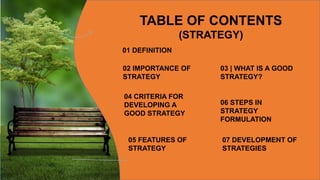
TABLE OF CONTENTS
(STRATEGY)
01 DEFINITION
02 IMPORTANCE OF
STRATEGY
04 CRITERIA FOR
DEVELOPING A
GOOD STRATEGY
05 FEATURES OF
STRATEGY
03 | WHAT IS A GOOD
STRATEGY?
06 STEPS IN
STRATEGY
FORMULATION
07 DEVELOPMENT OF
STRATEGIES
“Strategy” is derived from the Greek word
“stratçgos”; stratus (meaning army) and “ago”
(meaning leading/moving).
STRATEGY
STRATEGY
 Strategy is an action that managers take to attain one or more
of the organization’s goals.
 Strategy can also be defined as “ A general direction set for the
company and its various components to achieve a desired state
in the future. Strategy results from the detailed strategic
planning process”.
 Strategy can also be defined as knowledge of the goals, the
uncertainty of events and the need to take into consideration
the likely or actual behavior of others.
STRATEGY
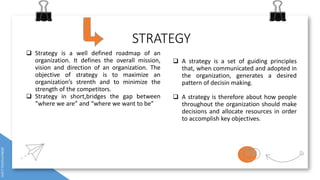
 A strategy is a set of guiding principles
that, when communicated and adopted in
the organization, generates a desired
pattern of decisin making.
 A strategy is therefore about how people
throughout the organization should make
decisions and allocate resources in order
to accomplish key objectives.
 Strategy is a well defined roadmap of an
organization. It defines the overall mission,
vision and direction of an organization. The
objective of strategy is to maximize an
organization’s strenth and to minimize the
strength of the competitors.
 Strategy in short,bridges the gap between
“where we are” and “where we want to be”
Strategy is a way of describing how
you are going to get things done. It
broadly answer the question, “How
do wet get there from here?”
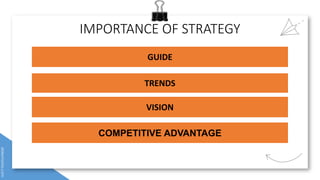
IMPORTANCE OF STRATEGY
GUIDE
TRENDS
VISION
COMPETITIVE ADVANTAGE
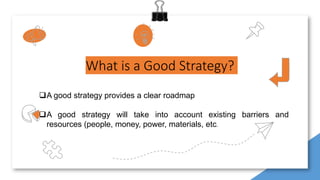
What is a Good Strategy?
A good strategy provides a clear roadmap
A good strategy will take into account existing barriers and
resources (people, money, power, materials, etc.
CRITERIA FOR DEVELOPING A GOOD STRATEGY
Give overall direction
Fit resources and opportunities
Minimize resistance and barriers
Reach those affected
Advance the mission
When should
you develop
strategies for
your
initiative?
Developing strategies is the fourth step
in the VMOSA (Vision, Mission,
Objectives, Strategies and Action Plan)
process. Developing strategies is the
essential step between figuring out your
objectives and making the changes to
reach them. Strategies should always be
formed in advance of taking action, not
deciding how to do something after you
have done it.
STRATEGY FORMULATION
Refers to the process of choosing the most
appropriate course oif action for the
realization of organizational goals and
objectives and thereby achieving the
organizational vision.
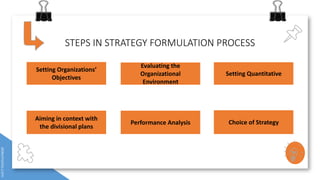
STEPS IN STRATEGY FORMULATION PROCESS
Setting Organizations’
Objectives
Aiming in context with
the divisional plans
Setting Quantitative
Evaluating the
Organizational
Environment
Performance Analysis Choice of Strategy
Development of Strategies
(Alternative Solutions)
Investigate ways
that other agencies
and communities
are achieving
similar objectives
Use knowledge
gained from
demonstration or
pilot projects that
offer possibilities in
achieving the
intended goals and
objectives.
Have staff and
others generate
ideas based on
their personal
experience
Ways to Evaluate Alternative Strategies
How much
would it cost to
implement?
Availability of
Resources
Are staff, money
and time to
implement
available?
Financial
Considerations
Target
Population
Ways to Evaluate Alternative Strategies
Social Costs What are the
long term
positive and
negative
consequemces
of the strategy to
the target
population
Intended
Objectives
Will the target
population
accept the given
strategy?
Will it achieve
the intended
objectives?
TABLE OF CONTENTS
(TARGET)
01 TARGET 02 SETTING
TARGETS
03 |BENEFITS OF
SETTING TARGETS
It is the desifred level of performance for a
specific performance indicator. Performance
indicators and targets are mechanisms to
operationalize objectives.
TARGET
TARGET
 Targets should be measurable and realistic.
 An action that should be undertaken in order to achieve the desired
objective. A program is composed of targets.
 Targets help define, in specific measurable terms, the desired
outcome of the strategy. They should be incorporated into a vision
statement to contribute to a “SMART” objective. Targets help to set
up a clear course of action and guide future direction.
 Targets provide a measure of how successful the strategy may have
been and determine required adjustment to improve performance
and results.
SETTING TARGETS
 Enable benefit measurement
 Be measurable from a
practical perspective
 Reflect recognized
performance measures.
 Be simple and easy to convey
 Relate directly to the
identified objectives
 Relate to outcome, not
outputs
BENEFITS OF SETTING TARGETS
Establishing clear goals
Motivating peoplr working by clarifying their expected performance and how they can measure
progress.
Providing a benchmark against which improvements can be measured
Demonstrating commitment to the sustainable agenda.
Generating potential marketing benefits.
THANK YOU!
TARGET AND STRATEGY FORMULATION.pptx

TARGET AND STRATEGY FORMULATION.pptx

  • 1.
  • 2.
    TABLE OF CONTENTS (STRATEGY) 01DEFINITION 02 IMPORTANCE OF STRATEGY 04 CRITERIA FOR DEVELOPING A GOOD STRATEGY 05 FEATURES OF STRATEGY 03 | WHAT IS A GOOD STRATEGY? 06 STEPS IN STRATEGY FORMULATION 07 DEVELOPMENT OF STRATEGIES
  • 3.
    “Strategy” is derivedfrom the Greek word “stratçgos”; stratus (meaning army) and “ago” (meaning leading/moving). STRATEGY
  • 4.
    STRATEGY  Strategy isan action that managers take to attain one or more of the organization’s goals.  Strategy can also be defined as “ A general direction set for the company and its various components to achieve a desired state in the future. Strategy results from the detailed strategic planning process”.  Strategy can also be defined as knowledge of the goals, the uncertainty of events and the need to take into consideration the likely or actual behavior of others.
  • 5.
    STRATEGY  A strategyis a set of guiding principles that, when communicated and adopted in the organization, generates a desired pattern of decisin making.  A strategy is therefore about how people throughout the organization should make decisions and allocate resources in order to accomplish key objectives.  Strategy is a well defined roadmap of an organization. It defines the overall mission, vision and direction of an organization. The objective of strategy is to maximize an organization’s strenth and to minimize the strength of the competitors.  Strategy in short,bridges the gap between “where we are” and “where we want to be”
  • 6.
    Strategy is away of describing how you are going to get things done. It broadly answer the question, “How do wet get there from here?”
  • 7.
  • 8.
    What is aGood Strategy? A good strategy provides a clear roadmap A good strategy will take into account existing barriers and resources (people, money, power, materials, etc.
  • 9.
    CRITERIA FOR DEVELOPINGA GOOD STRATEGY Give overall direction Fit resources and opportunities Minimize resistance and barriers Reach those affected Advance the mission
  • 10.
    When should you develop strategiesfor your initiative? Developing strategies is the fourth step in the VMOSA (Vision, Mission, Objectives, Strategies and Action Plan) process. Developing strategies is the essential step between figuring out your objectives and making the changes to reach them. Strategies should always be formed in advance of taking action, not deciding how to do something after you have done it.
  • 11.
    STRATEGY FORMULATION Refers tothe process of choosing the most appropriate course oif action for the realization of organizational goals and objectives and thereby achieving the organizational vision.
  • 12.
    STEPS IN STRATEGYFORMULATION PROCESS Setting Organizations’ Objectives Aiming in context with the divisional plans Setting Quantitative Evaluating the Organizational Environment Performance Analysis Choice of Strategy
  • 13.
    Development of Strategies (AlternativeSolutions) Investigate ways that other agencies and communities are achieving similar objectives Use knowledge gained from demonstration or pilot projects that offer possibilities in achieving the intended goals and objectives. Have staff and others generate ideas based on their personal experience
  • 14.
    Ways to EvaluateAlternative Strategies How much would it cost to implement? Availability of Resources Are staff, money and time to implement available? Financial Considerations Target Population
  • 15.
    Ways to EvaluateAlternative Strategies Social Costs What are the long term positive and negative consequemces of the strategy to the target population Intended Objectives Will the target population accept the given strategy? Will it achieve the intended objectives?
  • 16.
    TABLE OF CONTENTS (TARGET) 01TARGET 02 SETTING TARGETS 03 |BENEFITS OF SETTING TARGETS
  • 17.
    It is thedesifred level of performance for a specific performance indicator. Performance indicators and targets are mechanisms to operationalize objectives. TARGET
  • 18.
    TARGET  Targets shouldbe measurable and realistic.  An action that should be undertaken in order to achieve the desired objective. A program is composed of targets.  Targets help define, in specific measurable terms, the desired outcome of the strategy. They should be incorporated into a vision statement to contribute to a “SMART” objective. Targets help to set up a clear course of action and guide future direction.  Targets provide a measure of how successful the strategy may have been and determine required adjustment to improve performance and results.
  • 19.
    SETTING TARGETS  Enablebenefit measurement  Be measurable from a practical perspective  Reflect recognized performance measures.  Be simple and easy to convey  Relate directly to the identified objectives  Relate to outcome, not outputs
  • 20.
    BENEFITS OF SETTINGTARGETS Establishing clear goals Motivating peoplr working by clarifying their expected performance and how they can measure progress. Providing a benchmark against which improvements can be measured Demonstrating commitment to the sustainable agenda. Generating potential marketing benefits.
  • 21.