Historical Perspectives of
Curriculum Development
WHAT is taught to students.
What is curriculum?
There are many definitions that are correct…………. but for
our purposes we define curriculum as :
How Do We Define Curriculum?
Curriculum is
that which is
taught at
school
Curriculum is
a sequence of
courses
Curriculum is
a set of
subjects
Curriculum is
a set of
performance
objectives
Curriculum is
content
The development of curriculum in history is basically founded on
five outstanding motives
Religion
Political
Utilitarian
Mass
education
Excellence
in education
Curriculum different dimensions
Traditional
Modern
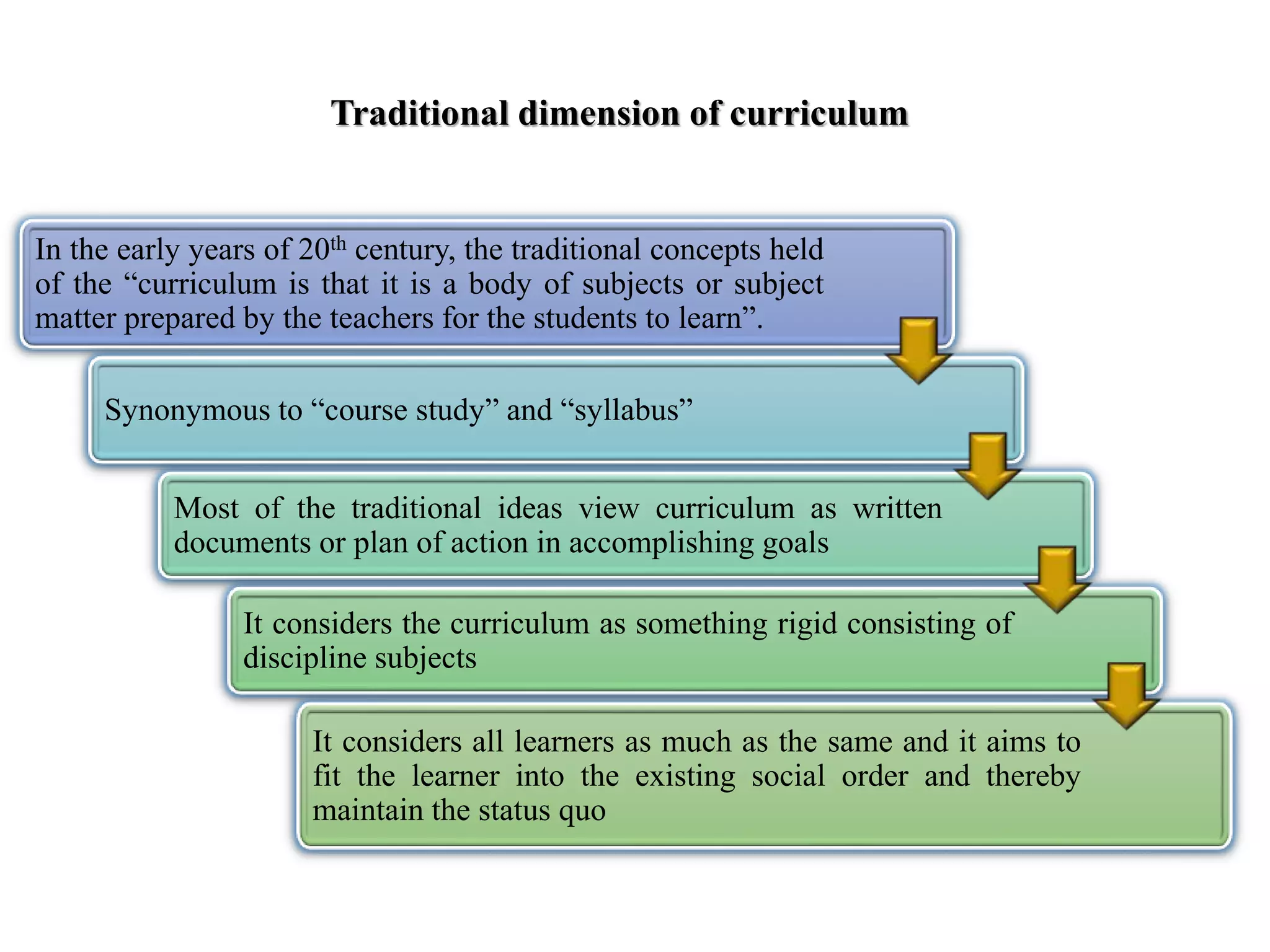
In the early years of 20th century, the traditional concepts held
of the “curriculum is that it is a body of subjects or subject
matter prepared by the teachers for the students to learn”.
Synonymous to “course study” and “syllabus”
Most of the traditional ideas view curriculum as written
documents or plan of action in accomplishing goals
It considers the curriculum as something rigid consisting of
discipline subjects
It considers all learners as much as the same and it aims to
fit the learner into the existing social order and thereby
maintain the status quo
Traditional dimension of curriculum
Its major motivation is discipline and considers freedom as an
outcome and not a means of education.
Its approach is authoritative and the teacher’s role is to assign
lessons and to recite recitations.
It is book-centered and the methods recommended are
memory work , mastery of facts and skills, and development
of abstract intelligence.
It has no interest in social action and life activities
Its measurement of outcomes are standard tests based on
subject matter mastery.
Traditional dimension of curriculum (cont…)
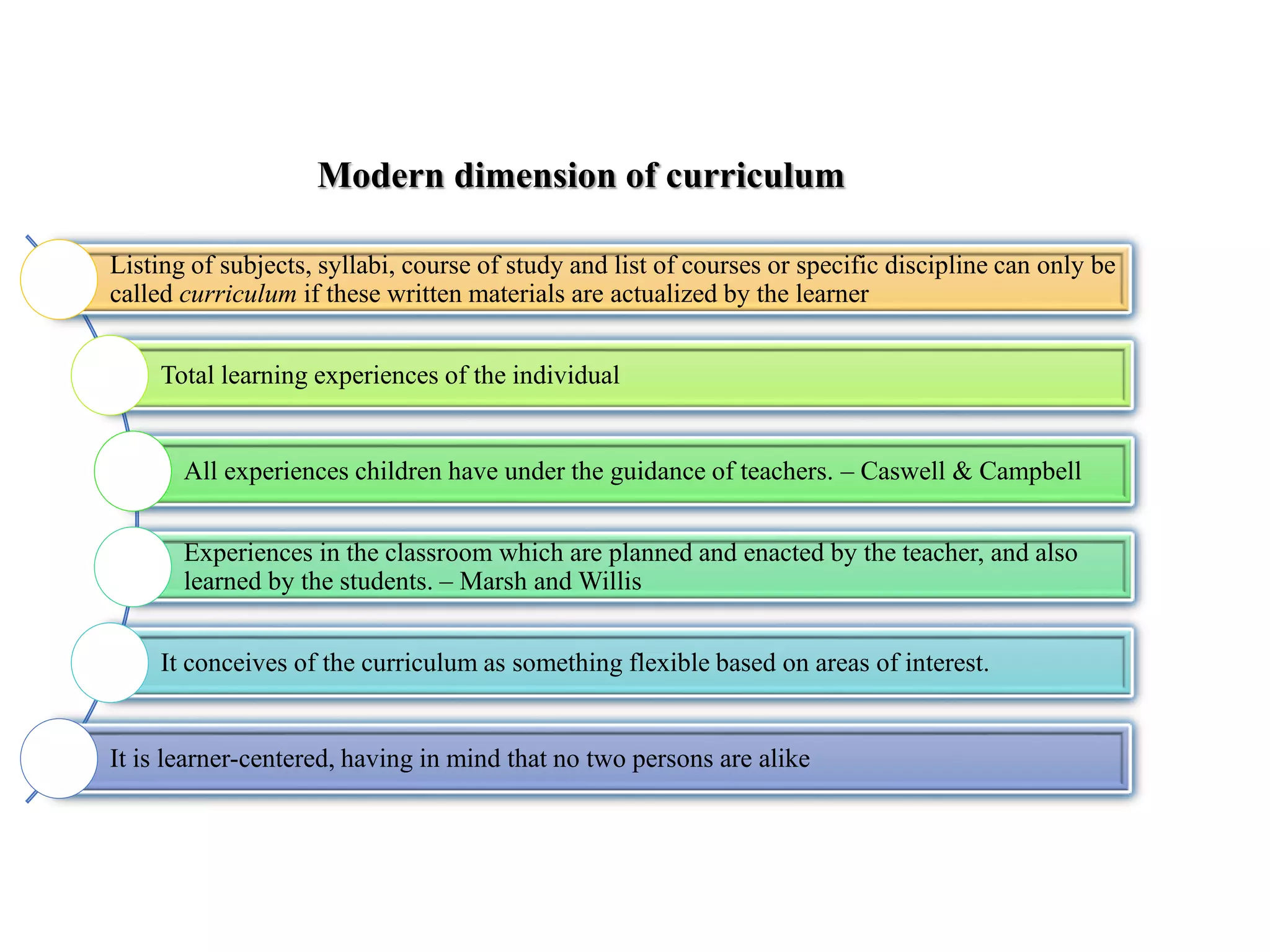
Listing of subjects, syllabi, course of study and list of courses or specific discipline can only be
called curriculum if these written materials are actualized by the learner
Total learning experiences of the individual
All experiences children have under the guidance of teachers. – Caswell & Campbell
Experiences in the classroom which are planned and enacted by the teacher, and also
learned by the students. – Marsh and Willis
It conceives of the curriculum as something flexible based on areas of interest.
It is learner-centered, having in mind that no two persons are alike
Modern dimension of curriculum
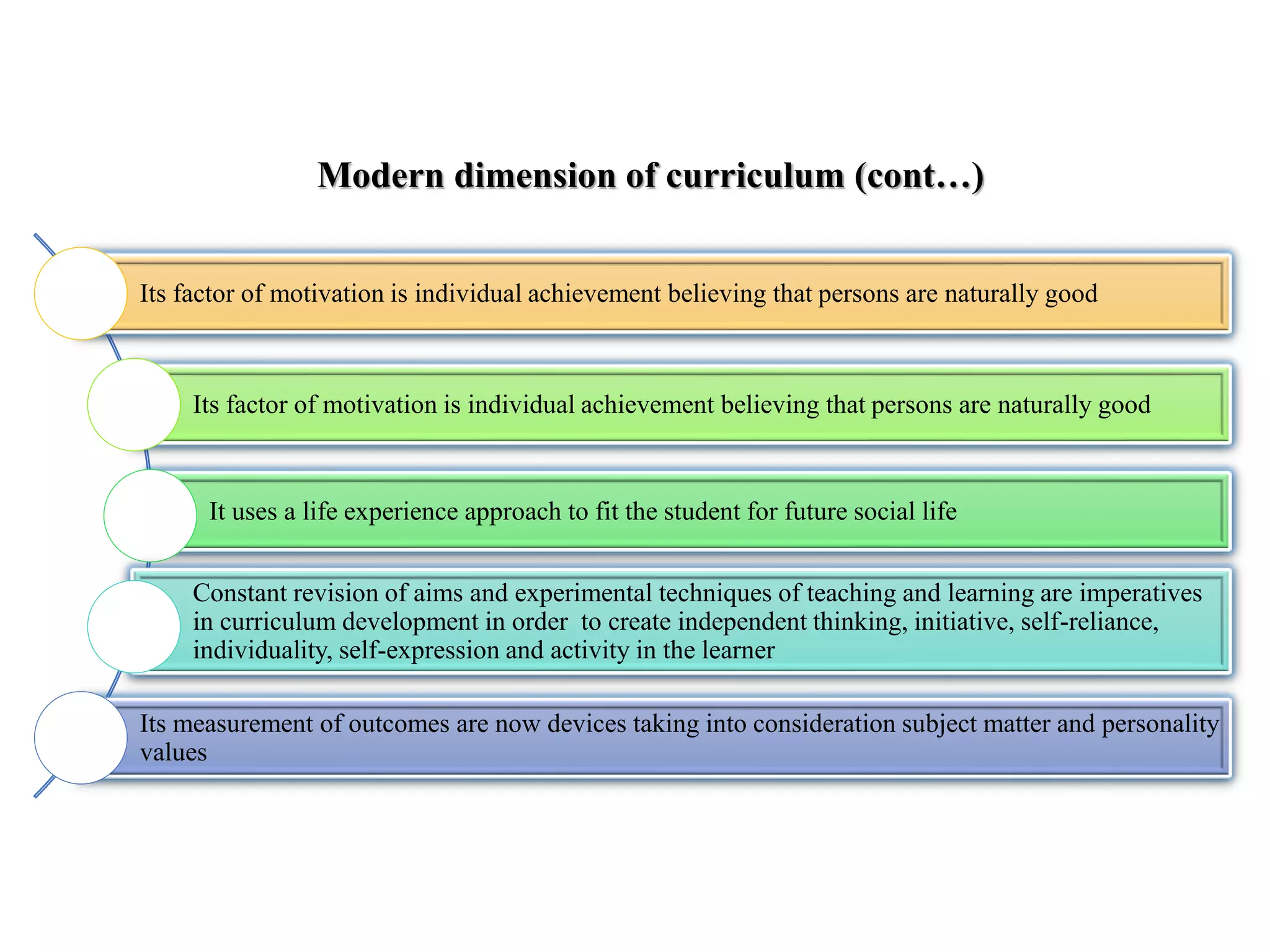
Its factor of motivation is individual achievement believing that persons are naturally good
It uses a life experience approach to fit the student for future social life
Constant revision of aims and experimental techniques of teaching and learning are imperatives
in curriculum development in order to create independent thinking, initiative, self-reliance,
individuality, self-expression and activity in the learner
Its measurement of outcomes are now devices taking into consideration subject matter and personality
values
Modern dimension of curriculum (cont…)
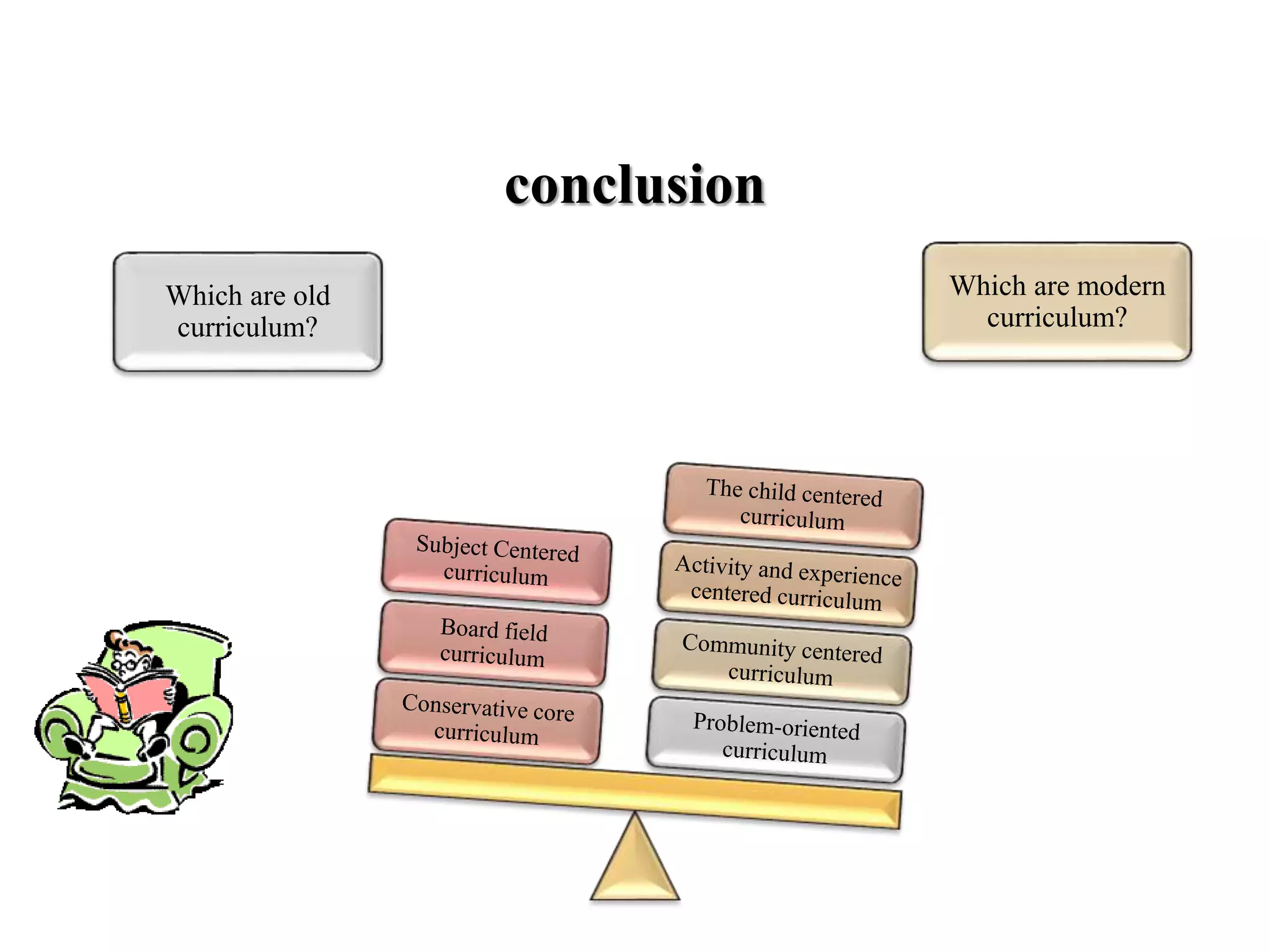
Which are old
curriculum?
Which are modern
curriculum?
conclusion

Historical prospective of curriculum development

  • 1.
  • 2.
    WHAT is taughtto students. What is curriculum? There are many definitions that are correct…………. but for our purposes we define curriculum as :
  • 3.
    How Do WeDefine Curriculum? Curriculum is that which is taught at school Curriculum is a sequence of courses Curriculum is a set of subjects Curriculum is a set of performance objectives Curriculum is content
  • 4.
    The development ofcurriculum in history is basically founded on five outstanding motives Religion Political Utilitarian Mass education Excellence in education
  • 5.
  • 6.
    In the earlyyears of 20th century, the traditional concepts held of the “curriculum is that it is a body of subjects or subject matter prepared by the teachers for the students to learn”. Synonymous to “course study” and “syllabus” Most of the traditional ideas view curriculum as written documents or plan of action in accomplishing goals It considers the curriculum as something rigid consisting of discipline subjects It considers all learners as much as the same and it aims to fit the learner into the existing social order and thereby maintain the status quo Traditional dimension of curriculum
  • 7.
    Its major motivationis discipline and considers freedom as an outcome and not a means of education. Its approach is authoritative and the teacher’s role is to assign lessons and to recite recitations. It is book-centered and the methods recommended are memory work , mastery of facts and skills, and development of abstract intelligence. It has no interest in social action and life activities Its measurement of outcomes are standard tests based on subject matter mastery. Traditional dimension of curriculum (cont…)
  • 8.
    Listing of subjects,syllabi, course of study and list of courses or specific discipline can only be called curriculum if these written materials are actualized by the learner Total learning experiences of the individual All experiences children have under the guidance of teachers. – Caswell & Campbell Experiences in the classroom which are planned and enacted by the teacher, and also learned by the students. – Marsh and Willis It conceives of the curriculum as something flexible based on areas of interest. It is learner-centered, having in mind that no two persons are alike Modern dimension of curriculum
  • 9.
    Its factor ofmotivation is individual achievement believing that persons are naturally good Its factor of motivation is individual achievement believing that persons are naturally good It uses a life experience approach to fit the student for future social life Constant revision of aims and experimental techniques of teaching and learning are imperatives in curriculum development in order to create independent thinking, initiative, self-reliance, individuality, self-expression and activity in the learner Its measurement of outcomes are now devices taking into consideration subject matter and personality values Modern dimension of curriculum (cont…)
  • 10.
    Which are old curriculum? Whichare modern curriculum? conclusion