This project has been funded with support from the European Commission. This Web site reflects the views only of the authors,
and the Commission cannot be held responsible for any use which may be made of the information contained therein.
Project partners
Twycross
School
http://www.geocapabilities.org
GeoCapabilities
Geography as PDK
(Powerful Disciplinary Knowledge)
This project has been funded with support from the European Commission. This Web site reflects the views only of the authors,
and the Commission cannot be held responsible for any use which may be made of the information contained therein.
Project partners
Twycross
School
http://www.geocapabilities.org
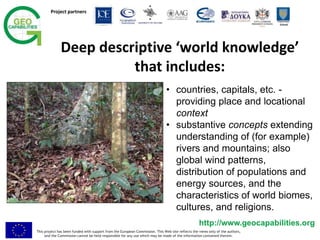
Deep descriptive ‘world knowledge’
that includes:
• countries, capitals, etc. -
providing place and locational
context
• substantive concepts extending
understanding of (for example)
rivers and mountains; also
global wind patterns,
distribution of populations and
energy sources, and the
characteristics of world biomes,
cultures, and religions.
This project has been funded with support from the European Commission. This Web site reflects the views only of the authors,
and the Commission cannot be held responsible for any use which may be made of the information contained therein.
Project partners
Twycross
School
http://www.geocapabilities.org
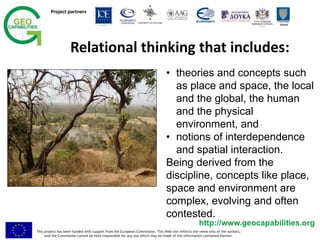
Relational thinking that includes:
• theories and concepts such
as place and space, the local
and the global, the human
and the physical
environment, and
• notions of interdependence
and spatial interaction.
Being derived from the
discipline, concepts like place,
space and environment are
complex, evolving and often
contested.
This project has been funded with support from the European Commission. This Web site reflects the views only of the authors,
and the Commission cannot be held responsible for any use which may be made of the information contained therein.
Project partners
Twycross
School
http://www.geocapabilities.org
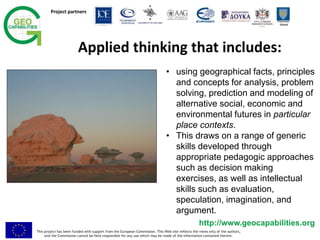
Applied thinking that includes:
• using geographical facts, principles
and concepts for analysis, problem
solving, prediction and modeling of
alternative social, economic and
environmental futures in particular
place contexts.
• This draws on a range of generic
skills developed through
appropriate pedagogic approaches
such as decision making
exercises, as well as intellectual
skills such as evaluation,
speculation, imagination, and
argument.

GeoCapabilities: Geography as Powerful Disciplinary Knowledge (PDK)

  • 1.
    This project hasbeen funded with support from the European Commission. This Web site reflects the views only of the authors, and the Commission cannot be held responsible for any use which may be made of the information contained therein. Project partners Twycross School http://www.geocapabilities.org GeoCapabilities Geography as PDK (Powerful Disciplinary Knowledge)
  • 2.
    This project hasbeen funded with support from the European Commission. This Web site reflects the views only of the authors, and the Commission cannot be held responsible for any use which may be made of the information contained therein. Project partners Twycross School http://www.geocapabilities.org Deep descriptive ‘world knowledge’ that includes: • countries, capitals, etc. - providing place and locational context • substantive concepts extending understanding of (for example) rivers and mountains; also global wind patterns, distribution of populations and energy sources, and the characteristics of world biomes, cultures, and religions.
  • 3.
    This project hasbeen funded with support from the European Commission. This Web site reflects the views only of the authors, and the Commission cannot be held responsible for any use which may be made of the information contained therein. Project partners Twycross School http://www.geocapabilities.org Relational thinking that includes: • theories and concepts such as place and space, the local and the global, the human and the physical environment, and • notions of interdependence and spatial interaction. Being derived from the discipline, concepts like place, space and environment are complex, evolving and often contested.
  • 4.
    This project hasbeen funded with support from the European Commission. This Web site reflects the views only of the authors, and the Commission cannot be held responsible for any use which may be made of the information contained therein. Project partners Twycross School http://www.geocapabilities.org Applied thinking that includes: • using geographical facts, principles and concepts for analysis, problem solving, prediction and modeling of alternative social, economic and environmental futures in particular place contexts. • This draws on a range of generic skills developed through appropriate pedagogic approaches such as decision making exercises, as well as intellectual skills such as evaluation, speculation, imagination, and argument.