Disciplinary Literacy:
Another Name for Teaching Texts
While you are waiting for this session to
begin, please type in the chat box:
1. Your name and position
2. The age of students you work with
3. Your comfort with teaching online
1
Disciplinary Literacy:
Another name for Teaching Texts
Dr. Susan Wegmann
swegmann@mail.ucf.edu
Council for Online Literacy Educators
Inaugural Conference,
November 18, 2010
3
Agree/Disagree
1. Reading is a one-way road from text to
person.
2. Most content area texts are written on
grade level.
3. Learning language is a social activity.
4
In every case, it is the reader who reads the
sense. . .We read to understand, or to begin
to understand. We cannot do but read.
Reading, almost as much as breathing, is
our essential function.
Alberto Manguel, (1996). A History of Reading. NY: Viking.
5
Disciplinary Literacy. . .
“…requires an understanding of how
knowledges are constructed and organized
in the content area, an understanding of what
counts as warrant or evidence for a claim,
and an understanding of the conventions of
communicating that knowledge” (Moje,
Ciechanowski, Kramer, Ellis, Carrillo &
Collazo, 2004, p. 45).
6
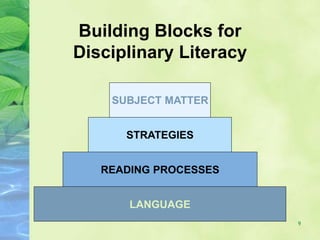
LANGUAGE
Building Blocks for
Disciplinary Literacy
7
LANGUAGE
READING PROCESSES
Building Blocks for
Disciplinary Literacy
8
LANGUAGE
READING PROCESSES
STRATEGIES
Building Blocks for
Disciplinary Literacy
9
LANGUAGE
READING PROCESSES
STRATEGIES
SUBJECT MATTER
Building Blocks for
Disciplinary Literacy
10
Defining Disciplinary Literacy
"Literacy is the state of being able to
participate fully in a to-and-fro interplay
between person and text.”
“Disciplinary Literacy” then, is being
literate in a particular discipline or
content area.
1.2 million students tested –
only 51% labeled as
“ready for college”
11
12
Discipline Specific Literacy Skills
Acknowledge
the interplay
between self
and text
13
Discipline Specific Literacy Skills
Knowledge of
specialized
vocabulary
Acknowledge
the interplay
between self
and text
14
Discipline Specific Literacy Skills
Test
taking
ability
Knowledge of
specialized
vocabulary
Acknowledge
the interplay
between self
and text
15
Discipline Specific Literacy Skills
Knowledge of
content text
structure
Test
taking
ability
Knowledge of
specialized
vocabulary
Acknowledge
the interplay
between self
and text
16
Discipline Specific Literacy Skills
Knowledge of
content text
structure
Test
taking
ability
Knowledge of
specialized
vocabulary
Ability to
identify
important
information
Acknowledge
the interplay
between self
and text
17
Discipline Specific Literacy Skills
Ability to
synthesize
information
using LER first,
then external
sources
Knowledge of
content text
structure
Test
taking
ability
Knowledge of
specialized
vocabulary
Ability to
identify
important
information
Acknowledge
the interplay
between self
and text
18
Discipline Specific Literacy Skills
Ability to
synthesize
information
using LER first,
then external
sources
Knowledge of
content text
structure
Test
taking
ability
Knowledge of
specialized
vocabulary
Ability to
identify
important
information
Ability to read
visual/graphic
information
Acknowledge
the interplay
between self
and text
19
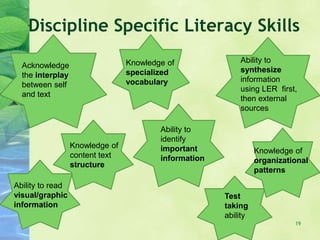
Discipline Specific Literacy Skills
Ability to
synthesize
information
using LER first,
then external
sources
Knowledge of
content text
structure
Test
taking
ability
Knowledge of
specialized
vocabulary
Knowledge of
organizational
patterns
Ability to
identify
important
information
Ability to read
visual/graphic
information
Acknowledge
the interplay
between self
and text
20
Discipline Specific Literacy Skills
Ability to
synthesize
information
using LER first,
then external
sources
Knowledge of
content text
structure
Test
taking
ability
Knowledge of
specialized
vocabulary
Knowledge of
organizational
patterns
Ability to
identify
important
information
Ability to read
visual/graphic
information
Research
skills
Acknowledge
the interplay
between self
and text
21
Expert readers. . .
• activate prior knowledge (LER)
• set goals for reading
• make predictions
• self-monitor
• construct the main idea
• critique the text’s propositions
• evaluate the structure of the text
22
Disciplinary Reading Strategies
Before Reading During Reading After Reading
Anticipation Guides Choose 10 Anticipation Guides
SQ3R QAR SQ3R
Structural Analysis SQ3R RAP
Read alouds RAP Written responses
Alternative Texts Graphic Organizers Read alouds
Scavenger Hunt QtA Reader’s Theatre
Graphic organizers Read alouds Alternative Texts
Interviews Text Sets Graphic Organizers
Text Sets Semantic Feature Analysis In just 10 minutes. . .
Digital Stories Read Encode Annotate
Ponder
Interviews
WebQuests Text Sets
WebQuests/Digital Stories
23
Semantic Feature Analysis
•
•
Democrat Republican Former
Governor
Former
Vice-
President
2 Full
Terms in
Office
Still Living
L. B.
Johnson
 –— –—  –— –—
Nixon –—  –—  –— –—
Ford –—  –—  –— 
Carter  –—  –— –— 
Reagan –—   –—  –—
24
DIRECTED TEXT MARKING
Instructor Directed Markings Type of Markings To Be Used
Title circle
Paragraphs number: 1, 2, 3, etc. (left margin)
Paragraph summary main idea word or brief phrase
(right margin)
Challenging vocabulary words box:
Location names bracket: [ ]
People named in the story wavy line vvvvvvvvvvvvvvv
Data that contains dates, asterisk
numbers, distances or
amounts; anything numerical
Webklipper.com
Limited amount of vocabulary
words per week.
Explicit vocabulary instruction
25
Disciplinary Vocabulary
Instruction
26
Vocabulary Frame
Antonym Definition
Silly sentence with definition of word Graphic/Picture
Word
27
K.I.M.
Key idea Information Memory clue
Drought Little or no rain (picture)
Coup Takeover of
government by the
military
(picture)
28
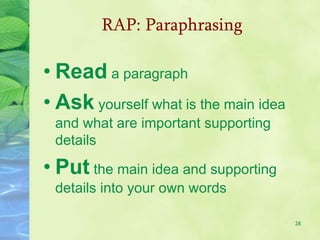
RAP: Paraphrasing
• Read a paragraph
• Ask yourself what is the main idea
and what are important supporting
details
• Put the main idea and supporting
details into your own words
29
Concept Map of Learning Unit
Unit Essential Question Examples/Steps/Vocab
Unit Topic/Concept
Major Concepts/Skills/Key Questions
30
Written responses to text:
Postcard/Letter to the (Textbook)
Editor
Student Authored Study Guides
Textbook Chapter Rewrites
Narrative about “Being there.”
Journal or diary entries
31
Written responses to text: (cont)
Write a Memoir
Sharing/Interactive writing
Written dialogue
Manga
32
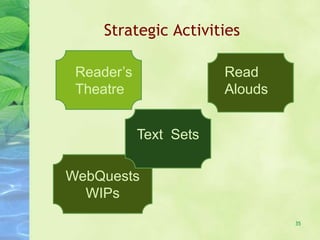
Strategic Activities
Read
Alouds
33
Read
Alouds
WebQuests
WIPs
Strategic Activities
34
Read
Alouds
WebQuests
WIPs
Text Sets
Strategic Activities
35
Read
Alouds
Reader’s
Theatre
WebQuests
WIPs
Text Sets
Strategic Activities
36
Strategic Activities
Read
Alouds
Reader’s
Theatre
WebQuests
WIPs
Interviews
Text Sets
37
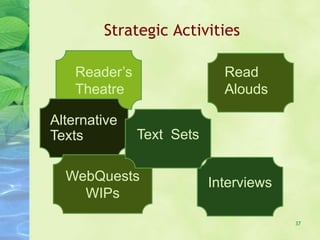
Strategic Activities
Read
Alouds
Reader’s
Theatre
Alternative
Texts
WebQuests
WIPs
Interviews
Text Sets
In just 10
minutes. .
38
Strategic Activities
Read
Alouds
Reader’s
Theatre
Alternative
Texts
WebQuests
WIPs
Interviews
Text Sets
In just 10
minutes. .
Scavenger
Hunt
39
Strategic Activities
Read
Alouds
Reader’s
Theatre
Alternative
Texts
WebQuests
WIPs
Interviews
Text Sets
In just 10
minutes. .
Scavenger
Hunt
40
Strategic Activities
Read
Alouds
Reader’s
Theatre
Alternative
Texts
WebQuests
WIPs
Digital
Stories
Interviews
Text Sets
41
42
Best Web 2.0 Applications for 2010
1. Sitehoover
2. Titan Pads
3. Clp.ly
4. Flisti
5. Send Shots
6. Simple Guide Tool
7. Copytaste
8. Twextra
9. Mappy Friends
10.Explorra
Best Web 2.0 Applications for 2010
11. Life’s Photo timeline
12. Crocodoc
13. WebKlipper
14. ZooBurst
15. Fotobabble
16. Tripline
17. Story Jumper
18. TxBear
19. Wallwisher
20. Simple Booklet 43
44
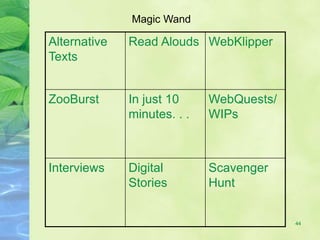
Magic Wand
Alternative
Texts
Read Alouds WebKlipper
ZooBurst In just 10
minutes. . .
WebQuests/
WIPs
Interviews Digital
Stories
Scavenger
Hunt
45
I was more than a teacher. And less. In the . . .
classroom you are a drill sergeant, a rabbi,
a shoulder to cry on, a disciplinarian, a
singer, a low-level scholar, a clerk, a
referee, a clown, a counselor, a dress-code
enforcer, a conductor, an apologist, a
philosopher, a collaborator, a tapdancer, a
politician, a therapist, a fool, a traffic cop, a
priest, a mother-father-brother-sister-uncle-
aunt, a bookkeeper, a critic, a psychologist,
the last straw.
Frank McCourt
46
Miscellaneous Treats
• Electronic Field Trips
– Yellowstone National Park
– http://www.windowsintowonderland.org/
• Google Earth (earth.google.com)
• TeacherTube (www.teachertube.com)
47
References
Allington, R. (2002) You can’t learn much from books you can’t read.
Educational Leadership, 60 (3). 16-19.
Beck, I. L., McKeown, M. G., Hamilton, R. L., & Kucan, L.
(1997).Questioning the author: An approach for enhancing student
engagement with text. Newark, DE: International Reading
Association.
Lewin, L. (2006). Reading response that really matters to middle
schoolers. New York: Scholastic.
Rasinski, T. (2000). Speed does matter in reading. The Reading
Teacher, 54, 146–151.
Scraper, K. (2006, May). What a character! Bringing out the best in your
students through reader’s theater. Paper presented at International
Reading Association, Chicago, IL. Retrieved August 9, 2007 from
http://www.edwriter.com/downloads/2006_IRA_Handout.pdf
Swanson, H.L. (1999). Instructional components that predict treatment
outcomes for students with LD: Support for a combined strategy and
direct instruction model. Learning Disability Research and Practice,
14(3), 129-140
48
• Au, K. H. & Raphael, T. E. (2000). Equity and literacy in the next millennium. Reading Research Quarterly, 35, 170-
188. Pp. 178-18
• Bercaw, L., & Wegmann, S. (2003) Literature Discussions, Participant Stance, and the Discussion Filter American
Reading Forum Yearbook of Proceedings, 2003. Available online:
http://www.americanreadingforum.org/03_yearbook/html/Bercaw.htm
• Bloom, B. (1975). Language development. In F. D. Horowitz (Ed.) Review of child development research, 4, (pp.
245-303). Chicago: University of Chicago Press.
• Britton, J. (1993). Language and learning. Portsmouth, NH: Boynton/Cook.
• Cazden, C. (1988). Classroom discourse. Portsmouth, NH: Heinneman.
• Draper, R. J. (2002) Every teacher a literacy teacher? An analysis of the literacy-related messages in secondary
methods textbooks. Journal of Literacy Research.
• Find Articles at http://findarticles.com/p/articles/mi_qa3785/is_200210/ai_n9087467
• McCourt, F. (2005) Teacher Man. New York: Scribner. An excellent website for videos for content area teachers:
http://school.discovery.com/teachers/archive/
• Mehan, H. (1979a) Learning Lessons. Cambridge: Harvard University Press.
• Mehan, H. (1979b) What time is it, Denise?: Asking known information questions in classroom discourse. Theory into
Practice, 18, 285-294.
• Piaget, J. (1964). Six Psychological Studies. New York: Vintage. For more information about Piaget's work:
www.piaget.org or perform a Google search.
• Probst, R. (1987) Available online: http://www.ericdigests.org/pre-926/theory.htm
• Rosenblatt, L. (1938/1983). Literature as exploration (4th ed.). New York; MLA.
• Rosenblatt, L. (1994) The reader, the text, the poem. Carbondale, IL: Southern Illinois University Press.
• For a great article that examines the contribution of Rosenblatt to literary interpretation, see
http://www.vccaedu.org/inquiry/inquiry-spring97/i11chur.html
• Street, B. V. (1999). The meanings of literacy. In d. A. Wagner, R. L. Venezky, & B. V. Street (Eds.), Literacy: An
international handbook. (pp. 34-42). Boulder, CO: Westview Press.
• Taylor, B. M., & Beach, R. W. (1984). The Effects of Text Structure Instruction on Middle-Grade Students'
Comprehension and Production of Expository Text. Reading Research Quarterly, Vol. 19, 2. pp. 134-146.
• Vygotsky, L. (1978). Mind in Society. Cambridge, MA: Harvard University Press. For more information about
Vygotsky's work: http://www.kolar.org/vygotsky/ or perform a Google search.
• Wikipedia definition of Literacy
• Wimsatt, W. K. (1954) The Verbal Icon: Studies in the Meaning of Poetry. Kentucky: University of Kentucky Press.
Disciplinary Literacy:
Another name for Teaching Texts
Dr. Susan Wegmann
swegmann@mail.ucf.edu
Council for Online Literacy Educators
Inaugural Conference,
November 18, 2010

Disciplinary Literacykeynotewegmann

  • 1.
    Disciplinary Literacy: Another Namefor Teaching Texts While you are waiting for this session to begin, please type in the chat box: 1. Your name and position 2. The age of students you work with 3. Your comfort with teaching online 1
  • 2.
    Disciplinary Literacy: Another namefor Teaching Texts Dr. Susan Wegmann swegmann@mail.ucf.edu Council for Online Literacy Educators Inaugural Conference, November 18, 2010
  • 3.
    3 Agree/Disagree 1. Reading isa one-way road from text to person. 2. Most content area texts are written on grade level. 3. Learning language is a social activity.
  • 4.
    4 In every case,it is the reader who reads the sense. . .We read to understand, or to begin to understand. We cannot do but read. Reading, almost as much as breathing, is our essential function. Alberto Manguel, (1996). A History of Reading. NY: Viking.
  • 5.
    5 Disciplinary Literacy. .. “…requires an understanding of how knowledges are constructed and organized in the content area, an understanding of what counts as warrant or evidence for a claim, and an understanding of the conventions of communicating that knowledge” (Moje, Ciechanowski, Kramer, Ellis, Carrillo & Collazo, 2004, p. 45).
  • 6.
  • 7.
  • 8.
  • 9.
  • 10.
    10 Defining Disciplinary Literacy "Literacyis the state of being able to participate fully in a to-and-fro interplay between person and text.” “Disciplinary Literacy” then, is being literate in a particular discipline or content area.
  • 11.
    1.2 million studentstested – only 51% labeled as “ready for college” 11
  • 12.
    12 Discipline Specific LiteracySkills Acknowledge the interplay between self and text
  • 13.
    13 Discipline Specific LiteracySkills Knowledge of specialized vocabulary Acknowledge the interplay between self and text
  • 14.
    14 Discipline Specific LiteracySkills Test taking ability Knowledge of specialized vocabulary Acknowledge the interplay between self and text
  • 15.
    15 Discipline Specific LiteracySkills Knowledge of content text structure Test taking ability Knowledge of specialized vocabulary Acknowledge the interplay between self and text
  • 16.
    16 Discipline Specific LiteracySkills Knowledge of content text structure Test taking ability Knowledge of specialized vocabulary Ability to identify important information Acknowledge the interplay between self and text
  • 17.
    17 Discipline Specific LiteracySkills Ability to synthesize information using LER first, then external sources Knowledge of content text structure Test taking ability Knowledge of specialized vocabulary Ability to identify important information Acknowledge the interplay between self and text
  • 18.
    18 Discipline Specific LiteracySkills Ability to synthesize information using LER first, then external sources Knowledge of content text structure Test taking ability Knowledge of specialized vocabulary Ability to identify important information Ability to read visual/graphic information Acknowledge the interplay between self and text
  • 19.
    19 Discipline Specific LiteracySkills Ability to synthesize information using LER first, then external sources Knowledge of content text structure Test taking ability Knowledge of specialized vocabulary Knowledge of organizational patterns Ability to identify important information Ability to read visual/graphic information Acknowledge the interplay between self and text
  • 20.
    20 Discipline Specific LiteracySkills Ability to synthesize information using LER first, then external sources Knowledge of content text structure Test taking ability Knowledge of specialized vocabulary Knowledge of organizational patterns Ability to identify important information Ability to read visual/graphic information Research skills Acknowledge the interplay between self and text
  • 21.
    21 Expert readers. .. • activate prior knowledge (LER) • set goals for reading • make predictions • self-monitor • construct the main idea • critique the text’s propositions • evaluate the structure of the text
  • 22.
    22 Disciplinary Reading Strategies BeforeReading During Reading After Reading Anticipation Guides Choose 10 Anticipation Guides SQ3R QAR SQ3R Structural Analysis SQ3R RAP Read alouds RAP Written responses Alternative Texts Graphic Organizers Read alouds Scavenger Hunt QtA Reader’s Theatre Graphic organizers Read alouds Alternative Texts Interviews Text Sets Graphic Organizers Text Sets Semantic Feature Analysis In just 10 minutes. . . Digital Stories Read Encode Annotate Ponder Interviews WebQuests Text Sets WebQuests/Digital Stories
  • 23.
    23 Semantic Feature Analysis • • DemocratRepublican Former Governor Former Vice- President 2 Full Terms in Office Still Living L. B. Johnson  –— –—  –— –— Nixon –—  –—  –— –— Ford –—  –—  –—  Carter  –—  –— –—  Reagan –—   –—  –—
  • 24.
    24 DIRECTED TEXT MARKING InstructorDirected Markings Type of Markings To Be Used Title circle Paragraphs number: 1, 2, 3, etc. (left margin) Paragraph summary main idea word or brief phrase (right margin) Challenging vocabulary words box: Location names bracket: [ ] People named in the story wavy line vvvvvvvvvvvvvvv Data that contains dates, asterisk numbers, distances or amounts; anything numerical Webklipper.com
  • 25.
    Limited amount ofvocabulary words per week. Explicit vocabulary instruction 25 Disciplinary Vocabulary Instruction
  • 26.
    26 Vocabulary Frame Antonym Definition Sillysentence with definition of word Graphic/Picture Word
  • 27.
    27 K.I.M. Key idea InformationMemory clue Drought Little or no rain (picture) Coup Takeover of government by the military (picture)
  • 28.
    28 RAP: Paraphrasing • Reada paragraph • Ask yourself what is the main idea and what are important supporting details • Put the main idea and supporting details into your own words
  • 29.
    29 Concept Map ofLearning Unit Unit Essential Question Examples/Steps/Vocab Unit Topic/Concept Major Concepts/Skills/Key Questions
  • 30.
    30 Written responses totext: Postcard/Letter to the (Textbook) Editor Student Authored Study Guides Textbook Chapter Rewrites Narrative about “Being there.” Journal or diary entries
  • 31.
    31 Written responses totext: (cont) Write a Memoir Sharing/Interactive writing Written dialogue Manga
  • 32.
  • 33.
  • 34.
  • 35.
  • 36.
  • 37.
  • 38.
    In just 10 minutes.. 38 Strategic Activities Read Alouds Reader’s Theatre Alternative Texts WebQuests WIPs Interviews Text Sets
  • 39.
    In just 10 minutes.. Scavenger Hunt 39 Strategic Activities Read Alouds Reader’s Theatre Alternative Texts WebQuests WIPs Interviews Text Sets
  • 40.
    In just 10 minutes.. Scavenger Hunt 40 Strategic Activities Read Alouds Reader’s Theatre Alternative Texts WebQuests WIPs Digital Stories Interviews Text Sets
  • 41.
  • 42.
    42 Best Web 2.0Applications for 2010 1. Sitehoover 2. Titan Pads 3. Clp.ly 4. Flisti 5. Send Shots 6. Simple Guide Tool 7. Copytaste 8. Twextra 9. Mappy Friends 10.Explorra
  • 43.
    Best Web 2.0Applications for 2010 11. Life’s Photo timeline 12. Crocodoc 13. WebKlipper 14. ZooBurst 15. Fotobabble 16. Tripline 17. Story Jumper 18. TxBear 19. Wallwisher 20. Simple Booklet 43
  • 44.
    44 Magic Wand Alternative Texts Read AloudsWebKlipper ZooBurst In just 10 minutes. . . WebQuests/ WIPs Interviews Digital Stories Scavenger Hunt
  • 45.
    45 I was morethan a teacher. And less. In the . . . classroom you are a drill sergeant, a rabbi, a shoulder to cry on, a disciplinarian, a singer, a low-level scholar, a clerk, a referee, a clown, a counselor, a dress-code enforcer, a conductor, an apologist, a philosopher, a collaborator, a tapdancer, a politician, a therapist, a fool, a traffic cop, a priest, a mother-father-brother-sister-uncle- aunt, a bookkeeper, a critic, a psychologist, the last straw. Frank McCourt
  • 46.
    46 Miscellaneous Treats • ElectronicField Trips – Yellowstone National Park – http://www.windowsintowonderland.org/ • Google Earth (earth.google.com) • TeacherTube (www.teachertube.com)
  • 47.
    47 References Allington, R. (2002)You can’t learn much from books you can’t read. Educational Leadership, 60 (3). 16-19. Beck, I. L., McKeown, M. G., Hamilton, R. L., & Kucan, L. (1997).Questioning the author: An approach for enhancing student engagement with text. Newark, DE: International Reading Association. Lewin, L. (2006). Reading response that really matters to middle schoolers. New York: Scholastic. Rasinski, T. (2000). Speed does matter in reading. The Reading Teacher, 54, 146–151. Scraper, K. (2006, May). What a character! Bringing out the best in your students through reader’s theater. Paper presented at International Reading Association, Chicago, IL. Retrieved August 9, 2007 from http://www.edwriter.com/downloads/2006_IRA_Handout.pdf Swanson, H.L. (1999). Instructional components that predict treatment outcomes for students with LD: Support for a combined strategy and direct instruction model. Learning Disability Research and Practice, 14(3), 129-140
  • 48.
    48 • Au, K.H. & Raphael, T. E. (2000). Equity and literacy in the next millennium. Reading Research Quarterly, 35, 170- 188. Pp. 178-18 • Bercaw, L., & Wegmann, S. (2003) Literature Discussions, Participant Stance, and the Discussion Filter American Reading Forum Yearbook of Proceedings, 2003. Available online: http://www.americanreadingforum.org/03_yearbook/html/Bercaw.htm • Bloom, B. (1975). Language development. In F. D. Horowitz (Ed.) Review of child development research, 4, (pp. 245-303). Chicago: University of Chicago Press. • Britton, J. (1993). Language and learning. Portsmouth, NH: Boynton/Cook. • Cazden, C. (1988). Classroom discourse. Portsmouth, NH: Heinneman. • Draper, R. J. (2002) Every teacher a literacy teacher? An analysis of the literacy-related messages in secondary methods textbooks. Journal of Literacy Research. • Find Articles at http://findarticles.com/p/articles/mi_qa3785/is_200210/ai_n9087467 • McCourt, F. (2005) Teacher Man. New York: Scribner. An excellent website for videos for content area teachers: http://school.discovery.com/teachers/archive/ • Mehan, H. (1979a) Learning Lessons. Cambridge: Harvard University Press. • Mehan, H. (1979b) What time is it, Denise?: Asking known information questions in classroom discourse. Theory into Practice, 18, 285-294. • Piaget, J. (1964). Six Psychological Studies. New York: Vintage. For more information about Piaget's work: www.piaget.org or perform a Google search. • Probst, R. (1987) Available online: http://www.ericdigests.org/pre-926/theory.htm • Rosenblatt, L. (1938/1983). Literature as exploration (4th ed.). New York; MLA. • Rosenblatt, L. (1994) The reader, the text, the poem. Carbondale, IL: Southern Illinois University Press. • For a great article that examines the contribution of Rosenblatt to literary interpretation, see http://www.vccaedu.org/inquiry/inquiry-spring97/i11chur.html • Street, B. V. (1999). The meanings of literacy. In d. A. Wagner, R. L. Venezky, & B. V. Street (Eds.), Literacy: An international handbook. (pp. 34-42). Boulder, CO: Westview Press. • Taylor, B. M., & Beach, R. W. (1984). The Effects of Text Structure Instruction on Middle-Grade Students' Comprehension and Production of Expository Text. Reading Research Quarterly, Vol. 19, 2. pp. 134-146. • Vygotsky, L. (1978). Mind in Society. Cambridge, MA: Harvard University Press. For more information about Vygotsky's work: http://www.kolar.org/vygotsky/ or perform a Google search. • Wikipedia definition of Literacy • Wimsatt, W. K. (1954) The Verbal Icon: Studies in the Meaning of Poetry. Kentucky: University of Kentucky Press.
  • 49.
    Disciplinary Literacy: Another namefor Teaching Texts Dr. Susan Wegmann swegmann@mail.ucf.edu Council for Online Literacy Educators Inaugural Conference, November 18, 2010

Editor's Notes

  • #12 Strengthen reading instruction in all high school courses by incorporating complex reading materials into course content.The type of text to which students are exposed in high school has a significant impact on their readiness for college-level reading.Specifically, students need to be able to read complex texts if they are to be ready for college. All courses in high school, not just English and social studies but mathematics and science as well, must challenge students to read and understand complex texts.
  • #26 From the National Reading Panel’s report: strong connection to vocabulary in the reading process (NICHD, p. 4-15). both direct and indirect vocabulary instruction should be used to achieve reading comprehension.Effective vocabulary instruction also requires active participation from students. Also recommended: Multiple exposures to words in both indirect and direct learning.Who better to teach vocabulary than content area teachers who know the content???!Blachowicz and Fisher (2005) suggest choosing the following kinds of words:Comprehension words (necessary for comprehending the subject or content)Useful words (practical across several fields)Academic words and phrases (such as “essential message” , “in contrast to”)Generative words (prefixes, suffixes, and roots that can be identified and applied to other words)
  • #27 Vocabulary Frames are a flashcard method for learning new vocabulary. Do not use Vocabulary Frames for every vocabulary word encountered. Words that introduce new concepts are best used with Vocabulary Frames.Top Right Corner: Write the word’s definitionTop Left Corner: Write the word’s opposite and cross it outLower Left Corner: Write a silly sentence that uses the definition of the wordLower Right Corner: Draw a graphic to help you visualize the conceptIn the Center: Write the wordOther ideas for explicit placement on card:Isolate any prefixesIsolate the rootNote the meaning of the rootIsolate any suffixesLabel the part of speech in parenthesis
  • #44 Webklipper: annotation and extractor for web pages: http://webklipper.com/k/KGyIAr0cga2AFVdooC4r Zooburst: pop up books: http://www.zooburst.com/zb_books-viewer.php?book=4c7d7e4911329Ten: LIFE has unveiled a neat new feature that lets you search for any photos in its archives and create an online timeline/slideshow that you can share with a unique url address. Their Photo Timeline lets you use their original captions or you can edit them and create your own, as well as writing your own description for your whole creation. After you log-in (you can do so using your Twitter, Facebook, Yahoo, or Google accounts — it would be nice if they allowed on site registration, but I guess you can’t have everything!), it’s just a matter of searching and dragging the photos to your timeline/slideshow. Nine: Crocodoc is a super-simple application that allows you to annotate webpages with virtual post-it notes and drawings. You can also upload any document you create and immediate make it into a webpage.Eight: WebKlipper lets you easily, without requiring registration, annotate any webpage with virtual post-it notes or a highlighter. You’re then given the url address of the annotated webpage. It’s quite easy to use. Students can use it to demonstrate reading strategies (visualizing, asking questions, making a connection, etc.).Seven: ZooBurst, allows you to create your own “customized 3D pop-up books.” You can see a number of examples at their site.Six: Fotobabble, is a neat application where people can post photos along with an audio description. It has gotten even better recently. Now, users can grab images off the web by just using the photo’s url address. Before, uploading images was the only option. It’s one of the best Web 2.0 applications of the year for educators, and is on The Best Sites To Practice Speaking English list. It’s a simple tool students can use to practice their speaking skills. It’s very easy to use but, just in case, Russell Stannard at the great Teacher Training Videos has posted a good video tutorial on how to use the app. You can see examples my students have created here.Five: Tripline is a great map-making application. You just list the various places you want to go in a journey, or a famous trip that has happened in history or literature, or a class field trip itinerary, and a embeddable map is created showing the trip where you can add written descriptions and photos. You can use your own photos or just through Flickr. Plus, you can pick a soundtrack to go with it as it automatically plays through the travels. Here are examples of the ride of Paul Revere and the Lewis and Clark Expedition. It’s super-easy to use, and the only tricky part is that you can’t add photos until after you create your trip and save it. That’s not a big deal, unless you couldn’t figure it out like me and had to contact the site.Four: Story Jumper is a new site that lets kids create their own story books. Online versions are free, and you can pay for hard copies. Registration is quick and easy. You can create your books from “scratch” or use one of several templates they have (one or two of them didn’t seem particularly intuitive to me, but most were fine, and the “scratch” version was certainly easy). They offer lots of easy “props” to integrate into the stories, and you can upload your own photos and type your own text. Once you’re finished, you can email the link to yourself and post it on a student/teacher blog or website.Three: TxtBear is a new and very useful web application that allows you to easily upload and document and immediately turn it into a webpage. A site like this is one is wonderful for students and others who are not very tech savvy. All they have to do is create a document in Word (including easily copying and pasting images into it), which they might be more familiar with, and easily turn it into a website. Students can upload papers they’ve written, as well. Then, they can just copy and paste its url address into a teacher or student blog. For example, now I have students type essays in a Word Document and then copy and paste them directly into the comments section of our class blog. With TxtBear, they use Word, illustrate it if they want, and then paste the link into the class blog. It makes the document much more readable that way.Two: The Middlespot Search Engine has made previous “The Best…” lists. Their new version is like an even easier and embeddableWallwisher. In other words, it’s a virtual bulletin board with virtual “stickies.” If you’re searching for an image, website, or video, though, you don’t necessarily have to copy and paste their url addresses (though you can) — if they are in the search results you just click on it to go into your “mashup” and it goes to it automatically. No registration is necessary, and you can collaborate with others.One: Simple Booklet is a great new tool that lets you create online books and reports that can be embedded or linked to by its url address. It’s free, you can grab images and videos off the web, and extremely simple to use. No registration is required. What’s not to like? Coincidentally, it’s also designed by Middlespot.