Learning Theory Presentation Veronica Smith Carson Summers Matthew Wimberly
Behaviorism Came into popularity during the Industrial Revolution Popularized by scientific research into animals Two distinct methods of conditioning Classic conditioning – using reflexes found in nature Operant conditioning – introducing new reflexes through reinforcement
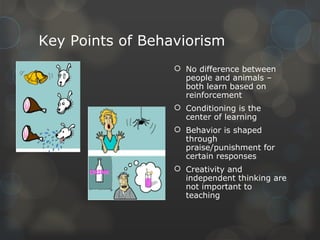
Key Points of Behaviorism No difference between people and animals – both learn based on reinforcement Conditioning is the center of learning Behavior is shaped through praise/punishment for certain responses Creativity and independent thinking are not important to teaching
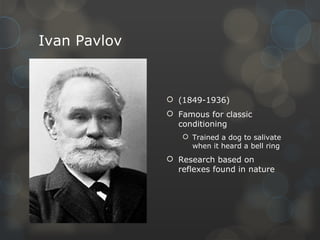
Ivan Pavlov (1849-1936) Famous for classic conditioning Trained a dog to salivate when it heard a bell ring Research based on reflexes found in nature
John Watson (1878-1958 ) Famous  for “Little Albert” experiment Conditioned an 18 month old boy to fear rats “ Give me a dozen healthy infants …and I’ll guarantee to take any one at random and train him to be any type of specialist I might select…”
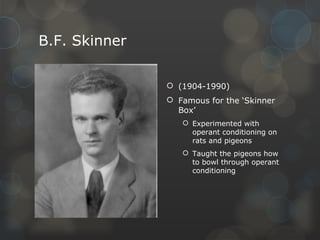
B.F. Skinner (1904-1990) Famous for the ‘Skinner Box’ Experimented with operant conditioning on rats and pigeons Taught the pigeons how to bowl through operant conditioning
Classroom Implications Reward charts and systems are considered effective methods of reinforcement under behaviorism. Can also be applied to classroom control – ringing a bell or turning off the lights to quiet kids down, for example. To utilize technology with this approach, students could be rewarded with technology-enhanced lessons in order to reinforce good behavior.
We think that behaviorism… Can be useful at a young age to teach skills that are fundamental to the schooling environment For instance, not throwing things and keeping quiet Can also be effective for students with behavioral issues May not be as effective when students move on to more difficult concepts than basic behavior Creative thinking and reasoning are not a part of a behaviorist approach
Citations Pavlov’s Dogs and Conditioning in People charts:  http://www.nobelprize.org/educational/medicine/pavlov/readmore.html Ivan Pavlov:  http://www.nobelprize.org/nobel_prizes/medicine/laureates/1904/pavlov-bio.html John Watson:  http://psychology.about.com/od/profilesofmajorthinkers/p/watson.htm   B. F. Skinner:  http:// www.bfskinner.org/BFSkinner/AboutSkinner.html

Behaviorism ppt

  • 1.
    Learning Theory PresentationVeronica Smith Carson Summers Matthew Wimberly
  • 2.
    Behaviorism Came intopopularity during the Industrial Revolution Popularized by scientific research into animals Two distinct methods of conditioning Classic conditioning – using reflexes found in nature Operant conditioning – introducing new reflexes through reinforcement
  • 3.
    Key Points ofBehaviorism No difference between people and animals – both learn based on reinforcement Conditioning is the center of learning Behavior is shaped through praise/punishment for certain responses Creativity and independent thinking are not important to teaching
  • 4.
    Ivan Pavlov (1849-1936)Famous for classic conditioning Trained a dog to salivate when it heard a bell ring Research based on reflexes found in nature
  • 5.
    John Watson (1878-1958) Famous for “Little Albert” experiment Conditioned an 18 month old boy to fear rats “ Give me a dozen healthy infants …and I’ll guarantee to take any one at random and train him to be any type of specialist I might select…”
  • 6.
    B.F. Skinner (1904-1990)Famous for the ‘Skinner Box’ Experimented with operant conditioning on rats and pigeons Taught the pigeons how to bowl through operant conditioning
  • 7.
    Classroom Implications Rewardcharts and systems are considered effective methods of reinforcement under behaviorism. Can also be applied to classroom control – ringing a bell or turning off the lights to quiet kids down, for example. To utilize technology with this approach, students could be rewarded with technology-enhanced lessons in order to reinforce good behavior.
  • 8.
    We think thatbehaviorism… Can be useful at a young age to teach skills that are fundamental to the schooling environment For instance, not throwing things and keeping quiet Can also be effective for students with behavioral issues May not be as effective when students move on to more difficult concepts than basic behavior Creative thinking and reasoning are not a part of a behaviorist approach
  • 9.
    Citations Pavlov’s Dogsand Conditioning in People charts: http://www.nobelprize.org/educational/medicine/pavlov/readmore.html Ivan Pavlov: http://www.nobelprize.org/nobel_prizes/medicine/laureates/1904/pavlov-bio.html John Watson: http://psychology.about.com/od/profilesofmajorthinkers/p/watson.htm B. F. Skinner: http:// www.bfskinner.org/BFSkinner/AboutSkinner.html