Beats in Music
Gillian Trotter
Physics 101 203
What is a beat?
 When two waves of similar amplitude, but different
frequency interfere, there is a resulting wave.
 The resultant wave has a fluctuating amplitude, due to
areas of constructive and destructive interference.
What is a beat?
 By definition, a beat is a periodic
variation of sound or amplitude due
to the combination of two waves
having similar but not identical
frequencies.
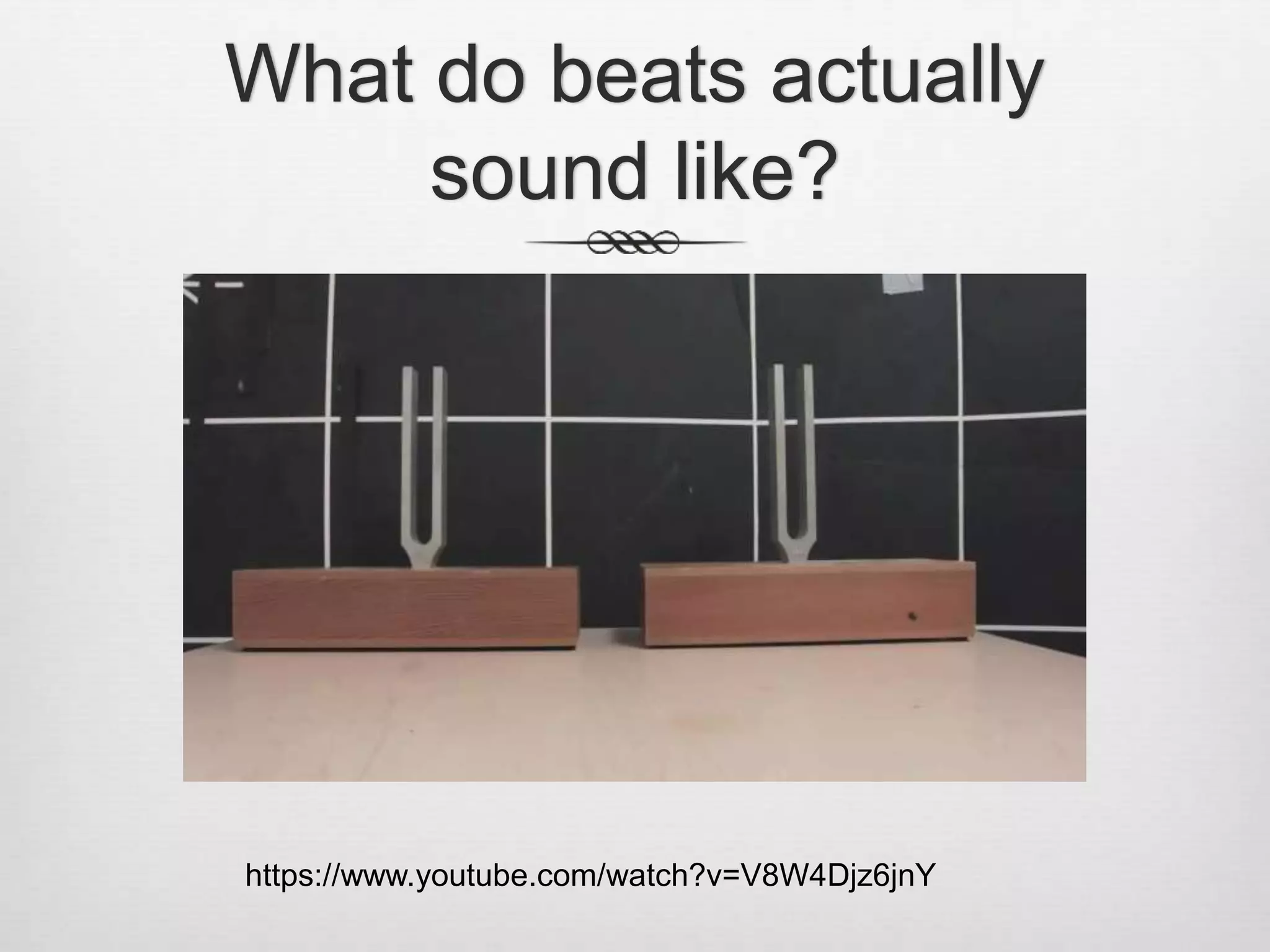
What do beats actually
sound like?
https://www.youtube.com/watch?v=V8W4Djz6jnY
What do beats actually
sound like?
 In the video on the previous slide, the
pulsations that could be heard when both
tuning forks were struck were the beats!
 The two waves were interfering and creating
different resultant amplitudes.
What do beats actually
sound like?
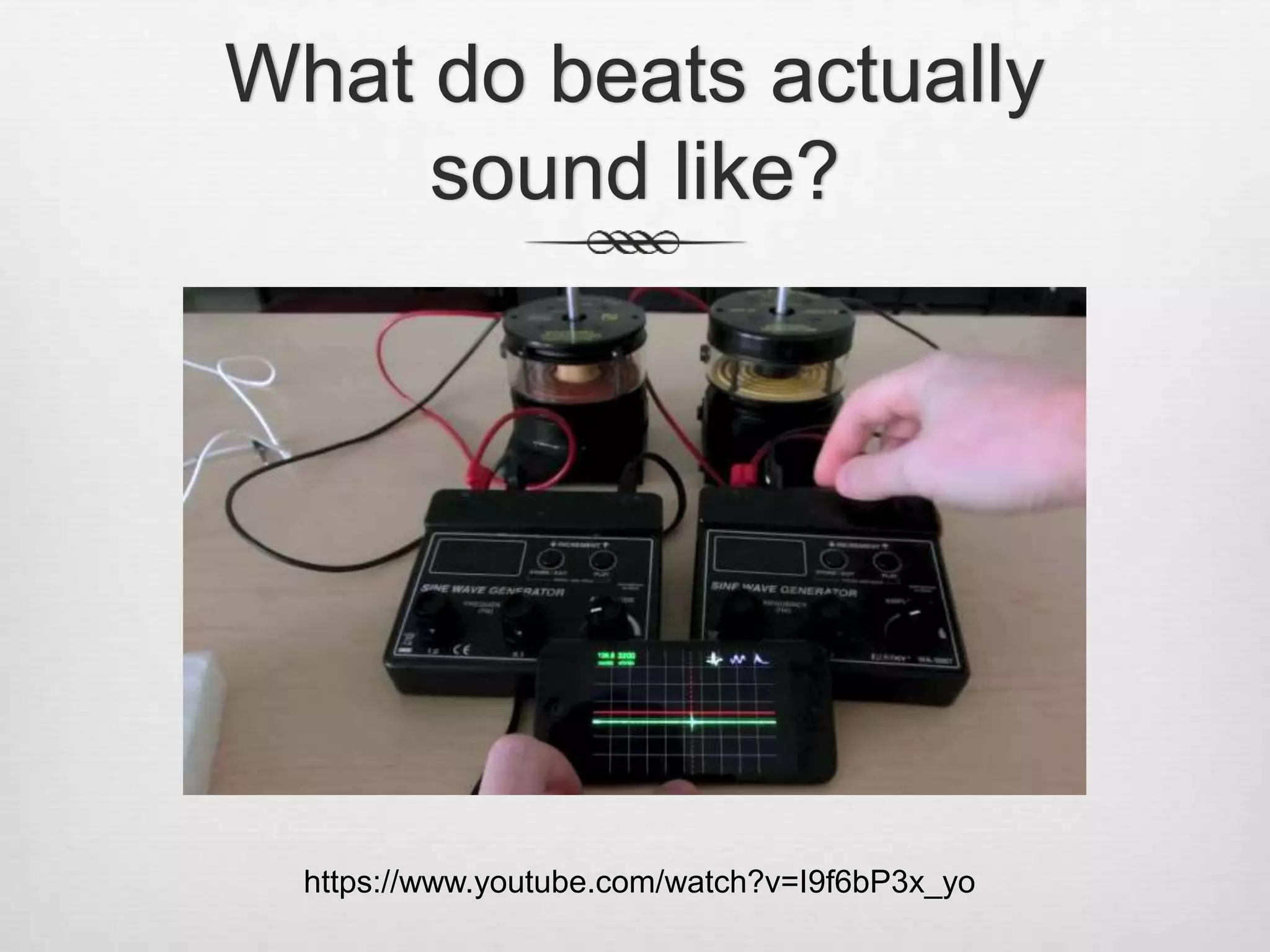
 In the next video, we can see on a visual app how
the resultant amplitude of two similar frequencies is
the same.
 However, as the frequency of one of the sine
generators is changed, a difference in amplitudes
can be seen and heard.
 As the disparity between the two frequencies
increases, the number of beat frequency also
increases.
What do beats actually
sound like?
https://www.youtube.com/watch?v=I9f6bP3x_yo
Beat Frequency
 In the last video we heard that as the difference in
angular frequency between the two waves
increased, so did the beat frequency.
 Beat frequency is the number of pulsations heard
in one second when two sound waves of different
frequencies interfere.
Beats in Music
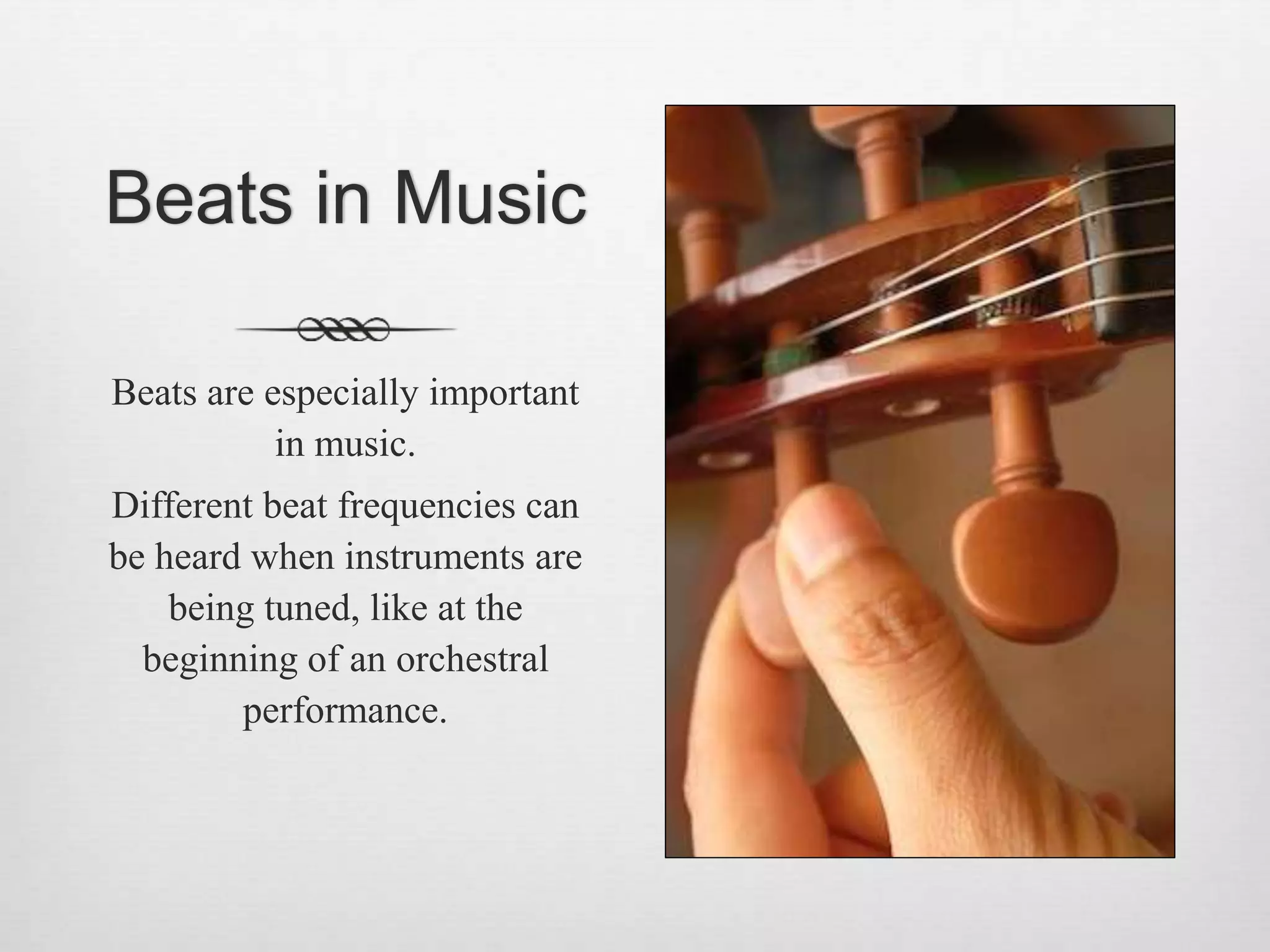
Beats are especially important
in music.
Different beat frequencies can
be heard when instruments are
being tuned, like at the
beginning of an orchestral
performance.
Tuning
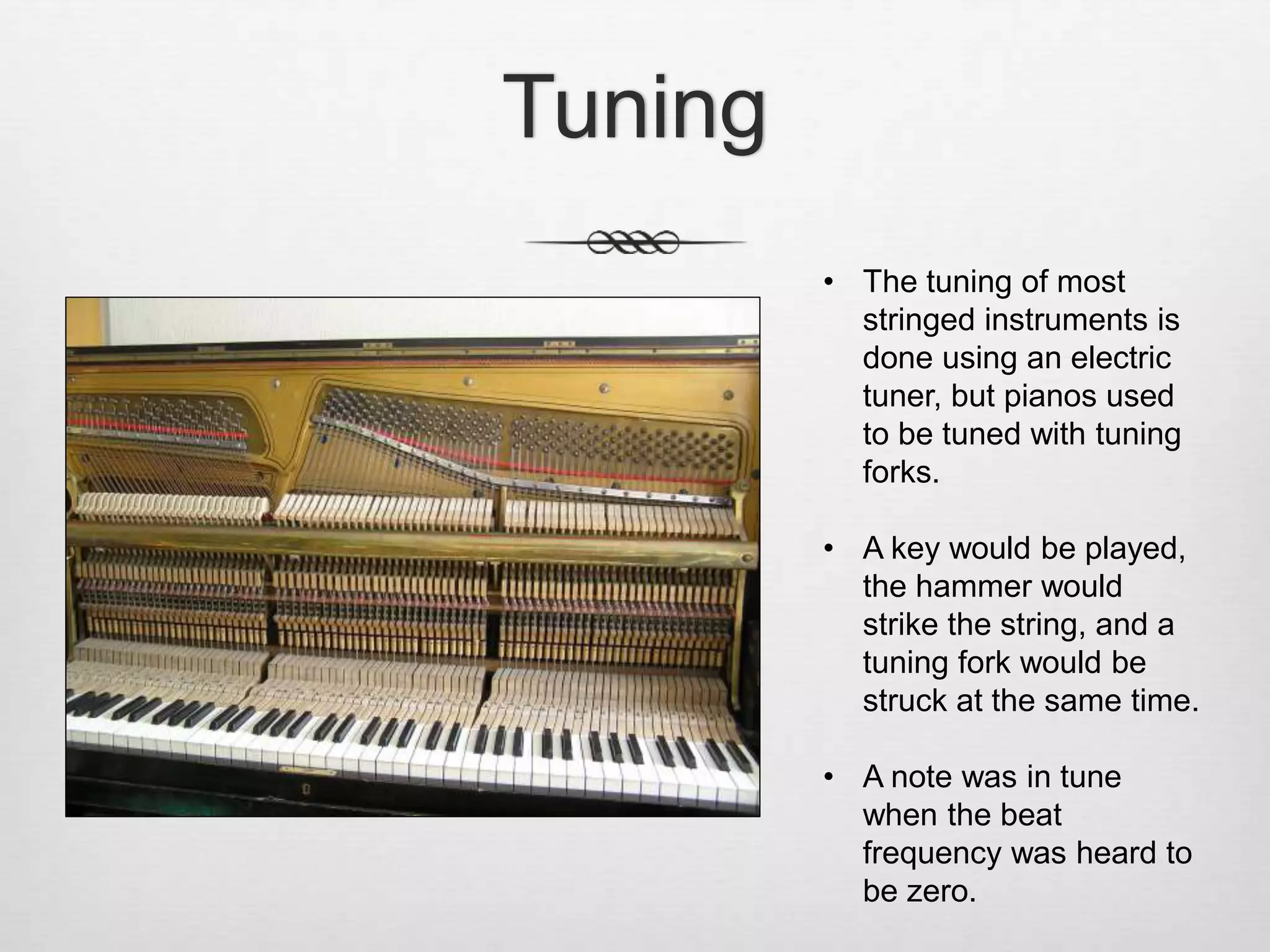
• The tuning of most
stringed instruments is
done using an electric
tuner, but pianos used
to be tuned with tuning
forks.
• A key would be played,
the hammer would
strike the string, and a
tuning fork would be
struck at the same time.
• A note was in tune
when the beat
frequency was heard to
be zero.
Tuning
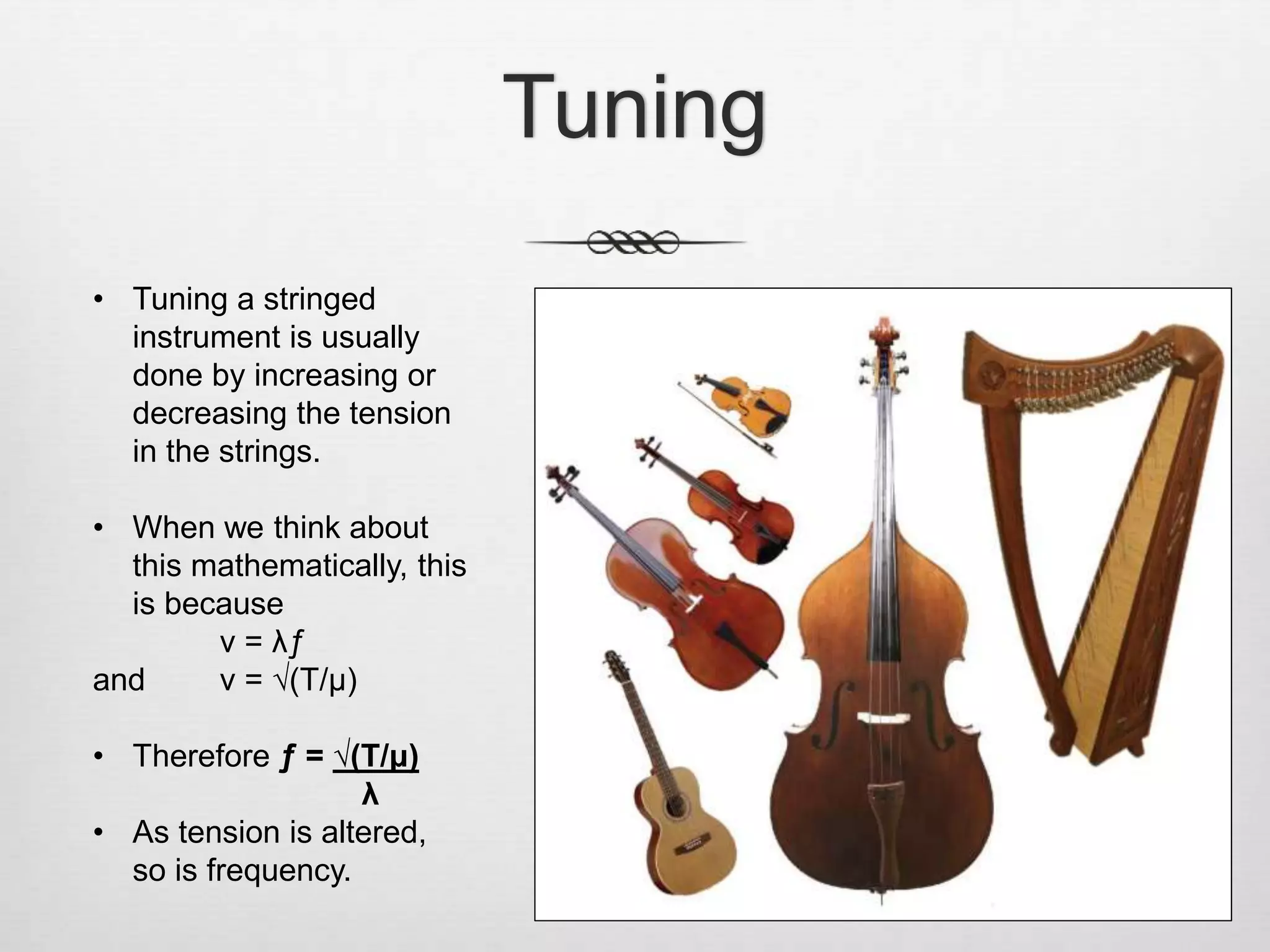
• Tuning a stringed
instrument is usually
done by increasing or
decreasing the tension
in the strings.
• When we think about
this mathematically, this
is because
v = λƒ
and v = √(T/μ)
• Therefore ƒ = √(T/μ)
λ
• As tension is altered,
so is frequency.
A Question About Beat
Frequency
An A (440 Hz) is played on the piano at the same
time as a tuning fork of 446 Hz is struck.
 1. What is the beat
frequency you hear?
 2. How many beats will be
heard in one second?
 3. How many beats will be
heard in 10 seconds?
Answers
1. What is the beat frequency you hear?
The beat frequency is equal to the difference between the two frequencies
being played. To solve this question we simply have to subtract 440 Hz
from 446 Hz, with the result being 6 Hz.
2. How many beats will be heard in one second?
The number of beats heard in one second is equal to the beat frequency.
This is because the measurement of Hz is actually equal to s-1. Therefore
the answer is 6 beats per second, or 6 beats s-1.
3. How many beats will be heard in 10 seconds?
Since we know how many beats are produced in one second, we can
multiply 6 beats/second by 10 seconds to obtain 60 beats.

Learning Objects 7 - Beats and Beat Frequency

  • 1.
    Beats in Music GillianTrotter Physics 101 203
  • 2.
    What is abeat?  When two waves of similar amplitude, but different frequency interfere, there is a resulting wave.  The resultant wave has a fluctuating amplitude, due to areas of constructive and destructive interference.
  • 3.
    What is abeat?  By definition, a beat is a periodic variation of sound or amplitude due to the combination of two waves having similar but not identical frequencies.
  • 4.
    What do beatsactually sound like? https://www.youtube.com/watch?v=V8W4Djz6jnY
  • 5.
    What do beatsactually sound like?  In the video on the previous slide, the pulsations that could be heard when both tuning forks were struck were the beats!  The two waves were interfering and creating different resultant amplitudes.
  • 6.
    What do beatsactually sound like?  In the next video, we can see on a visual app how the resultant amplitude of two similar frequencies is the same.  However, as the frequency of one of the sine generators is changed, a difference in amplitudes can be seen and heard.  As the disparity between the two frequencies increases, the number of beat frequency also increases.
  • 7.
    What do beatsactually sound like? https://www.youtube.com/watch?v=I9f6bP3x_yo
  • 8.
    Beat Frequency  Inthe last video we heard that as the difference in angular frequency between the two waves increased, so did the beat frequency.  Beat frequency is the number of pulsations heard in one second when two sound waves of different frequencies interfere.
  • 9.
    Beats in Music Beatsare especially important in music. Different beat frequencies can be heard when instruments are being tuned, like at the beginning of an orchestral performance.
  • 10.
    Tuning • The tuningof most stringed instruments is done using an electric tuner, but pianos used to be tuned with tuning forks. • A key would be played, the hammer would strike the string, and a tuning fork would be struck at the same time. • A note was in tune when the beat frequency was heard to be zero.
  • 11.
    Tuning • Tuning astringed instrument is usually done by increasing or decreasing the tension in the strings. • When we think about this mathematically, this is because v = λƒ and v = √(T/μ) • Therefore ƒ = √(T/μ) λ • As tension is altered, so is frequency.
  • 12.
    A Question AboutBeat Frequency An A (440 Hz) is played on the piano at the same time as a tuning fork of 446 Hz is struck.  1. What is the beat frequency you hear?  2. How many beats will be heard in one second?  3. How many beats will be heard in 10 seconds?
  • 13.
    Answers 1. What isthe beat frequency you hear? The beat frequency is equal to the difference between the two frequencies being played. To solve this question we simply have to subtract 440 Hz from 446 Hz, with the result being 6 Hz. 2. How many beats will be heard in one second? The number of beats heard in one second is equal to the beat frequency. This is because the measurement of Hz is actually equal to s-1. Therefore the answer is 6 beats per second, or 6 beats s-1. 3. How many beats will be heard in 10 seconds? Since we know how many beats are produced in one second, we can multiply 6 beats/second by 10 seconds to obtain 60 beats.