Beats
Brandon Morton PHYS 101 (L2I)
Waves of Different
Frequencies
 Two sound waves approach the human ear with similar
but different frequencies
 Which causes alternating constructive and de-
constructive interference
 Giving alternatively soft and loud sound
 This causes a “Beat” to occur
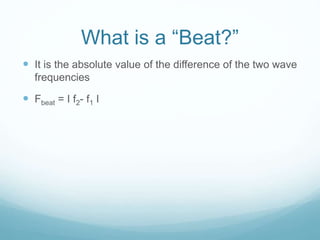
What is a “Beat?”
 It is the absolute value of the difference of the two wave
frequencies
 Fbeat = I f2- f1 I
Other important Equations
 ω= (ω1 + ω2)/2 (Mean angular frequency)
 Δω= (ω1 + ω2)/2 (Angular Frequency Difference)
Sample Question
 A piano tuner plays an out of tune A note on his piano
and then strikes his 440 Hz tuning fork. He notices a
beat of 2 Hz. When he tightens the piano string and
plays the note again the beat remains at 2 Hz. What
was the frequency of the note before he tightened the
string? (Note: The A note is 440 Hz).
 A. 438 Hz
 B. 440 Hz
 C. 442 Hz
 D. 444 Hz
Detailed Answer
 The original out of tune A note must have been 438 Hz
or 442 Hz since it created a beat frequency of 2 Hz with
the 440 Hz tuning fork
 Beat Frequency = I f2 – f1 I
 I 442 – 440 I or I 438 – 440 I = 2 Hz
 When the string was tightened, the velocity of the
wave, and thus the frequency must have increased.
 V = √ (T/μ) *where T is tension
Answer Continued
 V = fλ, where λ remains constant because the length of the
string remains constant
 When the frequency increased the beat remained at 2 Hz so
it must have increased to 442 Hz
 Which is the only othe frequency that would produce a 2 Hz
beat
 Thus A. is the answer
 Also, intuitively, when you tighten a string, you know from
past experience, the frequency increases. Meaning it started
at 438 Hz and ended at 442 Hz
Sample question
 A car travels at night at 10 m/s past a row of identical trees.
Each tree is 1 m thick and 1 m from the nearest tree. A child
watching the trees go by flickers a flash light on and off at a
rate of 4 times per second. If the child can only see the trees
when the flash light is on, how fast will the trees appear to
the child as they pass?
 A. 1 tree per second
 B. 4 tree per second
 C. 9 tree per second
 D. 20 tree per second
Detailed Answer
 Five trees pass each second. (five trees and five
spaces equal 10 m.)
 This is a frequency of 5 trees per second
 The frequency of the flashing light is 4 flashes per
second
 The frequency of the flashing light and the frequency of
the trees create a beat frequency
 I f2 – f1 I = I 5 – 4 I = 1
Answer Continued
Answer Continued
 The photo just depicts the two frequencies combined to
show how you only see 1 tree per second from the
child’s perspective.
 The answer is A. one tree per second
Bibliography
 orums.studentdoctor.net/threads/ek-physics-690-beat-
frequency-question-and-answer-included.796368/
(Accessed March 11th, 2015)
 http://sci.tech-archive.net/Archive/sci.physics/2005-
03/3216.html (Accessed March 11th, 2015)
 Examkrackers 1001 questions in MCAT Physics 2003
edition by Jonathan Orsay edited by Scott Calvin page
141

LO8: Beat Frequency

  • 1.
  • 2.
    Waves of Different Frequencies Two sound waves approach the human ear with similar but different frequencies  Which causes alternating constructive and de- constructive interference  Giving alternatively soft and loud sound  This causes a “Beat” to occur
  • 3.
    What is a“Beat?”  It is the absolute value of the difference of the two wave frequencies  Fbeat = I f2- f1 I
  • 4.
    Other important Equations ω= (ω1 + ω2)/2 (Mean angular frequency)  Δω= (ω1 + ω2)/2 (Angular Frequency Difference)
  • 5.
    Sample Question  Apiano tuner plays an out of tune A note on his piano and then strikes his 440 Hz tuning fork. He notices a beat of 2 Hz. When he tightens the piano string and plays the note again the beat remains at 2 Hz. What was the frequency of the note before he tightened the string? (Note: The A note is 440 Hz).  A. 438 Hz  B. 440 Hz  C. 442 Hz  D. 444 Hz
  • 6.
    Detailed Answer  Theoriginal out of tune A note must have been 438 Hz or 442 Hz since it created a beat frequency of 2 Hz with the 440 Hz tuning fork  Beat Frequency = I f2 – f1 I  I 442 – 440 I or I 438 – 440 I = 2 Hz  When the string was tightened, the velocity of the wave, and thus the frequency must have increased.  V = √ (T/μ) *where T is tension
  • 7.
    Answer Continued  V= fλ, where λ remains constant because the length of the string remains constant  When the frequency increased the beat remained at 2 Hz so it must have increased to 442 Hz  Which is the only othe frequency that would produce a 2 Hz beat  Thus A. is the answer  Also, intuitively, when you tighten a string, you know from past experience, the frequency increases. Meaning it started at 438 Hz and ended at 442 Hz
  • 8.
    Sample question  Acar travels at night at 10 m/s past a row of identical trees. Each tree is 1 m thick and 1 m from the nearest tree. A child watching the trees go by flickers a flash light on and off at a rate of 4 times per second. If the child can only see the trees when the flash light is on, how fast will the trees appear to the child as they pass?  A. 1 tree per second  B. 4 tree per second  C. 9 tree per second  D. 20 tree per second
  • 9.
    Detailed Answer  Fivetrees pass each second. (five trees and five spaces equal 10 m.)  This is a frequency of 5 trees per second  The frequency of the flashing light is 4 flashes per second  The frequency of the flashing light and the frequency of the trees create a beat frequency  I f2 – f1 I = I 5 – 4 I = 1
  • 10.
  • 11.
    Answer Continued  Thephoto just depicts the two frequencies combined to show how you only see 1 tree per second from the child’s perspective.  The answer is A. one tree per second
  • 12.
    Bibliography  orums.studentdoctor.net/threads/ek-physics-690-beat- frequency-question-and-answer-included.796368/ (Accessed March11th, 2015)  http://sci.tech-archive.net/Archive/sci.physics/2005- 03/3216.html (Accessed March 11th, 2015)  Examkrackers 1001 questions in MCAT Physics 2003 edition by Jonathan Orsay edited by Scott Calvin page 141

Editor's Notes

  • #6 orums.studentdoctor.net/threads/ek-physics-690-beat-frequency-question-and-answer-included.796368/ Accessed march 11th, 2015
  • #9 http://sci.tech-archive.net/Archive/sci.physics/2005-03/3216.html Accessed March 11th, 2015
  • #11 Examkrackers 1001 questions in MCAT Physics by Jonathan Orsay edited by Scott Calvin page 141