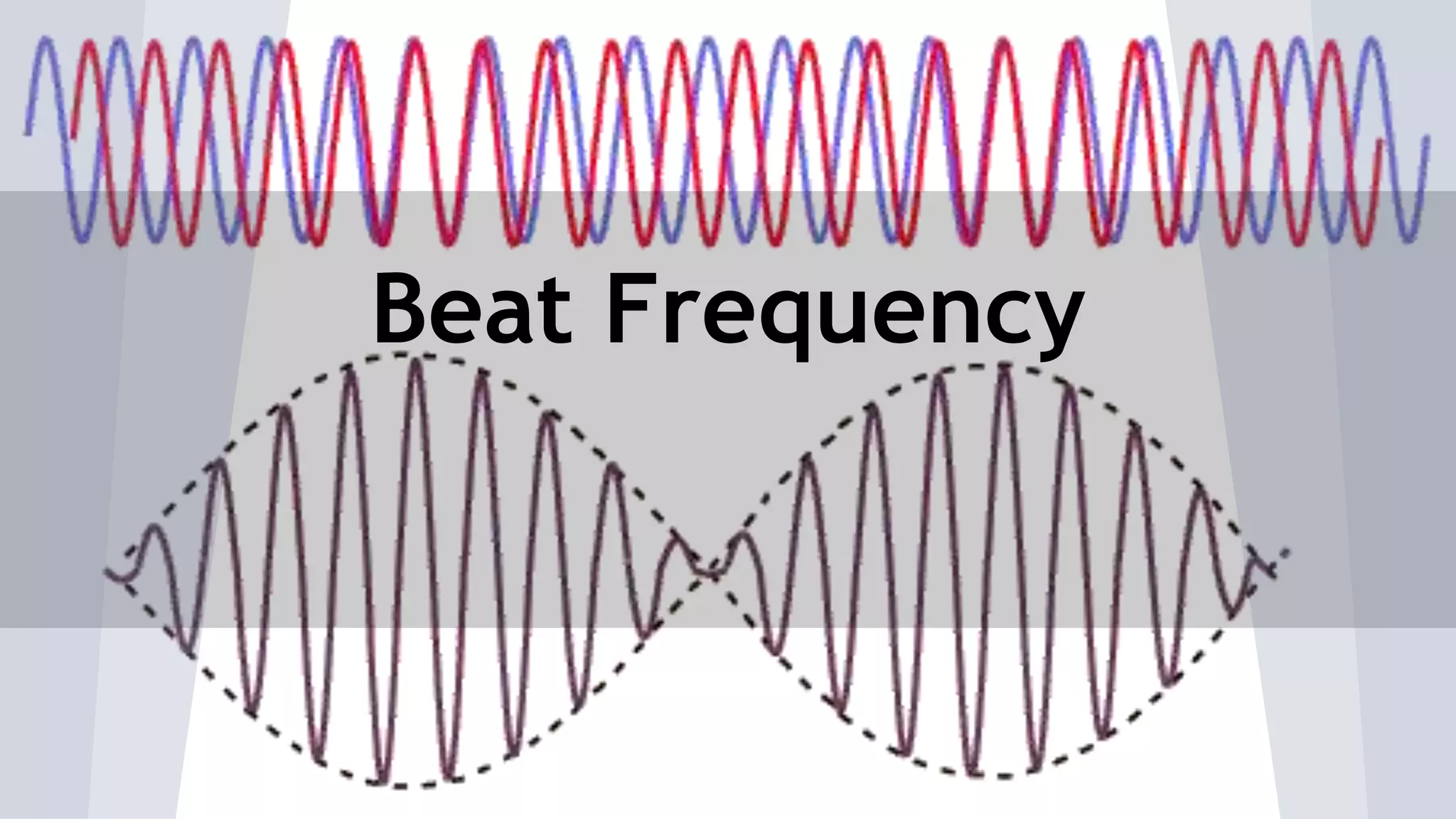
Beat Frequency
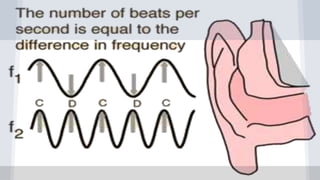
● Interference of two sound waves with slightly
different frequencies
 The sound of the beat is from the increase
and decrease in amplitude as a function of
time
What is a Beat?
What is Beat Frequency?
● the rate of beats or the number of beats per second
● difference between the frequency of two interacting
sound waves
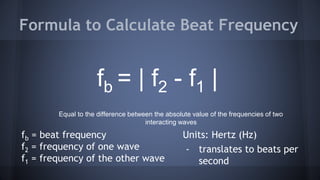
fb = beat frequency
f2 = frequency of one wave
f1 = frequency of the other wave
Formula to Calculate Beat Frequency
fb = | f2 - f1 |
Equal to the difference between the absolute value of the frequencies of two
interacting waves
Units: Hertz (Hz)
- translates to beats per
second
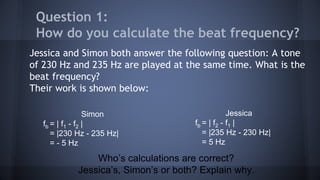
Jessica and Simon both answer the following question: A tone
of 230 Hz and 235 Hz are played at the same time. What is the
beat frequency?
Their work is shown below:
Question 1:
How do you calculate the beat frequency?
Who’s calculations are correct?
Jessica’s, Simon’s or both? Explain why.
Jessica
fb = | f2 - f1 |
= |235 Hz - 230 Hz|
= 5 Hz
Simon
fb = | f1 - f2 |
= |230 Hz - 235 Hz|
= - 5 Hz
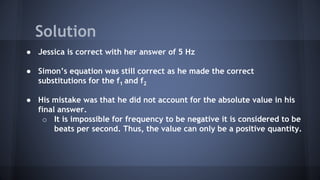
● Jessica is correct with her answer of 5 Hz
● Simon’s equation was still correct as he made the correct
substitutions for the f1 and f2
● His mistake was that he did not account for the absolute value in his
final answer.
o It is impossible for frequency to be negative it is considered to be
beats per second. Thus, the value can only be a positive quantity.
Solution
● You will hear beats when two or more sounds have a beat
frequency of 20-30 Hz
● You will hear a tone when two or more sounds have a beat
frequency greater than 30 Hz
● The greater the beat frequency, the easier it is to hear the
beats
● It is fairly easy to detect beat frequencies as low as 1 Hz
Detecting Beat Frequencies
If two waves have a beat frequency of 0.5 Hz and
two other waves have a beat frequency of 15 Hz,
which modulation would you detect first?
Question 2: Speed in Different Mediums
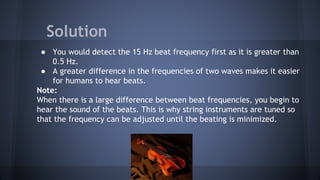
● You would detect the 15 Hz beat frequency first as it is greater than
0.5 Hz.
● A greater difference in the frequencies of two waves makes it easier
for humans to hear beats.
Note:
When there is a large difference between beat frequencies, you begin to
hear the sound of the beats. This is why string instruments are tuned so
that the frequency can be adjusted until the beating is minimized.
Solution
● Askill, John, Dr. "Physics of Music Chapter 3 by Dr. John Askill." Physics of Music Chapter 3 by Dr. John Askill.
N.p., n.d. Web. 16 Mar. 2015.
<http://fiziks.net/Music%20Sample%20Chapter%20Three/musicsamplechapter3.htm>.
● "Beats." Beat Frequencies. N.p., n.d. Web. 16 Mar. 2015.<http://hyperphysics.phy-
astr.gsu.edu/hbase/sound/beat.html>.
● "Beats." Beats. Michigan Tech, n.d. Web. 16 Mar. 2015. <http://www.phy.mtu.edu/~suits/beats.html>.
● Hawkes, Robert. Physics for Scientists and Engineers: An Interactive Approach. Toronto: Nelson Education,
2014. Print.
Citations

LO 7/8

  • 1.
  • 2.
    ● Interference oftwo sound waves with slightly different frequencies  The sound of the beat is from the increase and decrease in amplitude as a function of time What is a Beat?
  • 3.
    What is BeatFrequency? ● the rate of beats or the number of beats per second ● difference between the frequency of two interacting sound waves
  • 5.
    fb = beatfrequency f2 = frequency of one wave f1 = frequency of the other wave Formula to Calculate Beat Frequency fb = | f2 - f1 | Equal to the difference between the absolute value of the frequencies of two interacting waves Units: Hertz (Hz) - translates to beats per second
  • 6.
    Jessica and Simonboth answer the following question: A tone of 230 Hz and 235 Hz are played at the same time. What is the beat frequency? Their work is shown below: Question 1: How do you calculate the beat frequency? Who’s calculations are correct? Jessica’s, Simon’s or both? Explain why. Jessica fb = | f2 - f1 | = |235 Hz - 230 Hz| = 5 Hz Simon fb = | f1 - f2 | = |230 Hz - 235 Hz| = - 5 Hz
  • 7.
    ● Jessica iscorrect with her answer of 5 Hz ● Simon’s equation was still correct as he made the correct substitutions for the f1 and f2 ● His mistake was that he did not account for the absolute value in his final answer. o It is impossible for frequency to be negative it is considered to be beats per second. Thus, the value can only be a positive quantity. Solution
  • 8.
    ● You willhear beats when two or more sounds have a beat frequency of 20-30 Hz ● You will hear a tone when two or more sounds have a beat frequency greater than 30 Hz ● The greater the beat frequency, the easier it is to hear the beats ● It is fairly easy to detect beat frequencies as low as 1 Hz Detecting Beat Frequencies
  • 9.
    If two waveshave a beat frequency of 0.5 Hz and two other waves have a beat frequency of 15 Hz, which modulation would you detect first? Question 2: Speed in Different Mediums
  • 10.
    ● You woulddetect the 15 Hz beat frequency first as it is greater than 0.5 Hz. ● A greater difference in the frequencies of two waves makes it easier for humans to hear beats. Note: When there is a large difference between beat frequencies, you begin to hear the sound of the beats. This is why string instruments are tuned so that the frequency can be adjusted until the beating is minimized. Solution
  • 11.
    ● Askill, John,Dr. "Physics of Music Chapter 3 by Dr. John Askill." Physics of Music Chapter 3 by Dr. John Askill. N.p., n.d. Web. 16 Mar. 2015. <http://fiziks.net/Music%20Sample%20Chapter%20Three/musicsamplechapter3.htm>. ● "Beats." Beat Frequencies. N.p., n.d. Web. 16 Mar. 2015.<http://hyperphysics.phy- astr.gsu.edu/hbase/sound/beat.html>. ● "Beats." Beats. Michigan Tech, n.d. Web. 16 Mar. 2015. <http://www.phy.mtu.edu/~suits/beats.html>. ● Hawkes, Robert. Physics for Scientists and Engineers: An Interactive Approach. Toronto: Nelson Education, 2014. Print. Citations