Beats
Tony Mo
Student #: 14449145
Phys 101
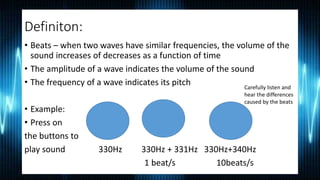
Definiton:
• Beats – when two waves have similar frequencies, the volume of the
sound increases of decreases as a function of time
• The amplitude of a wave indicates the volume of the sound
• The frequency of a wave indicates its pitch
• Example:
• Press on
the buttons to
play sound 330Hz 330Hz + 331Hz 330Hz+340Hz
1 beat/s 10beats/s
Carefully listen and
hear the differences
caused by the beats
Tones with a large
difference in frequency
400 hz200hz 300hz 200hz + 400hz 300hz+400hz200hz + 300hz
*Notice that beats are no longer present
Graph of 2 waves with large
difference in frequency
Equations:
Resultant wave is fixed at x=xo so that
the amplitude is only in terms of time
and not position as well
Amplitude Modulation
As a function of time As a function of position
Questions:
• Derek and Sloan decide to play a song together. Derek is playing
the guitar while Sloan is playing the drums. If Derek plays at a
frequency of 350Hz while Sloan plays at 330Hz, What is the mean
angular frequency (assuming the phase constant is 0)? What is the
beat frequency? How many beats is heard in 2 seconds?
Solutions:
• For part 1 we are given the frequency,
• 𝜔(𝐷𝑒𝑟𝑒𝑘) = 2𝜋𝑓 = 2𝜋(350ℎ𝑧) = 2199 rads/s
• 𝜔 𝑆𝑙𝑜𝑎𝑛 = 2𝜋𝑓 = 2𝜋 330ℎ𝑧 = 2073
𝑟𝑎𝑑𝑠
𝑠
• 𝜔𝑎𝑣𝑔 =
𝜔𝑑𝑒𝑟𝑒𝑘+𝜔𝑠𝑙𝑜𝑎𝑛
2
= 2136
𝑟𝑎𝑑𝑠
𝑠
• 𝐵𝑒𝑎𝑡 𝑓𝑟𝑒𝑞𝑢𝑒𝑛𝑐𝑦 = 𝑓𝐷𝑒𝑟𝑒𝑘 − 𝑓𝑆𝑙𝑜𝑎𝑛 = 350ℎ𝑧 − 330ℎ𝑧 =
20ℎ𝑧
• 𝐵𝑒𝑎𝑡𝑠 𝑝𝑒𝑟 𝑠𝑒𝑐𝑜𝑛𝑑 = 𝑓𝐷𝑒𝑟𝑒𝑘 − 𝑓𝑆𝑙𝑜𝑎𝑛 𝑥 𝑡𝑖𝑚𝑒 = (350ℎ𝑧 −
Bibliography
• Background images from google
• Graph and Equations from Physics for Scientists and Engineers - 1e
Hawkes, Iqbal, Mansour, Milner-Bolotin, and Willia
• Sound created with Audacity

Phys 101 lo #6

  • 1.
    Beats Tony Mo Student #:14449145 Phys 101
  • 2.
    Definiton: • Beats –when two waves have similar frequencies, the volume of the sound increases of decreases as a function of time • The amplitude of a wave indicates the volume of the sound • The frequency of a wave indicates its pitch • Example: • Press on the buttons to play sound 330Hz 330Hz + 331Hz 330Hz+340Hz 1 beat/s 10beats/s Carefully listen and hear the differences caused by the beats
  • 3.
    Tones with alarge difference in frequency 400 hz200hz 300hz 200hz + 400hz 300hz+400hz200hz + 300hz *Notice that beats are no longer present Graph of 2 waves with large difference in frequency
  • 4.
    Equations: Resultant wave isfixed at x=xo so that the amplitude is only in terms of time and not position as well
  • 5.
    Amplitude Modulation As afunction of time As a function of position
  • 6.
    Questions: • Derek andSloan decide to play a song together. Derek is playing the guitar while Sloan is playing the drums. If Derek plays at a frequency of 350Hz while Sloan plays at 330Hz, What is the mean angular frequency (assuming the phase constant is 0)? What is the beat frequency? How many beats is heard in 2 seconds?
  • 7.
    Solutions: • For part1 we are given the frequency, • 𝜔(𝐷𝑒𝑟𝑒𝑘) = 2𝜋𝑓 = 2𝜋(350ℎ𝑧) = 2199 rads/s • 𝜔 𝑆𝑙𝑜𝑎𝑛 = 2𝜋𝑓 = 2𝜋 330ℎ𝑧 = 2073 𝑟𝑎𝑑𝑠 𝑠 • 𝜔𝑎𝑣𝑔 = 𝜔𝑑𝑒𝑟𝑒𝑘+𝜔𝑠𝑙𝑜𝑎𝑛 2 = 2136 𝑟𝑎𝑑𝑠 𝑠 • 𝐵𝑒𝑎𝑡 𝑓𝑟𝑒𝑞𝑢𝑒𝑛𝑐𝑦 = 𝑓𝐷𝑒𝑟𝑒𝑘 − 𝑓𝑆𝑙𝑜𝑎𝑛 = 350ℎ𝑧 − 330ℎ𝑧 = 20ℎ𝑧 • 𝐵𝑒𝑎𝑡𝑠 𝑝𝑒𝑟 𝑠𝑒𝑐𝑜𝑛𝑑 = 𝑓𝐷𝑒𝑟𝑒𝑘 − 𝑓𝑆𝑙𝑜𝑎𝑛 𝑥 𝑡𝑖𝑚𝑒 = (350ℎ𝑧 −
  • 8.
    Bibliography • Background imagesfrom google • Graph and Equations from Physics for Scientists and Engineers - 1e Hawkes, Iqbal, Mansour, Milner-Bolotin, and Willia • Sound created with Audacity