MEASUREMENT
TEST
EVALUATION
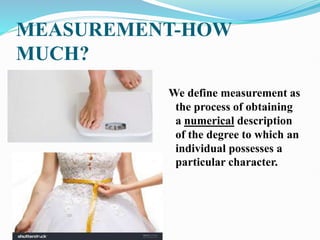
MEASUREMENT-HOW
MUCH?
We define measurement as
the process of obtaining
a numerical description
of the degree to which an
individual possesses a
particular character.
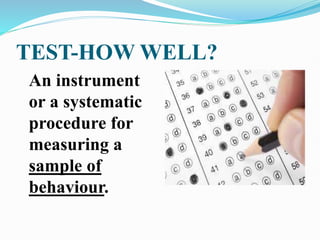
TEST-HOW WELL?
An instrument
or a systematic
procedure for
measuring a
sample of
behaviour.
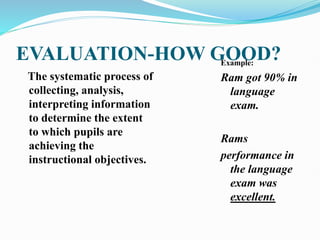
EVALUATION-HOW GOOD?
The systematic process of
collecting, analysis,
interpreting information
to determine the extent
to which pupils are
achieving the
instructional objectives.
Example:
Ram got 90% in
language
exam.
Rams
performance in
the language
exam was
excellent.
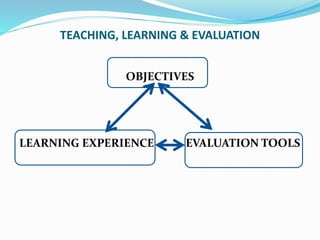
TEACHING, LEARNING & EVALUATION
OBJECTIVES
LEARNING EXPERIENCE EVALUATION TOOLS
TEACHING, LEARNING &
EVALUATION
OBJECTIVES
AIMS
Long term goals
General
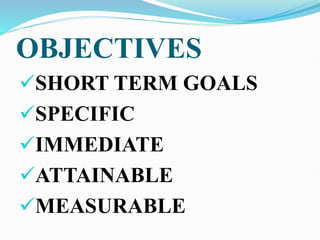
OBJECTIVES
SHORT TERM GOALS
SPECIFIC
IMMEDIATE
ATTAINABLE
MEASURABLE
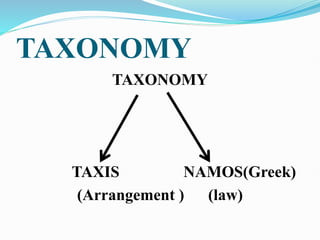
TAXONOMY
TAXONOMY
TAXIS NAMOS(Greek)
(Arrangement ) (law)
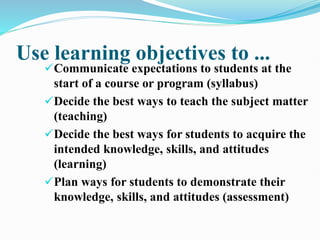
Use learning objectives to ...
Communicate expectations to students at the
start of a course or program (syllabus)
Decide the best ways to teach the subject matter
(teaching)
Decide the best ways for students to acquire the
intended knowledge, skills, and attitudes
(learning)
Plan ways for students to demonstrate their
knowledge, skills, and attitudes (assessment)
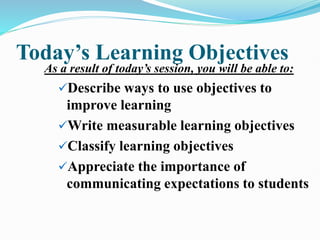
Today’s Learning Objectives
As a result of today’s session, you will be able to:
Describe ways to use objectives to
improve learning
Write measurable learning objectives
Classify learning objectives
Appreciate the importance of
communicating expectations to students
BENJAMIN.S.BLOOM(1956)
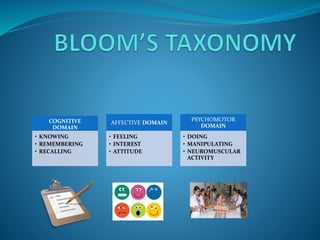
COGNITIVE
DOMAIN
• KNOWING
• REMEMBERING
• RECALLING
AFFECTIVE DOMAIN
• FEELING
• INTEREST
• ATTITUDE
PSYCHOMOTOR
DOMAIN
• DOING
• MANIPULATING
• NEUROMUSCULAR
ACTIVITY
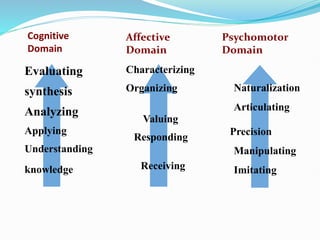
Cognitive
Domain
Evaluating
synthesis
Analyzing
Applying
Understanding
knowledge
Characterizing
Organizing
Valuing
Responding
Affective
Domain
Psychomotor
Domain
Naturalization
Articulating
Precision
Manipulating
Imitating
Receiving
KNOWLEDGE-Remembering
The learner is able to recall, restate and remember
learned information
 Describing
 Finding
 Identifying
 Listing
 Retrieving
 Naming
 Locating
 Recognizing
Can students recall information?
Remembering
The learner is able to recall, restate and remember learned
information.
 Recognising
 Listing
 Describing
 Identifying
 Retrieving
 Naming
 Locating
 Finding
Can you recall information?
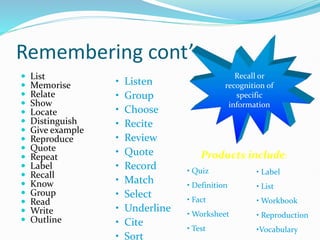
Remembering cont’
 List
 Memorise
 Relate
 Show
 Locate
 Distinguish
 Give example
 Reproduce
 Quote
 Repeat
 Label
 Recall
 Know
 Group
 Read
 Write
 Outline
• Listen
• Group
• Choose
• Recite
• Review
• Quote
• Record
• Match
• Select
• Underline
• Cite
• Sort
Recall or
recognition of
specific
information
Products include:
• Quiz
• Definition
• Fact
• Worksheet
• Test
• Label
• List
• Workbook
• Reproduction
•Vocabulary
Understanding
Student grasps meaning of information
by interpreting and translating
what has been learned
 Classifying
 Comparing
 Exemplifying
 Explaining
 Inferring
 Interpreting
 Paraphrasing
 Summarizing
Can students explain ideas or concepts?
Understanding
The learner grasps the meaning of information by
interpreting and translating what has been learned.
 Interpreting
 Exemplifying
 Summarising
 Inferring
 Paraphrasing
 Classifying
 Comparing
 Explaining
Can you explain ideas or concepts?
Understanding cont’
 Restate
 Identify
 Discuss
 Retell
 Research
 Annotate
 Translate
 Give examples of
 Paraphrase
 Reorganise
 Associate
• Describe
• Report
• Recognise
• Review
• Observe
• Outline
• Account for
• Interpret
• Give main
idea
• Estimate
Understanding
of given
information
Products include:
• Recitation
• Summary
• Collection
• Explanation
• Show and tell
• Example
• Quiz
• List
• Label
• Outline
Applying
Student makes use of information in a context
different from the one in which it was learned
 Implementing
 Carrying out
 Using
 Executing
Can students use the information in
another familiar situation?
c =
Applying
The learner makes use of information in a context
different from the one in which it was learned.
 Implementing
 Carrying out
 Using
 Executing
Can you use the information in another
familiar situation?
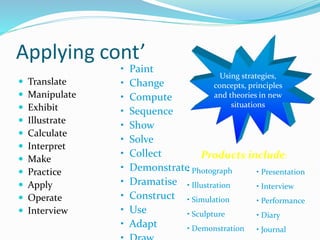
Applying cont’
 Translate
 Manipulate
 Exhibit
 Illustrate
 Calculate
 Interpret
 Make
 Practice
 Apply
 Operate
 Interview
• Paint
• Change
• Compute
• Sequence
• Show
• Solve
• Collect
• Demonstrate
• Dramatise
• Construct
• Use
• Adapt
Using strategies,
concepts, principles
and theories in new
situations
Products include:
• Photograph
• Illustration
• Simulation
• Sculpture
• Demonstration
• Presentation
• Interview
• Performance
• Diary
• Journal
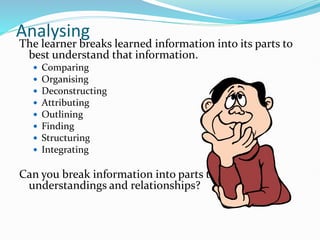
Analyzing
Student breaks learned information into
its parts to best understand that information
 Attributing
 Comparing
 Deconstructing
 Finding
 Integrating
 Organizing
 Outlining
 Structuring
Can students break information into parts to
explore understandings and relationships?
Analysing
The learner breaks learned information into its parts to
best understand that information.
 Comparing
 Organising
 Deconstructing
 Attributing
 Outlining
 Finding
 Structuring
 Integrating
Can you break information into parts to explore
understandings and relationships?
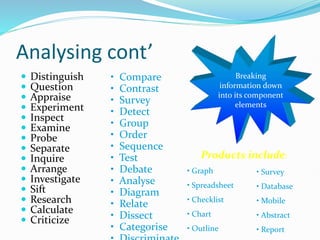
Analysing cont’
 Distinguish
 Question
 Appraise
 Experiment
 Inspect
 Examine
 Probe
 Separate
 Inquire
 Arrange
 Investigate
 Sift
 Research
 Calculate
 Criticize
• Compare
• Contrast
• Survey
• Detect
• Group
• Order
• Sequence
• Test
• Debate
• Analyse
• Diagram
• Relate
• Dissect
• Categorise
Breaking
information down
into its component
elements
Products include:
• Graph
• Spreadsheet
• Checklist
• Chart
• Outline
• Survey
• Database
• Mobile
• Abstract
• Report
Evaluating
Student makes decisions based on in-depth
reflection, criticism and assessment
 Checking
 Critiquing
 Detecting
 Experimenting
 Hypothesising
 Judging
 Monitoring
 Testing
Can students justify a decision or
a course of action?
Evaluating
The learner makes decisions based on in-depth reflection,
criticism and assessment.
 Checking
 Hypothesising
 Critiquing
 Experimenting
 Judging
 Testing
 Detecting
 Monitoring
Can you justify a decision or course of action?
Evaluating cont’
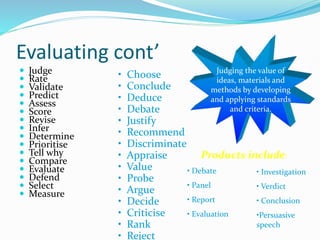
 Judge
 Rate
 Validate
 Predict
 Assess
 Score
 Revise
 Infer
 Determine
 Prioritise
 Tell why
 Compare
 Evaluate
 Defend
 Select
 Measure
• Choose
• Conclude
• Deduce
• Debate
• Justify
• Recommend
• Discriminate
• Appraise
• Value
• Probe
• Argue
• Decide
• Criticise
• Rank
• Reject
Judging the value of
ideas, materials and
methods by developing
and applying standards
and criteria.
Products include:
• Debate
• Panel
• Report
• Evaluation
• Investigation
• Verdict
• Conclusion
•Persuasive
speech
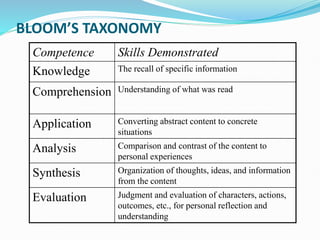
BLOOM’S TAXONOMY
Competence Skills Demonstrated
Knowledge The recall of specific information
Comprehension Understanding of what was read
Application Converting abstract content to concrete
situations
Analysis Comparison and contrast of the content to
personal experiences
Synthesis Organization of thoughts, ideas, and information
from the content
Evaluation Judgment and evaluation of characters, actions,
outcomes, etc., for personal reflection and
understanding
KNOWLEDGE
Memorization
 Observation and recall of information
 Knowledge of dates, events, places
 Knowledge of major ideas
 Mastery of subject matter
KNOWLEDGE
Memorization
 Arrange
 Define
 Describe
 Duplicate
 Identify
 Label
 List
 Memorize
 Name
 Order
 Quote
 Recall
 Recognize
 Relate
 Repeat
 Reproduce
COMPREHENSION
Understanding
 Understand information
 Grasp meaning
 Translate knowledge into new content
 Interpret facts, compare, contrast
 Order, group, infer causes
 Predict consequences
COMPREHENSION
Understanding
 Classify
 Describe
 Discuss
 Explain
 Express
 Identify
 Indicate
 Locate
 Recognize
 Report
 Restate
 Review
 Select
 Translate
APPLICATION Using
 Use information
 Use methods, concepts, theories in new situations
 Solve problems using required skills or knowledge
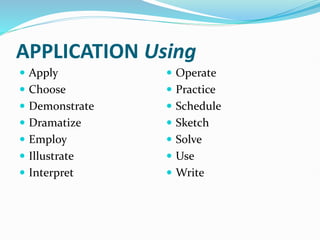
APPLICATION Using
 Apply
 Choose
 Demonstrate
 Dramatize
 Employ
 Illustrate
 Interpret
 Operate
 Practice
 Schedule
 Sketch
 Solve
 Use
 Write
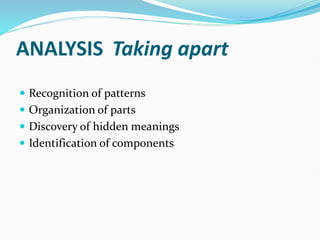
ANALYSIS Taking apart
 Recognition of patterns
 Organization of parts
 Discovery of hidden meanings
 Identification of components
ANALYSIS Taking apart
 Analyze
 Appraise
 Calculate
 Categorize
 Compare
 Contrast
 Criticize
 Differentiate
 Discriminate
 Distinguish
 Examine
 Experiment
 Question
 Test
SYNTHESIS Putting together
 Use old ideas to create new ones
 Generalize from given facts
 Relate knowledge from several areas
 Predict, draw conclusions
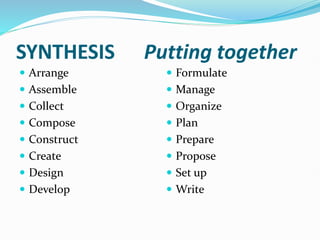
SYNTHESIS Putting together
 Arrange
 Assemble
 Collect
 Compose
 Construct
 Create
 Design
 Develop
 Formulate
 Manage
 Organize
 Plan
 Prepare
 Propose
 Set up
 Write
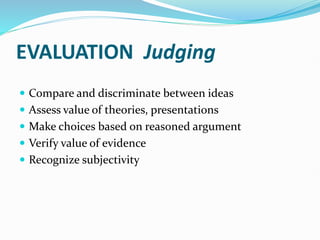
EVALUATION Judging
 Compare and discriminate between ideas
 Assess value of theories, presentations
 Make choices based on reasoned argument
 Verify value of evidence
 Recognize subjectivity
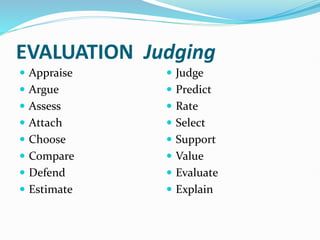
EVALUATION Judging
 Appraise
 Argue
 Assess
 Attach
 Choose
 Compare
 Defend
 Estimate
 Judge
 Predict
 Rate
 Select
 Support
 Value
 Evaluate
 Explain
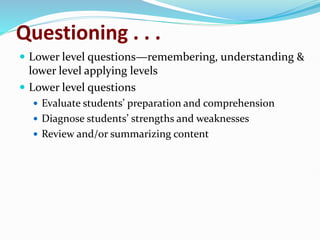
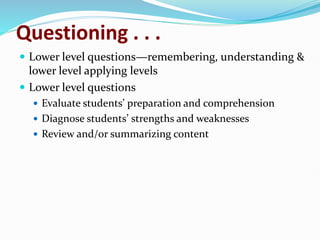
Questioning . . .
 Lower level questions—remembering, understanding &
lower level applying levels
 Lower level questions
 Evaluate students’ preparation and comprehension
 Diagnose students’ strengths and weaknesses
 Review and/or summarizing content
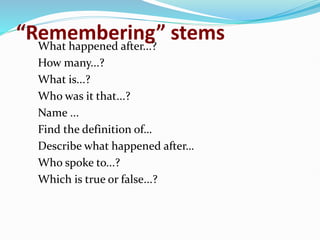
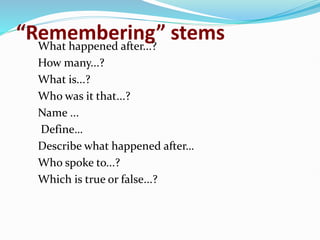
“Remembering” stems
What happened after...?
How many...?
What is...?
Who was it that...?
Name ...
Find the definition of…
Describe what happened after…
Who spoke to...?
Which is true or false...?
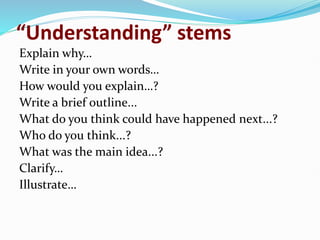
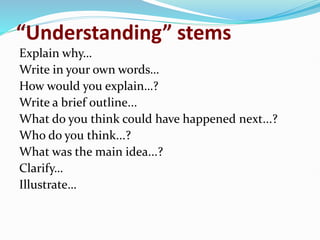
“Understanding” stems
Explain why…
Write in your own words…
How would you explain…?
Write a brief outline...
What do you think could have happened next...?
Who do you think...?
What was the main idea...?
Clarify…
Illustrate…
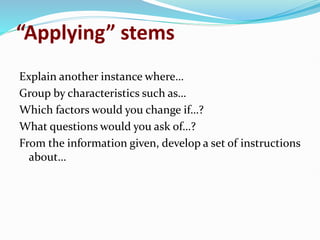
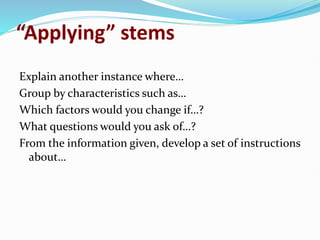
“Applying” stems
Explain another instance where…
Group by characteristics such as…
Which factors would you change if…?
What questions would you ask of…?
From the information given, develop a set of instructions
about…
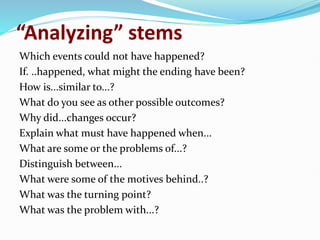
“Analyzing” stems
Which events could not have happened?
If. ..happened, what might the ending have been?
How is...similar to...?
What do you see as other possible outcomes?
Why did...changes occur?
Explain what must have happened when...
What are some or the problems of...?
Distinguish between...
What were some of the motives behind..?
What was the turning point?
What was the problem with...?
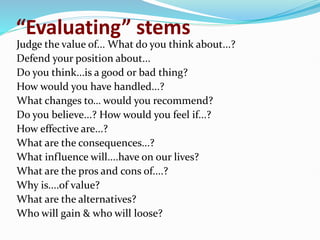
“Evaluating” stems
Judge the value of... What do you think about...?
Defend your position about...
Do you think...is a good or bad thing?
How would you have handled...?
What changes to… would you recommend?
Do you believe...? How would you feel if...?
How effective are...?
What are the consequences...?
What influence will....have on our lives?
What are the pros and cons of....?
Why is....of value?
What are the alternatives?
Who will gain & who will loose?
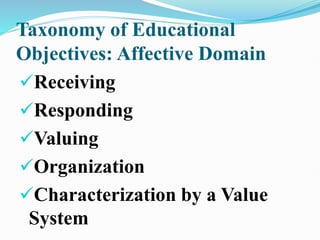
Taxonomy of Educational
Objectives: Affective Domain
Receiving
Responding
Valuing
Organization
Characterization by a Value
System
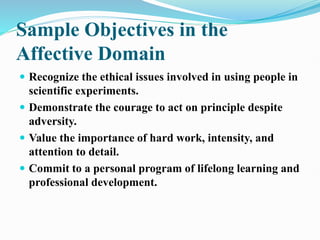
Sample Objectives in the
Affective Domain
 Recognize the ethical issues involved in using people in
scientific experiments.
 Demonstrate the courage to act on principle despite
adversity.
 Value the importance of hard work, intensity, and
attention to detail.
 Commit to a personal program of lifelong learning and
professional development.
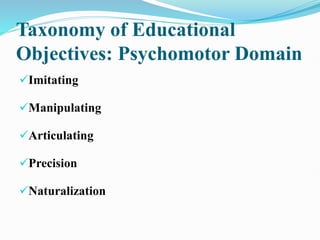
Taxonomy of Educational
Objectives: Psychomotor Domain
Imitating
Manipulating
Articulating
Precision
Naturalization
Sample Objectives in the
Psychomotor Domain
 Use appropriate nonverbal communications, e.g.,
gestures, eye contact, poise.
 Create interactive 3-D models of products and
environments using lightweight metals.
 Determine the stress and deformation states of
structures using the appropriate physical tools and
measures.
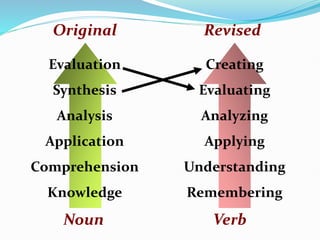
Evaluation
Synthesis
Analysis
Application
Comprehension
Knowledge
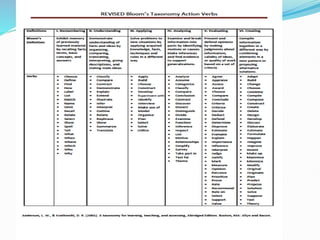
Creating
Evaluating
Analyzing
Applying
Understanding
Remembering
Original Revised
Noun Verb
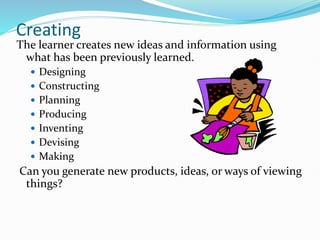
Creating
The learner creates new ideas and information using
what has been previously learned.
 Designing
 Constructing
 Planning
 Producing
 Inventing
 Devising
 Making
Can you generate new products, ideas, or ways of viewing
things?
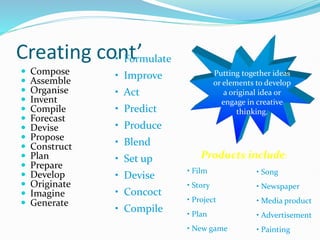
Creating cont’
 Compose
 Assemble
 Organise
 Invent
 Compile
 Forecast
 Devise
 Propose
 Construct
 Plan
 Prepare
 Develop
 Originate
 Imagine
 Generate
• Formulate
• Improve
• Act
• Predict
• Produce
• Blend
• Set up
• Devise
• Concoct
• Compile
Putting together ideas
or elements to develop
a original idea or
engage in creative
thinking.
Products include:
• Film
• Story
• Project
• Plan
• New game
• Song
• Newspaper
• Media product
• Advertisement
• Painting
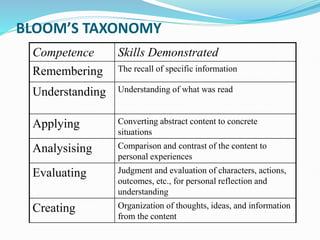
BLOOM’S TAXONOMY
Competence Skills Demonstrated
Remembering The recall of specific information
Understanding Understanding of what was read
Applying Converting abstract content to concrete
situations
Analysising Comparison and contrast of the content to
personal experiences
Evaluating Judgment and evaluation of characters, actions,
outcomes, etc., for personal reflection and
understanding
Creating Organization of thoughts, ideas, and information
from the content
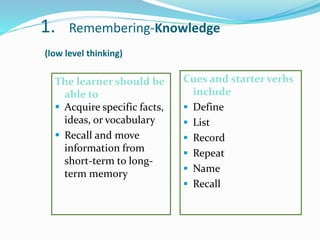
1. Remembering-Knowledge
(low level thinking)
The learner should be
able to
 Acquire specific facts,
ideas, or vocabulary
 Recall and move
information from
short-term to long-
term memory
Cues and starter verbs
include
 Define
 List
 Record
 Repeat
 Name
 Recall
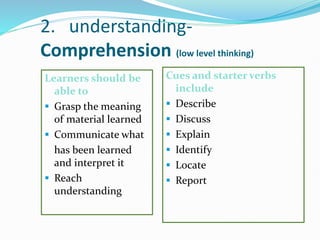
2. understanding-
Comprehension (low level thinking)
Learners should be
able to
 Grasp the meaning
of material learned
 Communicate what
has been learned
and interpret it
 Reach
understanding
Cues and starter verbs
include
 Describe
 Discuss
 Explain
 Identify
 Locate
 Report
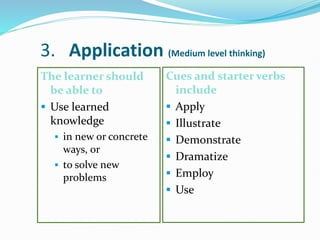
3. Application (Medium level thinking)
The learner should
be able to
 Use learned
knowledge
 in new or concrete
ways, or
 to solve new
problems
Cues and starter verbs
include
 Apply
 Illustrate
 Demonstrate
 Dramatize
 Employ
 Use
Eileen Herteis, The Gwenna Moss Teaching &
Learning Centre
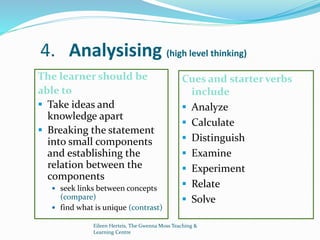
4. Analysising (high level thinking)
The learner should be
able to
 Take ideas and
knowledge apart
 Breaking the statement
into small components
and establishing the
relation between the
components
 seek links between concepts
(compare)
 find what is unique (contrast)
Cues and starter verbs
include
 Analyze
 Calculate
 Distinguish
 Examine
 Experiment
 Relate
 Solve
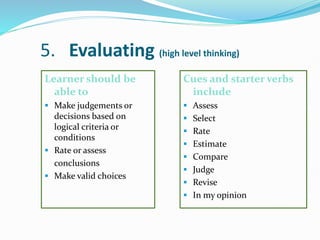
5. Evaluating (high level thinking)
Learner should be
able to
 Make judgements or
decisions based on
logical criteria or
conditions
 Rate or assess
conclusions
 Make valid choices
Cues and starter verbs
include
 Assess
 Select
 Rate
 Estimate
 Compare
 Judge
 Revise
 In my opinion
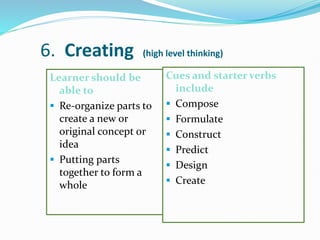
6. Creating (high level thinking)
Learner should be
able to
 Re-organize parts to
create a new or
original concept or
idea
 Putting parts
together to form a
whole
Cues and starter verbs
include
 Compose
 Formulate
 Construct
 Predict
 Design
 Create
Questioning . . .
 Lower level questions—remembering, understanding &
lower level applying levels
 Lower level questions
 Evaluate students’ preparation and comprehension
 Diagnose students’ strengths and weaknesses
 Review and/or summarizing content
“Remembering” stems
What happened after...?
How many...?
What is...?
Who was it that...?
Name ...
Define…
Describe what happened after…
Who spoke to...?
Which is true or false...?
“Understanding” stems
Explain why…
Write in your own words…
How would you explain…?
Write a brief outline...
What do you think could have happened next...?
Who do you think...?
What was the main idea...?
Clarify…
Illustrate…
“Applying” stems
Explain another instance where…
Group by characteristics such as…
Which factors would you change if…?
What questions would you ask of…?
From the information given, develop a set of instructions
about…
“Analyzing” stems
Which events could not have happened?
If. ..happened, what might the ending have been?
How is...similar to...?
What do you see as other possible outcomes?
Why did...changes occur?
Explain what must have happened when...
What are some or the problems of...?
Distinguish between...
What were some of the motives behind..?
What was the turning point?
What was the problem with...?
“Evaluating” stems
Judge the value of... What do you think about...?
Defend your position about...
Do you think...is a good or bad thing?
How would you have handled...?
What changes to… would you recommend?
Do you believe...? How would you feel if...?
How effective are...?
What are the consequences...?
What influence will....have on our lives?
What are the pros and cons of....?
Why is....of value?
What are the alternatives?
Who will gain & who will loose?
Bloom’s Taxonomy Provides
1. The basis for creating C-L-E-A-R student
learning expectations:
 Comprehensible to students
 Learner-Centered
 Evident, observable in fulfillment
 Attainable, but of a high standard
 Related to the course content and goals
Bloom’s Taxonomy Provides
2. Cues for asking questions that
stimulate classroom discussion
3. A framework for ensuring that you
encourage students’ higher-order thinking skills
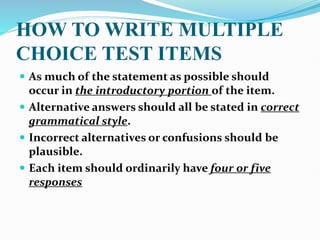
HOW TO WRITE MULTIPLE
CHOICE TEST ITEMS
 As much of the statement as possible should
occur in the introductory portion of the item.
 Alternative answers should all be stated in correct
grammatical style.
 Incorrect alternatives or confusions should be
plausible.
 Each item should ordinarily have four or five
responses
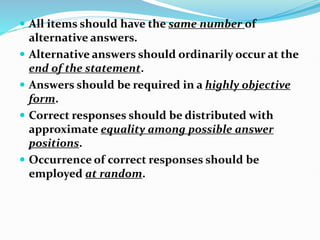
 All items should have the same number of
alternative answers.
 Alternative answers should ordinarily occur at the
end of the statement.
 Answers should be required in a highly objective
form.
 Correct responses should be distributed with
approximate equality among possible answer
positions.
 Occurrence of correct responses should be
employed at random.
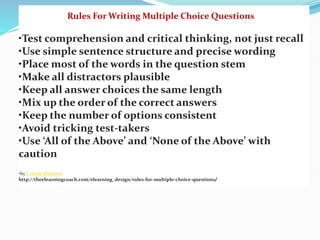
Rules For Writing Multiple Choice Questions
•Test comprehension and critical thinking, not just recall
•Use simple sentence structure and precise wording
•Place most of the words in the question stem
•Make all distractors plausible
•Keep all answer choices the same length
•Mix up the order of the correct answers
•Keep the number of options consistent
•Avoid tricking test-takers
•Use ‘All of the Above’ and ‘None of the Above’ with
caution
•by Connie Malamed
http://theelearningcoach.com/elearning_design/rules-for-multiple-choice-questions/
REMEMBERING (KNOWLEDGE)
What, when, where, , who, which….
MATHS:
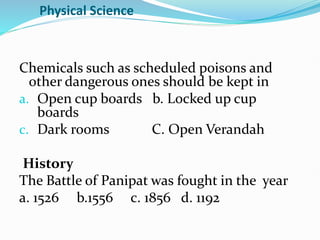
Physical Science
Chemicals such as scheduled poisons and
other dangerous ones should be kept in
a. Open cup boards b. Locked up cup
boards
c. Dark rooms C. Open Verandah
History
The Battle of Panipat was fought in the year
a. 1526 b.1556 c. 1856 d. 1192
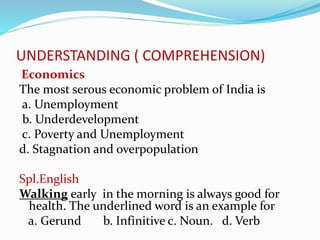
UNDERSTANDING ( COMPREHENSION)
Economics
The most serous economic problem of India is
a. Unemployment
b. Underdevelopment
c. Poverty and Unemployment
d. Stagnation and overpopulation
Spl.English
Walking early in the morning is always good for
health. The underlined word is an example for
a. Gerund b. Infinitive c. Noun. d. Verb
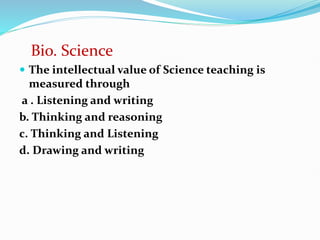
Bio. Science
 The intellectual value of Science teaching is
measured through
a . Listening and writing
b. Thinking and reasoning
c. Thinking and Listening
d. Drawing and writing
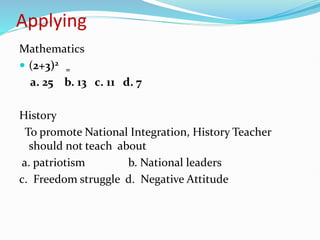
Applying
Mathematics
 (2+3)2
=
a. 25 b. 13 c. 11 d. 7
History
To promote National Integration, History Teacher
should not teach about
a. patriotism b. National leaders
c. Freedom struggle d. Negative Attitude
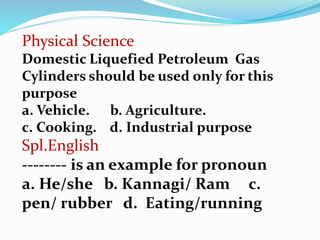
Physical Science
Domestic Liquefied Petroleum Gas
Cylinders should be used only for this
purpose
a. Vehicle. b. Agriculture.
c. Cooking. d. Industrial purpose
Spl.English
-------- is an example for pronoun
a. He/she b. Kannagi/ Ram c.
pen/ rubber d. Eating/running
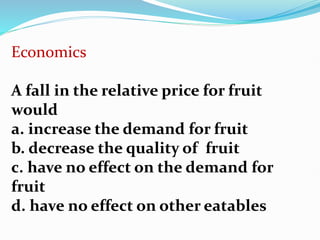
Economics
A fall in the relative price for fruit
would
a. increase the demand for fruit
b. decrease the quality of fruit
c. have no effect on the demand for
fruit
d. have no effect on other eatables
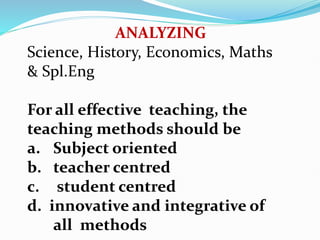
ANALYZING
Science, History, Economics, Maths
& Spl.Eng
For all effective teaching, the
teaching methods should be
a. Subject oriented
b. teacher centred
c. student centred
d. innovative and integrative of
all methods
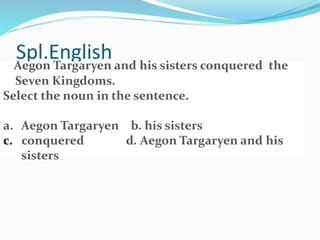
Spl.English
Aegon Targaryen and his sisters conquered the
Seven Kingdoms.
Select the noun in the sentence.
a. Aegon Targaryen b. his sisters
c. conquered d. Aegon Targaryen and his
sisters
EVALUATING
The History teacher is tracing the history of
Archimedis’ Law, narrating the
biography of the scientist. This shows the
correlation between History and
a. Social science
b. Biological science
c. Sociology
d. Physical science
Economics
At present Economic Condition, the
urgent need of our country is
a. To educate the illiterates and creating
awareness about all matters of
national
importance
b. To divert the attention of the people to
accumulate wealth
c. Just to increase the number of
educational
institutions
d. To encourage child labour
Spl.English
Reading good books will not
serve as a tool for
a. mental stimulation
b. stress reduction
c. better writing skill
d. negative thinking
Science
Which out of the following is the
most important advantage of a
science kit
a. Portable and unbreakable
b. made from locally available
materials
c. useful for demonstration when
labs are
not avaliable
d. low cost and are readily available
Creating
To develop the potential of the students the
teacher can ask them to
•design any lab
•conduct mock parliament
•act as an ordinary teacher
•get motivated to imbibe all the skills of an
inspiring teacher
References and Resources
Cruz, E. (2003). Bloom's revised taxonomy. In B. Hoffman (Ed.), Encyclopedia of Educational Technology.
http://coe.sdsu.edu/eet/Articles/bloomrev/start.htm
Dalton, J. & Smith, D. (1986) Extending children’s special abilities: Strategies for primary classrooms.
http://www.teachers.ash.org.au/researchskills/dalton.htm
Ferguson, C. (2002). Using the revised Bloom’s Taxonomy to plan and deliver team-taught, integrated,
thematic units. Theory into Practice, 41(4), 239-244.
Forehand, M. (2008). Bloom’s Taxonomy: From emerging perspectives on learning, teaching and
technology. http://projects.coe.uga.edu/epltt/index.php?title=Bloom%27s_Taxonomy
Mager, R. E. (1997). Making instruction work or skillbloomers: A step-by-step guide to designing and
developing instruction that works, (2nd ed.). Atlanta, GA: The Center for Effective Performance, Inc.
Mager, R. E. (1997). Preparing instructional objectives: A critical tool in the development of effective
instruction, (3rd ed.). Atlanta, GA: The Center for Effective Performance, Inc.
Pohl, Michael. (2000). Learning to think, thinking to learn: Models and strategies to develop a classroom
culture of thinking. Cheltenham, Vic.: Hawker Brownlow.
Tarlinton (2003). Bloom’s revised taxonomy.
http://www.kurwongbss.qld.edu.au/thinking/Bloom/bloomspres.ppt.
University of Illinois, Center for Teaching Excellence (2006). Bloom’s taxonomy.
www.oir.uiuc.edu/Did/docs/QUESTION/quest1.htm

OERDoc_739_7060_11_08_2021.pptx

  • 2.
  • 3.
    MEASUREMENT-HOW MUCH? We define measurementas the process of obtaining a numerical description of the degree to which an individual possesses a particular character.
  • 4.
    TEST-HOW WELL? An instrument ora systematic procedure for measuring a sample of behaviour.
  • 5.
    EVALUATION-HOW GOOD? The systematicprocess of collecting, analysis, interpreting information to determine the extent to which pupils are achieving the instructional objectives. Example: Ram got 90% in language exam. Rams performance in the language exam was excellent.
  • 6.
    TEACHING, LEARNING &EVALUATION OBJECTIVES LEARNING EXPERIENCE EVALUATION TOOLS
  • 7.
  • 8.
  • 9.
  • 10.
  • 11.
    Use learning objectivesto ... Communicate expectations to students at the start of a course or program (syllabus) Decide the best ways to teach the subject matter (teaching) Decide the best ways for students to acquire the intended knowledge, skills, and attitudes (learning) Plan ways for students to demonstrate their knowledge, skills, and attitudes (assessment)
  • 12.
    Today’s Learning Objectives Asa result of today’s session, you will be able to: Describe ways to use objectives to improve learning Write measurable learning objectives Classify learning objectives Appreciate the importance of communicating expectations to students
  • 13.
  • 14.
    COGNITIVE DOMAIN • KNOWING • REMEMBERING •RECALLING AFFECTIVE DOMAIN • FEELING • INTEREST • ATTITUDE PSYCHOMOTOR DOMAIN • DOING • MANIPULATING • NEUROMUSCULAR ACTIVITY
  • 15.
  • 16.
    KNOWLEDGE-Remembering The learner isable to recall, restate and remember learned information  Describing  Finding  Identifying  Listing  Retrieving  Naming  Locating  Recognizing Can students recall information?
  • 17.
    Remembering The learner isable to recall, restate and remember learned information.  Recognising  Listing  Describing  Identifying  Retrieving  Naming  Locating  Finding Can you recall information?
  • 18.
    Remembering cont’  List Memorise  Relate  Show  Locate  Distinguish  Give example  Reproduce  Quote  Repeat  Label  Recall  Know  Group  Read  Write  Outline • Listen • Group • Choose • Recite • Review • Quote • Record • Match • Select • Underline • Cite • Sort Recall or recognition of specific information Products include: • Quiz • Definition • Fact • Worksheet • Test • Label • List • Workbook • Reproduction •Vocabulary
  • 19.
    Understanding Student grasps meaningof information by interpreting and translating what has been learned  Classifying  Comparing  Exemplifying  Explaining  Inferring  Interpreting  Paraphrasing  Summarizing Can students explain ideas or concepts?
  • 20.
    Understanding The learner graspsthe meaning of information by interpreting and translating what has been learned.  Interpreting  Exemplifying  Summarising  Inferring  Paraphrasing  Classifying  Comparing  Explaining Can you explain ideas or concepts?
  • 21.
    Understanding cont’  Restate Identify  Discuss  Retell  Research  Annotate  Translate  Give examples of  Paraphrase  Reorganise  Associate • Describe • Report • Recognise • Review • Observe • Outline • Account for • Interpret • Give main idea • Estimate Understanding of given information Products include: • Recitation • Summary • Collection • Explanation • Show and tell • Example • Quiz • List • Label • Outline
  • 22.
    Applying Student makes useof information in a context different from the one in which it was learned  Implementing  Carrying out  Using  Executing Can students use the information in another familiar situation? c =
  • 23.
    Applying The learner makesuse of information in a context different from the one in which it was learned.  Implementing  Carrying out  Using  Executing Can you use the information in another familiar situation?
  • 24.
    Applying cont’  Translate Manipulate  Exhibit  Illustrate  Calculate  Interpret  Make  Practice  Apply  Operate  Interview • Paint • Change • Compute • Sequence • Show • Solve • Collect • Demonstrate • Dramatise • Construct • Use • Adapt Using strategies, concepts, principles and theories in new situations Products include: • Photograph • Illustration • Simulation • Sculpture • Demonstration • Presentation • Interview • Performance • Diary • Journal
  • 25.
    Analyzing Student breaks learnedinformation into its parts to best understand that information  Attributing  Comparing  Deconstructing  Finding  Integrating  Organizing  Outlining  Structuring Can students break information into parts to explore understandings and relationships?
  • 26.
    Analysing The learner breakslearned information into its parts to best understand that information.  Comparing  Organising  Deconstructing  Attributing  Outlining  Finding  Structuring  Integrating Can you break information into parts to explore understandings and relationships?
  • 27.
    Analysing cont’  Distinguish Question  Appraise  Experiment  Inspect  Examine  Probe  Separate  Inquire  Arrange  Investigate  Sift  Research  Calculate  Criticize • Compare • Contrast • Survey • Detect • Group • Order • Sequence • Test • Debate • Analyse • Diagram • Relate • Dissect • Categorise Breaking information down into its component elements Products include: • Graph • Spreadsheet • Checklist • Chart • Outline • Survey • Database • Mobile • Abstract • Report
  • 28.
    Evaluating Student makes decisionsbased on in-depth reflection, criticism and assessment  Checking  Critiquing  Detecting  Experimenting  Hypothesising  Judging  Monitoring  Testing Can students justify a decision or a course of action?
  • 29.
    Evaluating The learner makesdecisions based on in-depth reflection, criticism and assessment.  Checking  Hypothesising  Critiquing  Experimenting  Judging  Testing  Detecting  Monitoring Can you justify a decision or course of action?
  • 30.
    Evaluating cont’  Judge Rate  Validate  Predict  Assess  Score  Revise  Infer  Determine  Prioritise  Tell why  Compare  Evaluate  Defend  Select  Measure • Choose • Conclude • Deduce • Debate • Justify • Recommend • Discriminate • Appraise • Value • Probe • Argue • Decide • Criticise • Rank • Reject Judging the value of ideas, materials and methods by developing and applying standards and criteria. Products include: • Debate • Panel • Report • Evaluation • Investigation • Verdict • Conclusion •Persuasive speech
  • 31.
    BLOOM’S TAXONOMY Competence SkillsDemonstrated Knowledge The recall of specific information Comprehension Understanding of what was read Application Converting abstract content to concrete situations Analysis Comparison and contrast of the content to personal experiences Synthesis Organization of thoughts, ideas, and information from the content Evaluation Judgment and evaluation of characters, actions, outcomes, etc., for personal reflection and understanding
  • 32.
    KNOWLEDGE Memorization  Observation andrecall of information  Knowledge of dates, events, places  Knowledge of major ideas  Mastery of subject matter
  • 33.
    KNOWLEDGE Memorization  Arrange  Define Describe  Duplicate  Identify  Label  List  Memorize  Name  Order  Quote  Recall  Recognize  Relate  Repeat  Reproduce
  • 34.
    COMPREHENSION Understanding  Understand information Grasp meaning  Translate knowledge into new content  Interpret facts, compare, contrast  Order, group, infer causes  Predict consequences
  • 35.
    COMPREHENSION Understanding  Classify  Describe Discuss  Explain  Express  Identify  Indicate  Locate  Recognize  Report  Restate  Review  Select  Translate
  • 36.
    APPLICATION Using  Useinformation  Use methods, concepts, theories in new situations  Solve problems using required skills or knowledge
  • 37.
    APPLICATION Using  Apply Choose  Demonstrate  Dramatize  Employ  Illustrate  Interpret  Operate  Practice  Schedule  Sketch  Solve  Use  Write
  • 38.
    ANALYSIS Taking apart Recognition of patterns  Organization of parts  Discovery of hidden meanings  Identification of components
  • 39.
    ANALYSIS Taking apart Analyze  Appraise  Calculate  Categorize  Compare  Contrast  Criticize  Differentiate  Discriminate  Distinguish  Examine  Experiment  Question  Test
  • 40.
    SYNTHESIS Putting together Use old ideas to create new ones  Generalize from given facts  Relate knowledge from several areas  Predict, draw conclusions
  • 41.
    SYNTHESIS Putting together Arrange  Assemble  Collect  Compose  Construct  Create  Design  Develop  Formulate  Manage  Organize  Plan  Prepare  Propose  Set up  Write
  • 42.
    EVALUATION Judging  Compareand discriminate between ideas  Assess value of theories, presentations  Make choices based on reasoned argument  Verify value of evidence  Recognize subjectivity
  • 43.
    EVALUATION Judging  Appraise Argue  Assess  Attach  Choose  Compare  Defend  Estimate  Judge  Predict  Rate  Select  Support  Value  Evaluate  Explain
  • 44.
    Questioning . ..  Lower level questions—remembering, understanding & lower level applying levels  Lower level questions  Evaluate students’ preparation and comprehension  Diagnose students’ strengths and weaknesses  Review and/or summarizing content
  • 45.
    “Remembering” stems What happenedafter...? How many...? What is...? Who was it that...? Name ... Find the definition of… Describe what happened after… Who spoke to...? Which is true or false...?
  • 46.
    “Understanding” stems Explain why… Writein your own words… How would you explain…? Write a brief outline... What do you think could have happened next...? Who do you think...? What was the main idea...? Clarify… Illustrate…
  • 47.
    “Applying” stems Explain anotherinstance where… Group by characteristics such as… Which factors would you change if…? What questions would you ask of…? From the information given, develop a set of instructions about…
  • 48.
    “Analyzing” stems Which eventscould not have happened? If. ..happened, what might the ending have been? How is...similar to...? What do you see as other possible outcomes? Why did...changes occur? Explain what must have happened when... What are some or the problems of...? Distinguish between... What were some of the motives behind..? What was the turning point? What was the problem with...?
  • 49.
    “Evaluating” stems Judge thevalue of... What do you think about...? Defend your position about... Do you think...is a good or bad thing? How would you have handled...? What changes to… would you recommend? Do you believe...? How would you feel if...? How effective are...? What are the consequences...? What influence will....have on our lives? What are the pros and cons of....? Why is....of value? What are the alternatives? Who will gain & who will loose?
  • 50.
    Taxonomy of Educational Objectives:Affective Domain Receiving Responding Valuing Organization Characterization by a Value System
  • 51.
    Sample Objectives inthe Affective Domain  Recognize the ethical issues involved in using people in scientific experiments.  Demonstrate the courage to act on principle despite adversity.  Value the importance of hard work, intensity, and attention to detail.  Commit to a personal program of lifelong learning and professional development.
  • 52.
    Taxonomy of Educational Objectives:Psychomotor Domain Imitating Manipulating Articulating Precision Naturalization
  • 53.
    Sample Objectives inthe Psychomotor Domain  Use appropriate nonverbal communications, e.g., gestures, eye contact, poise.  Create interactive 3-D models of products and environments using lightweight metals.  Determine the stress and deformation states of structures using the appropriate physical tools and measures.
  • 55.
  • 56.
    Creating The learner createsnew ideas and information using what has been previously learned.  Designing  Constructing  Planning  Producing  Inventing  Devising  Making Can you generate new products, ideas, or ways of viewing things?
  • 57.
    Creating cont’  Compose Assemble  Organise  Invent  Compile  Forecast  Devise  Propose  Construct  Plan  Prepare  Develop  Originate  Imagine  Generate • Formulate • Improve • Act • Predict • Produce • Blend • Set up • Devise • Concoct • Compile Putting together ideas or elements to develop a original idea or engage in creative thinking. Products include: • Film • Story • Project • Plan • New game • Song • Newspaper • Media product • Advertisement • Painting
  • 58.
    BLOOM’S TAXONOMY Competence SkillsDemonstrated Remembering The recall of specific information Understanding Understanding of what was read Applying Converting abstract content to concrete situations Analysising Comparison and contrast of the content to personal experiences Evaluating Judgment and evaluation of characters, actions, outcomes, etc., for personal reflection and understanding Creating Organization of thoughts, ideas, and information from the content
  • 59.
    1. Remembering-Knowledge (low levelthinking) The learner should be able to  Acquire specific facts, ideas, or vocabulary  Recall and move information from short-term to long- term memory Cues and starter verbs include  Define  List  Record  Repeat  Name  Recall
  • 60.
    2. understanding- Comprehension (lowlevel thinking) Learners should be able to  Grasp the meaning of material learned  Communicate what has been learned and interpret it  Reach understanding Cues and starter verbs include  Describe  Discuss  Explain  Identify  Locate  Report
  • 61.
    3. Application (Mediumlevel thinking) The learner should be able to  Use learned knowledge  in new or concrete ways, or  to solve new problems Cues and starter verbs include  Apply  Illustrate  Demonstrate  Dramatize  Employ  Use
  • 62.
    Eileen Herteis, TheGwenna Moss Teaching & Learning Centre 4. Analysising (high level thinking) The learner should be able to  Take ideas and knowledge apart  Breaking the statement into small components and establishing the relation between the components  seek links between concepts (compare)  find what is unique (contrast) Cues and starter verbs include  Analyze  Calculate  Distinguish  Examine  Experiment  Relate  Solve
  • 63.
    5. Evaluating (highlevel thinking) Learner should be able to  Make judgements or decisions based on logical criteria or conditions  Rate or assess conclusions  Make valid choices Cues and starter verbs include  Assess  Select  Rate  Estimate  Compare  Judge  Revise  In my opinion
  • 64.
    6. Creating (highlevel thinking) Learner should be able to  Re-organize parts to create a new or original concept or idea  Putting parts together to form a whole Cues and starter verbs include  Compose  Formulate  Construct  Predict  Design  Create
  • 65.
    Questioning . ..  Lower level questions—remembering, understanding & lower level applying levels  Lower level questions  Evaluate students’ preparation and comprehension  Diagnose students’ strengths and weaknesses  Review and/or summarizing content
  • 66.
    “Remembering” stems What happenedafter...? How many...? What is...? Who was it that...? Name ... Define… Describe what happened after… Who spoke to...? Which is true or false...?
  • 67.
    “Understanding” stems Explain why… Writein your own words… How would you explain…? Write a brief outline... What do you think could have happened next...? Who do you think...? What was the main idea...? Clarify… Illustrate…
  • 68.
    “Applying” stems Explain anotherinstance where… Group by characteristics such as… Which factors would you change if…? What questions would you ask of…? From the information given, develop a set of instructions about…
  • 69.
    “Analyzing” stems Which eventscould not have happened? If. ..happened, what might the ending have been? How is...similar to...? What do you see as other possible outcomes? Why did...changes occur? Explain what must have happened when... What are some or the problems of...? Distinguish between... What were some of the motives behind..? What was the turning point? What was the problem with...?
  • 70.
    “Evaluating” stems Judge thevalue of... What do you think about...? Defend your position about... Do you think...is a good or bad thing? How would you have handled...? What changes to… would you recommend? Do you believe...? How would you feel if...? How effective are...? What are the consequences...? What influence will....have on our lives? What are the pros and cons of....? Why is....of value? What are the alternatives? Who will gain & who will loose?
  • 71.
    Bloom’s Taxonomy Provides 1.The basis for creating C-L-E-A-R student learning expectations:  Comprehensible to students  Learner-Centered  Evident, observable in fulfillment  Attainable, but of a high standard  Related to the course content and goals
  • 72.
    Bloom’s Taxonomy Provides 2.Cues for asking questions that stimulate classroom discussion 3. A framework for ensuring that you encourage students’ higher-order thinking skills
  • 73.
    HOW TO WRITEMULTIPLE CHOICE TEST ITEMS  As much of the statement as possible should occur in the introductory portion of the item.  Alternative answers should all be stated in correct grammatical style.  Incorrect alternatives or confusions should be plausible.  Each item should ordinarily have four or five responses
  • 74.
     All itemsshould have the same number of alternative answers.  Alternative answers should ordinarily occur at the end of the statement.  Answers should be required in a highly objective form.  Correct responses should be distributed with approximate equality among possible answer positions.  Occurrence of correct responses should be employed at random.
  • 75.
    Rules For WritingMultiple Choice Questions •Test comprehension and critical thinking, not just recall •Use simple sentence structure and precise wording •Place most of the words in the question stem •Make all distractors plausible •Keep all answer choices the same length •Mix up the order of the correct answers •Keep the number of options consistent •Avoid tricking test-takers •Use ‘All of the Above’ and ‘None of the Above’ with caution •by Connie Malamed http://theelearningcoach.com/elearning_design/rules-for-multiple-choice-questions/
  • 76.
    REMEMBERING (KNOWLEDGE) What, when,where, , who, which…. MATHS:
  • 77.
    Physical Science Chemicals suchas scheduled poisons and other dangerous ones should be kept in a. Open cup boards b. Locked up cup boards c. Dark rooms C. Open Verandah History The Battle of Panipat was fought in the year a. 1526 b.1556 c. 1856 d. 1192
  • 78.
    UNDERSTANDING ( COMPREHENSION) Economics Themost serous economic problem of India is a. Unemployment b. Underdevelopment c. Poverty and Unemployment d. Stagnation and overpopulation Spl.English Walking early in the morning is always good for health. The underlined word is an example for a. Gerund b. Infinitive c. Noun. d. Verb
  • 79.
    Bio. Science  Theintellectual value of Science teaching is measured through a . Listening and writing b. Thinking and reasoning c. Thinking and Listening d. Drawing and writing
  • 80.
    Applying Mathematics  (2+3)2 = a. 25b. 13 c. 11 d. 7 History To promote National Integration, History Teacher should not teach about a. patriotism b. National leaders c. Freedom struggle d. Negative Attitude
  • 81.
    Physical Science Domestic LiquefiedPetroleum Gas Cylinders should be used only for this purpose a. Vehicle. b. Agriculture. c. Cooking. d. Industrial purpose Spl.English -------- is an example for pronoun a. He/she b. Kannagi/ Ram c. pen/ rubber d. Eating/running
  • 82.
    Economics A fall inthe relative price for fruit would a. increase the demand for fruit b. decrease the quality of fruit c. have no effect on the demand for fruit d. have no effect on other eatables
  • 83.
    ANALYZING Science, History, Economics,Maths & Spl.Eng For all effective teaching, the teaching methods should be a. Subject oriented b. teacher centred c. student centred d. innovative and integrative of all methods
  • 84.
    Spl.English Aegon Targaryen andhis sisters conquered the Seven Kingdoms. Select the noun in the sentence. a. Aegon Targaryen b. his sisters c. conquered d. Aegon Targaryen and his sisters
  • 85.
    EVALUATING The History teacheris tracing the history of Archimedis’ Law, narrating the biography of the scientist. This shows the correlation between History and a. Social science b. Biological science c. Sociology d. Physical science
  • 86.
    Economics At present EconomicCondition, the urgent need of our country is a. To educate the illiterates and creating awareness about all matters of national importance b. To divert the attention of the people to accumulate wealth c. Just to increase the number of educational institutions d. To encourage child labour
  • 87.
    Spl.English Reading good bookswill not serve as a tool for a. mental stimulation b. stress reduction c. better writing skill d. negative thinking
  • 88.
    Science Which out ofthe following is the most important advantage of a science kit a. Portable and unbreakable b. made from locally available materials c. useful for demonstration when labs are not avaliable d. low cost and are readily available
  • 89.
    Creating To develop thepotential of the students the teacher can ask them to •design any lab •conduct mock parliament •act as an ordinary teacher •get motivated to imbibe all the skills of an inspiring teacher
  • 91.
    References and Resources Cruz,E. (2003). Bloom's revised taxonomy. In B. Hoffman (Ed.), Encyclopedia of Educational Technology. http://coe.sdsu.edu/eet/Articles/bloomrev/start.htm Dalton, J. & Smith, D. (1986) Extending children’s special abilities: Strategies for primary classrooms. http://www.teachers.ash.org.au/researchskills/dalton.htm Ferguson, C. (2002). Using the revised Bloom’s Taxonomy to plan and deliver team-taught, integrated, thematic units. Theory into Practice, 41(4), 239-244. Forehand, M. (2008). Bloom’s Taxonomy: From emerging perspectives on learning, teaching and technology. http://projects.coe.uga.edu/epltt/index.php?title=Bloom%27s_Taxonomy Mager, R. E. (1997). Making instruction work or skillbloomers: A step-by-step guide to designing and developing instruction that works, (2nd ed.). Atlanta, GA: The Center for Effective Performance, Inc. Mager, R. E. (1997). Preparing instructional objectives: A critical tool in the development of effective instruction, (3rd ed.). Atlanta, GA: The Center for Effective Performance, Inc. Pohl, Michael. (2000). Learning to think, thinking to learn: Models and strategies to develop a classroom culture of thinking. Cheltenham, Vic.: Hawker Brownlow. Tarlinton (2003). Bloom’s revised taxonomy. http://www.kurwongbss.qld.edu.au/thinking/Bloom/bloomspres.ppt. University of Illinois, Center for Teaching Excellence (2006). Bloom’s taxonomy. www.oir.uiuc.edu/Did/docs/QUESTION/quest1.htm