







W
HSG
-
A
LEARNING
SCHO
O
L’S
JO
URNEY
KATHY HERLOCK
Deputy Headteacher
Westcliff High School for Girls
WHSG OBJECTIVE
To develop our
“flexpertise” in
enabling learning
“FLEXPERTISE”?
“21st
Century education should be
the business of coaching the
development of “flexpertise” –
building confidence and capacity
and how to respond to trick
situations”
Guy Claxton
KEY QUESTIONS FOR
LEARNERS
What am I learning?
Why am I learning it?
Why am I learning it in this
particular way?
WHY IS OUR FOCUS ON
LEARNING?
Our Ofsted of 2008 was a big disappointment
We needed to improve the quality of teaching
and learning
HOW ARE WE DOING
IT?
We refocused our plan to improve the
Quality
of Teaching and Learning at the school
We created teacher Teaching and Learning
Communities (TLCs)
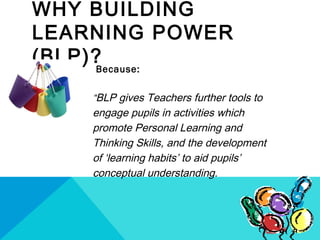
WHY BUILDING
LEARNING POWER
(BLP)?Because:
“BLP gives Teachers further tools to
engage pupils in activities which
promote Personal Learning and
Thinking Skills, and the development
of ‘learning habits’ to aid pupils’
conceptual understanding.
OUR APPROACH TO EMBEDDING
BLP
Graham Powell trained Learning Coaches
to
lead TLCs
Learning Coaches undertook a Learning
Review with Graham Powell
POSITIVE KEY MESSAGES
FROM THE REVIEW
• “Students are eager to learn and comply readily with their
teachers’ requests and expectations”
• “They are keen to succeed”
• “Behaviour is impeccable “
• “Students take pride in their work”
• “Year 7 students are naturally curious and inquisitive and are
willing to ask questions and explore possibilities”
KEY MESSAGES NEEDING
ACTION
Students:
•“expect their teachers to provide them with the
answers and solutions”
•“lose focus and attention when they are required to listen for
extended periods”
•“In Year 7 students do not get as many opportunities as they might
to exploit and develop these habits of mind.
•“In Year 10 students are more compliant”
“The pressure of examination courses may be causing them to be
more spoon-fed and reliant on their teachers.”
THE WAY FORWARD…
• ½ termly TLCs focus on Building Learning Capacity
• Devised workshops to aid in the understanding of
‘Learning Habits’
• All Year 7 students engage with BLP on arrival in
September
• All new Year 12 students engage with BLP on
arrival in September
• Reworked Lesson Planning pro-forma – designed
with learning in mind
• Reworked Lesson Observation pro-forma – designed
with learning in mind
• Pairing off for BLP “observations”
BUILDING LEARNING
CAPACITY
What are learning
habits?
LEARNING HABITS
SHOULD BE
• Routine
• Second nature
• Aquired over time
• Used in all learning experiences
• Orchestrated and guided by teachers
• Fostered through experience
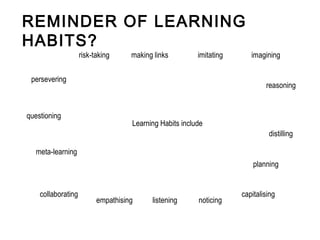
Learning Habits include
imagining
reasoning
distilling
planning
capitalising
listening
collaborating
meta-learning
risk-taking
questioning
making links
persevering
empathising
imitating
noticing
REMINDER OF LEARNING
HABITS?
TEACHERS AND HABIT
FORMING
As teachers we are in the habit-forming
business.
Those habits we model in front of young people
influence the ways in which they perform and
behave.
Therefore, we need to be sure to foster productive
learning habits.
TEACHERS SHOULD:
• Provide rich and varied occasions for exercising
learning habits
• Infuse learning habits into lessons to enhance
understanding
• Recognise and celebrate the use and growth of
learning habits
• Expect students to take ownership and responsibility
for their learning habits
• Explore the development of learning habits with
students
DUAL OBJECTIVES
At the start of a lesson students should be
asking:
What am I going to learn?
How am I going to learn it?
QUESTIONS
TEACHERS SHOULD
ASK:
Are our teaching habits helping students
learning habits?
How might we need to change some of our
teaching habits?
TEACHERS SHOULD DO
LESS OF…
• Being driven by subject content
• Asking all the questions
• Making it too easy for students
• Saying ”That’s right”
• Avoiding the uncomfortable
• Providing solutions too readily when pupil
are
• stuck
• Interrupting learning
• Insisting “will you listen!”
• Over preparing material
• Being the centre of attention
TEACHERS SHOULD DO
MORE OF …
• Valuing imagining as part of their subject
area
• Inviting students to really speculate and
experiment
• Exercising lateral thinking habits
• Encouraging thinking out loud
• Showing a real interest in what pupil are
saying
• Using tentative (“could be”, “might be”)
language
TEACHERS SHOULD
EXPERIMENT WITH…
Using different media in the
classroom
Making links and thinking in
metaphors
Asking “What if?”
Listening in different ways
RECENT ACTIONS
• BLP Handbook
• Students as teachers
• Conferences with Claxton and TLO
consultants
• Students undertaking learning walks
• Developing a language for learning
• Involving governors in training
ALL TEACHERS AT
WHSG UNDERTAKE…
School-based research
( Classroom enquiries)
SCHOOL BASED RESEARCH
QUESTIONS
“What is the effect of students leading revision sessions on
test results?”
“To investigate the extent to which new year 12 students
can fully engage with the use of BLP and to reflect on
how my teaching needs to change in response to my
findings.”
“Do teaching techniques affect outcomes? “
“ To investigate how working collaboratively aids
students’ learning capacity". 
“AN OUTSTANDING
SCHOOL”
“Outstanding teaching”
Ofsted 2010
1. WHERE IS WE NOW?
2. WHERE DO WE WANT TO BE?
3. WHERE DO WE NEED TO BE?
3 KEY QUESTIONS…
TLO
LEARNING QUALITY
FRAMEWORK (LQF)
An assessment of where
we are now
OUR WAY FORWARD
• Sharing our practice with
parents – helping them to model
learning
• Displaying a language for
learning around the school
• Developing our students as
learning coaches for other
students and staff
Kathy Herlock
Deputy Headteacher
Westcliff High School for Girls
Kenilworth Gardens
Westcliff on Sea
Essex
SS0 0BS
email: st-kathy.herlock@whsg.info
Tel: 01702 476026

A learning school journey_whsg

  • 1.
  • 2.
    WHSG OBJECTIVE To developour “flexpertise” in enabling learning
  • 3.
    “FLEXPERTISE”? “21st Century education shouldbe the business of coaching the development of “flexpertise” – building confidence and capacity and how to respond to trick situations” Guy Claxton
  • 4.
    KEY QUESTIONS FOR LEARNERS Whatam I learning? Why am I learning it? Why am I learning it in this particular way?
  • 5.
    WHY IS OURFOCUS ON LEARNING? Our Ofsted of 2008 was a big disappointment We needed to improve the quality of teaching and learning
  • 6.
    HOW ARE WEDOING IT? We refocused our plan to improve the Quality of Teaching and Learning at the school We created teacher Teaching and Learning Communities (TLCs)
  • 7.
    WHY BUILDING LEARNING POWER (BLP)?Because: “BLPgives Teachers further tools to engage pupils in activities which promote Personal Learning and Thinking Skills, and the development of ‘learning habits’ to aid pupils’ conceptual understanding.
  • 8.
    OUR APPROACH TOEMBEDDING BLP Graham Powell trained Learning Coaches to lead TLCs Learning Coaches undertook a Learning Review with Graham Powell
  • 9.
    POSITIVE KEY MESSAGES FROMTHE REVIEW • “Students are eager to learn and comply readily with their teachers’ requests and expectations” • “They are keen to succeed” • “Behaviour is impeccable “ • “Students take pride in their work” • “Year 7 students are naturally curious and inquisitive and are willing to ask questions and explore possibilities”
  • 10.
    KEY MESSAGES NEEDING ACTION Students: •“expecttheir teachers to provide them with the answers and solutions” •“lose focus and attention when they are required to listen for extended periods” •“In Year 7 students do not get as many opportunities as they might to exploit and develop these habits of mind. •“In Year 10 students are more compliant” “The pressure of examination courses may be causing them to be more spoon-fed and reliant on their teachers.”
  • 11.
    THE WAY FORWARD… •½ termly TLCs focus on Building Learning Capacity • Devised workshops to aid in the understanding of ‘Learning Habits’ • All Year 7 students engage with BLP on arrival in September • All new Year 12 students engage with BLP on arrival in September • Reworked Lesson Planning pro-forma – designed with learning in mind • Reworked Lesson Observation pro-forma – designed with learning in mind • Pairing off for BLP “observations”
  • 12.
  • 13.
    LEARNING HABITS SHOULD BE •Routine • Second nature • Aquired over time • Used in all learning experiences • Orchestrated and guided by teachers • Fostered through experience
  • 14.
  • 15.
    TEACHERS AND HABIT FORMING Asteachers we are in the habit-forming business. Those habits we model in front of young people influence the ways in which they perform and behave. Therefore, we need to be sure to foster productive learning habits.
  • 16.
    TEACHERS SHOULD: • Providerich and varied occasions for exercising learning habits • Infuse learning habits into lessons to enhance understanding • Recognise and celebrate the use and growth of learning habits • Expect students to take ownership and responsibility for their learning habits • Explore the development of learning habits with students
  • 17.
    DUAL OBJECTIVES At thestart of a lesson students should be asking: What am I going to learn? How am I going to learn it?
  • 18.
    QUESTIONS TEACHERS SHOULD ASK: Are ourteaching habits helping students learning habits? How might we need to change some of our teaching habits?
  • 19.
    TEACHERS SHOULD DO LESSOF… • Being driven by subject content • Asking all the questions • Making it too easy for students • Saying ”That’s right” • Avoiding the uncomfortable • Providing solutions too readily when pupil are • stuck • Interrupting learning • Insisting “will you listen!” • Over preparing material • Being the centre of attention
  • 20.
    TEACHERS SHOULD DO MOREOF … • Valuing imagining as part of their subject area • Inviting students to really speculate and experiment • Exercising lateral thinking habits • Encouraging thinking out loud • Showing a real interest in what pupil are saying • Using tentative (“could be”, “might be”) language
  • 21.
    TEACHERS SHOULD EXPERIMENT WITH… Usingdifferent media in the classroom Making links and thinking in metaphors Asking “What if?” Listening in different ways
  • 22.
    RECENT ACTIONS • BLPHandbook • Students as teachers • Conferences with Claxton and TLO consultants • Students undertaking learning walks • Developing a language for learning • Involving governors in training
  • 23.
    ALL TEACHERS AT WHSGUNDERTAKE… School-based research ( Classroom enquiries)
  • 24.
    SCHOOL BASED RESEARCH QUESTIONS “Whatis the effect of students leading revision sessions on test results?” “To investigate the extent to which new year 12 students can fully engage with the use of BLP and to reflect on how my teaching needs to change in response to my findings.” “Do teaching techniques affect outcomes? “ “ To investigate how working collaboratively aids students’ learning capacity". 
  • 25.
  • 26.
    1. WHERE ISWE NOW? 2. WHERE DO WE WANT TO BE? 3. WHERE DO WE NEED TO BE? 3 KEY QUESTIONS…
  • 27.
    TLO LEARNING QUALITY FRAMEWORK (LQF) Anassessment of where we are now
  • 28.
    OUR WAY FORWARD •Sharing our practice with parents – helping them to model learning • Displaying a language for learning around the school • Developing our students as learning coaches for other students and staff
  • 29.
    Kathy Herlock Deputy Headteacher WestcliffHigh School for Girls Kenilworth Gardens Westcliff on Sea Essex SS0 0BS email: st-kathy.herlock@whsg.info Tel: 01702 476026